


Erhalten Sie Zugang zu diesem und mehr als 300000 Büchern ab EUR 5,99 monatlich.
- Herausgeber: Luath Press
- Kategorie: Lebensstil
- Sprache: Englisch
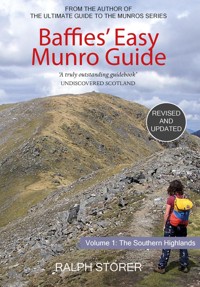
Baffies, the entertainments convenor of the Go-Take-a-Hike Mountaineering Club, is allergic to exertion, prone to lassitude, suffers from altitude sickness above 600m, blisters easily and bleeds readily. Think the Munros are too difficult? Think again. Baffies' Easy Munro Guide is the first of a series of reliable rucksack guides to some of the more easily tackled Munros. Twenty-five routes, each covering one main Munro, all with detailed maps and full colour throughout - this lightly humorous and opinionated book will tell you everything you need to reach the summit. Thousands of people each year attempt to conquer the Munros. This guide allows beginners and those looking for a less strenuous challenge to join in. It is perfect for anyone exploring Scotland's beautiful mountains, whatever his or her level of experience.
Sie lesen das E-Book in den Legimi-Apps auf:
Seitenzahl: 128
Veröffentlichungsjahr: 2020
Das E-Book (TTS) können Sie hören im Abo „Legimi Premium” in Legimi-Apps auf:
Ähnliche















RALPH STORER is an experienced hillwalker who has hiked extensively around the world. Despite being a Sassenach by birth, he has lived in Scotland since studying psychology at Dundee University and has a great affinity for the Highlands. As well as disappearing into the hills for a regular fix of nature, he also writes novels and sexological non-fiction, and produces darkwave music on his home computer.
Baffies’ Easy Munro Guide, Volume 1: Southern Highlands is the first volume in a series that draws on his decades of experience in finding easy ways up the Scottish mountains.
His books are exceptional… Storer subverts the guidebook genre completely. THE ANGRY CORRIE
THE ULTIMATE GUIDE TO THE MUNROS series
... picks up where others leave off.CAMERON MCNEISH
Fabulously illustrated… Entertaining as well as informative… One of the definitive guides to the Munros.PRESS & JOURNAL
Irresistibly funny and useful; an innovatively thought-through guidebook that makes an appetising broth of its wit, experience and visual and literary tools. Brilliant.OUTDOOR WRITERS & PHOTOGRAPHERS GUILD
With the winning combination of reliable advice and quirky humour, this is the ideal hillwalking companion.SCOTS MAGAZINE
A truly indispensible guide for the Munro-bagger. Bursting with information, wit and a delightful irreverence, it's a joy to read. An absolute gem!ALEX MACKINNON, MANAGER, WATERSTONE’S, EDINBURGH
BAFFIES’ EASY MUNRO GUIDE series
A truly outstanding guidebook.UNDISCOVERED SCOTLAND
Packed to bursting with concise information and route descriptions. There should be room for this guide in every couch potato’s rucksack.OUTDOOR WRITERS & PHOTOGRAPHERS GUILD
It is perfect for anyone exploring Scotland’s beautiful mountains, whatever his or her level of experience. GUIDEPOST
THE JOY OF HILLWALKING
A treat for all hillwalkers active or chairbound. SCOTS INDEPENDENT
50 SHADES OF HILLWALKING
A fantastic celebration of this addictive pastime. DON CURRIE, SCOTLAND OUTDOORS
THE ULTIMATE MOUNTAIN TRIVIA QUIZ CHALLENGE
A thoroughly fascinating way to kill time – every bothy should be furnished with one.
ROGER COX, THE SCOTSMAN
ALSO BY THE SAME AUTHOR:
100 Best Routes on Scottish Mountains (Little Brown)
50 Best Routes on Skye and Raasay (Birlinn)
Exploring Scottish Hill Tracks (Little Brown)
For Judith
Hillwalking and mountaineering are not risk-free activities and may prove injurious to users of this book. While every care and effort has been taken in its preparation, readers should note that information contained within may not be accurate and can change following publication. Neither the publisher nor the author accept any liability for injury or damage of any kind arising directly or indirectly from the book’s contents.
First published 2012
Revised and updated 2018
e-ISBN: 978-1-912387-51-9
The paper used in this book is recyclable. It is made from low-chlorine pulps produced in a low-energy, low-emission manner from renewable forests.
Printed and bound by CPI Antony Rowe, Chippenham
Typeset in Tahoma by Ralph Storer
All maps reproduced by permission of Ordnance Survey on behalf of HMSO. © Crown copyright 2018. All rights reserved. Ordnance Survey Licence number 100016659.
All photographs by the author, including front cover (Ben Challum), except those on pages 2, 31, 33 and 44 by Allan Leighton.
The author’s right to be identified as author of this book under the Copyright, Designs and Patents Act 1988 has been asserted.
© Ralph Storer
CONTENTS
PREFACE
INTRODUCTION
1 Ben Lomond
2 Beinn Narnain (& Beinn Ime)
3 Ben Vorlich (Loch Lomond)
4 Ben Lui (& Beinn a’ Chleibh)
5 Beinn Dubhchraig
6 Beinn Chabhair
7 Cruach Ardrain (& Beinn Tulaichean)
8 Ben More (& Stob Binnein))
9 Ben Vorlich (Loch Earn)
10 Stuc a' Chroin
11 Ben Chonzie
12 Ben Challum
13 Meall Glas
14 Meall Ghaordaidh
15 Ben Lawers (& Beinn Ghlas)
16 Meall Corranaich (& Meall a’ Choire Leith)
17 Meall Greigh (& Meall Garbh)
18 Meall nan Tarmachan
19 Beinn Dorain (& Beinn an Dothaidh)
20 Beinn Achaladair
21 Beinn Mhanach
22 Meall nan Aighean (& Carn Mairg)
23 Meall Buidhe
24 Stuchd an Lochain
25 Schiehallion
PREFACE
So you want to climb Munros but have understandable concerns that you may end up teetering precariously above an abysmal drop, sitting gingerly astride a knife-edge ridge or groping futilely for handfuls of grass on a crumbling rock ledge. If possible, you’d like to make it down to the foot of the mountain again. In one piece. Before dusk.
Let me introduce you to your new best friend: Baffies, the Entertainments Convenor of the Go-Take-a-Hike Mountaineering Club. In his club bio he lists himself as someone who is allergic to exertion, is prone to lassitude, suffers from altitude sickness above 600m, blisters easily and bleeds readily. However meagre your hillwalking credentials, if he can make it to the summit, so can you.
Our sister publication The Ultimate Guide to the Munros does what it says on the cover and describes routes of all kinds up all of the Munros. Not all of these are suitable for sensitive souls such as Baffies, hence the decision to ‘delegate’ him to write the guidebook you now hold in your hands.
When the club committee first suggested to him that he was the ideal person for the task, he almost choked on his triple chocolate layer cake. Only after we had managed to hold him down long enough to explain the book’s remit did he come to embrace the idea. Indeed, he set about researching the contents with such a hitherto unseen fervour and thoroughness that we are proud to have the results associated with the club’s name – a guidebook dedicated to finding easy ways up Munros.
Herein you will find easy walking routes up 25 Munros (and more!) – routes that require no rock climbing, no scrambling, no tightrope walking, no technical expertise whatsoever. Of course, hillwalking can never be a risk-free activity. No Munro is as easy to reach from an armchair as the TV remote. You will be expected to be able to put one foot in front of the other... and repeat.
Given that proviso, you will find no easier way to climb Munros than to follow in the footsteps of Baffies. I leave you in his capable hands.
Ralph Storer, President
Go-Take-a-Hike Mountaineering Club
INTRODUCTION
OF MOUNTAINS AND MUNROS
It’s a big place, the Scottish Highlands. It contains so many mountains that even resident hillwalkers struggle to climb them all in a lifetime. How many mountains? That depends…
If two summits 100m apart are separated by a shallow dip, do they constitute two mountains or one mountain with two tops? If the latter, then exactly how far apart do they have to be, and how deep does the intervening dip have to be, before they become two separate mountains?
Sir Hugh Munro (1856–1919), the third President of the Scottish Mountaineering Club, tackled this problem when he published his ‘Tables of Heights over 3000 Feet’ in the 1891 edition of the SMC Journal. Choosing the criterion of 3000ft in the imperial system of measurement as his cut-off point, he counted 283 separate Mountains and a further 255 Tops that were over 3000ft but not sufficiently separated from a Mountain to be considered separate Mountains themselves.
In a country with a highpoint of 4409ft (1344m) at the summit of Ben Nevis, the choice of 3000ft as a cut-off point is aesthetically justifiable and gives a satisfying number of Mountains. A metric cut-off point of 1000m (3280ft), giving a more humble 137 Mountains, has never captured the hillgoing public’s imagination.
Unfortunately, Sir Hugh omitted to leave to posterity the criteria he used to distinguish Mountains from Tops, and Tops from other highpoints over 3000ft. In his notes to the Tables he even broached the impossibility of ever making definitive distinctions. Consider, for example, the problem of differentiating between Mountains, Tops and other highpoints on the Cairngorm plateaus, where every knoll surpasses 3000ft.
The old sign at Achallader Farm, which issued an irresistible invitation, has sadly not been moved to the new car park.
Sir Hugh Munro himself never became a Munroist (someone who has climbed all the Munros). Of the Tables of the day, he climbed all but three: the Inaccessible Pinnacle (although that did not become a Munro until 1921), Carn an Fhidhleir and Carn Cloich-mhuilinn. The latter, which he was saving until last because it was close to his home, was ironically demoted to Top status in 1981.
The Tables were a substantial achievement in an age when mapping of the Highlands was still rudimentary, but no sooner did they appear than their definitiveness become the subject of debate. In subsequent years Munro continued to fine-tune them, using new sources such as the Revised Six-inch Survey of the late 1890s. His notes formed the basis of a new edition of the Tables, published posthumously in 1921, which listed 276 separate Mountains (now known as Munros) and 267 Tops.
The 1921 edition also included J. Rooke Corbett’s list of mountains with heights between 2500ft and 3000ft (‘Corbetts’), and Percy Donald’s list of hills in the Scottish Lowlands of 2000ft or over (‘Donalds’). Corbett’s test for a separate mountain was that it needed a re-ascent of 500ft (c150m) on all sides. Donald’s test was more mathematical. A ‘Donald’ had to be 17 units from another one, where a unit was one twelfth of a mile (approx. one seventh of a kilometre) or one 50ft (approx. 15m) contour. Munro may well have used some similar formula concerning distance and height differential.
Over the years, various developments have conspired to prompt further amendments to the Tables, including metrication, improved surveying methods (most recently by satellite), and a desire on the part of each succeeding generation of editors to reduce what they have regarded as ‘anomalies.’ For example, the ‘mountain range in miniature’ of Beinn Eighe was awarded a second Munro in 1997 to redress the balance with similar but over-endowed multi-topped ridges such as the seven-Munro South Glen Shiel Ridge. Changes and the reasons for change are detailed individually in the main text (see Peak Fitness for details).
The first metric edition of the Tables in 1974 listed 279 Munros and 262 Tops. The 1981 edition listed 276 Munros and 240 Tops. The 1990 edition added an extra Munro. The 1997 edition listed 284 Munros and 227 Tops. Since then, following GPS satellite re-measurement, Sgurr nan Ceannaichean (2009), Beinn a’ Chlaidheimh (2012) and Knight’s Peak (2013) have been demoted, leaving 282 Munros and 226 Tops.
Watch this space.
The first person to bag all the Munros may have been the Rev Archibald Robertson in 1901, although his notebooks bear no mention of him having climbed the Inaccessible Pinnacle and note that he gave up on Ben Wyvis to avoid a wetting.
The second Munroist was the Rev Ronald Burn, who additionally bagged all the Tops, in 1923, thus becoming the first ‘Compleat Munroist’ or Compleater. The third was James Parker, who additionally bagged all the Tops and Furths (the 3000ft summits of England, Wales and Ireland), in 1929. The latest edition of the Tables lists 1745 known Munroists.
THE SCOTTISH HIGHLANDS
The Scottish Highlands are characterised by a patchwork of mountains separated by deep glens, the result of glacial erosion in the distant past. On a global scale the mountains reach an insignificant height, topping out at (1344m/4409ft) on Ben Nevis. But in form they hold their own against any range in the world, many rising bold and beautiful from sea-level. For hillwalkers they have distinct advantages over higher mountain ranges: their height is ideal for day walks and glens give easy road access.
Moreover, the variety of mountain forms and landscapes is arguably greater than in any mountainous area of equivalent size. This is due to many factors, notably differing regional geology and the influence of the sea.
In an attempt to give some order to this complexity, the Highlands are traditionally divided into six regions, as detailed below. The potted overviews mislead in that they mask the variety within each region, ignore numerous exceptions to the rule and reflect road access as much as discernible regional boundaries, but they serve as introductory descriptions.
The Southern Highlands 46 Munros
Gentle, green and accessible, with scope for a great variety of mountain walks.
The Central Highlands 73 Munros
A combination of all the other regions, with some of the greatest rock faces in the country.
The Cairngorms 50 Munros
Great rolling plateaus, vast corries, remote mountain sanctuaries, sub-arctic ambience.
The Western Highlands 62 Munros
Dramatic landscapes, endless seascapes, narrow ridges, arrowhead peaks, rugged terrain.
The Northern Highlands 38 Munros
Massive, monolithic mountains rising out of a desolate, watery wilderness.
The Islands 13 Munros
Exquisite mountainscapes, knife-edge ridges, sky-high scrambling, maritime ambience.
THE SOUTHERN HIGHLANDS
The region covered by this guidebook, as its name implies, is the most southerly region in the Scottish Highlands. It is bounded on the west by the sea, on the east by the Tay Valley (the A9 Perth – Pitlochry road) and on the north by a line that runs along the A85 from Oban to Tyndrum, up the A82 to Rannoch Moor, then eastwards along Loch Rannoch and Loch Tummel to Pitlochry. In the south it is bounded by the central belt of Scotland between Glasgow and Edinburgh, below which the Southern Uplands continue to the English border.
The region itself is divided into two distinct halves by a geological zone of fracture known as the Highland Boundary Fault, which runs in a straight line across the breadth of Scotland from south-west to northeast. From the west coast it crosses Loch Lomond at Balmaha, passes through the Trossachs at Aberfoyle and heads north-east through Glen Artney to the Tay Valley and beyond, eventually to reach the east coast at Stonehaven.
Although the fault is hundreds of millions of years old, tremors are still felt along it as the rocks continue to settle, making the town of Crieff the earthquake capital of the British Isles.
South of the Highland Boundary Fault lie green rounded hills, while north of it lie rougher mountains, including all the region’s 46 Munros and accompanying 21 Tops, to say nothing of 36 Corbetts. The rocks are mostly sedimentary but they have been greatly metamorphosed, uplifted and folded over time. Rolling folds parallel to the Highland Boundary Fault have rippled the land into Munro-height mountains separated by deep depressions, of which the largest is the great strath that runs from Crianlarich through Glen Dochart to Killin, then along Loch Tay to Aberfeldy and Pitlochry.
Although the ground to the north of the fault is rougher than that to the south, it is nowhere near as rugged as further north and west in the Highlands, while the igneous Cairngorm plateaus to the east are different again. The Southern Highland landscape is more gentle, more rounded and more verdant, though with enough geological variation and Ice Age sculpting to include an occasional rock playground for climbers and scramblers. Examples include the overhanging rock faces of The Cobbler, the great Prow of Stuc a’ Chroin and the craggy corries of the Bridge of Orchy mountains.
Apart from some notable exceptions, the Munros cluster in groups separated by lochs and deep glens, which carry an extensive road system that eases access. Within each group the Munros are often close enough together to make multi-bagging trips practicable. The region therefore has the best of both worlds. Its Munros are easily accessible individually, while their clustering facilitates combined ascents.




