


9,99 €
Mehr erfahren.
- Herausgeber: The History Press
- Kategorie: Geisteswissenschaft
- Sprache: Englisch
By the time of the Armistice in 1918, around 6.5 million prisoners of war were held by the belligerents. Little has been written about these prisoners, possibly because the story is not one of unmitigated suffering and cruelty. Nevertheless, hardships did occur and the alleged neglect and ill-treatment of prisoners captured on the Western Front became the subject of major propaganda campaigns in Britain and Germany as the war progressed. "Barbed Wire Disease" looks at the conditions facing those British and German prisoners, and the claims and counter-claims relating to their treatment. At the same time, it sets the story in the wider context of the commitment by both governments to treat prisoners humanely in accordance with the recently agreed Hague and Geneva Conventions. The political and diplomatic efforts to abide by the new rules are examined in detail, along with the use of reprisals against prisoners, Britain's voluntary relief effort and the effect of face-to-face negotiations at the height of the war. This comprehensive analysis, using unpublished official files and cabinet papers, concludes by documenting the first ever efforts to bring war criminals to justice before international tribunals.
Das E-Book können Sie in Legimi-Apps oder einer beliebigen App lesen, die das folgende Format unterstützen:
Veröffentlichungsjahr: 2011
Ähnliche




















BARBED WIRE DISEASE
BARBED WIRE DISEASE
BRITISH & GERMAN PRISONERS OF WAR, 1914–19
JOHN YARNALL
To Grace
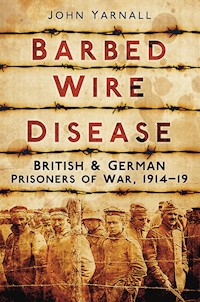
Cover illustration: German prisoners in a French prison camp. French Pictorial Service, 1917–1919 (National Archives via pingnews)
First published 2011 by Spellmount, an imprint of
The History Press
The Mill, Brimscombe Port
Stroud, Gloucestershire, GL5 2QG
www.thehistorypress.co.uk
This ebook edition first published in 2011
All rights reserved
© John Yarnall, 2011
The right of John Yarnall, to be identified as the Author of this work has been asserted in accordance with the Copyrights, Designs and Patents Act 1988.
This ebook is copyright material and must not be copied, reproduced, transferred, distributed, leased, licensed or publicly performed or used in any way except as specifically permitted in writing by the publishers, as allowed under the terms and conditions under which it was purchased or as strictly permitted by applicable copyright law. Any unauthorised distribution or use of this text may be a direct infringement of the author’s and publisher’s rights, and those responsible may be liable in law accordingly.
EPUB ISBN 978 0 7524 7262 1
MOBI ISBN 978 0 7524 7261 4
Original typesetting by The History Press
CONTENTS
Preface
Introduction
1 Civilians: The Innocent Bystanders
2 Applying the Conventions
3 Germany: Problems & Inspections
4 The British Experience
5 Wittenberg, Gardelegen & Typhus
6 From Capture to the Camps
7 Reprisals
8 Parcels, Assistance & Relief
9 Daily Life in Germany
10 Daily Life in the UK
11 Exchanges, Internments & Agreements
12 The Armistice & Repatriation
13 Leipzig: The Aftermath
Notes
Bibliography
Acknowledgements
PREFACE
The number of prisoners taken during the Great War was vast. By 1918, the total number of prisoners held by the belligerents exceeded 6.5 million. The majority of these were held by Germany and Austria-Hungary, 3.4 million, and Russia, 2.25 million. France held 350,000 and Britain 328,000. The remainder were scattered around the other belligerents. Of the 328,000 prisoners held by Britain, about half were located in camps in the United Kingdom and the remainder in British run camps in France and elsewhere. About 185,000 British prisoners were held by Germany.1
This study concentrates on British and German prisoners taken on the Western Front, where alleged neglect and ill-treatment became the subject of major propaganda campaigns in both countries. It looks at day-to-day problems as they unfolded and at the more major disputes which were to arise, drawing heavily on published and unpublished official documents, as well as contemporary newspapers and other accounts. This book also identifies many examples of hardship and ill-treatment and some of deliberate physical abuse. But the full story of prisoners in the Great War goes beyond a simple narrative of their experiences and the conditions they faced. That is not to say that these issues are not important, because from the point of view of individual prisoners they are, after all, what really mattered. But such conditions need to be seen against the wider background of the diplomatic, political and military objectives which gave rise to them. This study sets the wider context. Incidents such as the suffering caused to Allied prisoners by the mismanagement of typhus outbreaks in some of the German camps in the early part of the war, or the shooting of unarmed interned civilians during a food riot at a camp in the Isle of Man, stand out as particular examples of unacceptable treatment. By contrast, the treatment by both sides of many prisoners, and of officers especially, reached standards which would be more than acceptable today. The political and diplomatic story is similarly one of both successes and failures. Military considerations overrode diplomatic preferences on numerous occasions, especially in relation to exchanges – perhaps most notably in the case of the British policy to intern rather than exchange enemy civilians at the insistence of the War Office – and also in relation to the decision by both sides to employ prisoners in the war zone. But the predominant diplomatic theme to emerge is the willingness of both sides to invest heavily in the cause of improving the lot of prisoners and ensuring their humane treatment. Their progressive approach achieved much in securing practical improvements in conditions, including agreement on limited prisoner exchanges and internments in neutral countries. Their final achievement in drafting comprehensive agreements to plug the gaps exposed in the workings of the recently agreed Hague and Geneva conventions represented a real step forward. The process of achieving this success forms a major focus of the study. Sadly, much of the work was completed too late to have any great practical impact during the war itself. The lessons learnt were, however, invaluable to those whose task it was to update the conventions at Geneva in 1929, in advance of the Second World War.
INTRODUCTION
The First World War was the first major war in history to be conducted on the basis of internationally agreed standards for the treatment of prisoners and wounded taken on the battlefield, marking a milestone in the evolution of the treatment of prisoners through the ages. In the earliest times prisoners of war (POWs) had been simply put to death or, if they were more fortunate, enslaved for their labour value. In medieval times, they had been sent to the galleys, not just for the duration but often to stay there beyond the end of the conflict in which they were engaged. Later, it became the practice for prisoners to be exchanged or ransomed by their captors. By the seventeenth century, POWs began to be regarded as prisoners of the state rather than the property of their individual captors. This gave rise to the first international agreements on prisoners. A treaty between Spain and England in 1630 provided for the speedy return of prisoners following the end of hostilities, and a treaty between the USA and Prussia in 1785 sowed the first seeds of regulation on the way in which prisoners should be treated. State involvement also gave rise to the development in the seventeenth and eighteenth centuries of ‘cartels’, or agreements for the exchange of prisoners based on elaborate tariffs. Such cartels usually included the condition that those exchanged would take no further part in hostilities. These arrangements themselves eventually died out, however, to be replaced by the now more familiar practice of internment for the duration, followed by repatriation.1
Despite these improvements, prisoners continued to be treated harshly into the nineteenth century. But during the nineteenth century, as weapons became more destructive and casualties increased, pressure grew to make war more humane. In 1863, the International Committee of the Red Cross was established at Geneva after the Battle of Solferino (1859), where some 40,000 sick and wounded had been left on the battlefield with no mechanism in place for their care. At a diplomatic conference called by the Red Cross in 1864, the First Geneva Convention was adopted by sixteen states.2 This established the principles that relief should be given to the wounded on the battlefield without any distinction as to nationality, and that medical personnel and their units (to be identified by the Red Cross symbol) were to be treated as neutral and inviolable. The convention was expanded and updated in 1906.3 The Hague Peace conferences of 1899 and 1907 continued the process of developing international humanitarian law by applying the Geneva Convention to sea warfare4 and by agreeing conventions (the Hague conventions) governing the conduct of war on land.5 Amongst other things, the Hague conventions set out detailed rules on the treatment of prisoners. At the time of the First World War, the 1907 Hague Convention and the 1906 Geneva Convention together provided a comprehensive set of rules available to all belligerents. Both Britain and Germany had ratified the conventions and had it as declared policy to comply with their provisions. But even states that had not signed up to the conventions now had before them a set of rules representing contemporary thinking on how POWs and the wounded should be treated.
The underlying theme of the 1907 Hague Convention – and its specific requirement – was that prisoners should be treated humanely. The convention stated specifically that prisoners were in the power of the capturing government and not the individuals who had captured them. Thus governments were responsible and could be held accountable for the fate of those who fell into their hands. Furthermore, the convention made clear that whilst it was permissible to intern prisoners, this was to be done only as an indispensable measure of safety: prisoners were not criminals or convicts and internment was not to be regarded as a punishment. Their belongings and well-being were also to be protected. Personal belongings – as opposed to horses, weapons, etc. – were to remain theirs. Prisoners were to be clothed, fed and accommodated on the same basis as the troops of the capturing government. Officers were to receive the same pay as those of equivalent rank in the country of capture. Participating governments were required to establish bureaux for the exchange of information on prisoners; these bureaux and the prisoners themselves were to be allowed free postage; and facilities were to be provided to enable relief societies to operate. Prisoners were to be repatriated as soon as possible after the onset of peace. These measures established a special and protected status for POWs – a status which recognised their position as legitimate combatants. At the same time, the convention imposed obligations. Prisoners were to be subject to the army laws of the capturing state. Soldiers (but not officers) could be used as labour, but not excessively or in connection with operations of war, and they were to be paid for this. Those who attempted to escape and were unsuccessful could be punished (though successful escapees could not be punished for their escape if they were subsequently captured again). Parole could be requested of prisoners but not demanded; any breaches of parole, however, would result in the removal of their rights and they could then be brought before the courts. Prisoners were obliged to give their name and rank on capture.
For its part, the 1906 Geneva Convention stated that the sick and the wounded were to be treated as POWs, while leaving the door open for belligerents to agree alternative arrangements to internment, such as repatriation or transfer to a neutral country. Medical personnel, army chaplains and others engaged in the collection, transport and treatment of the sick and wounded and in the administration of medical units, were, on the other hand, to be respected and protected, and, if they fell into the hands of the enemy, were not to be treated as POWs. This did not mean that medical personnel were automatically allowed to go free or to move about without let or hindrance. The convention stipulated that, if called upon, medical personnel must continue to carry out their duties under the enemy’s directions; medical personnel could be required, for example, to stay with and treat POWs on their own side on their surrender, subsequently being sent back to their own lines only gradually. The convention also imposed other duties. States were required to send to the enemy identification marks or tokens found on the dead and a nominal roll of the sick and the wounded collected by them. They were to keep each other informed of the subsequent movements of the sick and wounded. They were required to collect articles and valuables found on the battlefield or left by the sick and wounded who had died in their hands, so that these could be sent on to those appropriate.
Despite the comprehensive nature of the conventions, the war, when it came, exposed many situations unforeseen by their drafters. Dealing with these was to become a major preoccupation of the British and German Governments, both internally and in their dealings with each other. The two sides were also closely dependent on and were well served by the neutral governments, especially the United States which acted as protecting power to both Britain and Germany – until the US itself entered the war in 1917.
A major role was played by James W. Gerard, a former associate justice of the New York Supreme Court and US Ambassador to Berlin since 1913. After the US entered the war, Gerard was to gather a reputation for being aggressively anti-German. He gained particular notoriety for a speech he made in New York in November 1917, when he remarked that if the 500,000 German-Americans in the US were to rise up, there were 501,000 lamp posts available to hang them from.6 His memoirs, My Four Years in Germany (1917) and Face to Face with Kaiserism (1918), were highly critical of the German regime, including its attitude towards prisoners. But his disenchantment with Germany was gradual rather than immediate and the diplomatic papers show that during his time as ambassador he carried out his duties assiduously. Despite the opinions he subsequently aired, Gerard remained highly regarded at home for the way in which he had carried out his duties in Berlin with impeccable neutrality, enabling him to press his case effectively with both sides.7 This was especially effective in the case of prisoners, where Gerard demonstrated a particular empathy with prisoners’ needs and saw it as his role to maximise their welfare. His work in this area made a major contribution in cooling the temperature between the two sides in the face of often exaggerated reports of ill-treatment, thus avoiding reprisals, as well as paving the way for improving standards generally.
In London, the British Government had the good fortune to have Walter Hines Page as US Ambassador for the whole of the war. Page was renowned for his pro-British leanings, which ultimately led to a rift between him and US President Woodrow Wilson in the face of Wilson’s firm policy of neutrality. Page was one of the key influences in finally bringing the US into the war. The diplomatic papers expose a number of instances where the US Embassy in London clearly played down problems over the condition of prisoners held in the UK when reporting to Germany.
Policy responsibility for POW matters within the British Government was effectively split between the Foreign Office and the War Office, with the Home Office having administrative responsibility for civilian internment camps. The lead in looking after the interests of British prisoners held by the enemy was taken for most of the war by the Foreign Office, and in particular by Lord Newton, who was appointed as Assistant Under-Secretary in March 1916 and head of a newly created POW Department within the Foreign Office later the same year. A former diplomat and Conservative MP until he inherited his title in 1898, Newton was a reforming politician who shared Gerard’s empathy with the needs of prisoners and worked diligently on their behalf until the end of the war. Newton had many critics during the war but came to be highly regarded for his success in negotiating prisoner exchanges and internments. Newton himself is said to have commented that this work brought him ‘for the first and last time the sweets of popularity’.8 Continuity on POW matters at the War Office was provided by Lieutenant-General Sir Herbert Belfield, head of the Directorate of Prisoners of War, established in February 1915.
The information available to the British Government about the treatment of prisoners in Germany came from a number of sources, ranging from reports from overseas diplomatic posts, to foreign newspapers and, of course, the reports from US Ambassador Gerard (and subsequently the Netherlands which took over as protecting power when the US entered the war). More direct information about conditions came from escaped or repatriated prisoners themselves, whose reports formed the basis of many of the British Government’s initial concerns about treatment and featured heavily in published White Papers. In order to build up a comprehensive picture from such first-hand reports, the government also established at an early stage a special committee (‘The Government Committee on the Treatment by the Enemy of British Prisoners of War’) to interview all returning prisoners. Such prisoners were in turn forbidden to talk to the press. The Government Committee was chaired by Sir Robert Younger, a Chancery Division judge, and supported for most of its existence by Dame Adelaide Livingstone as its honorary secretary. Dame Livingstone was among the first women to be created DBE for her wartime services in 1918. She was subsequently to secure greater fame as the organiser of the Peace Ballot in 1934–35. The Government Committee published a number of reports during the war based on its interviews. While the committee’s publications were without exception critical of the treatment meted out to British prisoners, and clearly formed part of the government’s propaganda campaign, the reports of the prisoners themselves form an invaluable primary source for the historian.
Many others outside the government also came to be involved in the care and management of prisoners, most notably the Red Cross and volunteer relief organisations. Such bodies were destined to play a major part in ameliorating the many forms of hardship which prisoners were, by definition, bound to face.
1
CIVILIANS: THE INNOCENT BYSTANDERS
As perhaps the first manifestation of the First World War as total war, enemy civilians were being interned in the UK before any combatant prisoners had been taken by British forces. The large-scale internment of enemy aliens, which came to be undertaken by both sides, was to continue throughout the war. The policy was controversial, invoking public anger in both countries at the perceived injustice of its own citizens being caught up in the conflict as innocent bystanders. At the same time, in Britain especially, there was little public appetite to allow enemy aliens simply to roam free. From a practical point of view, internment imposed costs on both sides in having to feed and house large numbers of internees, as well as diverting scarce administrative resources from more important areas. Throughout the war, attempts were made to reduce or eliminate the difficulties of internment through negotiations on full or partial civilian exchanges. The problems associated with this proved intractable, however, until final success came too late to have any practical effect. While the driving force behind the policy of internment was logical, its application was imperfect and its success questionable. An examination of the official record must bring into question whether, in the end, it proved misguided.
Large-scale internment represented a departure from previous practice. Traditionally, governments had been tolerant towards the presence of enemy aliens. For centuries it had been common to include in treaties provision for civilians to be given time, perhaps six to nine months, in which to settle their affairs before being required to leave the country.1 Though the Hague Convention did not extend to civilians, discussion during its drafting confirmed the widely held view that it was not acceptable simply to imprison enemy subjects at the outbreak of war. But where civilians were imprisoned, it was also the view under international law that they should be treated in the same way as combatant POWs with all the privileges that such status provided.2 The view that civilians could not automatically be imprisoned was reiterated in the British Manual of Military Law, issued by the War Office in 1914. But the Manual went on to argue that this did not mean that all enemy aliens could be allowed to go about their business unhindered. First, there was the question of security. It was clearly necessary to be able to regulate those who might be engaged in spying or sabotage. The Manual specifically acknowledged this by referring to the right of every state to take ‘such steps as it may deem necessary for the control of persons whose presence or conduct appear dangerous to its safety’.3 Secondly, the relatively recent spread of conscription gave rise to a newly formed view under international law, that a state could not be compelled to let go unhindered those who would then join the forces of the opposing side. The position of civilians at the outbreak of the war was thus evolving, with no clear and absolute framework setting out how they should be treated.4
The scope for a more aggressive policy than had been adopted in the past was particularly attractive in Britain, where sensitivity towards enemy aliens was already high. Fears over spying, sabotage and invasion had been growing in Britain for many years, stoked by writers of fiction such as George Chesney (The Battle for Dorking, 1871), Erskine Childers (The Riddle of the Sands, 1903) and William Le Queux (Invasion of 1910, 1906). Such fear was not confined to the public imagination either. Official concern that German spies were active in Britain, possibly as part of an extensive network, had led directly to the establishment of the British Secret Service (MI5 and MI6) in 1909. Coupled with this, the population of enemy aliens in Britain was large. At the outbreak of war, the enemy population comprised over 50,000 Germans and 10,000 Austrians. Some of these were simply on holiday or were the passengers or crews of visiting merchant ships. Others were diplomats, professionals or itinerant workers such as waiters. Many were long-term residents, such as the husbands or wives of native citizens. In contrast to the position in Britain, there were fewer than 10,000 British citizens in Germany. This disparity in numbers was to influence directly the attitude of the two sides throughout the war.
Unlike the British Government, it is clear that Germany had no predetermined policy towards enemy civilians. Events in Germany in the first few days of the war appear to have been spontaneous and unco-ordinated. There were reports of Russians and French being seized by the crowds and in some instances shot, and even Americans being subjected to the suspicion generated by foreigners. US Ambassador Gerard records:
A curious rumour spread all over Germany to the effect that automobiles loaded with French gold were being rushed across the country to Russia. Peasants and gamekeepers and others turned out on the roads with guns, and travelling by automobile became extremely dangerous. A German Countess was shot, an officer wounded and the Duchess of Ratibor was shot in the arm. It was some time before this excitement was allayed, and many notices were published in the newspapers before this mania was driven from the popular brain.
There were rumours also that the Russians had poisoned the Muggelsee, the lake from whence Berlin draws part of its water supply. There were constant rumours of the arrest of Russian spies disguised as women throughout Germany.5
In Berlin, the official German reaction on 5 August was to round up all British subjects. Gerard notes that:
During the day British subjects, without distinction of age or sex, were seized, wherever found, and sent to the fortress at Spandau. I remonstrated with von Jagow [the German Minister of Foreign Affairs] and told him that that was a measure taken only in the Middle Ages, and I believe that he remonstrated with the authorities and arranged for a cessation of the arbitrary arrests of women.6
Following this initial reaction, the German Government quickly became more relaxed. Instead of being automatically interned, British subjects were soon allowed considerable liberty, being required only to report to the local police station during the day, and being forbidden to remain out at night. While not officially allowed to leave, many were in fact able to escape, making their way to Britain across the neutral frontiers. Such people clearly saw their future as intolerable within Germany, though some at least were far from happy at having to leave, as a letter from C.B. Maxse, the British Consul-General in Amsterdam, to Sir Edward Grey, Foreign Secretary, records:
Since the stream of British refugees set in through Holland I have had occasion to remark that many British subjects, who have resided for some time in Germany, have apparently lost all patriotic instinct. I have reported on this subject in previous despatches dealing with the reception of British refugees in this country. I have even had a British born woman of the educated classes in my room at this office, who told me that she sincerely hoped that Germany would win and the British be beaten. This class of person absolutely refuses to believe any statements regarding German atrocities in Belgium, the way the war was initiated by that country’s double dealing, or even to read any British newspapers or official publications that may be handed to them. I am happy to say that their number has not been great, but they have been exceedingly virulent. I have made it a rule to ask them in reply why, holding such views, they did not wish to remain in Germany and become naturalized there, especially as in some cases they had previously told me that they had lost touch with their families in England.7
For its part, the British Government made clear its policy from the outset. On the day after the outbreak, McKenna, the Home Secretary, introduced a bill to enable restrictions to be placed on aliens by means of Orders in Council. McKenna justified the move in the following terms:
Information in the possession of the Government proves that cases of espionage have been frequent in recent years and that many spies have been caught and dealt with by the police. Within the last 24 hours no fewer than 21 spies, or suspected spies, have been arrested in various places all over the country, chiefly in important military or naval centres, some of them known to the authorities to be spies.8
The bill secured an immediate passage through parliament and Orders in Council started to be made the following day. Aliens were required to register with local officials and prohibited from entering designated areas, such as those within the vicinity of ports, dockyards and military installations. They were prohibited from travelling without a permit and from possessing firearms, communications equipment and other items. They were also prohibited from reading German language newspapers and from working in the banking business.
Alongside these measures the War Office issued a separate order providing for the immediate internment of all German and Austrian males between the ages of 17 and 42, excepting those who could clearly demonstrate that they were exempt from military service. At an urgently convened meeting of government departments, however, it became clear straightaway that this policy could not be fully implemented because of a lack of suitable accommodation to house the large number of prospective internees involved. It was therefore decided that internment would be restricted initially to those Germans whom the police regarded as dangerous, viz. spies and saboteurs. Later in August, following concern by the commissioner of police about the large number of Germans now unemployed, it was further agreed that those who might become dangerous through unemployment or destitution should also be interned, and on 7 September it was decided to intern all reservists, with unmarried or destitute men being taken first. After between 8,000 and 9,000 had been arrested under these arrangements, internment was again suspended through lack of accommodation. A further purge instituted on 20 October brought the number interned to 12,400, out of a total German population in the UK of 55,686 men, women and children.9 The pattern of prioritising the internment of enemy aliens according to availability of accommodation and in reaction to events was then to continue for much of the war. In December 1914, for example, McKenna reported to the Cabinet that the policy of internment was causing hardship and many aliens were now being released – 1,100 had been released in November on report from the police that they represented no danger. He went on to say that the War Office was now considering a general release of all those interned since 20 October, subject to police vetting of the individuals. But in a further reversal provoked by public outrage following the sinking of the Lusitania, Asquith announced in May 1915 the internment (subject to individual exceptions) of all non naturalised men of military age.10 By December 1915, the total number of enemy alien civilians interned in the UK had reached 32,272.11
The British policy on internment was strongly resented by the German Government, which took the position that it was wrong in principle to detain anyone not in the armed forces. German public opinion was also outraged. In October 1914, the German Imperial Foreign Office issued an ultimatum threatening the arrest of all male British subjects in Germany between the ages of 17 and 55 unless the British Government confirmed by 5 November that all Germans not especially suspicious had been released. Having failed to receive such confirmation, the German Government duly carried out its threat, leading Gerard to try to de-escalate the situation in a note handed to Grey on 13 November:
Although it may already be too late to be of much practical effect, I feel it my duty, in the interest of humanity, to urge you to obtain some formal declaration on the part of the British Government as to its purpose in ordering the wholesale concentration of Germans in Great Britain and Ireland, as is understood here to be the case. It is known here that many of the Germans interned belong to the labouring classes, and that their position is actually improved by their internment, and it is recognised that the British Government has the right to arrest persons when any well-founded ground for suspecting them to be spies exists. Great popular resentment has been created by the reports of the arrests of other Germans, however, and the German authorities cannot explain or understand why German travellers who have been taken from ocean steamers should not be permitted to remain at liberty, of course under police control, even if they are compelled to stay in England. The order for the general concentration of British males between the ages of 17 and 55, which went into effect on the 6th instant, was occasioned by the pressure of public opinion, which has been still further excited by the newspaper reports of a considerable number of deaths in the concentration camps. Up to the 6th considerable liberty of movement has been allowed to British subjects in Germany, and, as you were informed in my telegram of the 5th, many petitions were received from them setting forth the favourable conditions under which they were permitted to live and carry on their business, and urging the similar treatment of German subjects in England. I cannot but feel that to a great extent the English action and the German retaliation has been caused by a misunderstanding which we should do our best to remove. It seems to me that we should do all in our power to prevent an increase in the bitterness which seems to have arisen between the German and English peoples, and to make it possible for the two countries to become friends on the close of the war.12
As has already been noted, the fundamental difference between the policies adopted in Britain and Germany arose mainly because of the huge disparity in the number of enemy aliens held by either side. Grey had already sought US assistance in making clear to the German Government the ‘reasonableness’ of the British policy in the light of this.13 Grey argued that the large number of enemy aliens in the UK caused legitimate concern to the military authorities responsible for the national defence. For the government not to have acted in the way it had, with the consequent risk to the public safety, would have represented a dereliction of its duty. This had been the sole driving force behind the government’s actions and there had never once been any intention ‘to indulge in a domestic act of hostility towards German subjects as such, or in any way to inflict hardship for hardship’s sake on innocent civilians’. He then went on to state that every effort was being made to mitigate the inconvenience to those detained and to provide the best possible treatment under the circumstances. He hoped that in the future the necessarily austere conditions in the civilian internment camps would be improved further, and that the defects in procedures and conditions which had inevitably arisen from the need to act quickly would be rectified. By contrast:
The German Government, on the other hand, have not the same excuse for proceeding to a wholesale arrest of British subjects in Germany, since, owing to the small number of them, the scattered condition in which they live, and the different character of the classes to which they belong, they cannot, under any circumstances, be regarded as constituting the same danger to Germany that the masses of German subjects in Great Britain constitute to this country.
The possibility of securing the repatriation of British subjects was first considered by the British Government just a few days into the war, in the face of mounting concern about the conditions they were facing in Germany. Almost simultaneously, the German Government offered to allow all remaining British subjects to leave, provided the British Government would release all the German citizens held in the UK.14 While the British Foreign Office would have been more than happy to go along with this proposal, the War Office found it unacceptable on the basis that an ‘all for all’ exchange would result in Germany gaining a clear manpower advantage. During inter-departmental discussions, the War Office pressed this point and went on to secure a HMG ‘established principle’ that in all present and future exchanges no side should gain militarily at the expense of the other.15 In the light of this principle, the British Government then set about negotiating, with some success, a more limited exchange which would exclude all male civilians of military age and those already in custody for crimes or under suspicion of espionage. The German Government agreed to release all women and children and arranged special trains to the Dutch frontier for the purpose (Britain had been allowing women and children to leave since the outbreak but Germany had not) and agreement was also reached on the exchange of physicians and clergymen of military age. By the end of October 1914, the German Government announced that all British civilians, except those between ages 17 and 55, were now free to leave the country.16 But apart from piecemeal agreements providing for the exchange of invalid civilians or civilians incapacitated from military service and other minor categories, a more comprehensive agreement relating to those of military age remained elusive.
Concern over the fate of British civilians held in Germany had exposed a fundamental policy rift between the Foreign Office and the War Office that was to persist for most of the war. The Foreign Office, supported by a substantial body of public opinion, took as its prime objective the need to alleviate the hardship faced by British citizens held in Germany. The War Office, on the other hand, remained firm that nothing should be done to increase the military manpower available to the enemy even if, in the process, this exacerbated the hardship faced by British citizens. War Office intransigence on this point extended so far as to resist even the exchange of older civilians at present unfit to serve, causing Lord Robert Cecil at the Foreign Office to write at one stage to Harold Tennant, Under-Secretary of State for War:
I cannot help thinking that our military authorities are unnecessarily rigid as regards the standard of invalidity applied to German civilians in this country who may claim to be repatriated as unfit for military service. While I have no doubt that the German authorities are sending into the trenches numbers of men who are not fit to go, this does not really strengthen their fighting force, does it? It is merely a counsel of despair adopted to enable them to keep up the appearance of formidable numbers when the reality has in fact begun to disappear. There seems, therefore, no reason why sickly Germans of forty five years of age and upwards should not be sent back, and to refrain from doing so affords the Germans some ground for refusing to send back British subjects who are really useless for military purposes.17
At the end of 1915, the Foreign Office renewed its attempts before the Cabinet to soften the War Office’s stance on exchanges.18 It argued that the conditions facing all British POWs in Germany, combatant and civilians alike, would become intolerable as the blockade strengthened its grip. And while British POWs in Germany were supported by food parcels – a practice likely to increase – German POWs in Great Britain were mainly fed and clothed at the expense of the British taxpayer. As far as civilians were concerned, the papers noted that ‘a number of the older civilians are suffering a good deal – especially from the mental effects of long imprisonment under conditions which, though relatively improved, are still severe for men of education’. Even though the Cabinet accepted a sub-committee’s recommendation of February 1916 – that the Home Office, in consultation with the War Office and the Admiralty, should draw up rules for the repatriation of those over 50, and those over 45 who were unfit for service at the front (except in both cases if the intelligence services disagreed) – the War Office and Admiralty quickly made sure that it would come to nothing. A note by Lord Newton, circulated to the Cabinet in May, recorded that so many conditions had been attached to the resulting scheme at the insistence of the War Office and Admiralty that it was doubtful that its adoption would have much effect.19
Newton then returned to the general case for action to relieve the suffering of British civilians in Germany. Newton pointed out to the Cabinet that by now most had been confined for nearly two years and that great hardship would result if they had to spend another winter there. He returned to the question of their mental state, commenting that: ‘Confinement is especially trying to the middle-aged and well educated, to which categories most of the interned belong, and it is stated on authority of persons recently released that a considerable number of prisoners are beginning to show signs of insanity.’ Newton went on to argue that following the introduction of conscription by the British, objections to a wider exchange of civilians were no longer applicable, since the Admiralty and War Office would now have a claim on repatriated civilians in the same way as the Germans. There were also considerable savings to be had from getting rid of as many of the interned Germans as possible as they were costing the taxpayer £50,000 to £60,000 a month. Newton concluded by meeting head on the War Office argument that any substantial exchange would automatically assist the enemy militarily:
Amongst the Germans interned are boys of under 18 and men above the military age; others who are detained because they are considered to possess certain qualifications which may be of assistance to the enemy, such as a knowledge of chemistry or engineering; men of indifferent health and physique, who have never performed any military service, and men who have married English wives and have sons serving in the British Army. There are also amongst the interned a considerable number of undesirables, who are suffering from venereal diseases of a more or less malignant type; well known agitators, and bad characters with the worst possible police records. In such cases the individual military value to the State must be infinitesimal, and common sense suggests that to get rid of them permanently would not only be of great benefit to this country, but to the detriment of the enemy.
It should also be borne in mind that many of the interned, although previously well disposed, will emerge from their confinement, upon the conclusion of the war, impoverished and animated with the bitterest hostility against this country. In addition to constituting a dangerous element in the population, they will increase the social and economic difficulties which must inevitably follow the release of hundreds and thousands of men liberated from naval and military service.
It is obvious that the requirements of the Admiralty and War Office must be paramount in this matter, but it seems open to question whether any potential military or naval gain to the enemy would not be amply compensated by the advantages which we should obtain by a much wider exchange of civilian prisoners, quite apart from humanitarian considerations.
Newton’s arguments were augmented by Grey himself in a further paper setting out the arguments for and against an exchange of civilians, circulated to the Cabinet in August.20 In this Grey listed a number of factors in favour of an exchange. He argued that an exchange would solve ‘the problem’ of the disposal of between 20,000 and 30,000 Germans on the conclusion of peace; it would result in the civilian camps becoming available for large numbers of combatant POWs; and it would add to Germany’s food-shortage problems, while saving Great Britain some trouble and expense. Grey also believed that the German Government would agree not to employ repatriated civilians in military or naval operations, while acknowledging that should they not honour such an undertaking, a substantial number of men of military value would be placed at their disposal.
Some wearing down of the opposition by the War Office and Admiralty to exchanges did appear to have occurred when negotiations were opened up with the German Government between August and October 1916 on a British proposal for an exchange of all civilians aged over 45. In a note to Laughlin, the US Chargé d’ Affaires, Grey explained that HMG were ‘most anxious to arrange for the immediate release of civilians over 45, owing to the deplorable accounts which are reaching them as to the mental condition of many of the older men both in the British and German internment camps’.21 But despite German acceptance and a counter-proposal for the full release of all civilians and repatriation for those who wanted it – coupled with an undertaking by the German Government that any prisoners so released would not enter the army or navy – the British War Office were finally to renege, yet again, on the original proposal. They now insisted on adding to the exchange of all over-45s the rider that each party should have the right to detain for military reasons twenty persons who would otherwise be released. The German Government were finally to acquiesce in October 1916, regretting in passing the British rejection of a general exchange, ‘as the only excuse for their detention is removed by non-employment in the army’.22 Agreement on the exchange of over-45s, which formally came into effect on 2 January 1917, represented in principle a significant milestone, but in practical terms its success was short-lived, due primarily to lack of transport. In addition, the intensification of the submarine campaign, the breaking off of diplomatic relations between the United States and Germany on 3 February, and the declaration of a blockade zone by Germany, all conspired to inhibit any real chance of progress. The exchanges were in fact suspended in February, by which time only 370 Germans and seventy British had been released. Of the seventy British, forty-five were at that time still in Holland waiting for transport, and only twenty-five had actually reached home.23 The breakdown of the agreement was greeted with dismay in Britain, where support continued to be strong for a total exchange.
The irritation felt within the Foreign Office at the continuing hard line being taken by the War Office, and their rejection of a formula which appeared to offer a full and final solution to the problem of enemy alien civilians, brought to a head the rift that had been growing since the outbreak. At the end of September 1916, Grey formally recommended to the Cabinet that responsibility for prisoners should be removed from the Foreign Office and given to the War Office and Admiralty, in order to bring the principle into line with the reality, and to make clear to the British public where the blame for the continuing retention of British civilians in Germany should lie.24 As a result, primary responsibility for POW affairs was transferred to the War Office. The Foreign Office retained responsibility only for matters concerning US representation of British interests. A new POW Department, under Lord Newton, was established to look after the interests of British POWs.




