


39,99 €
Mehr erfahren.
- Herausgeber: John Wiley & Sons
- Kategorie: Geisteswissenschaft
- Sprache: Englisch
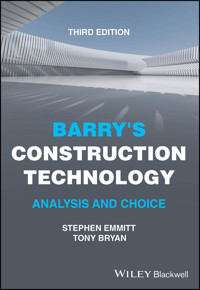
Updated resource guiding readers through the analysis and choices required to ensure a building will perform as expected
Robin Barry’s Construction of Buildings was first published in 1958 as a five-volume set and rapidly became a standard work on the subject. Following Barry’s death in 2002, a two-volume format was adopted with new authors. Developed from an earlier book by Tony Bryan, this new third volume, Barry’s Construction Technology, extends the coverage to show how decisions about the design, production, maintenance and disposal of buildings may be thought through given the materials and technology available. The book challenges the reader to think about the consequences of making choices and decisions rather than relying on using what has been used before.
Barry’s Construction Technology: Analysis and Choice includes information on:
- The climate emergency and the low carbon agenda as a fundamental part of construction technology analysis and choice
- Regenerative design, net zero buildings, and the circular economy for the built environment
- Constraints that location, legislation, codes and standards, sustainability, insurance, and commercial pressures apply to the performance of buildings
- Specific construction technology examples, with emphasis on questioning what we do and why, with the aim of informing and stimulating the reader to ask questions when confronted with all design and construction projects
Barry’s Construction Technology: Analysis and Choice is an essential, practical, and up-to-date reference for undergraduate students of all building construction programmes including surveying, construction management, architectural technology, and architecture.
Sie lesen das E-Book in den Legimi-Apps auf:
Seitenzahl: 628
Veröffentlichungsjahr: 2025
Ähnliche














Table of Contents
Cover
Table of Contents
Title Page
Copyright
Preface
Part I Analysis
Chapter 1 AT A GLANCE
1 The Framework for Understanding
1.1 Responding to the climate emergency – rethinking how and why we build
1.2 Process and knowledge
1.3 The initial suggestion
1.4 Carrying out the evaluation
1.5 Physical and social context
1.6 The basis of analysis
1.7 Knowledge needed for choice
Chapter 2 AT A GLANCE
2 Building Purpose and Performance
2.1 Activities, space and construction
2.2 Introduction to performance requirements
2.3 The performance gap
2.4 Environmental impact as performance criteria
2.5 Analysis of physical behaviour
2.6 The role of observation and science in the analysis
Chapter 3 AT A GLANCE
3 Linking the Design Concept to Construction Choice
3.1 Flows and transfers
3.2 Concept design
3.3 General and constructed forms
3.4 The emergence of general building forms
3.5 Emerging technologies – uncertainty and risk
Chapter 4 AT A GLANCE
4 Construction Variables and Choice
4.1 The variables of construction – the outcome of choice
4.2 Choosing materials
4.3 Choosing shape
4.4 Choosing size
4.5 Spatial relationships
4.6 Joints and fixings
Chapter 5 AT A GLANCE
5 Defining Conditions
5.1 Physical and social conditions
5.2 Activity and construction‐modifying environments
5.3 The dynamics of the system
5.4 Choice of interior elements of the building
5.5 Understanding what goes on within the building fabric
Chapter 6 AT A GLANCE
6 The Resource Base
6.1 Materials – the primary resource
6.2 Buildings as material banks – the recycled resource
6.3 Knowledge and skill – the human resource
6.4 Production equipment – the technological resource
6.5 Money – the enabling resource
6.6 Time – the temporal resource
Chapter 7 AT A GLANCE
7 Sustainability – Social Concerns and Technical Interventions
7.1 Sustainability – two major forces
7.2 Responding to the climate emergency
7.3 Buildings as systems
7.4 Renewable energy sources
7.5 Water and waste
7.6 Materials choice and detailing
Chapter 8 AT A GLANCE
8 Physical Behaviour Creating Environments
8.1 The building as a system
8.2 The dry environment
8.3 The warm environment
8.4 The light environment
8.5 The acoustic environment
8.6 The clean environment
8.7 The safe environment
8.8 The private environment
Chapter 9 AT A GLANCE
9 Physical Behaviour Under Load
9.1 Forces ‐ external and internal
9.2 Basic structural members
9.3 Curving (and folding) structural members
9.4 Structural connections
9.5 Grid members – pin‐jointed frames
9.6 Building structures – wind stability
9.7 Stress–strain and the choice of material
9.8 Structural analysis and design
9.9 Movements and structural behaviour
9.10 Stresses in the ground
9.11 The major structural forms
Chapter 10 AT A GLANCE
10 Physical Behaviour Over Time
10.1 Reliability: renewal, maintenance, repair and reuse
10.2 Basis of analysis
10.3 Soiling and cleaning
10.4 Durability of materials
10.5 Movements in components
10.6 Ground movement, settlement and subsidence
10.7 Movement and detailing
10.8 Wear of components
Chapter 11 AT A GLANCE
11 Interface Design
11.1 Interfaces
11.2 The enclosure–services interface
11.3 The enclosure–structure interface
11.4 The structure–services interface
11.5 Detailing interfaces
Chapter 12 AT A GLANCE
12 Manufacture, Assembly and Disassembly
12.1 Realisation of performance criteria
12.2 Visualising stages and sequences
12.3 Analysis of operations, methods and resources
12.4 Materials and labour
12.5 Production equipment
12.6 Production options
12.7 Knowledge and expertise for the analysis of the process
Part II Choice
Chapter 13 AT A GLANCE
13 Applying the Framework
13.1 The need for an integrated approach
13.2 Individual and collective choices
13.3 The basis of the case studies
13.4 The case studies
Chapter 14 AT A GLANCE
14 Foundations: Do We Need to Dig a Hole?
14.1 Structural integrity of foundations
14.2 Foundation design
14.3 Economics of foundations
14.4 Exploring some scenarios
Chapter 15 AT A GLANCE
15 Walls: The Paradox of the Cavity Wall
15.1 Walls by function
15.2 General forms
15.3 Walls in the case study
15.4 Masonry cavity external walls
15.5 Paradox
Chapter 16 AT A GLANCE
16 Openings: The Door and Window Performance Dilemma
16.1 The hole in the external wall
16.2 Doors and windows – the components in the openings
16.3 How could we do things differently?
Index
End User License Agreement
List of Tables
Chapter 8
Table 8.1 The role of fabric and services
Table 8.2 Forces potentially assisting water to enter at joints
Chapter 12
Table 12.1 Production equipment
List of Illustrations
Chapter 1
Figure 1.1 Relationship of process of choice to knowledge required.
Figure 1.2 Framework of analysis.
Chapter 3
Figure 3.1 Typical form associated with types of structure.
Figure 3.2 Generic description of house construction.
Figure 3.3 Constructed form description of house construction.
Chapter 4
Figure 4.1 Variables or outcome of choice.
Figure 4.2 Sizing depth of lintel.
Figure 4.3 Identification of achievable deviations.
Figure 4.4 Specification of allowable deviations.
Figure 4.5 Possible dimensional deviations.
Figure 4.6 Dimensional control framework.
Figure 4.7 Joints and fixings.
Chapter 5
Figure 5.1 Physical and social environments.
Figure 5.2 Environmental flows – a dynamic system.
Chapter 7
Figure 7.1 Thermal gains and losses.
Figure 7.2 Side, cross and stack ventilation.
Figure 7.3 Summer night purging (commercial building).
Figure 7.4 Winter heat gains (domestic building).
Figure 7.5 Winter gains, summer shading.
Figure 7.6 Building layouts capable of using natural ventilation and lightin...
Figure 7.7 Materials life cycle.
Chapter 8
Figure 8.1 Physical and social environments.
Figure 8.2 Creating internal conditions – possible technologies.
Figure 8.3 Aspects of active services systems.
Figure 8.4 The role of sub‐elements of the roof.
Figure 8.5 Generic forms of walls to resist penetrating damp.
Figure 8.6 Pathways and details to resist damp penetration at sills.
Figure 8.7 Pathways and details to resist rising damp.
Figure 8.8 Typical temperature drop across insulated cavity wall.
Figure 8.9 Effect of studs as a thermal bridge in timber frame wall panel.
Figure 8.10 Thermal (cold) bridge and details to reduce heat loss at window ...
Figure 8.11 Temperature gradient with position of insulation in cavity wall.
Figure 8.12 Typical wind pressures around buildings.
Figure 8.13 Natural ventilation using atrium or internal street.
Figure 8.14 Sound source and transmission paths.
Figure 8.15 Timber joisted floor and details to provide sound proofing.
Figure 8.16 Typical fire time–temperature curve.
Chapter 9
Figure 9.1 Struts and ties.
Figure 9.2 Beams.
Figure 9.3 Walls.
Figure 9.4 Slabs.
Figure 9.5 Lateral instabilities.
Figure 9.6 Curved structures across the span.
Figure 9.7 Curved (folded) in the direction of the span.
Figure 9.8 Structural action of connections.
Figure 9.9 Effect of rigid connections.
Figure 9.10 Pin‐jointed frames – the truss.
Figure 9.11 Detail of joints in pin‐jointed truss.
Figure 9.12 Stability of walls and frames.
Figure 9.13 Stress–strain curves.
Figure 9.14 Stress in ground due to foundation loading.
Figure 9.15 Basic members and arrangements of skeletal frames.
Chapter 10
Figure 10.1 Timber fence post – deterioration and improved durability specif...
Chapter 11
Figure 11.1 Load transfer options from external enclosure to structure.
Chapter 12
Figure 12.1 Strip foundation.
Figure 12.2 Strip foundations – stages and sequence of construction.
Figure 12.3 Strip foundations – operations associated with stages of constru...
Chapter 14
Figure 14.1 Plain concrete strip foundation.
Figure 14.2 Design considerations for plain concrete strip foundation.
Figure 14.3 Reinforced concrete ‘wide’ strip foundation.
Figure 14.4 Steps in plain concrete strip foundation.
Figure 14.5 Plain concrete ‘trench fill’ strip foundation.
Figure 14.6 Pile and beam foundation.
Figure 14.7 Plane raft foundation.
Figure 14.8 Edge beam raft foundation.
Chapter 15
Figure 15.1 Masonry walls in brick and block.
Figure 15.2 Masonry brick and block modularity.
Figure 15.3 Loads on the external cavity wall.
Figure 15.4 Cavity wall ties – types and spacing.
Figure 15.5 Masonry cavity wall – DPC arrangements.
Figure 15.6 Masonry cavity wall – basic specification.
Chapter 16
Figure 16.1 Openings in walls – terminology.
Figure 16.2 Openings in walls – alternative head details.
Figure 16.3 Openings in walls – alternative jamb details.
Figure 16.4 Openings in walls – alternative sill details.
Guide
Cover
Table of Contents
Title Page
Copyright
Preface
Begin Reading
Index
End User License Agreement
Pages
iii
iv
ix
x
xi
1
3
5
6
7
8
9
10
11
12
13
14
15
17
19
20
21
22
23
24
25
26
27
28
29
30
31
32
33
35
36
37
38
39
40
41
42
43
44
45
46
47
49
50
51
52
53
54
55
56
57
58
59
60
61
62
63
65
66
67
68
69
70
71
72
73
75
76
77
78
79
80
81
82
83
84
85
87
89
90
91
92
93
94
95
96
97
98
99
100
101
102
103
104
105
106
107
109
110
111
112
113
114
115
116
117
118
119
120
121
122
123
124
125
126
127
128
129
130
131
132
133
134
135
136
137
138
139
140
141
142
143
144
145
146
147
148
149
151
152
153
154
155
156
157
158
159
160
161
162
163
164
165
166
167
168
169
170
171
172
173
175
176
177
178
179
180
181
182
183
184
185
186
187
189
190
191
192
193
194
195
196
197
199
200
201
202
203
204
205
206
207
208
209
210
211
212
213
214
215
216
217
218
219
221
223
224
225
226
227
228
229
231
232
233
234
235
236
237
238
239
240
241
242
243
244
245
247
249
250
251
252
253
254
255
256
257
258
259
260
261
262
263
265
267
268
269
270
271
272
273
274
275
277
278
279
280
281
282
283
284
285
BARRY’S CONSTRUCTION TECHNOLOGY
Analysis and Choice
Third Edition
Stephen Emmitt
University of BathUnited Kingdom
Tony Bryan
United Kingdom
This edition first published 2025.© 2025 John Wiley & Sons Ltd.
Edition HistoryWiley Blackwell (1e, 2005), Wiley Blackwell (2e, 2010).
All rights reserved, including rights for text and data mining and training of artificial technologies or similar technologies. No part of this publication may be reproduced, stored in a retrieval system, or transmitted, in any form or by any means, electronic, mechanical, photocopying, recording or otherwise, except as permitted by law. Advice on how to obtain permission to reuse material from this title is available at http://www.wiley.com/go/permissions.
The right of Stephen Emmitt and Tony Bryan to be identified as the authors of this work has been asserted in accordance with law.
Registered OfficesJohn Wiley & Sons, Inc., 111 River Street, Hoboken, NJ 07030, USAJohn Wiley & Sons Ltd, New Era House, 8 Oldlands Way, Bognor Regis, West Sussex, PO22 9NQ, UK
For details of our global editorial offices, customer services, and more information about Wiley products visit us at www.wiley.com.
The manufacturer's authorized representative according to the EU General Product Safety Regulation is Wiley‐VCH GmbH, Boschstr. 12, 69469 Weinheim, Germany, e‐mail: [email protected].
Wiley also publishes its books in a variety of electronic formats and by print‐on‐demand. Some content that appears in standard print versions of this book may not be available in other formats.
Trademarks: Wiley and the Wiley logo are trademarks or registered trademarks of John Wiley & Sons, Inc. and/or its affiliates in the United States and other countries and may not be used without written permission. All other trademarks are the property of their respective owners. John Wiley & Sons, Inc. is not associated with any product or vendor mentioned in this book.
Limit of Liability/Disclaimer of WarrantyWhile the publisher and authors have used their best efforts in preparing this work, they make no representations or warranties with respect to the accuracy or completeness of the contents of this work and specifically disclaim all warranties, including without limitation any implied warranties of merchantability or fitness for a particular purpose. No warranty may be created or extended by sales representatives, written sales materials or promotional statements for this work. This work is sold with the understanding that the publisher is not engaged in rendering professional services. The advice and strategies contained herein may not be suitable for your situation. You should consult with a specialist where appropriate. The fact that an organization, website, or product is referred to in this work as a citation and/or potential source of further information does not mean that the publisher and authors endorse the information or services the organization, website, or product may provide or recommendations it may make. Further, readers should be aware that websites listed in this work may have changed or disappeared between when this work was written and when it is read. Neither the publisher nor authors shall be liable for any loss of profit or any other commercial damages, including but not limited to special, incidental, consequential, or other damages.
Library of Congress Cataloging‐in‐Publication Data Applied for:
Paperback ISBN: 9781394264643
Cover Design: WileyCover Image: © Jason marz/Getty Images
Preface
This book has been written for readers at the beginning of their career, studying with a view to practise in one of the professions concerned with the design, engineering, construction, upgrading and recycling of buildings. It is written for the novice who, with study and experience, will become an expert in their chosen field. The more fundamental ideas developed in the text may need to be revisited as experience grows, and the book can be referred to in the early years of practice and maybe beyond.
The book takes as its theme the process of choice: what the expert must know and how the expert could think through the myriad of decisions that have to be made about the design, production, maintenance, adaptation, reuse, and recycling of buildings. While this involves a process of analysis, the basis of which is universally applicable, the final choice is dictated by context. The context is set by time and place, available finance, the nature of the activity to be undertaken in the building and the aspirations of its benefactor, which includes the client, the building users and more widely the local community. The process of choice is about seeking appropriate solutions in a physical and cultural context. This decision‐making process is made easier in some respects by the uptake of digital tools that help to provide ‘the solution’ to complex challenges; and made harder in other respects because the reasoning built into the software is often hidden from the decision maker. Regardless of the level of digital sophistication used to assist analysis and choice, there is still a need for professionals to understand the fundamentals, and hence be equipped to challenge automated solutions. Relying, for example, on standard solutions contained in Building Information Modelling (BIM) libraries, which are often copied without sufficient scrutiny and questioning, is not what a client is paying for. Clients employ professionals to make informed decisions, drawing on their expertise and experience to deliver value. This is enhanced by using digital tools and technologies to help with analysis and choice.
For a text of this nature it may seem to be dominated by words and not illustrations. The contention is that for the novice or the practising professional faced with new challenges, ideas, and situations, an explanation of possible solutions is required. Presenting a final working drawing may be the outcome of choice, but it is the process of analysis, with its need for explanations, that gives the confidence that the solution will perform as intended, and it can be built safely and economically. A picture only paints a thousand words if you already have the words to explain it. We hope that the reader will find that the text tells a good story, that the development of the ideas is logical and easy to follow, but perhaps above all that it is seen as valuable in the world of modern construction practice. It is also hoped that the text will be illuminating and the illustrations supportive in providing the explanations of both the analysis and the solutions suggested for choice.
This third edition of the book has been reimagined to be part of the Barry's Construction of Buildings series, and readers are directed to Barry's Introduction to Construction of Buildings and Barry's Advanced Construction of Buildings for guidance on typical solutions to familiar construction challenges. This has allowed for simplification of content and a strengthening of the analysis and choice philosophy within the text. We have strengthened the sustainability and resilience argument by considering the circular construction economy and buildings as resource bases. We have also moved the chapter on sustainability to earlier in Part One of the book and refocused the second part of the book to making more sustainable and resilient choices. We have simplified and condensed the second part of the book, concentrating on a small number of building elements to challenge the reader. Rather than repeat many of the typical details in the Barry books, we have tried to suggest ways forward by challenging readers to think creatively and objectively.
The first part of the book focuses on the key areas of analysis that must be considered to check that the proposed construction will perform (will not fail), can be safely built, and performs as intended during its service life. These tests are seen as fundamental to the final choice. To carry out these analyses this book suggests that it is necessary to visualise not only the physical form of the final construction, however outline or tentative, but also, equally importantly, its response to the dynamic conditions under which it must perform. The key question is ‘What if I do it like this?’ The answer comes from an understanding of how it works and how it is built, this understanding coming from explanations of why things happen, drawing on knowledge from several other disciplines, such as science and economics. Each of the areas of analysis presented in this book is independent, and therefore each analysis must be separate, yet all must be satisfactory before the final choice is made. Choice is a juggling act: checking a proposal in one area of analysis may suggest changes that will affect others. For example, structurally sound solutions may be difficult to build, or solutions that will last without maintenance may be too expensive as a capital investment. There will, therefore, need to be some compromise to achieve a balance of performance criteria in the final choice that satisfies all areas of analysis.
The second part of the book puts analysis into practice, focusing on making a choice for a thought‐provoking situation. The chapters are designed to challenge the reader and go beyond conventional solutions to seek original solutions to the challenges of our time. One of the drivers behind these challenges is the climate emergency. Another driver is the need to provide a human centric built environment that benefits all members of society. Both drivers should inform analysis and choice.
The background to the book content is grounded in the regulations relating to the UK, however, the scenarios are deliberately designed to appeal to readers with different contexts and climates, as the principles are widely applicable. The notion of the framework for understanding developed in the book encourages the idea of seeking relevant and current information in the context of each project. Following this argument, the book does not give references to other publications, other than the Barry series. The intention is to encourage readers to conduct their own research and reflection and develop their analytical and decision‐making competences. This may well link to new and emerging technologies, such as artificial intelligence (AI), machine learning (ML), and bespoke software that collectively can guide the student and practitioner towards making better informed decisions. In practice much of the workflow now follows a digital protocol, and this is starting to be reflected in education. Thus what is presented in this book should be seen as supporting and encouraging creative thinking, regardless of the digital tools to be used.
This book is written with the conviction that by focusing on the process of choice the range of theory and knowledge that is useful to practice becomes explicit, making the link between knowledge and practice, and between understanding and experience, clear. As study, and then practice, unfolds for everyone it is the power to reflect that develops understanding and continual improvement. It is hoped that the framework suggested in this book will help not just the process of choice but also the process of reflection. Readers should take from this text what understanding they can to use it to develop their own good judgement in whatever part they play in the great enterprise of construction and the development of a resilient built environment.
PART IAnalysis
The Framework for Understanding: Chapter 1 AT A GLANCE
What? With the need to respond to the climate emergency and design and engineer buildings that provide a positive impact on the planet there comes a need to better understand the decisions that we make. This requires a framework for understanding. The process of choice is one of suggestions and evaluation that requires knowledge of the physical construction and the dynamic systems in which the building will be built and will operate over a long period.
Why? We need to rethink how, why, what and when we build; and where we build. When there is a changing demand for buildings and rapidly developing technical knowledge, the role of experience changes from predominantly reproducing known solutions to the integration of experience into a process of analysis to explore new possibilities. Climate change is a disrupter and the response to this disruption is to innovate. The initial suggestion will probably be based on precedent and general building forms to start the process of analysis and choice to meet current requirements, from which specific, more sustainable and resilient solutions can be derived.
When? Decisions need to be made throughout the life of a construction project and beyond through the long life of the building in service, and its eventual disassembly and reuse of precious resources into new constructions. The design and the resource availability define the criteria for the evaluation. This must be set within a physical and cultural context. How a suggestion is generated and the extent to which a formal evaluation must be undertaken will depend on the scale and nature of any changes from current practice. This will be influenced by the wants and needs of the building sponsor and the resources available at the time.
How? The majority of decisions are made collectively. Thus, everyone contributing to a building project must appreciate and understand the need for collective decision making, which requires a degree of compromise and determination to see solutions realised in a constructed artefact. Similarly, everyone contributing to the use and management of a building must appreciate the impact that their choices are having on the serviceability and usability of the building. By better understanding our collective decision making we will be better positioned to enable a carbon neutral and healthy built environment. The evaluation needs to be carried out through seven areas of analysis: appearance, behaviour creating environments, behaviour under load, behaviour over time, manufacture and assembly, cost, environmental and social concerns. This will involve constant reference to regulations, design knowledge, production expertise and maintenance intelligence.
1The Framework for Understanding
This opening chapter outlines a framework to help develop an understanding of what must be known to take decisions on how and why we build. This is developed against a background of climate change and the impact that the built environment has on the natural environment. Responding to climate change requires a rethink about how we make decisions. This emphasises the importance of analysis and choice. The framework developed in this book suggests a way of going about selecting construction and identifies the knowledge that is required to make informed choices. It is the framework that will be developed and used throughout the book to help readers to reflect on the reasons behind the choices they make. These choices need to consider a wide variety of parameters that are underscored by the impact of the solution on the natural environment.
1.1 Responding to the climate emergency – rethinking how and why we build
It is necessary to start with the challenge facing all societies and industries and the urgent need to tackle climate change. The built environment makes a significant impact on the natural world. It is estimated that approximately 11% of greenhouse gas emissions come from the built environment. Some of the emissions are produced during the production of the building, which includes the extraction and processing of materials and the assembly of materials to realise a building project. This includes new buildings and works to the existing building stock. Some of the emissions are produced while the building is being used, primarily by using energy to create a comfortable indoor environment for the occupants. Much of the energy will be used for heating and cooling, with lighting and equipment also requiring energy. As the building weathers there will be the need for maintenance and repair, along with replacement of items that have failed or are no longer functional. As building users' needs change there may also be the need to carry out major alterations and upgrades. Sometimes this is essential to improve the serviceability of the building, sometimes it is linked to changing tastes and fashions. And when the building has finally reached the end of its service life, it provides a material bank for new building projects, with valuable materials and components recovered and reused in new building projects or repurposed into new (building) products. This prevents demolition and construction waste going to landfill and the loss of valuable resources, such as metals, bricks, concrete, glass and plastics. All these stages have an impact on carbon emissions and pollution. It is, therefore, imperative that as a society we start to design, build and operate buildings that make a positive impact on our natural environment, and which are resilient to a changing climate. This means that we need to reduce the carbon footprint of all construction activities and reduce the energy consumed when the building is in use. The choices that everyone makes who are involved in the design, engineering, construction, use, maintenance, upgrading and recycling of buildings will have an impact on the building's performance and its environmental impact. Thus the building needs to be envisaged in its entire life cycle to enable a more resilient outcome from the analysis and choice.
In many circumstances the ‘best’ and ‘most appropriate’ technology for a given context is not necessarily more complex or technologically more sophisticated, but a ‘simpler’ technology that draws on our heritage of vernacular building materials and techniques. Research and testing have shown that many ‘natural’ materials are a more practical choice compared to the more industrialised and processed carbon intensive materials. We have also developed a better understanding of the importance of existing buildings and the opportunities to renovate, upgrade, retrofit, disassemble and reuse. This reflects the development of a more conscientious approach in the procurement of usable space by those who commission and regulate the built environment.
Environmental consciousness is a significant driver in consumer decisions and hence a core customer value, which shapes purchasing and procurement decisions. Environmental consciousness shapes the analysis and choice. There are several ways of making a positive difference to our natural and built environment. The main argument is to reduce, reuse, recycle, regenerate and revitalise. These are themes that are developed further in this text, sometimes implicitly and sometimes explicitly. Taking this thinking forward we can view a building as a circular or closed system, where there is no waste produced during the entire life cycle of the building. This requires analysis and choice in a framework that considers the long‐term future of the building, and which also requires a degree of speculation as to how the future may look. This demands a rethink about how, when, why and what we build; and where. It also requires a fundamental questioning of current building legislation, codes and design guidance to go beyond what we currently know and to innovate. This, of course, raises the spectre of risk, and the balance required between exposure to risk and the realisation of value for society. It also raises questions about building technologies. Do we put our faith in offsite production, modern methods of construction, ‘greener’ industrial processes, and innovative materials? Do we revisit sustainable techniques from the past and adapt them to our current expectations, relying entirely on bio‐based (renewable) materials? Or is it a mixture of high‐tech and low‐tech choices, for example 3D printing of building components using sustainable (bio‐based) materials? Does the solution have to be complex? Why cannot we return to simpler construction assemblages that embrace passive design principles, and which may be more durable in the longer term? Can we put our faith in digital technologies and software without necessarily understanding the algorithms and data that inform the solutions?
These and similar questions are easy to raise. They are less easy to answer when faced with often competing performance criteria. Fortunately, there are established design guides and green building rating systems such as BREEAM (UK), LEED (US), Green Star (Australia) and many others that help to guide professionals towards sustainable analysis and choice. These decision‐making guides are complimented by a rapidly expanding array of digital tools that help with the modelling, calculation and visualisation of buildings at all stages in their lifespan. Some of these are best suited to familiar building forms and technologies, although they are becoming more sophisticated and applicable to a wider range of building forms and technologies.
Digital dilemmas and opportunities
The digital revolution has certainly made it easier to design, detail and specify a building. Building information models (BIMs) contain typologies of details that can be easily imported from the BIM library into the design, requiring little in the way of thinking or reflection. These are solutions that are known to work, based on previous experience. The problem with taking an ‘easy’ approach is that professionals may stop thinking and reflecting on what is required for a specific context, and more importantly what is required to tackle climate change. Standard solutions do not suit all circumstances, and one could argue that standard solutions are no longer appropriate for reducing the built environment's carbon footprint. This may be further compounded when using software to simulate and predict building performance. Do we really understand the background information that informs the software and the algorithms being used to give ‘the’ answer? This is not to say that digital tools are not useful; they are. The point is that professionals need to understand exactly what it is that the digital tools are contributing to the decision‐making process, and how they can assist with analysis and choice. Professionals need to have the knowledge and insight to be able to question the digital ‘solution’ to ensure that it is a sensible choice for the context. Thus, to understand what digital tools can contribute, and how, requires an understanding of construction technology and an ability to ask the difficult questions. Too much reliance on established typologies and details may hinder the urgent need for change to a carbon free built environment. And this brings us onto the topic of artificial intelligence (AI), machine learning (ML) and generative design.
We now have the computing power and know how to generate millions of virtual solutions for a given challenge. We can model the building using BIM and virtual digital twins to examine the way in which buildings may behave if the conditions are adjusted. BIM allows the virtual construction and disassembly of the building long before the final decision is taken to go into production. This helps to reduce errors and improves coordination, as well as aiding the safe and economic construction of the building virtually before the design enters production. Virtual digital twins can be linked via the internet to sensors in buildings that gather real time data on, for example, temperature, humidity, lighting and occupancy levels, etc. This allows a reactive adjustment of building systems by using automation; known as smart or intelligent buildings. The data will inform predictive maintenance, allowing for targeted and timely interventions to maintain building performance. These data also help designers and building managers to take the learning into new, yet unknown, situations. This process is being made much easier using AI to analyse the data. AI can also contribute to a greener environment, for example by informing carbon accounting.
Digital tools are enablers of innovation and a powerful driver in the realisation of a net zero built environment. They assist decision making and generate solutions that would be impossible to do manually. The future may be an automated technological building that co‐exists with a simpler form of user‐control over one's immediate environment. One relies on the technology performing, for example the sensors, switches and gears opening the window; and one relies on the user performing, for example remembering to open and close the window. The argument in this book is not for one or the other, as both complexity and simplicity can, and do, co‐exist.
1.2 Process and knowledge
This book provides examples of construction, showing how we currently build, and introduces the understanding necessary to explain how the decisions we make influence the performance of the completed building project. These two types of knowledge are both vital to making decisions as to how we should create and maintain buildings in the future. This book sets this knowledge in the context of the process of making choices for the construction. In practice, a great deal of knowledge exists of the types of construction we may use and the materials and details that may be specified. There is, however, the need for any proposed construction works to answer the questions ‘Will it fail?’ and ‘Can it be built?’ Clearly it requires the answer to these two questions to be ‘No, it will not fail’ and ‘Yes, it can be built’. These categorical answers may be difficult to give in practice. There often needs to be some analysis to develop a level of confidence with which to make the choice. The amount of analysis required determines the level of understanding and experience needed to provide the evaluation of the suggested solution before the decision is taken to put the final proposal into practice.
It is this basic ability to suggest how a building may be constructed and then to carry out an evaluation asking the questions whether it will fail and whether it can be built that is developed in this book. The evaluation points to changes in the suggestion, which after re‐evaluation will lead, through a series of refinements, to the specification and details to be adopted. This requires knowledge of what potential solutions may look like, with current practice and precedent as the major sources for an initial suggestion. It requires an understanding of what is necessary to be specified to describe the proposed construction in sufficient detail to carry out the evaluation. The ability to carry out the evaluation, on the other hand, is dependent on an ability to ‘see’ the proposal working in the dynamic systems of the physical and social conditions in which the building is to be built. This process of choice and the way it leads to the identification of the knowledge required is shown in Figure 1.1.
It will be shown later that the process of choice is not just an analysis of the behaviour of physical performance. This evaluation of a proposal's response to the dynamic physical, chemical and biological systems of nature is vital, but building also takes place in a social, legislative and cultural context. There will be an imperative to ensure that the resources and know‐how are available to manufacture and assemble the building safely, economically and in a timely fashion. This will require knowledge of the available industrial systems associated with on‐site and offsite production, in addition to the availability of labour and craft skills. Further, it will be necessary to ensure that the cost of the solution is monitored, and that its social and environmental impact is audited. These will demand an understanding of both the economic and social systems in which the building is to be created and operated.
Figure 1.1Relationship of process of choice to knowledge required.
1.3 The initial suggestion
If the process is suggestion and evaluation, and the starting point is suggestion, it is necessary to know how we make the initial suggestion. How do we make that first best guess so that we can get started? In most cases the suggestion is informed by precedents. A precedent is a building or building detail that serves as an example of ‘good’ design and construction. Something, somewhere, has been done before that gives clues as to how the new solutions may be formulated. The precedent provides knowledge of solutions and how they perform in practice, i.e. how the building weathers over time and how the building users interact with the building. This knowledge can be used to inform or suggest subsequent actions, feeding into design possibilities and probabilities.
In times where change is limited the circumstances will have been faced several times in the past and successful solutions will have evolved. The well‐tried and tested solution needs only to be suggested and, with some evaluation to ensure the circumstances have not materially changed, can be immediately adopted. If the circumstances are changing, current solutions may still be the best starting point. They represent not only a sound basis in performance but also an existing base of resources and know‐how to manufacture and produce the materials and details. Evaluation may modify but not fundamentally change the solution, which is best described as incremental innovation. This, over time, gives rise to several general forms, known as typologies, from which specific solutions can be derived. A building language, a vernacular, has been developed that forms the precedent on which subsequent, informed, decisions are taken. Building design precedents can be found in the architectural literature that focus on a particular building typology, such as a school, a hospital or housing. Building technology precedents can be found in the building technology literature, such as the companion series to this book: Barry's Introduction to Construction of Buildings and Barry's Advanced Construction of Buildings. These books provide examples of how buildings could be assembled, not how they should be assembled. They offer tried and tested solutions that provide the initial suggestion to be evaluated and improved.
In some cases, perhaps where there are increasing user demands, or the structure of industrial practice is changing, then similar or related practice may have to be investigated to test and develop new solutions, for example, looking to other industries to see how technological change is impacting manufacturing. On the occasions where suggestions must be derived from little or no existing previous work, a more fundamental understanding of the behaviour of the construction will have to be applied as a way of mitigating risk. This is exactly what our response to the climate emergency requires: a fundamental rethink about the precedents that we have relied on and a return to the underlying principles of design and construction technology. This suggest a mixture of radical innovation through technological development (hi‐tech) and a return to some of the earlier principles of design and construction that were predicated on limited resources and the need to recycle (low‐tech). Fundamental decisions, such as to reuse an existing building rather than to demolish it, can have a major impact on embodied energy and material use. As an approximate guide, repurposing buildings has a 50% lower embodied energy use compared to demolition and new build.
While experts approach making suggestions based on their knowledge and experience, it is, in many ways, not necessary to know much at all to make suggestions and get started. It is the evaluation that requires the expertise. Novices or casual observers may make suggestions that may be hailed as brilliant observation, but in truth they have no way of knowing whether that suggestion is workable or not, or whether it will stand the test of time. It will take the expert to spot its potential and prove its worth through evaluation. The power of the expert to spot potential is probably associated with the ability to carry out a rapid, approximate evaluation before subjecting the suggestion to more rigorous and explicit analysis, using digital tools to calculate, model and simulate the outcome. This provides an estimate of the expected performance, which, in an ideal world will be very close to the actual performance.
1.4 Carrying out the evaluation
The heart of the success of the process of technological choice lies in the ability to be able to carry out an evaluation. The need to carry out a series of analytical exercises determines the knowledge required and manner of its application. It requires a level of understanding to answer the question ‘What if we build the building as proposed?’ and will involve several professionals and specialists to provide the answer(s).
While the suggestion and the ultimate solution describe the construction in what appears to be a static detail, the evaluation of the suggested construction must describe a dynamic system of behaviour (Will it fail? Will it perform?) and a production process (Can it be built? Can it be disassembled?). The process starts with the client's brief, which will inform the development of the design by establishing performance criteria. The design will be developed as a response to the social and physical context in which the building is to be built. It is against these criteria that performance will be judged. There will be many possible ways to construct a building to achieve the performance levels expressed in the client's brief. The criteria for choice of the technical solution comes from the identification of the function of the parts and how they contribute to the function of the building as one entity. The whole should be more than the sum of the parts.
It is too easy to see technology as only being the final construction, an assembly of components and materials that forms the building as a static object. However, making the choice of what construction should be adopted has to be rooted in an understanding of the building as a dynamic system responding to changes in conditions and open to a failure to perform as intended. It is necessary to be able to envisage not only the physical construction but also the building's behaviour under the conditions it will have to endure during its service life. Both are of equal importance. If the suggestion is not visualised correctly, its behaviour under analysis may be misinterpreted. Some specification of performance must be established and then the suggestion must be tested in the mind to assess the risk of failure within agreed design conditions. If the dynamic system of behaviour is not visualised correctly, a flawed proposal may be adopted. Picturing the building as a dynamic system will involve identifying the flows and transfers that take place both within the building and through the construction fabric, as explored further in the chapters that follow.
Technological choice demands skills in these areas of visualising the object and the systems, and then the conceptual manipulation of the systems acting on the construction to predict behaviour and assess the risk of failure. If the two basic questions to ask of a proposed solution are whether it will fail and whether it can be built, the criteria for choice come from an understanding not only of the potential dynamic flows and transfers when the building is in operation but also of the resources available. Performance can only be realised if the resources are available to construct the building. This relies on the manufacturing and assembly possibilities but will also include the existence of design expertise and the options for maintenance and recycling. Knowledge of available techniques and know‐how for production is crucial to the choice of the final construction if it is to be successful as a building design and as a completed building project.
As a design concept emerges, it is necessary to question what construction solutions may be used to fulfil the design requirements. It is then necessary to question whether this solution is available with current technology and resources within any environmental, cost, or time parameters. The resources available make the design a reality. Technology stands between the design of the building and the management of the resources. Choices can be made that may extend current production and design knowledge, but this must be recognised, and any costs involved in prototypes or training and the risks involved must be accepted before the final choice is made. The design and resources available condition the choice. These two areas are shown in Figure 1.2. These are the two areas that must be understood before any analysis can be started leading to the final choice of construction.
Figure 1.2Framework of analysis.
1.5 Physical and social context
Figure 1.2 also indicates that before any choice for a specific building can be made it is necessary to understand something of the context in which it will be constructed. There needs to be some knowledge of the conditions that exist when and where the building is to be built, possibly with some assessment of how conditions may change in the future.
Construction takes place within, and has an impact on, the world in which it is undertaken. Some description of this world is necessary for both technical and socio‐economic analyses. The world can be represented as a series of contexts, both physical and cultural. The physical context includes nature and climate. These exert forces that act on the building; they provide the raw resources and may be adversely affected by the construction and operation of buildings. The physical context includes the surrounding development and the need for the design to respond to existing buildings and spaces. People and their social, economic and political systems create the cultural context. It needs a response to local, national and global needs, based on beliefs and fundamental world views of the relationship between individuals and between society and the other components of the natural world.
The interaction between these two sets of contexts has been brought into focus by the need for sustainable development. The realisation that development cannot continue without consideration of its impact on the natural environment as well as established economic and social considerations calls for new knowledge associated with materials choice, energy use and waste disposal aspects of our chosen construction. There are, therefore, dangers in seeing these two sets of contexts as separate. However, it is still useful to consider them as having different dynamics. To resolve technical questions it is necessary to understand the physical context; and to evaluate the chance of a solution being successfully applied requires an understanding of society, its economic and political systems.
1.6 The basis of analysis
Having identified the design concept and the resource base as providing the criteria for choice, and having recognised the need to understand the physical and social context in which we build, it is possible to identify five areas of analysis (shown in Figure 1.2). The design concept is the translation of the physical and social needs for the operation of the whole building into a scheme that identifies the function and performance of each of the parts. To achieve this, the design concept must articulate both the arrangement and appearance of the spaces and the technical contribution each part of the construction will make to the creation and maintenance of the internal conditions. Two tests indicated in Figure 1.2 must be applied to a suggestion to see if it complies with the design concept:
Does the physical behaviour of the construction provide a building fulfilling its functions to the required performance level?
Does it provide the right attributes of appearance?
The test for physical behaviour involves three separate areas of analysis:
Creating environments
Under load
Over time
Three tests indicated in Figure 1.2 should be applied to a suggestion to see if it is achievable with available resources:
Can it be produced, including its manufacture and assembly and the subsequent processes of maintenance and recycling, with existing skills and know‐how in a reasonable time and at the required quality?
Are the resources available at reasonable cost?
Will it be compatible with the prevailing environmental and social concerns?
These resources are both natural (from the environment) and social, so both aspects must be part of the evaluation. It is only possible to use resources that nature has provided. However, the level of economic development in a society will provide the capacity to process materials, develop the skills and machinery to work them, the intellectual capacity to undertake design, and the provision of capital to invest in the enterprise of the construction. Both the technical properties of materials and the existence of the knowledge to exploit them, plus any environmental impact of their use, must be analysed in evaluating a suggested form of construction.
These areas of analysis to be undertaken are, by and large, unrelated to each other and each needs its own tools of analysis and knowledge base to be successfully applied. Carrying out one analysis may indicate the need for a change in the suggestion, but the change that is chosen may make the analysis of a previous aspect invalid. It is not until all the relevant areas of analysis are shown to be satisfactory that the suggestions can be adopted as the solution. The analysis must be undertaken for all aspects of the construction, from the overall structural system to the finest detail such as the screw that fixes the final fitting to a wall. The work in this is clearly overwhelming if it must be carried out for every building that is constructed. It follows that designers take shortcuts and rely on solutions that are known to work, and which informs much of the process of choice.
One of the most important decisions that experts take, of all the thousands of choices that must be made to fully specify the construction, is which of the areas of analysis for which parts of the building are significant. Where, if analysis is not thought through, is the greatest risk of failure? It is not clear how experts make this judgement. One possible explanation is that while looking at a suggestion they make many rapid checks against the seven criteria. From their knowledge and experience they take a view on what is well within failure limits and where the risks of failure are higher.
1.7 Knowledge needed for choice
It is now possible to start to identify the knowledge that is required and the areas of understanding that must be developed to carry out a full evaluation that considers the entire life of the building in a circular construction economy. Although used in various combinations in the different areas of analysis, it is possible to put forward a tentative list of types of knowledge that will be required:
Setting the performance levels as the criteria against which the evaluation will be made.
Defining the conditions under which performance must be achieved.
Determining the fundamental behaviour of the construction that would lead to failure to meet performance requirements.
Identifying the materials' properties that will govern the behaviour and performance of the building as one entity.
Thinking through the behaviour of the combination of materials and details under the conditions envisaged.
Identifying and simulating the process of manufacture and assembly, together with the resources required to produce the building within quality, time, cost and safety parameters.
Simulating the process of disassembly and materials recovery at a specific, if uncertain, point in the future.
The cost in economic, social and environmental terms of using a particular form of construction to meet performance criteria.
The process of evaluation requires the building to be conceptualised in several ways. While the final building will be visualised as a physical construction, it is necessary to perceive the building in several other ways when carrying out the evaluation. Initially, the construction must be seen as fulfilling a set of functions with associated performance levels. For evaluation, the building should be viewed as a series of physical systems responding dynamically to changing conditions. The building then must be seen as a series of production operations with the resources required for the realisation of the design. All these will have economic, environmental and social implications that must be understood as part of the decision‐making process. When all of these can be mastered, choices can be made associated with an assessment of risk and reward to realise a successful building.
In the chapters that follow the intention is to provide a logical sequence of events to enable analysis and choice. Although the chapters are designed to flow from one to another, they are also designed to be dipped into, and readers may well find themselves going from one chapter back to another as they explore various themes; much like one would do in practice when reviewing information and making a choice following a series of iterations.
Chapters 2, 3 and 4 are designed to set the scene. Chapter 2 provides a narrative surrounding the development of performance criteria. The design concept is linked to making choices about the construction, which is explored in Chapter 3. This involves the consideration of construction variables, which is the theme of Chapter 4. From this base it is then possible to consider how physical and social conditions are defined (Chapter 5), the resource base that influences choice (Chapter 6) and sustainability in Chapter 7.
Chapters 8, 9 and 10 are dedicated to different aspects of behaviour. Chapter 8 explores the inter‐related aspects of the environments that we create. Chapter 9 focuses on the physical behaviour of the building under load. Chapter 10 looks at the building's physical behaviour over time. Collectively these chapters cover the main phases of the building's life cycle. Once this is understood, it is then possible to think about interface design (Chapter 11) and the processes necessary to assemble the building (Chapter 12).
Part 2 of the book explores choice and challenges readers to question standard construction solutions. Chapter 13 describes how we could use the framework to question how we currently build. This is followed by chapters that aim to confront embedded behaviours and established construction solutions. The subjects tackled are foundations (Chapter 14), cavity walls (Chapter 15) and windows and doors (Chapter 16). These three chapters conclude with reflective exercises to be tackled by readers by themselves or as a group exercise in the physical or virtual classroom.
Building Purpose and Performance: Chapter 2 AT A GLANCE
What? The purpose or function of the building is to support the activities to be carried out within it, using both physical and social performance criteria. Performance criteria have evolved as buildings have become more sophisticated and users have become more demanding of their buildings. This has helped to emphasise the importance of performance and has also resulted in a better awareness of the difference in anticipated performance and actual performance; known as the performance gap.
Why? Choice of construction can only be made in the knowledge of the environments in which the construction operates and an understanding of the mechanisms or actions that lead to under‐performance or failure. Both physical and social functions of the building lead to physical performance requirements covering environmental, structural and reliability aspects of the construction. These requirements lead to performance expectations and hence definitions of success or failure. The other factors to be considered in making the choice of construction include production resources and know‐how, cost, legislation and the need to consider the whole life of the building and its environmental impact.
When? The purpose and performance of a building are best established at the briefing stage, and subsequently tested, adjusted and reaffirmed as the design evolves from early ideas and concepts through to the confirmation of materials and components in drawings and specifications. The building will be assembled based on the information provided by the design team. When the building is complete and in use there will be an opportunity to assess its performance against it predicted performance. This will be achieved by conducting post‐occupancy evaluation, using the performance criteria as the benchmark to gauge performance in use.
How?




