


15,99 €
Mehr erfahren.
- Herausgeber: John Wiley & Sons
- Kategorie: Fachliteratur
- Serie: J-B Short Format Series
- Sprache: Englisch
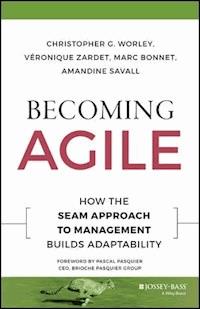
An in-depth example of The Agility Factor in action Becoming Agile: How the SEAM Approach to Management Builds Adaptability illustrates the process of becoming an agile organization. Reflecting the principles presented in The Agility Factor, readers are taken on a real-world journey of transformation and change. This short-format case study of the French company Brioche Pasquier highlights how one organization successfully implemented the principles of agility using the socio-economic approach to management, detailing each step of the process and describing how every decision brought the goal closer within reach. Readers get inside the heads of decision makers to gain insight into how tough decisions were made, how new, important, and flexible management tools were implemented, and how the necessary changes ultimately benefitted both the organization and the people who made it work. From overarching policy to day-to-day procedure, the story provides a clear example of how an agile organization is developed, giving readers a foundation upon which to implement similar changes in their own organization. Smart companies understand the importance of agility, but identifying where and how to initiate those first steps often leads to paralysis by analysis. This case study allows readers to learn from an organization that got through the inertia and put the principles of agility into action, with incredible results. * Understand how the principles of agility can be implemented using a specific intervention strategy * Tailor those principles to suit any organization * Calculate and convert the "hidden costs" of traditional organizational design into flexible, value added activities * Formulate and execute an actionable agility strategy Big changes require a deep understanding of the problem at hand, and a viable plan for steering the organization in a better direction. By seeing how it's been done before, organizations can take a proven approach and tailor it to their specific needs. For those tasked with formulating the agility strategy, Becoming Agile: How the SEAM Approach to Management Builds Adaptability provides invaluable insight.
Sie lesen das E-Book in den Legimi-Apps auf:
Seitenzahl: 207
Veröffentlichungsjahr: 2015
Ähnliche

















Jossey-Bass Short Format Series
Written by thought leaders and experts in their fields, pieces in the Jossey-Bass Short Format Series provide busy, on-the-go professionals, managers, and leaders around the world with must-have, just-in-time information in a concise and actionable format.
To learn more, visit www.josseybass.com/go/shortform.
Also by the Authors
Built to Change by Edward E. Lawler, III, Christopher G. Worley, and Jerry Porras
Management Reset by Edward E. Lawler, III, Christopher G. Worley, and David Creelman
The Agility Factor: Building Adaptable Organizations for Superior Performance by Christopher G. Worley, Thomas Williams, and Edward E. Lawler, III
Assessing Organization Agility by Christopher G. Worley, Thomas Williams, and Edward E. Lawler, III
BECOMING AGILE
How the SEAM Approach to Management Builds Adaptability
CHRISTOPHER G. WORLEY VÉRONIQUE ZARDET MARC BONNET AMANDINE SAVALL
Cover image: Cheetah running © GettyImages/ Oxford Scientific Cover design: Wiley
This book is printed on acid-free paper.
Copyright © 2015 by Christopher G. Worley, Véronique Zardet, Marc Bonnet, and Amandine Savall. All rights reserved
Published by John Wiley & Sons, Inc., Hoboken, New Jersey
Published simultaneously in Canada
No part of this publication may be reproduced, stored in a retrieval system, or transmitted in any form or by any means, electronic, mechanical, photocopying, recording, scanning, or otherwise, except as permitted under Section 107 or 108 of the 1976 United States Copyright Act, without either the prior written permission of the Publisher, or authorization through payment of the appropriate per-copy fee to the Copyright Clearance Center, 222 Rosewood Drive, Danvers, MA 01923, (978) 750-8400, fax (978) 646-8600, or on the web at www.copyright.com. Requests to the Publisher for permission should be addressed to the Permissions Department, John Wiley & Sons, Inc., 111 River Street, Hoboken, NJ 07030, (201) 748-6011, fax (201) 748-6008, or online at www.wiley.com/go/permissions.
Limit of Liability/Disclaimer of Warranty: While the publisher and author have used their best efforts in preparing this book, they make no representations or warranties with the respect to the accuracy or completeness of the contents of this book and specifically disclaim any implied warranties of merchantability or fitness for a particular purpose. No warranty may be created or extended by sales representatives or written sales materials. The advice and strategies contained herein may not be suitable for your situation. You should consult with a professional where appropriate. Neither the publisher nor the author shall be liable for damages arising herefrom.
For general information about our other products and services, please contact our Customer Care Department within the United States at (800) 762-2974, outside the United States at (317) 572-3993 or fax (317) 572-4002.
Wiley publishes in a variety of print and electronic formats and by print-on-demand. Some material included with standard print versions of this book may not be included in e-books or in print-on-demand. If this book refers to media such as a CD or DVD that is not included in the version you purchased, you may download this material at http://booksupport.wiley.com. For more information about Wiley products, visit www.wiley.com.
Library of Congress Cataloging-in-Publication Data
Worley, Christopher G. Becoming agile : how the SEAM approach to management builds adaptability / Christopher G. Worley, Veronique Zardet, Marc Bonnet, Amandine Savall. pages cm. — (Jossey-Bass short format series) Includes index. ISBN 978-1-119-01166-8 (cloth); ISBN 978-1-119-01168-2 (pdf); ISBN 978-1-119-01167-5 (epub) 1. Organizational change. 2. Organizational effectiveness. 3. Management. I. Title. HD58.8.W6834 2015 658.4′06—dc23
2015020881
CONTENTS
Foreword
Preface
Acknowledgments
1 One Vision, Two Perspectives
Purpose of the Book
Agility and Performance
A Socio-Economic Theory of Organizations
Overview of the Book
Note
References
2 The Beginnings of Agility at Brioche Pasquier
BPG and the SEAM Methodology
The Initial Improvement Process at BPG
BPG’s Agility
References
3 The Brioche Pasquier Group Goes Global
Chapter Overview
Act 1: Internationalizing the Sales Function
Act 2: From International Sales to International Production
Act 3: From International to Global
Assessing BPG’s Agility
Summary
Note
References
4 Implementing Agility and SEAM
A Comparison and Integration of Agility and SEAM
An Agility Implementation Framework
Reflections on Becoming Agile
Conclusion
References
About the Authors
The Research Sponsor Organizations
The Center for Effective Organizations (CEO)
The Institute for Socio-Economic Organization Research (ISEOR)
The Center for Leadership and Effective Organizations (CLEO)
Index
EULA
List of Tables
Chapter 1
Table 1.1
Chapter 2
Table 2.1
Table 2.2
Table 2.3
Table 2.4
Production Waste Calculation
Production Loss Calculation
Table 2.5
Table 2.6
Table 2.7
Chapter 3
Table 3.1
Table 3.2
Table 3.3
Chapter 4
Table 4.1
Table 4.2
Table 4.3
Table 4.4
List of Illustrations
Chapter 1
Figure 1.1
The Ecological Perspective
Figure 1.2
The Transformational Perspective
Figure 1.3
The Dynamic Capabilities Perspective
Figure 1.4
The Agility Pyramid
Chapter 2
Figure 2.1
BPG Organization Chart (1984)
Figure 2.2
BPG Organizational Chart (1988)
Figure 2.3
BPG’s Goal and Strategy
Figure 2.4
The HORIVERT Model
Figure 2.5
Semi-Annual Priority Planning Process
Figure 2.6
How BPG Links Key Management Tools
Figure 2.7
Redesigning the Brioche Production Process (Before and After)
Figure 2.8
Typical BPG Site Organization Chart
Chapter 3
Figure 3.1
BPG Organizational Chart in early 2000s
Figure 3.2
Act 1: Internationalizing the Sales Function (1998–2000)
Figure 3.3
Act 2: Internationalizing Production (2001–2007)
Figure 3.4
Act 3: Globalizing Operations (2007–2014)
Figure 3.5
BPG Organizational Chart (2007)
Figure 3.6
Chronology of BPG and the Galaxy Desserts Relationship
Guide
Cover
Table of Contents
Preface
Pages
vii
viii
ix
x
xi
xiii
xiv
xv
xvi
xvii
xviii
xix
1
2
3
4
5
6
7
8
9
10
11
12
13
14
15
16
17
18
20
21
22
24
25
26
27
28
29
30
31
33
34
35
36
37
38
39
40
41
44
45
47
48
49
50
51
54
55
56
57
58
59
60
61
62
63
65
66
67
68
69
70
71
72
73
75
76
77
78
79
81
83
84
85
86
87
88
90
91
92
93
94
95
96
97
98
100
101
102
103
104
105
106
107
108
109
110
111
113
114
115
116
117
118
120
121
122
123
124
127
129
130
131
132
135
136
137
138
139
140
141
142
143
145
146
147
149
150
151
152
153
Foreword
The main challenge companies will face in the future is an issue of great importance to me. It is also a priority for Brioche Pasquier’s human resource development strategy: the balance paradigm. Balance results from a reasoned consideration of the external environment versus the internal environment. The external environment demands immediacy, hyper-specialization, and a technical approach to the fields of sales management, finance, production, and other functions, but it also discourages a more holistic approach that would pay significant attention to the people in the company. To enable such a balance in organizational practices, one between the external and the internal environments, leaders must formalize a strategy, write it down, and translate it into company projects that match and reflect their being and will and draw on the company’s basic management principles. Such formality helps to avoid unwarranted turnarounds that might result from unstable, turbulent, and short-term business pressures. Indeed, our aim is to sustain our strategic view over the long run.
Lesen Sie weiter in der vollständigen Ausgabe!
Lesen Sie weiter in der vollständigen Ausgabe!
Lesen Sie weiter in der vollständigen Ausgabe!
Lesen Sie weiter in der vollständigen Ausgabe!
Lesen Sie weiter in der vollständigen Ausgabe!
Lesen Sie weiter in der vollständigen Ausgabe!
Lesen Sie weiter in der vollständigen Ausgabe!
Lesen Sie weiter in der vollständigen Ausgabe!
Lesen Sie weiter in der vollständigen Ausgabe!
Lesen Sie weiter in der vollständigen Ausgabe!




