


54,99 €
Mehr erfahren.
- Herausgeber: John Wiley & Sons
- Kategorie: Fachliteratur
- Serie: Wiley Finance Editions
- Sprache: Englisch
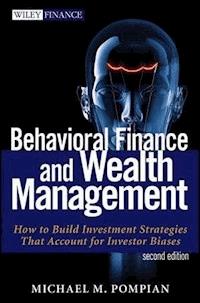
The book that applies behavioral finance to the real world Understanding how to use behavioral finance theory in investing is a hot topic these days. Nobel laureate Daniel Kahneman has described financial advising as a prescriptive activity whose main objective should be to guide investors to make decisions that serve their best interests. The reality? That's easier said than done. In the Second Edition of Behavioral Finance and Wealth Management, Michael Pompian takes a practical approach to the growing science of behavioral finance, and puts it to use for real investors. He applies knowledge of 20 of the most prominent individual investor biases into "behaviorally-modified" asset allocation decisions. Offering investors and financial advisors a "self-help" book, Pompian shows how to create investment strategies that leverage the latest cutting edge research into behavioral biases of individual investors. This book: * Shows investors and financial advisors how to either moderate or adapt to behavioral biases, in order to improve investment results and identifies "the best practical allocation" for investment portfolios. Using these two sound approaches for guiding investment decision-making, behavioral biases are incorporated into the portfolio management process * Uses updated cases studies to show investors and financial advisors how an investor's behavior can be modified to improve investment decision-making * Provides useable methods for creating behaviorally modified investment portfolios, which may help investors to reach their long term financial goals * Heightens awareness of biases so that financial decisions and resulting economic outcomes are improved * Offers advice on managing the effects of each bias in order to improve investment results This Second Edition illustrates investors' behavioral biases in detail and offers financial advisors and their clients practical advice about how to apply the science of behavioral finance to improve overall investment decision making.
Sie lesen das E-Book in den Legimi-Apps auf:
Seitenzahl: 503
Veröffentlichungsjahr: 2011
Ähnliche

















Contents
Cover
Series
Title Page
Copyright
Dedication
Preface
A CHALLENGING ENVIRONMENT
WHY THIS BOOK?
WHO SHOULD USE THIS BOOK?
WHEN TO USE THIS BOOK?
PLAN OF THE BOOK
Acknowledgments
PART ONE: Introduction to Behavioral Finance
CHAPTER 1: What Is Behavioral Finance?
BEHAVIORAL FINANCE: THE BIG PICTURE
STANDARD FINANCE VERSUS BEHAVIORAL FINANCE
THE ROLE OF BEHAVIORAL FINANCE WITH PRIVATE CLIENTS
HOW PRACTICAL APPLICATION OF BEHAVIORAL FINANCE CAN CREATE A SUCCESSFUL ADVISORY RELATIONSHIP
CHAPTER 2: The History of Behavioral Finance Micro
HISTORICAL PERSPECTIVE ON THE LINK BETWEEN PSYCHOLOGY AND ECONOMICS
MODERN BEHAVIORAL FINANCE
PSYCHOGRAPHIC MODELS USED IN BEHAVIORAL FINANCE
CHAPTER 3: Introduction to Behavioral Biases
INTRODUCTION
BEHAVIORAL BIASES DEFINED
WHY UNDERSTANDING AND IDENTIFYING BEHAVIORAL BIASES IS IMPORTANT
CATEGORIZATION OF BEHAVIORAL BIASES
DIFFERENCES BETWEEN COGNITIVE AND EMOTIONAL BIASES
DIFFERENCE AMONG COGNITIVE BIASES
EMOTIONAL BIASES
A FINAL WORD ON BIASES
SUMMARY OF PART ONE
PART TWO: Belief Perseverance Biases Defined and Illustrated
CHAPTER 4: Cognitive Dissonance Bias
BIAS DESCRIPTION
PRACTICAL APPLICATION
RESEARCH REVIEW
DIAGNOSTIC TESTING
ADVICE
CONCLUSION
CHAPTER 5: Conservatism Bias
BIAS DESCRIPTION
PRACTICAL APPLICATION
RESEARCH REVIEW
DIAGNOSTIC TESTING
ADVICE
CHAPTER 6: Confirmation Bias
BIAS DESCRIPTION
PRACTICAL APPLICATION
RESEARCH REVIEW
DIAGNOSTIC TESTING
ADVICE
CHAPTER 7: Representativeness Bias
BIAS DESCRIPTION
PRACTICAL APPLICATION
RESEARCH REVIEW
DIAGNOSTIC TESTING
ADVICE
CHAPTER 8: Illusion of Control Bias
BIAS DESCRIPTION
PRACTICAL APPLICATION
RESEARCH REVIEW
DIAGNOSTIC TESTING
ADVICE
FINAL THOUGHT
CHAPTER 9: Hindsight Bias
BIAS DESCRIPTION
PRACTICAL APPLICATION
RESEARCH REVIEW
DIAGNOSTIC TESTING
ADVICE
PART THREE: Information Processing Biases Defined and Illustrated
OVERVIEW OF THE STRUCTURE OF CHAPTERS 10 THROUGH 16
CHAPTER 10: Mental Accounting Bias
BIAS DESCRIPTION
PRACTICAL APPLICATION
RESEARCH REVIEW
DIAGNOSTIC TESTING
ADVICE
THE BEHAVIORAL FINANCE APPROACH TO ASSET ALLOCATION BASED ON MENTAL ACCOUNTING
CHAPTER 11: Anchoring and Adjustment Bias
BIAS DESCRIPTION
PRACTICAL APPLICATION
RESEARCH REVIEW
DIAGNOSTIC TESTING
ADVICE
BONUS DISCUSSION: INVESTMENT STRATEGIES THAT LEVERAGE ANCHORING AND ADJUSTMENT BIAS
CHAPTER 12: Framing Bias
BIAS DESCRIPTION
PRACTICAL APPLICATION
RESEARCH REVIEW
DIAGNOSTIC TESTING
ADVICE
CHAPTER 13: Availability Bias
BIAS DESCRIPTION
PRACTICAL APPLICATION
RESEARCH REVIEW
DIAGNOSTIC TEST
ADVICE
CHAPTER 14: Self-Attribution Bias
BIAS DESCRIPTION
PRACTICAL APPLICATION
RESEARCH REVIEW
DIAGNOSTIC TESTING
ADVICE
CHAPTER 15: Outcome Bias
BIAS DESCRIPTION
DIAGNOSTIC
CHAPTER 16: Recency Bias
BIAS DESCRIPTION
PRACTICAL APPLICATION
RESEARCH REVIEW
DIAGNOSTIC TESTING
ADVICE
PART FOUR: Emotional Biases Defined and Illustrated
CHAPTER 17: Loss Aversion Bias
BIAS DESCRIPTION
PRACTICAL APPLICATION
RESEARCH REVIEW
DIAGNOSTIC TESTING
ADVICE
CHAPTER 18: Overconfidence Bias
BIAS DESCRIPTION
PRACTICAL APPLICATION
RESEARCH REVIEW
DIAGNOSTIC TESTING
ADVICE
A FINAL WORD ON OVERCONFIDENCE
CHAPTER 19: Self-Control Bias
BIAS DESCRIPTION
PRACTICAL APPLICATION
RESEARCH REVIEW
DIAGNOSTIC TESTING
ADVICE
CHAPTER 20: Status Quo Bias
BIAS DESCRIPTION
PRACTICAL APPLICATION
RESEARCH REVIEW
DIAGNOSTIC TESTING
ADVICE
CHAPTER 21: Endowment Bias
BIAS DESCRIPTION
PRACTICAL APPLICATION
RESEARCH REVIEW
DIAGNOSTIC TESTING
ADVICE
CHAPTER 22: Regret Aversion Bias
BIAS DESCRIPTION
PRACTICAL APPLICATION
RESEARCH REVIEW
DIAGNOSTIC TESTING
ADVICE
CHAPTER 23: Affinity Bias
BIAS DESCRIPTION
RESEARCH REVIEW
DIAGNOSTIC TESTING
ADVICE
PART FIVE: Application of Behavioral Finance to Asset Allocation and Case Studies
CHAPTER 24: Application of Behavioral Finance to Asset Allocation
PRACTICAL APPLICATION OF BEHAVIORAL FINANCE
BEST PRACTICAL ALLOCATION
GUIDELINES FOR DETERMINING BEST PRACTICAL ASSET ALLOCATION
QUANTITATIVE GUIDELINES FOR INCORPORATING BEHAVIORAL FINANCE IN ASSET ALLOCATION
INVESTMENT POLICY AND ASSET ALLOCATION
CHAPTER 25: Case Studies
CASE STUDY A: MR. NICHOLAS
CASE STUDY B: MRS. ALEXANDER
SUMMARY OF CASE STUDIES
PART SIX: Behavioral Investor Types
CHAPTER 26: Behavioral Investor Type Diagnostic Process
BACKGROUND OF THE DEVELOPMENT OF BEHAVIORAL INVESTOR TYPES
PSYCHOGRAPHIC MODELS OF INVESTOR BEHAVIOR
EARLY PSYCHOGRAPHIC MODELS
THE BEHAVIORAL ALPHA PROCESS: A TOP-DOWN APPROACH
THE BIT IDENTIFICATION PROCESS
SUMMARY
CHAPTER 27: Behavioral Investor Types
INTRODUCTION
PRESERVER
FOLLOWER
INDEPENDENT
ACCUMULATOR
SUMMARY
Index
Founded in 1807, John Wiley & Sons is the oldest independent publishing company in the United States. With offices in North America, Europe, Australia and Asia, Wiley is globally committed to developing and marketing print and electronic products and services for our customers’ professional and personal knowledge and understanding.
The Wiley Finance series contains books written specifically for finance and investment professionals as well as sophisticated individual investors and their financial advisors. Book topics range from portfolio management to e-commerce, risk management, financial engineering, valuation, and financial instrument analysis, as well as much more.
For a list of available titles, visit our Web site at www.WileyFinance.com.
Copyright © 2012 by Michael M. Pompian. All rights reserved.
Published by John Wiley & Sons, Inc., Hoboken, New Jersey. Published simultaneously in Canada.
No part of this publication may be reproduced, stored in a retrieval system, or transmitted in any form or by any means, electronic, mechanical, photocopying, recording, scanning, or otherwise, except as permitted under Section 107 or 108 of the 1976 United States Copyright Act, without either the prior written permission of the Publisher, or authorization through payment of the appropriate per-copy fee to the Copyright Clearance Center, Inc., 222 Rosewood Drive, Danvers, MA 01923, (978) 750-8400, fax (978) 646-8600, or on the Web at www.copyright.com. Requests to the Publisher for permission should be addressed to the Permissions Department, John Wiley & Sons, Inc., 111 River Street, Hoboken, NJ 07030, (201) 748-6011, fax (201) 748-6008, or online at http://www.wiley.com/go/permissions.
Limit of Liability/Disclaimer of Warranty: While the publisher and author have used their best efforts in preparing this book, they make no representations or warranties with respect to the accuracy or completeness of the contents of this book and specifically disclaim any implied warranties of merchantability or fitness for a particular purpose. No warranty may be created or extended by sales representatives or written sales materials. The advice and strategies contained herein may not be suitable for your situation. You should consult with a professional where appropriate. Neither the publisher nor author shall be liable for any loss of profit or any other commercial damages, including but not limited to special, incidental, consequential, or other damages.
For general information on our other products and services or for technical support, please contact our Customer Care Department within the United States at (800) 762-2974, outside the United States at (317) 572-3993 or fax (317) 572-4002.
Wiley also publishes its books in a variety of electronic formats. Some content that appears in print may not be available in electronic books. For more information about Wiley products, visit our web site at www.wiley.com.
Library of Congress Cataloging-in-Publication Data
Pompian, Michael M., 1963– Behavioral finance and wealth management : how to build investment strategies that account for investor biases / Michael Pompian. –2nd ed. p. cm. – (Wiley finance series) Includes index. ISBN 978-1-118-01432-5 (cloth); ISBN 978-1-118-18227-7 (ebk) ISBN 978-1-118-18228-4 (ebk); ISBN 978-1-118-18229-1 (ebk) 1. Investments–Psychological aspects. 2. Investments–Decision making.;I. Title. HG4515.15.P66 2012 332.601′9–dc23 2011039271
I would like to dedicate this book
to my brother Dave and his family.
Preface
It is with great satisfaction that I write this preface. Fifteen years ago, I embarked upon a quest to introduce the benefits of applying behavioral finance in practice with my first published article. Six years ago the first edition of this book was published. In that edition, I noted that behavioral finance was an emerging topic and that, hopefully, it would become a well-recognized discipline in finance. At the time, the debate as to whether or not behavioral finance was to be taken seriously by, mainly, academics and some practitioners, was in full force. Six years on, this debate appears to essentially be over. Behavioral finance is now part of the financial lexicon in many circles, such as the advisor-client relationship, the financial press, the academic literature, financial journals, and so on. It's not whether behavioral finance exists, but rather how can we begin to learn from the research that has been done and help ourselves become better investors. This second edition continues to help both clients and their advisors benefit from the practical application of behavioral finance.
This book is intended to be a guide both to understanding irrational investor behavior and to creating individual investors’ portfolios that account for these irrational behaviors. The investment business is dominated by “benchmarks” against which performance of an investment portfolio should be judged. Often, investor think they should “beat the market” just because that is what they think defines success. In my view, private clients should begin thinking about their benchmarks in terms of how well they help them progress toward their financial goals, not so much whether an investment manager beats their benchmark or their portfolio outperformed the policy benchmark. Knowledge of behavioral biases and their affect on the investment process can go a long way to changing the way we view investment success. Often times, when applying behavioral finance to real-world investment programs, an optimal portfolio is one with which an investor can comfortably live, so that he or she has the ability to adhere to his or her investment program, while at the same time reach long-term financial goals.
The last edition of the book was written in the wake of the run-up in stock prices in the late 1990s and the subsequent popping of the technology bubble. This time, the latest financial bombshell was the 2008–2009 bursting of the housing and credit bubbles. And given the response to this financial crisis by central banks around the world, by keeping interest rates ultra-low, similar to the years preceding the most recent crisis, my view is we may be in store for continued volatility. Therefore, understanding irrational investor behavior is as important as it has ever been, probably more so. This is true not only for the markets in general but most especially for individual investors. This book will be used primarily by financial advisors, but it can also be effectively used by sophisticated individual investors who wish to become more introspective about their own behaviors and to truly try to understand how to create a portfolio that works for them. The book is not intended to sit on the polished mahogany bookcases of successful advisors as a showpiece: It is a guidebook to be used and implemented in the pursuit of building better portfolios.
The reality of today's advisor-investor relationship demands a better understanding of individual investors’ behavioral biases and an awareness of these biases when structuring investment portfolios. Advisors need to focus more acutely on why their clients make the decisions they do and whether behaviors need to be modified or adapted. If advisors can successfully accomplish this difficult task, the relationship will be strengthened considerably, and advisors can enjoy the loyalty of clients who end the search for a new advisor.
In the past 250 years, many schools of economic and social thought have been developed, some of which have come and gone, while others are still very relevant today. We will explore some of these ideas to give some perspective on where behavioral finance is today. In the past 30 years, the interest in behavioral finance as a discipline has not only emerged but rather exploded onto the scene, with many articles written by very prestigious authors in prestigious publications and now is consistently in the mainstream media. We will review some of the key people who have shaped the current body of behavioral finance thinking and the work done by them. The intent is to take the study of behavioral finance to another level: reviewing the most important behavioral biases in terms that advisors and investors can understand, and demonstrating how biases are to be used in practice through the use of case studies—a “how-to” of behavioral finance. We will also explore some of the new frontiers of behavioral finance, things not even discussed by today's advisors that may be commonly discussed in the next 30 years.
A CHALLENGING ENVIRONMENT
In the last edition, I noted that investment advisors have never had a more challenging environment to work in. I wrote: “Many advisors thought they had found nirvana in the late 1990s, only to find themselves in quicksand in 2001 and 2002.” Now, we merely need to substitute the years 2005 through 2007 and 2008–2009 into the same sentence. As the old adage goes, the more things change the more they stay the same. And once again we find ourselves in a low-return environment. Like then, advisors are still being peppered with the vexing questions from their clients:
“Why is this fund not up as much as that fund?”
“The market has not done well the past quarter—what should we do?”
“Why is asset allocation so important?”
“Why are we investing in alternative investments?”
“Why aren't we investing in alternative investments?”
“Why don't we take the same approach to investing in college money and retirement money?”
“Why don't we buy fewer stocks so we can get better returns?”
Advisors need a handbook that can help them deal with the behavioral and emotional sides of investing, so that they can help their clients understand why they have trouble sticking to a long-term program of investing.
WHY THIS BOOK?
The first edition of the book was conceived only after many hours, weeks, and years of researching, studying, and applying behavioral finance concepts to real-world investment situations. When I began taking an interest in how portfolios might be adjusted for behavioral biases back in the late 1990s, when the technology bubble was in full force, I sought a book like this one but couldn't find one. I did not set a goal of writing a book at that time; I merely took an interest in the subject and began reading. It wasn't until my wife, who was going through a job transition, came home one night talking about the Myers-Briggs personality type test she took that I began to consider the idea of writing about behavioral finance. My thought process at the time was relatively simple: Doesn't it make sense that people of differing personality types would want to invest differently? I couldn't find any literature on this topic. So, with the help of a colleague on the private wealth committee at NYSSA (the New York Society of Securities Analysts—the local CFA chapter), John Longo, PhD, I began my quest to write on the practical application of behavioral finance. Our paper, entitled “A New Paradigm for Practical Application of Behavioral Finance: Correlating Personality Type and Gender with Established Behavioral Biases,” was ultimately published in the Journal of Wealth Management in the fall of 2003 and, at the time, was one of the most popular articles in that issue.
Since that time, I have written several papers, a new Wiley book entitled Advising Ultra Affluent Clients and Family Offices, and a monthly column for MorningstarAdvisor.com that have expanded my work. In 2008, I published “Behavioral Investor Types,” an article that ran in the Journal of Financial Planning. This work attempts to categorize investors into four “behavioral investor types,” which will be reviewed in this book briefly and fully explained in my next Wiley book, entitled Behavioral Finance and Investor Types, coming out later in 2012 or 2013. As a wealth manager, I have found the value of understanding the behavioral finance and have discovered some useful ways to adjust investment programs for behavioral biases. You will learn about these methods. By writing this book, I hope to spread the knowledge that I have developed and accumulated so that other advisors and clients can benefit from these insights.
WHO SHOULD USE THIS BOOK?
The book was originally intended as a handbook for wealth management practitioners who help clients create and manage investment portfolios. As the book evolved, it became clear that individual investors could also greatly benefit from it. The following are the target audience for the book:
Traditional Wire-house Financial Advisors. A substantial portion of the wealth in the United States and abroad is in the very capable hands of traditional wire-house financial advisors. From a historical perspective, these advisors have not traditionally been held to a fiduciary standard, as the client relationship was based primarily on financial planning being “incidental” to the brokerage of investments. In today's modern era, many believe that this will have to change, as “wealth management,” “investment advice,” and brokerage will merge to become one. And the change is indeed taking place within these hallowed organizations. Thus, it is crucial that financial advisors develop stronger relationships with their clients because advisors will be held to a higher standard of responsibility. Applying behavioral finance will be a critical step in this process as the financial services industry continues to evolve.Private Bank Advisors and Portfolio Managers. Private banks, such at U.S. Trust, Bessemer Trust, and the like, have always taken a very solemn, straightlaced approach to client portfolios. Stocks, bonds, and cash were really it for hundreds of years. Lately, many of these banks have added such nontraditional offerings as venture capital, hedge funds, and others to their lineup of investment product offerings. However, many clients, including many extremely wealthy clients, still have the big three—stocks, bonds, and cash—for better or worse. Private banks would be well served to begin to adopt a more progressive approach to serving clients. Bank clients tend to be conservative, but they also tend to be trusting and hands-off clients. This client base represents a vast frontier to which behavioral finance could be applied because these clients either do not recognize that they do not have an appropriate portfolio or tend to recognize only too late that they should have been more or less aggressive with their portfolios. Private banks have developed a great trust with their clients and should leverage this trust to include behavioral finance in these relationships.Independent Financial Advisors. Independent registered representatives (wealth managers who are Series 7 registered but who are not affiliated with major stock brokerage firms) have a unique opportunity to apply behavioral finance to their clients. They are typically not part of a vast firm and may have fewer restrictions than their wire-house brethren. These advisors, although subject to regulatory scrutiny, can for the most part create their own ways of serving clients; and with many seeing that great success is growing their business, they can deepen and broaden these relationships by including behavioral finance.Registered Investment Advisors. Of all potential advisors that could include behavioral finance as a part of the process of delivering wealth management services, it is my belief that registered investment advisors (RIAs) are well positioned to do so. Why? Because RIAs are typically smaller firms, which have fewer regulations than other advisors. I envision RIAs asking clients, “How do you feel about this portfolio?” “If we changed your allocation to more aggressive, how might your behavior change?” Many other types of advisors cannot and will not ask these types of questions for fear of regulatory or other matters, such as pricing, investment choices, or others.Consultants and Other Financial Advisors. Consultants to individual investors, family offices, or other entities that invest for individuals can also greatly benefit from this book. Understanding how and why their clients make investment decisions can greatly impact the investment choices consultants can recommend. When the investor is happy with his or her allocation and feels good about the selection of managers from a psychological perspective, the consultant has done his or her job and will likely keep that client for the long term.Individual Investors. For those individual investors who have the ability to look introspectively and assess their behavioral biases, this book is ideal. Many individual investors who choose either to do it themselves or to rely on a financial advisor only for peripheral advice often find themselves unable to separate their emotions from the investment decision-making process. This does not have to be a permanent condition. By reading this book and delving deep into their behaviors, individual investors can indeed learn to modify behaviors and to create portfolios that help them stick to their long-term investment programs and, thus, reach their long-term financial goals.WHEN TO USE THIS BOOK?
First and foremost, this book is generally intended for those who want to apply behavioral finance to the asset allocation process to create better portfolios for their clients or themselves. This book can be used:
When there is an opportunity to create or re-create an asset allocation from scratch. Advisors know well the pleasure of having only cash to invest for a client. The lack of such baggage as emotional ties to certain investments, tax implications, and a host of other issues that accompany an existing allocation is ideal. The time to apply the principles learned in this book is at the moment that one has the opportunity to invest only cash or to clean house on an existing portfolio.When a life trauma has taken place. Advisors often encounter a very emotional client who is faced with a critical investment decision during a traumatic time, such as a divorce, a death in the family, or job loss. These are the times that the advisor can add a significant amount of value to the client situation by using the concepts learned in this book.When a concentrated stock position is held. When a client holds a single stock or other concentrated stock position, emotions typically run high. In my practice, I find it incredibly difficult to get people off the dime and to diversify their single-stock holdings. The reasons are well known: “I know the company, so I feel comfortable holding the stock,” “I feel disloyal selling the stock,” “My peers will look down on me if I sell any stock,” “My grandfather owned this stock, so I will not sell it.” The list goes on and on. This is the exact time to employ behavioral finance. Advisors must isolate the biases that are being employed by the client and then work together with the client to relieve the stress caused by these biases. This book is essential in these cases.When retirement age is reached. When a client enters the retirement phase, behavioral finance becomes critically important. This is so because the portfolio structure can mean the difference between living a comfortable retirement and outliving one's assets. Retirement is typically a time of reassessment and reevaluation and is a great opportunity for the advisor to strengthen and deepen the relationship to include behavioral finance.When wealth transfer and legacy are being considered. Many wealthy clients want to leave a legacy. Is there any more emotional an issue than this one? Having a frank discussion about what is possible and what is not possible is difficult and is often fraught with emotional crosscurrents that the advisor would be well advised to stand clear of. However, by including behavioral finance into the discussion and taking an objective, outside-councilor's viewpoint, the client may well be able to draw his or her own conclusion about what direction to take when leaving a legacy.When a trust is being created. Creating a trust is also a time of emotion that may bring psychological biases to the surface. Mental accounting comes to mind. If a client says to himself or herself, “Okay, I will have this pot of trust money over here to invest, and that pot of spending money over there to invest,” the client may well miss the big picture of overall portfolio management. The practical application of behavioral finance can be of great assistance at these times.Naturally, there are many more situations not listed here that can arise where this book will be helpful.
PLAN OF THE BOOK
This edition of the book has an updated structure. In the last edition, Part One of the book not only provided an introduction to the practical application of behavioral finance but also an introduction to incorporating investor behavior into the asset allocation process for private clients. In this edition, Part One includes a definition of behavioral finance, a review of its history, and a new chapter that introduces behavioral biases. Asset allocation topics are covered in Part Five, Case Studies. Parts Two, Three, and Four are a comprehensive review of some of the most commonly found biases, complete with a general description, technical description, practical application, research review, implications for investors, diagnostic, and advice. This time, biases are broken out into three categories: Belief Perseverance Biases, Information Processing Biases, Emotional Biases to correspond to Part's Two, Three, and Four. Part Five includes completely updated case studies as well as the previously referenced “Application of Behavioral Finance to Asset Allocation” section. Lastly, Part Six includes my latest research into defining four “Behavioral Investor Types.”
MICHAEL M. POMPIAN
Acknowledgments
I would like to acknowledge all my colleagues, both present and past, who have contributed to broadening my knowledge not only in the topic of this book but also in wealth management in general. You know who you are. I would also like to acknowledge all of the behavioral finance academics and professionals who have granted permission for me to use their brilliant work. I also would like to acknowledge Cristina Hensel and all Wiley staff for their help in editing the book. Finally, I would like to thank my parents and extended family for giving me the support to write this book.
M. M. P.
PART ONE
Introduction to Behavioral Finance
In Part One, we present three chapters: Chapter 1 poses the question ``What is Behavioral Finance?'' This chapter also includes a review of some of the most important figures in the field of behavioral finance. In Chapter 2, we review the history of behavioral finance placing particular emphasis on understanding the differences between rational and irrational behavioral economic theories that have been developed over the year. Chapter 3 provides an introduction to behavioral biases, 20 of which will be reviewed in the book.
Throughout this part of the book, the goal is to have readers understand the basics of as well as the effects of behavioral biases on the investment process. By doing so investors and their advisors may be able to improve economic outcomes and attain stated financial objectives.
CHAPTER 1
What Is Behavioral Finance?
People in standard finance are rational. People in behavioral finance are normal.
—Meir Statman, PhD, Santa Clara University
At its core, behavioral finance attempts to understand and explain actual investor and market behaviors versus theories of investor behavior. This idea differs from traditional (or standard) finance, which is based on assumptions of how investors and markets should behave. Wealth managers from around the world who want to better serve their clients have begun to realize that they cannot rely solely on theories or mathematical models to explain individual investor and market behavior. As Meir Statman's quote puts it, standard finance people are modeled as “rational,” whereas behavioral finance people are modeled as “normal.” This can be interpreted to mean that “normal” people may behave irrationally—but the reality is that almost no one (actually, I will go so far as to say absolutely no one) behaves perfectly rationally, and dealing with normal people is what this book is all about. We will delve into the topic of the irrational behaviors of markets at times; however, the focus of the book is on individual investor behavior.
Lesen Sie weiter in der vollständigen Ausgabe!
Lesen Sie weiter in der vollständigen Ausgabe!
Lesen Sie weiter in der vollständigen Ausgabe!
Lesen Sie weiter in der vollständigen Ausgabe!
Lesen Sie weiter in der vollständigen Ausgabe!
Lesen Sie weiter in der vollständigen Ausgabe!
Lesen Sie weiter in der vollständigen Ausgabe!
Lesen Sie weiter in der vollständigen Ausgabe!
Lesen Sie weiter in der vollständigen Ausgabe!
Lesen Sie weiter in der vollständigen Ausgabe!
Lesen Sie weiter in der vollständigen Ausgabe!
Lesen Sie weiter in der vollständigen Ausgabe!
Lesen Sie weiter in der vollständigen Ausgabe!
Lesen Sie weiter in der vollständigen Ausgabe!
Lesen Sie weiter in der vollständigen Ausgabe!
Lesen Sie weiter in der vollständigen Ausgabe!
Lesen Sie weiter in der vollständigen Ausgabe!
Lesen Sie weiter in der vollständigen Ausgabe!
Lesen Sie weiter in der vollständigen Ausgabe!
Lesen Sie weiter in der vollständigen Ausgabe!
Lesen Sie weiter in der vollständigen Ausgabe!
Lesen Sie weiter in der vollständigen Ausgabe!
Lesen Sie weiter in der vollständigen Ausgabe!
Lesen Sie weiter in der vollständigen Ausgabe!
Lesen Sie weiter in der vollständigen Ausgabe!
Lesen Sie weiter in der vollständigen Ausgabe!
Lesen Sie weiter in der vollständigen Ausgabe!
Lesen Sie weiter in der vollständigen Ausgabe!
Lesen Sie weiter in der vollständigen Ausgabe!
Lesen Sie weiter in der vollständigen Ausgabe!
Lesen Sie weiter in der vollständigen Ausgabe!
Lesen Sie weiter in der vollständigen Ausgabe!




