


32,99 €
Mehr erfahren.
- Herausgeber: John Wiley & Sons
- Kategorie: Fachliteratur
- Serie: Wiley Finance Editions
- Sprache: Englisch
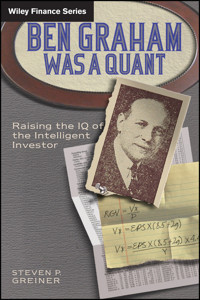
Innovative insights on creating models that will help you become a disciplined intelligent investor The pioneer of value investing, Benjamin Graham, believed in a philosophy that continues to be followed by some of today's most successful investors, such as Warren Buffett. Part of this philosophy includes adhering to your stock selection process come "hell or high water" which, in his view, was one of the most important aspects of investing. So, if a quant designs and implements mathematical models for predicting stock or market movements, what better way to remain objective, then to invest using algorithms or the quantitative method? This is exactly what Ben Graham Was a Quant will show you how to do. Opening with a brief history of quantitative investing, this book quickly moves on to focus on the fundamental and financial factors used in selecting "Graham" stocks, demonstrate how to test these factors, and discuss how to combine them into a quantitative model. * Reveals how to create custom screens based on Ben Graham's methods for security selection * Addresses what it takes to find those factors most influential in forecasting stock returns * Explores how to design models based on other styles and international strategies If you want to become a better investor, you need solid insights and the proper guidance. With Ben Graham Was a Quant, you'll receive this and much more, as you learn how to create quantitative models that follow in the footsteps of Graham's value philosophy.
Sie lesen das E-Book in den Legimi-Apps auf:
Seitenzahl: 611
Veröffentlichungsjahr: 2011
Ähnliche



















Contents
Cover
Series
Title Page
Copyright
Dedication
Preface
Introduction: The Birth of the Quant
CHARACTERIZING THE QUANT
ACTIVE VERSUS PASSIVE INVESTING
Chapter 1: Desperately Seeking Alpha
THE BEGINNINGS OF THE MODERN ALPHA ERA
IMPORTANT HISTORY OF INVESTMENT MANAGEMENT
METHODS OF ALPHA SEARCHING
Chapter 2: Risky Business
EXPERIENCED VERSUS EXPOSED RISK
THE BLACK SWAN: A MINOR ELE EVENT—ARE QUANTS TO BLAME?
ACTIVE VERSUS PASSIVE RISK
OTHER RISK MEASURES: VAR, C-VAR, AND ETL
SUMMARY
Chapter 3: Beta Is Not “Sharpe” Enough
BACK TO BETA
BETA AND VOLATILITY
THE WAY TO A BETTER BETA: INTRODUCING THE G-FACTOR
TRACKING ERROR: THE DEVIANT DIFFERENTIAL MEASURER
SUMMARY
Chapter 4: Mr. Graham, I Give You Intelligence
FAMA-FRENCH EQUATION
THE GRAHAM FORMULA
FACTORS FOR USE IN QUANT MODELS
MOMENTUM: INCREASING INVESTOR INTEREST
VOLATILITY AS A FACTOR IN ALPHA MODELS
Chapter 5: Modeling Pitfalls and Perils
DATA AVAILABILITY, LOOK-AHEAD, AND SURVIVORSHIP BIASES
BUILDING MODELS YOU CAN TRUST
SCENARIO, OUT-OF-SAMPLE, AND SHOCK TESTING
DATA SNOOPING AND MINING
STATISTICAL SIGNIFICANCE AND OTHER FASCINATIONS
CHOOSING AN INVESTMENT PHILOSOPHY
GROWTH, VALUE, QUALITY
INVESTMENT CONSULTANT AS DUTCH UNCLE
WHERE ARE THE RELATIVE GROWTH MANAGERS?
Chapter 6: Testing the Graham Crackers … er, Factors
THE FIRST TESTS: SORTING
TIME-SERIES PLOTS
THE NEXT TESTS: SCENARIO ANALYSIS
Chapter 7: Building Models from Factors
SURVIVING FACTORS
WEIGHTING THE FACTORS
THE ART VERSUS SCIENCE OF MODELING
TIME SERIES OF RETURNS
OTHER CONDITIONAL INFORMATION
THE FINAL MODEL
OTHER METHODS OF MEASURING PERFORMANCE: ATTRIBUTION ANALYSIS VIA BRINSON AND RISK DECOMPOSITION
REGRESSION OF THE GRAHAM FACTORS WITH FORWARD RETURNS
Chapter 8: Building Portfolios from Models
THE DEMING WAY: BENCHMARKING YOUR PORTFOLIO
PORTFOLIO CONSTRUCTION ISSUES
USING AN ONLINE BROKER: FIDELITY, E*TRADE, TD AMERITRADE, SCHWAB, INTERACTIVE BROKERS, AND TRADESTATION
WORKING WITH A PROFESSIONAL INVESTMENT MANAGEMENT SYSTEM: BLOOMBERG, CLARIFI, AND FACTSET
Chapter 9: Barguments: The Antidementia Bacterium
THE COLOSSAL NONFAILURE OF ASSET ALLOCATION
THE STOCK MARKET AS A CLASS OF SYSTEMS
STOCHASTIC PORTFOLIO THEORY: AN INTRODUCTION
PORTFOLIO OPTIMIZATION: THE LAYMAN’S PERSPECTIVE
TAX-EFFICIENT OPTIMIZATION
SUMMARY
Chapter 10: Past and Future View
WHY DID GLOBAL CONTAGION AND MELTDOWN OCCUR?
FALLOUT OF CRISES
THE RISE OF THE MULTINATIONAL STATE-OWNED ENTERPRISES
THE EMERGED MARKETS
THE FUTURE QUANT
Notes
PREFACE
INTRODUCTION: THE BIRTH OF QUANT
CHAPTER 1: DESPERATELY SEEKING ALPHA
CHAPTER 2: RISKY BUSINESS
CHAPTER 3: BETA IS NOT “SHARPE” ENOUGH
CHAPTER 4: MR. GRAHAM, I GIVE YOU INTELLIGENCE
CHAPTER 5: MODELING PITFALLS AND PERILS
CHAPTER 6: TESTING THE GRAHAM CRACKERS … ER, FACTORS
CHAPTER 7: BUILDING MODELS FROM FACTORS
CHAPTER 8: BUILDING PORTFOLIOS FROM MODELS
CHAPTER 9: BARGUMENTS: THE ANTIDEMENTIA BACTERIUM
CHAPTER 10: PAST AND FUTURE VIEW
Acknowledgments
About the Author
Index
Founded in 1807, John Wiley & Sons is the oldest independent publishing company in the United States. With offices in North America, Europe, Australia, and Asia, Wiley is globally committed to developing and marketing print and electronic products and services for our customers’ professional and personal knowledge and understanding.
The Wiley Finance series contains books written specifically for finance and investment professionals as well as sophisticated individual investors and their financial advisors. Book topics range from portfolio management to e-commerce, risk management, financial engineering, valuation, and financial instrument analysis, as well as much more.
For a list of available titles, visit our Web site at www.WileyFinance.com.
Copyright © 2011 by Steven P. Greiner, PhD. All rights reserved.
Published by John Wiley & Sons, Inc., Hoboken, New Jersey. Published simultaneously in Canada.
No part of this publication may be reproduced, stored in a retrieval system, or transmitted in any form or by any means, electronic, mechanical, photocopying, recording, scanning, or otherwise, except as permitted under Section 107 or 108 of the 1976 United States Copyright Act, without either the prior written permission of the Publisher, or authorization through payment of the appropriate per-copy fee to the Copyright Clearance Center, Inc., 222 Rosewood Drive, Danvers, MA 01923, (978) 750-8400, fax (978) 646-8600, or on the Web at www.copyright.com. Requests to the Publisher for permission should be addressed to the Permissions Department, John Wiley & Sons, Inc., 111 River Street, Hoboken, NJ 07030, (201) 748-6011, fax (201) 748-6008, or online at http://www.wiley.com/go/permissions.
Limit of Liability/Disclaimer of Warranty: While the publisher and author have used their best efforts in preparing this book, they make no representations or warranties with respect to the accuracy or completeness of the contents of this book and specifically disclaim any implied warranties of merchantability or fitness for a particular purpose. No warranty may be created or extended by sales representatives or written sales materials. The advice and strategies contained herein may not be suitable for your situation. You should consult with a professional where appropriate. Neither the publisher nor author shall be liable for any loss of profit or any other commercial damages, including but not limited to special, incidental, consequential, or other damages.
Data for charts used in the book was provided by FactSet. Copyright © 2000–2010 FactSet Research Systems Inc. All rights reserved.
For general information on our other products and services or for technical support, please contact our Customer Care Department within the United States at (800) 762-2974, outside the United States at (317) 572-3993 or fax (317) 572-4002.
Wiley also publishes its books in a variety of electronic formats. Some content that appears in print may not be available in electronic books. For more information about Wiley products, visit our web site at www.wiley.com.
Library of Congress Cataloging-in-Publication Data:
Greiner, Steven P. Ben Graham was a quant : raising the IQ of the intelligent investor / Steven P. Greiner. p. cm. – (Wiley finance series) Includes bibliographical references and index. ISBN 978-0-470-64207-8 (cloth); ISBN 978-1-118-01340-3 (ebk); ISBN 978-1-118-01338-0 (ebk); ISBN 978-1-118-01339-7 (ebk) 1. Securities. 2. Investments. 3. Investment analysis. 4. Graham, Benjamin, 1894–1976. I. Title. HG4521.G723 2011 332.63′2042–dc22 2010039909
There are two groups I dedicate this book to. The first are those just entering the quant workforce, whether experienced scientists making a career change, or those graduating from some financial engineering curriculum. They should find the history in this book enabling. The second group are those people who helped me get started in this business, too numerous to mention individually. To both, I raise a hearty glass of burgundy and toast them, “to success in the markets.” Cheers!
Preface
I earnestly ask that everything be read with an open mind and that the defects in a subject so difficult may be not so much reprehended as investigated, and kindly supplemented, by new endeavors of my readers.
—Isaac Newton, The Principia1
The history of quantitative investing goes back farther than most people realize. You might even say it got its start long before the famous Black-Scholes option pricing equation was introduced.2 You could even say it began before the advent of computers, and certainly before the PC revolution. The history of quantitative investing began when Ben Graham put his philosophy into easy-to-understand screens. Graham later wrote The Intelligent Investor, which Warren Buffett read in 1950 and used to develop his brilliant formula for investing.3 Since then, quantitative investing has come from the impoverished backwater of investing to the forefront of today’s asset management business.
So what is quantitative investing? What does it mean to be a quant? How can the average investor use the tools of this perhaps esoteric but benign field? Quantitative investing has grown widely over the past few years, due in part to its successful implementation during the years following the tech bubble until about 2006. Since then poorer years followed, in which algorithms all but replaced the fundamental investment manager. Then during the 2007--2009 credit crisis, quant investing got a bad rap when many criticized quantitative risk management as the cause of the crisis and even more said that, minimally, it did not help avoid losses. For these people, quant is a wasting asset and should be relegated to its backwater beginnings for it is indeed impoverishing. However, these criticisms come from a misunderstanding of what quant methods are and what it means to be a quantitative investment manager or what it means to use a quantitative process in building stock portfolios. We shall clarify these matters in the body of this work.
In reality, investment managers have a bias or an investment philosophy they adhere to. These investment philosophies can be value oriented like Ben Graham’s, or they can be growth oriented, focusing on growing earnings, sales, or margins. Good managers adhere to their principles both in good times and in bad. That is precisely the message (not the only one) famed value investor Ben Graham advocates in TheIntelligent Investor—that of adhering to your stock selection process come hell or high water, and it puts the onus on the individual investor to control your impulses to give in to primal urges or behaviors governed by fear. For instance, we are naturally disposed to not sell assets at prices below cost (i.e., the sunk-cost effect) because we expect price rebound and are subject to anchoring (we tend to remember the most recent history and act accordingly). This results in investors chasing historical returns rather than expected returns, so we constantly choose last year’s winning mutual funds to invest in. However, if we design and implement mathematical models for predicting stock or market movements, then there can be no better way to remain objective than to turn your investment process over to algorithms, or quantitative investing!
This book is for you, the investor, who likes to sleep at night secure in the knowledge that the stocks you own are good bets, even if you have no way of knowing their daily share price. What is so good about quantitative investing is that it ultimately leads to disciplined investing. Codifying Ben Graham’s value philosophy and marrying it with quantitative methods is a win-win for the investor and that is what this book is about.
This book will teach you how to:
Create custom screens based on Graham’s methods for security selection.Find the most influential factors in forecasting stock returns, focusing on the fundamental and financial factors used in selecting Graham stocks.Test these factors with software on the market today.Combine these factors into a quantitative model and become a disciplined intelligent investor.Build models for other style, size, and international strategies.There is no reason you cannot benefit from the research of myriad PhD’s, academics, and Wall Street whiz kids just because you did not take college calculus. This book is the essential how-to when it comes to building your own quantitative model and joining the ranks of the quants with the added benefit of maintaining the 3T’s (i.e., tried, true, and trusted) fundamental approaches of Ben Graham. All this and very little mathematics! Nevertheless, we cannot forget that despite his investment methods, Graham himself suffered a harrowing loss of over 65 percent during the Crash of 1929--1932. The adage “past performance is not a predictor of future returns” must always apply.
This book is not about financial planning, estate planning, or tax planning. This book is part tutorial, part history lesson, part critique, and part future outlook. Though the prudent investor must remain aware of corporate bond yields, this book is mostly about investing in stocks. Also, it generally refers to investment of liquid investable securities and does not address emergency cash needs, household budgeting, or the like. You might also read this book before tackling Ben Graham’s The Intelligent Investor, especially if you are approaching the investment field from an engineering background rather than a financial one, for the brevity of the financial terms in this book is far more understandable, approachable, and filtered down to those most relevant variables for you. Conversely, in Ben’s Graham’s book, an accounting background is more helpful than a degree in mechanical engineering.
Likewise, the investable universe in vogue today that includes stocks (equities), fixed income (government and corporate bonds), commodities, futures, options, and real estate are all part of an institutional asset allocation schema that is not addressed here either. This book is 99 percent about equities with a smidgen of corporate debt.
You will come away with a much better understanding of value, growth, relative value, quality, momentum, and various styles associated with equity investing. Certainly the Morningstar-style box, defined by small to large and value to growth, will be studied, and the differences among developed markets, global investing, international investing, and emerging markets will all be heavily defined. We will cover how the Graham method can be applied to markets outside the United States as well.
Generally, this book takes the perspective of the long-term investor talking about saving for retirement, so this constitutes the focus we have adopted, well in line with Graham’s focus. In addition, we concentrate on mid- to large-cap equities in the United States and talk about how to apply the Graham method to global markets. Global markets allow for the universe of equities chosen. As written previously, the very first step is to define the investment area one wants to concentrate on and, from this, choose the universe of stocks on which the intelligent investor should concentrate.
This book is organized as follows: The introduction covers some history and identifies who the quants are, where they came from, and the types of quants that exist. Chapter 1 defines the search for alpha and explains what alpha is. Chapter 2 discusses risk; it is a “think chapter” filled with useful information and new perspectives. Chapter 2 also functions a bit as an apologetic for quants, but it comes down hard on those who criticize quant methods without also lauding their accomplishments. Chapter 3 moves on to discuss some inadequacies of modern portfolio theory and explains why easy approximations and assumptions are usually violated in finance. It is here that g-factor is introduced as a better method to measure stock volatility.
After the first three chapters, you will be armed to dig into Graham’s method, which is outlined in Chapter 4. The chapter defines the Graham factors and shows examples of other factors, illustrating what they are and how they are measured and validated. Chapter 5 is an important chapter that teaches the relevant methods in building factor models, and it reviews important data considerations before modeling can commence. Chapter 6 is about the actual testing of factors; you will see exactly how to do so with live examples and data. Chapter 7 takes the output of the previous chapter and shows how to put factors together to form models, specifically several Graham models. Chapter 8 summarizes the issues for putting the Graham model to work and reviews consideration for building a portfolio.
Chapters 9 and 10 are more unusual. Chapter 9 breaks down stock returns by discussing new ways to describe them and introduces better, lesser known theories on stock behavior. This is not a finance chapter. However, it has its base in econophysics, but it is far easier to understand than material you would find elsewhere written by academics. Chapter 10 offers the future view. Anyone who cares to know what the world will be like in the near future as well as twenty years from now should read this chapter. It is based on broad trends that seem to have nothing to stop them from continuing. From here, get your latte or pour your favorite Bordeaux and jump in. You are about to get the keys to quantdom!
Steven P. Greiner Chicago, Illinois November 2010
Chapter 1
Desperately Seeking Alpha
Thus, if the earth were viewed from the planets, it would doubtless shine with the light of its own clouds, and its solid body would be almost hidden beneath the clouds. Thus, the belts of Jupiter are formed in the clouds of that planet, since they change their situation relative to one another, and the solid body of Jupiter is seen with greater difficulty through those clouds. And the bodies of comets must be much more hidden beneath their atmospheres, which are both deeper and thicker.
Lesen Sie weiter in der vollständigen Ausgabe!
Lesen Sie weiter in der vollständigen Ausgabe!
Lesen Sie weiter in der vollständigen Ausgabe!
Lesen Sie weiter in der vollständigen Ausgabe!
Lesen Sie weiter in der vollständigen Ausgabe!
Lesen Sie weiter in der vollständigen Ausgabe!
Lesen Sie weiter in der vollständigen Ausgabe!
Lesen Sie weiter in der vollständigen Ausgabe!
Lesen Sie weiter in der vollständigen Ausgabe!
Lesen Sie weiter in der vollständigen Ausgabe!
Lesen Sie weiter in der vollständigen Ausgabe!
Lesen Sie weiter in der vollständigen Ausgabe!
Lesen Sie weiter in der vollständigen Ausgabe!




