


Erhalten Sie Zugang zu diesem und mehr als 300000 Büchern ab EUR 5,99 monatlich.
- Herausgeber: THP Ireland
- Kategorie: Geisteswissenschaft
- Sprache: Englisch
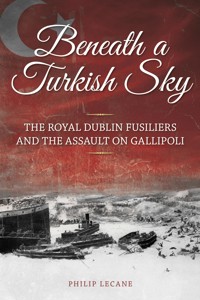
It was the First World War's largest seaborne invasion and the Irish were at the forefront. Recruited in Ireland, the Royal Dublin Fusiliers were ordered to spearhead the invasion of Gallipoli in Turkey. Deadlocked in trench warfare on the Western Front, the British High Command hoped the assault would Germany's ally out of the war. Using letters and photographs, this book tells the story of the 'Dubs' officers and men called from an idyllic posting in India to be billeted on the civilian population in England. They then set off on what was presented as a great adventure to win glory and capture Constantinople. The book also gives the story of the Turkish defenders and the locality being invaded. Accompanied by the Royal Munster Fusiliers, packed aboard the SS River Clyde, the 'Dubs' landed from ships boats on the fiercely defended beach at Sedd-el-Bahr. The song The Foggy Dew says, "It were better to die beneath an Irish sky than at Suvla or Sedd-el-Bahr." This book tells the story of the forgotten Irishmen who died beneath a Turkish sky in what was Ireland's D-Day.
Sie lesen das E-Book in den Legimi-Apps auf:
Seitenzahl: 651
Veröffentlichungsjahr: 2015
Das E-Book (TTS) können Sie hören im Abo „Legimi Premium” in Legimi-Apps auf:
Ähnliche




















Dedicated to
my wife Kate (née Grant); my father Philip;
my mother Eileen (née O’Brien) 1932–1994;
Nora Byrne; Rita and Donal O’Driscoll;
Gaye and Norman O’Neill, friends who stood beside me.
The book is also in memory of two Dubliners who wrote of men caught up in war:
my inspiration, Cornelius Ryan 1920–1974,author of The Longest Day and A Bridge Too Far,
and my friend, Patrick Hogarty 1926–2005,author of Remembrance and The Old Toughs.
‘’Twas better to die ’neath an Irish sky
than at Suvla or Sud-el-Bahr.’
‘The Foggy Dew’
Acknowledgements
Holding down a full-time non-academic job, this book has taken me nine years to write. Many people have helped me over that time and I am very grateful to them all. My wife Kate’s love and support sustained me when the going was tough. She has always believed in the book. She was a war widow during the lengthy periods I spent on the computer – writing or on the internet. I know she will be glad that I have returned from V Beach.
Life blessed me with amazing parents, my father, Philip, and my late mother, Eileen. My father showed me that life can contain magic and my mother showed me it can contain joy. Being the son of a wholesale newsagent gave me access to an Aladdin’s cave of books and my mother took me to the cinema from a young age – both fuelled my imagination.
Nora Byrne, Rita and Donal O’Driscoll, Gaye and Norman O’Neill were there for me when I most needed support and I will always be grateful for this. It is a very great honour to have Dr Jeff Kildea, the holder of the Keith Cameron Chair of Australian History at University College Dublin, write the foreword to this book. The author of the excellent Anzacs and Ireland, he is a rarity among Australian historians, in having a knowledge and understanding of Irish participation in the Gallipoli campaign. ‘The Gallipoli Three’, Mike Lee, Michael Robson and Dave Neenan helped me in so many ways. As well as being excellent company, the two Michaels were very generous with their time and always willing to help with research. Both were there for me during the final push towards publication. Mike and Sally Lee are incredibly hospitable and I have come to think of their house as my second home. Also excellent company, Dave helped me over rough terrain in Gallipoli prior to my hip replacement operation and over the metaphorical rough terrain that was the final phase of the book. He assembled an exercise bike to keep me going on rainy days and a television table to ensure I did not get too much exercise. I am very grateful to Ken Kinsella, author of Out of the Dark1914–1918, who was amazingly supportive during my push towards publication. With their encyclopaedic knowledge of the Royal Dublin Fusiliers, my good friends Liam and Conor Dodd displayed terrier-like persistence in tracking down numerous items of information for me. Special thanks are due to my fellow Royal Dublin Fusiliers Association committee members: Tom Burke MBE, Nick Broughall, Seán Connolly, Captain Séamus Greene (retired), and Brian Moroney. Tom was a trailblazer in commemorating the Irish who served in the First World War; Nick has always shared with me a particular interest in Gallipoli; Seán mans the association’s website and put me in contact with the relatives of some of the V Beach men; Séamus was hugely supportive in seeking out photographs and illustrations, for which I am very grateful; and Brian plans the association’s overseas expeditions, ensuring everything runs on time. Unusual for a regimental sergeant-major, he does amazing work on keeping up our morale and makes us laugh until our sides ache. I owe a very particular debt of gratitude to the late Pat Hogarty, who was also a committee member. His book Remembrance: A Brief History of ‘The Blue Caps’ – The 1st Battalion Royal Dublin Fusiliers 1914-1922 was an invaluable source for my book. Chris Holland and Tony Jordan’s book The Story Behind the Monument: The 29th Division in Warwickshire and North Oxfordshire January-March 1915 was another invaluable source. I would also like to thank Tony Jordan for his very great kindness to me during my research. Thanks too to my fellow author Denise Deegan for her forensic editing of much of the book. Her comments and suggestions were most helpful. I am deeply grateful to Professor Lucienne Thys-Şenocak of Koç University, Istanbul, Turkey, for her very great kindness to me in sharing aspects of her research. The information she gave me on the castle at V Beach added greatly to the story. To Dr Piotr Nykier for taking the time and trouble to send me high quality photographs from his excellent website www.navyingallipoli.com and giving me permission to use them.1 Unfortunately, pressure of space did not allow their publication, with priority being given to photographs of men mentioned in the text. To Steve Chambers for his kindness in providing photographs from his personal collection. To Peter Hart for his kind permission to reproduce his map of Gallipoli.
To members of The Great War Forum website, I owe a very great debt of gratitude, a matter I address in greater detail in my author’s preface. For now, I will particularly mention three members of the Forum. Kate Willis for the eight-year loan of one of her valuable books, to a First World War researcher she has never met; Simon Riches for his research in the Liddle Archives on the trail of Captain John Kerr, original captain of the River Clyde; John Hartley for sharing his research on the footballer-musician Samuel Clough. The Great War Forum not only gave me very valuable information for this book but it also introduced me to some good friends: the previously mentioned Michael Robson, Eric Goossens who, with his wife Özlem, runs by far the best accommodation on the Gallipoli peninsula (see www.thegallipolihouses.com). Eric provided me with much valuable Gallipoli information and accompanied Mike Lee, Michael Robson, Dave Neenan and me on very interesting field trips on the peninsula. The Forum also introduced me to Lyn and Keith Edmonds, who were hugely supportive as I worked towards publication. They surely merit the Gallipoli Long Service Medal as the people who have visited the peninsula the greatest number of times. My thanks to David Buckley of the Royal Dublin Fusiliers Association for the extended loan of material from his collection and to Austin Fennessy of the Medal Society of Ireland for the extended loan of The Incomparable 29th and the River Clyde.
With the names of their relatives in brackets, I am very grateful to the following for personal stories: Jim Bowskill (Leading Stoker William Bowskill); Linda Carter (Edward Nugent); David Christmas (Arthur Wright); Michael Constant (Interpreter Maurice Constanini); Brian Filbey (Stephen Filbey), unfortunately, loss of contact with Brian meant I was unable to get the story of Stephen’s later life; Ray Ludford (Michael Ludford); Letitia Pollard (Gerald Pollard); and Pam Smith (Harry Fox). My particular thanks to Hilary Tulloch (née Grimshaw) for inviting me to her home, where she shared information and family mementoes of Cecil Grimshaw. I greatly appreciate her patience with my many detailed questions, I am very grateful for her generous assistance in the final push towards publication. Brian Dodds for the tour of the parts of Newry associated with Sam and Jack Mallaghan. Roger Hutchinson, for his ongoing kindness and helpfulness with my queries about Sam and Jack. Gloria Hutchinson for her eleventh-hour dash to solve a riddle. Warrant Officer (retired) Myles Smyth for his unfailing courtesy, patience and humour in answering my many queries about Nicholas Smyth. Again, pressure of space did not always allow me to include all his information in the book. While uncertain whether I would be interested in his story, because her grandfather was not an Irishman, Lyn Edmonds readily gave me her research on Benjamin Hurt. He was a ‘Dub’ and fought at V Beach, Lyn, so he is part of the story. Thank you to Captain Howard Cook for information on his grandfather Ormond Cook, owner of the SS River Clyde.
My thanks are due also to the following people: Michael Carraher, author of San Fairy Ann: Motor Cyles and British Victory 1914-1918, for interesting discussions on relevant topics; Jean Prendergast for information on Royal Munster Fusiliers combatants with Cork connections and for telephone conversations and email communications that are always both interesting and amusing; Stephen Nulty for ongoing research support on a wide range of topics; Historian Mary Long for information on the Rooth family; Family Researcher Pam Stepney for information on the family of Royal Dublin Fusilier Officer Tom Frankland; Jimmy Taylor for his unfailing kindness in answering my ongoing research queries; Michael Pegum of irishwarmemorials.ie for ongoing support. I consider Michael to be one of the finest of the army of unsung heroes, who labour without recognition to commemorate Ireland’s First World War dead; Mal Murray of the Gallipoli Association for answering my research queries and particularly in shedding some light on the riddle surrounding interpreter Maurice Constantini; Martin Staunton for ongoing research, advice and encouragement; Torquay Reference Library for the first names of the mayor and mayoress in 1915, my cousin Karen Phillips for work on photos, Joe Byrne and Philip Jackson whose always enjoyable company helped sustain my morale on the long road to complete the book. Special thanks to Ronan Colgan, Beth Amphlett, Chris West and the staff at The History Press. Thank you also to anyone I may have inadvertently forgotten and to those who provided information that, for reasons of space and structure, did not make it into the book.
Notes
1 Dr Piotr Nykiel is the author of Wyprawa do Zlotego Rogu. Azialania wojenne w Darrdanelach I na Morzu Egeskim (sieprień 1914–marzec 1915) (Expedition to the Golden Horn. Military Operations in the Dardanelles and on the Aegean Sea (August 1914-March 1915)).
Contents
Title
Dedication
Quote
Acknowledgements
Foreword
Author’s Preface
Prologue: The Lonely Graves
1 India: At the Empire’s Front Gate
2 England: Coming Home to Blighty
3 Defending their Homeland: The Turks, the Dardanelles and Gallipoli
4 Voyagers: Sailing to the Mediterranean
5 Lemnos: The Invasion Force Gathers
6 Ertuğrul Koyo – V Beach: 25 April 1915
7 Getting off the Beach
8 Fighting and Dying
9 From Then to Now
Appendix 1 The British Battalion
Appendix 2 The Adversaries
Appendix 3 Blue Cap Distinguished Conduct Medal Awards
Appendix 4 Brevet Major Thomas Frankland, Royal Dublin Fusiliers
Appendix 5 Ormond Cook, owner of the
SS River Clyde
Appendix 6 Beach Party for V Beach, 25 April 1915
Bibliography
About the Author
Copyright
Foreword
As an Australian I have lived all my life in a country where Gallipoli is a word that resonates with meaning, as it does in New Zealand. Elsewhere, those with a reasonable knowledge of the history of the First World War will recognise it as the name of the 1915 campaign to knock Turkey out of the war. But for Australians it is much more than that. For the Gallipoli campaign is widely regarded in Australia as the crucible of the nation, a period in our history when the inhabitants of the six former British colonies that had federated in 1901 were forged into citizens of the Australian nation. At an Anzac Day lunch in London in 1919 Prime Minister Billy Hughes told his audience that Australia was ‘born on the shores of Gallipoli'. Many Australians challenge that view: in 2008 former Australian Prime Minister Paul Keating described Hughes’ idea of the nation born at Gallipoli as ‘utter and complete nonsense’. But the passion which the debate arouses in Australia confirms that Gallipoli, the place and the event, is well ingrained into our national psyche. If further evidence is needed, an examination of a bibliography relating to the Gallipoli campaign will turn up hundreds of titles covering Australia’s participation in the campaign written by Australians and/or published in Australia.
Yet, for all that, Australians remain ignorant of many of the details of the campaign. They tend to think we and our New Zealand partners were the only ones there, apart from the Turks of course. Some Australians would be aware that British troops were there, but few would know that they included men from Irish regiments, and fewer still that many of those Irishmen fought alongside the Anzacs in battles such as Second Krithia, Lone Pine, Chunuk Bair and Hill 60, and at places iconic to Australians such as Quinn’s Post, or that on the first day of the campaign more Irishmen were killed at the landing beaches than Anzacs.
But it is not only Australians who have forgotten the part played by their Irish cousins-in-arms; the collective amnesia extends to the Irish themselves. In Ireland, especially the Republic, the Dardanelles campaign is largely unknown and, except for commemorations organised by Australians and New Zealanders, the anniversary of the landing on 25 April passes almost unmarked in Ireland, notwithstanding that about the same number of Irishmen as New Zealanders died there. For, although the Irish were as gallant in battle as the Anzacs, their sacrifice at Gallipoli in the Empire’s cause came to be portrayed at home as a betrayal of the Irish nation and its struggle for independence. In the words of the nationalist song ‘The Foggy Dew’, which commemorates those who died in the Easter Rising: ‘’Twas better to die ’neath an Irish sky than at Suvla or Sedd el Bahr.’
While a number of books on the Irish at Gallipoli appeared during and immediately after the war, such as Michael McDonagh’s The Irish at the Front (1916), Bryan Cooper’s The Tenth (Irish) Division in Gallipoli (1918) and Cyril Falls’ The History of the Royal Irish Rifles (1925), the field soon dried up and remained so until the early 1980s. But over the past three decades academic and journalist historians have rediscovered the part played by Irish soldiers in the First World War. Although the figures vary, it is commonly accepted that about 200,000 Irishmen fought in the war and about 35,000 were killed or died as a result of their war service. Spurred on by a growing interest in genealogy and the advent of the decade of commemorations the Irish have emerged from their social amnesia with a hunger to know more and more about the part which the Irish played in the war.
It is in this context that Philip Lecane’s Beneath a Turkish Sky comes to be published at such an important time. A number of books appearing in the last few years have discussed the Irish at Gallipoli, but often as part of more general works such as Myles Dungan’s Irish Voices from the Great War (1995) or Tom Johnstone’s Orange, Green and Khaki (1992) or concentrating on the Suvla Bay landing in August 1915, such as Philip Orr’s Field of Bones (2006). Beneath a Turkish Sky is the first book to be published specifically on the landing of the 1st Battalion Royal Dublin Fusiliers and 1st Battalion Royal Munster Fusiliers at V Beach, Gallipoli on 25 April 1915. Its concentration on that one event in a campaign that lasted nine months, demonstrates the level of sophistication that Irish interest in the Gallipoli campaign has reached. While these days many sources will give an interested reader an overview of Irish involvement in the campaign, it is only works such as this that will enable the Irish people to develop a deeper understanding of the important part the Irish played at Gallipoli and the suffering they endured.
As with his earlier book on the 1918 sinking of RMS Leinster, the mail boat from Dublin’s southern port of Dún Laoghaire (then Kingstown) to Holyhead in Wales (Torpedoed (2005)), Philip approaches the subject from the level of the individuals involved. While painting the broader picture so that we fully understand the significance of the Gallipoli campaign and the context of the involvement of the Irish in it, he peels the onion layer by layer so that we gain an intimate understanding of the momentous events from the viewpoint of those involved. As such it is a work of prodigious research, interrogating a wide variety of sources both obvious and obscure.
Under Philip’s tutelage we travel with the men of the Dublin and Munster Fusiliers back from their colonial postings in India and Burma, we join them in the camps in England as they train for the new war they have been recalled to fight, we embark with them on their voyage to the Greek island of Lemnos in preparation for the landing at Gallipoli and we spend two days with them, 25 and 26 April, sharing their ordeal in the landing at V Beach and its immediate aftermath.
Any good historian, and Philip is one of them, must have a sense of place if he or she is going to give the reader a true understanding of the events described. Philip has visited Gallipoli on a number of occasions and many times has walked along V Beach, contemplating the terror which infused the soldiers as they huddled under the sandbank to avoid the hail of Turkish bullets, has crawled into the crumbling ruins of Sedd el Bahr Fort from which the Turkish defenders unleashed a withering fire on the hapless troops disembarking from the River Clyde, has stood on the heights above V Beach envisaging the landing from the point of view of the Turkish riflemen and has wandered through the narrow streets of Sedd el Bahr village, through which the exhausted Munsters and Dublins cautiously advanced the next day, constantly harassed by snipers. As an Australian brought up on tales of the courage and tenacity of the Anzacs in their landing at Z Beach (now called Anzac Cove), I am humbled by Philip’s account of the Irish at V Beach. While over 700 Anzacs were killed in the first few days of the campaign, the landing itself at Z Beach was largely unopposed. Most were killed in the fighting in the hills and gullies above the beach once the Turkish reserves arrived to repel the invaders. For the Irish the slaughter occurred mostly on the beach itself, with many being killed as they sat helpless in open boats or when they emerged from the sanctuary of the River Clyde onto the gangways saturated with Turkish fire. If the gallantry of the Anzacs who stormed the heights above Anzac Cove deserves to be remembered, as it is and undoubtedly does, then that of the Irish at V Beach should never be forgotten either. Publication of Beneath a Turkish Sky is an important step in ensuring that will not happen.
Jeff Kildea
Keith Cameron Chair of Australian History
University College Dublin
Author’s Preface
‘On a recent UK quiz show with university graduates, not one member of either team knew the location of Gallipoli.’
Helles Landing: Gallipoli, by Huw & Jill Rodge (2003)
In November 1914, the British cabinet effectively gave responsibility for overseeing war operations to the War Council, a sub-committee of the cabinet. The War Council consisted of Prime Minister Herbert Asquith, Secretary of State for War Lord Herbert Kitchener, First Lord of the Admiralty Winston Churchill, Chancellor of the Exchequer David Lloyd George, Secretary of State for Foreign Affairs Sir Edward Grey, and Secretary of State for India Robert Crewe-Milnes, Marquis of Crewe. Particular meetings of the War Council were also attended by other cabinet ministers and army and naval officers. In practise, the War Council was dominated by Asquith, Kitchener and Churchill.
At the beginning of 1915, British and French armies on the Western Front found it impossible to break through the approximately 350 miles of heavily fortified German trenches that stretched from the English Channel to the Swiss border. Some British strategists, including Winston Churchill, felt the stalemate could only be broken by attacking Germany’s ally, Turkey. The War Council decided a combined British-French fleet should force its way up the Dardanelles, the narrow seaway that leads from the Aegean Sea to the Sea of Marmara. The fleet would then cross the Sea of Marmara to the Turkish capital of Constantinople (Istanbul). It was believed this would bring about a Turkish surrender. This in turn would allow Britain and France to establish a supply route across the Black Sea to their ally Russia. It would also provide an opportunity to attack Germany and her ally, Austro-Hungry, on their eastern flank.
The attack on Turkey was badly planned and poorly executed. In March 1915, a combined British-French fleet was unable to force its way through the Dardanelles, because the narrow seaway was mined and both of its shores defended by artillery. The War Council therefore decided troops would be landed on the Gallipoli Peninsula, on the European side of the Dardanelles. Their objective would be to seize part of the peninsula and capture or immobilise the Turkish guns that dominated the Dardanelles. It was believed this would enable the seaway to be cleared of mines and allow the combined British-French fleet to sail to Constantinople.
Early on Sunday morning, 25 April 1915, British troops (including Irish battalions) landed on five beaches on the Gallipoli Peninsula. Australian and New Zealand troops landed on another beach and French troops landed on the Asian side of the Dardanelles. Some of the landings met with strong resistance from the Turks and – apart from the French landing – the Allies failed to achieve their initial objectives. This failure was followed by a protracted campaign, involving trench warfare similar to that on the Western Front. In August 1915, a further landing at Suvla Bay, further up the Gallipoli Peninsula, failed to break the deadlock and, in January 1916, the Allies withdrew from the peninsula.
The Special Commissions (Dardanelles and Mesopotamia) Act 1916 established the Dardanelles Commission to investigate the planning and conduct of the Gallipoli campaign. The report of the Dardanelles Commission makes it clear the decision-making processes that led to the invasion of Gallipoli were gravely flawed. Military and naval ‘expert advisers’ who attended meetings of the War Council told the Dardanelles Commission they felt their role was to express their views only if called upon to do so, and they were rarely called upon. The political members of the War Council, however, told the Commission that the silence of the ‘expert advisers’ implied agreement with the plans under discussion. Apart from any other flaws in the decision-making process, this confusion on the role of ‘expert advisers’ alone was surely a recipe for disaster.
According to the report, the Commission was:
struck with the atmosphere of vagueness and want of precision which seems to have characterised the proceedings of the War Council … Some of those present at the meetings of the Council left without having any clear idea of what had or had not been decided.
While the War Council’s objectives remained unchanged during the Gallipoli campaign, views on how to attain these objectives gradually underwent a profound change.
The necessity for employing a large military force became daily more apparent. The idea of a purely naval operation was gradually dropped … It does not appear that either the Cabinet or the War Council ever definitely discussed and deliberately changed the policy. General Callwell (Director of Military Operations) says that it would be very difficult to assign any date at which the change took place. ‘We drifted,’ he said, ‘into the big military attack.’
According to the Commission’s report, ‘After March 19th (1915) there was no further meeting of the War Council until May 14th, and we are unable to ascertain any precise date on which, after the failure of the naval attack, military operations on the Gallipoli campaign were definitely decided on’ The Dardanelles Commission issued its report in 1919, after the war was over. The report concluded the campaign was poorly planned, difficulties had been underestimated, delays after the first attack had wasted precious time and there had been insufficient artillery and ammunition. The final report was published in 1919, after the war was over. While various decision makers were mildly censured, publication of the report per se does not appear to have had a negative impact any of their careers.1
Apart from the Official History of the War: Military Operations: Gallipoli Vol. 1, most books on the Gallipoli campaign tend to fall into one of three broad categories. The first is comprised of personal memoirs written shortly after the campaign. The second and third are comprised of more recent books that either look at the entire campaign or focus on aspects of the Australian experience.2 The fact the Gallipoli campaign was relatively short meant that authors, including those writing memoirs, were in a position to examine the overall campaign (or the Australian aspects of the campaign) within a single book. So the initial landings, on 25 April 1915, are usually briefly covered as part of the overall story. With the exception of the landing at Z Beach, now popularly known as Anzac Cove, the story of the initial landings has yet to be covered in the detail it merits. The fact that participants from both sides are no longer available for interview means a book such as The Longest Day – Cornelius Ryan’s epic work on the Second World War D-Day landings – will never be written about the 25 April 1915 Gallipoli landings.3 Long tantalised by the all-too-brief references to the V Beach/Sedd el Bahr landing in books on Gallipoli, I set out to research the story of what happened there on 25 April 1915. The story has never been – and probably never will be – told in the detail deserved by the men of both sides who fought there. But some attempt at a detailed account is long overdue.
My research into the Sedd el Bahr landing was hampered by the lack of a war diary for the 1st Battalion Royal Dublin Fusiliers for the period of the landing.4 However, the availability of two excellent sources allowed the telling of a part of the story not accessible through official documents and battalion histories. Patrick Hogarty’s Remembrance and Chris Holland and Tony Jordan’s The Story Behind the Monument tell the little-known story of British troops billeted on England’s civilian population in the early part of the First World War. The authors of both publications researched local newspapers (Hogarty in Torquay and Holland & Jordan in Warwickshire and North Oxfordshire) for information on the soldiers who were billeted in these areas in late 1914 and early 1915. This book has also greatly benefited from Denis Stoneham’s article ‘Steamship River Clyde – How Britain Failed to Save a Hero of Gallipoli’, published in World Ship Review (No. 40, June 2005).
The myth that there are no Turkish sources available on the Gallipoli campaign was strongly dispelled by Dr Edward J. Erickson, Lieutenant-Colonel US Army (Retired), in Ordered to Die: A History of the Ottoman Army in the First World War and Ottoman Army Effectiveness in World War 1: A Comparative Study. His works are invaluable sources on the Turkish experiences at Sedd el Bahr. During the writing of this book Dr Jeff Kildea made me aware of research being carried out by the Australian War Memorial on Turkish records of the Gallipoli campaign. Harvey Broadbent, Director of the Gallipoli Centenary Research Project and Senior Research Fellow, Department of Modern History, Macquarie University, New South Wales, very kindly briefed me on the scope of the project. Unfortunately my book went to print before the project’s findings were published.
The V Beach landing took place below the village and the old fortress of Sedd el Bahr. I was most fortunate to be able to consult with Professor Lucienne Thys-Şenocak of Koç University, Turkey. She very generously made available to me a pre-publication draft of Defending the Dardanelles: The Fortresses of Seddülbahir and Kumkale and the legacy ofTurhanSultan, Chapter 4 of her book Ottoman Women Builders: The Architectural Patronage of Hadice Turhan Sultan. I am deeply grateful for her kindness and assistance to me. The Great War Forum website, http://1914-1918.invisionzone.com/forums/, and some of its members have been an amazing resource to me in the writing of this book. Like me, the vast majority of the Forum’s members are non-academic First World War historians. The depth of their combined knowledge is matched only by the breath of their helpfulness and, indeed, their great kindness. I highly recommend the site to all who are engaged in First World War research.
The major part of the force that landed at Sedd el Bahr on 25 April 1915 comprised of two-and-a-half British infantry battalions i.e. the 1st Battalion Royal Dublin Fusiliers, the 1st Battalion Royal Munster Fusiliers and two of the four companies of the 2nd Battalion Hampshire Regiment.5 This book uses the Royal Dublin Fusiliers as the primary focus of the story.
What is now modern-day Turkey was part of the Ottoman Empire in 1915. Although the men who opposed the landing at Sedd el Bahr were officially known as Ottomans, they were commonly known to their enemies – and often to themselves – as Turks. In this book the terms Ottoman and Turk are used interchangeably. Although the current Turkish name for the place where the 25 April 1915 landing took place is Seddülbahir, I decided to use the contemporary spelling most used by British sources (which at the time included Irish sources), i.e. Sedd el Bahr.6 Though the Turkish name for their capital was Istanbul, I have referred to it as Constantinople, the name by which it was known in the English speaking world at the time of the Gallipoli campaign.
Starting in 2005, and still continuing, one of the ‘hottest’ topics on the online Great War Forum has been a discussion as to whether or not the Turks had machine guns at the landing beaches on 25 April. On the one hand are numerous British and Australian accounts of having been fired at by machine guns, on the other are claims that the Turks had very few machine guns. The debate has included discussions on what exactly constitutes a machine-gun. For example, was a pom-pom gun a machine-gun? Not having any particular authority to comment on the issue, I have not entered the debate in this book. Where particular witnesses have stated they were fired on by machine guns, I have quoted this without comment.
There is an unresolved issue around casualties sustained by the Royal Dublin Fusiliers and Royal Munster Fusiliers during the landing at V Beach. Possibly because the landing has not previously been studied in any great depth, statements regarding the casualties sustained by both battalions on 25 April 1915 have been lacking in clarity. Several books appear to imply that hundreds of men from the Dublins and Munsters were killed during the landing at V Beach. Yet online Commonwealth War Grave Commission records show only approximately sixty Dublins and approximately fifty Munsters being recorded as killed on that day.7
One cannot conclude from this, however, that the landing was a minor action or that heavy casualties were not sustained. The quoted figures pose a problem when compared with the figures for the strength of both battalions just four days later. Out of the twenty-five officers and 987 men of the Royal Dublin Fusiliers who had gone to Gallipoli, the battalion had only one officer and 344 men fit for service on 29 April. The corresponding figures for the Munsters are that of the twenty-eight officers and 1,002 men who had gone to Gallipoli, only twelve officers and 588 men were available for service on 29 April. Because of their numerical deficiencies, both battalions were amalgamated for a short period, until reinforcements arrived. Given that the two battalions were in action only on 25 April and 26 April, why was there such a huge difference in the strength of the Dublins and Munsters between their arrival in the Mediterranean and on 29 April? There are two possible answers. Either the number of deaths cited for 25 April (based on figures supplied by both battalions) are incorrect or huge numbers were wounded during the landing. With no medical facilities available ashore, the wounded were quickly evacuated. Those who died aboard hospital ships or in hospitals around the Mediterranean would not have been recorded as having died in Gallipoli. Knowing that Lieutenant Raymond de Lusignan of the Dublins, recorded as killed on 26 April, was actually killed the previous day, I would tentatively suggest that perhaps at least some of the Dublins recorded for 26 April were in fact killed the previous day. In a letter home, Lance-Corporal John Walsh of the Munsters said that Private James Searles was killed on 25 April. Yet he is recorded as having been killed on 27 April. This whole issue would certainly merit further study.
‘The Foggy Dew’ is a song about Ireland’s 1916 Rising. Some sources attribute the song to Peadar Kearney, composer of the national anthem of the Republic of Ireland. Other sources attribute it to Canon Charles O’Neill, a parish priest of Kilcoo and later Newcastle, both places in County Down, Northern Ireland.8 The confusion about authorship is hardly helped by the fact that there are a number of versions of the song. All versions contain the lines: ‘’Twas better to die ’neath an Irish sky, than at Suvla or Sud-el-Bahr’ (note the spelling). One version of the song says that if the Irishmen who died in the First World War had died in the 1916 Easter Rising, ‘Their graves we’d keep where the Fenians sleep,’ while in another version it is ‘Their names we’d keep where the Fenians sleep.’ Until recently, the Irishmen and Irishwomen who served in the First World War were written out of their country’s history. Many of the men who died at V Beach were Irishmen. In telling their story – and that of their British comrades – I hope to restore to memory some of those who died beneath a Turkish sky.
A brief outline of the structure of the book might benefit the reader. With some mention of the 1st Battalion Royal Munster Fusiliers and the 2nd Battalion Hampshire Regiment, the early chapters of the book focus on the 1st Battalion Royal Dublin Fusiliers. We meet them in India, follow them on their journey to England, look at their time in England and their departure from Avonmouth. Their story is interspersed with events occurring elsewhere, such as meetings of the War Council and the naval attacks on the Dardanelles. These events are introduced to give a sense of the slowly unfolding disaster that led to the deaths of hundreds of men in the sea and on the beach below Sedd el Bahr village at the tip of the Gallipoli Peninsula. As the Royal Dublin Fusiliers leave Avonmouth, the focus of the story switches to Turkey, the country they are about to invade. The book then returns to the Royal Dublin Fusiliers and other units as they voyage from Avonmouth to Egypt. It looks at their time in Egypt and their voyage to Mudros harbour on Lemnos.
The following chapter tells of the gathering of the invasion force at Lemnos Island and the journey of the V Beach contingent to the Gallipoli Peninsula. The story of the landing at V Beach is then told. The next two chapters cover the aftermath of the landing and the rest of the Gallipoli campaign. The final chapter tells the stories of some of the survivors of V Beach in the years that followed, as well as relatives of some of those who still lie beneath a Turkish sky. It might be helpful for readers to refer to Appendices 1 and 2 while reading the main text.
I would very much like to hear from any reader who has further information on the SS River Clyde or any of the men – Irish, British or Turkish – who fought at Sedd el Bahr. I can be contacted at the email address below or through the email address of the Royal Dublin Fusiliers Association: [email protected] Please ask that your email be forwarded to me. The Royal Dublin Fusiliers Association promotes remembrance of the Irish men and women who served in the First World War. The association’s highly informative website is at www.greatwar.ie. I also highly commend the site www.royaldublinfusiliers.com to the reader. As previously mentioned, I very highly recommend the site of The Great War Forum http://1914-1918.invisionzone.com/forums/.
Philip Lecane,
Notes
1 In 1915, Churchill had taken much of the blame for the fiasco, eventually resigning from government.
2 Australians have undertaken far more detailed research about units of their army’s participation in the Gallipoli Campaign than the British have into theirs.
3 The Gallipoli book that comes closest to Ryan’s work is Gallipoli: The Landings at Helles by Huw and Jill Rodge. It covers the landings at all five Helles beaches on the tip of the Gallipoli Peninsula. Excellently researched and written, it contains the most detail I have come across about the Helles landings. The excellent Hell’s Foundation: A Town, its Myths and Gallipoli by Geoffrey Moorhouse tells the story of the Lancashire Fusiliers and their regimental home of Bury during and after the First World War. The landing at W Beach – now known as Lancashire Landing – forms part of the story.
4 At the time of writing, the National Archives does not have a war diary available for the period in question.
5 While the official history of the Hampshires is titled The Royal Hampshire Regiment 1914-1918, the regiment did not have the Royal prefix during either of the world wars.
6 Variations of this spelling were also used by contemporary Ottoman/Turkish sources.
7 I say approximately because it depends on how one does the count. Does one for instance count the Dublin’s chaplain Father William Finn, who is recorded in CWGC records as Army Chaplains Department? What about Staff Sergeant Percival Bonynge who was attached to the Dublin’s, but recorded as Army Ordinance Corps? Then there was Captain Thomas Frankland of the Dublins, killed after landing at W Beach, while serving as brigade major of 29th Division’s 86th Brigade. While Major Charles Jarrett of the Munsters was killed at V Beach, he will not be located in a search of the records for V Beach cemetery or those of the Helles Memorial to the missing, because he is commemorated at Lancashire Landing Cemetery, where the men killed at W Beach are buried.
8 I do not feel it necessary to cite these sources, as none of those I have read furnished creditable proof to support their particular claim of the song’s authorship.
‘What I write about is not war,but the courage of man.’
Cornelius Ryan,
author of The Longest Day and A Bridge Too Far
‘This war has fallen heavily on some regiments. Scarcely any has suffered more severely, none has won greater distinction, than the Dublin Fusiliers.’
Winston Churchill, in London to Ladysmith via Pretoria
Prologue
The Lonely Graves
‘In this generation we redeem their memory,
acknowledging their serviceand the pain of those who loved them.’
President Mary McAleese,remembering Ireland’s First World War dead, at Messines, Belgium, 11 November 1998
V Beach Cemetery, Sedd el Bahr, Gallipoli, Turkey, 24 March 2010
The cemetery lies at the tip of the Gallipoli peninsula in Turkey, just yards from where the men were killed. A few miles away, a steady stream of people come from the Southern Hemisphere to visit the graves of the Australians and New Zealanders who were killed in the Gallipoli campaign. But few come to visit the lonely cemetery on the seashore. For almost a century the men of the Royal Dublin Fusiliers and the Royal Munster Fusiliers who died on the beach and in the sea have waited for Ireland to remember them. Their voices seem to echo in the still air. Lieutenant-Colonel Richard Rooth, the Dublins commanding officer, who died leading his men: ‘We are an Irish battalion, and we are far from home.’ Father William Finn, the Dublin’s chaplain, who came ashore in the same boat as Rooth: ‘The priest’s place is with the dying soldier.’ The ghosts of the Royal Munster Fusiliers are also here: ‘I turned to a chap on my right. His name was Fitzgerald. He was from Cork, but soon he was over the border’ [i.e. dead.]1 ‘Jimmy Searles was killed on the 25th April and was buried by the seaside.’2
But today the amnesia will end and remembering will begin. A woman enters the cemetery with her husband. Accompanying them are Turkish and Irish dignitaries, together with members of the media from both countries. All eyes are on the dignified woman. Mary McAleese, President of the Republic of Ireland, has come to tell the ghosts their long wait is over; she has come to hear their story and to bring it back home across the sea.
The President laid a wreath in memory of all who died at V Beach. She was then shown a number of particular graves and special memorials and was told about the men who are buried or commemorated there. For one brief moment the men who died at V Beach have attracted media attention. But one moment is all that is needed. Later that day a film of President McAleese’s visit to the remote cemetery is shown on Irish and Turkish television. The following day, the visit is given front-page coverage in Irish and Turkish newspapers. In Ireland people began to discuss the coverage and some start to speak about their relatives who served in the disastrous Gallipoli campaign.
Notes
1 Private James Fitzgerald from Blarney, County Cork.
2 Private James Searles from Bandon, County Cork.
CHAPTER 1
India:At the Empire’s Front Gate
‘The East India Company maintained its own army, composed of a few “European” regiments – white men, mostly Irish – and a growing number of “native” regiments.’
Queen Victoria’s Little Wars, by Byron Farwell
Ahmednagar Barracks, Deccan, India, 1910-1913
The elephant and tiger on the buttons of their khaki British Army uniforms showed the men were members of the Royal Dublin Fusiliers, a regiment with a history dating back to the early days of British involvement in India. The soldiers were from the Dublins 1st Battalion. They had been taught the battalion’s history; learning it had not been established as part of the British Army, but as part of a private army formed in India by the East India Company in the 1660s. After the Indian Mutiny, the battalion – and the rest of the East India Company army – had been taken into the British Army. Like most battalions in the army, it subsequently underwent a number of name changes, eventually becoming, in 1881, the 1st Battalion, Royal Dublin Fusiliers. The battalion had its own traditions, its own motto – Spectamur Agendo (We are known by our deeds) and its own nickname – The Blue Caps (originally Neill’s Blue Caps, named after Commanding Officer James Neill, who supplied the men with blue coverings for their caps during the Indian Mutiny).
Comprised of between 800 and 1,000 officers and other ranks, the battalion was the British Army’s basic infantry tactical unit. Membership of the 1st Battalion, Royal Dublin Fusiliers was 80 per cent Irish and 16.9 per cent English. While the recruiting area for the Royal Dublin Fusiliers was comprised of counties Carlow, Dublin, Kildare and Wicklow, 61.7 per cent of the 1st Battalion were born in Dublin city or county.1 Like London and Liverpool, Dublin was designated a special recruiting district outside the territorial system. The three cities ‘acted as magnets for large numbers of men … who came to them in search of work and who, if they could not find it, might enlist.’2 The Inspector-General of Recruiting often directed that recruits from the three cities should be sent to regiments in need of men, whose own recruiting districts could not supply them.
Most British infantry regiments had two battalions. One tended to be based ‘at home’ (England, Scotland, Wales or Ireland) and the other overseas. The priority was to keep the overseas battalion up to strength. New recruits would be sent to the ‘at home’ battalion for a period of training, following which they would be sent to the overseas battalion as part of a draft (i.e. reinforcements). Having spent a number of years overseas, a battalion would come ‘home’ and its sister battalion would go overseas.
Stephen Filbey and Harry Fox were firm friends. Their friendship was doubtless cemented by the fact that both had been placed in the Foundling Hospital, London, and it seems likely they would have known each other while at the institution.3 Fox was a few years older, born on 10 July 1878. As his single-parent mother was unable to care for him, he was placed in the Foundling Hospital. The hospital named the infant Henry (known as Harry) Fox and later fostered him with the Clarke family in Hadlow near Tonbridge, Kent. Many families from the surrounding area took in foundlings from the hospital. Given the fact he maintained contact with them when he joined the army, Harry seems to have had a very good experience with the Clarkes, a couple who over many years fostered more than forty children. When aged five or six, foundlings were usually returned to the hospital to attend school. Some sang in the chapel choir and attracted large congregations whose collections helped to fund the hospital. Some were taught to play musical instruments and many of the boys went on to serve in military bands. On 10 April 1893, at the age of fourteen, Harry Fox joined the Royal Dublin Fusiliers as a drummer.4 Of low stature; he eventually grew to 5ft 3in. Queen Victoria, who was not exactly a tall person herself, once spotted the boy drummer on parade and asked for him to be presented to her. Harry served in the Boer War and later in Malta, Crete, Egypt and the Sudan. He eventually attained the rank of band sergeant.
Stephen Filbey was born on 2 May 1884, to twenty-two-year-old Emily Higgs, a shirtmaker. Charles Pugh, the boy’s father, worked in a drapery. The month the boy was born, his father gave notice to his employer. He abandoned Emily and their son, fleeing to New Zealand and then Australia. Emily’s father, Edward Higgs, and her five brothers worked as lightermen in London’s Docklands. (A lighter is a flat-bottomed barge used to transfer goods to and from moored ships. Unpowered, they were moved and steered using long oars, with their motive power provided by water currents.) Ironically, lighters would play a significant part in the landing at Sedd el Bahr on 25 April 1915.
Sergeant Stephen Filbey and Sergeant Harry Fox, 1912.
By the time of his grandson’s birth, Edward Higgs’s health had deteriorated. He was unable to financially support Emily and the boy. Emily continued to work in the shirt factory, while her mother Eliza cared for the boy during working hours. In January 1885, Eliza died. With no one to care for her son during the day, Emily was forced to stop working, leaving herself and her father with no income. By this stage, her brothers either had their own families to support or were unemployed. Emily petitioned the Foundling Hospital to take care of her baby. However, entry was conditional. The hospital would only accept a firstborn or only child, the mother had to be of good reputation, the mother and child had to have been abandoned by the father and the child had to be admitted before its first birthday. Representatives of the hospital interviewed Emily, her family, her former employer and the sister of the boy’s father. Emily and her father were deemed to be ‘most respectable people of their class’ and her petition was accepted by the hospital. On 14 April 1885 Emily Higgs walked to the Foundling Hospital, where she gave up her child Charles Higgs, half a month before his first birthday. Foundling tokens (coins, buttons, jewellery, poems) were given by mothers leaving their babies, allowing the hospital to match a mother with her child should she ever come back to claim it. But, like the majority of children at the hospital, Charles never saw his mother again. On the day he was admitted, Charles Higgs’ identity was wiped clean. An identity tag was placed around his neck with Foundling Hospital identity number 22014. Infant number 22014 was bathed, wrapped in a clean blanket and taken to the institution’s chapel, where he was baptised into the Church of England and given the name Stephen Filbey. Stephen was fostered by Ellen and George Underwood (a farm labourer) in Chertsey, Surrey. While Ellen, aged sixty, was the official foster mother, it is likely her daughter Ellen Stevens, aged thirty-five, helped care for the several foundlings fostered by her mother. From 1885 to 1889, Stephen lived in a pastoral setting with his foster parents and several other foster children. Like Harry Fox, Stephen was returned to the hospital at about the age of five. This would have been an extremely traumatic experience for him. The first few days and nights in the institution would have been a nightmare for a young boy whose only memories would have been of his Underwood parents and life in the country. Newly returned foundlings were housed in a special area of the institution until they could be integrated into the boys or girls wing. Like Harry Fox, Stephen was chosen for the Foundling Hospital band. Learning to play a number of instruments, he became proficient at the cello. Even if Harry and Stephen had not known each other before, due to the difference in their ages, it seems likely they would have become familiar – and possibly friendly – while in the band. There was an overlap period, from 1889 to 1893, when both attended the Foundling Hospital and younger boys learned to befriend older boys for protection against bullying. Perhaps Filbey and Fox teamed up for mutual support: Fox being older but of small stature, Filbey being younger but bigger.
Most foundlings never left the grounds of the institution, although they could hear and partially see everyday London life in the vicinity of the hospital. The institution had an indoor pool, where they were taught to swim, an uncommon skill for the time. The fact they could swim would serve both Harry and Stephen well on the day they landed at Sedd el Bahr on 25 April 1915.
On 6 April 1899, aged fourteen years and eleven months, Stephen Filbey joined the Royal Dublin Fusiliers in London, as a boy soldier. He was 5ft 1½in in height, with fair complexion, blue eyes and brown hair. He had scars on the back of his head and on his left shin. He gave his profession as musician. He signed on for a period of twelve years and was assigned as a drummer, with regimental number 6662. On 18 November 1902, he was one of a draft for the 1st Battalion Royal Dublin Fusiliers in Malta. Doubtless he was glad to see fellow ex-foundling Harry Fox welcoming him to the battalion. Like Harry, Stephen became a member of the 1st Battalion’s band.
Subsequently serving in Cyprus, the battalion later returned to Malta. In late 1905, it moved to Alexandria in Egypt, in 1907 to Khartoum in the Sudan and in 1908 to Cairo in Egypt. At Malta, on 3 March 1905, Stephen passed classes of instruction for rank of corporal. On 10 March, he was appointed lance-corporal. Two and a half months later, on 2 March 1906, at Alexandria, he was reduced to the rank of private, presumably for some misconduct of the type to which soldiers are regularly prone. However, he was again appointed lance-corporal on 30 October 1906. The following year saw the battalion based at Khartoum in the Sudan, where they rode camels in the desert. On 3 September 1909, in Cairo, Stephen signed on for a further period of service with the Dublins, for a term that would give him a total service of twenty-one years. The following year found the battalion back in India, the land of its birth, where it was based at Ahmednagar.
One of Stephen Filbey’s favourite off-duty pursuits was snake hunting. He and some of his pals, quite likely including Harry Fox, would leave the barracks at Ahmednagar and head for town. There, they would seek out local Indian mongoose owners and bargain with them for their hire and that of their animals. The soldiers had to keep a number of factors in mind. While trying to acquire the ‘best’ mongoose of the bunch, each man was also trying to hire the animal for the lowest possible cost. Having completed the transaction, the men had to calculate how much money to bet on their hired mongoose. Then, the party of Indians and off-duty soldiers would head off into the bush, each mongoose on a long leash.
In the bush, the party would search for snake holes in the ground, particularly those of the deadly cobra. Once a snake’s lair was located, a mongoose would be sent in, its long leash being slowly played out. The men eagerly awaited the sounds which indicated the mongoose had found a snake and that mortal combat had ensued. Meanwhile, the men kept careful watch on the snake holes in case an agitated cobra emerged. Most times the mongoose emerged from the hole, a dead cobra in its mouth. The winner of the snake hunt was the man whose mongoose had killed the largest or the most snakes. These hunts would appear to have been the lower-rank equivalent to the tiger hunts in which officers engaged.
Harry Fox and Stephen Filbey were members of the battalion’s band and both were eventually promoted to the rank of sergeant. Stephen had a luxurious moustache, of which he was very proud. One night, presumably after a few drinks, Harry and others cut off half of Stephen’s moustache while he was asleep. Furious when he discovered what had happened, Stephen was unable to discover the culprit. To prevent ridicule in the sergeants-mess, he had to shave off the other half of his moustache. Presumably, however, this still did not save him from an unmerciful ribbing. A few months later, Harry was seeing Stephen off at a railway station. As the train pulled out Harry shouted that it was he who had cut his friend’s moustache. The train disappeared with Stephen shaking his fist in anger at Harry.
Stephen had a talent for tennis that resulted in his being invited to play with the battalion’s officers. When his present-day family first heard of this fact they found it very difficult to believe, because of the strict protocol that officers did not socialise with other ranks. Stephen’s grandson Brian Filbey, however, subsequently acquired a photograph showing his grandfather wearing tennis clothes, with officer tennis players, their wives and Indian ball-boys seated in front.
On 29 February 1912, the men of the regimental band participated in a Programme of Sports held at South Lines, Ahmednagar. Entries, heats and places were published in a brochure printed after the event. Stephen Filbey and Harry Fox were mentioned several times.
Private James Burke was from Kilkenny City.5 The seventh of eight children, his mother died when he was nine. His father deserted the family soon afterwards. At the age of ten, James left the family home. Sleeping in a barn near the village of Ballyragget, he was discovered by farmer Sam Thorpe. On hearing his story, Thorpe and his sister Dolly took him to live with them and their housekeeper, Martha Ruddock. A Protestant family, the Thorpes ensured the Roman Catholic Burke attended mass every Sunday. Burke stayed with the Thorpes for four years. He then returned to his family home, to find it deserted and subsequently worked at various jobs, including behind the scenes at a circus.
In late 1908, Burke joined the Special Reserve as a part-time soldier at the Royal Dublin Fusiliers depot at Naas. Presumably he enjoyed the experience because, three months later, in early 1909, he transferred to the regular army, enlisting for a period of seven years with the colours to be followed by five years with the reserve. Posted to the 2nd Battalion Royal Dublin Fusiliers in England, he went absent without leave in February and April 1910, returning voluntarily on both occasions. His absences probably occurred following failure to report to the barracks on time following periods of leave, or possibly followed times spent drinking.
British Army battalions stationed at home would periodically send drafts (i.e. reinforcements) to battalions from the same regiment serving abroad. On 8 August 1910, Burke was posted to the 1st Battalion, which was stationed in India. Led by the battalion band, playing ‘The Wearing of the Green’, Burke and a draft of about thirty men, marched out the gates of Aldershot Barracks on their way to the railway station. Among the draft was Private Benjamin Hurt. Born in Milford, Derbyshire in 1884, he had worked on a farm as a waggoner and as a collier, before joining the Dubs in Birmingham on 7 June 1909. A week later he was at the regimental depot in Naas, County Kildare. On 29 September 1909, his training completed, he was transferred to the 2nd Battalion in England.6
James Burke, Benjamin Hurt and the rest of the Royal Dublin Fusilier draft docked at Bombay on 8 September 1910. From there they boarded a train to Ahmednagar. The train consisted of a series of roofless wagons, akin to horse boxes, pulled by an engine travelling at about 5 miles per hour. The wagons did not have seats and the men sat on the floor, which was strewn with banana skins, orange peel and red spittle, deposited by betel-chewing travellers who had previously been in the wagon. After a week under the blazing sun, the train pulled into Ahmednagar station. The station stood in a jungle, without another building in sight. The ground outside was covered by rice fields. A crowd of Indian men, women and children stood begging in the station with outstretched hands. The soldiers later learned the village of Ahmednagar was further back in the jungle.
The sergeant in charge of the draft lined up the men and addressed them. He said the journey had been hard on them all, but when they left the station, the locals would be watching. He asked the men to straighten up and not to let down ‘the old Dubs’. He said the barracks was about a mile away and he did not want to see any man fall out. As the draft emerged from the station they were met by about six Blue Cap




