


Erhalten Sie Zugang zu diesem und mehr als 300000 Büchern ab EUR 5,99 monatlich.
- Herausgeber: Salt
- Kategorie: Gesellschafts- und Liebesromane
- Serie: Best British Short Stories
- Sprache: Englisch
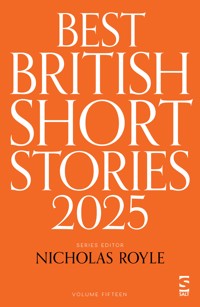
The definitive showcase of the year's finest British short stories 'Bravo to Salt's beacon of delight and intrigue – its annual collection of the UK's best short stories, from established and emerging voices.' —Duncan Minshull Now relaunched for a new era, Best British Short Stories returns with a bold new look and a renewed commitment to celebrating the art of the short story. As we enter our fifteenth volume, this much-loved annual collection continues to be the go-to anthology for readers seeking the most exciting and diverse voices in contemporary British fiction. Assembled by series editor Nicholas Royle, Best British Short Stories 2025 presents a stellar selection of stories first published in 2024, drawn from magazines, journals, anthologies, collections, chapbooks, and online. Whether you're a devoted follower or discovering the series for the first time, this new edition reaffirms our mission to champion storytelling in all its forms. 'If the latest iteration of Salt's Best British Short Stories collection is anything to go by then the genre remains in safe hands.' —Lawrence Foley, TLS Featuring stories by: David Bevan, Rose Biggin, Christopher Burns, Ian Critchley, Pippa Goldschmidt, Linden Hibbert, Hannah Hoare, Catrin Kean, Roger Luckhurst, Baret Magarian, Wyl Menmuir, Alison Moore, Okechukwu Nzelu, Simon Okotie, Imogen Reid, C. D. Rose, Iain Sinclair, Elizabeth Stott, Mark Valentine, and Naomi Wood.
Sie lesen das E-Book in den Legimi-Apps auf:
Seitenzahl: 363
Veröffentlichungsjahr: 2025
Das E-Book (TTS) können Sie hören im Abo „Legimi Premium” in Legimi-Apps auf:
Ähnliche



















i
Contents
v
vi
To the memory of Robert Coover (1932–2024)
vii
viii
NICHOLAS ROYLE
Introduction
This is the fifteenth volume of Best British Short Stories. To mark the occasion, here are fifteen lists that pertain, in one way or another, to the short story.
Fifteen UK publishers that aren’t afraid of short stories
British Library Publishing
CB editions
Comma Press
Confingo Publishing
Dead Ink Books
Faber & Faber
Fitzcarraldo Editions
Fly on the Wall Press
Galley Beggar Press
Influx Press
Jacaranda Books
Nightjar Press
Peepal Tree Press
Salt Publishing
Scratch Books
Fourteen UK print literary magazines that publish short stories
Confingo
Extra Teeth
Granta
Gutter
Lighthouse
London Magazine
New Welsh Review
Open Pen
Remains
Seaside Gothic
Shooter
Stand
Tears in the Fence
Wasafirix
Thirteen writers best known for their short fiction
Robert Aickman
Jorge Luis Borges
Ray Bradbury
Raymond Carver
Julio Cortazar
Roald Dahl
Lydia Davis
Shirley Jackson
Franz Kafka
Katherine Mansfield
Alice Munro
Edgar Allan Poe
Saki
Twelve individuals who do a great deal to support the short story in the UK (with apologies to those people whose names will come to me only when it’s too late)
Jess Chandler, publisher Prototype Publishing
Ailsa Cox, founder Edge Hill Prize
Jonny Davidson, production editor British Library
David Gaffney, author, deviser short fiction projects
Cathy Galvin, founder Word Factory
Jonathan Gibbs, author, creator A Personal Anthology
Dominic Jaeckle, author, publisher
Johnny Mains, anthologist, author, genre researcher
Alberto Manguel, author, critic, anthologist
Chris Power, short story writer, critic, broadcaster
Amanda Saint, founder Retreat West
Tony White, author, founder Piece of Paper Press
Eleven great films based on short stories
Don’t Look Now
Rear Window Blow-up
2001: A Space Odyssey
The Loneliness of the Long-Distance Runner
They Live
The Swimmerxi
The Birds
Minority Report
Total Recall
Memento
Ten short story collections published by Picador, 1972–1999
Alan Beard, Taking Doreen Out of the Sky
Jorge Luis Borges, The Aleph and Other Stories 1933–1969
Rebecca Brown, The Terrible Girls
Robert Coover, Pricksongs & Descants
MJ Fitzgerald, Ropedancer
Ellen Gilchrist, In the Land of Dreamy Dreams
Jamaica Kincaid, At the Bottom of the River
Ian McEwan, First Love, Last Rites
Bridget O’Connor, Here Comes John
Bruno Schulz, The Street of Crocodiles
Nine short story anthologies published by Picador 1972–2001 with the caveat that some of these include novel extracts
Dermot Bolger, The Picador Book of Contemporary Irish Fiction
Amit Chaudhuri, The Picador Book of Modern Indian Literature
Carolyn Choa & David Su Li-qun, The Picador Book of Contemporary Chinese Fiction
Clifton Fadiman, The World of the Short Story
Frederick R Karl & Leo Hamalian, The Naked i
Patrick McGrath & Bradford Morrow, The New Gothic
Peter Kravitz, The Picador Book of Contemporary Scottish Fiction
George Lamming, Cannon Shot and Glass Beads
Alberto Manguel, Black Waterxii
Eight random notes
Hats off to Extra Teeth, the only UK literary magazine, possibly the only literary magazine anywhere, to employ a vibe consultant. In fact, Nyla Ahmad is described on the Extra Teeth website as both ‘vibe consultant’ and ‘vibes consultant’. So, which is correct? I asked the question. On social media, the response came back: ‘Both are correct! Vibes is used when consulting on the multiple different vibes of a person, place or thing, whereas vibe relates to the general overall impression.’ I’m now wondering if Best British Short Stories needs a vibe – or vibes – consultant and, if so, who it should be.Since the publication of Best British Short Stories 2024, three readers have contacted me, to say they liked my story reprinted in that volume. I explained to them that I was not the author of ‘Strangers Meet We When’ by Nicholas Royle, taken from David Bowie, Enid Blyton and the Sun Machine, by Nicholas Royle; that it was the work of the author I call the other Nicholas Royle; that he and I are two different authors; that he even suggested adding a note to his biographical note explaining all of this, but I decided against it, perhaps unwisely. What could or should I have done differently so that readers would not think that I had committed the ultimate act of vanity and narcissism, as an editor, by selecting a story of my own to be included in a book with the word ‘best’ in its title? Should I have included that explanatory line in Royle’s biog note? Does anyone read biog notes? My thinking was that anyone who thought I had included a story of my own had only to read Royle-the-author’s biog note and Royle-the-editor’s biog note and they would see that these were two different writers. This was naïve of me and so I decided to write about the issue in this introduction for the record. What, then, should an editor xiiido? I felt that his story deserved to be picked. Should I have not picked it, simply because we write under the same name? Should the Writers Guild or the Society of Authors have a rule stipulating that there may not be two authors with the same name, that the newcomer should come up with a new name, as Equity demands of actors? Royle published his first book – Telepathy and Literature: Essays on the Reading Mind (1990) – before I published either the first anthology I edited, Darklands (1991), or my first novel, Counterparts (1993). How would I have reacted had I been obliged to come up with a different name? I would not have been pleased. And now that I think about it, I had been publishing short stories, in magazines and anthologies, under what I regarded as my own name, since 1984, some of which I forwarded, precociously, to Giles Gordon in the hope that he and David Hughes might select one of them for their series, Best Short Stories, which they never did. Indeed, as I have written in one of these introductions before, so I’m sorry to repeat myself, but it is a story told at my own expense, Gordon eventually wrote to ask me, in the gentlest, politest, but still quite a direct way, to desist. ‘In truth your stories just don’t appeal sufficiently to us,’ he wrote. ‘They are certainly most competent but they don’t, for us, sing out with the necessary individuality and voice. I’d suggest that in future we contact you if we see a story of yours which appeals rather than your going to the trouble of sending stories to us.’ My name did appear in the introduction to Best Short Stories 1992, when the editors acknowledged Darklands, from which they reprinted Stephen Gallagher’s ‘The Visitors’ Book’. Gordon and Hughes wrote, ‘Above all we congratulate Nicholas Royle, himself a prolific short-story writer, for editing and publishing the first of what he intends as a regular visitor to the scene, based on his belief that good writers of horror were missing out. We xivmight easily, had space allowed, have fallen for more of his choices than Stephen Gallagher’s restrained treat of a ghost story.’ My stories since have been reprinted in anthologies containing the word ‘best’ in their title, but they were selected by the editors of those series (Karl Edward Wagner, Stephen Jones, Ellen Datlow and others), not by me. I do know of one editor of an anthology that, while it may not have included the word ‘best’ in its title, did have a cover line describing its featured authors as ‘literary legends’, who included one of his own stories, but generally it’s considered just not done.I can’t claim to read every new story published or broadcast by every British writer, but I read as many as I can. While it was still going, Ambit provided me with a complimentary subscription so that I could keep track of all the stories they were publishing. Extra Teeth and Confingo have done the same. Occasionally a publisher will send a new anthology or collection. Sometimes I request a book. Some authors send me their own stories, as I used to send mine to Giles Gordon and David Hughes. Sometimes I’ve picked one of those or, if they’ve sent me, say, the anthology in which their story appeared, I’ve ended up picking up a different story by a different author from the same anthology, and I can only imagine the look on their face when they discover that’s what I’ve done. Think of someone sucking on a lemon. I don’t necessarily privilege new writers over established writers, but if it came down to a straight fight between new author A and established author Z, and I genuinely thought each story as good as the other, I’d probably go for new author A. Or forgotten author B. Over established author Z, who doesn’t need the exposure and more than likely will insist that all communications go through their agent.xvI sometimes wonder if there might be some readers who think I include too many stories by writers they have not heard of and too few stories by big names. In addition to the big names I have included, I could add, here, some other big names I have tried to include, but who for one reason or another either never replied or did reply, or had others reply on their behalf, and said no. Or asked for £900. Which is the same as saying no.I think a lot of people feel that the words ‘anthology’ and ‘collection’ are interchangeable. For clarity, I reserve ‘anthology’ for a book containing stories by different authors and ‘collection’ for a single-author volume. I’m not alone in this, but it’s not like it’s a rule or anything.I believe it’s good practice, if you are editing an anthology, to acknowledge where a story was first published, rather than where you happened to come across it, if you saw it in a later work.I also think it’s good practice, when assembling your own stories for a collection, to acknowledge where each story first appeared or was broadcast.I have sometimes picked stories that were published in the first instance by me. I don’t do this in order to publicise my own publishing efforts, but because I believe those stories are among the best and don’t deserve to be overlooked simply because they were published by me – or by Nightjar Press, in most cases. It is true, of course, that I see everything that Nightjar publishes, whereas I don’t see everything that Cape or Faber or Penguin publish. I would be delighted if more writers encouraged their publishers to send me any anthologies or collections containing new work by British writers. It is not difficult to get in touch with me via social media or via Salt Publishing.xviSeven much-missed literary magazines
Adam
Ambit
Antaeus
Hotel
Panurge
Transatlantic Review
Warwick Review
Six great double acts in the world of the short story
Livi Michael & Sonya Moor – Small Pleasures podcast
Giles Gordon & David Hughes – Best Short Stories 1986–1995
Stephen Jones & David Sutton – Dark Voices, Dark Terrors etc
Ailsa Cox & Elizabeth Baines – Metropolitan magazine
Robert Aickman & Elizabeth Jane Howard – We Are For the Dark
Mark Valentine & John Howard – Secret Europe etc
Five short stories with the title, ‘Snow’
Ted Hughes, Wodwo
James Lasdun, The Silver Age
Jayne Anne Phillips, Black Tickets
Miles Tripp, More Tales of Unease
Marc Werner, Murmurations
Four random examples of disrespect towards the short story
Reviewing Rupert Everett’s short story collection The American No (Abacus) in the Sunday Times, Hadley Freeman wrote: ‘… his new book, The American No, which is described in the press release, rather untemptingly, as a short story collection.’Included in the blurb on the back of Cees Nooteboom’s short story collection The Foxes Come at Night (MacLehose Press): ‘Set in the cities and islands of the Mediterranean, the eight stories in The Foxes Come at Night read more like a novel, a meditation on memory, life and death.’Standfirst to Observer review by Lucy Scholes of Saba Sams’ novel Gunk (Bloomsbury): ‘Saba Sams, one of Granta’s best xviiyoung novelists, paints a complex picture of motherhood in her first full-length book.’ Saba Sams’ first book, as the review points out, was her short story collection, Send Nudes, but according to the standfirst, which would normally be written by a sub-editor, if they still employ subs at the new Tortoise-owned Observer, that was not a full-length book. Send Nudes is 210 pages long.Jamaica Kincaid’s first book, published in the US in 1983 and in the UK by Picador in 1984, was At the Bottom of the River. Barely eighty pages, it is a wonderful collection, but you wouldn’t know that if you picked up the latest edition reissued in Picador Collection. The front cover has the title, the author’s name and the publisher’s logo, and a detail from a painting by Hughie Lee-Smith. On the back cover Derek Walcott’s warm endorsement is followed by a blurb that mentions ‘pieces’ and ‘works’, but the dreaded words ‘short stories’ do not appear anywhere on the cover.Three publications that occasionally publish short stories
Guardian
New Statesman
Prospect
Two books that are either novels or short story collections depending on who you talk to
Samuel Beckett, More Pricks Than Kicks
Claire-Louise Bennett, Pond
One brilliant idea
Every Friday morning I look forward to the email due to arrive that afternoon with the latest addition to Jonathan Gibbs’s ingenious online project, A Personal Anthology. Writers and readers imagine themselves in a world in which they have at their finger tips all the xviiishort stories that have ever been published and they are free to select whatever they want to create their Personal Anthology. They ‘dreamedit’ it, in Gibbs’s words, and then tell us what they have chosen and write a few lines about each story. There are no copyright issues, because there are no stories (although, if they’re available online, Gibbs links to them), just these pithy paragraphs about the stories they’ve chosen. But – and for me it’s a big but and getting bigger – some contributors’ interpretations of what is a short story are broader than the spine width on JG Ballard’s The Complete Short Stories (Flamingo – so broad the paperback edition was split between two volumes). Gibbs, for whom I have the greatest respect and admiration, not only allows such flouting of the rules, he seems actively to encourage it. Indeed, it would seem, there are no rules. (You know where you are with rules.) A recent selection, posted while I was concocting this introduction, included an essay, a novella, a novel, and a song. What next? An encyclopaedia? A sandwich? An ironing board? This minor gripe aside, A Personal Anthology – sustainable, infinite, inspiring – remains one of the most exciting and positive additions in recent years to what Clifton Fadiman called ‘the world of the short story’, but it takes its name from another book published by Picador – Jorge Luis Borges’s A Personal Anthology, which of course was a collection rather than an anthology, but let’s not get into that. Gibbs launched his A Personal Anthology in 2017 and from time to time it has gone on a break, but I always worry when it does, in case, like a favourite bar closing down, it doesn’t come back. I always think favourite bars, favourite cafés, favourite second-hand bookshops, shouldn’t be allowed to close down. Similarly, if Gibbs ever threatens to pull down the shutters permanently, he must be talked out of it. If you don’t know A Personal Anthology, sign up now at apersonalanthology.com.
Nicholas Royle
Manchester, May 2025
CD ROSE
I’m in Love With a German Film Star
The Passions – ‘I’m in Love With a German Film Star’ (Polydor 7”, 1981)
Four slow notes of shiver, blush, echoplex, and delay, then a tiny cascade, a shimmer, and a drop. A perfectly distracted rhythm section. A cold glow of voice. Not the first record I ever bought, but the first time I ever heard music.
It hadn’t been a glamorous world, but now it was.
The Cure – ‘All Cats Are Grey’ (from Faith, Fiction, 1981)
I lay on the threadbare carpet in my room and watched the lights from passing cars throw abstract movies across the walls. I’d put this on and the room became a cathedral of shadow and smoke. It’s the last track on side one and the tone arm on my record player didn’t work properly so the music faded into the hiss and scratch of the runout groove. Even then, I knew that somewhere out there, Magda was listening to this, too.
La Düsseldorf – ‘Silver Cloud’ (Teldec 7", 1976)
I wouldn’t hear this until much later, but when I did I knew that Magda had spent the long summer of 1976 dancing to it with a boy called Andreas or Jürgen or Max who was not worthy of her.2
Bernthøler – ‘My Suitor’ (Blanco Y Negro 7", 1984)
A video shop had opened between the chippy and the florist and as if by accident or magic they had a small section of the titles I only ever saw namechecked in the NME or showing at the Aaben in Hulme. The owner didn’t seem to know what certificate they were and didn’t blink when I checked out Herzen und Knochen. It isn’t her best film, but it was enough.
Magda’s luminous face appears fifteen minutes in. Her first word – zwischen – is a mere preposition that becomes a jouissant epiphany as she says it. All my future lay in those five phonemes.
John Peel played this record around the same time, but I couldn’t get hold of it until it received a UK release nearly a year later. For some reason I became convinced that Magda was the singer, even though I knew it wasn’t her. I could hear her, I thought, singing to me through it. The last scene of the film would have been so much better had this been its soundtrack.
The Durutti Column – ‘Sketch For Dawn (II)’ (from LC, Factory, 1982)
An example of how music can go beyond evocation to become the thing itself. The bass is a long narrow avenue somewhere in Europe, the piano the high windows of a slightly shabby late-nineteenth-century apartment building, its echo the footsteps in their stairwells. There are trees, it is late summer or early autumn. The guitar is the touch of mist in the air.
Vini Reilly (who is the Durutti Column) recorded this in a damp flat in Chorlton, but several years later I would find myself buying then living in the place he had brought into being in this song, on the street that had been one of the principal locations for Die Flammende Haut. Reilly mutters the song’s few words, but there’s something in there about a late night or early morning cigarette burning dreams away, and I’m not sure if it was this line or 3the way Magda held a cigarette in Herzen und Knochen that made me take up smoking. I blame neither of them for it.
Associates – ‘White Car in Germany’ (Situation Two 12", 1981)
I’m listing the twelve-inch here, but it is also track one side one of the duo’s Fourth Drawer Down LP, which I listened to obsessively on a Walkman throughout 1982 as I took the bus to school, already seeing myself on the open autobahn, speeding past cities, through forests, and over bridges in a vintage Porsche 911 convertible, a scene that would form the title sequence of Tränen sind im Regen unsichtbar, Magda’s only venture into romantic comedy, and still much underappreciated.
Wim Mertens – ‘Struggle For Pleasure’ (Ariola/Les Disques du Crépuscule 12", 1983)
It’s been used everywhere (phone adverts, a Peter Greenaway film, some godawful Café del Mar chill-out compilation) and at first I thought I’d leave it out, but I’m certain I remember hearing it over the tannoy in Brussel-Zuid, or perhaps it was Köln Hauptbahnhof, or maybe Amsterdam Centraal, that first time I boarded a train to the Continent. On one long leg of the journey I met a girl called Claudia, who was interested in me because I was pretending to read Kafka, and who I was interested in because I told myself she looked like Magda. She fell asleep on my shoulder and woke up when we got to Hannover, or Hamburg, or somewhere, then got off, leaving me her name and address written on a slip of paper that I put between the leaves of the Penguin Modern Classic and forgot about, until now, when I listen to this piece of music again.
Robert Görl – ‘Mit Dir’ (Mute 12", 1983)
Find the video for this and at three minutes forty seconds in, watch very carefully to see Magda appear as one of the faces in the slowly 4dancing crowd. The camera closes in on her and then, as if almost afraid of so much beauty, rapidly cuts away.
Grauzone – ‘Eisbär’ (Emi Electrola 7", 1981)
In a small feature in Kino magazine (Sept ’83), Magda lists this as one of her favourite records.
Clock DVA – ‘Four Hours’ (Fetish 7", 1981)
Many years later I got a rare chance to see Mein Herz ist eine Bombe, mein Kopf ist ein Gedicht while sitting on an upturned beer crate in a Kreuzberg basement. An experimental short made while Magda was still a drama student, it’s not part of her official filmography (as much as one exists at all), but essential viewing for anyone seriously interested.
As the Super 8 projector spooled and whirred and the image on the screen flickered, I knew that the director of the film and Magda had been fucking while listening to this record.
Neu – ‘Seeland’ (from Neu 75, United Artists, 1975)
This is the music in the closing scenes of Die Flammende Haut, where we see Magda walking for hours through the deserted city, alone, as dawn slowly breaks and she eventually reaches the sea. I knew the song long before I got to see the film and when I saw it, it felt like a homecoming. There is no more poignant scene in the history of cinema.
The film is currently unavailable on streaming, DVD, or even VHS, so I have instead played my copy of the record so often I can no longer tell where the rain effect ends and the surface noise of the worn vinyl begins.
David Bowie – ‘Helden’ (RCA 7", 1977)
Via the address of the production company listed at the end of Haut, I wrote to Magda asking what this song meant to her, or 5even – I hoped! – if she would record herself singing it. I never received a reply, and suspect that this is because while Bowie himself remained tight-lipped on the subject, the two must have run into each other during his time in Berlin. There is one line in the song which can only refer to Magda. His decision to record this version of his most bleakly yearning and melancholically ecstatic song auf Deutsch was surely an indirect message to her.
Blondie – ‘Atomic’ (Chrysalis 7", 1980)
Silbernes Feuer, Magda’s last film, was famously troubled. On-set tensions, three directors, and a production company going bust meant it was never properly finished, and despite the existence of several dubious ‘final’ cuts it has never received an official release. This song was supposed to accompany the climactic scene in which Magda leads revellers from a nightclub onto the streets of a collapsing city, but licensing issues rendered it unavailable. It was replaced with a cover version by legendary DDR punk band Zwitschermaschine, which I have sadly been unable to track down.
Tonnetz – ‘Magda’ (Chain Reaction 12", 1997)
All glitch and sparkle, this immersive piece of low-slung minimal techno I found via a recommendation on a discussion board dedicated to German cinema. The site told me many things: that she had married four times; that she was living in Los Angeles and working on a new film; that she had undergone extensive cosmetic surgery in order never to be recognised again; that she still loved clubbing; that she had been a Stasi agent; that ‘Magda’ was only ever a pseudonym used to cover her real identity; that she had made several other films that had gone straight to streaming; that she was living in Prestwich; that she had never really existed at all. I knew that most of these theories were nonsense.6
Alva Noto – ‘A Forest’ (Noton DL, 2020)
The famous Cure song stripped to vapour traces, murmurs, and distant sighs. This was playing out in Berghain when I saw her again. Despite the darkness I recognised her immediately but did not approach as I had been taking some very strong painkillers while recovering from the high-speed accident that had written off the Porsche. She was dancing, of course, incredibly slowly, alone, and unselfconscious. I wanted to leave her that way.
This is the only Magda song that I do not possess as an object (its only physical form is an extremely expensive limited edition etched disc that I can no longer afford), and I rue this absence, as I fear my memories and dreams will vanish as quickly as a single spoken word or the vision of a face on a screen if I cannot touch them.
LINDEN HIBBERT
Torsos
The police were called to the scene at the museum. The message was simple: a foot had been found. The note was passed to an inspector at his desk, who took pleasure in reading these five words aloud to himself. The case had pleasing potential, he thought, rising to fetch his coat.
Arriving at the museum the inspector was ushered around to the side entrance of the building. Inside, he found the curator waiting for him beside an audio point, signalled by a large graphic of an ear.
He knew nothing of curators; she was the first of her kind he had met, and he suspected the situation was mutual. He sniffed at her, expecting the earthy scent of a digger but she gave off a peculiar hint of rare elements and death. Startled, he reminded himself to assume nothing. He was here to ask questions, and yet there was a great deal that even an inspector could not ask.
Withdrawing his notebook from his top pocket, he turned to a blank page and licked his pencil, fighting the compulsion to sniff its new-sharpened point. He began.
It was you who reported the incident?
She nodded.
And discovered it also?
She hesitated.
You can nod.
She nodded.8
His pencil awaited an elaboration, but when none was forthcoming, he offered her a way in.
A foot, I believe?
She nodded again, her expression distressed. He could hear her pulse quickening over what he could only assume was the sound of a clock ticking, which of course was impossible.
Perhaps I could see for myself?
Of course.
The whole conversation possessed an underlying tension. It was some moments yet before the inspector understood that some of that tension was arising from him. As he put it to himself later, he felt on the other side of things here, in this place of former worlds. Closing the notepad, he nodded at her rather formally, and suggested she lead the way. She walked ahead of him, noiselessly, he noted. His own shoes squeaked against the tiles, and his breathing was magnified by the otherwise total lack of sound, which he experienced as pressure against his eardrums. The light everywhere was constant and brilliant. The walls and floor a strangely indescribable neutral colour that was yet dazzling. The curator finally paused at an area that had been roped off and used the iris scanner to open the doors. He followed her into the first of a series of interconnected galleries. As he entered, he inhaled deeply. Ah, he thought to himself, thisis the scent of antiquity!
The smells that greeted him were complex and overwhelming. His nose reddened and his eyes watered. Withdrawing his standard issue cambric handkerchief, he started swabbing. The scent was strongest, he observed, in the centre of all this whiteness. He followed it to its source. Something human appeared to be suspended in air.
Is that—
He moved closer. Three torsos were apparently levitating in the centre of the room, though he very quickly spotted the near invisible wires on which they were suspended.9
As a professional man who made every effort not to express shock at crime scenes, nevertheless, he understood that shock was the desired response, indeed the very intention of the exhibition’s design. The curator seemed content with him until he withdrew his notebook again and waved the pencil at her unspoken criticism. Police protocol, he assured her. It’s perfectly safe. She looked unconvinced. No hacking this way either, he added. She stared back at him.
Trying to put the awkwardness of the moment behind him, he set to work jotting down all that he saw and smelled and heard. He was particularly partial to sketching evidence. It made him notice things he might otherwise overlook. There were three suspended torsos and one lying on its back on the pure white floor. The wires and rig that had held it suspended from the ceiling were neatly folded in a pile.
His sketch carefully noted differences among the three hanging torsos and, despite the damage, the fourth on the ground. The furthest left torso, he noticed as he captured it with his pencil, and the most complete of the four, was the torso of a man, from chin and neck down to the right hip, the left side being slightly truncated at both ends. He had the remains of both shoulders, but nothing beyond the deltoid. He might, once, have been carrying something, for the finely wrought muscles of his chest and belly seemed tighter on one side, and the other side subtly elongated. The torsos to the right down to the one on the floor were each slightly less complete, the first having only one shoulder, the third beginning at the pectoral muscles and ending at the belly. Still, the inspector noted, it was possible for him to know the whole from the fragment. The only individual sense from one to the other was the potential attitude each might have held. That was the only aspect requiring a degree of conjecture.
Lastly, he started to note the damage to the torso lying on the floor. Sketching also avoided the use of language, he noted, words 10like damage or the word wound, which was hovering in his head. Images simply showed evidence without implying opinion, which was, in his position, far safer ground. All the time he was sketching the curator continued observing him, as though he were somehow under suspicion rather than the other way round. What stuck him when he came to stand over the torso very carefully, so as not to affect the spatter pattern on the ground around it, was the shape of the mutilation of the belly. The damage appeared to be blunt force trauma from below, and from the side, such as the prison stompings he had seen early in his career. He squatted down and craned his neck to see as low as he could. Certainly, some damage had been inflicted from below in an upwards motion, like an upper cut or a kick. There was no damage from dropping it all the way from suspension to the floor, that kind of impact on the diaphragm area would be notably different. He turned his attention to the spatter evidence from the different blows. The material was quite well distributed across the floor, a fine dust. Licking the tip of one finger he pressed it into the dust and tasted it. He heard the curator’s shudder of disgust.
Mmmm, he said aloud. Interesting.
It was more than interesting. For his palette possessed a capacity for history that his brain lacked, recognising the musk of long dead beasts, the barest hint of the east wind, the rains that had scoured the land when this torso was first created; he felt the hum of half-life from a hint of granite, tasted lime, calcium, potassium, and underlying carbon.
Still squatted down amid the spatter of dust, he gestured to the torsos. Tell me about them.
The curator, who had drifted away slightly, turned back to him. What would you like to know?
The way she said it was quite clearly a rebuttal and at odds from the words of her arrival when she had still been in shock. Then he had felt her silence as an inability to find the words. Now she was 11digging in her heels and resisting, which could slow things down. He cleared his throat.
For example, are they copies or originals?
Her eyebrows rose and fell in what appeared to him to be genuine shock at his ignorance. Then she said, I can’t believe you really have to ask? I thought they had sent me an inspector. No museum of our calibre would display copies.
Over the spiral spine of his notebook, he noted her disgust in the margin as an observation, nothing more. He could get in serious trouble for noting down certain kinds of things, he knew.
He felt he needed to explain in case she made things unpleasant for him later. Someone like her could. A quiet word, no more, and his career would be over.
The thing is, he began and then stopped himself. The planets, the stratosphere felt closer to him than history. This whole conversation made him feel like he was floating, unmoored. It wasn’t as if this kind of thing had been taught at his school. Not history this ancient anyway. He’d learned exactly what he needed to know and nothing more. His sense of a period beyond his own lifetime was hazy.
So, originals? He felt the need to be explicit.
Yes!
Rare?
Priceless.
This was not entirely what he had meant but he recorded the comment anyway. He had the strange sensation that the more he asked the further away from the details of the crime he was travelling.
He sketched out the spatter pattern and scribbled notes about scent and texture and colour in the margin. He had by now a shorthand which he had to practise regularly since crimes of any sort were so rare these days. He took his time, though she started to pace and circle around him. He felt her agitation was merely 12fuelled by a discomfort of his craft. He possessed the ability to smell and taste her loneliness, which her agitated state only seemed to heighten, and what he smelled and tasted of her brought out his compassion for her hard edges: how difficult it must be to possess all this knowledge that no one can share.
They are so fine, he mused, so beautiful, he continued, staring down at the damaged torso.
Is that a rhetorical question?
What? No. I was just thinking.
She consulted a small display near her wrist.
You don’t need to stay here, if you have something pressing, he said. I can find you if I have any other questions.
This really isn’t somewhere you can just wander around.
Her words hurt him and as a result the hurt cut free a question that he had been pondering but knew better than to ask.
How did they get here anyway?
She restarted pacing again in a rather stressful manner.
Everything is documented, she said, and all documentation is in order, if that is what you are suggesting.
He frowned. He felt he was stumbling around mines not knowing which might erupt in his face. I just meant, he began, if they are so rare, so very old, how long they have been here? What has been done to preserve them?
She tapped her finger against her hand, as though she were counting down to one in her head to calm herself.
We’ve had them since their rediscovery. They were removed here for their protection and held here ever since.
Removed from where?
You know I cannot tell you.
He was meant to look away at this point, to act subservient. That was the drill with these types. They didn’t like being required to explain themselves to people like him. They resented it. Before he could say anything aloud, she was talking again in a curt 13voice, as though he were the one who needed reminding of the law.
It is for me to know what is and isn’t relevant, she said. What youshould be considering, the question you should concern yourself with, is the crime itself.
Which is?
Category violation.
He stood up too quickly feeling pins and needles in his legs from having been squatted down taking evidence for so long. Aware of her power over him, he dropped his head to his chest as though in apology, and took a step back, stumbling backwards over something unseen. Winded at first, he spun himself round by the arms to see what he had tripped over and found the foot!
Of course, he said aloud, for he had forgotten all about it.
It was almost the same colour as the interior of the museum. It would have been difficult if not almost impossible to detect from a distance. There was something lonely-looking and vulnerable about it lying there on its side which tugged on his heart. He estimated it was about three times the scale and size of the torsos, which were life-sized, and although, when he first saw it, he had been certain it was lying lying down, now, as he sketched it, it stood upright, the flat of its sole pressed to the floor. Getting back onto his feet he circled it. It had the air of something quivering with the effort of staying still, about to take flight. Such a fine ankle, showing just a hint of shin and calf. The foot was balanced perfectly on a sinewy arch, its toes splayed, as though it had never known the restriction of boots. It was the most beautiful foot he had ever seen. He fought an urge to lift his trouser leg, remove his shoe and sock and regard his own foot.
He came and stood behind the heel and looked in the direction in which its toes were pointing.
Hmm, he said, following the direction of the centre metatarsal with difficulty because of the flat colour of the walls into which it 14merged. Over there, he said firmly. It’s pointed over there. Where does that direction lead?
Though he didn’t expect an answer, the curator wearily walked in the direction he had indicated. As she neared the wall, he saw something.
Is that a door? he asked, excitedly, pointing beyond her as the curator leaned towards a scanner to get the door. The inspector hurried over. The door silently opened.
Where does it go?
Gallery four, she explained. She held the door for him.
Gallery four?
Legs.
Legs. He smiled but she did not. Well, worth a look, I should think.
He hurried into the room in case the doors suddenly shut him out, and yet for all this rushing and excitement to explore the museum, he felt part of him remained in the first gallery beside the foot. It was a curious thing how much it moved him. Without intending to he had slowed down and now lagged some distance behind the curator. Doubtless he would lag still further as there was so much to take in, so many pairs of legs – hundreds and hundreds – in cabinets lining the walls of this narrow space, floor to ceiling. Most were behind glass though not all. He couldn’t grasp the basis on which some were protected while others were not. A small number were evidently still in pairs, but many more were lined by their original side of the pairing, with left legs on one side and the right on the other.
Legs seem more common than torsos, he called after the curator.
He walked slowly, observing the similarity of display here with that of the torsos, each ranked in order of completeness, starting, where he had first entered this gallery nearest the torso exhibition, with legs that were in a few cases whole, or in larger parts, preserved, with less visible joins. All stood upright. Progressing 15down the room, they shortened and there were visible differences in quality, but the presiding factor remained height. About mid-way he reached the legs cut off at the knee, and beyond that they were fragments of kneecap, and then fragments of what he took to be shins.
How he wished he could just linger, take it all in. He made a note to himself to return, but it seemed their intended destination was in yet another, more distant gallery. The curator had long since exited and so he was forced to continue. When at last he spied the curator waiting for him, he asked, Is this how they wantto be catalogued?
She scissored her jaws looking annoyed.
Again, you are missing the point, inspector. We curate. That does not mean we consult. That is not how curation works. They are grouped by their aesthetic significance, their contribution to aesthetics.
And who decides that?
He regretted the question. It was the foot, he realised, it had made him a little daring.
Do you really want to be thrown off this case?
You could explain, couldn’t you, but you won’t.
You don’t need to know!
It was odd because one of the central tenets of the police corps was that all policemen were the same. That rank did not duly matter. Rank was more connected with age and pension criteria. Long service. Lose a policeman and he can always be replaced. One is the same as the other. He muttered something along those lines and the curator, hearing him, finally made a sound of approval.
Exactly.
A head is a head, he said, quoting without remembering where he had read it. A leg is a leg.
At last she seemed to be pleased with him. For someone like you, inspector, she concurred, A head isa head, a leg is a leg. But heads 16are not legs. Not the same value, you understand. As you see we have many legs but, alas, scant few heads.




