


29,99 €
Mehr erfahren.
- Herausgeber: John Wiley & Sons
- Kategorie: Fachliteratur
- Sprache: Englisch
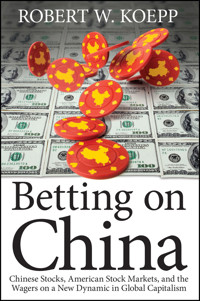
The promise and perils of Chinese stocks in American stock markets Betting on China takes readers on an illuminating journey into the often confusing and poorly understood world of Chinese stock issuances in America. With insightful qualitative and quantitative analysis, it looks at the phenomenon of equity and capital exchanged between the world's two largest economies and the implications for global finance. Written in an accessible narrative style and amply supported by hard data, the book examines the context and underpinnings of the Sino-American equity relationship, revealing its core dynamics through real-world case studies that range from the precedent-setting blockbuster IPO of China Mobile to the near breakdown of the U.S.-China equity exchange mechanism brought about by short seller attacks on Chinese concept stocks. Combining an insider's eye with an outsider's objectivity, American born author and Beijing-based consultant Robert Koepp explores the reasons and the means by which China, America, and the global economy reap enormous gains from the process of Chinese companies issuing equity shares on U.S. stock markets. Betting on China exposes the complexities and nuances of a vital but underappreciated pillar of modern international finance and offers a window into China's role as a dominant but still modernizing economic superpower. * Analyzes on a macro- and microscale the forces that move Chinese companies to raise capital on NASDAQ and the New York Stock Exchange and what this means for the world at large * Explores the real stories behind why and how China-based enterprises develop as public companies listed in the United States--and why government regulations need to work in support of and not against this force of market nature * Shows that the "betting" on China that occurs through the U.S. equity market exchanges is critical for getting an accurate picture of China's position and prospects in our interactively connected global economy Detailed but accessible, Betting on China is essential reading for global finance professionals, policymakers and regulators, students of finance, people doing business in China, and anyone curious about China's place in--and impact on--the global economy today and in the years to come.
Sie lesen das E-Book in den Legimi-Apps auf:
Seitenzahl: 332
Veröffentlichungsjahr: 2012
Ähnliche



















Contents
Acknowledgments
Preface
Chapter 1: Wagers of the Dance
A Hierarchy of Financial Footwork
IPOs for Cash-out and Cash-in
A Ground-Level View
U.S. China Issuances Measuring Up
Chapter 2: Realities, Theories, and Gung Ho
The China Wave
Big-Stakes Games
Ying–Yang IPOs
Market Détente
Breaking Molds
Adam Smith’s China Bet
Gains, Rules, and Risks
Information versus Noise
Real “Gung Ho”
Chapter 3: China Mobile
First Dish in an IPO Banquet
Birth in a Maelstrom
Ripple Effects
Assimilating Global Standards
Of Men and Governance
Red Chip Scare
Spillover Effects
Quantity, Banditry, and Quality
New Generations, New Markets
Nothing and Everything
Chapter 4: Spreadtrum Communications
Stirring the Waters
The Basic Spreadtrum Story
Leading a New Chinese Industry
Pulling Back from the Brink
Shortsighted Shorting
Shorts Caught Short
Chapter 5: Calling the Bluff
Initial Misgivings
In Through the Back Door
Dawn of the CRM Dread
A Short Love Affair for CRMs
Unaccountable Accounting
The Din of CRM Noise
A Reversal for RM Overhype
Chapter 6: Longtop Financial
The Longtop Shocker
A Fallen Icon
Deception’s Depths
A China Problem?
New Stakes in the Game
The SEC’s Big Bet
Upping the Ante
Beyond the Brink?
Chapter 7: Continuing the Bet
Evolving Accountability
The Adaptability Challenge
Appendix
About the Author
Index
Copyright © 2012 John Wiley & Sons Singapore Pte. Ltd.
Published in 2012 by John Wiley & Sons Singapore Pte. Ltd. 1 Fusionopolis Walk, #07–01, Solaris South Tower, Singapore 138628. All rights reserved.
No part of this publication may be reproduced, stored in a retrieval system, or transmitted in any form or by any means, electronic, mechanical, photocopying, recording, scanning, or otherwise, except as expressly permitted by law, without either the prior written permission of the Publisher, or authorization through payment of the appropriate photocopy fee to the Copyright Clearance Center. Requests for permission should be addressed to the Publisher, John Wiley & Sons Singapore Pte. Ltd., 1 Fusionopolis Walk, #07–01, Solaris South Tower, Singapore 138628, tel: 65–6643–8000, fax: 65–6643–8008, e-mail: [email protected].
This publication is designed to provide accurate and authoritative information in regard to the subject matter covered. It is sold with the understanding that the Publisher is not engaged in rendering professional services. If professional advice or other expert assistance is required, the services of a competent professional person should be sought. Neither the author nor the Publisher is liable for any actions prompted or caused by the information presented in this book. Any views expressed herein are those of the author and do not represent the views of the organizations he works for.
Other Wiley Editorial Offices
John Wiley & Sons, 111 River Street, Hoboken, NJ 07030, USA
John Wiley & Sons, The Atrium, Southern Gate, Chichester, West Sussex, P019 8SQ, United Kingdom
John Wiley & Sons (Canada) Ltd., 5353 Dundas Street West, Suite 400, Toronto, Ontario, M9B 6HB, Canada
John Wiley & Sons Australia Ltd., 42 McDougall Street, Milton, Queensland 4064, Australia
Wiley-VCH, Boschstrasse 12, D-69469 Weinheim, Germany
ISBN 978-1-118-08714-5 (Cloth)
ISBN 978-1-118-08716-9 (ePDF)
ISBN 978-1-118-08715-2 (Mobi)
ISBN 978-1-118-08717-6 (ePub)
To Michelle and Robbie
Acknowledgments
There are many people to thank for their support of my efforts to bring Betting on China to fruition. Sufficiently acknowledging all of them is not feasible, so I hope that all those who have been of help in so many different ways will not mind indulging me to limit recognition here to those who played the most direct roles in the book’s realization.
First, I equally acknowledge (in alphabetical order) Ian Lewis, partner at Mayer Brown JSM in Beijing, and Jerry Wu, the founder and CEO of Draco Natural Products, a San Jose, California–headquartered, Shanghai-based manufacturer of pharmaceutical-grade herbal ingredients. Both Ian and Jerry were instrumental in providing deeply appreciated logistical support for the research and writing of the book. Ian also provided extremely useful comments on the manuscript. Additional facilitation of the research effort was provided by David Kuo, principal at Los Angeles, California–based boutique investment bank NewCap Partners, whose international focus is on the Greater China region.
I am especially grateful to Nick Melchior, senior publishing editor at Wiley, for taking an interest in the book and accepting—in ways that I know repeatedly tried his patience—my frequent changes with content and scheduling. Emilie Herman, senior editorial manager, and Judy Howarth, senior development editor, were instrumental in the formulation of the final product, as was Stefan Skeen, senior production editor.
The unflappable James Barth, senior finance fellow (and a former colleague and mentor) at the Milken Institute, proved once again to be an enlightening and intellectually challenging discussion partner as we reviewed core ideas in the book via long-distance communications and during his occasional visits to Beijing. Jim also provided thoughtful commentary on the written contents that were especially helpful in adding perspective to my thinking on the subjects covered.
A longtime friend and business associate, John Carlson (whose interest in and dedication to constructive U.S.–China dialogue goes back to his days as assistant press secretary to President Richard Nixon and then deputy press secretary to President Gerald Ford), as usual showed himself to be unflinchingly morally supportive of an undertaking like Betting on China. John is literally a gung ho ex–U.S. military Special Forces officer who, while always the consummate gentleman, likewise never hesitated to call me out when he thought my thinking ran astray.
Carrie Wang, the epitome of a multitasking, transcontinental Chinese media entrepreneur who has more affiliations than can be easily mentioned here, was phenomenal in her willingness to listen to my evolving thoughts for the book and to encourage me through to its finalization. She furthermore offered invaluable feedback from her experiences as a been-there, done-that former officer of a NASDAQ-listed Chinese corporation.
Zach Fanders, a young and rising member of Beijing’s expatriate financial community, proved to be a great person for exchanging ideas with in between weight-lifting sets at the health club where we both are members. Zach also helpfully fed back his written thoughts on the disjointed early version of the manuscript I sent him, a body of written work whose condition was about as out of shape as my own body became while I sacrificed gym time for trips to restaurants, cafes, and bars to complete the book.
Special thanks also to Tom DiVivo, managing director and group manager for Asia/Pacific Depositary Receipts in New York at BNY Mellon. Tom was great for suggestions of parts of the manuscript and off-the-record sharing or experiences and perceptions of the inner workings of the American Depository Receipts system.
A great number of others among colleagues, clients, associates, and friends have also contributed less directly to the development of this work. To avoid possible offense at unintentionally leaving anyone out or—considering some of the book’s controversial subject matter—unintentionally leaving anyone in, I do not mention them here by name but thank them nonetheless.
It should go without saying that despite the wonderful, collective support I have received in taking Betting on China from concept to completion, the responsibility for any errors or omissions in the manuscript is mine alone.
Finally, I want to acknowledge my children, Michelle and Robbie, to whom this book is dedicated. Their importance to me is beyond description. They have been constant sources of inspiration. Mentioning as much and dedicating this book to them are but small tokens of my gratitude for them simply being just who they are.
Preface
Getting It and Betting It
China is easily the least understood of the world’s major economies. Given the mystery that perpetually enshrouded the China of older times to the world outside, this is hardly a new phenomenon. But it is one whose implications grow increasingly consequential with each day that the People’s Republic of China (PRC) rises in importance as a modern economic superpower.
Not “getting” China did not matter much for the people beyond its borders during the nearly two millennia in which trade with the lands of the Celestial Empire was conducted by caravans lumbering along the trails of the Silk Road; or when newly industrialized foreign powers could unilaterally dictate terms of commerce with the weakened Chinese states of the late Qing dynasty and warlord-dominated Republican era. After a fiercely independent Communist-led “New China” of the current PRC arose in 1949, its governing ideology pushed the country to recuse itself from international commerce until market-oriented reforms began three decades later.
Since China’s pivotal reopening to the outside in 1979, both it and the world beyond have been dramatically changing. China has gone from avoiding foreign trade to becoming the epicenter of a worldwide, integrated manufacturing system. Along the way, it has emerged as a leader in key global industries such as mobile telecommunications, automobiles, and alternative energy. China’s demand today for and supply of commodities and natural resources moves world prices. An apocryphal story that used to circulate in the World Beyond China (WBC) not so long ago related that if all the people in China jumped at the same time, the Earth would be knocked off its axis. Turned out that the teeming masses of China never needed to jump; they just needed to start producing and consuming enough to genuinely reorient the world in its material economic existence.
In response to this reorientation of our planet’s economy, companies from the WBC have beat a path to China to invest their euros, dollars, and yen in order to hitch a ride on what appears to be the unstoppable steamrollering of China’s economic juggernaut. People from every corner of the WBC flock to Chinese cities for study or employment, or to strike deals in order to maintain competitiveness in a global market system that effectively revolves around the machinations of a country whose modern existence bears truth to the Chinese name for China: “” (), which literally means “the central nation.” This state of affairs has stood out in stark relief throughout the dismal months and years during and after the global financial crisis of 2008–2009, when China’s unhesitating economic expansion hummed along as the only major engine for worldwide economic growth.
Lesen Sie weiter in der vollständigen Ausgabe!
Lesen Sie weiter in der vollständigen Ausgabe!
Lesen Sie weiter in der vollständigen Ausgabe!
Lesen Sie weiter in der vollständigen Ausgabe!
Lesen Sie weiter in der vollständigen Ausgabe!
Lesen Sie weiter in der vollständigen Ausgabe!
Lesen Sie weiter in der vollständigen Ausgabe!
Lesen Sie weiter in der vollständigen Ausgabe!
Lesen Sie weiter in der vollständigen Ausgabe!
Lesen Sie weiter in der vollständigen Ausgabe!




