


20,99 €
Mehr erfahren.
- Herausgeber: John Wiley & Sons
- Kategorie: Geisteswissenschaft
- Sprache: Englisch
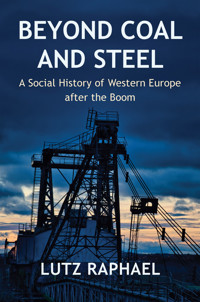
In the 1970s, the economic and social foundations of Western Europe underwent an unprecedented transformation. Old industries like coal and steel disappeared, millions of people lost their jobs and formerly flourishing towns and cities went into decline. Traditional political agendas gave way to new social problems and concerns. What happened to industrial citizens – their workplaces, their careers and their homes? How did social rights and political participation of workers change when markets became global, management lean and financial capital dominant? How did companies change and how were personal skills and work tasks reinvented under the impact of new technologies? How did workers – men and women – live through these decades of uncertainty and upheaval?
Lutz Raphael reconstructs the highly variegated story of deindustrialization in Western Europe with a particular focus on Britain, France and West Germany. Extending over three decades, this transformation was accompanied by significant rises in productivity and consumerism, but it also came at a heavy cost, ushering in many low-income jobs, growing inequality and a crisis of democratic representation. Its legacy is everywhere around us today – it is the transformation that has shaped our world.
Sie lesen das E-Book in den Legimi-Apps auf:
Seitenzahl: 796
Veröffentlichungsjahr: 2023
Ähnliche


















Table of Contents
Cover
Title Page
Copyright Page
List of figures
List of tables
Acknowledgements
Introduction: Perspectives on a history of Western European society after the boom
A history ‘from below’
A history ‘from yesterday’
Reference points for a social history of deindustrialization
A ‘history of society’: the implications of a concept
Methodology: the complications of close-up and bird’s-eye perspectives, the effects of theory and the selection of sources
Notes
PART I A BIRD’S-EYE VIEW
Three national labour regimes in transition
1 Industrial labour in Western Europe after the economic boom from the perspective of political economy
Deindustrialization in Western Europe
The application of new technologies in manufacturing
Monetary stability, industrial subsidies and privatization
The path to financial market capitalism
Workers in times of deindustrialization
The cumulative dynamics of economic structural change
Notes
2 Farewell to class struggle and fixed social structures
Upheavals – a knowledge history
Neoliberal discourses of crisis and interpretations of trends
Three national perspectives on democratic class conflict
Social classification in official statistics
New boundaries
New political languages of mobilization
Radical changes in the cultural representation of the world of industrial work
Lack of voice and lack of visibility: society’s blurred perceptions of industrial realities
Notes
3 Political history from below: labour conflict and new social movements
Social protests and labour conflicts: the frameworks and conditions specific to each nation
Militancy and new social movements (1968–79)
Mobilization and protest in crisis (1979–90)
Return to rebellion (1990–2005)
The disappearance of industrial workers from the political arena
Notes
4 Industrial citizens and wage earners: labour relations, social benefits and wages
Industrial wage labour and social security in the early 1970s
The erosion of collective bargaining rights
Wages and payment systems in transition
Individual protection rights and legalization
Farewell to the social package
Crisis of social citizenship
Notes
5 Skilled work, production knowledge and educational capital: conflicts of interpretation and readjustments
The longue durée of production knowledge and educational capital
Post-industrial education ideologies
The many lives of the German vocational education and training system
Skills acquisition, knowledge loss and de-qualification: the road to the knowledge society in Britain
Traditional distance and new hierarchies: qualifications and production knowledge in France
Knowledge systems and new production regimes
Winners and losers
Notes
PART II CLOSE-UPS
Fields of experience and horizons of expectation in times of upheaval
6 Life courses, work and unemployment in times of upheaval
Working-life stories and life-course research
Paths into industrial employment in the 1950s and 1960s
Continuity and change: career paths and working lives in France after the boom
Britain: working lives between catastrophe and radical change
Industrial labour in West Germany: between growth and precarious stability
Marriage, household and family solidarity
Looking back and looking ahead
Notes
7 Transformations in company regimes
The factory as a ‘field of social action’
The company as an interface of solidarities and ties
A comparison of institutional frameworks and long-term effects in the three countries
Company regimes in the automobile industry, 1970–2000
Exceptional normality: after the breakdown of company regimes
The industrial company as a safe refuge
Notes
8 Industrial districts, social spaces, ‘problem neighbourhoods’ and owner-occupier areas: social spaces and deindustrialization
New regional disparities
Structural change in industrial areas
From satellite towns to ‘problem neighbourhoods’ and terraced housing estates
Double absence: transit spaces
The end of socio-moral milieus and the crisis of local working cultures
Notes
Conclusion: The history of deindustrialization as a history of contemporary problems
Notes
Sources and literature
1 Databases, statistics, archival documents
2 Literature
Index
End User License Agreement
List of Tables
Chapter 1
Table 1.1
Employment in industry (including construction) in Asia (in thousands)
Table 1.2
Industrial sectors by number of employees in 1989 (in thousands)
Table 1.3
Distribution of industrial employees in Britain and Germany by company size (as ...
Chapter 3
Table 3.1
Frequency of strikes in Britain, 1964–79
Table 3.2
Industrial disputes in the manufacturing sector: working days lost to strikes pe...
Chapter 5
Table 5.1
Vocational qualifications in industry and technology per hundred thousand employ...
Table 5.2
Independent work design for skilled West German workers
Table 5.3
Performance control for skilled West German workers
Chapter 6
Table 6.1
Reconstruction of the working life of F.
Table 6.2
The M. family: a multi-generational household, 1986–2001
Chapter 7
Table 7.1
Types of company regime
List of Illustrations
Chapter 1
Figure 1.1
Bernd and Hilla Becher,
Blast furnace, Homecourt, Lorraine, France
, 1980.
Figure 1.2
Photograph of the first industrial robot from ASEA (later ABB) with inventor Bjö...
Figure 1.3
Josef Ackermann, CEO of Deutsche Bank, making the victory sign in 2004.
Chapter 2
Figure 2.1
Bodo Hombach and Peter Mandelson (signing his book
The Blair Revolution
)...
Figure 2.2
On the constellations of contemporary milieus.
Figure 2.3
‘Let the workers have their say’ (Security – Working Hours ...
Figure 2.4
‘Inside every one of us is a special talent waiting to come out.’ ...
Chapter 3
Figure 3.1
‘It’s right to lock up the bosses.’ Still from Tout Va Bien...
Figure 3.2
Piles of rubbish in Leicester Square, London, 1979.
Figure 3.3
Police arresting Arthur Scargill during the British miners’ strike in 198...
Figure 3.4
‘Jobs not unemployment’: occupation of the Rhine bridge between Rh...
Figure 3.5
Cover of
Der Spiegel
on the strike for the 35-hour week.
Chapter 4
Figure 4.1
Negotiations in Grenelle, May 1968.
Figure 4.2
No work or no pension? Cartoon accompanying an article entitled ‘Those Wi...
Chapter 5
Figure 5.1
Gary S. Becker,
Human Capital
. Cover of the 1993 edition.
Figure 5.2
Apprentices at Daimler-Benz, 1997.
Figure 5.3
‘Everyone to leave school with the
bac
.’ Front page of the ...
Chapter 6
Figure 6.1
Unemployment in Britain by age group, 1975–2010.
Figure 6.2
Cover of
Mit 15 hat man noch Träume: Arbeiterjugend in der BRD
(At...
Chapter 7
Figure 7.1
100,000 Bluebirds: employees at the Nissan works in Sunderland, 1989.
Figure 7.2
Toyota workers on strike in Valenciennes, 2009.
Figure 7.3
Cover of the business magazine
Die Wirtschaftswoche
of 5 November 1993 on...
Chapter 8
Figure 8.1
The Clyde Waterfront, Glasgow, 2013.
Figure 8.2
An aerial view of Smartville Hambach.
Figure 8.3
Model of the Cité Colonel-Fabien.
Figure 8.4
Youth – hopes for the future dashed: still from the film Sweet Sixteen (G...
Guide
Cover
Table of Contents
Begin Reading
Pages
iii
iv
vii
viii
ix
x
xi
xii
xiii
xiv
1
2
3
4
5
6
7
8
9
10
11
12
13
14
15
16
17
18
19
20
21
22
23
24
25
26
27
28
29
30
31
32
33
34
35
36
37
38
39
40
41
42
43
44
45
46
47
48
49
50
51
52
53
54
55
56
57
58
59
60
61
62
63
64
65
66
67
68
69
70
71
72
73
74
75
76
77
78
79
80
81
82
83
84
85
86
87
88
89
90
91
92
93
94
95
96
97
98
99
100
101
102
103
104
105
106
107
108
109
110
111
112
113
114
115
116
117
118
119
120
121
122
123
124
125
126
127
128
129
130
131
132
133
134
135
136
137
138
139
140
141
142
143
144
145
146
147
148
149
150
151
152
153
154
155
156
157
158
159
160
161
162
163
164
165
166
167
168
169
170
171
172
173
174
175
176
177
178
179
180
181
182
183
184
185
186
187
188
189
190
191
192
193
194
195
196
197
198
199
200
201
202
203
204
205
206
207
208
209
210
211
212
213
214
215
216
217
218
219
220
221
222
223
224
225
226
227
228
229
230
231
232
233
234
235
236
237
238
239
240
241
242
243
244
245
246
247
248
249
250
251
252
253
254
255
256
257
258
259
260
261
262
263
264
265
266
267
268
269
270
271
272
273
274
275
276
277
278
279
280
281
282
283
284
285
286
287
288
289
290
291
292
293
294
295
296
297
298
299
300
301
302
303
304
305
306
307
308
309
310
311
312
313
314
360
361
362
363
364
365
366
367
368
369
370
371
372
373
374
375
376
377
378
379
380
381
382
383
384
385
386
387
388
389
390
391
392
393
394
395
396
397
398
399
400
401
402
403
404
405
406
407
408
409
410
411
Beyond Coal and Steel
A Social History of Western Europe after the Boom
Lutz Raphael
Translated by Kate Tranter
polity
Copyright Page
Originally published in German as Jenseits von Kohle und Stahl: Eine Gesellschaftsgeschichte Westeuropas nach dem Boom © Suhrkamp Verlag Berlin 2019. All rights reserved by and controlled through Suhrkamp Verlag Berlin.
This English edition © Polity Press, 2023
The translation and production of this book were enabled by a grant from the Deutsche Forschungsgemeinschaft (German Research Foundation).
Polity Press
65 Bridge Street
Cambridge CB2 1UR, UK
Polity Press
111 River Street
Hoboken, NJ 07030, USA
All rights reserved. Except for the quotation of short passages for the purpose of criticism and review, no part of this publication may be reproduced, stored in a retrieval system or transmitted, in any form or by any means, electronic, mechanical, photocopying, recording or otherwise, without the prior permission of the publisher.
ISBN-13: 978-1-5095-5437-9 – hardback
ISBN-13: 978-1-5095-5438-6 – paperback
A catalogue record for this book is available from the British Library.
Library of Congress Control Number: 2023933992
by Fakenham Prepress Solutions, Fakenham, Norfolk NR21 8NL
The publisher has used its best endeavours to ensure that the URLs for external websites referred to in this book are correct and active at the time of going to press. However, the publisher has no responsibility for the websites and can make no guarantee that a site will remain live or that the content is or will remain appropriate.
Every effort has been made to trace all copyright holders, but if any have been overlooked the publisher will be pleased to include any necessary credits in any subsequent reprint or edition.
For further information on Polity, visit our website: politybooks.com
LIST OF FIGURES
1.1 Bernd and Hilla Becher, Blast furnace, Homecourt, Lorraine, France, 1980. © Estate Bernd & Hilla Becher, represented by Max Becher
1.2 Photograph of the first industrial robot from ASEA (later ABB) with inventor Björn Weichbrodt © ABB, Freiburg
1.3 Josef Ackermann, CEO of Deutsche Bank, making the victory sign in 2004. © Oliver Berg/dpa-pool picture alliance.
2.1 Bodo Hombach and Peter Mandelson (signing his book The Blair Revolution) in the restaurant Pont de La Tour in London, 22 November 1998. Photo: Sinead Lynch/Financial Times/FT.com, 22 November 1998. © Financial Times. All rights reserved.
2.2 On the constellations of contemporary milieus. Diagram from Gerhard Schulze, Die Erlebnisgesellschaft. Kultursoziologie der Gegenwart (The Experience Society), Frankfurt/ M., 1992, p. 384. © Campus Verlag, Frankfurt am Main.
2.3 ‘Let the workers have their say’ (Security – Working Hours – Working Norms. Let the workers have their say.) Design: Communimage, Trizay. Collection Alain Gescon.
2.4 ‘Inside every one of us is a special talent waiting to come out.’ Billy Elliot – I Will Dance (GB, 2000; director: Stephen Daldry). Photo 12/Alamy stock photo.
3.1 ‘It’s right to lock up the bosses.’ Still from Tout Va Bien (France, 1972; director: Jean-Luc Godard). © Gaumont Film Company.
3.2Piles of rubbish in Leicester Square, London, 1979. © Peter Marlowe/Magnum Photos/Agentur Focus.
3.3 Police arresting Arthur Scargill during the British miners’ strike in 1984. © Peter Arkell, London.
3.4 ‘Jobs not unemployment’: occupation of the Rhine bridge between Rheinhausen and Hochfeld on 10 December 1987. © Manfred Vollmer, Essen.
3.5 Cover of Der Spiegel on the strike for the 35-hour week. © Der Spiegel 21/1984.
4.1 Negotiations in Grenelle, May 1968. Copyright Keystone France/Getty Images.
4.2 No work or no pension? Cartoon accompanying an article entitled ‘Those Without Work Get Old Quicker’, in Der Spiegel 43 (1983), pp. 76–92, here p. 92. © Horst Hatzinger, Munich.
5.1 Gary S. Becker, Human Capital. Cover of the 1993 edition. © The University of Chicago Press, Chicago. With kind permission.
5.2 Apprentices at Daimler-Benz, 1997. © Wolfgang Steche, Heidelberg.
5.3 ‘Everyone to leave school with the bac.’ Front page of the newspaper Libération on 13 November 1985. © Libération.
6.1 Unemployment in Britain by age group, 1975–2010. Barbara Petrongola and John van Reenen, ‘The Level of Youth Employment is at a Record High’: https://blogs.lse.ac.uk/politicsandpolicy/youth-unemployment/.
6.2 Cover of Mit 15 hat man noch Träume: Arbeiterjugend in der BRD (At 15 We Still Dream: Working-Class Youth in West Germany), published by S. Fischer 1975. © S. Fischer Verlag, Frankfurt am Main.
7.1 100,000 Bluebirds: employees at the Nissan works in Sunderland, 1989. Photo from Steven Hugill, ‘Celebrating 30 Years since Nissan’s Sunderland Bluebird Made First Flight’, in The Northern Echo, 8 July 2016.
7.2 Toyota workers on strike in Valenciennes, 2009. © picture alliance/Reuters/Pascal Rossignol.
7.3 Cover of the business magazine Die Wirtschaftswoche of 5 November 1993 on the four-day week at Volkswagen. © Handelsblatt GmbH, Düsseldorf.
8.1 The Clyde Waterfront, Glasgow, 2013. © Kit Downey Photography/Getty Images.
8.2An aerial view of Smartville Hambach. © DaimlerAG.
8.3 Model of the Cité Colonel-Fabien. © Fonds Lurçat. CNAM/SIAF/Cité de l’architecture et du patrimoinel. Archives d’architecture du XXe siècle/VG Bild-Kunst, Bonn, 2019.
8.4 Youth – hopes for the future dashed: still from the film Sweet Sixteen (GB, 2002; director: Ken Loach). © Copyright Sixteen Films.
LIST OF TABLES
1.1 Employment in industry (including construction) in Asia (in thousands)
1.2 Industrial sectors by number of employees in 1989 (in thousands)
1.3 Distribution of industrial employees in Britain and Germany by company size (as percentage of employees)
3.1 Frequency of strikes in Britain, 1964–79
3.2 Industrial disputes in the manufacturing sector: working days lost to strikes per thousand employees
5.1 Vocational qualifications in industry and technology per hundred thousand employees in 1985
5.2 Independent work design for skilled West German workers
5.3 Performance control for skilled West German workers
6.1 Reconstruction of the working life of F.
6.2 The M. family: a multi-generational household, 1986–2001
7.1 Types of company regime
ACKNOWLEDGEMENTS
This book has been long in the making. The idea originated in 2008 when work began on a research programme entitled ‘After the Boom – Studies on the History of Western Europe after 1970’ led by Anselm Doering-Manteuffel and myself. We were a group of historians at the universities of Trier and Tübingen who wanted to discover the specific essence of the last three decades of the twentieth century. In particular, we wanted to understand the structural transformations that changed societies in Western Europe during this period. The research association was and still is funded by the German Research Foundation (Deutsche Forschungsgemeinschaft, DFG), initially within the framework of a combined application of the two universities of Tübingen and Trier and since 2013 as a DFG Leibniz Research Group at the University of Trier.
I have profited immensely from numerous conversations with Tobias Dietrich, Anselm Doering-Manteuffel, Raphael Dorn, Maria Dörnemann, Fernando Esposito, Tobias Gerstung, Hannah Jonas, Martin Kindtner, Christian Marx, Silke Mende, Arndt Neumann, Morten Reitmayer and Wiebke Wiede. They supported this project from the outset with critical comments, discussed my ideas with me and always provided me with references to current studies and new results. I would like to express my sincere thanks to them all for their intellectual interest and support.
Both Nicole Mayer-Ahuja and Serge Paugam provided me with generous support for the analysis of important documents and social data by providing access to the archives of the research institutes they direct, the Centre Maurice Halbwachs in Paris and the Soziologisches Forschungsinstitut (SOFI) at the University of Göttingen. I am deeply grateful to them for their kind and unbureaucratic assistance.
The wealth of useful information available in the database of the Socio-Economic Panel (SOEP) would probably have remained hidden to me if it had not been for the helpful advice of Christoph Weischer, and I was able to access and use it thanks to the help of Raphael Dorn. After the latter had successfully solved the various problems of restructuring the presentation of the data, we were both able to use new methods of collective biographical evaluation in our analyses. For this and for our joint work with the SOEP, I am extremely grateful.
This book would not have been able to take shape as it did after 2010 were it not for the support I received through a whole chain of fortunate circumstances. A fellowship at the International Centre ‘Work and Human Lifecycle in Global History’ at the Humboldt University in Berlin permitted me to immerse myself from October 2010 to August 2011 in the topic from a comparative German–French perspective. The subsequent period of research as visiting fellow of the European Studies Centre at St Antony’s College in Oxford encouraged me to include Britain in my study. I would like to thank both institutions and their directors at this point. It would not have been possible for me to carry out this research and write the book at the same time as my university teaching and other research projects if I had not been fortunate enough to receive the Gottfried Wilhelm Leibniz Prize from the DFG in 2013. I am extremely grateful to all the judges for this honour and generous financial support for my research. It was finally the Gerda Henkel Foundation which enabled me to take up a guest professorship at the London School of Economics and at the German Historical Institute in London in the academic year 2015–16. This gave me the opportunity to bring my research on the British perspective to a provisional close and present first drafts. I am indebted to all my colleagues at both these institutions for their hospitality and for their numerous criticisms and suggestions, which I hope I have been able to accommodate adequately. I am particularly grateful to Jane Caplan, Andreas Eckert, Andreas Gestrich and Jürgen Kocka.
I had the opportunity of presenting the first draft of some chapters in various places as talks or lectures and always benefited from the subsequent discussions. I would like particularly to thank David Gugerli, Ulrich Herbert, Ariane Leendertz, Nicole Mayer-Ahuja, Ute Schneider and Jacob Tanner for their interest and critical support. A true intellectual act of friendship was provided by Brigitta Berner, Clelia Caruso, Anselm Doering-Manteuffel, Andreas Gestrich, Christian Marx, Arndt Neumann, Martin Reitmayer and Christoph Weischer. They were prepared to read first drafts and comment on them critically, a process which also ironed out many smaller and larger deficiencies. I am extremely grateful to them all. I am equally grateful to Niklas Penth and Pascal Licher for their masterful work on the notes and the bibliography as well as their help with various searches. Arndt Neumann developed the design and the text for the illustrations and demonstrated a special flair in choosing them. I am very grateful to him for this.
The book finally profited vitally from the fact that I was given the opportunity of presenting its ideas and aims in summer 2018 in the Frankfurt Adorno Lectures, organized and hosted by the Institute for Social Research at the Johannes Wolfgang Goethe University in Frankfurt in cooperation with Suhrkamp publishers. My thanks go to Axel Honneth for bestowing me with this honour and his team for the perfect organization and support at these events.
Last but not least, I would like to thank Eva Gilmer. Her careful and patient editing did not allow the slightest linguistic inaccuracy or stylistic peculiarity to go undetected and she quietly and competently insisted on a concise and reader-friendly text. My final thanks, however, are reserved for Kate Tranter. With her meticulous translation of the original edition, she competently transformed this typically German text into an equally concise and reader-friendly English version.
INTRODUCTIONPerspectives on a history of Western European society after the boom
Between 1970 and 2000, every country in Western Europe was affected by profound and structural change which was propelled by various crises. This book is concerned with the circumstances and consequences of this change, whose main characteristic is the multi-faceted decline of the industrial sector in the different national economies or economic areas. As a result, it is often defined as ‘deindustrialization’ and described as a transition from an industrial society to a service society. The ‘old’ industries, the steelworks, coal mines, dockyards and textile factories, which had been the backbone of these economies during the decades of the postwar economic boom, disappeared during this process of change, taking away millions of jobs. Industrial employment decreased, but at the same time, and closely linked to this, the industrial sector experienced a significant increase in labour productivity. As far as technology is concerned, these decades were marked by the spread of electronic and computerized data processing in all areas of industry, from production to customer services, with far-reaching consequences. On the whole, the structural change described in this book was a long-term trend which we in Western Europe have become accustomed to, much as we would to any natural phenomenon. From a historian’s point of view, this is a basic process, comparable to the increase in life expectancy or the diversification of lifestyles.
This process had numerous and serious social consequences. While in most countries in Western Europe in the mid-1970s industrial workers made up by far the largest social group, both by profession and by status, nowadays most people in these countries work in a wide variety of jobs in the service sector. This caused major changes in Western European societies over the last three decades of the twentieth century, which still reverberate today. Whereas in the boom years industrial expansion in the three countries in this comparative study – Britain, France and West Germany – was accompanied by full employment, from the beginning of the 1970s there was a return of the mass unemployment of the interwar period, especially of youth unemployment and the long-term unemployed. At the same time, industrial knowledge was either devalued or redefined, careers had to be reinvented and life plans revised. Flexibility became the buzzword of the period.
Bidding farewell to the industrial labourer also meant bidding farewell to the industrial futures that still inspired the collective imagination of Western European societies around 1970. They now restyled themselves as ‘post-industrial’ or ‘service’ societies, eagerly assisted in this redefinition by social scientists, political advisers and journalists. Industrial society immediately began to be given its own history as a phase of Western European modernity that had come to an end. Museums and monuments began to be built or extended to commemorate the first era of industrialization; sometimes this structural change was even accompanied by whole regions being turned into museums.
A history ‘from below’
Tracing such a fundamental, long-term and comprehensive process always runs the risk of slipping into a narrative pattern whose rhetoric implies a more or less inherent inevitability. It is a pattern preferred by politicians and contemporary analysts, then as now, to cloak their current pragmatic goals in a gold-leaf mantle of historical philosophy. To avoid this risk, I have chosen a different narrative perspective for this book, focussing on the lives and experiences of industrial workers. The protagonists of my social history of industrial labour are the workers themselves, male and female, skilled and unskilled, who found themselves increasingly sidelined and to a certain extent invisible to the public eye when future opportunities and risks were being discussed. The advantage of this perspective for writing a critical history is obvious: it is easier to discover the ‘cost of progress’ – that is, the processes of social decline and the increase of social inequality and marginalization – than if I were to adopt the position of those who emerged from this long transformation as ‘winners’, such as the employers and employees in the information technology (IT) and finance sectors, in marketing and consultancy or in research and development. A social history written from the perspective of these groups would no doubt bring out the undeniably impressive opportunities and potential of a new ‘post-industrial’ order far more strongly than it does here. On the other hand, it would offer fewer insights into the dynamics of the growing social inequality linked to these structural changes, which has become increasingly evident since the turn of the century.
By the mid-1990s, the issue of social inequality had more or less disappeared from the socio-political academic debate in Western Europe. It returned all the more intensely nearly twenty years later, not least because of Thomas Piketty’s acclaimed studies.1 With it came a heightened interest in the negative social effects of the post-industrial order. It suddenly became clear how limited the opportunities for participation were (and still are) for those with little or no income or possessions. It also became clear how little social recognition they received for their work and skills, and still do receive from the media and the public in everyday social interaction. One of the aims of this book is to show how this increase in the imbalance of economic, political and social inequality was seen from the point of view of ‘ordinary people’ in the reality of their daily lives. Another aim is to examine the forces that were mobilized and the institutional barriers that were erected to counteract the social consequences of this trend. The book also aims to contribute to the understanding of the current crisis of liberal democracy. The roots of this crisis can now be traced back clearly to the topic of this book: the decades of upheaval in the industrial societies of the West. Structural transformation led to tangible changes in social conditions in Western democracies.2 I again use the perspective ‘from below’ to examine whether the way these basic conditions were transformed for workers meant that basic forms of ‘social relational equality’3 were eroded.
A history ‘from yesterday’
When the ‘fat years’ of the economic boom after 1948 came to a definitive end in Western Europe a quarter of a century later, sections of the industrial workforce suffered the same fate as farmers and craftspeople had several decades earlier. During their own lifetime, they became part of a future past, with no prospects in the present, let alone in the future. They were to a certain extent overtaken by events. In their attempts to understand processes of structural transformation, historians rarely take the perspective of such actors seriously. In this book, I aim to combine the perspective ‘from below’ described above with the less familiar perspective ‘from yesterday’. In this way, I attempt to counteract the effects of a common professional disease that often seems to afflict contemporary social history, which is to follow a sociological view of future-oriented trends and so to discover the beginnings of anything new primarily in the social phenomena of the immediate past. This is ultimately based on an obsession with narratives relating to progress or growth, whereas narratives relating to the decline or disappearance of social groups or entities tend to be met with silence or indifference.4 In contrast, I will devote the following chapters to examining the changes affecting the living and working conditions of a shrinking industrial workforce in order to bring to light aspects of living and working environments neglected even today. Depending on the country or region, this will reveal lines of continuity and forces of stability which have together contributed to give the three Western European societies in question their specific profile – a profile, incidentally, that in some respects entirely failed to meet the expectations of a post-industrial order.
My thesis is, therefore, that the upheavals in Western European societies can only be understood if we consider the tension between the spheres of experience of the existing industrial society and the horizons of expectation of the emerging ‘service society’. These tensions had been mounting since the mid-1970s. The numerous protests, strikes and conflicts that accompanied the process of deindustrialization show, for example, that it, too, had a history of politicization, whose impact is still felt today. Looking at concrete occupational biographies also reveals how complex and disparate the real lives of those directly affected by structural transformation were. Ultra-stable and precarious worlds existed side by side, as did old and new patterns of order and different horizons of expectations specific to certain generations and groups. Some enjoyed repeated promotion and long periods of affiliation to one company; others faced unemployment and threats to their livelihood; others experienced labour migration or the power of local ties. The interpretive schemes that shaped politics and society in the three countries examined here were correspondingly diverse.
Reference points for a social history of deindustrialization
Around fifteen years ago, my colleague Anselm Doering-Manteuffel and I were involved at the start of a wider research programme in contemporary history. In this context, we drew up initial principles and research perspectives for a history of Western Europe in the three decades from 1970 to 2000.5 Our thesis at the time was that during this period in Western Europe there were clear ‘structural fractures’ and simultaneously there was ‘revolutionary social change’. By ‘structural fractures’ we mean striking discontinuities that were already clearly visible at the time. These include the demise of the older branches of industry and the crises in the old industrial regions as well as the rise of computer technology and financial market capitalism. ‘Revolutionary social change’, on the other hand, denotes the turning points resulting from the accumulation of change that gradually developed over a longer period and without the awareness of people at the time. This applies, for example, to the increase of women in paid employment, the growth of consumption and the opening and expansion of education systems. Structural fractures and the turning points of social change have transformed the contours of Western European societies and left their mark in a wide variety of spheres and fields of action. This is why a comprehensive history of these post-boom decades can only be conceived as a synthesis of a variety of different approaches, both methodological and thematic. The studies undertaken in our research network available so far and from which I draw in this book are correspondingly wide-ranging.6
These two categories of ‘structural fractures’ and ‘revolutionary social change’ also serve as a reminder that in this transition phase there was a certain openness to a variety of paths of development. This is a further reason for my decision to choose a comparative perspective for this book and to examine the transformation of the industrial worlds of France, Britain and West Germany. This approach makes it easier to recognize and describe the scope available to the actors and the idiosyncratic regional and national effects that link the economy, politics, culture and society. The following pages will repeatedly demonstrate that the basic process of deindustrialization never led to an erosion of the specific profiles of these three Western European countries and their regions, even in times of internationalization and globalization. On the contrary, national, regional and local differences in Western Europe tended to become more marked during this period. It also seemed to me that a comparative approach could be fruitful because since the 1980s there has been broad consensus amongst the political and economic elites of Western Europe on the means and goals of economic and social policies.
This consensus means that the history of ideas speaks of a (neo)liberal era and that the corresponding programmatic statements have sometimes been credited with an impact powerful enough to move mountains. It is true that the new spirit of (Western) capitalism had a profound influence on the process of European unification, not least in the 1990s. It is also true that between 1983 and 2008 there was a great deal of common ground in the government policy agendas of the three countries in question, from privatization to the opening up of international financial markets and the expansion and alignment of education systems right through to the cost-cutting restructuring of public social welfare systems.7 Nevertheless, we must take extreme care with our methodology, for two reasons. On the one hand, a series of national singularities, mostly developed historically, have led to this ‘new spirit’ being ‘materialized’ in a way which is not identical in these three countries. On the other hand, the dwindling significance of national borders for the impact of economic trends, legal norms and cultural practices means that a single-country focus is inadequate. It may even be unproductive as the crucial processes as far as both similarities and differences are concerned were acted out on the regional or local level.
The question is why I chose these three countries, France, Britain and Germany, for my study and not, say, Spain, Italy or the Netherlands. Apart from purely subjective reasons to do with my previous knowledge and language skills, there are a number of objective reasons for this choice. These are the three largest economies in Western Europe and their development into industrial societies followed very different paths. During the period in question, they were members of the European Union and their national economies were integrated into the European single market. They also offer a broad spectrum of both specific national characteristics and typical choices in the political and social structuring of the transition period. This meant that I could draw on a wealth of empirical material for the analysis of the interaction between national path dependencies and processes of Europeanization and internationalization. One important constraint, however, should be mentioned. My Western European comparison encountered considerable difficulties in the case of the Federal Republic of Germany after 1990, since it was only then that the industry-based socialist society in the regions of former East Germany, the German Democratic Republic (GDR), collapsed, albeit with almost revolutionary character and speed. There was a completely different basis for this dramatic structural collapse than for the transformations taking place in Western Europe since the 1970s, which stretched over a period of at least three decades. For this reason, it has been necessary in some comparative cases to use or generate data series which refer solely to the old German Federal Republic, former West Germany, right up to the end of the period of study in the year 2000. It should also be noted that it was not possible to discuss the specifics of the upheavals in what were then the new German federal states in this book, even though there are many indications that a comparison with developments in a slightly different period in Britain, particularly the 1980s, could offer many new insights into the transformation process of the GDR.8
A ‘history of society’: the implications of a concept
This book is also an attempt to renew and update the concept of a ‘history of society’ that was developed by scholars studying the history of modern industrial societies in Europe. The original proposal by Eric Hobsbawm in 1971 saw ‘history of society’ as a concept which linked the historical study of population development, social structures, social classes or social groups and mentalities with the history of overarching social systems or spaces. Compared to classical social historical research, this meant a broadening of the scope of what it claims to explain but also of its subject matter and methodology. Hobsbawm accepted very different approaches and starting points for this kind of social history but adhered to the idea that any concrete historical analysis of a distinct phenomenon should be embedded in the larger framework of the transformation of social structures, for which the category ‘society’ is used. Its theoretical basis was provided either by typologies of social formations based on Marx – that is, epoch-specific, transnational or global structural features – or by more narrowly defined typologies, such as the concept of moral economy for the early modern period. The concept of history of society was as open as its author was sceptical in the face of the considerable difficulties in its concrete empirical implementation.9
West German history of society (Gesellschaftsgeschichte), as pioneered by Hans-Ulrich Wehler, applied this approach less theoretically while at the same time taking it in a decidedly national-historical direction: ‘Modern Gesellschaftsgeschichte understands its subject to be the whole of society, in the sense of “society” and “société”; it thus attempts to capture as much as possible of the basic processes that have determined, and perhaps still do determine, the historical development of a large-scale system that usually lies within state and political boundaries.’10 In doing so, however, it was condemned to perform a feat of synthesis that only seemed feasible at the macro level.
The idea of an overall or total history of European societies that were constituted politically as nations was admittedly ambitious and it was difficult to defend its methodology against the focussed attacks of structural-analytical microhistory or anthropologically informed cultural history. Accordingly, a good twenty years after the publication of the last volume of Wehler’s Deutsche Gesellschaftsgeschichte (History of German Society), such attempts at historiographic surveys and descriptions of social bodies designated as ‘nations’ are largely met with scepticism. This kind of approach is also not suitable for my project, since nation-state demarcations increasingly lost their significance for the circulation of goods, capital, people and ideas in the course of European unification. The challenge this poses for a history of society approach can be illustrated by a simple example: in France and West Germany in the 1970s and 1980s, between 15 and 20 per cent of those working in industrial production were ‘foreigners’ or labour migrants who lived in at least two social, economic and cultural areas. Their social space was completely different from that of their indigenous colleagues, but in a social history focussed on national entities they are assigned solely to a national social ‘container’. At the same time, the proportion of cross-border production processes in the industrial production of all three countries increased steadily and with it the proportion of employees who crossed borders for work. This also has to be taken into account by any history of contemporary society. Thus, when addressing concrete research questions, the term ‘society’ is redefined as a relational concept.11
A remaining key problem is that nation-state and society are often equated. I aim to avoid the pitfalls of a methodological nationalism without, however, ignoring the nationalizing effects that a good two hundred years of nation building have had on European societies. Capital and labour may not have changed their character at national borders, but nationally regulated education systems, national welfare systems and, above all, the nationally constituted arenas of political communication, with their specific political languages, shaped the living conditions and communication patterns of the British, French and Germans at the end of the twentieth century. This means that the ‘nation as a container’ does emerge at various points in my study, more or less clearly, and with a claim to provide explanations. At the same time, the numerous cross-border transfers and mutual observations must also be considered. British, French and German companies that invested in their respective neighbouring countries tried to implement best practices and solutions there; politicians of all three countries hoped to learn from the mistakes and successes of their neighbours. Finally, all three countries were at that time in the process of making their legal regulations compatible as well as opening up their national markets in all areas of the economy.
At this point, it might seem that the best way to solve the key problem of a history of society outlined above and avoid the nation-state trap is to choose Europe as a reference point. However, existing social histories of Europe show that this merely shifts the problem to a higher level. In one respect, they even exacerbate the problem since they are condemned to remain at the macro level of major trends and highly aggregated social statistics to an even greater extent than their nation-state counterparts. As a result, the regional dimension again remains underexposed, and it is extremely laborious and hardly possible in such a framework to do justice to the political and cultural dimensions fundamental to a social history. However, in view of the advancement of European integration in the late twentieth and early twenty-first centuries towards the European single market and monetary union, it would be a mistake to omit the European dimension as a mere economic reality, administrative superstructure or political idea, because it has of course had long-term effects on the social realities of the member countries. I allow for this by making the industrial regions of Western Europe the wider frame of reference for my comparative study. Further studies will have to determine whether this is appropriate: that is, whether the insights gained here can also be applied to countries such as Luxembourg, Belgium or Sweden, or whether they will need revision.12
This book thus works with an open concept of ‘society’ and employs five quite different methodological approaches without weighing them against each other as such. The first uses political economy. It allows us to adopt an interdisciplinary perspective and relate transnational economic processes to attempts to direct them politically. This seems to me to be a promising approach which enables the basic process of deindustrialization to be grasped more precisely in its concrete forms. It will be applied in chapter 1. The second approach, which I will use primarily in chapter 4, focuses on legal regulations. It is concerned with the significance and specificity of legal patterns pertaining to labour, social relations and collective bargaining and their impact on social dynamics in this period of upheaval. The third approach, which will be applied in chapters 2and 4, works with the history of knowledge. On the one hand, it is concerned with the changes in the interpretive schemes and representations of the social world that provided orientation for contemporary actors, not only for the decisions they made in the labour world and related conflicts but also for their everyday routines (chapter 2). On the other hand, this approach generates the question of changes in knowledge systems that were directly linked to the transformation processes in the industrial worlds of the time. It draws attention to the changing value of educational and professional qualifications and to the emergence of new bodies of knowledge and distributions of knowledge and competencies in an era that was shaped by the rise of the prominent new digital technologies (chapter 5).
The fourth approach focuses on events. ‘History of society’ ought not only to be concerned with trends and anonymous social change but also to assign relevance and significance to events. This applies on both a large and a small scale. Events that are media-staged formats of collective occasions represent the sphere of the political par excellence still today. While their precise consequences for society and the economy are far from clear, it seems evident to me that such events have a powerful impact. In addition to these ‘loud’ headline events, there are micro events far removed from the media that mark individual and collective biographies: career choice, leaving home and retirement are important as landmarks – they shape experiences and life courses. I will use an event-centred perspective in chapter 3 to examine the history of political protest movements, and in chapter 6, where I will look at working lives and biographies. The fifth aspect in this social history of deindustrialization is the socio-spatial dimension. Here I am particularly interested (especially in chapters 7 and 8) in the spatially bound forces of stability and dramatization effects that have led to all three countries studied here experiencing greater differences and a more striking distribution of inequality in their social spaces today than they did fifty years ago.
Methodology: the complications of close-up and bird’s-eye perspectives, the effects of theory and the selection of sources
‘History of society’ is thus a perspective or a frame of reference that guides historians’ attention, but it should not let the actual concept of society determine the objects and spaces to be studied. The early epistemological optimism of social history has been destroyed by another methodological insight, namely that findings from the macro and micro levels cannot simply be merged, and although the insights they provide can be generalized, they are not always congruent. This phenomenon was termed the ‘law of levels’ by Siegfried Kracauer, one of the first social and cultural theorists to engage with it systematically. It creates serious problems of representation, since constructions of the past which arise from individual levels of investigation do not (always) fit together in the end.13 In this book, I try to make a virtue out of this necessity by confidently ignoring the ‘law of levels’ in order to reveal complexities and opportunities for action by repeatedly switching back and forth between micro and macro levels. Thus, for example, I examine the shifts within individual work biographies in the same way as the shifts that the rise of international financial markets caused in British, French and West German industrial companies. I combine this variation between close-up and bird’s-eye perspectives with frequent moves between categories of comparison, now looking at countries, then at regions, now at companies, then at households or individuals.
Historians automatically encounter confusing traces of complex social worlds later than social scientists, for example. This is an advantage in one respect. The longer time frame preceding both longer and shorter chains of events enables historians to gain an overview that social scientists who are oriented to the present can usually only achieve by means of strong theory-based constructions and abstractions combined with precise methods. These explanatory models, theories and diagnoses developed by the social sciences have already been used by the historical actors in our period of study in their attempts to evaluate, correct and steer the course of events and the futures of their businesses, careers or nations. Social historians of the recent past constantly stumble across such ‘theory effects’. These are maxims of action or figures of legitimation with practical implications. They stem from social science knowledge production and compel us to be theoretically vigilant.
Strictly speaking, a ‘history of society’ cannot do without a detailed history of knowledge. Or at least it cannot dispense with historicizing those social data and figures of thought from the social sciences which seemed to be relevant to behaviour and have a broad impact – in other words, which had left the esoteric circle of professional interpreters of society and social researchers and were circulating in the wider social world. For this reason, in the process of analysing the social ‘realities’ of workplaces, employment, occupational status and living quarters in this book, I have to deal repeatedly with this unverified ‘knowledge’ (doxa). In this context, I will frequently connect the two levels of social and symbolic structures, but in the initial two chapters I keep them analytically apart so as to first present the basic outlines of economic processes and perceptions of society in these three Western European societies.
Theoretical vigilance in this context also means taking contemporary social science research seriously and being prepared to consider its results and its explanatory models and theories as aids to historical analysis. In spite of their nature as constructs, it does not mean that having reconstructed their contexts of origin historically and critically, historians should simply dismiss them as historical artefacts with no practical contemporary relevance. A narrative that feigned ignorance would simply fall below the level of knowledge of the social sciences and would always run the risk of accepting unverified ‘truths’ (doxa) as the closest, apparently natural means of explanation. Social historians are also unable to avoid their own constructs. Being vigilant in this case means always laying open the theory-driven insights that have inspired or directed the creation of our constructs. In this respect, social historians must be in constant dialogue with their social science colleagues, their research ideas and explanatory models. Following Kracauer’s concept of the ‘historical idea’, I consider ‘research ideas’ to be those hypotheses or theories that open up new research perspectives, highlight new research topics and reveal potential, previously overlooked connections. ‘They introduce a new principle of explanation; they reveal – with one stroke, as it were – as yet unsuspected contexts and relationships of a relatively wide scope; and they invariably involve matters of great import.’14 For this book, six such main research ideas have emerged.
The first idea comes from the American industrial sociologists Michael Piore and Charles Sabel, who in the early 1980s already predicted that there would be massive structural changes in the relationship between capital and labour in the course of the third industrial revolution.15 They foresaw a move towards flexible quality production, accompanied by a redistribution of labour and knowledge, a shift to smaller industrial production units and the upgrading of regional solutions to enable new competitive industrial production. This hypothesis has helped me enormously in the effort not to lose sight of the big picture, even though the fields of industrial sociology and business research present such heterogeneous findings and research theses.
The second idea comes from the French sociologists Stéphane Beaud and Michel Pialoux. Given the dramatic upheavals in France, they pointed out the often-overlooked connection between social disparities in ‘democratized’ education systems and transformations in the industrial world of work. In doing so, they paved the way to challenging one of the most powerful ideological tropes of this epoch, namely that all problems of inequality and discrimination would be eliminated by broadening access to general education and qualifications.16
My third research idea stems from the German industrial sociologist Hermann Kotthoff. His assumption is that in the world of work, specifically in companies, cooperation and conflict have not only institutional and economic aspects but also a genuine socio-cultural dimension. This was a major key to a better understanding of the corresponding dynamics in times of great change and constant uncertainty.17
This idea in turn points to two other crucial theoretical assumptions to which my study is committed. With the concepts of ‘social recognition’ and ‘relational equality’, Axel Honneth and Pierre Rosanvallon have provided fundamental reflections on the reciprocity of social relations, which I follow in this book.18 Individual recognition and lack of discrimination as the norm is the fourth research idea. It denotes a fundamental dimension of social relations in the industrial societies of Western Europe, which were characterized by collective (class) structures and socio-economic inequality. Indeed, many disputes in the world of work were and still are, sometimes even primarily, about social recognition, even if this is often overlooked. I use this idea to gain a better understanding of how the relations between social groups developed in the course of the upheavals studied here.
Next I would like to highlight Pierre Bourdieu’s reference to effets de lieu, site effects, as the fifth research idea that has guided me. By considering changes in social spaces, their symbolic value and the structures of inequality realized in them, my gaze was diverted from workplaces to housing and forms of settlement, which enabled me to make insightful observations.19
The sixth idea comes from the French ethnologist Olivier Schwartz. In his research on the private lives and cultural practices of blue- and white-collar workers in France, he uses the term classes populaires20 to bring together two dimensions that are frequently separated and analysed from completely different perspectives using very different categories. These dimensions are socio-economic inequality and cultural distance or difference. What connects them, in Schwartz’s view, is the relationship between the dominating and the dominated (dominants–dominés). It is only through this relationship that both socio-economic and cultural differences acquire social relevance and meaning. Combining a perspective on inequality that was originally sociological with one that is culturalist seems to me a particularly suitable approach to do justice to the changes observed in the three countries during the period under investigation. Classes populaires is a term that permits us to link the formation of classes or social groups based on economic status with cultural dynamics and new considerations of cultural capital. It also permits us to recognize the deficits of traditional class analysis, which is unable to capture the dual logic of both cultural and socio-economic influences. For my purpose of writing a comparative social history, there are numerous benefits of using the term classes populaires. First, it enables the disparate national traditions of class formation (see chapter 2) to be seen as variations of one basic constellation. Second, it helps to account for cultural and economic factors in equal measure. And, third, it makes it possible to conceptualize the social and cultural convergence of previously separate occupational groups and social status groups.
In addition to these six research ideas, I draw on a multitude of theoretical insights of the most diverse provenance, thus taking an eclectic or – to put it more positively – pluralistic approach. This is not unusual for a historian. Readers will soon notice my preference for tracing actions, events and processes back to the specific logic of social fields of action. Indeed, I ascribe considerable significance to the way individual actors are embedded in such social configurations and repeatedly give more explanatory credit to the ‘social’ and its inherent logic than to the abstract, instrumentally rational logics of action favoured by methodological individualism. Whether such a holistic view is better suited to do justice to the complexity of the upheavals analysed here is for others to decide.
Lastly, in this book I adhere to yet another basic assumption of social theory that has long since ceased to be self-evident. I continue to regard work as a nucleus of the formation of social structure, both in the period under study and in the present. Now as ever, work both as gainful employment and as a profession defines not only socio-economic positions, but also social inclusion and participation. Work experiences shape the formation and position of cultural and political groups or are conversely influenced by them. My position differs from many others in the social sciences and history which consider work to have already lost its formative social power to shape consumption and leisure in the last three decades of the twentieth century.21 I am adamant that work is pivotal to a socio-historical perspective. Whether this will take us far enough remains to be seen.
A few final remarks on sources, data and documents. A ‘history of society’ as attempted here has no preference for a certain type of source, knows no primacy of state archives or official statistics. It only finds traces of events, processes or ideas that it takes up, regardless of how they have been handed down and who has preserved them. In many cases, it uses the results of contemporary empirical social research for a critical secondary analysis. I have therefore reinterpreted sociological research documents, for example, and used them as historical sources many times in this book and have combined findings from very different sources, in full awareness of the methodological risks this entails. Expanding the source base in such a way is in my view to the advantage of socio-historical research and means it can effectively evade the common demand for methodological monogamy as proof of what is deemed to be professional rigour. However, I am, of course, also aware that the quantitative evaluation of social data originating from both official and social research is a different procedure from the historical-critical reading and interpretation of life testimonies, political documents, academic publications and legal texts.
In fact, no individual researcher would ever be able to completely examine and analyse all the available material relevant to this study. The critical selection of data and documents therefore plays a significant role and would have deserved to be fully presented and explained in each case. I have largely refrained from this for reasons of space, but hope, nevertheless, that debate amongst experts will bring to light the errors and misinterpretations that certainly exist and introduce new, better documents to further the argument. A list of the most important data series and archival materials used, along with official statistics and published documents, can be found at the beginning of the bibliography as an aid to the reader.
One point has to be mentioned here. It would have been easier to meet the aim of this book to present a perspective ‘from below’ if comparable data on the social spheres of the classes populaires had been available for all three countries. This was sadly not the case. For Germany, the Socio-Economic Panel (SOEP) provided the basis for a relatively comprehensive set of data for the social space of industrial workers, their partners, parents and children from 1984 to 2001.22 However, data of this kind were not available for France and Britain for a similarly long period or with a similar amount of information. This means that data sets were differently generated and structured and had to be examined and repeatedly checked to see whether a quantitative comparison could lead to any kind of meaningful result.
Notes
1
Particularly prominent, of course, Thomas Piketty,
Capital in the Twenty-First Century
, Cambridge, MA, 2013.
2
Pierre Rosanvallon,
Society of Equals
, Boston, 2013.
3
Ibid., pp. 303–6.
4
This applies to classical contemporary history as well as to social history, but not to the history of ideas and culture and cultural studies in general, and certainly not to literature. A prime example from the field of social history is Peter Laslett,
The World We Have Lost: England before the Industrial Age
, 4th edition, London, 2004 [1966]. However, such nostalgia-suspect approaches do not fit with a critical social history that should not seal itself off from the present.
5
See also Anselm Doering-Manteuffel and Lutz Raphael,




