


Erhalten Sie Zugang zu diesem und mehr als 300000 Büchern ab EUR 5,99 monatlich.
- Herausgeber: Neofelis
- Kategorie: Geisteswissenschaft
- Sprache: Englisch
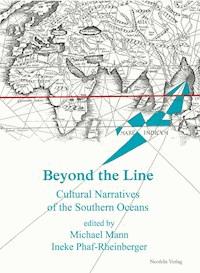
The title of Beyond the Line refers to the imaginary “Line” drawn between North and South, a division established by the Peace Treaty of Cateau-Cambrésis in 1559. This is an early modern time and Eurocentric construction, according to which the southern oceanic world has long been taken as symbol of expansionist philosophies and practices.
An obvious motivation for changing this “Line” division is the growing influence of the “Global South” in the contemporary economic and political setting. However, another motivation for changing opinions in regard to the “Line” is equally important. We observe an emergent consciousness of the pivotal role of the oceanic world for human life. This requires the reformulation of former views and raises numerous questions. A diversity of connections comes to the mind, which demands the composition of a catalogue of case studies with an oceanic horizon.
Through this operation, different problems are being linked together. Which problems encounter historians with their research on fishes in the archives? How to trace records about pirates of non-European descent in the Indian Ocean? Which role play the Oceans as mediators for labor migrations, not only of the Black Atlantic but also of people moving from Asia to Africa and vice versa? What do we know about workers on the oceans and their routes? When considering oceans as “contact zones,” with which criteria can their influence in different literary texts be analyzed? Is it possible to study nationalisms taking into account these transoceanic relationships? And how do artists address these questions in their use of the media?
Against the background of this catalogue of oceanic questions, “old” stories are told anew. Sometimes, their cultural stereotypes are recycled to criticize political and social situations. Or, in other cases, they are adopted for elaborating alternative options. In this sense, the contributions concentrate on countries like India, Kenya, Angola, or Brazil and cover different academic fields. A variety of objects and situations are explored, which have been and still are determinant for the construction of cultural narratives in view of the modified relationship with the geographically southern oceanic regions.
Sie lesen das E-Book in den Legimi-Apps auf:
Seitenzahl: 498
Veröffentlichungsjahr: 2014
Das E-Book (TTS) können Sie hören im Abo „Legimi Premium” in Legimi-Apps auf:
Ähnliche




















Michael Mann / Ineke Phaf-Rheinberger (eds)
Beyond the Line
Cultural Narratives of the Southern Oceans
Beyond the Line
Cultural Narratives
of the Southern Oceans
edited by
Michael Mann and Ineke Phaf-Rheinberger
Neofelis Verlag
German National Library Cataloguing in Publication Data
A catalogue record for this book is available from the German National Library:
http://dnb.d-nb.de
© 2014 Neofelis Verlag UG (haftungsbeschränkt), Berlin
www.neofelis-verlag.de
All rights reserved.
Cover Design: Marija Skara
Epub 2.0
ISBN: 978-3-943414-31-8
Contents
Michael Mann / Ineke Phaf-Rheinberger
Introduction: ‘Beyond the Line’ –Constructions and Concepts with Focus on the Southern Oceans
I. Studying the Ocean
Georg Berkemer
The Seaman and the Fish: Discoveries beyond the Line
Michael Mann
Life on the Water.
Soldiers, Slaves and Other Subalterns on Board of Ships in the Indian Ocean
Derek L. Elliott / Sebastian R. Prange
Beyond Piracy:
Maritime Violence and Colonial Encounters in Indian History
Margret Frenz
Swaray for Kenya, 1949–1965:The Ambiguities of Transnational Politics
II. Narrating the Ocean
Frank Schulze-Engler
Africa’s Asian Options –Indian Ocean Imaginaries in East African Literature
Ute Fendler
Fabulating the Indian Ocean –An Emerging Network of Imaginaries?
Ana Sobral
“Oceans of Pain”:The Sea as Memory and Metaphor in Angolan Poetry and Rap Music
Ineke Phaf-Rheinberger
Oceanic Modernity in Contemporary Narratives –Remembering Slavery in Brazil and Angola
Introduction: ‘Beyond the Line’ –
Constructions and Concepts with Focuson the Southern Oceans
Michael Mann / Ineke Phaf-Rheinberger
1. Beyond which Line?
The title of this volume, “Beyond the Line”, refers to the fact that all its contributions address constructions and concepts elaborated with regard to the Southern Oceans. “Beyond the Line” draws on the phrase “no peace beyond the line” that appeared in the peace treaty of Cateau-Cambrésis which was concluded in 1559. Both phrases became quite well known in historical research. However, the question remains what line is actually referred to? Many essays have been written on this subject and James A. Williamson, in his famous studyHawkins of Plymouth, seems to provide an ultimate solution:
In peace or war in Europe there was no peace beyond the line. The phrase is often quoted by people who do not explain what line they mean. The Tropic of Cancer will not by itself answer the question, neither will the lines of demarcation. “Line” is in fact a misquotation, which should be “lines”. The “lines of amity” were verbally agreed upon by the French and Spanish negotiators of the Peace of Cateau-Cambrésis in 1559. They were to be the Tropic of Cancer and the prime meridian passing through Ferro in the Canaries. On the European side of both lines the treaty was to be binding; west and south of them it was to be disregarded. The agreement was a belated recognition of what had long been the practice.1
The peace treaty of Cateau-Cambrésis did not mention any concrete line as a line of demarcation. Only an oral agreement added to the treaty is said to have indicated some lines of amity. Academic research maintained, first, that the addition to the peace treaty did in fact refer to two lines fixing an imaginary ‘Atlantic cross’ based on the Tropic of Cancer and the European understanding of a global Meridian and, second, that peace was only valid on the European side of the lines.2Most legal historians and maritime historians followed this interpretation rather uncritically. More recently it is argued that hardly any concrete juridical and legal idea existed about the line.3
Williamson resumes that from the sixteenth century on the phrase “no peace beyond the line” referred to European sovereigns’ well-established practice of issuing “letters of marque and reprisal”. It was also in some way taken for granted that such letters created and demarcated the space for buccaneering, freebooting, and piracy in a maritime space defined by meridian and longitude. The line was constructed on the Atlantic Ocean and made the maritime territories a legal, political, and cultural construction in cartography since Early Modern History. European peace treaties among sovereigns were in almost all cases written documents and the stipulation of the validity of peace and war overseas was not congruent with contemporary European ‘international’ law. This might explain why no preserving text of the oral agreement exists. In essence, however, European bilateral and multilateral peace treaties were considered to be of universal value. But in reference to trade and commercial matters it was different. The Spanish persistently defended de jure regulations against de facto practice and implementation to ensure their trading monopoly with the colonies in the Caribbean and Central America, thereby trying to defend a space for their own mercantile operations.4
“The line” only became a matter of bilateral and multilateral regulations in the course of the seventeenth century. After the defeat of the Spanish Armada in 1588 and the founding of the Northern European East India trading companies such as the English East India Company in 1600 and the Dutch Vereenigde Oostindische Compagnie in 1602, particularly the Dutch claimed free access to all oceans of the globe. This debate basically continued the old legal question of mare clausum and mare liberum.5 The Dutch as well as the English claimed the right to free and peaceful trade on the seas of the world, which did not imply the establishment of peaceful conditions in overseas territories. Hugo Grotius became famous for his treatise “Mare Liberum” published in 1609 in which he rejected the Papal Treaty of Tordesillas (1494) that had divided the globe into a Spanish and a Portuguese sphere of expansion and occupation. In contrast, Grotius demanded open access for all seafaring nations to the oceans of the globe.6 Interestingly, at the same time, the line (always singular, never plural “lines”) began to be increasingly mentioned in European treaties. It was understood that the Tropic of Cancer, i. e., the equinoctial, marked off all colonial territories, roughly distinguishing between Europe and the rest of the world.
A second line was not explicitly addressed but implicitly thought of: the meridian passing through the Canary Islands and the Azores. According to present day geography, it is not possible to draw the line that way but, in accordance with nautical knowledge in the sixteenth century when methods of determining latitudes did not exist,7 cartographers placed the Azores on the same meridian as the Canary Islands.8 In a restricted sense, as it was understood at that time, “beyond the line” basically confined the broad maritime space of the Caribbean,9 which became a legendary region for European adventurers seeking their fortune. This might explain the enormous success of the first fiction book on pirates, De Americaensche Zee-Rovers, written by the French Huguenot Alexandre Exquemelin and published in Amsterdam in 1678. The book was immediately translated into German, Spanish, English, and French and has been often rewritten ever since.10 While it seems clear that in Early Modern History “the line” was the Tropic of Cancer, the northern equinoctial and the equator were, however, often mixed up, both denominations being used at the same time in different documents.
Lesen Sie weiter in der vollständigen Ausgabe!
Lesen Sie weiter in der vollständigen Ausgabe!
Lesen Sie weiter in der vollständigen Ausgabe!
Lesen Sie weiter in der vollständigen Ausgabe!
Lesen Sie weiter in der vollständigen Ausgabe!
Lesen Sie weiter in der vollständigen Ausgabe!
Lesen Sie weiter in der vollständigen Ausgabe!
Lesen Sie weiter in der vollständigen Ausgabe!




