


17,99 €
Mehr erfahren.
- Herausgeber: John Wiley & Sons
- Kategorie: Fachliteratur
- Sprache: Englisch
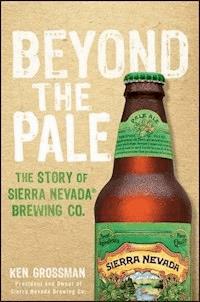
Personal tales of perseverance and beer making from the founder of Sierra Nevada Brewing Co. Beyond the Pale chronicles Ken Grossman's journey from hobbyist homebrewer to owner of Sierra Nevada Brewing Co., one of the most successful craft breweries in the United States. From youthful adventures to pioneering craft brewer, Ken Grossman shares the trials and tribulations of building a brewery that produces more than 800,000 barrels of beer a year while maintaining its commitment to using the finest ingredients available. Since Grossman founded Sierra Nevada in 1980, part of a growing beer revolution in America, critics have proclaimed his beer to be "among the best brewed anywhere in the world." * Beyond the Pale describes Grossman's unique approach to making and distributing one of America's best-loved brands of beer, while focusing on people, the planet and the product * Explores the "Sierra Nevada way," as exemplified by founder Ken Grossman, which includes an emphasis on sustainability, nonconformity, following one's passion, and doing things the right way * Details Grossman's start, home-brewing five-gallon batches of beer on his own, becoming a proficient home brewer, and later, building a small brewery in the town of Chico, California Beyond the Pale shows how with hard work, dedication, and focus, you can be successful following your dream.
Sie lesen das E-Book in den Legimi-Apps auf:
Seitenzahl: 455
Veröffentlichungsjahr: 2013
Ähnliche



















CONTENTS
Preface
Acknowledgments
Chapter 1: A Toaster, a Dryer, and a Glimpse of Things to Come
Setting the Stage
Toddler Tinkering
Cast of Characters
Youthful Adventures
Education My Way
A Central Character Enters the Scene
New Hobbies
My Homebrewing Beginnings
Moving On
Chapter 2: Chico
Making Ends Meet
Opening The Homebrew Shop
The Homebrew Shop Grows
The Turning Point
Going Pro
Chapter 3: Pioneer Days
The Plan
The Scavenger Hunt
Friends and Resources
An Expensive Lesson
Putting the Puzzle Together
Chapter 4: Materials and Ingredients
Water
Malt
Yeast
Hops
Chapter 5: A Bag Full of Dreams but Empty Pockets
The First Big Brew
Brewing the First Pale Ale
Chapter 6: To Market, To Market
The Three-Tier System
Our First Sales Pitch
A Bottleneck in Packaging
Casting a Wider Net
Learning the Ropes
The Growing Revolution
Chapter 7: Growing Pains
Over the Ocean and through the Woods
From Relics to Reliability
Getting Bigger and Better
New Business Models for Craft Brewers
Chapter 8: Moving On Up
New Neighborhood
Old World Copper, New World Brewhouse
Hello 20th Street
Goodbye Gilman Way
Stepping Up Production
Back to the Mountains
Growing Boundaries
Adding Infrastructure
Finest Quality
Chapter 9: The Time of Troubles
Legal Jousting
Continued Growth
Forward Motion
Considering Proposals
The Changing Industry Changes the Deal
Chapter 10: The Winchester Mystery Brewery
New Brewery, Old Habits
An Industry Evolved
Chapter 11: Fork in the Road
Project Ocean
Refocusing
Loss of a Friend
Chapter 12: Germinating a Workforce
Everybody Pitches In
Not a Creature was Stirring except for the Brewer
Fostering Talent
Employee Wellness
A Holistic Approach
The Health Opportunity Program (HOP)
It’s the Little Things
Chapter 13: New Millennium, New Challenges
HOP Wars
The Barley Business
Chapter 14: Doing the Right Thing
Finding Alternative Power
Fuel Cells
Solar Power
Keeping Track
Chapter 15: Good Is Not Good Enough
Fresh Beer Is Best
The Search for the Holy Grail
Back to My Roots
Sharing What We Learned
Collaborations
Collaborating for a Cause
Chapter 16: The Future
No End in Sight to Sales Increases
Supplemental Images
Index
Cover image: (Bottle and Hops) Courtesy of Author
Cover design: Mike J. Freeland
Copyright © 2013 by Sierra Nevada Brewing Co. All rights reserved.
Published by John Wiley & Sons, Inc., Hoboken, New Jersey.
Published simultaneously in Canada.
No part of this publication may be reproduced, stored in a retrieval system, or transmitted in any form or by any means, electronic, mechanical, photocopying, recording, scanning, or otherwise, except as permitted under Section 107 or 108 of the 1976 United States Copyright Act, without either the prior written permission of the Publisher, or authorization through payment of the appropriate per-copy fee to the Copyright Clearance Center, 222 Rosewood Drive, Danvers, MA 01923, (978) 750-8400, fax (978) 646-8600, or on the web at www.copyright.com. Requests to the Publisher for permission should be addressed to the Permissions Department, John Wiley & Sons, Inc., 111 River Street, Hoboken, NJ 07030, (201) 748-6011, fax (201) 748-6008, or online at www.wiley.com/go/permissions.
Limit of Liability/Disclaimer of Warranty: While the publisher and author have used their best efforts in preparing this book, they make no representations or warranties with the respect to the accuracy or completeness of the contents of this book and specifically disclaim any implied warranties of merchantability or fitness for a particular purpose. No warranty may be created or extended by sales representatives or written sales materials. The advice and strategies contained herein may not be suitable for your situation. You should consult with a professional where appropriate. Neither the publisher nor the author shall be liable for damages arising herefrom.
For general information about our other products and services, please contact our Customer Care Department within the United States at (800) 762-2974, outside the United States at (317) 572-3993 or fax (317) 572-4002.
Wiley publishes in a variety of print and electronic formats and by print-on-demand. Some material included with standard print versions of this book may not be included in e-books or in print-on-demand. If this book refers to media such as a CD or DVD that is not included in the version you purchased, you may download this material at http://booksupport.wiley.com. For more information about Wiley products, visit www.wiley.com.
Library of Congress Cataloging-in-Publication Data:
Grossman, Ken, 1954-
Beyond the Pale: The Story of Sierra Nevada Brewing Co./Ken Grossman.
Includes index.
ISBN: 978-1-118-00736-5 (cloth); ISBN: 978-1-118-22188-4 (ebk);
ISBN: 978-1-118-23557-7 (ebk)
1. Sierra Nevada Brewing Co. 2. Brewing industry–California–History.3. Beer industry–California–History 4. Grossman, Ken, 1954- 5. Brewers–California–Biography. I. Title.
HD9397.U54
338.7′66342092–dc23
[B]
2013020065
PREFACE
In 2009, I was first approached by my friend and colleague Sam Calagione, founder of Dogfish Head Brewery, about being involved in a book on the dawn of American craft brewing. Sam planned on doing several long, in-depth interviews with a handful of brewers to try to capture what it was like during the early years before many people accepted or even knew what “craft beer” or being a craft brewer was all about. The marketplace was so different than it is today, and it’s hard for many beer drinkers who grew up with craft beer to imagine a time when there were virtually no options other than American light lagers and a few almost indistinguishable imported lagers.
I was enthusiastically but cautiously on board and welcomed the opportunity to revisit those early years of building Sierra Nevada Brewing Co. and tell my story. Over the years several people had tried to convince me to write my own book, but I never felt I had time and put it off. When Sam asked, my time was already pretty well committed, as usual, but it seemed worthwhile. I thought I could fit it into my busy schedule since he would be doing most of the work. Sam had already written two beer books, and I thought he had the desire and energy to dig in to the story.
In the past few years, there have been several accurate and well-researched publications that have done a good job touching on the early pioneers of craft brewing and the industry’s rapid growth over the past 30 years, as well as giving a good overview of the wider beer industry. Maureen Ogle’s Ambitious Brew, Tom Acitelli’s The Audacity of Hops, and Steve Hindy and Tom Potters’ Beer School give readers an inside look at the craft industry. Even so, there’s a lot that hasn’t been written about the amazing American beer revolution that has spawned an unprecedented consumer movement and that has now spread globally with US-inspired craft breweries opening in dozens of countries around the world.
Sam planned to write a more focused book with just the handful of brewers who took a big leap of faith and decided to get into the brewing business when, based on all accounts, the odds were heavily stacked against them. He was going to start with the first generation of homebrewers who went “pro” in the late 1970s and early 1980s. Charlie Papazian’s participation would weave in the role that homebrewing played and the establishment of the Association of Brewers, which became the current Brewers Association.
When Sierra Nevada took that leap, the American brewing industry had hit bottom, with scarcely 40 individual brewing companies in existence. The industry had hit a high of more than 3,000 breweries in the 1870s but declined after that as a result of Prohibition, the repeal of Prohibition, and other forces. The few small breweries that remained in the 1970s were unable to compete with a handful of aggressive national brands that capitalized on economies of scale both in lower production costs and in their ability to leverage syndicated radio, and later TV, to promote their increasingly homogenous light lagers. Most of the surviving small brewers tried to match the style and price of national brands, but with declining volumes and, in most cases, deteriorating pre-Prohibition plants, they couldn’t remain competitive or sustain their companies.
Sam intended to focus on the small group of brewers who were the first to reverse that trend. In the late 1970s there were half a dozen of us who made the jump from homebrewing to establishing the first crop of micro, or craft, breweries in America. Most people in the brewing industry thought we were nuts, and the rate of brewery consolidation had some analysts predicting that there would be only two or three breweries that survived into the future. People wondered what we were thinking, opening breweries when so many had failed so recently. Even many of my closest family members and friends weren’t sure it was such a great idea, but I persisted with my vision for Sierra Nevada.
I can’t speak for everyone in that early group, but I think most of us had a similar vision. We wanted to make a different kind of beer; we didn’t want to make what the other breweries were brewing. In most parts of the country, there really wasn’t any interesting American beer on the shelves, and the majority of what you could find was light lager. As accomplished homebrewers we wanted to brew the types of beer we had grown to love, and we wanted to share our beer, our hoppy, dark, flavorful creations. Our friends loved our beers; certainly we could find other people who would as well. We all had modest ambitions and severely limited budgets. All of us borrowed and begged money from family and friends because no institution would loan us a penny. We cobbled together our breweries with used parts, resourcefulness, and ingenuity and proceeded to brew the beers we loved. At the time, what we were doing certainly didn’t seem to be a movement and definitely didn’t seem to be one that would grow for more than 30 years to become what it is today.
To get started on his book, Sam came to Chico and we spent time discussing those early years and developing the framework for what he’d write. He has a publisher interested in the book but is still in the planning stages. In the meantime, Sam’s publisher (John Wiley & Sons, Inc.) was also very interested in my story and wanted to tell it, so they asked me if I wanted to write my own book. I didn’t jump at the chance when they asked because my life was getting more complicated by the minute. I had been agonizing about building a second brewery and had just made the decision to move forward with looking for a location. The last thing I needed on my plate was writing a book, so I dragged my feet for several months until one day I had an uncharacteristic lapse in judgment and finally succumbed.
Looking back, it’s hard to say exactly why I caved in. Still, I know that our consumers and fans are interested in the Sierra Nevada story. Only recently have we expanded Sierra Nevada’s tours, and I’m still surprised by the number of people who come to Chico with the sole purpose of visiting the brewery. I’m also keenly aware that I haven’t made this journey on my own. My family, friends, and employees have been there in one way or another every step of the way, and Sierra Nevada wouldn’t be what it is without them. I’m not inclined to wax nostalgic, but as my children take a greater role in the company and I contemplate my future, it seemed like a good time to look back at how we started and got to where we are today.
This book has taken much longer than anyone involved ever intended, and I owe a great debt of gratitude to all involved for their patience and persistence. Juggling my duties running my brewery in Chico and designing a new brewery in North Carolina coupled with frequent travel the past few years has made focusing on a book difficult. This project would not have been possible without all of the help I received from my daughter, Sierra Grossman, and Melissa Cafferata, who took my ramblings and musings and turned them into an organized story.
As much as I have grumbled about this undertaking and additional burden to my already full schedule, the process has been both enlightening and very rewarding. Thankfully, I squirreled away a good stash of historical information about Sierra Nevada (there are also many people who accuse me of being a pack rat). While writing this book, I came upon a lot of great memories and some anguish rereading and looking at thousands of old articles, photographs, and correspondences. Sierra and Melissa have joked that their next project will be a museum full of my mementos from the last 30-some years.
I am often asked how it feels now to have built this successful company. My first response is usually that I didn’t build it on my own; legions of people have contributed to Sierra Nevada’s success. Of course, watching your seemingly impossible dream grow into a successful reality is great. And to do it in beer is even better. The craft brewing community is a wonderful place to work, and I’m proud to have been part of the craft revolution in this country. It’s been a long slog at times and a lot of hard work for the past 30-plus years, but I’ve always found that being persistent and staying true to my values has paid off. I hope you enjoy the ride as much as I have.
ACKNOWLEDGMENTS
This book is dedicated to the unfathomable number of people who have contributed to the success of Sierra Nevada Brewing Co., both those who have helped craft our amazing beers and our fans—brewery visitors, Pub regulars, and loyal drinkers. We’ve all played a part in the American craft brewing revolution that forever changed the beer industry.
Beyond the Pale would not have been possible without all the effort of my daughter, Sierra Grossman, and her partner in crime, Melissa Cafferata, who acted as my editors, bringing life to my often disjointed stream of thoughts and weaving them into a cohesive story.
My mother, Eleanor Guy, put up with my harebrained ideas and, although it caused her great anxiety over the years, always supported me.
Initially the brewery was only a pipe dream with a scant chance of success, but almost from the beginning it took on a life of its own, too often becoming a demanding and all-consuming force that nearly overwhelmed me. Building the brewery over the past 35 years has brought me a great deal of joy and satisfaction, but I am also keenly aware of the sacrifices that others have made to support my dream. I want to thank my family—Katie, Sierra, Carrie, and Brian—and acknowledge what they endured. For me, the balance of work and home life was often severely tilted, and many times I was so involved with the brewery that I neglected my very special and amazing family.
I would especially like to thank my wife, Katie, who has stuck with me all these years through this often tumultuous and challenging voyage. Katie bore the brunt of raising our family and keeping some semblance of normality at our home when I was totally absorbed in some challenging phase of the brewery’s growth (and there have been many). To Katie: It’s been a hell of a journey so far, and I know it’s not been an easy one, but thanks for sticking with me.
CHAPTER 1
A TOASTER, A DRYER, AND A GLIMPSE OF THINGS TO COME
Blessed is the mother who gives birth to a brewer.
—Czech saying
When I was two years old, I inserted a pair of tweezers into an electrical outlet. I vaporized them, gave myself quite a jolt, blew a fuse, and scared the wits out of my mother. Blowing a fuse was new, but I was already a dedicated student of electrical theory and this was not the first experiment that had unexpected results. It was this type of outcome that taught me to hide my experimentation from my mother; however, it’s hard to hide a blown fuse. She knew that I loved to take things apart, but she didn’t know the extent of my curiosity or how much it would shape the course of my life. The fact that I’ve survived to write this story is either incredible luck or a true testament to man’s (or a boy’s) ability to survive against amazing odds.
Setting the Stage
I grew up in a typical, middle-class family in the 1950s. My mom was a housewife, raising three kids with a husband who was rarely around. My father was a partner in a small law firm that specialized in an obscure and now mostly obsolete aspect of the law related to interstate trucking; he had clients around the country and traveled a lot. He practiced law during the time when a three-martini lunch was the norm, and he fully embraced the program. I can recall visiting his office when I was young, but only a few times. I remember being fascinated by their now-antique phone switchboard with all the plugs and sockets that the receptionist used to route calls. On one occasion, I swapped a few of the plugs while playing with it and probably disconnected a few important calls. He didn’t bring us kids to the office very often after that.
Lesen Sie weiter in der vollständigen Ausgabe!
Lesen Sie weiter in der vollständigen Ausgabe!
Lesen Sie weiter in der vollständigen Ausgabe!
Lesen Sie weiter in der vollständigen Ausgabe!
Lesen Sie weiter in der vollständigen Ausgabe!
Lesen Sie weiter in der vollständigen Ausgabe!
Lesen Sie weiter in der vollständigen Ausgabe!
Lesen Sie weiter in der vollständigen Ausgabe!
Lesen Sie weiter in der vollständigen Ausgabe!
Lesen Sie weiter in der vollständigen Ausgabe!
Lesen Sie weiter in der vollständigen Ausgabe!
Lesen Sie weiter in der vollständigen Ausgabe!
Lesen Sie weiter in der vollständigen Ausgabe!
Lesen Sie weiter in der vollständigen Ausgabe!
Lesen Sie weiter in der vollständigen Ausgabe!
Lesen Sie weiter in der vollständigen Ausgabe!
Lesen Sie weiter in der vollständigen Ausgabe!




