


2,99 €
Mehr erfahren.
- Herausgeber: Edizioni Epoké
- Kategorie: Geisteswissenschaft
- Sprache: Englisch
During the last 15 years Putin’s policies have produced a number of controversial effects both at the international and domestic levels, some diplomatic results, and unresolved regional conflicts. In foreign policy he accordingly launched the idea of a Greater Europe. To this aim and with the view to highlighting the goodwill of the Russian government to enhance cooperation with the European Union as a pro-active and equal partner. Sooner than expected, political divergences and vital interests emerged. As a result, the Greater Europe project was progressively frozen, if not plainly abandoned. However, the EU-Russia joint attempts to solve the Ukrainian crises, which were undertaken during the “Normandy Four” meetings (Germany, France, Russia, Ukraine), resulted in signing the weak – but still important – Minsk agreements. This helps to prove that there is still room for cooperation between the two sides. These agreements may hopefully set the stage for a more comprehensive deal aiming to close the gap between the EU’s and Russia’s competing visions.
Das E-Book können Sie in Legimi-Apps oder einer beliebigen App lesen, die das folgende Format unterstützen:
Veröffentlichungsjahr: 2017
Ähnliche




















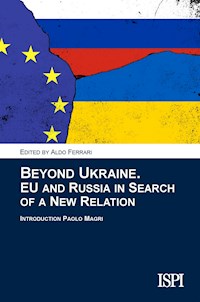
Beyond Ukraine.EU and Russia in Search of a New Relation
Edited by Aldo Ferrari
ISBN 978-88-98014-76-7
©2015 Edizioni Epoké
Firs edition: 2015
Edizioni Epoké. Via N. Bixio, 5
15067, Novi Ligure (AL)
http://www.edizioniepoke.it
ISPI. Via Clerici, 5
20121, Milano
www.ispionline.it
Graphic project and layout: Simone Tedeschi
I edition.
All Rights reserved. No part of this book may be reprinted or reproduced or utilised in any form or by any electronic, mechanical, or other means, now known or hereafter invented, including photocopying and recording, or in any information storage or retrieval system, without permission in writing from the publisher.
The Italian Institute for International Political Studies (ISPI) is an independent think tank dedicated to being a resource for government officials, business executives, journalists, civil servants, students and the public at large wishing to better understand international issues. It monitors geopolitical areas as well as major trends in international affairs.
Founded in Milan in 1934, ISPI is the only Italian Institute – and one of the few in Europe – to place research activities side by side to training, organization of international conferences, and the analysis of the international environment for businesses. Comprehensive interdisciplinary analysis is achieved through close collaboration with experts (academics and non-academics alike) in political, economic, legal, historical and strategic studies and through an ever-growing network of think tanks, research centers and Universities in Europe and beyond
Contents
Introduction
Paolo Magri
1. The EU and Russia after Crimea: Is Ukraine the Knot?
Carmen Claudín, Nicolás de Pedro
2. EU-Russia: What Went Wrong?
Aldo Ferrari
3. After Maidan: Re-Starting NATO-Russia Relations
Luca Ratti
4. Russia, Poland and the “New Europe”: Inevitable Clash?
Stefan Bielański
5. Seen from Moscow: Greater Europe at Risk
Ivan Timofeev
6. The Logic of U.S. Engagement: Talking to Russia - and European Allies in the Lead
Sean Kay
Conclusions. What Policy Actions for the EU?
Aldo Ferrari
About the Authors
Introduction
During the last 15 years Putin’s policies have produced a number of controversial effects both at the international and domestic levels, some diplomatic results (Syria, Iran), and unresolved regional conflicts (such as in Chechnya, Georgia and, currently, Ukraine). In strictly domestic terms, the early Putin era seemed to bring a sense of stability that most Russians had long waited for, after Yeltsin’s chaotic years, often called the “crazy 90’s”. More recently, mainly owing to high oil prices which remained over hundred dollars for the most part of 2008-2014, the Russian economy experienced a stable and rapid growth. However, as soon as the oil price dropped and sanctions were imposed on the country due to the Ukrainian crisis, its economy and currency inevitably plummeted. The rationale behind it is also the Kremlin’s growing power centralization in both the economic and political spheres, which goes hand in hand with the lack of economic reforms and over reliance on energy revenues.




