


19,99 €
Mehr erfahren.
- Herausgeber: John Wiley & Sons
- Kategorie: Fachliteratur
- Sprache: Englisch
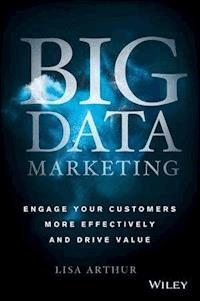
Leverage big data insights to improve customer experiences and insure business success Many of today's businesses find themselves caught in a snarl of internal data, paralyzed by internal silos, and executing antiquated marketing approaches. As a result, consumers are losing patience, shareholders are clamoring for growth and differentiation, and marketers are left struggling to untangle the massive mess. Big Data Marketing provides a strategic road map for executives who want to clear the chaos and start driving competitive advantage and top line growth. Using real-world examples, non-technical language, additional downloadable resources, and a healthy dose of humor, Big Data Marketing will help you discover the remedy offered by data-driven marketing. * Explains how marketers can use data to learn what they need to know * Details strategies to drive marketing relevance and Return On Marketing Investment (ROMI) * Provides a five-step approach in the journey to a more data-driven marketing organization * Author Lisa Arthur, the Chief Marketing Officer for Teradata Applications, the leader in integrated marketing software, meets with thousands of CMOs and marketing professionals annually through public speaking and events Big Data Marketing reveals patterns in your customers' behavior and proven ways to elevate customer experiences. Leverage these insights to insure your business's success.
Sie lesen das E-Book in den Legimi-Apps auf:
Seitenzahl: 244
Veröffentlichungsjahr: 2013
Ähnliche



















Table of Contents
Title Page
Copyright
Dedication
Foreword
Acknowledgments
Introduction
Part I: The Problem: How Did We Get Here?
Chapter 1: Moving Out of the Dark Ages
The Threat of Digital Disruption
The Enlightened Age of Data
Notes
Chapter 2: Why Is Marketing Antiquated?
Tactical (versus Strategic) Marketing
Manual Marketing Management
Silos of Data and Demand for Real-time Engagement
Communicating the Value of Marketing
Lack of Talent and Training
Fragmented and Often Missing Data
Notes
Chapter 3: The Data Hairball
What Is the Data Hairball?
The Data Hairball and the Customer Experience
Blending Art and Science
Integrated Marketing, Really
Data Privacy and Security
Notes
Part II: Get Ready for Big Data Marketing
Chapter 4: Definitions for the Real World of Big Data Marketing
Big Data Terminology
Big Data Marketing
Integrated Marketing Management (IMM)
Marketing Operations Management
Customer Interaction Management
Digital Messaging
Digital Marketing
Notes
Chapter 5: Meet the Modern Marketing Department (Michelangelo Meets Einstein)
The CMO as a Change Agent
The Data Scientist
The CMO and CIO Dynamic
Notes
Part III: The Five Steps to Data-Driven Marketing and Big Data Insights
Chapter 6: Step One: Get Smart, Get Strategic
Vision Leads to Strategy
Customer Interaction Strategy
Analytics Strategy
Data Strategy
Organizational Strategy
Technology Strategy
Notes
Chapter 7: Step Two: Tear Down the Silos
Tearing Down Silos Internal to Marketing
Tearing Down Silos between Marketing and Other Lines of Business
Developing a Strategic Framework for Synergy
New Best Friends: The CMO and the CIO
Notes
Chapter 8: Step Three: Untangle the Data Hairball
Start with Talent
Silos Can Threaten Big Data Strategy
Data Strategy
Discovering Big Data
Big Data Insights Combat Churn for US Telecommunications Provider
Notes
Chapter 9: Step Four: Make Metrics Your Mantra
Use Metrics to Measure Outcomes
Lessons Learned from Cost per Lead
Part I: The ROI versus ROMI Debate
Part II: The ROI versus ROMMI Debate
Metrics Are the Cornerstone of Accountability
Metrics Improve Buy-In and Alignment
Reasons for Misalignment
Notes
Chapter 10: Step Five: Process Is the New Black
Process Is One of Marketing's New Four P's
Integrated Marketing Processes Accelerate Results
Concept to Campaign to Cash
Process Innovation at a Global IT Services Company
Agile Marketing
Notes
Part IV: Realizing the Value of Big Data Marketing
Chapter 11: Drive Value through Relevant Marketing
Internal Value through Integrating Marketing
External Value through Integrating Marketing
Notes
Chapter 12: The Bright, Enlightened World of Customer Experience
The People Marketing Challenge
The People Marketing Opportunity
The Mobile Marketing Challenge
The Mobile Marketing Opportunity
The Information Management Marketing Challenge
The Information Marketing Opportunity
The Big Data Marketing Challenge
The Big Data Marketing Opportunity
Notes
Resources
About the Author
Index
Cover image: Studio 504/Getty Images
Cover design: Paul McCarthy
Copyright © 2013 by Lisa Arthur. All rights reserved.
Published by John Wiley & Sons, Inc., Hoboken, New Jersey.
Published simultaneously in Canada.
No part of this publication may be reproduced, stored in a retrieval system, or transmitted in any form or by any means, electronic, mechanical, photocopying, recording, scanning, or otherwise, except as permitted under Section 107 or 108 of the 1976 United States Copyright Act, without either the prior written permission of the Publisher, or authorization through payment of the appropriate per-copy fee to the Copyright Clearance Center, 222 Rosewood Drive, Danvers, MA 01923, (978) 750-8400, fax (978) 646-8600, or on the web at www.copyright.com. Requests to the Publisher for permission should be addressed to the Permissions Department, John Wiley & Sons, Inc., 111 River Street, Hoboken, NJ 07030, (201) 748-6011, fax (201) 748-6008, or online at www.wiley.com/go/permissions.
Limit of Liability/Disclaimer of Warranty: While the publisher and author have used their best efforts in preparing this book, they make no representations or warranties with the respect to the accuracy or completeness of the contents of this book and specifically disclaim any implied warranties of merchantability or fitness for a particular purpose. No warranty may be created or extended by sales representatives or written sales materials. The advice and strategies contained herein may not be suitable for your situation. You should consult with a professional where appropriate. Neither the publisher nor the author shall be liable for damages arising herefrom.
For general information about our other products and services, please contact our Customer Care Department within the United States at (800) 762-2974, outside the United States at (317) 572-3993 or fax (317) 572-4002.
Wiley publishes in a variety of print and electronic formats and by print-on-demand. Some material included with standard print versions of this book may not be included in e-books or in print-on-demand. If this book refers to media such as a CD or DVD that is not included in the version you purchased, you may download this material at http://booksupport.wiley.com. For more information about Wiley products, visit www.wiley.com.
ISBN: 978-1-118-73389-9 (cloth)
ISBN: 978-1-118-73402-5 (ebk)
ISBN: 978-1-118-73405-6 (ebk)
For my love, my muse, and my true north, Michael Bloom.
For my butterfly mom, Betty Burris.
Foreword
Why did you get into marketing? I am guessing that it's not because you had a burning desire to refine propensity models until the wee hours of the morning, or to wrestle with integrating social media comments with web clickstream data. But those are exactly the kinds of activities that make marketers great these days. The function is undergoing a dramatic transformation toward a world of data-driven decisions that this book describes in detail. You may have gravitated toward marketing because it is one of the most creative areas of business, and you still need to possess that attribute to succeed. But creativity is increasingly judged not only in the human imagination, but also in clickthroughs, conversions, and lift.
Marketing is not, of course, the only area of business undergoing this transformation. Few people enter the retail industry because they have a fascination with point-of-sale data, and few baseball fans want to work for a team so they can compute its Pythagorean winning percentage. The world in general is becoming more data-driven, and the change in marketing is only one example of that overall shift.
However, as Lisa Arthur details in the chapters that follow, the change in marketing is especially dramatic. In little more than a decade, the function has gone from emphasizing pretty pictures and catchy phrases to one that captures, integrates, and analyzes data of all types. Needless to say, many marketers—and the managers outside the function who relate to marketers—are not quite prepared for this transformation. They've heard the noise about data-driven marketing, but they're hoping they can retire before they really have to change their entire orientation.
But unless they're well into their sixties, retirement won't help much. Every day, marketing assets become increasingly digitized. Every day, more information about customers' preferences and behaviors becomes available. Every day, the opportunity cost of not pursuing data-driven marketing piles up.
There is both an organizational and an individual imperative for reading this book, internalizing its lessons, and continuing the pursuit of data-driven marketing. At the organizational level, some group of people needs to take the lead within companies in moving toward a data and analytics-focused culture. Marketing, as the function most impacted by the rise of data—and as the most frequent gatherer and user of customer data—is in an excellent position to take the lead and to lead by example. If marketing can target customer promotions, understand the attribution of digital media to sales, and segment to markets of one, the rest of the organization can't help but move in the same data-driven direction.
If marketing takes the lead in this regard, it can also seize an opportunity to take primary responsibility for managing customer interaction data. As you probably realize, marketing is not the only customer-oriented function in most organizations. It shares that responsibility with sales and customer service. My view is that over the next several years, organizations will feel the need to clarify who is really responsible for customer information. If marketing groups can demonstrate that they are adept at managing and using customer information—and making the data accessible to other organizations that need it—there's a good chance that marketing will get the role for the entire organization.
Of course, in order to do that successfully, marketing will need to step up its professionalism in data management. As Arthur points out, that means discipline, a process orientation, and lots of work on data integration. These are not generally traits that are traditionally associated with marketing, so some changes need to be made. Arthur refers to the prediction by Gartner that by the year 2017, marketing organizations will spend more on technology than IT organizations. I am not sure that prediction will come true (and even less sure it will happen on this date), but if it's even close, marketing data management will have to adopt some of the same approaches to data hygiene (security, backup, version control, and so forth) that IT organizations have employed for decades.
There is some irony in the move by marketing into professionally managed information and technology. Over the years, marketers have frequently been guilty of a “renegade” approach to IT. Instead of working with the IT function to create a professional approach to data management, marketers often tried to evade scrutiny by acquiring technology and managing complex data environments on their own. The marketers in question may well have gotten their database up or analyzed their social media sentiments more quickly and inexpensively. However, this renegade approach has led to fragmented and siloed customer data, as well as some inefficiencies in technology architecture and platform management.
Going forward, it's not that marketing will replace IT in the professional management of data, but will collaborate with it. Indeed, one organization—Arthur's own firm, Teradata—recently combined the jobs of chief marketing officer (CMO) and chief information officer (CIO). Perhaps we will see more such combinations, but in any case we will certainly need to see collaboration. Whenever I meet CMOs who don't work closely with their companies' CIOs, I consider shorting their stock. I can't imagine the companies will be successful if marketing and IT don't get along.
At the individual level, it's now clear that marketers at every level need to embrace technology and data as key elements of their professional portfolios. Everyone needs to know something; some need to know a lot. Every individual marketer needs to stake out a position on the continuum that has traditional, creative, intuitive marketing on one end (a position that is no longer tenable by itself), and hard-core digital data management on the other. If you're on the extreme data-oriented end, you may not look much different from a traditional IT person, although you will happen to specialize in managing customer-oriented data.
Some marketers will need to go back for formal schooling to develop this expertise; others can get by, as Arthur notes, with internal skill development programs within companies. Highly self-motivated individuals may even be able to acquire the needed knowledge by studying the voluminous amount of online information on this topic. Whatever means you choose, acquiring this sort of knowledge takes hard work.
And in marketing, the work to keep up with expanding IT and big data knowledge won't stop for the foreseeable future. It's great that you are reading this book, and Arthur will have provided you with a solid foundation for big data marketing by the time you reach its end. However, the world of data-driven marketing is changing at a dramatic pace. New channels to the customer, new application categories, new types of data to exploit, and new vendors and offerings emerge all the time. To be successful in data-driven marketing, you'll have to become a student of this domain for the rest of your career.
This may seem daunting, but try to look at it as a fantastic time to be in this profession. What could be more stimulating than being in a part of business where the foundations are being shaken on a daily basis? Where better to be than in the vanguard of this change? Wouldn't you prefer to be a leader of this transformation than to be led by someone else? In short, it's a wonderful time to be a data-driven marketer if you like change, excitement, and new ideas. And if you don't like those things, marketing probably isn't the best place for you anyway!
—Thomas H. Davenport
Acknowledgments
First, I'd like to acknowledge you, the reader of this book. Thank you for helping eliminate the hype and mystery from big data and data-driven marketing. Since all profits from the sale of this book will be donated to the American Red Cross, I am also sincerely grateful for your purchase. The American Red Cross is an organization passionate about its donors and the lives they save, and I am extremely proud that together we're contributing to the success of that mission.
I'd also like to say thank you to all the marketers I've met and shared stories with over the years. You inspired me to write this book, as we stand at the dawn of the Enlightened Age of Data. Let's keep talking and working together to elevate our teams and how we engage with customers; then, the rest will be history, as the saying goes.
I owe infinite gratitude and professional kudos to two brilliant women who came together with me to complete this project. Kathy Siranosian, you are an amazing partner in crime. This book would still be an outline and a dream if it weren't for your positive spirit, your tireless contributions, and your talent in translating my stories into compelling chapters. Applause and crowd noise also go to Kelly Jones, who researched and wrote case studies under extreme deadlines and continually contributed a fresh perspective. Thank you, content mavens, both your names should be alongside mine on the jacket. Another shout-out goes to Paige O'Neill, who helped outline the book, Christy Uher-Ferguson for her early reviews and feedback, and Mary Gros for helping secure the best thought leaders out there! What a powerful team of women and brainpower we have!
A big thank-you goes out to Teradata Corporation. Darryl McDonald, the president of Teradata Applications, and my manager, never blinked an eye when I asked to write this book while working as our chief marketing officer. Additional big thanks to Bill Franks, Ed Dupee, Gerald Hardister, David Scwheer, Lauren Ames, Dana Chamberlain, Wes Moore, Sherri Morgan, John Sawyer, Katherine Knowles, Tina Watkins, and Julyn Farrington, who all helped make this book happen. Even though there were many nights and weekends when I wondered if I was crazy for attempting this project on such a short deadline, I knew I had the backing and support of the Teradata team.
I'd be remiss if I didn't thank my Wiley editors, Adrianna Johnson and Christine Moore. Adrianna, you have been a beacon of light managing this process, a first time for me. Above and beyond navigating the publishing world, both you and Christine provided insightful edits and guidance to help my words truly resonate. Thank you and everyone at Wiley for such a robust and productive partnership.
To the strong women in my life, I wouldn't be here without you. To my mother, Betty Burris, my sister, Rebecca Davis, and my former executive coach, Debi Mueller: Thank you for all your love, wisdom, and support. Likewise, a sincere thank-you to my brother, Bob Burris, and adopted brother Lee Zeidman, who taught me how to be me in a man's world.
Finally, I count myself the luckiest woman in the world to share my life and passions with my husband, partner, and writing inspiration, Michael Bloom. Michael, a writer as well, continues to be my secret weapon professionally, as well as a source of ideation—and extraordinary coffee—when I need fuel to keep going. Thanks, my love, for your brutal honesty, your laser insight, and your understanding, even when my Eric Clapton T-shirt (which I frequently wear when I write) stayed on just a little bit too long! Michael, you are a true and equal partner. I wouldn't be able to do what I do without you.
Introduction
Big data. I've been a marketer since 1984, and never have there been two words that cause more anguish in the C-suite. Over the years, I've seen corporate leaders execute masterful acquisitions, heroic management of budget cuts, aggressive staffing reductions, and other feats of strength. They seem to take most business hurdles more or less in stride, but mention the words big data, and the conversation changes. Every member of the C-suite agrees big data is an issue that needs immediate attention. The problem is, very few know what to do about it, and, of course, that indecision just adds to the anxiety. As companies put off formulating their plans, the data continues to stream in, creating massive tangles of information, processes, and applications. The knot grows. Insights and value get buried in all the chaos. Stomachs begin to ache. And no one wants to admit they're falling farther and farther behind.
I want to change that dynamic, and I wrote this book because it's time to open up the conversation about big data. As uncomfortable as it may be, we need to start discussing big data—the good, the bad, and the ugly—without hype, without sales pitches, and without fear. Today's business leaders need to roll up their sleeves and confront the challenge of big data head-on, but in order to do so, they must first have a clear view of the task ahead of them. I truly believe that kind of clarity can only be achieved through honest, real-world dialogue. That's why this book isn't filled with complex mathematical models and lists of confusing statistics. Instead, I chose to focus on what I've discovered as a marketer who's coming of age in the era of big data marketing. I wrote about my mistakes and successes, as well as the triumphs of those I have had the pleasure to learn from along the way. You'll find page after page of practical advice about how to drive the changes required to begin reaping the benefits of big data insights.
If you want your business to move forward, if you're tired of all the sensationalism and hype, if you're ready to ease that knot in your stomach, you've come to the right place. Turn the page. Let's start the conversation.
Lesen Sie weiter in der vollständigen Ausgabe!
Lesen Sie weiter in der vollständigen Ausgabe!
Lesen Sie weiter in der vollständigen Ausgabe!
Lesen Sie weiter in der vollständigen Ausgabe!
Lesen Sie weiter in der vollständigen Ausgabe!
Lesen Sie weiter in der vollständigen Ausgabe!
Lesen Sie weiter in der vollständigen Ausgabe!
Lesen Sie weiter in der vollständigen Ausgabe!
Lesen Sie weiter in der vollständigen Ausgabe!
Lesen Sie weiter in der vollständigen Ausgabe!
Lesen Sie weiter in der vollständigen Ausgabe!
Lesen Sie weiter in der vollständigen Ausgabe!
Lesen Sie weiter in der vollständigen Ausgabe!
Lesen Sie weiter in der vollständigen Ausgabe!
Lesen Sie weiter in der vollständigen Ausgabe!
Lesen Sie weiter in der vollständigen Ausgabe!
Lesen Sie weiter in der vollständigen Ausgabe!
Lesen Sie weiter in der vollständigen Ausgabe!
Lesen Sie weiter in der vollständigen Ausgabe!




