


Erhalten Sie Zugang zu diesem und mehr als 300000 Büchern ab EUR 5,99 monatlich.
- Herausgeber: Atlantic Books
- Kategorie: Geisteswissenschaft
- Sprache: Englisch
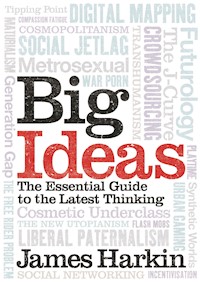
A witty and indispensable guide to modern-day buzzwords. Big Ideas explains where concepts like 'the long tail', 'urban tribes' and 'soft power' came from, what they mean, and what their critics say about them. It includes explanations of key terms such as: Maturialism: the name given to the new trend among middle-aged people of spending their money on expensive 'youth' gadgets and services, and the new habit among advertisers of targeting the mid-life market, repositioning their brands as accessories to the distinctive joys of mid-life. The Tipping Point: the controversial idea that the best way to understand everything from changing fashions to the rise of teenage smoking is to imagine people as viruses and social phenomena as contagious epidemics. Social Jet Lag: an ailment suffered by up to half the population, social jet lag is said to arise when our body clocks falls out of synch with the demands of our environments, thus putting us at risk of chronic fatigue and an increased susceptibility to disease.
Sie lesen das E-Book in den Legimi-Apps auf:
Seitenzahl: 220
Veröffentlichungsjahr: 2012
Das E-Book (TTS) können Sie hören im Abo „Legimi Premium” in Legimi-Apps auf:
Ähnliche




















BIG IDEAS
Big Ideas
The Essential Guide to the Latest Thinking
JAMES HARKIN
Atlantic Books
First published as a Paperback Original in Great Britain in 2008 by Atlantic Books, an imprint of Grove Atlantic, Inc.
Copyright © James Harkin 2008
The moral right of James Harkin to be identified as the author of this work has been asserted in accordance with the Copyright, Designs and Patents Act of 1988.
All rights reserved. No part of this publication may be reproduced, stored in a retrieval system, or transmitted in any form or by any means, electronic, mechanical, photocopying, recording, or otherwise, without the prior permission of both the copyright owner and the above publisher of this book.
Every effort has been made to trace or contact all copyright-holders. The publishers will be pleased to make good any omissions or rectify any mistakes brought to their attention at the earliest opportunity.
9 8 7 6 5 4 3 2 1
A CIP catalogue record for this book is available from the British Library.
ISBN 978 1 84354 710 5
Printed in Great Britain
Atlantic Books An imprint of Grove Atlantic Ltd. Ormond House 26–27 Boswell Street London WC1N 3JZ
Contents
Introduction ix
The Advocacy Revolution 1
Badvertising 3
Bare Branches 5
Boomergeddon 7
Brand America 9
Citizen Journalism 11
Compassion Fatigue 13
The Cosmetic Underclass 15
Cosmopolitanism 17
Crowd-Sourcing 19
Crunchy Conservatism 21
Curation Nation 23
The Cyborg 24
Declinology 27
Democratization 29
Digital Maoism 31
Digital Mapping 33
The Economy of Prestige 34
Electronic Frontier Justice 36
The European Empire 38
The Experience Economy 40
The Free Rider or Collective Action Problem and the Prisoner's Dilemma 42
Futurology 44
Generation Gap 46
Good Business 48
Gotcha Politics 49
Happiness 52
Incentivization 54
Infomania 56
Libertarian Paternalism 58
Life-Caching 60
The Long Tail 61
Maturialism 63
The Menaissance 65
Muscular Liberalism 67
Neurotheology 70
The New Puritans 72
The New Utopianism 74
The Paradox of Choice 76
Peer-to-Peer Surveillance 78
Pension Fund Capitalism 80
Philoanthrocapitalism 82
Playtime 84
Positive Liberty 86
The Precautionary Principle 88
Pre-heritance 90
Proletarian Drift 91
Protirement 93
Public Value 95
Regretful Loners 97
Resilience 99
Slacktivism 101
Smart Mobs/Flash Mobs 103
Social Jet Lag 105
Social Networking 107
Social Physics 109
Soft Power 112
Status Anxiety 114
The Support Economy 116
Synthetic Worlds 118
The Time Economy 120
The Tipping Point 122
Transhumanism or The Singularity Thesis 124
True Cost Economics 127
Urban Gaming 129
Urban Villages 131
Virtual Anthropology 132
Virtual Politics 134
War Porn 136
Wild Card Theory or Black Swan Theory 138
Worst-Case Scenarios 141
Yeppies 143
Your Ideas 145
Introduction
What can it mean to be a 'libertarian paternalist', a 'slacktivist' or a 'transhumanist'? How does 'peer-to-peer' surveillance differ from ordinary snooping, and where can one go about finding a 'virtual anthropologist'? What is it like to live in an 'experience economy'? When people murmur knowingly about something called 'the wisdom of crowds', what are they talking about? Is there really a 'tipping point' in every field of human endeavour, and, if so, where does it come from and how does it work?
Assaulted by a battery of new ideas, buzzwords and neologisms, it is easy to feel left out. In the last few years, after several decades during which grand, overarching political ideologies were overthrown and ideas of any stripe were treated with suspicion, an esoteric new vocabulary of ideas bobbed back to the surface of social life and began to appear on everyone's lips. These new kinds of ideas came in different shapes and sizes. There were ideas as labels to help us describe and understand our changing world and the people in it; ideas as innovations to help us to change things; ideas to help turn businesses around and make money; most of all, there were ideas to make us, our organizations and our politicians more novel and more exciting. All of a sudden, it seemed, ideas – big, weighty, serious-sounding ideas – were the most fashionable currency in town, and everyone seemed to want one of their own.
One catalyst for this, in the world of politics at least, was a broad shifting of the tectonic plates and the sense of an era coming to an end. In North America and Europe, incumbent governments – George Bush's administration in North America, Tony Blair's New Labour project in Britain, Jacques Chirac's Presidency of France – began to look flailing and unwieldy, as if they were about to give way to something else. If the new generation of political contenders – not only David Cameron in the UK, but Nicolas Sarkozy in France and Barack Obama in the United States – did nothing else, they added a little intellectual Viagra back into political debate. They also did something to resuscitate the principle that ideas – abstractions which hover over and shape debates about what governments do – matter after all. Without ideas, everything is random: politicians are mere opportunists, coming up with arbitrary policy wheezes that bear no relationship to one another; policy prescriptions are nothing but focus groups writ large; delivery, polish and execution are everything. Thankfully, we have lost our patience with all that. The pressing questions at the beginning of the twenty-first century – among them the way that we approach risk and uncertainty, the state of the environment, the make-up of national identity, the nature and meaning of political terrorism, the progress of globalization and the politics of human rights – are very different from those in the past, but just as prone to riddle and wrong-headedness. They demand new ideas, bold concepts and fresh thinking.
But where would that thinking come from? Not from academic philosophers, for sure. Anglo-Saxon philosophers, steeped in the 'ordinary language' school of analytical philosophy, have long been suspicious of ideas of any stripe, which they saw as no more than an unwarranted fit of continental European enthusiasm. Their job, as they saw it, was to take ideas which already happened to exist – justice, liberty, etc. – and then refine and sharpen them into something which made sense. For these kinds of philosophers, big ideas were only raw materials, waiting to be burnished and buffed up by themselves into something approaching internal coherence. They were not much interested in thinking up ideas themselves. Ask them for one, and they were likely to reply that it was not their job.
Much better placed to think up big ideas were the continental European philosophers, whose initial enchantment with ideas about society and culture was as intense as their irritation with the pedantry of Anglo-Saxon philosophy. It was they, after all, who revelled in the grand ideas of Hegel, Marx and Freud and made them their own. No sooner had they inculcated us in their sweeping intellectual narratives, however, than they promptly spat them out. In 1984, for example, the French philosopher and former Marxist Jean-François Lyotard argued that grand ideologies or 'metanarratives' – if those were intended to order and explain all our knowledge and experience – had outlived their usefulness. What we were left with was 'postmodernism' – Lyotard defined this as 'an incredulity towards metanarratives' – which was sceptical of anything which purported to explain too much. Like many other left-leaning intellectuals during the last two decades, Lyotard spent much of his time feasting on the rotting carcass of twentieth-century ideologies like Marxism and socialism. These 'Post-it' intellectuals were largely successful in their mission to kick ideologies when they were on the way down, but their mission was almost wholly destructive. Very soon, however, we tired of verbose, dissembling intellectuals who wanted to tell us only what could not be understood. Anyone who talks too loosely about 'postmodernism' or 'post-structuralism' is nowadays themselves treated with a healthy dose of scepticism.
THE NEW LANDSCAPE OF IDEAS
Anyone looking to politicians or to university-based ideologues to stimulate new thinking, however, was looking in the wrong place. Long before Cameron, Obama and Sarkozy had become regular fixtures on our television sets, the media had detected an appetite for big ideas and, for those who cared to look, there was plenty of interest in new ideas around. The success of idea books like The Tipping Point and Freakonomics and a huge glut of books about happiness all signified to cultural commissars a thirst for good ideas clearly expressed. It became fashionable to establish an 'ideas factory' or 'ideas laboratory' within organizations, as if it were somehow possible to punch out ideas on an industrial scale. This thirst for new ideas spread to newspapers and magazines. The New Yorker, buoyed up by staff writers like Malcolm Gladwell, James Surowiecki and Louis Menand, developed an enviable reputation for helping to explain complex ideas to a lay audience. In the year 2000, the New York Times even inaugurated an annual 'ideas of the year' supplement, handing out gongs to the best new ideas around the world. In the UK, newspapers like the Guardian, the Financial Times and magazines like the New Statesman joined in, investing in 'ideas' columns whose job it was to navigate the deluge of new ideas which were being thrown their way.
This global market for new ideas began to move at breakneck speed. Good ideas had always been contagious, but thanks to the internet and the increasingly globalized media, new ideas and buzzwords – borrowed or shamelessly ripped off – were making their way around the world almost as soon as they were invented. As the new global landscape of ideas began to settle, something else became clear too. In the new marketplace for ideas, North America was way out in front. If distinctively European thinkers like Isaiah Berlin and emigrés from Europe to America like Hannah Arendt had dominated the battleground of ideas during the age of ideology (defined by the British historian Eric Hobsbawm as the years between the First World War and the fall of the Berlin Wall), one of the oddities of this new landscape of ideas was that the Americans seemed to be better at generating them. There were still some heavyweight moral and political philosophers around in Europe with novel things to say – Jürgen Habermas in Germany, Slavoj Zizek in Slovenia, Jean Baudrillard in France, for example – but they were few and far. When Baudrillard died in March 2007, at the age of seventy-seven, it seemed to signify the close of an intellectual era. Baudrillard, hero to the polo-necked, pointy-spectacled classes, had made it his life's work to argue that, under the weight of our relentless consumption of objects and media, simulated experiences had come to replace the real thing and reality and fantasy had blurred into one impenetrable edifice called 'hyper-reality'. He was much scoffed at by Anglophone philosophers for his efforts, but at least he took the trouble to engage with the real world, even if he didn't believe it was entirely real. In any case, Baudrillard was canny enough to know which way the intellectual wind blew. For all his criticism of American culture, he was enchanted by this place he called 'the original version of modernity'. France, he pointed out, was nothing more than 'a copy with subtitles'.
So why did the centre of gravitas shift towards America? One reason was the deep pockets of America's think tanks and its universities, the resources and reputations of which were able to attract the world's best thinkers and afford them the time to cogitate and write at their leisure. For example, in 2003 the controversial American libertarian think-tanker and fellow of the American Enterprise Institute Charles Murray published a book called Human Accomplishment; The Pursuit of Excellence in the Arts and Sciences, 800 BC to 1950, a huge tome full of graphs and tables in which Murray tried to rank the top 4,000 thinkers in human history. Setting aside the eccentricities of Murray's project for a moment, can anyone imagine a think tank in Europe with the resources and the confidence to allow one of its scholars to spend five years on a project as unashamedly intellectual as this?
But if America's dominance in the new global landscape of ideas was partly due to the pulling power of its universities and think tanks, it was also because Americans had become expert packagers of ideas. More than anywhere else in the world, American writers and thinkers seemed to have the knack of explaining complex ideas in an accessible way for a popular audience. Perhaps it was the fact that journalism in America was taken more seriously than it was in most other countries. Or maybe it was all in the branding, the discovery of that headline title or gimmick – 'Freakonomics', 'The Tipping Point', 'The Wisdom of Crowds' – which captured the essence of a complicated idea while intriguing the reader enough to read more. To cite an example: for a brief period in autumn 2006, the global media became very excited about the merits of a new book called The J Curve. Penned by an American political scientist called Ian Bremmer, the book purported to offer an account of how nations that emerge from authoritarianism go through a period of instability and disorder before they settle into a stable democracy. It was a rather pedestrian idea, and doubtless would have sunk without trace had it not been for two things. It helped, of course, that the book was published at a time when ruling elites in Britain and America were beginning to entertain serious doubts about their invasion of Iraq. But that wasn't the only reason Bremmer's book did well. Its title – The J Curve – seemed to suggest something impressively scientific and yet unutterably obvious about how countries take their first steps from dictatorship to democracy. If it had been written by a European academic, it would undoubtedly have been called 'Dictatorships in Transition: Towards a theory of the transition to post-authoritarian democracies', and would, as a result, have withered in the political science section of some of our more comprehensive bookshops. As it was, it cleaned up.
There was something else going on in the world of ideas, too. While academic output became ever more specialized, a new kind of professional emerged to take up the burden of talking about big ideas and thinking through social trends. Almost overnight, it seemed, we were confronted by legions of ideas salesmen – ideas entrepreneurs, media gurus, think-tankers and policy wonks, features journalists and talking heads, demographers and marketers, technologists, management theorists, futurologists and trend forecasters – whose job it became to think up easily digestible abstractions that might help to explain society and the terms of public debate. The think-tankers borrowed from Harvard professors like Robert Putnam and Mark Moore apparently hard-headed ideas like 'social capital' and 'public value' to make their work sound more respectable. The future-gazers rhapsodized about the accelerating pace of social change. The technologists forgot about society completely and instead talked up the idea that the new technologies would make distance disappear and allow products of all kinds to be customized to our individual taste. The demographers and marketers, meanwhile, set about slicing and dicing the populations into smaller and smaller categories with ever-increasing enthusiasm.
Much of it was tendentious rubbish, the tossed-off generalizations of intellectual chancers. But it would be a mistake to dismiss entirely this new breed of ideas professional. Unlike some academics, the new idea-makers lacked verbosity or obscurantism. They were well practised at expressing their ideas clearly, and most of their ideas were simple enough to be expressed in a couple of paragraphs – which is why their books, when they got around to writing them, tended to be puffed up with more padding than a lingerie model's bra. Their ideas might announce themselves in a gimmicky way, but those same ideas and the empirical research behind them could teach us a good deal about changes in the public mood and intellectual fashions. Trace the connections between them and they added up to something approximating a distinctively twenty-first century ideology. When the New York Times journalist Thomas Friedman shoehorned a variety of different trends into an awkward but informative thesis that 'The World is Flat', he was talking about the same revolt against hierarchies that motivated technologists to enthuse about the growing import of 'peer-to-peer' communications. When marketers talked up something called 'buzz marketing', they were championing exactly the same word-of-mouth phenomenon that Malcolm Gladwell, in his book The Tipping Point, had likened to a contagious virus. When researchers stopped celebrating how wonderful it was to be a 'singleton' and started referring to the same people as 'regretful loners', it told us a good deal about shifts in social attitudes to single living.
Any attempt to understand the contemporary world, then, needs to be broad-minded enough to sift through ideas of all kinds. But it is equally important to go armed with a razor-sharp bullshit detector. Government, the professions and the corporate world are now knee-deep in faddish ideas that appear with a fanfare before being mercilessly discarded like old toys. No sooner has one been purged than another has arisen to take its place. It helps that faddish concepts – usually based around mini-ideas like 'empowerment', 'positive thinking', or 'emotional intelligence' – are the lifeblood of a burgeoning cadre of management consultants, the witch doctors of the modern workplace.
BIG IDEAS: A HOW-TO GUIDE
How, then, can we measure the worth of an idea? Is it its intrinsic rightness or validity, or its power and the elegance with which it is expressed? One important measure of the worth of an idea about society is how far it ricochets through the culture and makes its presence felt. Ideas are in the ether; very often they are arrived at in different ways and in different places, in different disciplines and in different hierarchies of knowledge at around the same time. When the biologist Richard Dawkins developed his idea about a 'selfish gene' thirty years ago, he imported into genetics a highly contestable theory about human behaviour called game theory – and its most famous game, the prisoner's dilemma – which was being touted around by American economists, and which had been in turn borrowed from mathematicians. When, more recently, the former American Defense Secretary Donald Rumsfeld made his infamous speech about the 'known unknowns' when dealing with Iraq's hypothetical weapons of mass destruction, he was articulating exactly the same spectral aversion to uncertainty that European sociologists have filed under the heading 'risk society' and that European think-tankers know as 'the precautionary principle'.
If interesting ideas are all around us, the real trick is how to find an audience for them. Even if it is expertly packaged, however, an idea needs to have some substance if it is to have a chance of succeeding in the intellectual marketplace. What kind of ideas are doing well? The new ideas men and women were much less interested in grand schematic thinking about how societies worked than their predecessors. Rather, what fascinated them were the foibles and idiosyncrasies of human behaviour and how – with a little prior knowledge and a few handy hints – it might be possible to nudge that behaviour in a more fortuitous direction. They also tended to shamelessly mix up disciplines in an apparently iconoclastic way.
For some years now, the hottest research area within economics has been behavioural economics – a hybrid of economics with social psychology which sets out to understand real human behaviour within markets and demolish the clean-cut assumptions about human rationality made by conventional neo-classical economists. Very often it pays to bring science into the mix – in recent years, the public has been subjected to a fusion of science and art called 'sci-art', an attempted meshing of neuroscience and economics called 'neuroeconomics' and a controversial new hybrid of science and theology called 'neurotheology'. Then there is the network theory invented by Manuel Castells, which has now expanded its empire from science and computing into just about every field of human understanding. This laudable urge to join the dots between disciplines often stems from a rather sorry disillusionment among thinkers with the potential of their own discipline – and particularly the social sciences – to understand the world. Sometimes these attempts at imaginative fusion are simply nonsense on stilts, but they manage to turn intellectual heads all the same.
In the place of grand projects to change society, it would be fair to say, ideas had retreated to the more modest study of human behaviour at the micro-scale and how to change it. What remains impressive about the new crop of ideas, however, is the direction in which they are running. If the prevailing ideology since the era of Margaret Thatcher has been that there is no such thing as society, the real intellectual action in this decade has been to go beyond the fundamental axiom of neo-classical economics, the idea that each of us is an isolated individual concerned only to maximize our own advantage and understand afresh the dynamics of social or collective behaviour. The fundamental idea at the heart of Malcolm Gladwell's The Tipping Point, for example, is one which tries to explain how ideas and rumours are passed from one person to another.
In their books The Wisdom of Crowds and Critical Mass the journalist James Surowiecki and the science writer Philip Ball had a crack at explaining the sometimes unpredictable behaviour of crowds, and in the burgeoning discipline of network theory thinkers try to comprehend communities by imagining them as vast networks of connections. All of this represents a renewed interest in society, albeit at the expense of throwing out most of the intellectual armoury amassed by the social sciences in favour of techniques and analogies drawn from technology or the natural sciences. For Malcolm Gladwell humans are viruses which are prone to starting epidemics; for Philip Ball we are all gas particles prone to condensing abruptly into water; for the network theorists we are all lonely nodes hoping to bump into one another on a network. This renewed focus on what binds us together is entirely welcome; society, after all, has to be more than the sum of its parts. But the horizons of many of these ideas are nevertheless limited. What they suggest is that society is complex and potentially combustible, that interventions in it are prone to give rise to unintended consequences – and that change can be achieved only tentatively and at the margins, by gently nudging us blind, formless masses in one direction or another.
It can hardly be a coincidence that this is also the message that we hear on the lips of our politicians. Many of them, after all, have cherry-picked their ideas from think tanks, ideas entrepreneurs, demographers and marketing consultants. Ambitious politicians on both sides of the Atlantic, even those whose intellectual heritage is steeped in a rugged, narrowly economic libertarianism, are keen to rehabilitate the idea of society and point out that it does exist after all – but that it is battered, traumatized, ill at ease with itself and, a bit like Humpty Dumpty, in need of being put back together again. The new political ideas, as a consequence, are all about finding ways to make this happen. They make liberal use of buzzwords like 'social responsibility', 'active citizenship', 'sustainability' and 'community'. The proposals they usher forth include everything from making more use of the voluntary and charitable sectors, to rejigging the tax-and-benefit incentives on offer to encourage people to behave in more responsible ways. All this is well and good, but it smacks of a narrow managerialism whose approach to motivating its citizenry is a simple matter of neat technical fixes like economic carrots and sticks. It is not enough for politicians to tell us that society is bruised and in need of some attention. The only things capable of really reinvigorating political society are ideas which could bring people together with a shared purpose. New ideas like liberty, equality and fraternity were the motivating principles of the French Revolution, and a brand new idea about how social welfare and a healthy economy could go hand in hand was the impetus behind the birth of the welfare state. Both managed to inspire people in their time. We could do with being inspired again.
All this might sound idealistic, but maybe a little idealism is not such a bad thing. When the leading philosopher of German idealism, Georg Wilhelm Friedrich Hegel, was thinking and writing in the early nineteenth century, he wasn't floating woolly utopian schemes for the perfectability of human nature. What he meant by idealism was that our ideas about things are just as, if not more important than the things themselves, because they create those things and help determine the world that we live in. Ideas are like a boomerang – give up on them or hurl them disdainfully into the middle distance and they are likely to come back and hit you in the back of the head. Those who think they can sneer at them or shrug them off, after all, are usually the same people who routinely wave rather bad ideas through on the nod.
Any survey of contemporary ideas is bound to reflect the biases and prejudices of the author. This one, however, is designed to be broad enough to give a coherent snapshot of the world in which we live and its ideas of itself. Given that it is impossible to rid ourselves of the ideas which motivate us to action, it surely behoves us to scrutinize them more closely and to think up better ones – not just ideas to live by, or to make a quick buck out of, but to grasp the world with and change it for the better. Think big, think bold – because the ideas that you have are more powerful and more influential than you think.




