


22,99 €
Mehr erfahren.
- Herausgeber: John Wiley & Sons
- Kategorie: Fachliteratur
- Sprache: Englisch
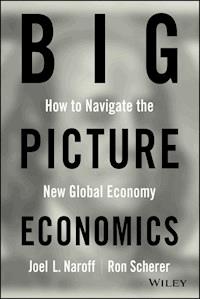
Navigate the economy with this insightful new book The world is awash with economic information. Governments release reports. Pundits give their interpretation on television. And the stock market may go its own way, confusing everyone. How can you better understand what it means for you? Big Picture Economics, a new book by award-winning columnist and futurist Joel Naroff and veteran journalist Ron Scherer, says the thread that ties everything together is "context." The authors show how consumers, business, the Federal Reserve, and government take into account what's going on around them to make critical decisions like buying new products, building new factories, changing interest rates, or setting budget goals. The book provides a clear roadmap to understanding the whole story behind the global economy. Big Picture Economics helps readers understand how context impacts decisions and decision makers. - The Federal Reserve and Congress in formulating economic policy - Consumers in a shopper nation and what makes us buy or not buy - Corporations making decisions on whether to build new factories and buy other companies - The federal budget that must deal with complex issues, including the reduction of health care spending - A simple test for tax cuts or increases: will they help the economy grow? - Where to produce and where to sell in a global economy that is more like a Mobius strip than a flat world - International events that can ripple through the economy and ultimately affect workers in the Midwest - Technology, such as intelligent drones to wearable computers, are changing the future Experts laud the book for its perceptive insights: "It all sounds like common sense, but it is actually based on a close, expert reading of economic history and what that history implies for the future. Read this book to become a more educated judge of economic policy." --Robert Moffitt, Krieger-Eisenhower Professor of Economics at Johns Hopkins University "Naroff and Scherer show how seemingly unrelated things like an upgrade of the Panama Canal, a Tex-Mex restaurant's menu change, or how many Americans are overweight turn out to be intricately linked to our daily experiences. What brings the book to life is the authors' focus on these hidden interconnections." --Brendan Conway, blogger and columnist, Barron's
Sie lesen das E-Book in den Legimi-Apps auf:
Seitenzahl: 431
Veröffentlichungsjahr: 2014
Ähnliche



















Contents
Preface
Acknowledgments
Chapter 1: Introduction to the Economics of Context
Adapting to the Economy—View from the Cab of a Truck
The Service Sector—The Enchilada Stops Here
The Cash Register Stops Singing
Celebrate for 15 Minutes
What Does Economics Teach Us about Context?
Economic Theory and Fiscal and Monetary Policy
Notes
Chapter 2: The Federal Reserve, Congress, and the Use of Context in Economic Policy
Public Policy Spreads a Wide Ripple
The View from the Hill
Why the Economic Forecast Matters
Economic Assumptions Matter: The Rosy Scenario
Does One Policy Fit All?
A Bank Loaded with Economists
The Importance of the Beige Book
From Beige to Blue and Green
Fed Policy
From Bubbles to Fed Meetings
The Fed Goofs
Notes
Chapter 3: We Are All Economists and Don’t Know It
Context Tells Us What We Can Afford
Frugal in Arizona
The Economy Gets Worse
Public Officials as Economic Forecasters
A Mayor as Economist
Tampa’s Faulty Economic Model
Changing the Economic DNA
How an Educator Put on an Economist’s Hat
A Fiscal Grand Canyon
Crow Solutions
The Business Owner as Economist
Greg Parker: From Fast Food to Economics
Convenience Store Economics
Things Are Bad, So Expand
Notes
Chapter 4: How a Perfect World Would Work
How We Got Here
Building the U.S. Economy: A Journey through Time
Money Makes the World Go ’Round
Money Is Not Enough (Don’t We Know That!)
The Banking System Made Simple
Big Brother Is Watching Over Us
The World Is Our Oyster
Chapter 5: Shopper Nation: Why We Buy or Don’t Buy
What Causes the Itch to Spend?
Seniors Get the Jobs but the Pay Leaves Many Cold
“Charg-It”
Why Debt Is Good—or Bad
The Rich Worry, Too
Economic Theory of Wealth
Feeling Good? Buy a Car
Notes
Chapter 6: How Is a Can of Tuna Like a Smartphone? Yes, Context!
A Company Decides to Build Chips
Computer Chips: Five Factoids on Making Computer Chips at GLOBALFOUNDRIES
The Urge to Merge Depends on Context
The Corporate Tax Conundrum
Corporations Are People, Too, and They React Accordingly
To Regulate or Not Regulate, That Is the Question!
Notes
Chapter 7: When to Spend, When to Cut, and When to Scratch Your Head Over the Federal Budget
Impact of Health Care on the Budget
Doubts from a Doctor
What If Lower Health Care Spending Continues?
How the Budget Interacts with the Economy
It’s Not the Deficit but the Interest That Matters
Notes
Chapter 8: Tax Policy: Does Cutting Taxes Cure All Ills?
There Is No Such Thing as a Free Tax Cut
How Much Do Americans Make and What Are They Taxed?
While the Distribution of Income Is Good or Inevitable, It Still Matters When It Comes to Tax Policy
Is the Answer to Every Economy Ill to Cut Corporate Taxes?
Notes
Chapter 9: Monetary Policy: Money, or Maybe the Federal Reserve, Makes the World Go ’Round
How Monetary Policy Works
Problems Facing the Fed
Meltdown of the U.S. Financial System
The Correct Way to Evaluate the Policies
Notes
Chapter 10: The Panama Canal Widens and the Middle Class Grows in China—How Does That Affect Indiana?
Ports Get Ready for Change
The View from the West Coast
Trade beyond the Canal
History: The Moat around Fortress America Has Dried Up
Even Small Countries Can Crash the World Economy
Free Trade Is a Goal, but Fair Trade Is a Necessity
Currency Manipulation Has Negative Implications beyond the Obvious
Notes
Chapter 11: What Do We Do Now?
“The Future Ain’t What It Used to Be”
Flying Robots, 3D Printers, and the Future
Will the Consumer Continue to Reign? Maybe, Maybe Not
Fracking: Controversial but Changing the Future
Can We Squeeze More Out of the Ground?
The Economics of More Energy
The Aging of Boomers Will Change the Economy Once Again
Notes
About the Authors
Index
End User License Agreement
List of Tables
Table 5.1 Older Workers Get the Jobs
Table 7.1 Contributions of Various Factors to Annual Growth in Per-Beneficiary Spending for the Elderly in Parts A and B of Medicare (percentage points)
Table 7.2 Major Foreign Holders of Treasury Securities (in billions of dollars)
Table 8.1 Estimated Income and Taxes for 2014
a
Table 8.2 Shares of Tax Filers with Adjusted Gross Incomes of $100,000 or Higher in Tax Year 2011
Pages
iii
iv
v
vi
ix
x
xi
xii
xiii
xiv
xv
xvi
xvii
xviii
1
2
3
4
5
6
7
8
9
10
11
12
13
14
15
16
17
18
19
20
21
22
23
24
25
26
27
28
29
30
31
32
33
34
35
36
37
38
39
40
41
42
43
44
45
46
47
48
49
50
51
52
53
54
55
56
57
58
59
60
61
62
63
64
65
66
67
68
69
70
71
72
73
74
75
76
77
78
79
80
81
82
83
84
85
86
87
88
89
90
91
92
93
94
95
96
97
98
99
100
101
102
103
104
105
106
107
108
109
110
111
112
113
114
115
116
117
118
119
120
121
122
123
124
125
126
127
128
129
130
131
132
133
134
135
136
137
138
139
140
141
142
143
144
145
146
147
148
149
150
151
152
153
154
155
156
157
158
159
160
161
162
163
164
165
166
167
168
169
170
171
172
173
174
175
176
177
178
179
180
181
182
183
184
185
186
187
188
189
190
191
192
193
194
195
196
197
198
199
200
201
202
203
204
205
206
207
208
209
210
211
212
213
214
215
216
217
218
219
220
221
222
223
224
225
226
227
228
229
230
231
232
233
234
235
236
237
238
Guide
Cover
Table of Contents
Begin Reading
Big Picture Economics
How to Navigate the New Global Economy
Joel Naroff
Ron Scherer
Cover design: Michael J. Freeland
Cover image: © Photodisc / Jupiter Images
Copyright © 2014 by Joel Naroff and Ron Scherer. All rights reserved.
Published by John Wiley & Sons, Inc., Hoboken, New Jersey.
Published simultaneously in Canada.
No part of this publication may be reproduced, stored in a retrieval system, or transmitted in any form or by any means, electronic, mechanical, photocopying, recording, scanning, or otherwise, except as permitted under Section 107 or 108 of the 1976 United States Copyright Act, without either the prior written permission of the Publisher, or authorization through payment of the appropriate per-copy fee to the Copyright Clearance Center, Inc., 222 Rosewood Drive, Danvers, MA 01923, (978) 750-8400, fax (978) 646-8600, or on the Web at www.copyright.com. Requests to the Publisher for permission should be addressed to the Permissions Department, John Wiley & Sons, Inc., 111 River Street, Hoboken, NJ 07030, (201) 748-6011, fax (201) 748-6008, or online at http://www.wiley.com/go/permissions.
Limit of Liability/Disclaimer of Warranty: While the publisher and author have used their best efforts in preparing this book, they make no representations or warranties with respect to the accuracy or completeness of the contents of this book and specifically disclaim any implied warranties of merchantability or fitness for a particular purpose. No warranty may be created or extended by sales representatives or written sales materials. The advice and strategies contained herein may not be suitable for your situation. You should consult with a professional where appropriate. Neither the publisher nor author shall be liable for any loss of profit or any other commercial damages, including but not limited to special, incidental, consequential, or other damages.
For general information on our other products and services or for technical support, please contact our Customer Care Department within the United States at (800) 762-2974, outside the United States at (317) 572-3993 or fax (317) 572-4002.
Wiley publishes in a variety of print and electronic formats and by print-on-demand. Some material included with standard print versions of this book may not be included in e-books or in print-on-demand. If this book refers to media such as a CD or DVD that is not included in the version you purchased, you may download this material at http://booksupport.wiley.com. For more information about Wiley products, visit www.wiley.com.
ISBN 978-0-470-64181-1 (Hardcover)
ISBN 978-1-118-41809-3 (ePDF)
ISBN 978-1-118-41531-3 (ePub)
For Cindy
—Joel
For Kathy
—Ron
Preface
At times, the economy may seem like a washing machine with economic news sloshing all over the place. Consumer spending is up; the stock market is down. The Federal Reserve is lowering interest rates; Congress is cutting spending. Sometimes it may seem hard to believe anything ties it all together.
In Big Picture Economics: How to Navigate the New Global Economy, we show that there is one thread that holds it all together: Context.
Every sector of the economy—the consumer, business, the Federal Reserve, and Congress—all need to look at what’s going on around them when they make critical decisions buying new products, building new factories, hiking or lowering interest rates, or setting budget goals.
To help us reach that conclusion, we talked to real people. A truck driver explains how he sees the economy firsthand as he barrels down the highway and how it affects his financial decisions. The manager of a Tex-Mex restaurant chain describes the economics of making tacos and enchiladas in the middle of a recession. An administrative assistant, who had been furloughed, shares her budget-cutting secrets as she watches her paycheck shrink. A former president of the Dallas Fed describes how the central bank makes decisions. And an ex-staffer of a key congressional committee talks about how our politicians make decisions that affect us all.
At the same time as we are talking to real people in Big Picture Economics, we are trying to give a deeper perspective on economics, sometimes known as the Dismal Science. We look at the factors that make up the business cycle, as well as discuss global issues and taxation. We discuss whether a balanced budget is good, bad, or irrelevant. We delve into monetary policy, examining why the Federal Reserve has kept interest rates low for a long time. And we try to give some historical perspective on how we got to where we are.
To illustrate that we are all economists, we talked to the mayor of Tampa, Florida, about how he copes with running a city during a time when tax revenues are falling. One of his economic indicators: Are young people out walking their dogs? Yes, he sees it as part of context—an indication more people are living downtown.
The president of Arizona State University considers himself an education architect, redesigning the learning landscape at one of the nation’s largest universities. But he also tells us how he had to don an economist’s hat once the state legislature made a major cut to his funding.
Indeed, many of the people we talked to opened up about how the Great Recession—the one that began in 2007—influenced them. Yes, there were a lot of belts being tightened, but we also found that tough times stimulate a fair amount of creativity. A restaurant manager decided that he would offer patrons specials they couldn’t refuse so people would get used to eating out even when the economy was tanking. A president of the university started online courses that quickly brought in $100 million. A mayor tried to figure out ways to attract the type of business that would keep his daughter from moving away in search of rewarding work.
To better understand context and the corporate mind-set, we explore the inner workings of a huge new semiconductor factory to find out what economic factors made the owner of the factory decide to invest billions of dollars in the middle of the recession. In the same chapter, we also talk to a merger master, who helps corporations decide whether it’s a good time to buy or sell assets.
At times, Congress may seem to ignore what is happening in the economy. To get a deeper understanding of how Congress does or does not use context, we talked to a former staffer who worked on a key budget committee. He explained the context around some curious political decisions. In Big Picture Economics, we also look more closely at one of the largest parts of the federal budget—health care. It may sound counterintuitive, but we find that the rate of growth of health care spending is slowing. But a doctor who treats overweight patients every day warns that the drop may be only temporary unless we start to control what we eat.
In the last chapter of the book, we try to look into the future. We opine that one thing is certain: the rate of change is accelerating. In that chapter is a short discussion about the possible future of flying robots. Perhaps they could be used by farmers to examine their crops more closely, said one of their creators. After the chapter was written in late 2013, Jeff Bezos, the chief executive of Amazon.com, told the CBS show 60 Minutes, that he could envision the online retailer making deliveries to customers using what Amazon calls octocopters. Yes, very similar to the flying robots at Hearst. Getting government approval to use them could be a few years away—if it ever comes. But who knows—books may get delivered to your doorstep by an octocopter in the future.
All of this came together for us in a relatively short period of time. One of us is an economist and the other a journalist. In November 2012, over lunch at a mall in suburban Pennsylvania, we started to fill a legal pad with ideas, which eventually became chapters. That set us off on the adventure of writing a book. We can’t promise exotic locales, but we found that places such as Saratoga Springs, New York, and Bayonne, New Jersey, offered plenty of surprises in the world of economics. We hope you take the trip with us to discover why context matters in Big Picture Economics.
Acknowledgments
Lesen Sie weiter in der vollständigen Ausgabe!
Lesen Sie weiter in der vollständigen Ausgabe!
Lesen Sie weiter in der vollständigen Ausgabe!
Lesen Sie weiter in der vollständigen Ausgabe!
Lesen Sie weiter in der vollständigen Ausgabe!
Lesen Sie weiter in der vollständigen Ausgabe!
Lesen Sie weiter in der vollständigen Ausgabe!
Lesen Sie weiter in der vollständigen Ausgabe!
Lesen Sie weiter in der vollständigen Ausgabe!
Lesen Sie weiter in der vollständigen Ausgabe!
Lesen Sie weiter in der vollständigen Ausgabe!
Lesen Sie weiter in der vollständigen Ausgabe!
Lesen Sie weiter in der vollständigen Ausgabe!
Lesen Sie weiter in der vollständigen Ausgabe!




