


154,99 €
Mehr erfahren.
- Herausgeber: John Wiley & Sons
- Kategorie: Fachliteratur
- Sprache: Englisch
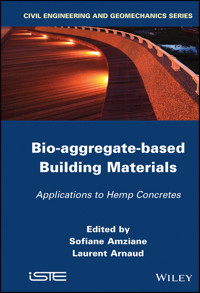
Using plant material as raw materials for construction is a relatively recent and original topic of research. This book presents an overview of the current knowledge on the material properties and environmental impact of construction materials made from plant particles, which are renewable, recyclable and easily available. It focuses on particles and as well on fibers issued from hemp plant, as well as discussing hemp concretes. The book begins by setting the environmental, economic and social context of agro-concretes, before discussing the nature of plant-based aggregates and binders. The formulation, implementation and mechanical behavior of such building materials are the subject of the following chapters. The focus is then put upon the hygrothermal behavior and acoustical properties of hempcrete, followed by the use of plant-based concretes in structures. The book concludes with the study of life-cycle analysis (LCA) of the environmental characteristics of a banked hempcrete wall on a wooden skeleton. Contents 1. Environmental, Economic and Social Context of Agro-Concretes, Vincent Nozahic and Sofiane Amziane. 2. Characterization of Plant-Based Aggregates. Vincent Picandet. 3. Binders, Gilles Escadeillas, Camille Magniont, Sofiane Amziane and Vincent Nozahic. 4. Formulation and Implementation, Christophe Lanos, Florence Collet, Gérard Lenain and Yves Hustache. 5. Mechanical Behavior, Laurent Arnaud, Sofiane Amziane, Vincent Nozahic and Etienne Gourlay. 6. Hygrothermal Behavior of Hempcrete, Laurent Arnaud, Driss Samri and Étienne Gourlay. 7. Acoustical Properties of Hemp Concretes, Philippe Glé, Emmanuel Gourdon and Laurent Arnaud. 8. Plant-Based Concretes in Structures: Structural Aspect - Addition of a Wooden Support to Absorb the Strain, Philippe Munoz and Didier Pipet. 9. Examination of the Environmental Characteristics of a Banked Hempcrete Wall on a Wooden Skeleton, by Lifecycle Analysis: Feedback on the LCA Experiment from 2005, Marie-Pierre Boutin and Cyril Flamin. About the Authors Sofiane Amziane is Professor and head of the Civil Engineering department at POLYTECH Clermont-Ferrand in France. He is also in charge of the research program dealing with bio-based building materials at Blaise Pascal University (Institut Pascal, Clermont Ferrand, France). He is the secretary of the RILEM Technical Committee 236-BBM dealing with bio-based building materials and the author or co-author of over one hundred papers in scientific journals such as Cement and Concrete Research, Composite Structures or Construction Building Materials as well as international conferences. Laurent Arnaud is a Bridges, Waters and Forestry Engineer (Ingénieur des Ponts, Eaux et Forêts) and researcher at Joseph Fourier University in Grenoble, France. He is also Professor at ENTPE (Ecole Nationale des Travaux Publics de l'Etat). Trained in the field of mechanical engineering, his research has been directed toward the characterization and development of new materials for civil engineering and construction. He is head of the international committee at RILEM - BBM, as well as the author of more than one hundred publications, and holder of an international invention patent.
Sie lesen das E-Book in den Legimi-Apps auf:
Seitenzahl: 458
Veröffentlichungsjahr: 2013
Ähnliche



















Contents
Foreword
Chapter 1. Environmental, Economic and Social Context of Agro-Concretes
1.1. Sustainable development, construction and materials
1.2. Standardization and regulation: toward a global approach
1.3. The materials: an increasingly crucial element
1.4. The specific case of concretes made from lignocellular particles
1.5. What does the term “Agro-concrete” mean?
1.6. Conclusions
1.7. Bibliography
Chapter 2. Characterization of Plant-Based Aggregates
2.1. Microstructure of the shiv particles
2.2. Particle Size Distribution (PSD)
2.3. Compactness and compressibility
2.4. Water absorption capacity
2.5. Bibliography
Chapter 3. Binders
3.1. Portland cements
3.2. Lime
3.3. Lime-pozzolan mixtures
3.4. Plaster
3.5. Summary
3.6. Bibliography
Chapter 4. Formulation and Implementation
4.1. Objectives
4.2. Rules of formulation
4.3. Examples of formulations
4.4. Installation techniques
4.5. Professional rules for buildings using hempcrete and hemp mortars
4.6. Bibliography
Chapter 5. Mechanical Behavior
5.1. Composite material
5.2. Modeling of the mechanical behavior
5.3. Toward the study of a stratified composite
5.4. Conclusion
5.5. Bibliography
Chapter 6. Hygrothermal Behavior of Hempcrete
6.1. Introduction
6.2. Heat conductivity
6.3. Hygrothermal transfers
6.4. Thermal characterization of various construction materials
6.5. Modeling of coupled heat- and mass transfers
6.6. Conclusions
6.7. Bibliography
Chapter 7. Acoustical Properties of Hemp Concretes
7.1. Introduction
7.2. Acoustical properties of the material on the basis of the main mechanisms
7.3. Modeling the acoustical properties
7.4. Application of the model to the acoustical characterization of shiv
7.5. Conclusion
7.6. Bibliography
Chapter 8. Plant-Based Concretes in Structures: Structural Aspect – Addition of a Wooden Support to Absorb the Strain.
8.1. Introduction
8.2. Preliminary test
8.3. Test on a composite panel of a wooden skeleton and hempcrete
8.4. Results and comparative analysis
8.5. Conclusions and reflections
8.6. Acknowledgements
8.7. Bibliography
Chapter 9. Examination of the Environmental Characteristics of a Banked Hempcrete Wall on a Wooden Skeleton, by Lifecycle Analysis: Feedback on the LCA Experiment from 2005
9.1. Introduction
9.2. Description of the products studied
9.3. Method for environmental evaluation of bio-sourced materials
9.4. Lifecycle Analysis on hempcrete – methodology, working hypotheses and results
9.5. Interpretations of the lifecycle, conclusions and reflections
9.6. Bibliography
List of Authors
Index
First published 2013 in Great Britain and the United States by ISTE Ltd and John Wiley & Sons, Inc.
Apart from any fair dealing for the purposes of research or private study, or criticism or review, as permitted under the Copyright, Designs and Patents Act 1988, this publication may only be reproduced, stored or transmitted, in any form or by any means, with the prior permission in writing of the publishers, or in the case of reprographic reproduction in accordance with the terms and licenses issued by the CLA. Enquiries concerning reproduction outside these terms should be sent to the publishers at the undermentioned address:
ISTE Ltd
27-37 St George’s Road
London SW19 4EU
UK
www.iste.co.uk
John Wiley & Sons, Inc.
111 River Street
Hoboken, NJ 07030
USA
www.wiley.com
© ISTE Ltd 2013
The rights of Sofiane Amziane and Laurent Arnaud to be identified as the author of this work have been asserted by them in accordance with the Copyright, Designs and Patents Act 1988.
Library of Congress Control Number: 2012954575
British Library Cataloguing-in-Publication Data
A CIP record for this book is available from the British Library
ISBN: 978-1-84821-404-0
Foreword
I am writing this foreword soon after finishing reading Sur la route du papier (On the Paper Trail) by Erik Orsenna: a wondrous journey, a lesson in history but also, and above all, a revelation about the workings of globalization. Paper is a harmless fibrous pulp – originally created from old rags, and later on and to date, from wood – which, filtered in the form of a thin layer, has enabled the most abstract creations of the human mind to be promulgated and become immortal.1 Though it has long been decried for the environmental consequences of its production, paper has now acquired a stamp of eco-friendliness thanks to the constant improvement of forestry and forest management, the manufacturing procedures and recycling. Is there any other “bio-sourced” material that has had a more profound impact on the development of civilization than paper? Assuredly not.
In another context, is there any other material that has made a greater contribution to the human race’s economic development for over a century, and to the mass development of infrastructures that that development has required, than concrete? Along with petroleum (for mobility) and silicon (for information and communication technology (ICT)), this artificial rock is one of the material foundations of our so-called developed societies. Concrete has enabled us to harness the energy from rivers, to build ports and airports, levees, sewage systems, roads, bridges, tunnels and more buildings than any other material.
Yet this material, a mixture of cement, sand and gravel which we simply call “concrete”, is in fact only one of the representatives of a broad category. After all, what is a concrete, if not a composite material made up of granular particles and a “glue” or binder holding everything together? According to that logic, bitumen concrete – that of the asphalt paving that now covers our roads in an almost monopolistic fashion – may be a serious challenger to cement concrete for the title of kingpin material in our infrastructures. Between them, these two materials alone constitute almost the totality of the “skeleton” of our lands. However, the intensive usage of these materials is not without consequences, either through greenhouse gas emissions or by the exhaustion of natural resources, be they fossil or mineral.
It might be tempting to leave the topic at that, unless for anecdotal purposes. However, there are at least two other concretes which merit our attention. The first is at least as widespread as cement and bitumen concretes on a worldwide scale; yet it is largely overlooked in our societies. Quite simply it is crude earth (not fired or baked like terracotta), which should, more correctly, be dubbed “clay concrete”, because it is its fine-grained constituent – clay – which, upon interaction with water as in the case of cement concrete, ensures the cohesion of the larger grains. In various forms – compacted, molded, pasted or plastered – it provides shelter to over a quarter of the world’s population. In France alone, the patrimony built of crude earth represents over a million houses. In the hands of master craftsmen and expert architects, the use of earth is fully capable of delivering on our desires for comfort and aesthetic beauty, whilst also satisfying our desire for eco-modernity.
This book is devoted to a fourth concrete, or rather a fourth family of concretes; original and promising from more than one point of view, which would seem to exhibit all the advantages of paper and earth, whilst still offering the convenience of use of our major industrial concretes. Contrary to popular opinion, sand and other granular (particulate) minerals are not an inexhaustible resource. Unless we wish to inflict irreparable damage on the environment, the time has come for recycling, or for using bio-sourced particulates, which is essentially the same thing. This is the path adopted by agro-concretes and, in particular, hemp concretes. France is the largest producer in Europe of Cannabis Sativa, whose fibers have been used to make rope for centuries. Yet this fast-growing plant, well adapted to temperate climates, harbors many other resources. Its stem, of a highly porous and therefore very lightweight wood, when ground up makes a surprising aggregate. Surprising, not on a mechanical level – the only level which truly counts for mineral aggregates, with cleanliness and shape in joint second place – but surprising, primarily, on a functional level: the level of hygrothermal equilibrium and acoustic properties.
Looking at the proliferation of synthetic materials available on the market, one might think that thermal, hydral and acoustic comfort is a domain in which the materials available – particularly when these materials are used in combination – have nearly reached the optimum desired. Polymer foams and organic and inorganic aerogels have extremely low thermal diffusivity and air permeability, which are difficult to better in the race toward very low values. Yet they lack inertia. When combined with other materials – or, even better, when a solid-to-liquid “phasechanging” material such as paraffin or a salt is added into the mixture – they (apparently) acquire the thermal inertia that they lack, by absorbing and reflecting the latent heat of fusion. In spite of their remarkable performances, these insulating materials still lack the “breathability” of certain natural materials, related to the capacity for absorption, transfer and phase-change of water in vapor and liquid form – all properties which depend on the characteristics of the porous space of the material and the thermal and hydric coupling which manifests itself in that space.
In the face of the complexity of combinations of synthetic materials employed to ensure an acceptable degree of comfort, agro-concretes and hemp concretes in particular offer a simple solution, which draws upon the exceptional porous texture – nearly always hierarchical – of certain plant structures. However, in order to take advantage of this property in terms of hygrothermal exchanges, the binder used must be able to work with the granular material rather than counteracting its properties.
The authors of this book present us with the elements, drawn directly from research, that help us comprehend the properties, function and formulation of agro-concretes. It is undoubtedly true that such concretes can never stand up to high- or ultra-high-performance mineral concretes, but it is not their intention to do so. First and foremost, they are intended to be insulating materials. Therefore, their primary intention is to sustainably ensure the comfort and durability of the dwelling, including the moderately dense dwellings towards which we are now tending.
This book has another virtue. It leads us to reflect on the physical bases for our criteria of “high environmental quality”, which are still largely founded upon the segmentation and selection of a few physical properties. The very least that can be said is that this manner of proceeding is not hugely well-adapted to materials in which there is extensive coupling between properties. This is precisely the case where bio-sourced materials are concerned. Let us hope that this book is distributed as widely as possible, so that a global, “performance-oriented” approach can finally emerge.
Henri VAN DAMMEIFSTTARDecember 2012
1 And, recently – but this is less noble – to package practically all the goods that we produce, in the form of cartons, boxes and bags.
Chapter 1
Environmental, Economic and Social Context of Agro-Concretes
Chapter written by Vincent NOZAHIC and Sofiane AMZIANE.
1.1. Sustainable development, construction and materials
After decades of virtuous and limitless consumption, the evidence is incontrovertible: human activities are not without impact on the environment and on humans themselves. It was not until 1987, with the Brundtland Commission [UNI 87], that this observation gave rise to a new concept: sustainable development. The report published by this commission, Our Common Future, defines the term as follows:
“Sustainable development is development that meets the needs of the present without compromising the ability of future generations to meet their own needs.” [UNI 87]
Thereafter, this concept has pervaded modern societies, ultimately becoming a political and economic issue, and an issue of the very survival of the human race… All human activities – industry, construction, agriculture, energy, transport, etc. – now have to deal with so-called “sustainable development” issues. The report unveiled by the United Nations Environment Program (UNEP) [UNE 09] constitutes an overview of the evolution of our societies since the publication of the Brundtland Report. The following quote, taken from that text, highlights the enormity of the challenge:
“There are no major issues raised in Our Common Future for which the foreseeable trends are favourable.” [UNE 07]
1.1.1. Environmental impacts of the construction sector
Above all, we must remember that the concept of sustainable development dealt with locally is often linked to problems on a worldwide scale, such as global warming or the gradual exhaustion of resources. These two criteria constitute the points of no return for our civilization.
As regards the climate, the scientific works of the IPCC1 serve as a referential framework. The second assessment report (SAR) published by this organization in 1995 [IPC 95] concludes that the “the balance of evidence suggests a discernible human influence on global climate”. A mere two years later, on the basis of this report and the UN Framework Convention on Climate Change [UNI 92], the international political debates culminated in the Kyoto Protocol [UNI 98]. This text commits the countries which have ratified it to reduce their GHG2 emissions by 5.2% in comparison to their level in 1990 over the period 2008–2012. The protocol came into force in 2005 and therefore will conclude in 2012. Owing to its use of nuclear and hydroelectric energy, which do not produce much GHG, France is committed to maintaining these levels of emissions.
For its part, the construction sector (residential and tertiary), much like the agricultural or industrial sectors, finds itself facing significant challenges in terms of reducing GHG emissions and energy consumption. The figures speak for themselves, but they must be analyzed seriously. Indeed, it is not always entirely clear what data have been taken into account when producing the figures, particularly in terms of drawing the distinction between a building’s function and its construction:
Lesen Sie weiter in der vollständigen Ausgabe!
Lesen Sie weiter in der vollständigen Ausgabe!
Lesen Sie weiter in der vollständigen Ausgabe!
Lesen Sie weiter in der vollständigen Ausgabe!
Lesen Sie weiter in der vollständigen Ausgabe!
Lesen Sie weiter in der vollständigen Ausgabe!
Lesen Sie weiter in der vollständigen Ausgabe!
Lesen Sie weiter in der vollständigen Ausgabe!
Lesen Sie weiter in der vollständigen Ausgabe!
Lesen Sie weiter in der vollständigen Ausgabe!




