


95,99 €
Mehr erfahren.
- Herausgeber: John Wiley & Sons
- Kategorie: Fachliteratur
- Sprache: Englisch
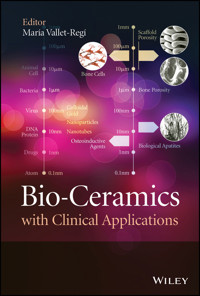
This publication offers a unique approach that links the materials science of bioceramics to clinical needs and applications.
Providing a structured account of this highly active area of research, the book reviews the clinical applications in bone tissue engineering, bone regeneration, joint replacement, drug-delivery systems and biomimetism, this book is an ideal resource for materials scientists and engineers, as well as for clinicians.
From the contents:
Part I Introduction
1. Bioceramics
2. Biomimetics
Part II Materials
3. Calcium Phosphate Bioceramics
4. Silica-based Ceramics: Glasses
5. Silica-based Ceramics: Mesoporous Silica
6. Alumina, Zirconia, and Other Non-oxide Inert Bioceramics
7. Carbon-based Materials in Biomedicine
Part III Material Shaping
8. Cements
9. Bioceramic Coatings for Medical Implants
10. Scaffold Designing
Part IV Research on Future Ceramics
11. Bone Biology and Regeneration
12. Ceramics for Drug Delivery
13. Ceramics for Gene Transfection
14. Ceramic Nanoparticles for Cancer Treatment
Sie lesen das E-Book in den Legimi-Apps auf:
Seitenzahl: 977
Veröffentlichungsjahr: 2014
Ähnliche



















Table of Contents
Cover
Title Page
Copyright
List of Contributors
Preface
Part I: Introduction
Chapter 1: Bioceramics
1.1 Introduction
1.2 Reactivity of the Bioceramics
1.3 First, Second, and Third Generations of Bioceramics
1.4 Multidisciplinary Field
1.5 Solutions for Bone Repairing
1.6 Biomedical Engineering
Recommended Reading
Chapter 2: Biomimetics
2.1 Biomimetics
2.2 Formation of Hard Tissues
2.3 Biominerals versus Biomaterials
Recommended Reading
Part II: Materials
Chapter 3: Calcium Phosphate Bioceramics
3.1 History of Calcium Phosphate Biomaterials
3.2 Generalities of Calcium Phosphates
3.3
In vivo
Response of Calcium Phosphate Bioceramics
3.4 Calcium Hydroxyapatite-Based Bioceramics
3.5 Tricalcium Phosphate-Based Bioceramics
3.6 Biphasic Calcium Phosphates (BCP)
3.7 Calcium Phosphate Nanoparticles
3.8 Calcium Phosphate Advanced Biomaterials
References
Chapter 4: Silica-based Ceramics: Glasses
4.1 Introduction
4.2 Glasses as Biomaterials
4.3 Increasing the Bioactivity of Glasses: New Methods of Synthesis
4.4 Strengthening and Adding New Capabilities to Bioactive Glasses
4.5 Non-silicate Glasses
4.6 Clinical Applications of Glasses
Recommended Reading
Chapter 5: Silica-based Ceramics: Mesoporous Silica
5.1 Introduction
5.2 Discovery of Ordered Mesoporous Silicas
5.3 Synthesis of Ordered Mesoporous Silicas
5.4 Mechanisms of Mesostructure Formation
5.5 Tuning the Structural Properties of Mesoporous Silicas
5.6 Structural Characterization of Mesoporous Silicas
5.7 Synthesis of Spherical Mesoporous Silica Nanoparticles
5.8 Organic Functionalization of Ordered Mesoporous Silicas
References
Chapter 6: Alumina, Zirconia, and Other Non-oxide Inert Bioceramics
6.1 A Perspective on the Clinical Application of Alumina and Zirconia
6.2 Novel Strategies Based on Alumina and Zirconia Ceramics
6.3 Non-oxidized Ceramics
References
Chapter 7: Carbon-based Materials in Biomedicine
7.1 Introduction
7.2 Carbon Allotropes
7.3 Carbon Compounds
References
Part III: Material Shaping
Chapter 8: Cements
Abbreviations
Glossary
8.1 Introduction
8.2 Calcium Phosphate Cements
8.3 Applications
8.4 Future Trends
8.5 Conclusions
References
Chapter 9: Bioceramic Coatings for Medical Implants
9.1 Introduction
9.2 Methods to Modify the Surface of an Implant
9.3 Bioactive Ceramic Coatings
9.4 Bioinert Ceramic Coatings
References
Chapter 10: Scaffold Designing
10.1 Introduction
10.2 Essential Requirements for Bone Tissue Engineering Scaffolds
10.3 Scaffold Processing Techniques
References
Part IV: Research on Future Ceramics
Chapter 11: Bone Biology and Regeneration
11.1 Introduction
11.2 The Skeleton
11.3 Bone Remodeling
11.4 Bone Cells
11.5 Bone Extracellular Matrix
11.6 Bone Diseases
11.7 Bone Mechanics
11.8 Bone Tissue Regeneration
11.9 Conclusions
References
Chapter 12: Ceramics for Drug Delivery
12.1 Introduction
12.2 Drug Delivery
12.3 Drug Delivery from Calcium Phosphates
12.4 Drug Delivery from Silica-based Ceramics
12.5 Drug Delivery from Carbon Nanotubes
12.6 Drug Delivery from Ceramic Coatings
References
Chapter 13: Ceramics for Gene Transfection
13.1 Gene Transfection
13.2 Gene Transfection Based on Nonviral Vectors
13.3 Ceramic Nanoparticles for Gene Transfection
References
Chapter 14: Ceramic Nanoparticles for Cancer Treatment
14.1 Delivery of Nanocarriers to Solid Tumors
14.2 Ceramic Nanoparticle Pharmacokinetics in Cancer Treatment
14.3 Cancer-targeted Therapy
14.4 Ceramic Nanoparticles for Cancer Treatment
14.5 Imaging and Theranostic Applications
References
Index
End User License Agreement
Pages
xiii
xiv
xv
xvi
xvii
3
4
5
6
7
8
9
10
11
12
13
14
15
16
17
18
19
20
21
22
25
26
27
28
29
30
31
32
33
34
35
36
37
38
39
40
41
42
43
44
45
46
47
48
49
50
51
52
53
54
55
56
57
58
59
60
61
62
63
64
65
66
67
68
69
70
71
73
74
75
76
77
78
79
80
81
82
83
84
85
86
87
88
89
90
91
92
93
94
95
96
97
98
99
100
101
102
103
104
105
106
107
108
109
110
111
112
113
114
115
116
117
118
119
120
121
122
123
124
125
126
127
128
129
130
131
132
133
134
135
136
137
138
139
140
141
142
143
144
145
146
147
148
149
150
151
153
154
155
156
157
158
159
160
161
162
163
164
165
166
167
168
169
170
171
172
173
175
176
177
178
179
180
181
182
183
184
185
186
187
188
189
190
191
192
195
196
197
198
199
200
201
202
203
204
205
206
207
208
209
210
211
212
213
214
215
216
217
218
219
220
221
222
223
224
225
226
227
228
229
230
231
232
233
234
235
236
237
238
239
240
241
242
243
244
245
246
247
249
250
251
252
253
254
255
256
257
258
259
260
261
262
263
264
265
266
267
268
269
270
271
272
273
274
275
276
277
278
279
280
281
282
283
284
285
286
287
288
289
1
291
292
293
294
295
296
297
298
299
300
301
302
303
304
305
306
307
308
309
310
311
312
313
317
318
319
320
321
322
323
324
325
326
327
328
329
330
331
332
333
334
335
336
337
338
339
340
341
342
343
344
345
346
347
348
349
350
351
352
353
354
355
356
357
358
359
360
361
362
363
364
365
366
367
368
369
370
371
372
373
374
375
376
377
378
379
380
381
382
383
384
385
386
387
388
389
390
391
392
393
394
395
396
397
398
399
400
401
402
403
404
405
406
407
408
409
410
411
412
413
414
415
416
417
418
419
421
422
423
424
425
426
427
428
429
430
431
432
433
434
435
436
437
438
439
440
441
442
443
444
445
446
447
448
449
450
451
452
453
454
455
23
193
315
457
458
459
460
461
462
463
464
465
Guide
Cover
Table of Contents
Preface
Part I: Introduction
List of Illustrations
Figure 1.1
Figure 1.2
Figure 1.3
Figure 1.4
Figure 1.5
Figure 1.6
Figure 1.7
Figure 1.8
Figure 1.9
Figure 1.10
Figure 1.11
Figure 2.1
Figure 2.2
Figure 2.3
Figure 2.4
Figure 2.5
Figure 3.1
Figure 3.2
Figure 3.3
Figure 3.4
Figure 3.5
Figure 3.6
Figure 3.7
Figure 3.8
Figure 3.9
Figure 3.10
Figure 3.11
Figure 3.12
Figure 3.13
Figure 3.14
Figure 3.15
Figure 3.16
Figure 3.17
Figure 3.18
Figure 3.19
Figure 3.20
Figure 3.21
Figure 3.22
Figure 4.1
Figure 4.2
Figure 4.3
Figure 4.4
Figure 4.5
Figure 4.6
Figure 4.7
Figure 4.8
Figure 4.9
Figure 4.10
Figure 4.11
Figure 4.12
Figure 4.13
Figure 4.14
Figure 4.15
Figure 4.16
Figure 4.17
Figure 4.18
Figure 4.19
Figure 5.1
Figure 5.2
Figure 5.3
Figure 5.4
Figure 5.5
Figure 5.6
Figure 5.7
Figure 5.8
Figure 5.9
Figure 5.10
Figure 5.11
Figure 5.12
Figure 5.13
Figure 5.14
Figure 5.15
Figure 5.16
Figure 5.17
Figure 6.1
Figure 6.2
Figure 6.3
Figure 6.4
Figure 6.5
Figure 7.1
Figure 7.2
Figure 7.3
Figure 7.4
Figure 7.5
Figure 7.6
Figure 8.1
Figure 8.2
Figure 8.3
Figure 8.4
Figure 8.5
Figure 8.6
Figure 8.7
Figure 8.8
Figure 8.9
Figure 8.10
Figure 8.11
Figure 8.12
Figure 8.13
Figure 8.14
Figure 8.15
Figure 8.16
Figure 9.1
Figure 9.2
Figure 9.3
Figure 9.4
Figure 9.5
Figure 9.6
Figure 9.7
Figure 9.8
Figure 9.9
Figure 9.10
Figure 9.11
Figure 10.1
Figure 10.2
Figure 10.3
Figure 10.4
Figure 10.5
Figure 10.7
Figure 10.6
Figure 10.8
Figure 10.9
Figure 10.10
Figure 10.11
Figure 10.12
Figure 11.1
Figure 11.2
Figure 11.3
Figure 11.4
Figure 11.5
Figure 11.6
Figure 11.7
Figure 11.8
Figure 11.9
Figure 11.10
Figure 11.11
Figure 11.12
Figure 11.13
Figure 12.1
Figure 12.2
Figure 12.3
Figure 12.4
Figure 12.5
Figure 12.6
Figure 12.7
Figure 13.1
Figure 13.2
Figure 13.3
Figure 13.4
Figure 14.1
Figure 14.2
Figure 14.3
Figure 14.4
Figure 14.5
Figure 14.6
List of Tables
Table 3.1
Table 3.2
Table 3.3
Table 3.4
Table 3.5
Table 3.6
Table 4.1
Table 5.1
Table 6.1
Table 6.2
Table 8.1
Table 8.2
Table 8.3
Table 8.4
Table 8.5
Table 8.6
Table 8.7
Table 8.8
Table 8.9
Table 10.1
Table 10.2
Table 11.1
Table 11.2
Table 12.1
Bioceramics with Clinical Applications
Edited by
María Vallet-Regí
This edition first published 2014
© 2014 John Wiley & Sons Ltd
Registered office
John Wiley & Sons Ltd, The Atrium, Southern Gate, Chichester, West Sussex, PO19 8SQ, United Kingdom
For details of our global editorial offices, for customer services and for information about how to apply for permission to reuse the copyright material in this book please see our website at www.wiley.com.
The right of the author to be identified as the author of this work has been asserted in accordance with the Copyright, Designs and Patents Act 1988.
All rights reserved. No part of this publication may be reproduced, stored in a retrieval system, or transmitted, in any form or by any means, electronic, mechanical, photocopying, recording or otherwise, except as permitted by the UK Copyright, Designs and Patents Act 1988, without the prior permission of the publisher.
Wiley also publishes its books in a variety of electronic formats. Some content that appears in print may not be available in electronic books.
Designations used by companies to distinguish their products are often claimed as trademarks. All brand names and product names used in this book are trade names, service marks, trademarks or registered trademarks of their respective owners. The publisher is not associated with any product or vendor mentioned in this book.
Limit of Liability/Disclaimer of Warranty: While the publisher and author have used their best efforts in preparing this book, they make no representations or warranties with respect to the accuracy or completeness of the contents of this book and specifically disclaim any implied warranties of merchantability or fitness for a particular purpose. It is sold on the understanding that the publisher is not engaged in rendering professional services and neither the publisher nor the author shall be liable for damages arising herefrom. If professional advice or other expert assistance is required, the services of a competent professional should be sought
The advice and strategies contained herein may not be suitable for every situation. In view of ongoing research, equipment modifications, changes in governmental regulations, and the constant flow of information relating to the use of experimental reagents, equipment, and devices, the reader is urged to review and evaluate the information provided in the package insert or instructions for each chemical, piece of equipment, reagent, or device for, among other things, any changes in the instructions or indication of usage and for added warnings and precautions. The fact that an organization or Website is referred to in this work as a citation and/or a potential source of further information does not mean that the author or the publisher endorses the information the organization or Website may provide or recommendations it may make. Further, readers should be aware that Internet Websites listed in this work may have changed or disappeared between when this work was written and when it is read. No warranty may be created or extended by any promotional statements for this work. Neither the publisher nor the author shall be liable for any damages arising herefrom.
Library of Congress Cataloging-in-Publication Data
Bioceramics with clinical applications / edited by Maria Vallet-Regi.
pages cm
Includes bibliographical references and index.
ISBN 978-1-118-40675-5 (cloth)
1. Ceramics in medicine. 2. Biomedical materials. I. Vallet-Regi, Maria, editor of compilation.
R857.C4B5534 2014
610.28'4—dc23
2013049091
A catalogue record for this book is available from the British Library.
ISBN: 9781118406755 (Cloth)
List of Contributors
Daniel Arcos
, Departamento de Química Inorgánica y Bioinorgánica, Facultad de Farmacia, Universidad Complutense de Madrid, Spain
and
CIBER de Bioingeniería, Biomateriales y Nanomedicina (CIBER-BBN), Spain
Alejandro Baeza
, Departamento de Química Inorgánica y Bioinorgánica, Facultad de Farmacia,Universidad Complutense de Madrid, Spain
and
CIBER de Bioingeniería, Biomateriales y Nanomedicina (CIBER-BBN), Spain
M. Victoria Cabañas
, Departamento de Química Inorgánica y Bioinorgánica, Facultad de Farmacia, Universidad Complutense de Madrid, Spain
Oscar Castaño
, Biomaterials for Regenerative Therapies, Institute for Bioengineering of Catalonia (IBEC), Spain
and
CIBER de Bioingeniería, Biomateriales y Nanomedicina (CIBER-BBN), Spain
and
Department of Materials Science and Metallurgy, Polytechnic University of Catalonia (UPC), Spain
Montserrat Colilla
, Departamento de Química Inorgánica y Bioinorgánica, Facultad de Farmacia, Universidad Complutense de Madrid, Spain
and
CIBER de Bioingeniería, Biomateriales y Nanomedicina (CIBER-BBN), Spain
Elisabeth Engel
, Biomaterials for Regenerative Therapies, Institute for Bioengineering of Catalonia, Spain
and
Department of Materials Science, Technical University of Catalonia, Spain
and
Biomedical Research Networking center in Bioengineering, Biomaterials and Nanomedicine (CIBER-BBN), Spain
Blanca González
, Departamento de Química Inorgánica y Bioinorgánica, Facultad de Farmacia, Universidad Complutense de Madrid, Spain
and
CIBER de Bioingeniería, Biomateriales y Nanomedicina (CIBER-BBN), Spain
Isabel Izquierdo-Barba
, Departamento de Química Inorgánica y Bioinorgánica, Facultad de Farmacia, Universidad Complutense de Madrid, Spain
and
CIBER de Bioingeniería, Biomateriales y Nanomedicina (CIBER-BBN), Spain
Miguel Manzano
, Departamento de Química Inorgánica y Bioinorgánica, Facultad de Farmacia, Universidad Complutense de Madrid, Spain
and
CIBER de Bioingeniería, Biomateriales y Nanomedicina (CIBER-BBN), Spain
Juan Peña López
, Departamento de Química Inorgánica y Bioinorgánica, Facultad de Farmacia, Universidad Complutense de Madrid, Spain
Soledad Pérez-Amodio
, Biomaterials for Regenerative Therapies, Institute for Bioengineering of Catalonia, Spain
and
Biomedical Research Networking center in Bioengineering, Biomaterials and Nanomedicine (CIBER-BBN), Spain
Josep A. Planell
, Biomaterials for Regenerative Therapies, Institute for Bioengineering of Catalonia (IBEC), Spain
and
CIBER de Bioingeniería, Biomateriales y Nanomedicina (CIBER-BBN), Spain
and
Open University of Catalonia (UOC), Spain
Antonio J. Salinas
, Departamento de Química Inorgánica y Bioinorgánica, Facultad de Farmacia, Universidad Complutense de Madrid, Spain
and
CIBER de Bioingeniería, Biomateriales y Nanomedicina (CIBER-BBN), Spain
María Vallet-Regí
, Departamento de Química Inorgánica y Bioinorgánica, Facultad de Farmacia, Universidad Complutense de Madrid, Spain
and
CIBER de Bioingeniería, Biomateriales y Nanomedicina (CIBER-BBN), Spain
Mercedes Vila
, Departamento de Química Inorgánica y Bioinorgánica, Facultad de Farmacia, Universidad Complutense de Madrid, Spain
and
CIBER de Bioingeniería, Biomateriales y Nanomedicina (CIBER-BBN)
Preface
What do I intend with this book? What do I want to convey to the readers? Who is going to be interested? Why have I chosen this organization of the contents?
All these questions have arisen before and during the writing of this book. In fact, the initial contents list has been modified a few times during the almost two years of this adventure.
One of my first targets is to stimulate interest in bioceramics and provide the tools for their development and commercialization with biomedical applications. This book aims to give a clear view of bioceramics, and tries to do it in such a way that the reader realizes that there is plenty still to be learned, as reflected in the book.
This book was born as a consequence of a kind invitation from Rebecca Stubbs, Senior Commissioning Editor at Wiley-Blackwell. At the start I had many doubts about editing a book and I let Rebecca know about it. However, her proposal made my head think about it, because undoubtedly it was a proposition that my heart could not reject, although common sense was telling me to stop. As you can see, finally, I became fully involved in this adventure of editing a book about bioceramics, which has been the central topic of my research and academic activities during the last 20 years. I wanted to write it with the senior members of my research team and a couple of friends who have also been working for a long time in this area, coordinated closely by myself to produce a textbook accessible to those uninitiated in this area, not simply a collection of chapters that are not integrated and coordinated in a single literary work. Of course, I also wanted to produce a book in which experts could go straight to the chapter in which they are interested without the necessity of reading the whole book. You, my friends the readers, will let me know if I have succeeded.
In the last two decades, Biomaterials has been incorporated into the studies of several universities. Beyond research activities, Master's courses, and PhD studies, this subject is also included in different degrees, such as Materials Engineering, Pharmacy, and so on. Bioceramics is one of the main topics in Biomaterials. In the last decade, the efforts of many groups involved in this new research area have led to new bioceramics and, in some recent cases, clinical applications. However, there is no text book dealing with the subjects proposed above in a complete way. This book will provide important information concerning the synthesis and characterization of bioceramics, aimed to be helpful for all those researchers involved in this field. I will pay special attention to explaining the relationship between the synthesis processes and the subsequent clinical applications, in an attempt to help students in the development of the new ideas framed in these topics.
The book has been divided into four parts:
Introduction
Materials
Material Shaping
Research on Future Ceramics
In the first part there is a general view of bioceramics, highlighting their reactivity and possibilities to regenerate bone, within a multidisciplinary context and especially nowadays in biomedical engineering. In the second chapter I give general and basic ideas of biomimetics. In both chapters there is a list of recommended reading to increase the reader's knowledge of these ideas.
Part II deals with the study of materials to fabricate bioceramics: from calcium phosphates, treated in Chapter 3; glasses, Chapter 4; and silica mesoporous materials, Chapter 5; up to inert bioceramics, described in Chapters 6 and 7.
Part III describes diverse possibilities of materials shaping. Thus, Chapter 8 deals with cements, Chapter 9 with coatings, and Chapter 10 with scaffolds fabricated as fibers, foams, or three-dimensional pieces.
Finally, Part IV tries to give a vision of new bioceramics still under research, some with future applications that are almost ready for commercialization, others needing a long time to come to market. It starts with an in-depth review of bone biology to be able to relate it to bone regeneration. This is followed by a chapter dedicated to ceramics for drug delivery, Chapter 12; another for gene transfection, Chapter 13; and, finally, Chapter 14 is dedicated to ceramic nanoparticles for cancer treatment.
This book will probably be read by a great community of researchers involved both in the academic and commercial world, such as materials engineers, chemical engineers, chemists, biologists, physicists, medical doctors, and so on. Amongst people from the academic community, undergraduates will have the chance of a first contact with top class research in the world of bioceramics and they might be motivated to start their scientific career in this topic. Postgraduates will have the opportunity to discover the important milestones in bioceramics and their application to biomedicine. Post-docs and senior researchers will use this book as the basis to start building their research. In this way, this book can be both an introductory and an advanced tool for academic researchers involved in the topic of bioceramics. As a second audience we could find medical doctors with further interest in implantable materials, and different companies interested in commercializing bioceramics with clinical applications.
I want to finish this preface by acknowledging Wiley editorial and Sarah Tilley, Senior Project Editor, for giving me the opportunity to editing this book, which collects my work in academia and research during the last 20 years, and also for giving their comprehensive technical support. Likewise, I want to express my greatest thanks to Dr. Fernando Conde, Pilar Cabañas, and Jose Manuel Moreno for their assistance during the elaboration of this manuscript. And, of course, I want to thank you, the reader of this book. I would love it to be useful to you to go forward in this passionate world of bioceramics, which undoubtedly can be of great usefulness in the society in which we live, helping in the health area and giving a better quality of life to everybody who could benefit from our research.
Now, my work as editor ends, in a book that I was always temped to write, but would never have had the guts to do it without the motivation of Rebecca. I am fully aware that some of the content of this book will be old in a few years, even before this book sees the light for the first time. This is only a small indication of the intensive and good research work carried out in the area of bioceramics, where the advance is constant and systematic. I wish that important solutions will be found and I also wish there will be companies brave enough to put them into practice in clinical applications.
And now, it is time for you, my dear reader, to enjoy the book, wishing from my heart that you like it and that it will be useful for you.
María Vallet-Regí
Part I
Introduction
Chapter 1Bioceramics
María Vallet-Regí
Departamento de Química Inorgánica y Bioinorgánica, Facultad de Farmacia, Universidad Complutense de Madrid, CIBER de Bioingeniería, Biomateriales y Nanomedicina (CIBER-BBN), Spain
1.1 Introduction
Ceramic materials are important sources of biomaterials for applications in biomedical engineering. Those ceramics intended to be in contact with living tissues are called bioceramics, and have experienced great development in the last 50 years. The medical needs of an increasingly aging population have driven a great deal of research work looking for new materials for the manufacture of implants. These are used to regenerate and repair living tissues damaged by disease or trauma. For specific clinical applications, mainly in orthopedics and dentistry, bioceramics are playing a key role.
In general, ceramics are inorganic materials with a combination of ionic and covalent bonding. The use of new ceramic materials represents an evolution of many aspects of mankind history. Many millennia ago, the possibility to store grains in ceramic receptacles allowed man to become a settler instead of a nomad hunter. Some centuries ago, the use of structural ceramics also brought great advances in the quality of life of man with the possibility of making clay bricks and tiles. Decades ago, ceramics produced a new revolution in the human way of life, with the development of functional ceramics in dielectrics, semiconductors, magnets, piezoelectrics, high temperature superconductors, and so on. In addition, ceramics have played an important role in improving the quality and length of human life through their use in biomaterials and medical devices.
Lesen Sie weiter in der vollständigen Ausgabe!
Lesen Sie weiter in der vollständigen Ausgabe!
Lesen Sie weiter in der vollständigen Ausgabe!
Lesen Sie weiter in der vollständigen Ausgabe!
Lesen Sie weiter in der vollständigen Ausgabe!
Lesen Sie weiter in der vollständigen Ausgabe!
Lesen Sie weiter in der vollständigen Ausgabe!
Lesen Sie weiter in der vollständigen Ausgabe!
Lesen Sie weiter in der vollständigen Ausgabe!
Lesen Sie weiter in der vollständigen Ausgabe!
Lesen Sie weiter in der vollständigen Ausgabe!
Lesen Sie weiter in der vollständigen Ausgabe!
Lesen Sie weiter in der vollständigen Ausgabe!
Lesen Sie weiter in der vollständigen Ausgabe!
Lesen Sie weiter in der vollständigen Ausgabe!
Lesen Sie weiter in der vollständigen Ausgabe!
Lesen Sie weiter in der vollständigen Ausgabe!
Lesen Sie weiter in der vollständigen Ausgabe!




