


103,99 €
Mehr erfahren.
- Herausgeber: John Wiley & Sons
- Kategorie: Fachliteratur
- Serie: Tribology in Practice Series (PEP)
- Sprache: Englisch
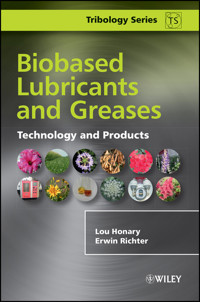
Due to the rise in petroleum prices as well as increasing environmental concerns, there is a need to develop biochemicals and bioproducts that offer realistic alternatives to their traditional counterparts; this book will address the lack of a centralized resource of information on lubricants and greases from renewable sources, and will be useful to a wide audience in industry and academia. It is based on 20 years of research and development at the UNI-NABL Center, and discusses the various types of vegetable oils available, comparing their characteristics, properties and benefits against those of typical petroleum oils as well as discussing common evaluation tests and giving examples and case studies of successful applications of biobased lubricants and greases. Whilst scientific and engineering research data is included, the book is written in an accessible manner and is illustrated throughout. * Focuses on an industrial application of lubrication technology undergoing current explosive growth in the global market. * Includes a detailed review of the material benefits of plant-based lubricants that include a better viscosity index and lubricity even at extreme temperatures, lower flammability due to higher flash points and lower pour points. * Covers the basic chemistry of vegetable oils as well as their profiles for use in lubricants and greases and environmental benefits. * Includes examples and case studies of where vegetable-based lubricants have been successfully employed in industry applications.
Sie lesen das E-Book in den Legimi-Apps auf:
Seitenzahl: 326
Veröffentlichungsjahr: 2011
Ähnliche



















Contents
About the Authors
Preface
Series Preface
Acknowledgements
Summary
Introduction
1: Historical Development of Vegetable Oil-based Lubricants
1.1 Introduction
1.2 Pioneering Industrial Uses of Vegetable Oils
1.3 Petroleum
2: Chemistry of Lubricants
2.1 The Nature of the Carbon Atom
2.2 Carbon and Hydrocarbons
3: Petroleum-based Lubricants
3.1 Introduction
3.2 Basic Chemistry of Crude Oils
4: Plant Oils
4.1 Chemistry of Vegetable Oils Relating to Lubricants
4.2 Triglycerides
4.3 Properties of Vegetable Oils
4.4 Vegetable Oil Processing
4.5 Oxidation
4.6 Winterization
4.7 Chemical Refining
4.8 Conventional Crop Oils
5: Synthetic Based Lubricants: Petroleum-Derived and Vegetable Oil-Derived
5.1 Esters
5.2 Esters for Biofuels
5.3 Complex Esters
5.4 Estolides
5.5 Other Chemical Modifications
6: Genetic Modification and Industrial Crops
6.1 Introduction
6.2 Industrial Crops
6.3 Future and Industrial Crops
7: Biobased Lubricants Technology
7.1 Determination of Oxidation Stability
7.2 Applications
7.3 Petroleum White Oil and Food Grade Lubricants
8: Performance Properties of Industrial Lubricants
8.1 Introduction
8.2 Common Performance Requirements
8.3 Heat Transfer Properties
8.4 Dielectric Properties
8.5 Fluid Quality
8.6 Fluid Compatibility
8.7 Hydrostatic Stability
8.8 Demulsibility
8.9 Oxidation Stability
8.10 Oxidation Stability for Mineral Oils
8.11 Elemental Analysis
8.12 Cleanliness
8.13 Storage and Shipping Temperatures
8.14 Tribological Performance of Biobased Lubricants
8.15 Metalworking Fluids
8.16 Biobased Engine Oils [5]
9: Biobased and Petroleum-Based Greases
9.1 How to Make Soap
9.2 Basic Process for Manufacturing Grease
9.3 Continuous Grease Manufacturing Process
9.4 Use of High Pressure-High, Shear Reaction Chambers (Contactor)
9.5 Vegetable Oil-based Greases
9.6 Grease Consistency
9.7 Grease Specifications
9.8 Friction and Wear Tests
9.9 Application Examples of Biobased Greases
10: Factors Affecting the Environment
10.1 Biodegradable and Biobased
10.2 REACH
10.3 Biodegradation of Oils
10.4 Toxicity Types and Testing Methods
10.5 Chronic Toxicity
10.6 Terrestrial Plant Toxicity
List of Useful Organizations
Useful Test Methods
Glossary
Index
Plates
This edition first published 2011
2011, John Wiley & Sons, Ltd
Registered office
John Wiley & Sons Ltd, The Atrium, Southern Gate, Chichester, West Sussex, PO19 8SQ, United Kingdom
For details of our global editorial offices, for customer services and for information about how to apply for permission to reuse the copyright material in this book please see our website at www.wiley.com.
The right of the author to be identified as the author of this work has been asserted in accordance with the Copyright, Designs and Patents Act 1988.
All rights reserved. No part of this publication may be reproduced, stored in a retrieval system, or transmitted, in any form or by any means, electronic, mechanical, photocopying, recording or otherwise, except as permitted by the UK Copyright, Designs and Patents Act 1988, without the prior permission of the publisher.
Wiley also publishes its books in a variety of electronic formats. Some content that appears in print may not be available in electronic books.
Designations used by companies to distinguish their products are often claimed as trademarks. All brand names and product names used in this book are trade names, service marks, trademarks or registered trademarks of their respective owners. The publisher is not associated with any product or vendor mentioned in this book. This publication is designed to provide accurate and authoritative information in regard to the subject matter covered. It is sold on the understanding that the publisher is not engaged in rendering professional services. If professional advice or other expert assistance is required, the services of a competent professional should be sought.
Library of Congress Cataloguing-in-Publication Data
Honary, Lou A. T.
Biobased lubricants and greases: chemistry, technology, and products/Lou A.T. Honary, Erwin Richter.
p. cm.
Includes index.
ISBN 978-0-470-74158-0 (cloth)
1. Vegetable oils as fuel. 2. Lubricating oils-Biocompatibility. 3. Plant biotechnology. 4. Biomass energy. I. Richter, Erwin William, 1934- II. Title.
TP359.V44H66 2010
665.5’385-dc22
2010025738
About the Authors
Lou A.T. Honary
Lou A.T. Honary is a professor and founding director of the University of Northern Iowa’s National Ag-Based Lubricants Center. He joined the UNI faculty in 1982 and in 1991, he initiated the research and development of soybean oil based lubricants and greases, leading to the creation of the UNI-NABL Center which is a premier applied research center specifically focused on biobased lubricants and greases.
As an applied researcher, Honary’s work has resulted in eight patents or co-patents, two more patents pending and numerous publications and presentations at national and international conferences. With the University of Northern Iowa’s Research Foundation, in 2000, Honary formed a commercial lubricants and grease manufactur- ing company that has brought to the market various biobased products and is recognized as a leader in biobased grease manufacturing. With over 40 commercial products currently on the market having their origins to his research, Honary is considered perhaps the most knowl- edgeable expert in the area of biobased lubricants and greases in the United States.
Professor Honary has served in leadership capacities in many organizations including memberships in the American Oil Chemist Society (AOCS), Society of Tribologists and Lubrication Engineers (STLE), Society of Automotive Engineers (SAE), National Lubricating Grease Lubricating Institute (NLGI), European Lubricating Grease Institute (ELGI), Ameri- can Society for Testing and Materials (ASTM), and National Fluid Power Association (NFPA). He has served as president of the Fluid Power Society (FPS), in Iowa, Member At Large on the Board of Directors of the International Fluids Power Association (IFPS), an Officer on the ASTM D02 Committee, and a member of the Board of Directors of NLGI, and chairman of a working group on the performance of biobased greases for ELGI.
Dr. Honary is an entrepreneurial professor recognized for his visionary approach to research. He has served on an Iowa Governor’s committees, on a congressionally mandated Biomass Research and Development Advisory Committee under the United States Department of Energy (DOE) and Department of Agriculture (USDA), and has served as a consultant to government and industry. Honary’s consulting work has included the preparation of a series of protocols for the creation of specifications for eleven biobased hydraulic oils for the US Department of the Navy to be used as a substitute for conventional hydraulic fluids.
As a passionate promoter of biobased products, Honary is known for many firsts, including patenting the first soybean oil based tractor hydraulic fluid, the first soybean oil based transformer oil, the first soybean oil based wood preservative as a creosote substitute, the first biobased solid stick lubricant for railroads, the first soybean oil based rail curve grease among many other products. In 2010 he and his team introduced a revolutionary efficient and safe heating process using microwave energy for the manufacturing of biobased greases.
Honary is a sought after speaker at various technical conferences owing to his ability to present complex concepts associated with biobased lubricants in a practical and easy to understand approach. This book provides an example of his passion for teaching by presenting an engaging and easy to follow approach, making this book both enjoyable to read and a resource to keep.
Erwin W. Richter
Erwin Richter was born in 1934. He taught inthe public schoolsof Michiganbeforereceiving his PhD in biochemistry from the University of Iowa in 1970. Hewas a member of the faculty at the University of Northern Iowa from 1963 to 1996. In 2001 he began working at The University of Northern Iowa’s National Ag-Based Lubricants Center as a consultant and continues there today. His interests in chemistry led him to develop his knowledge in the area of biolubricant development and testing. He is the author of several books and laboratory manuals dealing with chemistry education.
Preface
Vegetable oils present properties that are suitable for industrial and automotive lubricants and grease applications. They also present potential for usability as an alternative to petroleum when the demand for this finite resource is ever increasing.
The goals of writing this book include educating the next generation of students and professionals in this promising field to create and use biobased lubricants and greases. As the world petroleum resources continue to deplete, resource-poor and developing countries will have to struggle to compete to acquire high priced petroleum and petroleum products. Creating lubricant (and fuel) products from renewable sources can offer self sufficiency and potentially economical alternatives to the countries most desperate for these advantages.
After nearly two decades of research and development of biobased lubricants and greases, we hope that sharing our knowledge and expertise will help to create a long standing resource for the future. Both authors are seasoned professors and researchers, and the book is written in a way that it teaches the concepts for general audience comprehension. For more advanced concepts in biobased lubricants and greases, there are other sources that delve into the engineering and agronomical aspects of our work in greater detail.
With the hope of a better, greener future, we offer this book to our future generations.
Lou Honaryrwin Richter
Series Preface
There are increasing concerns and growing regulations over contamination and environmental pollution. One of the major concerns is pollution caused by mineral oils. As the world oil reserves are dwindling the pressures for finding alternative replacements are increasing. Vegetable oils are a biodegradable and renewable source of lubricants. Thus, they seem to be attractive candidates for the replacement of mineral oils. There are not many books on the market comprehensibly describing plant-based lubricants. Therefore, this book is a much welcomed edition to the Tribology Series. The major industrial crop sources of vegetable oils, together with their chemical and physical characteristics, are discussed in this book. The strength of this book is that it not only provides the comprehensive overview of oil producing plants but it also provides the details of oil testing and characterization methods. Potential applications of the vegetable oils are also shown. In this book, apart from vegetable oils, biobased greases, together with their specifications, are also described. Numerous detailed illustrations are very helpful in conveying the technical information to the reader. This book is richly illustrated with the colour pictures of oil producing plants, their seeds and equipment used in the oil testing and evaluation. Information is provided in an easily accessible form.
This book is a useful source of practical information on vegetable-based lubricants, their characteristics and testing methods. It is recommended for the readers working on plant-based lubricants and tribology. This book would be a useful reference to engineers, technicians and both under and postgraduate students with interest in plant-based lubricants.
Gwidon StachowiakUniversity of Western Australia Perth, Australia
Acknowledgements
I would like to acknowledge the resources and support provided by the University of Northern Iowa’s National Ag-Based Lubricants Center. Without access to a wealth of information on the development of biobased lubricants and products it would have been difficult to compile such an array of experiential information for this book.
Also, the staff at UNI-NABL Center were patient during the long hours of writing and were supportive of the efforts in any way possible. Special thanks are due to Meghan K. Reynolds who took the task of proofing some of the technical chapters for consistency and accuracy.
Additionally, special thanks are due to Mike Jensen and Alan Burgess of Environmental Lubricants Manufacturing, Inc. who selflessly shared hands-on and experiential information on their years of experience in commercially marketing biobased lubricants and greases. Their real life experiences in dealing with the post production and performance issues of biobased lubricants and greases have been helpful in pointing out the possible pitfalls of these new products.
My daughter, Shereena R. Honary deserves special thanks for proofreading the entire document for consistency and content. She was able to ‘remove Lou Honary’s accent’ from most of the chapters. Lastly, but certainly not the least importantly, my wife Carol deserves heartfelt thanks for her patience while I spend hours researching and writing the materials for this book.
I am also honored that my colleague, Dr. Erwin Richter was able to contribute a chapter to this book and adding his expertise in chemistry and the benefit of his years of teaching the subject. With his contribution, this book has become much more valuable.
Lou A.T. HonaryProfessor and Founding DirectorNational Ag-Based Lubricants CenterUniversity of Northern Iowa
Summary
This book includes the historical perspective of vegetable oils, their chemical overview, references and data on vegetable oil characteristics in comparison to petroleum oils, associated breeding and genetic modification technologies, and the successful products currently on the market. The book is written for the generalist and provides sufficient information in each area but is not too detailed as desired by the specialist. Illustrations and pictorial descriptions are utilized to help with conveyance of technical details. The book is unique in covering a combination of biobased lubricants and greases. This book should be a useful resource for a wide array of readers interested in understanding the potential of biobased lubricants.
Introduction
In the United States, national policy has created a new impetus for promoting and using biobased products. Moreover, worldwide demand for petroleum combined with geopolitical issues related to petroleum producing regions has created a more accepting market for alternative lubricants and greases.
The United States is the largest worldwide supplier of agricultural products and oilseeds like soybeans. Advanced mechanized farming, combined with superior seed and related technolo- gies, has made the country’s farmers highly efficient producers of commodity crops. Similarly, Canadian and European countries have invested significant amounts of resources in advancing production technologies for canola and rapeseed respectively. Other countries like Brazil have also increased production of oilseed crops like soybeans to the point of being competitive in the world market.
Since the authors’ research work has been mostly on the US-based crop oils, primarily soybean oil, the majority of the examples used in this book deal with soy oil. In industrial countries like the United States, an advanced and capable infrastructure for producing and shipping agricultural products has for many years resulted in surpluses far beyond the needs of their citizens. As a result, for years when petroleum prices were cheap, farmers in the United States, Canada, and Europe had to perpetually seek out new uses and new markets for their surplus agricultural products.
The authors performed their initial research at the University of Northern Iowa’s National Ag-Based Lubricants (NABL) Center funded by an association of the state of Iowa soybean growers. The goal of this research was to find new uses for the perennial surplus soybeans and soybean oil in non-food areas. As the worldwide demand for petroleum continued to increase, and petroleum prices skyrocketed, the cost parity for biofuels and bioproducts became a reality.
Materials presented in this book are derived from actual evaluation of properties of various vegetable oils and their performance as lubricants. In so far as is possible their performance properties are compared to their petroleum-based counterparts. The information presented includes data on the performance of vegetable oils including canola (and rapeseed) oil, sunflower oil, palm oil and some mixtures of these oils.
1
Historical Development of Vegetable Oil-based Lubricants
1.1 Introduction
Lubrication has probably been known to humans since the invention of the wheel. Recorded pictorial documents point to the use of water or edible oils as a lubricity liquid used by Egyptian pyramid builders when rolling large pieces of rocks on wooden rollers. Figure 1.1 shows a painting from an inner wall of the Tehuti-Hetep tomb. In this painting one worker is depicted as pouring a liquid in front of the rollers while others are pulling on the load [1].
Figure 1.1 Egyptian pyramid builder applying oil on rollers to reduce friction [1]. Reproduced with permission from Dowson, D., History of Tribology, 1998, John Wiley & Sons, Ltd, Chichester
The use of animal fat or vegetable oils for lubricating the wheels of horse-drawn carts and carriages has been well documented. It is not hard to visualize that the use of wooden axles and wheels, or even a combination of metallic wheels and axles would create friction and wear. Lubrication then becomes instinctive for human-made mechanical machinery, always seeking the most stable and efficient lubricant. Examples of these mechanical machines include Persian carriages, wind turbines running in wooden shafts, and waterwheels, all requiring some form of lubrication (Figure ).
Lesen Sie weiter in der vollständigen Ausgabe!
Lesen Sie weiter in der vollständigen Ausgabe!
Lesen Sie weiter in der vollständigen Ausgabe!
Lesen Sie weiter in der vollständigen Ausgabe!
Lesen Sie weiter in der vollständigen Ausgabe!
Lesen Sie weiter in der vollständigen Ausgabe!
Lesen Sie weiter in der vollständigen Ausgabe!
Lesen Sie weiter in der vollständigen Ausgabe!
Lesen Sie weiter in der vollständigen Ausgabe!
Lesen Sie weiter in der vollständigen Ausgabe!
Lesen Sie weiter in der vollständigen Ausgabe!
Lesen Sie weiter in der vollständigen Ausgabe!
Lesen Sie weiter in der vollständigen Ausgabe!
Lesen Sie weiter in der vollständigen Ausgabe!




