


9,59 €
Mehr erfahren.
- Herausgeber: Forum
- Kategorie: Geisteswissenschaft
- Sprache: Englisch
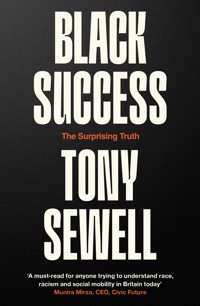
'Resounds with all the energy and enthusiasm of a man on a lifelong mission . . . This is a book for our time' The House Magazine 'A must-read for anyone trying to understand race, racism and social mobility in Britain today' Munira Mirza, CEO Civic Future 'As a black Briton with Caribbean heritage, this book spoke to my heart' Katharine Birbalsingh 'A game changer . . . Tony Sewell debunks the myths without ignoring the harsh facts of the black experience in Britain, and shows how we are all moving forward. Excellently researched and deeply motivating' Michael Dobbs, author of House of Cards In this truthful and often surprising book, Tony Sewell weaves together memoir and argument to explore the drivers of black success. He traces black people's hard-won achievements back to their source: family, education, hard work, discipline and the property market. He argues in favour of rejecting victimhood and low expectations and embracing high ambitions, drawing on a range of interviews and stories to offer a more exciting, sometimes visionary, new view of black life in Britain today. Five Star Reader Reviews 'Inspiring, uplifting and excellently written' 'The recipe for success … A call to the Black British community to focus on where we want to go' 'Essential reading … It gets five well-earned stars from me.
Das E-Book können Sie in Legimi-Apps oder einer beliebigen App lesen, die das folgende Format unterstützen:
Seitenzahl: 359
Veröffentlichungsjahr: 2024
Ähnliche




















ToDudley Young, Dennis (Emmanuel) Brown and my old friend William Shakespeare
Contents
AcknowledgementsIntroduction: from Brixton to the House of Lords Part 1: Education 1 Penge: The School of Hard Knocks 2 Finding My Voice: Gargoyles and Spider Gods 3 Cutting the Gordian Knot: The Hackney Learning Trust 4 Generating Genius: Six Steps to Success Part 2: Black Success 5 Nigeria’s Scrabble for Britain: The Reverse Missionaries 6 Nursing the Wrong Image: The Curious Journey of Mary Seacole 7 The Housing Lark: How a People Built Their Future 8 Odysseus and the Five Talents: Reaping What You Sow Appendix: A Summary of the Recommendations of the Commission for Race and Ethnic DisparitiesNotesOur crown has already been bought and paid for. All we have to do is wear it.James Baldwin
Walk like a champion.Buju Banton
I feel the same about the Black Lives Matter movement, its very name a sort of bleat. Give me Black Power, every time.Matthew Parris
Men at some time are masters of their fates:The fault, dear Brutus, is not in our stars,But in ourselves, that we are underlings.William Shakespeare
We run tings, tings nuh run we.Flourgon
Acknowledgements
I am happy to say that this work was inspired by several great souls. I need to thank Kathy Watson, who has been a wonderful guide throughout, making sure that wisdom prevailed over vanity. A special thanks must go to my publisher, George Owers, for having the faith and helping me through various drafts. Likewise to my agent Matthew Hamilton, who has been with me from the beginning. Particular thanks must go to Adele and Zindzi, who knew that after the storm would come the calm. And a special dedication to my old professor, the late Dudley Young, who continues to be in the wind and the trees.
Lastly I owe thanks to all those at Sewellness Park, Jamaica who worked hard while I was writing – save me some mangoes.
Introduction
from Brixton to the House of Lords
For black people of my generation, those three days and nights in April 1981 are defining. The Brixton Riots were nothing less than a black youth rebellion.
From the beginning of the month, the police had been using (and abusing) laws allowing them to stop and search people if they suspected wrongdoing. In so-called ‘Operation Swamp’, they focussed on areas with large numbers of black residents. Places like Brixton. There was an obvious point of friction between black unemployed youths and a police force that deliberately targeted them using the full force of the law.
At the time, I was in London – back from Essex University, where I was in my third year of a degree in English Literature. On the morning of Sunday 12 April, my brother and I were in church in Penge. Penge is just a few miles south of Brixton, but that day it felt like it belonged to a parallel universe. Our church had a predominantly white congregation. The riots were ongoing and, both at church and on the streets, people looked at me as though I were one of the rioters.
This was the biggest social justice issue of the day. But my church had no comment to make. As the sermon rang in my ears, I felt conflicted. Jesus, surely, would have been at the front of the crowds just a couple of miles down the road, screaming for fairness. He wouldn’t be here, praying for a better world from the safe cloisters of a church in Penge. He would be out there, making it happen.
After the service, my brother and I left the church both physically and emotionally, as we took the 20-minute bus ride to Brixton. The details of that weekend are well documented: injuries to police and civilians; buildings damaged; vehicles torched. The pictures are still terrifying: rows of police with riot shields, upturned cars, burning buildings, crowds of angry, frightened people.
That night, we met a policeman from Yorkshire. The Met had been bringing in police from all over the UK. He was in Brixton, and he was hopelessly lost.
‘Do you know how to get to Railton Road?’ he asked, in a thick Yorkshire burr. Of course I did. Railton Road, scene of the most violent clashes, was just a stone’s throw from my birthplace. Our exchange summed up the madness for me. People like this officer, probably well-meaning enough in their own way, were being brought in from distant parts of the country to police places and communities they had no understanding of.
When the dust settled, Lord Scarman was commissioned by the Conservative government to investigate the causes of the uprising, and race disparities in the UK more generally. His report was published in November 1981, and it can be seen as the first attempt to understand some of the issues facing the children of the Windrush Generation.
Out of the ashes of the riots came reporting of another kind, a different attempt to understand and sort through these issues: The Voice newspaper. This publication gave the descendants of the post-war generation an opportunity to speak about all the things that mattered to them most: love, humour, music, politics and money. Speaking to and for British-born African-Caribbean people, The Voice became one of the most successful black businesses in Britain, and one of the clearest examples of disadvantage being turned into advantage. I worked for the paper as a reporter, arts editor, commissioned historian and columnist spanning 15 years. Many top journalists have said to me that I was lucky to have such an exciting apprenticeship.
This book – and maybe my whole adult life – has been part of the process of exorcising the ghosts of 1981. We should never forget the terrible injustices; but at the same time, we need to clear a mental pathway for a new generation. We should avoid Pollyannaism, but we need to tell a new, positive story about ourselves. We need to be alive to injustice but celebrate our successes. All this requires skilful mental juggling. We must acknowledge the suffering of our parents and grandparents, but not be burdened with their trauma. Rather, inspired by their example of resilience and fortitude, we must create our own drive and agency in order to move forward.
The Voice is a perfect example of what I’m talking about. Out of the fires of the riots came a successful, forward-looking business. Despite the constant background hum of disadvantage, entrepreneurial people spotted an opportunity. When our mindset is driven by the great power of individual agency, by belief in our own abilities, we can achieve anything. This is what black success looks like. And here’s the surprising truth: it’s already happening.
*
In May 2020, George Floyd, a 46-year-old African-American man, was killed in Minneapolis. Police officer Derek Chauvin was later convicted of his murder. The video showing Floyd under the knee of a white policeman went across the world. In Britain, we staged copycat protests to the ones in America. Many of these protests were organised by Black Lives Matter and Stand Up to Racism. They quickly moved from the streets to companies, charities, local government and celebrities, all bending the knee in solidarity. All this happened amidst the first wave of Covid and the unprecedented UK lockdown.
When the dust settled, the then Conservative government commissioned me to write a report about race disparities in Britain. That report was published on 31 March 2021.
Two sets of disorders, two government reports, 40 years apart. There are enough similarities to make this the perfect moment to stop and reflect. What has changed? What real progress has been made since 1981? What are the differences between then and now?
There are some differences that I feel have been overlooked.
The Brixton disorders in 1981 were explicitly rooted in injustice in the UK. They were given international coverage, but nonetheless it was a local fight, arising out of distinctly British issues. The young people were predominantly African-Caribbean, the UK’s majority black population at the time. The protestors tended to be poor. They suffered from a lack of qualifications and high unemployment. The focus of their rebellion was heavy-handed police tactics.
The protests in 2020 were different. There were more white protesters, more students, more graduates, more professionals, more professional activists. Many of the young black people involved were not disaffected youth – unemployed, impoverished, pulled over by police time and time again. This cohort were at university or college, and they were protesting against ‘white privilege’ as well as police brutality. Anger was directed towards statues of nineteenth-century slave owners, names of school buildings, and the casting decisions of Hollywood movies. There weren’t specific laws or policies that protesters were seeking to reform – beyond changes to the KS3 curriculum.
The demonstrations were seen by some as a second, and long overdue, black awakening. During one demonstration, I saw a young black man dancing beautifully up the steps of St Martin-in-the-Fields in central London. The crowd was roaring him on as the loudspeakers played Diana Ross’s wonderful success anthem ‘I’m Coming Up’. To me, it summed up some of the complexity of that demonstration, and showed it was a world away from the uprisings of 1981. Did this protest of ‘black power’, inspired by events abroad, mean a new level of black militancy had taken over a new generation? No, this young man was more likely to be at university, heading to a great degree and a top job in the City. The numbers show that he was more likely to go into higher education than any low-income white youth in the north of England.
Some 40 years earlier, the Scarman Report had identified the Brixton disorders as a spontaneous eruption fuelled by a combination of general resentment and some specific incidents. Scarman placed them within a context of ‘complex political, social and economic factors’. He noted the problems of racial disadvantage and inner-city decline. Action was needed, and that action needed to be ‘urgent’. According to his report, ‘institutional racism’ did not exist, but there needed to be a policy of ‘direct coordinated attack on racial disadvantage’.
What made 2020 different? Instead of a recession, we had lockdown. Police actions triggered the protests, but those actions took place on the other side of the world. It wasn’t always clear how the American inciting incident fitted into the British context. Sometimes it felt as if we had borrowed another country’s racial tensions and added them to our own.
I was asked by the government to use this opportunity to have a serious conversation about race disparities in Britain. The rhetoric of the British protests needed to be tested against the facts and the data. What was the real situation of the black community? I became the chair of a new Commission on Race and Ethnic Disparities. The remit was straightforward: to review racial disparities focussing on areas such as poverty, education, employment, health and the criminal justice system.
After a long period of research, we offered our findings. The Report made two particularly important observations:
That there are indeed disparities for many groups relating to education, employment, crime and health – but that the majority of these did not originate from racism.That racism does still exist: the Report found that there are historic issues of trust, which remain real and important – but that things are improving, particularly in education and employment.The Report was received by some as an attempt to deny the reality of institutional racism. There followed what felt like a campaign to discredit our work and undermine its findings. However, there were also many who could see that this was a radical report with common-sense findings, and the government began to put into place many of the recommendations. Because they made sense. For example, the UK soon established its first Office for Health Disparities, which tackles issues such as high mortality rates for black women in childbirth.
The Report found many examples of black success. For example, in 2019 the average GCSE attainment score of eight for black African pupils was above that of white British pupils. 66.9% of black African young people had progressed to higher education by the age of 19. In key health outcomes, including life expectancy, overall mortality and many leading causes of death, ethnic minority groups have better outcomes than the white population. People with African-Caribbean heritage are more likely to own their own homes than other ethnic minority groups. Black women have better employment rates than their white counterparts and the ethnicity pay gap is decreasing (in 2019 it was 2.3% – down from 8.2% in 2015). Among the under-30s who are employed, there are no significant pay gaps for any ethnic minority group.
It’s not a bad tally at all, especially for a group that has only lived in the UK in significant numbers since the 1950s. Yet, the prevailing narrative is one of riots, gloom and despair – interspersed with flashes of sporting or musical genius. In the popular consciousness, black people seem to live at one of two poles – an inner-city world of failure, violence and criminality, or the red-carpet world of celebrities, excellence and awards.
In this book I want to tell other stories, about other kinds of excellence. The quiet everyday success of living a healthy life and buying property, of doing well at school and raising a family. The triumphs of independence and agency – of the individual and the entrepreneur.
In these success stories, I thought I might find not just a balance to the negative stories, but also a roadmap for the black community as a whole. Indeed, these stories provide a template that could be used by anyone, irrespective of their background and ethnicity.
Currently, there is a culture – often coming from well-meaning, but potentially patronising white people – that says black people have no control and no agency over their own experiences. It says that they are fixed in a system that is inevitably and always hostile to them.
I think that is wrong.
You can, and must, point to exceptions to the positive trend. For instance, the ‘hostile environment’ deliberately created by ex-prime minster Theresa May’s immigration policies. The hostile environment resulted in a number of longstanding residents being deported or unable to participate fully in our society. This was wrong, a clear injustice. The government was right to compensate the victims. However, even in this case the vast majority regularised their status once they were aware of the change in the law. The British government should have been more aware of how this would impact those in Caribbean communities. Still, it would have been useful to hear also from those who did manage to change their status. There is a risk that the Windrush scandal has made the black community out to be helpless and hapless – people with no agency in the world around them.
*
I am writing this book in the same year that the iconic black actor Sydney Poitier died, at the age of 94. Poitier was a man who rarely lost his cool, but in 1968 he finally snapped:
You could ask me many questions about many positive and wonderful things that are happening in this country, but we gather here to pay court to sensationalism. We gather here to pay court to negativism … you ask me one-dimensional questions that fall continually within the ‘negro-ness’ of my life. I am artist, man, American, contemporary, I am an awful lot of things, so I wish you would pay me the respect due and not simply ask me about those things.
Poitier points to a key plank in my theory of black success. It is about not allowing race to dominate your humanity.
This is also the view taken by the educator Ian Rowe, who like me comes from Jamaican stock but in his case made a mark in America. In some ways Ian’s career has a wonderful resemblance to my own. When he told me that my Report and my interviews had changed his life, I felt flattered that Tony Sewell, a poor boy from Brixton, could have an impact on one of the big thinkers in America.
Rowe is six years younger than me, and in the 1960s his parents, like mine, migrated from Jamaica – in their case to Brooklyn, New York City. My parents had made a similar journey when they took the plane to London in the 1950s. According to Ian, the family ‘moved up’ and ultimately settled in Laurelton, a white middle-class neighbourhood. We likewise graduated from Brixton to a mixed but predominantly white area called Penge. Like Laurelton, Penge would see an increase in its black population but never really suffered the major racial tensions that marred Ian’s American suburb. His high school, like mine, closed down after it was marked as one of the worst in the district.
Ian’s parents didn’t go straight to America. As his father, Vincent, wanted to pursue a degree in engineering, he travelled first to England, where he was able to work on the buses and study part-time. He sent for his love, Eula, who came to Britain to work as a nurse in 1955. And seven years later Ian was born, so technically he is a Londoner. According to Ian, the next adventure was to go to the United States, where his dad got a job at IBM and his mum worked as an analyst with the Manufacturers Hanover Bank. At this point in his story, it struck me that Ian was on his way to becoming part of the Jamaican middle class in America; by contrast, in 1960s Britain most Jamaicans were stuck in the low-income class and only a minority were able to move up. I always wondered how Ian would have progressed if his parents hadn’t moved to America. I am convinced that, like me, he would have taken advantage of the biggest opportunity on offer and got himself a free university education. Of course, with the introduction of student fees in 1998, things have changed from those good old days.
The story of Ian’s parents also helps to demystify some of the tropes around the Windrush legacy. They were not enticed by some noble calling to the mother country, any more than my own parents had been. They were simply running towards better economic conditions and away from the boredom of the Jamaican countryside. Money and adventure. They were not conned, they just took a risk; and in their case, as in that of my parents, it paid out for them and their children.
Like me, Ian benefitted from three pillars of security that helped him forge his way to success. The first was his family and the extended Jamaican family in New York; the second was his church and Christian upbringing; and the third was an innate passion to make his own way and not allow any negativity to thwart his goals. Ian calls this third factor ‘Agency’ and sees it as having two main characteristics: ‘agility’ and an underlying vision or agenda.
For Ian, as for me, the big exam question was not the fight for freedom but how to be free. The three pillars provide an answer to the question and a framework for living, one that Ian calls FREE – an acronym for Family, Religion, Education and Enterprise.
During the aftermath of the publication of my Report, I was the subject of an excellent interview in the Wall Street Journal. Ian read the story and was moved to get in touch. This is how, in a recent email, he recalls the influence of that article:
The first time I encountered Tony Sewell was in the pages of the Wall Street Journal. Here was a fellow black Jamaican in his adopted homeland – in Sewell’s case Great Britain, in mine the United States of America – engaged in a similar struggle to make sense of his country’s racial disparities, working to determine the best path forward to drive upward mobility.
America was in the midst of a national reckoning on race in the aftermath of the death of George Floyd, triggering Britain to embark upon a racial journey of its own. In ‘The Report That Shook Britain’s Race Lobby’, Sewell shared with the WSJ his experience as the Chairman of Britain’s Commission on Race and Ethnic Disparities. The expectation was that the commission would invoke the usual suspects of white privilege and systemic bias to be the all-purpose explanations for any instance of racial inequality.
Instead, the report ‘concluded that while Britain isn’t yet “a post-racial society”, neither is it any longer a place where “the system” is “deliberately rigged against ethnic minorities”’. Sewell and his 10-member commission, almost all of whom were ethnic minorities, offered a different hypothesis: ‘In many areas of investigation, including educational failure and crime, we were led upstream to family breakdown as one of the main reasons for poor outcomes. Family is also the foundation stone of success for many ethnic minorities.’
I felt I had met in Sewell a kindred spirit. As a Senior Fellow at the American Enterprise Institute, I researched the force that was typically at the heart of the perpetual cycle of economic disadvantage that has plagued certain communities. And in my own experience leading public charter schools in low-income communities in the Bronx, I had come to a similar realization: Family structure, and in particular the prevalence of single-parent homes, was a far more predictive factor driving poverty.
In time, I had the pleasure of meeting Sewell, and invited him to participate in a discussion on black advancement drawing on [Thomas Sowell’s book] The Economics and Politics of Race. Ultimately, I quoted Sewell in my own book Agency: ‘As our investigations proceeded, we increasingly felt that an unexplored approach to closing disparity gaps was to examine the extent individuals and their communities could help themselves through their own agency, rather than wait for invisible external forces to assemble to do the job.’
In 2021 I received an email from America asking me to contribute to what turned out to be a wonderful conference in Texas. Glenn Loury and Shelby Steele were heading the ticket and I proudly played for England. So many of the audience had already read and loved my Report that I felt like one of those black British actors getting a leading film role.
Not only did the conference go well, but Ian Rowe invited me to his own conference in Salt Lake City, Utah. It was here that we were able to perform a double act, sharing our rich Jamaican roots and preaching the new gospel of Agency. The American audience were intrigued to hear two black men from different continents preaching a similar message about family, enterprise, education and religion. Where our stars are truly aligned is that we both ended up running top education programmes for young people in the inner cities. Ian managed to run one of the best Charter school programmes in America, and I have delivered great outcomes with our STEM Generating Genius programme in Britain. We are now planning a joint US and UK speaking tour, where we hope to inspire a generation about the real power of Agency.
Derek Walcott, the Nobel prize-winning St Lucian poet, was one of the best chroniclers of the Caribbean, colonialism and the role of memory. His essay ‘Café Martinique’ is an examination of how the past holds on to us and holds us back. At the end of the essay, he writes, ‘The century has turned.’To those who can’t let go of the past, he says, ‘It is you who are waiting. And only you know what for. Meanwhile the rest of us have things to do. We move ahead.’
*
How did Britain’s 1950s Caribbean settlers find a route to prosperity? Why are Nigerians achieving so highly in the education system? Why do Jamaicans run so fast? How is Britain producing a conveyor belt of young black scientists?
So much of what we think we know about ‘black communities’ is rooted in misery and victimhood. This is not to diminish the reality of racism, but as Jamaican singer Dennis Brown would say, ‘What about the half that has never been told?’ This book tells that half.
Who is it for? People who are fair-minded. People who haven’t got a political axe to grind, who are open to listening to facts and examining the data. People who would like to hear a different story from the usual one about endless racism and relentless discrimination. People who would like to see which other more optimistic stories might exist and how they might shape their own lives in a positive direction. I hope, most of all, that people will read this book and feel inspired.
The book is divided into two parts. In the first we will look at my experiences in the education sector, and my own experiences of education and work, to see what are the ingredients that determine black success. I’ll walk you through a roughly chronological version of my life, taking in my own schooling, my time as a columnist and academic, and my experiences taking over a failing education system in East London and running an education charity for gifted black boys in STEM.
In the second half of the book, we look at examples of black success in surprising places. We’re going to celebrate that success and ask why examples of success in the mainstream – for instance in home ownership and entrepreneurship – are often overlooked, or tweaked to make a different story. To move ahead, there are things that black people must do. We must take hold of the fact that society is more open than it was in the past, especially in terms of legalities. We must believe that our actions can influence our outcomes. There are opportunities out there and we must take hold of them. That might mean going outside our own community, to the places where we imagine we don’t belong. This might be uncomfortable. But a degree of discomfort is an essential ingredient to success. As are education and training. Bringing things full circle, we’ll examine some of the ways in which black people, especially the children of African immigrants, have excelled in the education system. We’ll also look at class. Low-income white people have a lot in common with their black peers. Identity politics has got in the way of finding this potentially progressive common ground.
We need, then, to enjoy the successes of black people and, where possible, to describe and reproduce their steps so more black people can succeed. If readers take away the belief that, through their own effort and imagination, they can change their circumstances and their world while still holding onto a sense of social justice, I will be happy.
For that to happen, we must let go of the narrative that our fate is fixed by a hostile society. I want to see if there can be a way of acknowledging the injustices of the past while leaving them in the past, so that they are not allowed to blight our presents and our futures. Many battles have been fought and won. Black people suffered in the past – on the Middle Passage, in Caribbean plantations, in a hostile Britain – and yet many people broke through and escaped, fought back and challenged discrimination. It’s not that we should ignore past atrocities, but we don’t have to be paralysed by them.
The quote that guides this book comes from James Baldwin. It was also used by Maya Angelou. ‘Your crown has been bought and paid for. Put it on your head and wear it.’
Part 1
Education
1
Penge
The School of Hard Knocks
I went to a bog-standard secondary modern school in the 1970s – which is to say a failing school. Most of us graduated in ‘football and fighting’.
I had to get my classical education in alternative spaces. I point to four: my local library, where I worked part-time as a librarian; reggae music; Clive Lloyd’s West Indian cricket team; and my local Church of England Sunday school.
This education occurred against a backdrop of open racism, which for me mostly took the form of name-calling on the streets. It was reinforced by blatant and constant police harassment. Many of my generation were traumatised by this experience. Many have never, and will never, recover.
But, for myself, this early bout of racism didn’t traumatise me, slow my development or dent my confidence. Why? Some would say I was lucky, others that I was just thick-skinned. I don’t think it’s either. The real saviour was Sunday school and those instructive stories from the Good Book. They took me away from race and reminded me of my greater humanity.
My Sunday school was predominantly white and middle class. Through the church, I entered a world that was more aspirational than the one I was familiar with at my failing school. Yes, my fellow Christians were guilty of ignoring the wider racism in society, but I didn’t need their empathy. I only needed my fellow churchgoers to be themselves – to be fair, decent and loving. It was a wonderful escape from the madness around us.
Sunday school was my early university. Along with Greek mythology, it gave me a good grasp of the classics. For me, there was never a gap between a so-called Eurocentric grounding and an Afrocentric one. What I experienced was a wonderful synergy: I had white Sunday school coupled with the Jamaican reggae revival of the 1970s. Here too I found Judaeo-Christian stories and beliefs. On Sunday morning, I would learn the story of the children of Israel making their Exodus from Babylon – then go home to jump up to a reggae version of the same story. The songs of Bob Marley and Desmond Dekker meant that we had great theology and great pop music blaring out of the West Indian front room.
I saw myself as culturally privileged and felt very sorry for the white children in my school. They never went to church, and they were deeply envious of the new Jamaican popular culture that was sweeping London. I literally had the best of both worlds.
Although this story is personal, I think a lot of people will identify with it. I’m sure plenty of people will nod along in agreement when I say that there are, ironically, advantages to coming from a place that seems to have few or no advantages. We’ve been told a particular story about these things and I want to tell another one – starting with my own.
Straight outta Penge
Penge is a south-east London suburb. It sits within the London Borough of Bromley and is located 7.1 miles south-east of Charing Cross.
The Rolling Stones’ Bill Wyman went to the local grammar, Kentwood School, and his band was supposedly formed above the sweet shop opposite. David Bowie, born in neighbouring Beckenham, wrote the lyric, ‘It’s a very special knowledge that you’ve got my friend; you can walk around in New York while you sleep in Penge.’
For Bowie, Penge was a place you disengaged from. I lived there for more than a decade. I was born in Brixton, the spiritual headquarters of the black British community; it was there that many Caribbean migrants settled from the 1950s onwards. But my mother wanted to break away from the inner city and looked to the sunny uplands of sleepy Penge. So, we moved there when I was about four, and I stayed until I went to university.
Penge was contradictory. It had a mainly poor, majority white population at the time; yet when it came to elections, we always sent back a Conservative MP. That was because the borough was conjoined with our richer and bigger neighbour, Beckenham, whose residents would never dream of voting Labour.
For my inner-city cousins in Brixton or other black enclaves such as Hackney, Tottenham or Harlesden, Penge was ‘the countryside’. Why would anyone live out there, especially if you were black? They had a point. In the 1960s and 1970s, overt racism was wide and bold. Outside of the inner city, we had our share, mainly the constant shouting of the n-word by people driving by. This happened most intensely when I was at primary school. The issue of open racial abuse in the 1970s was tough – not only for me, but for my parents, who couldn’t really protect us from it. It wasn’t just National Front hooligan types. It also came from older people, who would sneeringly tell us: ‘Go back to your own country’. The idea of being black and British seemed to pose a problem for many people. Asked ‘Where do you come from?’, many of us got tired of the continued interrogation if we said London or Penge, so simply said Kingston, Jamaica, even though we had never been there. But as time wore on, Penge improved. Eventually, we found it to be a warm community, full of characters.
Our only contact with our grandparents came in the form (pre-internet) of blue airmail letters from Jamaica. The writers were my maternal grandmother and my paternal grandfather. We would rush downstairs to grab the letters and look in amazement at their beautiful handwriting and flawless grammar. We, on the other hand, were stuck in the so-called mother country barely literate after years in London state schools. The idea of being constrained by a ‘white curriculum’ and needing to go on a journey of black enlightenment to escape the influence of dead white men would have seemed ridiculous to me – I wanted an education like my grandparents.
I went to secondary school in the 1970s, the age of flared trousers, the three-day week, paraffin heaters and the 11-plus exam. Undoubtedly, the last of these had the greatest effect on society and on me. To understand my history, you need a quick tour of this wonderful British institution. In many ways, it’s as strange as the history of our monarchy. It was also a great commodity that Britain exported to its former colonies, many of whom still cling to it with a passion.
The exam was introduced in 1944, when, under the Butler Education Act, the schooling system in the UK was rearranged. All children aged between five and ten attended primary schools, and then, at the age of 11, they took an exam: depending on whether they passed or failed, they then went to an academic grammar school or to a secondary modern or technical institution.
Many politicians felt that the 11-plus system was unfair on less academically minded children. What seems clear in retrospect is that the move towards a comprehensive system was always based on a drive towards equality rather than educational considerations.
In many ways, the 11-plus exam represented the hidden beast of England – our class system, in which everyone was supposed to know their place. As we would sing in assembly, in the now redacted lines of ‘All things bright and beautiful’:
The rich man in his castle, the poor man at his gate,
God made them, high or lowly, and ordered their estate.
I failed the 11-plus and ended up in a secondary modern. Halfway through my time there, it became a comprehensive school.
Looking back, I still feel sorry for the new first-years at my school, standing around awkwardly in their neatly pressed uniforms as they were targeted by the thugs in the fourth form. One particular image stands out in memory: a tiny 11-year-old standing alone in the distant playing field and this small dot being eaten up by a stampede of about a hundred boys. When they had finished, they left a forlorn figure barely able to stand, uniform in shreds, his bags and books strewn across the field.
When I saw that, I was determined to escape. But how? Most young people left school at 16 and went straight to work. If you were black, you went to the local college to do City and Guilds courses. University was a place for the middle class.
The superhead of TV’s Educating Essex, Vic Goddard, who was brought up in Penge and went to my school, says in his book, ‘I was very lucky because the school was tough; all boys, culturally diverse, testosterone-laden and lots of them bussed out to the ’burbs from inner London.’
This idea of it being ‘lucky’ to attend a failing school is an interesting comment. But I know what Goddard means. Toughness made us. We were the first guinea pigs of the new comprehensive system and we had to fight to get out of the cage. The school gave Vic Goddard the drive and empathy he needed to be a great headteacher. It inspired me to be part of a future movement that would radically change the comprehensive school system forever. Disadvantage was turned to advantage and that became personal and social change.
The little boy caught up in that stampede had a rude awakening. He may have had some apprehension about his new school, but he couldn’t have expected that kind of battering. And although Kentwood did have people like Vic and myself who succeeded, a lot of students failed and ended up going nowhere, their dreams and ambitions scattered around them. The new comprehensive system couldn’t carry the majority across the line. The schools were no better than the secondary moderns they were set up to replace.
When I first went to Kentwood, I felt cheated by the unfairness of the 11-plus system that had dumped me into a substandard secondary school. However, it is interesting to look back at this period using our current lens. Today, people talk about ‘white privilege’. My school was two-thirds white and a third African-Caribbean. Comprehensive education didn’t discriminate: the schools gave an equally terrible education to all.
There was, however, one obvious disparity that was clearly an example of structural racism. At my school, when you asked most of the white boys where they were going to work, they either talked about some sort of building trade with their uncle, or getting a job at the DailyMirror, in the print department. The unions had full control, not just of wages and conditions, but also over who was hired. They ran a corrupt network that ensured that the sons of the print-workers were next in line for new jobs. One of the practices that worked against black applicants was the reliance of companies on word-of-mouth recruitment, as opposed to advertising or using the careers service.
Margaret Thatcher was elected with a mandate to ‘tame the unions’ after Labour’s Winter of Discontent in 1978–79. Britain had become a miserable place with endless strikes, rubbish on the streets, and a general sense of doom and gloom. London in particular was in need of a makeover. Thatcher implemented new labour laws that outlawed closed shops and secondary picketing and made secret ballots compulsory, instead of mass show-of-hands voting. It was Rupert Murdoch, the newspaper baron, who first used these new laws to break the unions’ power base. This was most visible when he was able to cut his labour costs by using new computerised technology at his Wapping plant in East London. Thatcher cut nepotism from an organisation that was meant to stand for fairness and equality.
There were other barriers that blocked access to employment. The key one was skills. Following our terrible schooling, many of my generation lacked the skills to succeed in a modern economy. This continued into the next generation. Even though some white boys did have escape routes to employment, as mentioned, there was still an enormous class barrier in the 1970s and 1980s. Both black and white youth suffered from a poor education system and slim employment prospects.
So, with all these problems in mind, how did I, and many others like me, manage to live successful and happy lives? The reasons are complex and counter-intuitive; they suggest that conventional myths about black success need to be unpicked.
So, let’s take a tour of Penge, and I’ll offer a brief autobiography – to unpack the secrets of black success.
The Good, the Bad, and the Library
We start on the famous Maple Road. Back in the 1970s, most of our markets were uncovered. They were the source of all our fruit and vegetables. I remember Davis the florist, which must have supplied flowers for countless Penge weddings, birthdays and funerals. All the black people in Penge seemed to know each other, but the town generally had a feeling of togetherness. No one could pull any airs and graces: we were all low-income and it gave us a sense of solidarity.
My mother was one of the dons in Penge market. Everyone knew her. Shops and traders knew not to cross her. They called her by her first name and were worried when they didn’t see her. At the top of the road, George the grocer had to have my mother’s Uncle Ben’s rice ready. The lady who sold the eggs looked after my mother’s shopping trolley while she made her way to the butchers. The best cut of meat had better be ready for her, and there was always laughing and joking. Jamaicans say: ‘We run tings, tings nuh run we’, which translated means ‘we are in charge of circumstances, we don’t let circumstances control us.’ Penge market was my first lesson in this kind of confidence-building. My mother was not going to be traumatised by the reality of the racism that existed in the UK. Like most of my parents’ generation, she knew what needed to be done. Weekly trips to the market with my mother were a masterclass in control, confidence and agency.
My parents’ generation often struggled to get bank loans because of discrimination. This forced the Caribbean community to invent their own credit service. My mother ran one of these informal banking schemes, which was called ‘Pardners’. Pardners was a way in which you could raise a large sum of money, usually to purchase large, significant items such as furniture. My mum would collect everyone’s money and, at the end of the week or month, one of the participants would get the total in a lump sum. The usual practice was that when your ‘hand’ came around, you would tip the banker. There had been scandals of bankers running off with the cash. However, like all great bankers, my mother had integrity and a grasp of the finer numerical details.
She worked in a small electronic components factory in Penge, about 800 metres from our house. My mother was the only black woman there, surrounded by about 50 white men. She loved it, saying that she preferred to work with men. I felt sorry for the men. They didn’t dare forget her birthday and, if anyone messed with her workstation, there would be no mercy. My mother used her networking skills to get a number of black youths jobs in the factory: this was her way of balancing the nepotism that saw white boys getting jobs through their fathers’ union connections. She was not naive about the reality of racism, but also had the confidence to use her own judgement and agency.




