


9,99 €
Mehr erfahren.
- Herausgeber: 50Minutes.com
- Kategorie: Geisteswissenschaft
- Serie: History
- Sprache: Englisch
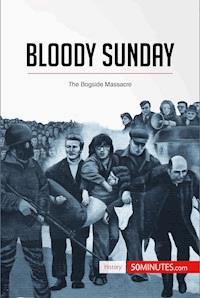
Keen to learn but short on time? Get to grips with the events of Bloody Sunday in next to no time with this concise guide.
50Minutes.com provides a clear and engaging analysis of Bloody Sunday. In January 1972, tensions between Catholic nationalists and Protestant unionists in Northern Ireland were at an all-time high. When a supposedly peaceful demonstration in the city of Derry turned violent, things were about to take a turn for the worse. Thirteen civilians were killed that day, and the truth would only come to light decades later.
In just 50 minutes you will:
• Discover the full political backdrop of the Troubles, starting with the power given to the English monarch to rule over Ireland as early as the 12th century
• Understand the growing tensions between Catholics and Protestants that led to the organisation of the demonstration and the British army’s paranoia and violence
• Uncover the truth that was eventually discovered surrounding the day’s events and their heavy death toll
ABOUT 50MINUTES.COM | History & Culture
50MINUTES.COM will enable you to quickly understand the main events, people, conflicts and discoveries from world history that have shaped the world we live in today. Our publications present the key information on a wide variety of topics in a quick and accessible way that is guaranteed to save you time on your journey of discovery.
Das E-Book können Sie in Legimi-Apps oder einer beliebigen App lesen, die das folgende Format unterstützen:
Seitenzahl: 40
Veröffentlichungsjahr: 2017
Ähnliche









Bloody Sunday
Key information
When: 30 January 1972.Where: Londonderry (Northern Ireland).Context: while the Troubles (also known as the Northern Ireland conflict) were still raging, a pacifist association organised a nonviolent protest. The British Army were sent in to arrest the ringleaders. Things soon spiralled out of control when the soldiers opened fire on the civilians.Impact: 14 Northern Irish Catholic civilians died during this operation. Following this massacre, Catholics in Northern Ireland strayed from their path of nonviolence and began to engage in armed combat.Introduction
With their song ‘Sunday Bloody Sunday’, the Irish rock group U2 forever carved the dark events that took place on 30 January 1972 in the city of Londonderry, Northern Ireland, into history. During a supposedly peaceful demonstration involving several thousand people, no fewer than 13 unarmed civilians, half of whom were under 20, were killed by soldiers from the British Parachute Regiment who had come to monitor the protest and prevent potential misconduct. The death toll grew four months later when a new victim died. The world was outraged at this event and, soon after the incident, the British embassy in Dublin was burned down.
This massacre marked the start of what would be the deadliest year of the Troubles, claiming nearly 500 victims, and was one of the peaks in the conflict between Protestants and Catholics which had begun in the late 1960s and only ended in 1998. But how did we get here? What could drive an army to open fire on the citizens of its own country?
Context
Ireland and Britain: a long and hateful history
The fates of Ireland and Britain have been intertwined since the 12th century, when in 1155 the English Pope Adrian IV (1100-1159) granted the right to govern Ireland to the English king at the time, Henry II (1133-1189), as well as to his successors.
Ireland was divided into different kingdoms which fought incessantly, forcing the King of England to intervene to re-establish calm. In doing so, he gained the submission of the Irish lords, who were subsequently acknowledged as his vassals. They acted in this way in the hope of benefitting from the king’s protection from the English barons who were trying to colonise Ireland. But instead of this, they soon found themselves divided between one part of Ireland that was colonised and ruled by English aristocracy and another part that, although under British rule, was still governed by Irish kings. Over the years, many Irish lords tried to oppose the English colonies by force of arms, but they were soon neutralised.
With the aim of increasing the monarchy’s revenue, the royal domain was extended in 1541, to the point that it covered the entire island. Ireland thus became a kingdom under the monarch Henry VIII (1491-1547). This change in the socio-political landscape could have played into the hands of the Irish lords. In fact, the king, who now owned all Irish land, could entrust it again to its former owners in the form of tenures, or concessions. The power of the Irish lords, as well as becoming hereditary, was thus ensured by the Crown instead of being subject to power struggles between clan leaders. However, the schism between London and Rome during Henry VIII’s reign further increased the gap between the Irish and the English. As the Pope had refused to annul his marriage with Catherine of Aragon (1485-1536), in 1534 the King of England announced the Act of Supremacy, which made him the sole supreme leader of the Church of England. Henry VIII was consequently excommunicated from the Catholic Church, which led to the creation of Anglicanism.




