


19,99 €
Mehr erfahren.
- Herausgeber: John Wiley & Sons
- Kategorie: Fachliteratur
- Sprache: Englisch
Something dramatic happened in the late summer and autumn of 2008. The post-Cold War world came to an abrupt end. This was the result of two conjoined crises. First, in its brief war with Georgia in August 2008, Russia asserted its military power to halt the expansion of NATO to its very borders. Secondly, on 15 September 2008 the Wall Street investment bank Lehman Brothers collapsed. This precipitated a severe financial crash and helped to push the world economy into the worst slump since the 1930s.
Both crises marked a severe setback for the global power of the United States, which had driven NATO expansion and forced through the liberalization of financial markets. More broadly they challenged the consensus that had reigned since the collapse of the Soviet bloc in 1989 that a US-orchestrated liberal capitalist order could offer the world peace and prosperity. Already badly damaged by the Iraq debacle, this consensus has now suffered potentially fatal blows.
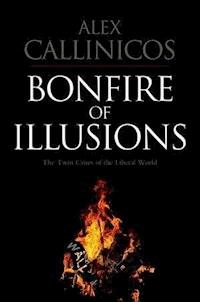
In Bonfire of Illusions Alex Callinicos explores these twin crises. He traces the credit crunch that developed in 2007-8 to a much more protracted crisis of overaccumulation and profitability that has gripped global capitalism since the late 1960s. He also confronts the interaction between economic and geopolitical events, highlighting the new assertiveness of nation-states and analysing the tense, complex relationship of interdependence and conflict that binds together the US and China. Finally, in response to the revelation that the market is not the solution to the world's problems, Callinicos reviews the prospects for alternatives to capitalism.
Sie lesen das E-Book in den Legimi-Apps auf:
Seitenzahl: 280
Veröffentlichungsjahr: 2013
Ähnliche

















Table of Contents
Cover
Title page
Copyright page
In Memoriam
Epigraph
Preface and Acknowledgements
Introduction: How the World Changed in 2008
1 Finance Humbled
What is financialization?
Three perspectives on financial crises
More than just a financial crisis
Dilemmas of recovery
2 Empire Confined
The state roars back
Collision of empires
Orchestrating disharmony
Conclusion: Regime Change or System Change?
The end of neoliberalism?
State, market and planning
Index
Copyright © A. T. Callinicos 2010
The right of A. T. Callinicos to be identified as Author of this Work has been asserted in accordance with the UK Copyright, Designs and Patents Act 1988.
First published in 2010 by Polity Press
Polity Press
65 Bridge Street
Cambridge CB2 1UR, UK
Polity Press
350 Main Street
Malden, MA 02148, USA
All rights reserved. Except for the quotation of short passages for the purpose of criticism and review, no part of this publication may be reproduced, stored in a retrieval system, or transmitted, in any form or by any means, electronic, mechanical, photocopying, recording or otherwise, without the prior permission of the publisher.
ISBN-13: 978-0-7456-4875-0 (hardback)
ISBN-13: 978-0-7456-4876-7 (paperback)
ISBN-13: 978-0-7456-5940-4 (Single-user ebook)
ISBN-13: 978-0-7456-5939-8 (Multi-user ebook)
A catalogue record for this book is available from the British Library.
The publisher has used its best endeavours to ensure that the URLs for external websites referred to in this book are correct and active at the time of going to press. However, the publisher has no responsibility for the websites and can make no guarantee that a site will remain live or that the content is or will remain appropriate.
Every effort has been made to trace all copyright holders, but if any have been inadvertently overlooked the publisher will be pleased to include any necessary credits in any subsequent reprint or edition.
For further information on Polity, visit our website: www.politybooks.com
In Memoriam
Peter Gowan
(1946–2009)
Chris Harman
(1942–2009)
‘One must always try to be as radical as reality itself.’
V. I. Lenin
Preface and Acknowledgements
I must confess to having had some second thoughts about the title of this book. The illusions that I had in mind were those forming the dominant ideology in the era since the end of the Cold War, and crucially the belief – most famously articulated by Francis Fukuyama when he announced the End of History in 1989 – that liberal capitalism offered the only basis on which humankind could hope to enjoy peace, prosperity and freedom. The starting point of this book is that this belief was exposed as illusory in the late summer and autumn of 2008, with the geopolitical setback suffered by the United States in the war between Russia and Georgia and the economic earthquake unleashed by the collapse of Lehman Brothers on 15 September 2008.
I still think that this is right, and indeed in this book I develop an extensive analysis in support based in particular on the long-term crisis of overaccumulation and profitability from which the advanced capitalist economies have been suffering for several decades. But I forgot the point that Marx made when he pointed out the limits of any purely intellectual critique of the religious beliefs people have: ‘To call them to give up their illusions about their condition is to call on them to give up a condition that requires illusions.’
Thus, despite the enormous material and symbolic blows that it has suffered, liberal capitalism attempts to steam ahead as if nothing happened. According to a study by the Bank of England published in November 2009, the state bailouts of the financial system have cost $14 trillion in the US, Britain and the euro-zone, nearly a quarter of global output. Yet governments still seek to propitiate the financial markets whose continued survival depends on their own efforts. Public services are butchered in the drive to return to neoliberal ‘normality’. Most absurdly, market solutions are proposed to the enormous problem of global warming.
And so the illusions have survived the bonfire. This is an exercise in collective deception and self-deception, but it indicates that we are dealing with illusions sustained by material interests. They are, in other words, a symptom of ‘a condition that requires illusions’. This makes ending that condition all the more urgent. The shambles of the Copenhagen climate summit in December 2009, which was torpedoed by cynical manoeuvres between the major powers, underlines how important it is to rid the world of an economic system driven by blind competition among firms and states.
In writing this book I have, of course, depended on others. At Polity I benefited from the support and assistance of Clare Ansell, Susan Beer, David Held and Sarah Lambert. Sam Ashman, Joseph Choonara and Chris Harman all read the book in draft and made very valuable comments. Lorenzo Fusaro helped me see the importance of David Harvey’s The Limits to Capital in integrating different partial perspectives on capitalism. I would like to thank them all for the help they have given me though naturally they are not responsible for the use I have made of it.
The year 2009 took a terrible cull of Marxist intellectuals of the 1960s generation. We saw the passing, for example, of Giovanni Arrighi and Jerry Cohen. Bonfire of Illusions is dedicated to two others. In the past decade, Peter Gowan developed a critical political economy of the contemporary world that is both original and stimulating. Before that Peter had, among many other things, headed a sustained effort to promote the development of anti-Stalinist socialism in what was still the Soviet Union and Eastern Europe. I learned a great deal from reading and talking to Peter. He was a splendid human being and his death in June 2009 was a great loss.
But then, suddenly and unexpectedly, Chris Harman died in November 2009. This is a source of grief that I still find it hard to express. Chris had been both a friend and a pervasive intellectual influence for more than thirty-five years. While he developed Marxist thought in many different areas, his work in political economy was particularly important and helped very much to shape my own views on the subject. It is especially sad that Chris should have died at a time when his writing on Marxist political economy was so productive, as is evident in what proved to be his last book, Zombie Capitalism. I read and commented on it in draft, as he did for both this book and its predecessor, Imperialism and Global Political Economy. It seems quite impossible that our long dialogue is over and I must continue without him.
Introduction: How the World Changed in 2008
The proclamation of some event or date as marking a historic turning point – a great end or beginning – has a distinguished ancestry. It starts, perhaps, with Goethe, after the French revolutionary forces had overwhelmed the armies of the old regime at Valmy in September 1792, announcing: ‘From this place and from this place forth commences a new era in the world’s history.’ But the practice has degenerated into the dullest of journalistic cliché, as the latest turn in fashion or in the political cycle is energetically spun as marking a profound discontinuity in historical time. No doubt at play here is one manifestation of the ideology of endless novelty that is an important aspect of how contemporary capitalism presents itself to the world.
All the same, just because this debasement has taken place doesn’t mean that events of a genuinely epochal character never take place.1 In my view, the late summer and early autumn of 2008 marked just such an event. Its nature is indicated by two episodes in particular; first, the brief war between Russia and Georgia in early August, and then, the collapse on Lehman Brothers on 15 September, which promptly precipitated the biggest global financial crash since the Great Depression of the 1930s. What event do these episodes – themselves of unequal significance, the second of greater import than the first – help to mark?
A first approximation would be to say that they indicate the end of the post-Cold War era. This goes against the common view that it was the terrorist attacks on New York and Washington on 11 September 2001 that brought this period to a close. But, when one thinks about it, this standard account isn’t really right. For the reunification of Europe on Western terms and the collapse of the Soviet Union opened a period of unprecedented supremacy by the United States in the interstate system. The ideological accompaniment of this American primacy – most influentially articulated by Francis Fukuyama in his theory of ‘The End of History’ – could be summed up in two propositions: that liberal capitalism was the only rationally acceptable socio-economic framework for a modern society and that a widening circle of liberal democracies could offer the world benign global governance. There were variations in how these propositions were articulated and pursued, but they constituted a common sense shared by the leaderships of the main Western states.
Lesen Sie weiter in der vollständigen Ausgabe!
Lesen Sie weiter in der vollständigen Ausgabe!
Lesen Sie weiter in der vollständigen Ausgabe!
Lesen Sie weiter in der vollständigen Ausgabe!




