


Erhalten Sie Zugang zu diesem und mehr als 300000 Büchern ab EUR 5,99 monatlich.
- Herausgeber: Crown House Publishing
- Kategorie: Fachliteratur
- Sprache: Englisch
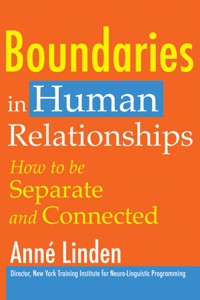
The most important distinction we can ever make in our lives is between who we are as an individual and our connection with others. Can we truly love another and be a whole, complete and unique person? How do we know the difference between our fear and a partner's or between our past anger and our here-and-now anger? The answer lies with boundaries - and this is a practical guide to unlocking these mysteries.
Sie lesen das E-Book in den Legimi-Apps auf:
Seitenzahl: 359
Veröffentlichungsjahr: 2008
Das E-Book (TTS) können Sie hören im Abo „Legimi Premium” in Legimi-Apps auf:
Ähnliche


















“Sing and dance together and be joyous, but let each one of you be alone Even as the strings of a lute are alone though they quiver with the same music.”
—The Prophet by Kahlil Gibran
Dedicated to Quinn, my Mythic Hounds, and the Standing People, because you nourish my soul!
Contents
Title Page
Dedication
Acknowledgments
Introduction
Chapter I: Boundaries
The mean ing of human boundaries, the loss of boundaries, and the inverse, walls; the experience of individuality and togetherness, isolation or loss of self
Chapter II: Internal/External Boundaries
The eight categories of the first level of human boundaries: Projection/Isolation, Mode, Causality, Polarity, Generalization, Threshold, Identity, and Time
Chapter III: Self/Other Boundaries
Some of the complexities of independence and dependence, autonomy, and intimacy in relationships with a significant other in the areas of marriage, family, friendship, and business in the second level of human boundaries
Chapter IV: Contextual Boundaries
The third level of human boundaries and the five associated categories that are specific to situation: Place, People, Activity, Time, and Gender
Chapter V: Patterns Necessary to Support Boundaries
The five psychological patterns: Ego Strength, Self as a Process, Ability to Empathize, Noticing Difference, and Observer Self; how they develop and contribute to the creation and maintenance of boundaries
Chapter VI: Doing Boundaries
The three fundamental skills that become the filters—perceptual, physiological, and cognitive—that enable a person to be separate and unique and connected to others
Chapter VII: Boundaries and Relationships
Personal experiences that reflect the effect of boundaries, loss of boundaries, and walls in different kinds of relationships: lovers, parents and children, friends/social, therapeutic, and business colleagues
Chapter VIII: Boundaries and Parts
The inner parts of a personality and how boundary distinctions, the lack of them, or walls will support or undermine the healthy functioning of the whole personality
Chapter IX: Boundaries and Identity
What identity is; the role boundary distinctions play in a person’s sense of self and the answer to the question, who am I?
Chapter X: Boundaries and Self-Esteem
Self-esteem: the relationship with oneself, and how boundaries, the lack of them, or walls positively contribute or sabotage the ability to live life fully
Suggested reading
For further information
Copyright
Acknowledgments
I am awed by and grateful for how much I have learned in the process of writing this book. This book came out of my teaching and now will inform and deepen my teaching—coming full circle!
I want to acknowledge and extend my deepest appreciation and heartfelt thanks to the following people: the colleagues and students in my Assistant Trainers Program for all their help in my research into human boundaries; to my extraordinary teachers, Richard Bandler, John Grinder, and Milton Erickson who each in their own special way opened the path to my mind and creativity; Natalie Koralnik, a student, colleague, and translator extrodinaire (she translated into French my first book, The Enneagram and NLP, and this, my third book), who encouraged me for more than two years to write this book; Hélène De Castilla, editor of Intereditions, who supported the idea of this book even before it was written; Suz, who is always there with positive feedback and belief in me; Melissa, whose wisdom and depth of spirit never ceases to amaze me; all those students and clients who have responded so enthusiastically to my seminars and therapeutic work based upon this approach to problems and fulfillment; and Peter Skinner, who helped me edit the manuscript. And, last but not least, thanks to Steven Fornal, who with great patience and fortitude has turned my almost illegible handwriting into clean, crisp type.
Introduction
This book explores how human beings remain individuals and yet can empathize and identify with others. It is an exploration of the many facets of individuality and togetherness, and it analyzes the most essential element that either supports or destroys self-esteem and relationships: boundaries, or the ability to be separate and connected.
I hope to increase the reader’s awareness of human boundaries and how we actually “do” them—because boundaries are not accidents of fate or random luck. This book is for the reader who is open to considering relationships and self-esteem from a different perspective. While I do include some exercises to increase the reader’s skill at purposefully “doing” boundaries, my primary intention is to provoke thought and questions.
In this book, I draw upon over 25 years of work as a teacher and therapist. I have observed and interacted with many students and clients, most of whom are adult professionals from business, the arts, education, and the helping professions, and many in the midst of either personal or professional transitions. All were motivated to improve themselves, their relationships, and their ability to communicate. This book is also the result of becoming aware of myself, my “stuck” places, traps, strengths, and my relationships with lovers, family, children, colleagues, friends, students, and clients.
I teach human communication and change using Neuro Linguistic Programming, Ericksonian Hypnosis, the Linden Parts Model, and the Linden Boundaries Model. To explain these models, I draw on years of experience and research into what makes for a successful relationship and a functioning, whole, and happy human being. I define “happy” not as deliriously gay, joyful, or ecstatic—but content yet yearning, satisfied but challenged, and moving toward as-yet unrealized dreams while savoring the present moment with all one’s senses.
About 20 years ago, boundaries became more than an intellectual, taken-for-granted, little-understood concept when a colleague and I were discussing our work and some recent examples of success and failure. At one moment, she looked at me and said, “Anné, all your work is about boundaries!” Immediately I knew this to be true, but at the same time I really didn’t know what it meant. I did not know specifically what human boundaries were, and I certainly did not know how they worked—how humans “did” boundaries. I knew for sure that they didn’t just happen, so I set out to discover what they were and how human beings create and maintain them.
At the time, I was lucky enough to have a small group of professionals in my Assistant Trainers Program, people with whom I had met four times a month for two years. They were intelligent, highly trained, and motivated professionals who enthusiastically participated in my research into boundaries. With their help over several years, I began to map out the basic structure of the Linden Boundaries Model. Since I am a teacher, this work evolved into trainings through which I further developed and refined the model and process of boundaries. The more I taught, the more I learned! When I began to write this book, I thought I understood boundaries and how they worked. I did, but writing my ideas down forced me to a much deeper level of understanding.
The first five chapters explore the structure of boundaries, what they are, and the patterns upon which they depend. Chapter 1 defines boundaries, loss of boundaries, and walls. There are three levels of boundaries, and Chapters 2, 3, and 4 describe these levels in depth. Chapter 5 lays out the five developmental, psychological patterns that form the foundation of boundaries. Chapter 6 explains the process of boundaries; it provides an in-depth study of how exactly the human being “does” boundaries. It also offers a step-by-step explanation of the three skills (perceptual, physiological, and cognitive) that we use to create and maintain boundaries. Exercises to increase awareness of and strengthen each skill are included at the end of Chapter 6. The last four chapters describe my own and others’ personal experiences that will deepen the reader’s understanding and recognition of the practical implications of boundaries in the important areas of our lives. They examine how the lack of boundaries or the exaggeration of them into walls influences our relationships, our identity, and our self-esteem.
Anné Linden January 2008
Chapter I
Boundaries
“How is it possible to be separate and connected?” This chapter describes the function of human boundaries and how they affect this apparent paradox of separation and connection. It examines the meaning of separate and connected; and what happens when the permeability of boundaries becomes so diffuse that there is no longer any separation and, conversely, when separation becomes so calcified that there can be no permeability thus preventing any connection.
I am a smart woman, but sometimes I sputter, repeat myself endlessly, yell, and in general speak with little sign of intelligence or coherence. Why? The answer is not temporary insanity, drunkenness, or senility. It is the loss of boundaries, that intangible distinction between our inner and outer worlds, between ourselves and others.
I call boundaries intangible because you cannot see, hear, touch, smell, or taste them, but they are real and essential to our wellbeing and functioning in this world. Have you ever considered how you know the difference between your emotions and your mate’s, your thoughts and your child’s? Do you even recognize that there is a difference, or is the difference so great that you sense a barrier between yourself and the rest of the world?
The French word frontiere serves for both boundaries and borders. Borders are those distinctions we make between countries, between where our property ends and our neighbors’ begin. Borders are lines drawn on maps, rivers and streets, guard posts with closed gates, fences, walls, hedges, doors. You can see or touch borders; they are what separates countries, property, houses, and offices. “Fences make good neighbors.” [Robert Frost, American poet]. What of the distinctions between emotions, thoughts, beliefs, and values? Between you and not you, between you and me?
Remember a time when you came home after a day away, and you felt glad to be back. As you entered the house, your feelings began to change. You started to feel down, but things were okay—you’d had a good day, and there were no dirty dishes in the sink. Then the person you live with came into the room. Her expression was dark, she was unusually quiet, she answered your questions in monosyllables, she was distant, and she stared off into space a lot. When you asked her if something was wrong she replied with a shrug and said “I don’t know.” You began to feel bad, even depressed. What was going on here? Could it be that you had “caught” your significant other’s emotions and felt them as though they were your own? Because of the nature of close relationships, it is easy to lose your boundaries, take on the other’s emotions or thoughts, or expect the other person to have the same thoughts or emotions that you have.
Boundaries are those distinctions that we make between ourselves and the world, between ourselves and significant others, and between different types of situations—that is, different contexts. These distinctions create separation and yet are permeable, allowing the exchange of emotions and information. The difference between permeable and solid is similar to that between a sponge and a brick. A sponge absorbs any moisture with which it comes into contact; the moisture passes through the sponge. A brick is not particularly porous, and any moisture it comes into contact with mostly rolls off, having little effect on the brick. Through permeability, human boundaries allow connection and simultaneously create separation. A great example of a boundary is your skin. Think for a moment about how your skin functions: it keeps you separate from the rest of the world and distinguishes you from the world around you. Without skin, much of you would be a puddle on the ground, without even as much form as a shapeshifter. At the same time that your skin is giving you form, it is permeable. It breathes, releasing toxins from your body into the air and taking in oxygen and other external elements. You can put a nicotine patch on your skin, and the nicotine enters your bloodstream. Consider the effect of other topical medications. Because of the permeability of your skin, the external substance is taken into your body. Imagine what it feels like to get something impermeable on your skin, such as oil-based paint or liquid glue. If you don’t wash it off, your skin soon begins to itch, become irritated, and eventually would die. Skin has two properties important for boundaries: the ability to separate, to make a distinction between you and the world around you, and permeability, which allows you to connect with the world around you. “(Skin) the limiting membrane that allows the human being to distinguish the difference between me and not me. That is the distinction between external reality and internal reality (including perception of external reality).” [Donald W. Winnicott, noted British pediatrician, child psychoanalyst, teacher, and theorist. 1896–1971]
When this separation becomes too rigid and solid, it becomes a wall, making exchange of experience and connection impossible. When the permeability becomes too diffuse and excessive, there is no separation, and you merge, becoming the other person, nature, judgment or value, taking on the other’s emotions. Boundaries are lost.
When you have boundaries, you are separate and connected. As you read these words, do you have a strong response to them? For some people, it is intolerable to be separate; separate means alone, isolated, without the possibility of connection. For others, connection can be threatening or suffocating, signifying a loss of self. The concept of separate and connected is a paradox. It seems to convey an inherent contradiction. How can you be connected when you are separate? And how can you be separate when you are connected? As F. Scott Fitzgerald said, “The test of a first-rate intelligence is the ability to hold two opposing ideas in the mind at the same time and still retain the ability to function.” Let’s examine these words and their meaning.
According to the dictionary, to separate means “to make a distinction.” The archaic meaning is “to set aside for a special purpose.” It could also mean “to sever,” “to block off,” “to isolate,” or “to become detached.” Connect means “to place or establish in a relationship,” “joined or linked together,” “having a social, professional or commercial relationship.” So is this concept truly contradictory, or is it in fact quite logical? By separate, I do not mean to sever, to block off, to isolate, or become detached but rather to make a distinction. Connected is to be linked, to have a relationship. How can you have a relationship or be linked to someone or something if you are not separate? If there is no distinction between you and the other, who is making the connection?
I have often encountered objections to the idea of being separate, because to some it implies being detached and cut off from others. I propose that if you are not separate you cannot connect. Connected does not mean merged. To merge means to become the other and lose yourself in the other. This state is desirable when making love, bonding with a baby, watching a sunset, or working in your garden. There are many times when you want to merge and become one with the other. This loss of self can be positive and wonderful. The purpose of no boundaries is to give up all distinctions and separation and lose yourself in another, to merge with nature or a situation that is pleasurable. However, as desirable as it may be, it must be done with awareness and choice. Otherwise, we lose our freedom, our uniqueness, ourselves. Every human being is unique and individual, and only with the ability to recognize and choose to “do” boundaries (or not) can you truly know yourself and touch your potential.
Boundaries are not something you must have all the time, but you must know the difference between when you are “doing” boundaries, when you create walls, and when you lose your boundaries. This awareness is essential for your self-esteem and for positive relations with others.
Boundaries enable you to know and understand yourself, including your values and beliefs, as separate and unique from others while still connecting with them. You can then be a part of the world and allow the world to touch you as you remain distinct from the world. The purpose of walls is to protect you from the world, from being overwhelmed by the emotions of others or by situations that are physically, mentally, emotionally, or spiritually dangerous.
When I lose my ability to communicate in any kind of rational way, when I sputter and yell, I’ve lost the distinction between my thoughts and feelings. I’ve become overwhelmed by my emotions, another person’s emotions and thoughts, or the emotions of the situation.
Once upon a time, there were two very devoted friends, Beatrice and Samantha. They enjoyed spending time together and were always very happy to see each other again after being apart. They were truly best friends. Beatrice thought Samantha was the most beautiful, elegant, and graceful creature she had ever seen, so she decided she wanted to be just like Samantha. She observed her very carefully and tried hard to look and move and sound like Samantha.
It seemed that the harder Beatrice tried, the less she succeeded. She became frustrated, impatient, discouraged, and finally depressed. No matter how much she tried to be like Samantha, she kept failing miserably. She knew it wasn’t working, but she couldn’t seem to give up her dream of being like Samantha. She’d beat herself up asking, “Why? Why can’t I look and be like Samantha? She is so perfect—why can’t I be like her?” Nothing seemed to work, and Beatrice felt worse and worse.
After several weeks of failing to become at all like Samantha, Beatrice had a dream. In the dream, she was floating high above the earth on a cloud, and as she floated she looked down and saw a group of Samanthas! You see, Samantha is an Afghan Hound! And as Beatrice watched these elegant, beautiful creatures, she became aware of a movie that described the history of the Afghan Hound unfolding just above this group. Such is the magical nature of dreams. Beatrice learned that Afghan Hounds were bred many, many years ago to hunt with the horsemen of Afghanistan. Thus, they have long, slender bodies and legs that help them cover ground quickly and keep up with the horses over steep, ice-clad mountains. They have a long, plume-like tail to help balance them on the treacherous terrain. Their long, silky hair keeps them warm in the frigid climate and because they are sighthounds—dogs who hunt primarily with their sense of sight—they have large eyes set as wide apart as their narrow skulls allow. Their muzzle and jaw are long and narrow, and because they hunt in packs of 20 to 30, they have plenty of help bringing down and holding their prey. Since they depend upon their eyes to hunt their sense of hearing is secondary; explaining why their ears are long and covered with silky hair. Everything about the Afghan Hound is designed for her mission in life: to hunt with the horsemen in the cold mountains of Afghanistan, and for this she is perfect.
As Beatrice continued to float on her cloud and to dream, she saw another group of dogs—Boxers. It happens that Beatrice is a Boxer, and as she watched this group, a movie of the history of Boxers unfolded above them. Boxers originated in Germany and are members of the working group of dogs. This group’s primary mission is to work with humans to help pull sleds, herd, rescue, and protect. The Boxer’s mission in life is to protect her human family. Her square body and legs support a wide and muscular chest that enables her to jump easily and use her short, square muzzle and jaw to fight and hold opponents—human or animal. She is short-haired with a short tail, which makes it harder for an enemy to grab hold of her. Since hearing is her most important sense, her ears stand up short and pointy to allow the greatest sensitivity to sound, while her eyes are quite small. Boxers are bred to their mission: incredible strength and power to defend and protect. As such, the Boxer is perfect.
Through this dream, Beatrice begins to realize that both sheandSamantha are beautiful. They are very different because their mission in life is different but within that purpose each is perfect just the way she is. Beatrice continues to love and admire Samantha and now understands that she is special and beautiful in her own way.
Chapter II
Internal/External Boundaries
At this first and most essential level of boundaries, there are eight categories in which boundaries can be distorted into loss of boundaries or walls:
Projection (no boundaries). Isolation (walls)Mode: no boundaries or walls between thinking, feeling, and doing Causality: no boundaries or walls results either in irrational connection or loss of logical connectionGeneralization: loss of boundaries creates the experience of “part equals the whole”Polarity: walls that result in extremesThreshold: no boundaries or walls leads to the inability to know when enough is enoughIdentity: no boundaries, merging a discrete external activity with the sense of selfTime: no boundaries or walls between past, present, or future, which distorts realityOnce you’re “grown up,” you know you’re not the maple tree in your back yard; and at the movies, you know you’re not in the front seat of a car with the good guy as he’s chased over a cliff by the bad guys. Even though you’re holding onto the arms of your seat so hard your fingers are cramping and you’re screaming silently, you know you’re not in the car—well, afterwards you know you weren’t, for a few seconds you are in that car!
Internal/external boundaries are the foundation of the three levels of boundaries. These boundaries begin to develop soon after birth, albeit in a primitive and unsophisticated way, and they remain unstable and inconsistent until adulthood. They are the distinctions that you make between your internal world: me, and the external world, not me. If I’m watching the news of a terrible accident on television and I’ve set healthy boundaries, I can empathize with the people involved and feel their pain, but I know it’s not me or my family that’s involved. I’m both separate and connected. If I lose my boundaries, I can’t continue to watch. I’m overwhelmed with fear or sadness as though I’m actually involved personally in the accident, that it’s happening right now to me or my family. I merge with the victims, and the distinctions between me and the people in the accident become so porous that all separation is lost. If I put up walls to protect myself from the pain of others, I detach, sever myself from the experience, and feel nothing. The separation becomes solid, and I have no connection to the emotions of others. This is the basis of desensitization. During war times, people put up walls to the horrific images of dead bodies, burned villages, and body bags until they feel very little. Walls are a self-protective mechanism against overwhelming emotion.
Limitations and more serious problems only occur when you’re not aware that you’re losing your boundaries or building walls. These patterns can become habitual or develop into the belief it’s “just how I am.” Awareness means to be conscious of something, to know, to realize what you’re doing; a habit is a sequence of behavior, thoughts, and feelings that is repeated predictably without conscious awareness when certain stimuli are present in the external world.
Some people respond to strong emotions by putting up walls to protect themselves, while others find comfort or safety in losing boundaries and merging. Both responses can be beneficial or satisfying except when they become habitual and you react the same way no matter what the external circumstances are. Without awareness, you have no choice, and when you have no choice, you’ll always do what you’ve always done and you’ll always get what you’ve always gotten! Habits are based on basic stimulus–response phenomena; something occurs in the external world, and you react automatically. Historically, many habits originate in childhood; when you are young, you don’t have dependable boundaries, and your initial responses are probably the result of loss of boundaries or walls. When these responses bring you feelings of pleasure or safety, the connection between an event in the external world and merging or detaching becomes hardwired into your unconscious. The more you do this, the better you get at it! It’s the same as rehearsing or practicing something. The association between the stimulus and the response becomes unconscious and automatic.
The response may become limiting or problematic as you get older even though the historic response had a positive effect.
A little boy of 18 months is sitting in his high chair waiting for his dinner. He is hungry, and he starts to holler and bang his spoon. His father gets a little frazzled and hurries to give him his pasta. Now, as an adult, whenever he doesn’t get what he wants when he wants it, he starts to yell and carry on. It’s not very useful behavior in a grown-up man, but it’s become an automatic response.
Nell has a second-grade teacher who indicates with certain words, tonality, and facial expressions that she doesn’t like what Nell draws in art class. To protect herself, Nell’s unconscious builds a wall around her spontaneity, allowing no external expression of it. This protects Nell from the teacher’s criticism but severely limits her as 30-year-old writer. Whenever external circumstances call for something creative and spontaneous, Nell’s unconscious erects a wall and shuts her down.
We will now examine the eight categories of Internal/External Boundaries: Projection/Isolation, Mode, Causality, Polarity, Generalization, Threshold, Identity, and Time.
1. Projection/Isolation
I’m sure you’ve had the experience of meeting someone and taking an instant dislike to that person. What triggered your response? Over time, your initial judgment may or may not have been proven accurate.
Peter was forced to spend time with Barbara because they worked together. Initially he disliked her, but as he got to know her, he actually began to appreciate her. It was a mystery to him why he had had such a negative reaction to her at first until he became aware that her tone of voice unconsciously reminded him of a first-grade teacher who had been very mean to him. He had lost his internal/external boundaries with Barbara: the memory of his teacher merged with his colleague, Barbara. Her tone of voice reminded him of the painful experiences that triggered those original emotions back in first grade. He lost his perspective: his colleague was not his first-grade teacher, even though it felt as if she were. As soon as he became aware of the similarity of their voices, he no longer experienced the old response. With awareness and boundaries, he could appreciate Barbara for who she was, separate from the memory of his teacher.
When we go to the movies or read a good novel, we want, at least momentarily, to lose our boundaries. You’re sitting in a movie theater with your feet on the sticky ground and your back against the chair, watching a large flat screen. Yet your heart begins to beat faster, your breath catches in your throat, and you may even gasp and grab the person’s arm next to you as you hear the sound of the killer’s footsteps and breathing as he walks down the dark hallway slowly and deliberately toward the closet where the heroine is hiding. You may be watching images of lovers parting forever, because of circumstances beyond their control, and you begin to cry. How is this possible? You’re sitting safely in a movie theater, watching pictures projected on a two-dimensional screen.
You’ve lost the distinction between yourself, where and who you are, and the pictures on the screen. You’ve leaped over that distinction and entered a fantasy world, making that world your reality. The lines between you and not you have evaporated. Why else go to the movies or read a good story but to enter another world or become someone else? How many times have you laughed out loud or cried out in pain at something you’re reading? Isn’t that the mark of a good book?
These are examples of Projection in the category of Projection/ Isolation, when you blur the distinction between a situation or person in the external world and your inner thoughts, memories, or emotions. You merge the two. When you distort your boundaries in this way there is always a loss of boundaries.
On the other hand, when walls are created between your internal and external worlds, isolation results.
Consider the policeman whose work at times involves the terrible images and sounds of the cruelty of one human being toward another. He learns to protect himself from this pain and suffering by building walls. This is useful and beneficial, enabling him to do his job and function. Except when it becomes a habit and the walls are there all the time; with his colleagues, his family, the victims. He becomes a cold, detached, cut-off human being who loses the ability to connect, to feel empathy, and to be vulnerable.
My son is a volunteer EMT (emergency medical technician) and he really cares about the people he helps. When assisting with serious accidents, he sometimes has trouble keeping his boundaries and gets overly emotionally involved. He’s told me about some EMTs who have been working for a long time and have become detached from the patients, treating them like objects. They have learned to build walls to protect themselves, but now they do so with every patient and every situation. All they can offer is a mechanical type of assistance and no human comfort.
A person who has been severely traumatized as a child because of abuse, neglect, or alarming manipulation will build walls in order to survive. Listen to soldiers who were prisoners of war describe what they did to survive. They imagined being somewhere else; built imaginary shields around themselves; thought of their tormentors as small and far away; withdrew deep inside themselves so nobody could get to them, thought of themselves as split off from their bodies (the real self separate from the body shell). This is how you build walls and it is a good example of when walls can help. However, when the walls become permanent, when there’s no choice, you become trapped inside the walls of your own prison, and connection becomes frighteningly difficult or impossible.
2. Mode
Have you ever felt guilty when you’ve found yourself attracted to someone who is not your significant other? Here you are in a committed relationship, yet you’re having fantasies about someone else. You might feel so guilty that you “confess” to your lover and all hell breaks loose. Wait a minute! Have you done anything? Actually acted on your thoughts and feelings? If not, what are you guilty about? You feel guilty because you’ve lost your boundaries between thinking and doing.
The second category of Internal/External Boundaries is Mode. People interact with the world in three different Modes: through thinking (remembering or imagining images, words, sounds, tastes, and smells); through feeling emotions; and through doing or acting in the external world (speaking, gesturing, opening a box, driving a car, climbing stairs, and so on). These three Modes are separate and distinct from each other. However, with boundaries in place, they strongly affect each other. Without boundaries, they merge. Thinking becomes the same as doing; doing the same as feeling. This results in confusion. When there are walls, each Mode is isolated from the other, and the Modes have no impact or influence on each other.
Mark is a young and talented supervisor; he appreciates and respects the team of social workers for whom he’s responsible. Their well-being and success is important to him, and he’s very aware of the excellent work they do. Over time, his team has become demoralized, and Mark doesn’t understand why. Finally, one of them confronts him, saying, “We work hard and do good work, but you never say anything about that. We don’t feel appreciated at all!” Mark is dumbfounded, because he does appreciate them. However, for him, thinking is the same as speaking out loud. He has told his team that he appreciates them, over and over again, but only inside his mind.
A 10-year-old girl has a fantasy of beating up her brother and dropping him out of the second-story window. He’s been really mean to her lately; not letting her go with him and his friends to the park. He’s always telling her, “Get lost, squirt!” She tells her mother what she wants to do to him. Her mother is horrified, lectures her, tells her father, and they ground her for a month. They keep telling her what a bad girl she is to have such evil thoughts. Her parents responded to her fantasies as though she had acted on them. They scolded her instead of telling her that they understood she was hurt and angry at her brother, explaining that he was getting older and wanted his own space. They neglected to explain that while thoughts and feelings are one thing, no matter how angry she felt, she must never actually do anything physically violent to her brother. Because her parents lost the boundaries between their daughter’s thoughts and her behavior, they may have damaged her self-esteem—and missed an opportunity to help her understand the difference between thinking and doing.
Albert has lots of ideas about what he wants to do with his life. One week, he’s going to go to bartending school so he can get a job and support himself while he goes back to university to get his teaching degree. The following week, he’s going to start his own limousine service, ferrying people back and forth to the city, a hundred miles away. Another week, he is going to move to Alaska and open a restaurant. And so it goes! He’s constantly thinking of how he’s going to fix up his house, help his parents, or get a better job, but he never does anything to make these ideas happen. There is such a wall between his thoughts and taking action that there’s no connection between the two, no essential realization that thought sets the goal, emotion motivates, and action makes it happen.
3. Causality
The third category is Causality. There is a normal, logical causality between certain actions. A ringing telephone generally prompts you to pick it up. Of course, you could choose not to, but there is a logical connection between these two events. Someone you meet puts out his hand in that universal gesture of shaking hands, and you respond by putting out your hand. A sudden loud noise makes you jump. These are situations when you can assume a normal causality exists. However, when walls are present or boundaries are lacking, there can be a severe distortion of reality. For instance, what is your response when you’ve had mean thoughts about someone and then something terrible happens to him? Do you feel somehow responsible? Children can be deeply traumatized when they get angry at a parent and say things like “I hate you” or “I wish you were dead,” and then that parent gets hurt or dies in an accident. The child blames herself because she thought it and said it, and then it happened. She has no boundaries between her thoughts, feelings, and words and the external event of the accident. It’s as though she made it happen. The lack of boundaries between her inner experience and the external event of the accident creates a false causality.
Imagine you’re in a situation that is very embarrassing and you wish with all your heart that you weren’t there, that you could just disappear. What do you do? You close your eyes, just like the child who covers his eyes and says, “Now you can’t see me!” Because of a loss of boundaries, you assume a causality that doesn’t exist. When you close your eyes and can’t see anything, you “become invisible”—the outside world cannot see you!
Consider the person who blames himself when bad things happen. He accepts a ride with you to the train station and your car breaks down. He may say, “I’m sorry, whenever I’m around things seem to go wrong.” Or the neighbor who comes to your son’s outdoor wedding and it begins to rain heavily. She says, “I always seem to bring bad luck!” Have you ever noticed that some people keep saying “I’m sorry” whenever difficult or uncomfortable things happen around them, even though they have nothing to do with them? This is known as “magical thinking,” and it promotes “center of the universe” syndrome. Babies and young children are the center of their universe, and that is as it should be. However, by the time they are 18, they should be realizing that the world does not revolve around them. Appropriate boundaries between cause and effect in your life help you to accept this.
On the other hand, walls between two related events prevent connection between behavior and the effects of behavior. We learn only when we experience consequences, and boundaries allow us to make the connection between our behavior and consequences.
A young man is feeling lonely and despondent. A good friend in a far-away state invites him to visit, and he jumps at the chance to see his friend and escape his present circumstances. He has such a good time that he stays longer than he had planned, longer than the vacation time he had been granted at his job. When he returns, he is fired. He complains that his boss is insensitive and wanted to fire him anyway because of office politics. He doesn’t take responsibility for his actions, and he certainly is not going to learn anything useful from this experience. With walls preventing any sense of cause and effect, he maintains total separation between his actions—taking more vacation time than that agreed upon and, as a result, getting fired.
Walls like this support “the blame game.” You blame someone or something else for your misfortune, because you’re keeping your behavior and the results of your behavior separate.
4. Polarity
In the first three categories, Projection/Isolation, Mode, and Causality, there can be walls, loss of boundaries or, of course, boundaries. In the fourth category, Polarity, there are only walls. Polarities occur when there is a dichotomy between two absolutes: all or nothing, good or bad, right or wrong—indeed any either/or situation. For example, “I can be rich or spiritual,” “I can think or feel,” “I’m attractive or ugly, a genius or stupid.” Polarities are the two ends of a black-and-white spectrum with no gray options in-between. In order for a Polarity to exist, there must be a solid wall between the two ends of this spectrum.
Jim is a public speaker who is very successful; however, when he has to speak on a new topic or to a type of group he’s never before addressed, he panics. He’s either completely confident or he’s totally incompetent. Confident for him means never having doubts or making mistakes, so when he does question himself or make a mistake, he immediately falls into the despair of “I can’t do anything.” The separation between confident and incompetent is complete; there’s no connection between mistakes and learning or improving. With boundaries, Jim will learn that true confidence is not about never making mistakes: it’s about being able to make a mistake and being confident that you can deal with it and learn.
Another example of Polarity is the mother who must be completely patient with her children at all times, no matter how stressful the circumstances are. If she loses it and snaps at one of them, she becomes, in her mind, a “bad mother.” She has no connection between her inner concept of patience and her external reality.
Some of you may be plagued with the belief that you can think or feel, but it is impossible to do both at the same time. It is as though a wall cuts across your neck, separating your head from the rest of your body. Functional thinking must include feelings. Imagine how limited your thinking would be if it were not informed by your feelings. Or course, we make the distinction between thinking and feeling but not to the exclusion of one or the other.
Those of you for whom knowledge is safety or sanity may be frightened of your emotions; you attempt to detach from them, or allow yourself to experience them only when you’re alone. When the walls do come down, you may bounce to a state without boundaries and become overwhelmed with your emotions with little access to your ability to think. Then you’re caught in a dichotomy and self-fulfilling prophesy: I can thinkorfeel.
Gertrude is an accomplished architect who has learned how important precise, clear thinking is in her profession. She thinks very well and never lets those pesky feelings intrude in her work. She is always surprised when her clients don’t seem to appreciate her—even when the home she produces for them is spectacular! Her people skills leave much to be desired. Because she is cut off from her feelings when interacting with her clients, she gives the impression of being cold and aloof. If she ever does let feelings into her work, she loses all boundaries and is completely inappropriate. On the other hand, in her personal life, she suffers. She continually chooses men who are cads, users, mean-spirited, or unavailable. She “goes with her feelings” totally in her love relationships and never uses her head. If she starts to think, she cuts off her feelings and becomes detached and gets nothing that she wants. She is in a loop that keeps proving itself over and over: “I can think or feel.”
Consider the example of a single father who both loves his children and is ambitious to succeed as a lawyer. He believes that in order to be successful, he has to give two hundred percent of himself to his job. He also believes that in order to take proper care of his teenage children and keep them safe, he must be there for them all the time. He may turn down a high-powered job and feel diminished and discontented, or he might take the job and then feel guilty and constantly worried that something horrible is going to happen to his kids! The plague of either/or. He can either be a successful lawyer or a good father. In this case, the wall is between his ambition and his children.
With boundaries, you can transform the either/or in your life into and!




