


68,99 €
Mehr erfahren.
- Herausgeber: John Wiley & Sons
- Kategorie: Geisteswissenschaft
- Serie: Blackwell Manifestos
- Sprache: Englisch
Breaking the Book is a manifesto on the cognitive consequences and emotional effects of human interactions with physical books that reveals why the traditional humanities disciplines are resistant to 'digital' humanities.
- Explores the reasons why the traditional humanities disciplines are resistant to 'digital humanities'
- Reveals facets of book history, offering it as an example of how different media shape our modes of thinking and feeling
- Gathers together the most important book history and literary criticism concerning the hundred years leading up to the early 19th-century emergence of mass print culture
- Predicts effects of the digital revolution on disciplinarity, expertise, and the institutional restructuring of the humanities
Sie lesen das E-Book in den Legimi-Apps auf:
Seitenzahl: 348
Veröffentlichungsjahr: 2015
Ähnliche




















CONTENTS
Cover
Title page
Acknowledgments
Advertisement
PART I:
Pre-Bound
1
Language by the Book
PART II:
Bound
2
Print Subjectivity, or the Case History
The Case History
Identification and Sympathy
3
Distributed Reading, or the Critic Filter
Content
Medium
PART III:
Unbound
Conclusion
Discipline and Error: Now is not the worst …
Conclusion
Works Cited
Index
End User License Agreement
List of Illustrations
Advertisement
Figure A.1 A North Point Press Edition of
The Senses of Walden
by Stanley Cavell; photograph by Laura Mandell.
Chapter 01
Figure 1.1 Forms of life.
Chapter 02
Figure 2.1 Title Page of Moxon’s
Mechanick Exercises
: http://gateway.proquest.com.lib-ezproxy.tamu.edu:2048/openurl?ctx_ver=Z39.88-2003&res_id=xri:eebo&rft_id=xri:eebo:image:64157:155
Figure 2.2 Foulis title page.
Figure 2.3 James Watson’s
Art of Printing
.
Figure 2.4 Another Foulis title page.
Figure 2.5 Word frequency counts, Burrows.
Figure 2.6 Author’s uses of typical words, Burrows.
Chapter 03
Figure 3.1 Bell’s book box, for traveling.
Figure 3.2 The Stacks, photograph by Laura Mandell.
Conclusion
Figure C.1 Broken book,
Blindness and Insight.
Figure C.2 Broken book,
Blindness and Insight.
Figure C.3 Wordsworth and de Man’s quotation of Wordsworth, compared in JuXta.
Figure C.4 A live database window in “Now Analyze That.”
Figures C.5 Screenshot of the coded poem key.
Figures C.6 Screenshot of a coded poem.
Figure C.7 A coded and visualized poem.
Figure C.8 A reading and interpretation tool, Prism, developed by the Praxis graduate program at the University of Virginia.
Guide
Cover
Table of Contents
Begin Reading
Pages
i
ii
iii
iv
vii
viii
ix
x
xi
xii
xiii
xiv
1
2
3
4
5
6
7
8
9
10
11
12
13
14
15
16
17
18
19
20
21
22
23
24
25
26
27
28
29
30
31
32
33
34
35
36
37
38
39
40
41
42
43
44
45
46
47
48
49
50
51
52
53
54
55
56
57
58
59
60
61
62
63
64
65
66
67
68
69
70
71
72
73
74
75
76
77
78
79
80
81
82
83
84
85
86
87
88
89
90
91
92
93
94
95
96
97
98
99
100
101
102
103
104
105
106
107
108
109
110
111
112
113
114
115
116
117
118
119
120
121
122
123
124
125
126
127
128
129
130
131
132
133
134
135
136
137
138
139
140
141
142
143
144
145
146
147
148
149
150
151
152
153
154
155
156
157
158
159
160
161
162
163
164
165
166
167
168
169
170
171
172
173
174
175
176
177
178
179
180
181
182
183
184
185
186
187
188
189
190
191
192
193
194
195
196
197
198
199
200
201
202
203
204
205
206
207
208
209
210
211
212
213
214
215
216
217
218
220
219
221
222
223
Wiley Blackwell Manifestos
In this series major critics make timely interventions to address important concepts and subjects, including topics as diverse as, for example: Culture, Race, Religion, History, Society, Geography, Literature, Literary Theory, Shakespeare, Cinema, and Modernism. Written accessibly and with verve and spirit, these books follow no uniform prescription but set out to engage and challenge the broadest range of readers, from undergraduates to postgraduates, university teachers and general readers – all those, in short, interested in ongoing debates and controversies in the humanities and social sciences.
Already Published
The Idea of Culture
Terry Eagleton
The Future of Christianity
Alister E. McGrath
Reading After Theory
Valentine Cunningham
21st-Century Modernism
Marjorie Perloff
The Future of Theory
Jean-Michel Rabaté
True Religion
Graham Ward
Inventing Popular Culture
John Storey
Myths for the Masses
Hanno Hardt
The Future of War
Christopher Coker
The Rhetoric of RHETORIC
Wayne C. Booth
When Faiths Collide
Martin E. Marty
The Future of Environmental Criticism
Lawrence Buell
The Idea of Latin America
Walter D. Mignolo
The Future of Society
William Outhwaite
Provoking Democracy
Caroline Levine
Rescuing the Bible
Roland Boer
Our Victorian Education
Dinah Birch
The Idea of English Ethnicity
Robert Young
Living with Theory
Vincent B. Leitch
Uses of Literature
Rita Felski
Religion and the Human Future
David E. Klemm and William Schweiker
The State of the Novel
Dominic Head
In Defense of Reading
Daniel R. Schwarz
Why Victorian Literature Still Matters
Philip Davis
The Savage Text
Adrian Thatcher
The Myth of Popular Culture
Perry Meisel
Phenomenal Shakespeare
Bruce R. Smith
Why Politics Can’t Be Freed From Religion
Ivan Strenski
What Cinema is!
Andrew Dudley
The Future of Christian Theology
David F. Ford
A Future for Criticism
Catherine Belsey
After the Fall
Richard Gray
After Globalization
Eric Cazdyn and Imre Szeman
Art Is Not What You Think It Is
Donald Preziosi and Claire Farago
The Global Future of English Studies
James F. English
The Future of Jewish Theology
Steven Kepnes
Where is American Literature?
Caroline Levander
New England Beyond Criticism
Elisa New
Philosophy and the Study of Religions
Kevin Schilbrack
The Future for Creative Writing
Graeme Harper
Breaking the Book: Print Humanities in the Digital Age
Laura Mandell
Breaking the Book
Print Humanities in the Digital Age
Laura Mandell
This edition first published 2015© 2015 John Wiley & Sons, Ltd
Registered OfficeJohn Wiley & Sons, Ltd, The Atrium, Southern Gate, Chichester, West Sussex, PO19 8SQ, UK
Editorial Offices350 Main Street, Malden, MA 02148-5020, USA9600 Garsington Road, Oxford, OX4 2DQ, UKThe Atrium, Southern Gate, Chichester, West Sussex, PO19 8SQ, UK
For details of our global editorial offices, for customer services, and for information about how to apply for permission to reuse the copyright material in this book please see our website at www.wiley.com/wiley-blackwell.
The right of Laura Mandell to be identified as the author of this work has been asserted in accordance with the UK Copyright, Designs and Patents Act 1988.
All rights reserved. No part of this publication may be reproduced, stored in a retrieval system, or transmitted, in any form or by any means, electronic, mechanical, photocopying, recording or otherwise, except as permitted by the UK Copyright, Designs and Patents Act 1988, without the prior permission of the publisher.
Wiley also publishes its books in a variety of electronic formats. Some content that appears in print may not be available in electronic books.
Designations used by companies to distinguish their products are often claimed as trademarks. All brand names and product names used in this book are trade names, service marks, trademarks or registered trademarks of their respective owners. The publisher is not associated with any product or vendor mentioned in this book.
Limit of Liability/Disclaimer of Warranty: While the publisher and author have used their best efforts in preparing this book, they make no representations or warranties with respect to the accuracy or completeness of the contents of this book and specifically disclaim any implied warranties of merchantability or fitness for a particular purpose. It is sold on the understanding that the publisher is not engaged in rendering professional services and neither the publisher nor the author shall be liable for damages arising herefrom. If professional advice or other expert assistance is required, the services of a competent professional should be sought.
Library of Congress Cataloging-in-Publication Data applied for
Hardback 9781118274552
A catalogue record for this book is available from the British Library.
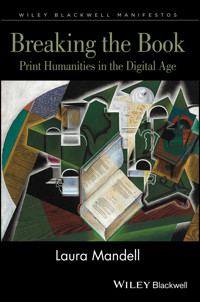
Cover image: Juan Gris, Book, Pipe and Glasses, oil on canvas, 1915. Private Collection / Photo © Christie’s Images / The Bridgeman Art Library.Cover design by Yvonne Kok, Singapore.
Acknowledgments
This book has been a long time coming and has been interrupted by many life events, the best of which was a new job in which I became director of the Initiative for Digital Humanities, Media, and Culture at Texas A&M University. It is a joy to work here. I would like to thank the audiences who have heard bits of these arguments and responded to them over the last three years at the University of Texas at Austin, University of Victoria, University of Rochester, Ohio State University, University of South Carolina, University of Colorado, and University of Montréal. I would also like to thank Margaret Ezell who helped prevent some “howlers,” and who insisted that none remaining are hers. Crucially, I want to thank librarian Robert L. Crivelli, of Sam Houston State University’s Newton Gresham Library, who charged a book that I needed to his own card when I drove 50 miles to Huntsville, Texas, to get a copy, the day before Christmas vacation, on a day when much to my dismay no money could be taken for me to purchase a guest card: thank you again for trusting me, Robert; you helped me write this book. Deepest thanks always go to my husband, Gregory Gundzik, and my two beautiful and talented children, Josef and Julia Gundzik.
Advertisement
Engagement with a single human artifact, in the palm of your hand, is the fundamental act of humanities scholarship. If the digital age is an age of abundance–let us teach attentiveness. (Nowviskie 2012)
The title of this manifesto, Breaking the Book, is meant to be tendentious, and it is meant as well to indicate a critical engagement with the book as a medium that may enable breaking its hold on us, on our thinking, written by a person who has been working in the field of digital humanities. But before I start criticizing, I must say: it is only the book medium that allows such critical thinking, including about itself, a fact that indicates possibility and limitation at the same time. The inability to understand their essential co-presence has impaired bookwork in literary criticism, especially over the last 10 years. And I have to say directly to the book before I start: that my criticism made here in this manifesto forebodes no severing of our loves.
Lesen Sie weiter in der vollständigen Ausgabe!
Lesen Sie weiter in der vollständigen Ausgabe!
Lesen Sie weiter in der vollständigen Ausgabe!
Lesen Sie weiter in der vollständigen Ausgabe!
Lesen Sie weiter in der vollständigen Ausgabe!
Lesen Sie weiter in der vollständigen Ausgabe!
Lesen Sie weiter in der vollständigen Ausgabe!
Lesen Sie weiter in der vollständigen Ausgabe!
Lesen Sie weiter in der vollständigen Ausgabe!
Lesen Sie weiter in der vollständigen Ausgabe!




