


15,99 €
Mehr erfahren.
- Herausgeber: John Wiley & Sons
- Kategorie: Fachliteratur
- Sprache: Englisch
Updated business wisdom from the founder of Dogfish Head, the nation's fastest growing independent craft brewery
Starting with nothing more than a home brewing kit, Sam Calagione turned his entrepreneurial dream into a foamy reality in the form of Dogfish Head Craft Brewery, one of America's best and fastest growing craft breweries.
In this newly updated Second Edition, Calagione offers a deeper real-world look at entrepreneurship and what it takes to operate and grow a successful business. In several new chapters, he discusses Dogfish's most innovative marketing ideas, including how social media has become an integral part of the business model and how other small businesses can use it to catch up with bigger competitors. Calagione also presents a compelling argument for choosing to keep his business small and artisanal, despite growing demand for his products.
- Updated to offer a more complete look at what it takes to keep a small business booming
- An inspiring story of renegade entrepreneurialism and the rewards of dreaming big, working hard, and thinking unconventionally
- Shows how to use social media to reach new customers and grow a business
For any entrepreneur with a dream, Brewing Up a Business, Second Edition presents an enlightening, in-depth look at what it takes to succeed on their own terms.
Sie lesen das E-Book in den Legimi-Apps auf:
Seitenzahl: 587
Veröffentlichungsjahr: 2011
Ähnliche


















Contents
Foreword: The Passion of the Individual
Preface
Introduction
Chapter 1: The Unconventional Beginnings of an Entrepreneur
Your Calling: Finding Your Passion
Recognizing Your Strengths
Taking Risks: Being a Business Pioneer
Values
Fitting the Pieces Together
The Value of Execution
Innovation: Turning Lemons into Lemon-Flavored Beer
Overcoming Obstacles to Business: Repealing Prohibition
Education + Body + Mind = Personality
We All Need a Little Help . . .
Making Your Idea a Reality
Chapter 2: Business from the Inside Out
Discovering Who You Are
Educate Yourself
Learning about Your Business
Learning from Those Who Came Before You
Know Yourself
Being Able to Roll with the Punches
A Business is a Reflection of Its Owner
Chapter 3: Keeping Your Balance
Nobody Told me There’d be Days Like This
It’s Me Against the World
The Businessperson as Artist
Reenergizing Yourself
Roaming
Rhythm
Chapter 4: Creating a Business Offering: Developing Goods and Services
Keeping Your Fingers on the Pulse of Your Industry
Finding a Niche and Scratching It
Developing a Product
The Small-Business Advantage
Your Company’s Identity is You First and Your Offering Second
Know What You Aren’t
Size Matters: Small is Beautiful
Turning Disadvantage to Your Advantage
Educate Your Customer about Your Product . . .
. . . and Let Them, in Turn, Educate You
Remembering That Quality + Distinction + Education = Value
Bigger, Faster, and Cheaper versus Smaller, Slower, and Better
Chapter 5: Crafting a Brand in a Cookie-Cutter World: Embracing Your Inefficiencies
Making Yourself a Household Name
Quality
Lessons on What Really Makes a Brand
Distinction or Extinction
Consistency of Message
Investment of Time into Your Brand
Chapter 6: Marketing on a Small-Business Budget
Make Your Marketing as Unique as You Are
Seamlessly Integrating Your Passion and Philosophy into Your Marketing
Knowing Your Market
Capturing Your Audience
Defining Your Market Position
Stand for Something, Because You Can’t Stand for Everything
To Advertise or Not to Advertise
Sucking and How It’s Good for You
Small Business’s Secret Weapon
Monitoring Your Monitor
Help from Our Friends
Expanding Your Offering: The 360-Degree Dogfish Experience
Turning Failure to Your Favor
Chapter 7: Going Social
Chapter 8: Publicity Stunts (Are Poorly Named)
The Power of Publicity
Spreading the Word
Putting an Interesting Spin on Your Message
What to Do
Don’t Pass Up the Chance to Promote What the Competition is Doing
What Not to Do
The Best Things in Life . . .
Location, Location, Location
If at First You Don’t Succeed
Teaming Up for Publicity Events
Creating Profitable Partnerships
Developing Alliances to Increase Sales
Developing Alliances to Further Your Company’s Unique Identity
Expanding Your Horizons . . . and Your Business
Successful Publicity
Chapter 9: Stalking the Killer App: Creating Innovation
Priming for Innovation
Bigger Isn’t Always Better
Broad Gap Apps
An Innovation’s Success is Based on Its Customer Response
Small Innovation is Better Than No Innovation
Promoting Innovation within the Company
Innovation That Starts Outside the Company
Our Duel with Dualism
Dual Product Release
Chapter 10: Selling Distinction, Specialization, and Variety
Success in Selling
Teaching the Value of Your Business
Know Your Customer
Name Your Price
Competition: Setting Yourself Up to Have None
Developing a Sales Budget
Finding Support within Your Industry
Prophets, Proponents, and Patrons: Your Sales Force
Your Sales Are Only as Good as Your Salespeople
Chapter 11: Cash is King (Well, Sort Of)
Tools of the Financial Trade
Call in the Experts
The Balance Sheet and Income Statement
Where the Money’s At
Maximizing Short-Term Profits versus Long-Term Financial Health
The Chicken of Risk and the Egg of Return on Investment
Calling for Backup
The Analytic and the Creative
The Best Decision You’ll Ever Make: Finding Someone Else to Do the Job
Chapter 12: Leadership: In Theory and in Practice
Create an Inspiring and Worthwhile Business Proposition
Communicating Your Worthwhile Business Proposal
Overcoming Meeting Avoidance
Lack of Communication
The Price of Not Communicating
Learning from Mistakes
Tracking, Recognizing, and Rewarding the Successful Execution of a Worthwhile Business Objective
Chapter 13: Effectively Managing Coworkers
Treating Coworkers Like Family
Developing Strong Management Skills
Hiring and Keeping Strong People
Setting Defined Expectations
Rewarding Coworkers
Chapter 14: Working Toward Irrelevance
Delegating Your Way to Obsolescence
Passing the Torch
Determining Your Own Fate
Sharing Your Shares
Knowing Your Options
The Future is Uncertain
Chapter 15: Home Brew Rendezvous
Chapter 16: To Small-Business Success
Goodness in Business
Index
Copyright © 2011 by Sam Calagione. All rights reserved.
Published by John Wiley & Sons, Inc., Hoboken, New Jersey.
Published simultaneously in Canada.
No part of this publication may be reproduced, stored in a retrieval system, or transmitted in any form or by any means, electronic, mechanical, photocopying, recording, scanning, or otherwise, except as permitted under Section 107 or 108 of the 1976 United States Copyright Act, without either the prior written permission of the Publisher, or authorization through payment of the appropriate per-copy fee to the Copyright Clearance Center, Inc., 222 Rosewood Drive, Danvers, MA 01923, (978) 750-8400, fax (978) 646-8600, or on the web at www.copyright.com. Requests to the Publisher for permission should be addressed to the Permissions Department, John Wiley & Sons, Inc., 111 River Street, Hoboken, NJ 07030, (201) 748-6011, fax (201) 748-6008, or online at http://www.wiley.com/go/permissions.
Limit of Liability/Disclaimer of Warranty: While the publisher and author have used their best efforts in preparing this book, they make no representations or warranties with respect to the accuracy or completeness of the contents of this book and specifically disclaim any implied warranties of merchantability or fitness for a particular purpose. No warranty may be created or extended by sales representatives or written sales materials. The advice and strategies contained herein may not be suitable for your situation. You should consult with a professional where appropriate. Neither the publisher nor author shall be liable for any loss of profit or any other commercial damages, including but not limited to special, incidental, consequential, or other damages.
For general information on our other products and services or for technical support, please contact our Customer Care Department within the United States at (800) 762-2974, outside the United States at (317) 572-3993 or fax (317) 572-4002.
Wiley also publishes its books in a variety of electronic formats. Some content that appears in print may not be available in electronic books. For more information about Wiley products, visit our web site at www.wiley.com.
ISBN 978-0-470-94231-4 (pbk); ISBN 978-1-118-06185-5 (ebk); ISBN 978-1-118-06186-2 (ebk); ISBN 978-1-118-06187-9 (ebk)
For my sweet gal, Mariah. Since I have met you, I have grown to believe there is nothing we can’t do together.
Foreword
THE PASSION OF THE INDIVIDUAL
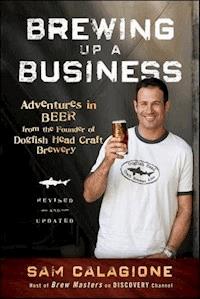
The cheerful chap on the cover of this book has every reason to smile. The military-looking vehicle behind him delivers only the matériel of sociability. People love him for it.
Sam Calagione does not aspire to sit among the suits at a boardroom table and be a slave to the military metaphors of marketing. He fights his own battles, on behalf of people with individual tastes and against the tyranny of timidity, conformity, and the lowest common denominator.
When I first took my pen to the same cause, 30 years ago, my colleagues asked if I had given up serious journalism. Did I no longer want to change the world? Almost all of them took beer seriously, but they nonetheless thought that writing about it was a frivolous pursuit.
Like Sam Calagione, I can simultaneously have fun in my job but pursue it with serious intent. Those of us who are truly demanding about our beer are a minority, but we are by no means insignificant in number, and we are willing to pay more for a brew we like.
For us, good beer is essential to the quality of life. People who love wine or bread or cheese, for example, would take the same view. These are all perfect products for the entrepreneur, but so are scores of others. In my view, a passion for the product is the first essential. If you have a passion, look at that first. Whatever excites your passion, there are surely others who feel the same way.
Passionate beer-lovers are seeking character, with its own individualistic interplay of flavors. Big breweries have the technical know-how to make such products but their kettles are too large for our market. Their cost accountants want to produce beers low in raw materials and high in acceptability. Their marketing people believe they can think small, but they cannot; well, not small enough. To have individualistic beers, we need small breweries. If you are not passionate about beer, you may be unaware of the renaissance of craft brewing in the United States since the late 1970s.
When I began writing about beer, there were fewer than 50 brewing companies in the United States, almost all of them making very similar beers. Today, there are more than 1,500, brewing beers in more than 100 styles. Many of those beers are highly individualistic, but none more so than Dogfish Head’s.
Their individuality is suggested by their names. I especially like Raison d’Etre (both the name and the beer); then Dogfish Head exceeded it with Raison d’Extra.
As his verbal dexterity suggests, Sam was an English major. He studied fiction and poetry. I’m told he takes Walt Whitman to bed with him, though I learned this from a young woman who has no firsthand knowledge of that. I think she wished she had. “You are spending the whole day with Sam Calagione?! Tomorrow?! He’s the Robert De Niro of brewers!” He hasn’t made a feature film yet, but he has been a Levi’s model and made a rap record.
Sadly for female admirers, he seems to have found the perfect wife while still at college. He has the ingenuity to invent new equipment for the brewhouse, and the muscle to row his beer across the Delaware River.
Now it turns out he can write a book, too: brisk, readable, and instructive. A man of such diverse attributes, abilities, and achievements sets an example that makes us all look deficient.
What can we do about this? I can write a Foreword, which aggrandizes myself: I become someone whose blessing he needed. And you? Read the book and brew up your own business. You don’t have to make beer. Just make a million. . . .
—Michael Jackson
Michael Jackson is the world’s best-selling author on beer and whiskey. His most recent books are The Great Beer Guide (New York: DK Inc.) and The Complete Guide to Single Malt Scotch (Philadelphia: Running Press).
Preface
In my college days I was an English major (fatefully, I minored in beer drinking—one man’s disciplinary probation is another man’s vocational research). I have always enjoyed reading more than studying. When I had an epiphany to open a brewery, I figured I could learn everything I needed to succeed in business by reading business books. Boy, was I wrong. However, I did learn a lot from reading great books by and about the business leaders who came before me. I have a shelf full of them. I especially enjoy books about entrepreneurs who started little companies with big visions: stories about women mixing up hand lotions in their home blenders and packing them in ketchup bottles, or guys cooking up the revolutionary sole (soul) of a running shoe in their waffle makers.
But nearly all of these books sit dormant on my bookshelf. I earmarked and underlined hundreds of inspirational philosophies and schemes that motivated me toward my dream of opening my own company. But I always seemed to lose interest in these stories at about the same point—just after the hero slays the dragon and brings the great idea to market, when the MBAs, bankers, and accountants bum-rush the stage and in the flash of a moment the company goes public. When my eyes come across that horrific, inevitable phrase “maximizing shareholder value,” they pretty much glaze over.
Entrepreneurs are fueled by risk and an inherent desire to make their mark in their world. In growing Dogfish Head I’ve done a lot of things right and a lot of things wrong. What I am most proud of is having done so many things. Everybody has dreams and ideas; our imaginations should be our most treasured assets. But the self-esteem and courage needed to continually face the Sisyphean task of moving your ideas from imagination toward reality are what propel an entrepreneur forward. Everyone has great ideas, but successful businesspeople tend to be better at executing great ideas. The sense of accomplishment that comes with this execution gives us the buzz we seek. This buzz would not be half as resonant if there were no risk involved. Executing your idea while fully aware of the risk enhances the natural buzz. When it comes to brewing up a business, I haven’t always known exactly what I am doing. The results of some of my efforts bear this out. I’m okay with that, and if you are in business for yourself or considering heading in that direction, you need to be okay with that, too. I am confident that even if you fall down in business and have to pick yourself up and start afresh every day, the courage that comes with embracing your struggle will be well worth it.
It’s that feeling of handing a cupful of moisturizer to the first customer, or watching the athlete take the first turn around the track in Aunt Jemima shoes, that feeling of Oh my god! What am I doing? is the most holy feeling an entrepreneur can experience. In my mind, it speaks to a basic and beautiful human condition—the rush of adrenaline, the fight-or-flight predicament. Not knowing if you are going to survive, if your idea is going to be embraced, is an exciting, daunting, and addictive feeling for an entrepreneur. It is our Raison d’Etre. And you can maintain and amplify that feeling regardless of what stage your business is in—even if you are still in the planning stages. It just seems to me that going public is by definition anti-entrepreneurial. You cannot let the tail of money wag the dog of inspiration.
Of course, there are legitimate reasons why a company goes public. I just can’t think of any off the top of my head. (I have promised my coworkers that the day Dogfish Head goes public I will dive into our largest fermenting vessel and tread beer for an entire eight-hour workday.) This book is not really for the folks faced with the challenge of bringing their companies public. This book is for the rest of us—the majority of us. Over 95 percent of the companies in the United States are privately owned. Over 80 percent of these are considered small companies—companies with revenues of less than $10 million. It is a documented fact that the number one reason small companies go out of business is lack of capital. Lack of capital is pretty much my middle name. I’m almost sure we were the only commercial brewery to ever accept delivery of a brewing system from the back of a UPS truck.
When we opened our doors, we had the dubious distinction of being the smallest brewery in the country. Today Dogfish Head is among the fastest-growing breweries in the United States. We are still tiny, but we are growing strong. And we are still learning from our mistakes. We’ve made more than a few. (Note to self: Do not put peppercorns and lavender buds in a beer and expect people to beat down your door for a pint of it.) But the one thing we have successfully done is establish a small brand that stands for quality and innovation. We have built this brand through our own belief and determination in what we are doing and the shared belief of our coworkers and customers. We’ve averaged 35 percent revenue growth per year over the past five years and are on track to surpass $50 million in sales this year. We built this brand spending less than 1 percent of our revenue on advertising. We do all our own marketing, product development, and social media in-house.
In this book I share some of the defining moments in the Dogfish Head corporate evolution that were monumental learning experiences. I regale you with stories of exploding stainless steel tanks, building and rowing a boat to deliver beer from Delaware to New Jersey (our first export), selling T-shirts at truck stops for gas money on the way home from beer festivals, and worse. But mostly I hope to commiserate and celebrate the amazing feeling of what it means to be an entrepreneur. Say it with me as you bring this book to the cash register: Oh my god! What am I doing?
Introduction
When I started Dogfish Head over 15 years ago, I never would have imagined the adventure that decision would take me on. Recently, I was packing my bags to head out to Germany, then Egypt, when I was reminded of how far we’ve come since brewing our first batch of beer. This past year has been an exciting one.
In the previous edition of this book, I wrote about the importance of roaming—of getting outside of the day-to-day operations, getting rid of the blinders, and seeing the world from 10,000 feet. How much you do outside of your workplace informs what you do in the workplace. Since then, the amount of travel I do for my job as the founder and president of Dogfish Head has increased exponentially as I’ve continued to search for new and exciting ingredients and inspirations for our beers. Our passion for what we do, our determination and dedication to our brand, has given us an opportunity to do a show for the Discovery Channel that began airing in November 2010. Dogfish Head was chosen to be the brewery featured in this prime time TV series, but the fact that a major cable network would choose to do an entire series around beer culture also shows that the popularity of craft beer in general continues to grow. It exemplifies how exciting a moment it is on the time line of craft beer in the United States.
The show is about celebrating the diversity and the passion in the international craft brewing community through the eyes of a relatively small but creative brewery that just happens to be located in rural Delaware.
When the folks from the Discovery Channel and the production company, ZPZ, came to us with the idea for the series, we basically said to them, “Well, we don’t really have time to do anything other than what we’re doing. But here’s what we’re doing.” We sent them the itinerary of what we already had in our plans for 2010, including installing a giant, beautiful structure called the Steam Punk Treehouse, built by the Five Ton Crane Art Collective in Oakland, California. We then told them about a new beer that we planned to make in conjunction with the Grain Surfboard Company, a small surfboard company in Maine that makes its boards by hand with sustainably harvested cedar wood. We’re going to use the scraps of its wood in the aging process for a new beer called Grain to Glass. We showed them the Miles Davis Bitches Brew project that we’ve been working on with Sony Records to do a beer that would be a mash-up of styles—a fusion of an imperial stout made with Mauritius brown sugar and Tej, which is the native African honey beer fermented with geisha root. It represents the fusion that is also symbolic, as Miles’s Bitches Brew album was the seminal fusion of jazz and rock, sort of the starting point for those worlds overlapping.
We outlined all of these really exciting projects that we already had on our dance card, and they were like “This is awesome!” Instead of having us go on the road and peek into breweries around the world, they decided to follow us on what we are already doing at Dogfish—because our world already intersects with so many other interesting entrepreneurial and artisanal companies. It was a great reminder to us that as far as we’ve come in scale since the previous edition of this book—and certainly since we opened Dogfish Head over 15 years ago—we really haven’t had to change too much of what our company is about. In other words, our original mission of “off-centered ales for off-centered people” still resonates as much (if not more) today as it did when we came up with it over 15 years ago. The only difference is in that era, we were the smallest craft brewery in the country, and today ours is one of the top 25 breweries in the United States, out of 1,600 breweries.
But look at what attracted the Discovery Channel to Dogfish. It’s also what I think attracts beer drinkers to our company. We recognize that we aren’t brewing for the status quo. We recognize that the average beer drinker will probably never try our beers, even if we were to have a significant 5, 10, or 20 percent market share in the United States. We are “off-centered,” meaning that we’re not going to appeal to the majority. That said, we’ve been able to carve out a very healthy niche, growing by catering to a very small but increasing and very engaged minority beer-drinking population—those who want more flavor, more diversity, more complexity, and more food compatibility in their beer. Those are the folks we’ve grown with; and there are a lot more of them today than there were when we were the smallest craft brewery in the country.
Now look at the other side of that: the off-centered ales. Since writing the first edition, we have created and introduced many different varieties of beers that didn’t exist when I wrote the first edition that are incredibly successful. To brew our Palo Santo Marron, we constructed the largest wood-brewing vessels used in the United States since before Prohibition. Our Namaste, which my wife Mariah named, means “the spirit in me acknowledges the spirit in you,” and is often said after yoga. It’s light in alcohol but is a flavorful version of a Belgian white beer to which we add lemongrass and organic oranges. We have a beer called Theobroma, one of the oldest-known cocoa beer recipes, which we collaborated on with Dr. Pat McGovern, the molecular archaeologist who also worked with us on Midas Touch and Chateau Jiahu.
As we’ve grown, we’ve become more experimental, more creative, embraced more risk, on the production and research and development (R&D) side than when we were smaller. Of course, we do still—to some limited degree—face a perception issue, where maybe for those at the epicenter of the beer community—the super-hard-core, dyed-in-the-wool beer geeks, as we call ourselves—Dogfish itself as a brewery isn’t a new thing. There are always new, exciting little breweries, and everyone always wants to talk about what’s new. But what has kept our company very relevant over the years is the recognition for pushing the boundaries of what beer can be. And this journey has now been accelerated with this show.
We went to Peru and brewed beers in wood-floored huts with the female chicha brewers of Peru, where the chicha—an alcoholic beverage—is fermented by chewing on purple Peruvian corn. The enzymes that are in human saliva convert the starches in that corn to sugars for the yeast to eat. We brewed a very traditional chicha recently and served it at our pub. Thirty of our coworkers came together to chew that corn, and we told our consumers exactly what we were doing and that it was sterile (after we chewed the corn and it fermented, we would boil it and then ferment it again so that it was sterile). But still, we were asking our off-centered friends to take this risk and drink a beer made with saliva! Who’d have thought that a commercial brewery—one of the top 25 commercial breweries in the country—would take a risk like that?
I roamed through Cairo, Egypt, which is believed to be one of the earliest meccas of commercial brewing and the domestic growing of crops from many, many millennia, to study the recipes originating from the hieroglyphics on the walls of tombs. The hieroglyphics show that in the ancient Egyptians’ language bread and beer were virtually synonymous. Whenever they showed the symbol for bread, they’d show the beer symbol next to it; so both of those things were literally the lifeblood of their society. It’s thought that slaves built the pyramids; in fact, it was ambitious workers—entrepreneurs, if you will—who were paid in a currency of beer to build the amazing pyramids. I’m looking forward to immersing myself in the ancient brewing culture of Egypt, as we’re actually bringing over a high-tech solution to make an authentic beer based on these hieroglyphics. Basically, we are going to culture the night air of Cairo. We will pull the wild yeast and bacteria out of the air, and then bring them to a very sophisticated brewing lab to culture up that wild yeast and propagate a batch of beer that we’ll make back here in the States. So again, we’re involved in many extremely ambitious and creative projects for a brewery of our size. And I don’t think that’s ever going to change for us. We’re going to keep flying our freak flag high and proud and keep pushing the outer limits of what beer can be.
It’s also been wonderful to see so many other craft brewers doing the same. When we first started Dogfish Head, we were considered heretics and weirdos for screwing with the tradition of making beer with just water, yeast, hops, and barley. We were one of the first breweries in the world to focus on beers made with exotic ingredients. Those early efforts played a big part in establishing a marketplace that’s accepting of more exotic and interesting beers, so that breweries like Founders can make a beer like its Breakfast Stout, with coffee and a hint of chocolate; or a brewery like Shorts can make its Bloody Mary beer, with tomatoes and horseradish; or a brewery like Allagash can make a beer with grapes in it.
Dogfish is proud of the role that we’ve played—along with a number of other great breweries—in expanding the American palate and knowledge of the diverse beers out there. This journey I’ve been able to go on around the world has given me an opportunity to see that this isn’t a local phenomenon; it’s a global phenomenon. I made a beer in New Zealand with tree tomatoes—a tangy and mildy sweet fruit—smoked over wood from the herbal, local pohutukawa tree. I got to drink those native beers of Peru that had fennel seeds, strawberries, and cinnamon. And then I’m going to Rome to pick thyme off the mountainsides and add it to the beer we made there, while sampling all the exotic beers being made in Italy today.
So there truly is a global movement toward better beer today, and I’ve been fortunate to have this bird’s-eye view as I’ve gone around the world and immersed myself in all these exotic brewing cultures. It’s a great reminder that long before the world was brewing slight variations on the very same style of light lager—which, unfortunately, today still dominates 99 percent of the international beer landscape—there were culturally unique and vibrant beers. And now, as more and more breweries around the world are coloring outside those lines, I’m proud that Dogfish Head has staked our little claim in that world. We’ve had a small but meaningful impact on the world of adventurous beers.
SOME THINGS DON’T CHANGE: SUCCESS IS STILL ABOUT THE PEOPLE
The strength of our company has been driven by the people. Identifying really motivated and really talented people is something that I focused on in the first edition of this book. There is no clearer, more impressive, and more concise example of what I meant by how important it is than the revenue that resulted from having a company of dedicated and passionate individuals. When I wrote the first edition of this book, we had about 50 or 60 coworkers. We have doubled that number and are at somewhere around 130 coworkers now. When I wrote the first edition, the company’s revenue was at about $8 million. Right now, we’re working on our budget for 2011 in which our combined company revenue for the production brewery, the distillery, the brewpub, and the merchandise is expected to exceed $52 million.
We’ve basically doubled our workforce, but will be multiplying our revenue by a factor of roughly six. How is it that we can accomplish this? Well, we’ve done a great job of identifying and attracting talented people to come with us on this journey. Our human resources director, Cindy, annually reviews how we’re doing benchmarked against our industry. We strive to provide the best benefits program, the most rewarding work environment, the most supportive culture, and the highest safety program of any company in our industry. But we’re also just trying to find people who want to come on this quixotic journey with us.
This work environment is not for everyone; you do have to be a very motivated person to make it here, because while yes, we are always doing better at managing our growing workforce and organization chart, we really look for people who work for themselves primarily. They don’t work for me, Sam Calagione, as the president of the company, and they don’t really work for Dogfish; or at least we all work for Dogfish exactly as much as how Dogfish works for all of us. They’re people who are entrepreneurial in that they bring their own pride and their own ingenuity into their work, and they want to be proud of the work they do. And so one of the biggest factors in our escalating success since the first edition of this book is our emphasis on the importance of hiring extremely talented people.
SUSTAINABLE GROWTH
The growth and success of Dogfish Head have not been without some bumps, hurdles, and difficult decisions along the way. Up until last year, we were averaging about 40 percent revenue growth per year, and we hit a wall where we saw that that annual percentage of revenue growth was just not sustainable. It was not fair to our coworkers, or to our own quality of life, to continue growing that fast, nor is it really sustainable in very bricks-and-mortar, intensive businesses like brewing. It’s not like software, where you come up with a great idea and then you can just go to market and build a billion widgets at a small cost. To produce 10,000 more barrels of beer next year means you have to buy 10,000 more barrels’ worth of stainless steel; purchase expensive tanks; buy 10,000 more barrels of barley, of hops, and of water; and hire enough people to produce 10,000 more barrels. Our industry has a disproportionately large cost of reinvestment to grow, and we made the decision in the past five years to be focused more on smart growth than on fast growth.
The other line in the sand that we drew is refusing to sell to private equity. About two years ago, we were approached with a number that Mariah and I could have retired very comfortably with forever, and we said no. We’ve been approached by folks on Wall Street who wanted to take us public, and we said no. We want to try to keep this a family business, with the hope that someday maybe we can make it last into the next generation—and we want to keep this as a company that’s owned by the people who run it. That’s our real goal. It precludes us from growing too quickly, because at some point when you’re a fast-growing but capital-intensive business, you outgrow traditional bank financing, and have to look toward venture capitalists or an initial public offering (IPO) or something like that. And we just didn’t like that. So we decided to reduce our growth rate to roughly 20 percent a year and see what happens. I know how fortunate we are to be in the position of having to control our growth. We don’t take this luxury for granted, and we are very thankful for the support of every single beer lover who has joined us on this journey.
The other big driver for us was that we didn’t want to turn into the 60 Minute Brewing Company. There aren’t many examples of breweries producing over 50,000 barrels annually and celebrating the whole breadth of their portfolio with the same gusto and attention to detail as Dogfish Head. Our best-selling beer, the 60 Minute IPA, accounts for 51 percent of our sales. But we don’t put any more energy into selling 60 Minute IPA than we do the Theobroma, the ancient Aztec cocoa beer that we make 200 barrels of once a year and that accounts for less than 0.005 percent of our volume. They’re all our children and we love them all equally; and frankly that’s been a challenge in this rapidly changing marketplace.
Since the publication of the first edition, consolidation has only intensified in all three tiers of the beer business: the suppliers, which are us—the brewers—making the beer; the distributors, which are the companies that take the beer, pay the breweries for it, and ship it to the retailers; and then the retailers, which are the liquor stores, bars, and restaurants. The U.S. federal government mandates a three-tier system that precludes breweries from selling direct to retailers. By and large, 99 percent of the beer sold throughout the United States is sold through distributors—and they’re an important component of our business.
Consolidation has been happening at an accelerated rate on the retail level. The big keep getting bigger, as in the cases of the Costcos and the Walmarts and the other big-box stores, and a larger and larger fraction of beer is being sold from those big-box chain stores. At the distributor level there’s been a lot of activity as well, with larger distributors gobbling up smaller ones. When Dogfish Head started, not many distributors knew who we were, much less had interest in carrying our beer. So oftentimes, we went with smaller, entrepreneurial, mom-and-pop distributors who were passionate about beer first and business second. Well, as our business grew, the distributors’ businesses grew, to the point where they got on the radar of the even bigger distributors. So the distributors buying Dogfish Head were bought out by much bigger distributors, usually ones with larger breweries—Miller, Coors, or Budweiser—already in their houses. They bought those little distributors because they saw breweries like Dogfish Head and other craft breweries in the portfolios of the smaller distributors that were diamonds in the rough—and the consumer was demanding that these little breweries be in their retail stores and on their taps in their restaurants. So to some degree, the consumer dictated that the big distributors pay attention to our business.
This, of course, doesn’t come without its own risk—and the biggest risk for us. Kona Brewery combined with Red Hook and Widmer and Goose Island; Magic Hat brewery combined with Pyramid, and then they combined with Genesee into a larger entity called North American Brewers that’s owned by a venture capitalist group. The biggest combinations, frankly, have happened among the really giant brewers. When I first wrote this book, Coors, Miller, and Budweiser were the three biggest independent brewers—or biggest conglomerate brewers—in the United States. Now, what’s ironic is that there are two giants left standing that have gone truly global—and neither of them is even an only American-owned entity. Today, Bud, Miller, and Coors have been replaced by two new entities: InBev, based in Belgium and Brazil, bought U.S.-based Anheuser-Busch in 2008 and now brews and distributes 200 brands of beer worldwide; and the U.S. divisions of South African brewers SABMiller and Molson Coors got rolled up together into MillerCoors. So now there are two giant global brewing entities that have over 70 percent market share worldwide. In the United States, these two entities account for over 85 percent of the beer sold. The somewhat independent big import brands, like Corona and Heineken, take up 8 or 9 percent, so that leaves about 5 percent market share for craft breweries. Even though breweries like Dogfish Head have multiplied times six, and other craft breweries like Sierra Nevada and New Belgium and smaller breweries like Allagash and Avery have expanded their presence significantly, craft beer has at most a 5 percent market share because we’re still such tiny breweries. Next year, when Dogfish Head does around $52 million in sales and 140,000 barrels, we will still have only about one-eighteenth of 1 percent market share. That’s how huge the domestic beer market is here in the United States. But it also gives us hope—because the small breweries are the only ones that are now growing.
This is probably what gives me the most hope: Craft beer is actually growing in a recession. How many other industries can show that the fastest growth is happening in the highest-priced segment? Certainly not the auto industry. Certainly not the housing industry. The big breweries that make the less expensive beer are flat, and the imports are flat. But domestic craft beers from small, independent traditional breweries are in demand. I stepped back and asked myself, “Well, why is that?” I believe that the consumers are voting with their wallets. They are way more discerning, they’re way more powerful, and they’re way more vocal than they were just five years ago. And they recognize that craft beer is an affordable luxury, unparalleled.
The other big reality is that people are choosing to support small, local companies. They see that there are international, sort of nameless, faceless, publicly traded, global breweries that dominate the commercial beer landscape—and yet there’s beer being made right in their hometown, literally. There are over 1,600 breweries in the United States today, and the average American now lives within 10 miles of a local brewery. These local brewers are in their community, doing festivals, doing beer dinners, doing tastings, and introducing themselves on a very human level and scale. And people are choosing to support businesses that are of a human scale. People are discouraged by the failures of global, publicly traded companies and are embracing the opportunity to support a small, local brewery—or any small, local business. It’s a very encouraging position for us all to be in, and it all plays into the ways that the business landscape has changed for us in the past five years at Dogfish Head.
This also demonstrates the reality of social media, in that just as consumers are choosing to support local businesses, those consumers are better educated, and way more powerful, than they were five years ago. Social media is at the heart of that. My wife Mariah, who has run our web site basically since we opened, has devoted most of our marketing energy as well as the vast majority of our resources to our online world. Dogfish Head has one of the biggest—if not the biggest—Twitter and Facebook accounts in the beer industry; and yet, we’re only the 25th largest brewery. Well, why is that? It’s because we started as a grassroots company. Social media is just a new-world, new-economy way of saying customer-to-customer marketing, or grassroots marketing. And so we use that online world to communicate directly with consumers. But they’re also the ones who are fanning the flames and acting as evangelists online, and in their communities, to turn each other on to what we’re doing at Dogfish Head. And that’s the crux of how we’ve grown, and how all craft brewers have grown in this recession: The consumer is louder, more powerful, better armed, more informed, and more willing to support the little guy—and that’s why we’re here today.
What I’ve learned and what I’ve been able to take away from all of this is that it comes down to passion. Passion, dedication, and commitment are what brought Dogfish Head to the amazing place it is at today. These elements are essential for success, and, if you channel them into your own business, you can and will achieve your goals and dreams. Take it from one small business owner to another: In good times and in bad, you have the potential for growth beyond your own expectations. Just believe in yourself and believe in your business.
CHAPTER 1
THE UNCONVENTIONAL BEGINNINGS OF AN ENTREPRENEUR
My dad backed our red pickup truck beneath the second-story window of my dormitory bedroom. My schoolmates in the next dorm room initiated a grand send-off by blasting Frank Sinatra’s “That’s Life” out their windows as we threw green garbage bags filled with clothes, cassettes, and books into the back of the truck below. I received this rousing tribute partly in acknowledgment of my proud Italian-American heritage, but mostly because I had just been kicked out of prep school a mere two months before graduation. My father drove me home in silence. When we reached the driveway of our house, he said simply, “Sammy, sometimes you’re a tough kid to love.”
I was so disappointed in myself at that moment. Yes, I was disappointed because I had let my father, my biggest supporter in the world, down to a cosmic degree. But I was mostly disappointed in myself because I had just lost the connection to the place where I had learned who I was and who I wanted to be—the place where, I would later realize, I decided to be an entrepreneur. For better or worse, I had figured out who I was and who I wanted to be while I was attending Northfield Mt. Hermon School (NMH)—the high school started by the world-renowned evangelist D. L. Moody—the school I never graduated from.
Not that I didn’t deserve to be kicked out. The administrators there finally sealed my fate under the blurry and all-encompassing “Accumulation of Offenses” section of the student handbook. I can recount a number of said offenses accumulated in my three-plus years there, and I think I should recount them again now. Looking back, I believe these offenses were indicative of the entrepreneurial fire I had burning within me.
I came right out of the gate with a willingness to embrace risk. I set the record for the earliest point in the school year when a student was placed on disciplinary probation. I had grown up in the town next to the school, and I wanted to show my two best friends the beauty of my new school as well as the beauty of the girls at my new school.
We snuck out my parents’ station wagon in the middle of the night and headed to campus, just three sophisticated 16-year-olds, smoking cigars and listening to Journey. We approached the school in a covert fashion that we thought would surely allow us to elude campus security. Instead of using the road, we drove up the football field, through the quad, and straight into a motion-detecting light. Not into the shaft of light, mind you, but into the pole that was holding the light itself. It detected our motion. We were greeted by a dorm parent who soon invited campus security to the party, and the rest was history.
My next year marked the second phase of my delinquent entrepreneurial development in which I exhibited ambition and an ability to organize coworkers toward a common objective. Our objective at this juncture was not getting kicked out.
In my junior year, I was not permitted to attend the prom. So another junior classmate and I designed a foolproof plan. We would act as chaperones for a bunch of senior friends who would be attending the prom. We decided to do this in style: A Winnebago was rented, beers were procured, bow ties were straightened. We headed off to the prom but never reached our destination, as much beer drinking, pool hopping, and roof surfing ensued. Though going down the highway at 60 miles per hour sitting Indian style on top of a Winnebago seemed like a good idea at the time, I can now see that it probably was not. The local authorities felt similarly, and we received a two-cruiser escort back to campus.
“You’re not going to get out of this one.” I believe those were the actual words used by the teacher whom the authorities handed us over to. We were all separated into different rooms so as not to be able to corroborate each other’s stories as we awaited our morning tribunal. The Winnebago was locked safely on campus, nearly overflowing with the various and sundry contraband. But this is where it turns into a story of uncommon valor and the creation of a united front committed to reaching a shared goal: beating the man. Walkie-talkies were employed, as were bicycles and door-opening coat hangers. We even used the sheets-tied-together-to-rappel-out-the-window motif celebrated in nearly every prison-break movie.
The following morning we were called to meet outside the Winnebago. There was a short, self-congratulatory speech by the teacher that mostly revolved around our foolishness for actually thinking we could get away with it. The door swung open and revealed . . . nothing but a very clean and contraband-free recreation vehicle. We were set free for lack of evidence. In the middle of the night we had successfully executed Project-Break-Back-In-and-Throw-It-All-Out. We had even made sure there was a vase of fresh-cut flowers on the dining table in the camper.
By senior year my entrepreneurial spirit knew no bounds. After the Winnebago incident, the powers that be decided to keep an eye on me. They said I could come back but only on the grounds that I live on campus in a dormitory. They didn’t realize that my friends had formed a juvenile-delinquent all-star team by signing up to live in the same dorm. We had diverse talents but shared a common love of partying and rule breaking. This would be the setting of my first endeavor into the beer business. I would visit my parents on the weekends, borrow the car, and cruise liquor stores for sympathetic western Massachusetts libertarian hippies willing to buy me beer as I waited in the shadows. I would return to school with an inordinately heavy hockey bag and parcel out the booty. There would always be an extra six-pack in it for me—the businessman. This proceeded throughout the year without a hitch. Yes, our beer-addled behavior sometimes raised suspicion—like when a faculty member opened the door to the recreation room only to find us playing two-on-two Ping-Pong wearing nothing but tube socks and ski goggles. But my luck couldn’t last, and I tempted fate. The businessman got caught and was put out of business.
YOUR CALLING: FINDING YOUR PASSION
There are a number of reasons why my time at Northfield Mt. Hermon was so crucial to my development as a creative person. The most important is that it was the place where I met and began to date my future wife, Mariah. At that time, aside from reading and writing, being with Mariah was one of the few things I was good at. I actually met Mariah’s mom, Rachel, first. She was friends with my favorite teacher, Bill Batty, and was at his house visiting his family for the weekend. Some friends and I were there that evening hanging out with Bill and his son John, who was a classmate of ours. Mariah’s mom made brownies for us that I was sure were the best I had ever tasted. She told me her daughter had just started her first term at NMH, and I told her that if her daughter could cook anything like her mom I was going to marry her someday. Within a couple of months I was dating Mariah, and we’ve been together ever since.
We began dating when we were all of 16 years old, so we’ve pretty much grown up together. Our personalities evolved to complement one another’s strengths and weaknesses. We attended different colleges in different parts of the country, spent separate semesters abroad in Australia, and still worked hard to see each other every chance we got. So much time and distance apart is not easy on a relationship, but through it all I got my first taste of how, if you want something bad enough and are willing to do anything necessary to make it happen, you can make it happen. This lesson has served me well in love and in life. Mariah was always the first person I went to for support and advice on the challenges we faced in the early years at Dogfish Head. She became my true partner in the company in our third year in business, and we’ve worked side by side to grow Dogfish Head since then. She is much more focused and practical than I am and has been as committed to guiding Dogfish Head toward where we are today as I have been. There are a million reasons why I love Mariah, one of which is that she is undoubtedly the only person in the world who has higher expectations of me than I have of myself. She is never surprised when we achieve great things; she would expect nothing less. I sensed that the first time I met her at NMH, and even more so after I was kindly asked to leave the school. In those first few weeks apart, our relationship became more difficult but also more rewarding as I saw she was willing to stand by me.
What sounds like a sad ending to a high school career was actually a pretty revelatory beginning. As I mentioned, getting kicked out of high school was one of the worst things to happen to me because that was where I learned who I was. The day I got kicked out, I also came to realize the person I wanted to be. I wanted to create. I wanted to make something that was a reflection of who I was. After getting kicked out of high school, I decided I wanted to be a writer, so I went off to college as an English major with hopes of being just that. Yes, I’m one of the elite fraternity of people in the country who graduated from college without ever actually receiving a high school degree. . . . We aren’t exactly Mensa.
RECOGNIZING YOUR STRENGTHS
Because beer has always played an important role in my life, I continued to hone my creativity with and passion for beer while at college. I modified an all-weather, thrift-store reclining chair to include a covert compartment that could hold a keg. When security showed up to bust a party, we’d sit on the chair and ask, “Keg, what keg?” I proudly contributed toward the invention of a drinking game called Biff that involved squeegees, milk crates, a Ping-Pong ball, and four contestants dressed only in tube socks and ski goggles (if it ain’t broke, don’t fix it). I graduated from college and realized I was more passionate about beer than a career in writing. So I started making my own beer and decided I wanted to open a brewery.
As an entrepreneur—as a person—you have to ask yourself what your defining inmost thought is. And then you have to do everything you can to express this belief to the people around you. I learned to love to read and write and express my creativity at Northfield Mt. Hermon. My inmost thought when I was first enrolled there was: “Rebel against authority in order to express yourself.” This is pretty much the same defining instinct that drives me today, but I’ve been fortunate enough to find a constructive outlet for this angst. I’ve created a company that subverts the definition of beer put forth by the so-called authorities at Anheuser-Busch and Coors.
If you are like me and did not earn a business degree or follow a clear and common path to create your business, you know there is no prescribed method to ensure success. I’m sure that majoring in business or getting an MBA gives you more tools and familiarity with the mechanics of business. But tools are useless unless you are able to use them. You could have the best set of tools in the world, but if you are not ready and capable of working with them they are useless to you. If you believe in your idea enough to make it happen, it must be a powerful idea. The way you harness the power of that idea is to believe you are the only person capable of making that idea a reality. Once you have this mind-set, you will see that a set of tools is not what builds a strong company—it’s the builder.
Opening a brewery—opening any business—seems like an impossible feat from a distance. But it starts with a faith in yourself—a belief that just because something hasn’t been done before doesn’t mean it shouldn’t be done at all. If anything, the more impossible your business idea seems to the world at large, the more opportunity there might be for you to succeed. Thomas Edison didn’t invent the lightbulb from scratch, but he was the first to imagine an entire country illuminated and powered by electricity. He set to work not just to create a durable lightbulb but to create an entire industry while naysayers around him predicted his failure. If you are going into business, the core of your strength lies in your ability to picture a world in which your idea makes a difference. However big or small that difference may be, however many people’s lives your idea ends up affecting, you need to recognize and celebrate your opportunity to make a difference. The lightbulb that went off above Edison’s head was not so much an actual physical lightbulb as it was a vision of a world in which he could make a difference.
TAKING RISKS: BEING A BUSINESS PIONEER
One of my earliest and fondest childhood memories is being “shot” in the back with a real arrow by my father as I rode a horse. He loaded the car with me, a camera, a bow, an arrow, and some ridiculous kiddie Western clothes he bought on a business trip to Texas. We drove to a farm that didn’t belong to anyone we knew but had a very old horse that he felt confident wouldn’t run away if he placed me on its back. He stuffed a flat piece of lumber under my shirt and jammed an arrow through the shirt into the wood. He placed me on a horse and “shot” me as I was doing my best wounded-cowboy impression. He was putting together a slide show for a group of fellow oral surgeons. He planned to end his lecture about a new, unorthodox tooth-implant system he had created with that picture of me on a horse with an arrow in my back. The message revolved around the perception of risk that comes with trying something new. The pioneers were the ones who risked their lives in order to create a new community in a new land. All small businesspeople are pioneers, and their companies are the hearts of their communities.
Of course there is risk that comes with being a pioneer, but the risk is minimized if the community is built on an impressive set of values—impressive in that they make an impression on the lives of the people who come in contact with them. These values start at home and shouldn’t be separate from your professional values if you are going to succeed. I think I sensed this idea emanating from my father even then, at the moment he was “shooting” me with an arrow.
The only predictable thing in the world of business is that the future cannot be predicted. Going into business is about embracing the unknown. You recognize very quickly that there is no safety net to catch your fall. While you cannot recover what could be lost by taking those risks, even many failed entrepreneurs agree that those risks are well worth taking. You have to believe in yourself and the integrity of your idea to really make a go of it. Business integrity is a combination of your values and work ethic and the value of your product or service to potential customers. To connect your personal values with a product that reflects those same values takes education. First you have to educate yourself on how to get into business and how to apply your own values to those of your business. Then you have to educate your coworkers and customers on what that business is all about. Unwavering faith and devotion to seeing your idea through are critical. This faith will come through your values and your education. No matter how much the daily unknowns of business push and pull you out of your comfort zone, you can execute your ideas if you are anchored by strong values.
VALUES
There are as many different reasons, motivations, methods, and models for starting a business as there are businesses. The one major characteristic consistent in every successful business that survives long past its inception is an adherence to core values.
The values you choose to focus on and emulate in your business create the backbone of your company more than your business plan, management team, marketing plan, budget, or product line will. Your values determine the quality of your product or service, how you treat your customers, the culture of your business, and how you interact with coworkers. The values essential to being a successful entrepreneur are not learned in a classroom or from a book. Values are acquired daily by interacting with people. In business, values are maintained through relationships with coworkers, colleagues, and customers. Having good business values starts with a single, all-important idea—either you treat people with love and respect or you don’t. It may sound naive and simplistic, but the execution can be quite complex. The manifestation of this respect is reflected in your business offering—either it represents a good value or it doesn’t. Before creating a valuable product or service, one must take inventory of personal values. In business it is easy to be conflicted between making a large profit and consistently satisfying customers and coworkers, thereby gaining their trust and loyalty.
Whether you are an MBA graduate running a publicly traded company or a one-person home-based entrepreneur, too often we measure our individual success by our paychecks. We focus on the monetary value attributed to our labor. For a business owner, this translates to your business’s profit margin. A large profit margin may feel like success for a short while, but a company focused entirely on increasing profits will not experience sustained success. To really know success in business is to have your personal values and those of your company be perfectly aligned.
FITTING THE PIECES TOGETHER
After graduating from Muhlenberg College in 1992, I moved to New York City because English was the only subject I had excelled in and I had a vague notion that I wanted to either teach or write. I also had a pretty strong notion that I wanted to move to the biggest city in the United States, go out all night, and revel in my youth. I moved in with a friend and enrolled in some writing courses at Columbia University. To pay the bills I worked as a waiter at a restaurant called Nacho Mama’s Burritos. There, I quickly became friends with Joshua Mandel, one of the owners. While the decor and the fare bespoke a Mexican restaurant, Joshua was so passionate about beer that serving unique and high-quality beers became a specialty of the restaurant.




