


Erhalten Sie Zugang zu diesem und mehr als 300000 Büchern ab EUR 5,99 monatlich.
- Herausgeber: The History Press
- Kategorie: Geisteswissenschaft
- Sprache: Englisch
Known affectionately as 'Dad's Army', the Home Guard was Britain's very serious attempt to protect our shores from invasion by Nazi Germany in the Second World War. In the 'Spitfire summer' of 1940, all that the 1 million unpaid, untrained part-timers of the Local Defence Volunteers (as the organisation was originally called) wanted was a service rifle for each man, but even that was too much for a country threatened by defeat to provide. Britain's Final Defence is the first book to explore the efforts made to arm the home defence force between 1940 and 1944 and describe the full range of weaponry available for Britain's last stand against invading Axis forces.
Sie lesen das E-Book in den Legimi-Apps auf:
Seitenzahl: 550
Veröffentlichungsjahr: 2016
Das E-Book (TTS) können Sie hören im Abo „Legimi Premium” in Legimi-Apps auf:
Ähnliche




















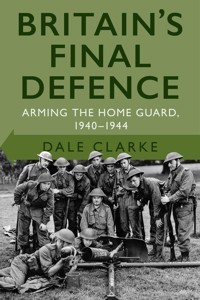
Cover image: ‘Members of the Post Office Home Guard receiving lessons on how to load the Spigot Mortar, 21st June 1943.’ (Official photograph; author’s collection)
First published 2016
This paperback edition published 2022
The History Press
97 St George’s Place, Cheltenham,
Gloucestershire, GL50 3QB
www.thehistorypress.co.uk
© Dale Clarke, 2016, 2022
The right of Dale Clarke to be identified as the Author of this work has been asserted in accordance with the Copyright, Designs and Patents Act 1988.
All rights reserved. No part of this book may be reprinted or reproduced or utilised in any form or by any electronic, mechanical or other means, now known or hereafter invented, including photocopying and recording, or in any information storage or retrieval system, without the permission in writing from the Publishers.
British Library Cataloguing in Publication Data.
A catalogue record for this book is available from the British Library.
ISBN 978 0 7509 6970 3
Typesetting and origination by The History Press
Printed and bound in Great Britain by TJ Books Limited, Padstow, Cornwall.
eBook converted by Geethik Technologies
CONTENTS
Introduction
1 The Threat
2 The Carriage of Arms
3 The Rifle Crisis
4 Improvisation
5 Pistols and Automatic Weapons
6 Sten Guns, Petroleum Warfare and Grenades
7 Sub-Artillery
8 Artillery
9 Auxiliary Units
10 The Matter of Perspective
Notes
Bibliography
INTRODUCTION
The organisation that became Britain’s Home Guard was founded on 14 May 1940, and ordered to ‘stand-down’ in November 1944. It was never called on to fight; the invasion it stood by to repel might never have been a practical possibility or even a real intention; and the weapons it used are a byword for the obsolete, improvised, naive and whimsical. So why does it matter?
During the latter half of 1940, and well into 1941, a Nazi invasion of the United Kingdom was, for the British, a probability if not a certainty. The threat of invasion, and the need to guard against raids and sabotage, provoked popular, political and media demands that civilians be armed. ‘Total Defence’, as it became known, transformed the political, military, social and physical landscape of Britain. The population was more politicised than it had been during the First World War and war, as an extension of politics, rather than patriotic duty, became a matter for the citizen militant – raising important legal and ethical issues over the nature of ‘combatants’, and making the government answerable to a vociferous, demanding and engaged public. This resulted in the formation of the Local Defence Volunteers – subsequently renamed the ‘Home Guard’ – and thus the need for the British government to arm not only the rapidly expanding wartime British Army, but also a paramilitary militia, numbering well over 1.5 million men. In June 1940, that was entirely beyond the capacity of the British weapons manufacturing industry, state and private – although this could not possibly be admitted for obvious military and political reasons. The result was the importation of huge quantities of unfamiliar weapons from the United States, and investigation into the use of unconventional production techniques, and the use of non-strategic materials and innovative technologies. Indeed, the very definition of a ‘weapon’ was called into question – leading, for example, to the formation of the Petroleum Warfare Department – as was the matter of whether any limits could be, or should be, imposed on the means of fighting for the UK’s national survival.
This book explores the weapons provided for the British Home Guard between 1940 and 1944, but will also examine the process through which a perception hardens into orthodoxy, which in turn can crystallise into an accepted ‘historical fact’. The perception in question is that the wartime British Home Guard was poorly armed – in modern parlance, that it lacked combat power. For many years the prevailing view has been that the Home Guard represents a nadir of military effectiveness. We will explore the way that perception formed, in the first few months of the organisation’s existence, as a result of a logistic crisis that the government could not possibly expose, was sustained through the period when the force actually flourished, and went on to become part of the post-war mythology of the Home Front. Most British families provided a member of the Home Guard, and the organisation is studied as part of the experience of the Home Front, as well as one of the manifestations of the ‘citizen militant’ that shaped post-war Britain. It is important, therefore, that some attempt is made to differentiate between fact and perception, and to point out the dangers of unthinkingly adhering to a largely illusory ‘orthodox view’. There are real lessons to be learned about the way Britons reacted to the perceived threats of invasion and subversion, and the way that reaction was handled; also, the dangers of failing to meet public expectations where the provision of military equipment is concerned – something that became all too apparent during the recent British deployments to Iraq and Afghanistan.
References to the weaponry of the British Home Guard are characterised by misunderstanding and misrepresentation. Misunderstanding stems from the fact that very few Home Guards, or subsequent historians, have been ‘weapons specialists’, and as a consequence mistakes, soldiers’ myths and old wives’ tales have gained undeserved currency. Misrepresentation is a matter of context: terms such as ‘old’, ‘ancient’ or ‘Great War’ were associated with Home Guard weapons from the outset, for journalistic effect, ignoring the fact that a significant proportion of the small arms and artillery fielded by the British Army between 1940 and 1943 were of First World War or Edwardian vintage.1 The wartime British public simply assumed that the weapons issued to the British Army were the best available. This, as we shall see, was not necessarily true. In terms of the study of military small arms and historical weapon systems the author is in an unusual position, being an army reservist with operational experience, a historian specialising in military technology and having been employed for several years as an armourer to the film and television industries. Much of that time was spent with Bapty & Co. Ltd, the UK’s largest and oldest supplier of warlike stores to film, television and the theatre. During the Second World War the company’s stock, and the collection of its owner, noted collector and authority the late Mr Mark Dineley, were placed at the disposal of the Home Guard. After the war, the company acquired additional stock, which included ex-Home Guard material. It was during the mid-1990s, while sorting, reassembling and restoring these items, that the author became convinced that the military potential of the Home Guard was being consistently underestimated. The Bapty collection represents a remarkable resource, further enhanced by a library/archive containing a wealth of period documents and illustrations.2
Since the 1970s, it has been impossible for any commentator to mention the Home Guard without reference to the BBC television situation comedy (also radio series, books, feature film and feature film reboot) Dad’s Army. In the public mind Dad’s Army was the Home Guard, and the Home Guard was Dad’s Army. More than that, Dad’s Army is seen to represent the armed aspect of the Home Front. In fact Dad’s Army did not accurately represent the historical Home Guard – any more than its cousin ’Allo ’Allo! can be said to accurately portray the French Resistance.3 Although writers David Croft and Jimmy Perry drew on their own wartime experiences, as did the cast, considerable liberties were taken, and omissions made, for the comedy formula to work. Indeed, entire demographic groups are omitted – specifically, female auxiliaries, men of military age in reserved occupations and the political (left-wing) element that was so influential during the earlier part of the Home Guard’s existence. One result of this was the need to create the portmanteau character ‘Corporal Jones’, an unlikely composite – simultaneously representing the ‘traditionalist’ and ‘unconventional warfare’ elements of the Home Guard – which only succeeds because of the skill of the writing and actor Clive Dunn’s talent. As we shall see, the actual composition of the Home Guard directly affected its expectations of, and reaction to, the weapons that the authorities provided and the tactical role it was assigned.4
The Home Guard may be deeply embedded in British popular culture, but it has been largely ignored by the academic establishment – despite the fact that the formation of an armed ‘people’s militia’, numbering, at its peak, almost 2 million men and some tens of thousands of women, and incorporating the framework of an organised, post-invasion resistance force, is among the UK’s more dramatic responses to ‘Total War’. A short popular history, Norman Longmate’s The Real Dad’s Army,5 was published in 1974 to capitalise on the success of the BBC series, the author discreetly accentuating the first few months of the organisation’s existence, when it most closely resembled the television portrayal. But despite, or perhaps because of the Dad’s Army phenomenon, the Home Guard continued to occupy an academic vacuum. It was not until 1995 that S.P. MacKenzie, Assistant Professor of History at the University of Carolina, Columbia, published The Home Guard,6 the first academic work wholly devoted to the subject, and still the most important. Professor MacKenzie’s conclusion may be summarised in a sentence: ‘National Morale, in short, determined the course of Home Guard development rather than strictly military considerations’ (MacKenzie, 1996, p. 179):
… national morale was a key component in sustaining a viable war effort. And what the people in arms wanted badly enough, they either got or appeared to get. The LDV had been formed, after all, in order to control the burgeoning demand for civilian defence that manifested itself in the spring of 1940 rather than because there was an overwhelming military need for such a force. (MacKenzie, 1996, p. 176)
In other words, the Home Guard was never intended to be a serious fighting force, and its poor weapons are evidence of this – as MacKenzie puts it: ‘weapons which in reality were of dubious fighting value, but which in all probability would never have to be fired in anger and could be presented as worthwhile’ (MacKenzie, 1996, p. 177). Whether the Home Guard was an elaborate confidence trick to engage the British public in the war effort, or a crucial component of Home Defence, is for the reader to judge. What we will demonstrate, however, was that the efforts made to arm the Home Guard were very serious indeed, and even the most elderly and optimistic weapons in the Home Guard arsenal were shared with other fighting services.
Published twelve years after Professor MacKenzie examined the Home Guard from the political perspective, Professor Penny Summerfield and Dr Corina Peniston-Bird’s Contesting Home Defence explored the organisation in its societal context.7 The authors endeavour to tease out the social reality of the Home Guard from subsequent mythology and contemporary public relations, in order to determine whether it really served as a unifying focal point for national defensive spirit, or proved divisive, as the Left, the Right, traditionalists, modernists, and – most particularly – men and women pulled in their own directions. Summerfield and Peniston-Bird examine the extent to which the wartime Home Guard has been mythologised and, indeed, was actively mythologised during the four and a half years of its existence, and the effect of Dad’s Army on perception of the Home Guard. The two academics also expose the difficulty of obtaining useful oral history from survivors of the Home Guard generation. The effect of Dad’s Army can be likened to that of Shakespeare’s depiction of Richard III, in that a portrayal has become so powerfully established that it insidiously alters reality:
Whether they regarded Dad’s Army as an accurate representation, were critical of its omissions, or … rather unwillingly accepted its judgements, men remembering their own Home Guard experiences could not escape Dad’s Army. As the dominant representation of the Home Guard from the 1970s into at least the early years of the twenty-first century, it influenced the imaginative possibilities of their own recall and shaped personal memories. (Summerfield and Peniston-Bird, 2007, p. 232)
It is not just that, by repeated exposure, recollections have aligned with the depiction; there is a further factor that an audience will not admit an account that is at variance with the cherished orthodox view. It is important to record, from the perspective of folk, social and oral history, that this study was written with assistance from three former Home Guards, one of whom served in the Auxiliary Units (i.e. the ‘British Resistance’), and none of whom had much time for Dad’s Army. It was a privilege to share their memories, and their input was extremely valuable. Nevertheless, the greatest weight has been placed on contemporary wartime or near-contemporary accounts, and careful interpretation of period documents and artefacts.
The strength of the Dad’s Army orthodoxy adds to the challenge of trying to determine to what extent the wartime Home Guard was appropriately and effectively armed. Indeed, until very recently, the whole topic was slightly embarrassing – almost unworthy of academic research. This self-consciousness is an inheritance from the earliest days of the Home Guard, and it is time to lay it to rest. It is perhaps more comfortable to examine the topic in broader terms, and the Home Guard does figure in studies of the English Volunteer tradition, such as Ian Beckett’s The Amateur Military Tradition,8 and Glen Steppler’s Britons, To Arms!9 It is also present as a component of the machinery of Home Defence in Peter Fleming’s delightful Invasion 194010 and, more recently, the Defence of Britain project.11 Fleming reflected the sardonic humour that was Britain’s emotional shield against the terrifying prospect of unlimited technological war with an all-conquering fascist dictatorship. Although immensely entertaining, this does carry the inherent risk of subsequent generations laughing at the British of 1940–44, rather than with them, as they prepared, with whatever was at hand, to sell their lives and their freedom dearly. Fleming’s counter-invasion theme was revisited by Arthur Ward in Resisting the Nazi Invader,12 a popular history with a lively and informative text, particularly with respect to the Auxiliary Units. These Home Guard ‘special forces’ units appeal to modern taste and have attracted interest out of proportion to their size or military significance. David Carroll’s short illustrated history The Home Guard13 added to the popular end of the Home Guard oeuvre, which also includes local history, such as K.R. Gulvin’s useful Kent Home Guard: A History.14 For anyone interested in the topic, the internet provides an almost overwhelming Home Guard resource, particularly at the local level. It is an invaluable research tool, but needs to be approached with caution. Online material includes numerous educational synopses reflecting the ‘orthodox’ (i.e. Dad’s Army) view of the Home Guard and its weapons, and, more interestingly, vast amounts of local unit histories and memoirs – admittedly of variable quality.15
Home Guard memorabilia, virtually worthless until the 1980s, is now eagerly sought by collectors and re-enactors, reflecting a general increase in interest in the Home Front. This interest has resulted in a market for niche publications such as Vehicles of the Home Guard and Uniforms of the Home Guard in the Historic Military Press ‘Through the Lens’ series,16 as well as facsimile reprints of some of the commercially produced and official weapons training leaflets. Nevertheless, for a Second World War military topic, coverage of the Home Guard is thin. In terms of period sources, however, the researcher is faced with an embarrassment of riches, as the large and enthusiastic membership provided a lucrative market for opportunistic publishers. In the immediate absence of official support or infrastructure, a variety of manuals were produced – starting with Lieutenant Colonel J.A. Barlow’s The Elements of Rifle Shooting, out of print after May 1938 but hastily republished in June 1940.17 July 1940 saw the publication of Rifle Training for War: A Textbook for Local Defence Volunteers,18 actually a revision of the manual produced for the First World War Home Guard equivalent, the Volunteer Training Corps (VTC). Capitalising on the organisation’s change of name, The Home Guard Pocket Manual (October 1940)19 was supported by the Ruberoid Company Ltd, and contained sound military advice from the RSM (regimental sergeant major) of the Sevenoaks Battalion Home Guard – as well as useful suggestions for the employment of Messrs Ruberoids’ products in the construction of fieldworks and blackout precautions.
From 1941, specialist military publishers Gale & Polden, of Aldershot, produced training manuals for the American small arms used by the Home Guard. Their semi-official publications were joined by entirely unofficial efforts such as ‘Bernards Pocket Books’, which included in their ‘Key to Victory’ series the Manual of Modern Automatic Guns and Commando and Guerrilla Tactics, among volumes dedicated to cycling, photography and ‘The Little Marvel’ Reference Book for Vegetable Growers.20 The content of unofficial manuals frequently exceeded anything that could or would be found in an official publication, and at times verged on the frenzied, as in The Home Guard Encyclopedia (c. 1941),21 which includes under its ‘Sample Diagrams and Exercises’ heading ‘Fig. 3: Smashing Out of the Jaws of Death’. The techniques for ‘tying up securely’, ‘extraction of information’ and ‘holds, releases and silent killing’ described in Bernard’s Manual of Commando and Guerrilla Warfare: Unarmed Combat22 (‘FOR H.G. & SERVICE USE’) reflect the trend towards a ‘people’s war’, and a willingness to set aside traditional conventions in order to prosecute a war of national survival. This was the ethos of those who had experience of fighting fascism, the veterans of the Spanish Civil War, including Hugh Slater, author of Home Guard for Victory!23 (published in January 1941 and reprinted four times before the end of the month).
With the conventional military discredited and unable to lend much support, the Local Defence Volunteers looked to the Spanish Civil War and Finnish Winter War for lessons in what today would be termed asymmetric warfare – the means by which a small, ill-equipped, irregular force might defeat, or at least slow, a larger, better organised and technologically superior enemy. Self-appointed guiding spirits of the Home Guard included war correspondent Major John Langdon-Davies, and author John Brophy. Langdon-Davies engaged in an exhausting round of lecturing to ‘100 Battalions’ of Home Guard in the winter of 1940–41.24 His lecture was subsequently published as the manual Home Guard Warfare, which also included much of the content of ‘Home Guard on Parade’, his regular feature for the Sunday Pictorial. Unlike some of the other Spanish Civil War veterans, Langdon-Davies was willing and able to bridge the two worlds of the conventional military and the ‘people’s war’. As the publisher noted in the preface to the sixth, revised, edition of The Home Guard Training Manual, the successor to Home Guard Warfare, published in May 1942: ‘Over 125,000 copies of this Home Guard Training Manual have now been sold, and it has become widely adopted since the War Office gave official sanction to its purchase out of training grant to the extent of one copy per platoon.’25 In its scope and content Langdon-Davies’ The Home Guard Training Manual, and its companion The Home Guard Fieldcraft Manual,26 can be said to be the definitive contemporary guides to the Home Guard.
An underage volunteer in the First World War, and subsequently a popular historian and novelist,27 John Brophy commanded a Home Guard company in the Second World War. His manual, Home Guard: A Handbook for the LDV, was published in September 1940 and had been reprinted nine times by March 1942, when a revised edition, Home Guard Handbook, was produced, itself to be reprinted just two months later. Like Langdon-Davies, Brophy was responsible for a stream of handy pocket-sized manuals that sought to instruct and inspire. Brophy wrote in the foreword to the revised edition of the Home Guard Handbook:
I believe that in general and in detail all my handbooks conform to the excellent Training and other Regulations of the Home Guard, and I should again like to emphasise that anything I write is to supplement and amplify official instructions which cannot always be made public and, if only for lack of paper, cannot be put into the hands of every member of the Home Guard. (Brophy, 1942, p. 10)
It is an odd assertion that a private individual should have the liberty to publish material ‘that cannot always be made public’ and that Hodder & Stoughton, Brophy’s publishers, had access to supplies of paper denied to the official organs of state. Certainly, in the early months of the LDV’s existence, authors such as Brophy and Langdon-Davies were filling a vacuum, but later their chief attraction must have been what Brophy himself described as ‘certain informalities of outlook and phrasing’ (Brophy, 1941a, p. 12). Professional writers, Brophy and Langdon-Davies kept alive the edgy feeling of novelty and threat that drove 1.5 million civilians to take up arms in the Home Guard, even as that threat ebbed away. The high-water mark of these private manuals was 1942; then the tide of the war started to turn, the public appetite for DIY combat training diminished and the Home Guard, now a properly integrated component of Home Defence – effectively a new, unpaid, Territorial Army to replace the one fighting overseas – was fully supported by the War Office.
The Home Guard generated a corpus of official documentation under the titles Home Guard Instruction (initially LDV Instruction) and Home Guard Information Circular. These sequentially numbered leaflets covered subjects as diverse as expenses and damages claims, the preservation of boots through the use of hobnails and the performance of anti-tank mines in the Western Desert. Contrary to Brophy’s suggestion above, very great efforts were made to keep the Home Guard interested and informed, with operational lessons being passed on from as far afield as Guadalcanal. Much of this material is preserved, amongst a mass of other Home Guard material, in the National Archives, Kew, and a surprising amount is to be found for sale from specialist booksellers and online. Of particular significance to this study is a series of volumes dating from 1942–43, making up Home Guard Instruction No. 51. These set out the Home Guard’s tactical doctrine, as well as listing the capabilities of weapons, and the organisation of platoons and squads, down to the roles of individual soldiers. They represent the final stage in the evolution of the organisation into an entirely competent, and accepted, component of Home Defence.28
In 1943, journalist and Home Guard Charles Graves celebrated the Home Guard (then at its apogee) in The Home Guard of Britain.29 This remains the closest thing to an ‘official history’ the organisation ever received, although it suffers from the disadvantage of having been completed some months before the final ‘stand-down’. When, in late 1944, the Home Guard did ‘stand down’, most members appreciated that this marked the end of a singular and formative experience (the Home Guard was officially disbanded on 31 December 1945).30 Various commemorative publications were produced, ranging in pretension from a twelve-page leaflet produced by the Intelligence Section, 8th Wiltshire Home Guard,31 to the 168-page Bureaucrats in Battledress – the history of the Ministry of Food Home Guard.32 The intention of the authors of these and countless similar publications was lyrically expounded by Major C.E. Mansell, late Officer Commanding ‘Dog Company’, 20th Battalion, Kent Home Guard, in the introduction to the commemorative ‘diary’ of his battalion:33
Sometimes on a Tuesday or a Thursday winter’s evening in years to come, we shall surely be sitting at home, by the fireside, listening to the rain beating upon the window pane and the wind howling, and we shall think of those four winters when we used to turn out for Parade at the Drill Hall.
Perhaps a friend will be there to share our thoughts and we shall start yarning about those Home Guard days and nights … At such times this little book will certainly be highly appreciated by us all. It will jog our memories and help us to recall countless incidents which otherwise are bound to fade in the course of time. (Brown and Peek, 1944, p. 2)
And fade they have. Such aides-memoir should be historical gold dust, but the reality for the historian is usually frustration. They are, to use Beckett’s phrase (1991, p. 271), ‘relentlessly anecdotal’; nevertheless, they should not be dismissed. Content varies and coverage of the earlier (LDV) period can be sketchy, but careful reading is rewarded with invaluable first-hand information. The ‘wartime’ publications end with Britain’s Home Guard: A Character Study,34 written, appropriately, by John Brophy and masterfully illustrated by fellow Home Guard, artist Eric Kennington. The tone is elegiac:
… without the Home Guard Britain itself could not exist. It guaranteed determined, skilful, organised resistance to the invader everywhere. It symbolized and made effective the will of the British people to defend their liberties, not merely while the period of acute danger persisted, but unremittingly till the continental despotism is overthrown. (Brophy, 1945, p. 9)
Several copies of an unpublished History of the Home Guard lie in the National Archives, the project to produce an official history having been started but abandoned.35 After a brief revival during the 1950s, the Home Guard lapsed into obscurity until 1968, and the screening of the first episode of Dad’s Army, which, of course, brings us full circle.
The key facet of this study is military technology and, in particular, the study of military firearms. In this context With British Snipers to the Reich, by Captain Clifford Shore, is of particular significance.36 Shore, an enthusiastic, skilled and knowledgeable rifle shot, served in the Home Guard before undergoing officer selection and joining the RAF Regiment (he was 33 years old in 1940). He crossed into Europe on D-Day+1 and saw active service with the RAF Regiment, before becoming an instructor to the Army Field Sniper School in Holland. With British Snipers to the Reich was written immediately following Shore’s demobilisation, between March and December 1946, at the suggestion of an American publisher.Although best known as a book on sniping, the references to the Home Guard, their small arms and musketry are of considerable importance. Other sources will be introduced in later chapters, but those most familiar to firearms cognoscenti are the works of Australia-based researcher and writer Ian Skennerton, and the ‘Collector Grade’ series of large-format monographs, edited by R. Blake Stevens of Ontario. Goldsmith’s The Grand Old Lady of No Man’s Land and The Browning Machine Gun, Laidler and Howroyd’s The Guns of Dagenham, Easterly’s The Belgian Rattlesnake and Ballou’s Rock in a Hard Place are the key resources for (respectively) the Vickers machine gun, Browning machine gun, Lanchester and Sten ‘machine carbines’, Lewis light machine gun and Browning Automatic Rifle (BAR).37 Other very useful and diverse technical information has emerged thanks to the efforts of the author’s colleagues in the Historical Breechloading Smallarms Association. It is, of course, impossible to undertake a study such as this without recourse to one or more of the late Ian Hogg’s books, and those of other noted specialists such as Terry Gander. However, wherever possible, technical specifications have been extracted from contemporary Home Guard publications, as data such as effective ranges or penetration of armour were often modified, in light of experience, by the time the equipment entered service with the Home Guard. Like Clifford Shore, the author of this book prefers to examine matters for himself, and he has examined, handled, restored and in many cases fired almost every weapon mentioned herein.
On 6 December 1944, just as the Volkssturm, the German equivalent of the Home Guard, was preparing for its last-ditch defence of the Reich, Britain’s Home Guard had been stood down. A.E. Stroud, a Home Guard trained to defend a ‘Tank Island’ in Wiltshire, wrote, summing up the feelings of all those who had given so much time and effort to the Home Guard:
Towards the end of 1943 and early 1944 … it was obvious that our invasion was near with its possibility of airborne raids in this country for disruption of communications and traffic.
I suppose we shall learn one day why this never happened, perhaps the answer is that we were so well prepared for it. I’m glad it didn’t happen, of course, but I can’t help feeling sometimes that I’d have liked to have seen our wheels go round in action just once, after all we did build a lovely machine, and never saw it work. (Stroud, 1944, p. 7)
1
THE THREAT
The Home Guard was born of a spontaneous reaction by the British public to the twin threats of invasion and subversion. In order to place the organisation, and its equipment and tactics, in context, it is necessary to explore those threats. During the First World War, large numbers of troops had been earmarked for Home Defence, and defences prepared along England’s East Coast. The bombardment of coastal towns by the German Imperial Navy in December 1914 served to further heighten the possibility of invasion, or large-scale raids or landings. These never happened, but bombardment continued, using German Army or navy airships and bomber aircraft. Although the subsequent civilian casualties failed to break the will of the British civilians at home and soldiers overseas, indiscriminate ‘terror bombing’ became established as a strategic option. The Spanish Civil War demonstrated what could be achieved using modern bombers against the civilian population – famously at Guernica – and aerial bombardment clearly represented a significant threat to the UK mainland in the event of another European war. The danger of public morale collapsing under the torrent of bombs from bombers that would ‘always get through’1 seemed a very real one. The threat to the UK of invasion, however, diminished in the minds of both the public and military planners, who briefly examined the possibility in 1939, and discounted it. When Great Britain declared war on Nazi Germany in September 1939, the obstacles presented by the Maginot Line, the French Army, and the Royal Navy, meant that an invasion by German troops was not regarded as a serious possibility. Just eight months later that view was completely reversed, following the German advances into Scandinavia on 9 April 1940, and on the Western Front a month later. From 10 May 1940, the day Churchill became prime minister, the British watched with growing horror and alarm as the apparently unstoppable German Army sliced through Western Europe. The invasion threat had suddenly become real, and if one single factor seized the public imagination, it was the German use of parachute troops, an innovation that seemed to render the Royal Navy, England’s traditional bulwark against invasion, impotent.
The possibility of airborne assault on the United Kingdom had been discussed since the first tentative ascents in hot air balloons, but in truth, air-landings had been the stuff of science fiction. That was entirely changed by the German assault on Norway; the effective use of parachute and air-landing troops there, and subsequently in the Low Countries, added instantaneous and ubiquitous invasion to the now well-established aerial threat. Importantly, the British public’s response to this new threat was not to flee, or demand that the government sue for peace, but rather to insist that the population be assisted to take up arms. This happened first unofficially as vigilante groups – the so-called ‘Parashots’ – spontaneously formed, and then, following a radio broadcast on the evening of 14 May 1940 by Anthony Eden, the Secretary of State for War, as officially sanctioned ‘Local Defence Volunteers’. In his broadcast Eden outlined the new threat posed by German parachute troops, and asked for volunteers to report to their local police stations:
Since the war began the Government have received countless enquiries from all over the Kingdom from men of all ages who are for one reason or another not at present engaged in military service, and who wish to do something for the defence of the country.
Now is your opportunity. We want large numbers of such men in Great Britain who are British subjects, between the ages of 17 and 65, to come forward and offer their services in order to make assurance doubly sure. The name of the new force which is now to be raised will be the ‘Local Defence Volunteers’. This name, Local Defence Volunteers, describes its duties in three words.2
However, the German threat, which seemed so real and immediate with enemy troops just across the English Channel, became rather less tangible when subjected to close scrutiny. This is reflected in the first of the unofficial LDV handbooks, Rifle Training for War, published in July 1940. The editor struggles with the fact that, whilst in broad terms, the raison d’être of the LDV was obvious, its actual role was far from clear:
At the time of writing, the precise duties of the L.D.V. have not been defined. They can, however, be guessed at and whatever they have to do they will surely find a knowledge of the rifle useful. The author wishes the best of luck to all his readers. They have answered the appeal to ‘repel boarders’, whether they come by sea or air. (Robinson and King, 1940, p. xii)
As envisaged in Rifle Training for War, the operational role of the LDV appeared to consist of small numbers of concerned citizens stalking and killing equally small numbers of Nazi paratroopers, preferably before they landed:
For instance a Volunteer [sic] or a pair of volunteers may see two or three parachutes dropping. If the volunteer is alone and is a good shot and near enough to open fire – say within two or three hundred yards of the nearest – he may decide to attempt to get one or two, or perhaps all of them, before they land. If two volunteers are on the watch in such a situation one may go back to report whilst the better shot remains to watch and shoot if he gets the chance. (Robinson and King, 1940, p. 2)
It is not apparent what purpose it would serve the enemy to drop such small numbers of parachutists, but it is abundantly clear why downed RAF aircrew ran a serious risk of being shot by their own countrymen.
Parachutist hysteria, and a persistent willingness to credit the Germans with extraordinary military capacities, led contemporary authorities to some unfortunate overestimations of German capabilities. In dismissing these exaggerations historians can also dismiss the threat. MacKenzie, for instance, after explaining that the Under Secretary of State for War, Lord Croft, believed in the summer of 1940 that the Germans could land up to 10,000 paratroops, points out: ‘the German armed forces had only 7,000 fully trained paratroopers in the spring of 1940, and had suffered quite severe losses in men and transports during operations in Holland’ (MacKenzie, 1996, p. 23). Writing in Invasion 1940 Derek Robinson puts the German parachute force still lower, 4,500 men at the start of Fall Gelb (Case Yellow), the invasion of France and the Low Countries, many of whom became casualties, particularly in the airborne set piece ‘Battle for the Hague’ (Robinson, 2006, p. 116). Although the Fallschirmjäger captured by the Dutch were released when Holland capitulated on 14 May, Robinson makes the point that the losses of Junkers Ju 52 transport aircraft in the campaign (213 out of 475) were crippling. Nevertheless, he estimates that in June 1940, Germany could have launched a lift of a maximum of 3,000 paratroops to England (Robinson, 2006, p. 112). Fleming, writing just sixteen years after the events he was describing, suggests that, pulling out all the stops, the parachute force might have amounted to between 6,000 and 7,000 Fallschirmjäger, with airlift capacity for a follow-on air-landing force of 15,000 – which as he points out, was smaller than the force that narrowly secured the rather thinly defended island of Crete in 1941 (Fleming, 1957, p. 70).3
Whether undertaken by 7,000 Fallschirmjäger or 3,000, this airborne assault could only be the overture for the main thrust, which would have to be an amphibious landing by conventional troops, bringing with them artillery and armour. Indeed, the German plan was to use parachute troops to secure the beachheads, much as the Allies would do in 1944. German plans for cross-Channel invasion have suffered from being measured against the Allied Normandy landings of June 1944 – but the Allies’ Operation OVERLORD was an entirely different undertaking, if only because of the scale and preparedness of the defences. German preparations in the summer of 1940, and their chances of success, need to be measured against previous joint operations. It is instructive to consider Churchill’s summation of the German assault on Norway:
Surprise, ruthlessness, and precision were the characteristics of the onslaught … Nowhere did the initial landing forces exceed two thousand men. Seven army divisions were employed … Three divisions were used in the assault phase, and four supported them through Oslo and Trondheim. Eight hundred operational aircraft and 250 to 300 transport planes were the salient and vital feature of the design. Within forty-eight hours all the main ports of Norway were in the German grip. (Churchill, 1954a, p. 473)
Even 3,000 fully trained, equipped and combat-tested paratroops were considerably more than any other combatant nation could field in the summer of 1940, and they were backed by the world’s most modern air force, undefeated in the recent campaigns in Poland and Western Europe. ‘Speed, ruthlessness and determination to advance at all costs’ might well have got German troops across the Channel before a shocked, demoralised and largely disarmed Britain could properly organise itself, and at that stage in the war it was impossible to believe that such a determined and capable enemy would let the opportunity slip through his fingers.
Periodical Notes on the German Army No. 28 (published by the War Office on 27 June 1940) explained: ‘From the time when the German Army overthrew the restrictions imposed by the Treaty of Versailles, the offensive spirit has been stressed in all training. The result of this teaching, an offensive, violent both in speed and ruthlessness, has already been well illustrated in the campaigns in Poland and on the Western Front.’4 The British public was never quite able to accept that such an army would fail to take any sort of direct action against the UK mainland. Writing in 1945, John Brophy put the popular view of Germany’s missed opportunity:
The probability is that it lay beyond the German imagination to conceive the state of defencelessness into which Britain had been allowed to lapse by her former rulers. Had they guessed how few tanks, guns, machine-guns, supplied with what scanty stocks of ammunition, lay between them and the greatest conquest they could hope for, they would certainly have launched their invading fleets, and reckoned any losses at sea and in the air a small price to pay. (Brophy, 1945, p. 18)
In Invasion 1940, Derek Robinson seeks to draw attention to a key factor in examining the practicality, or otherwise, of a German invasion of England in 1940 – the presence of the vastly superior British navy. It was this, he insists, not the Battle of Britain, and the pilots of Fighter Command, which prevented a German invasion (Robinson, 2006, p. 5): ‘Historians themselves have perpetuated one mistaken belief about what happened in 1940: the myth that “The Few” alone saved Britain from invasion.’ Robinson’s argument about the neglected importance of the Royal Navy is well made, but it misses the point that perceptions count, and it was not the old threat of a surface invasion that really galvanised the British at the time, but the entirely new threat of airborne envelopment.5 The counters to this apparently ubiquitous threat were Fighter Command in the air, and the Local Defence Volunteers on the ground – and that is the contemporary context in which the establishment of LDV/Home Guard must be viewed.
Periodical Notes on the German Army, No. 30, published by War Office intelligence department MI14 in August 1940, contains two sections: ‘Lessons of the Battle of France’ and ‘Possible German Tactics in an Attack on Great Britain’. The British General Staff’s viewpoint at the time is made perfectly clear:
In operations in the United Kingdom the German forces will be inferior in numbers to our own, are likely to be less well supplied with tanks and heavier supporting weapons and will also be handicapped by long and uncertain lines of communications across a sea dominated by the British Navy, and, it may be hoped, after the first 48 hours, by a shortage of food, ammunition and petrol.6
MI14 thus allows Robinson his point, but then (proceeding in the anticipated order of arrival in the UK) goes straight on to discuss parachute troops. After a general description of organisation and training the notes continue:
These troops might be employed against this country:-
(a) To prepare the way for the landing of air-borne troops. For this purpose they would land near areas (in open flat ground, not necessarily aerodromes) suitable for the landing of troop-carrying aircraft. They might, for example, be landed in an open space between two woods.
(b) To co-operate with landings from the sea. Parachute troops might be dropped in comparatively large numbers close to suitable beaches or harbours in order to cover the landing of sea-borne troops. These parachute landings might take place before or during attempts to gain a foot-hold on the beaches, etc.
(c) To cause confusion or effect dispersion of our own forces by widespread landings in small groups. These small detachments would try to establish contact with agents and Fifth Columnists with the object of carrying out sabotage, stampeding the population and bringing the normal life of the country to a standstill. Parachutists might be used simultaneously in all three roles described above and some might be disguised in British uniforms and speak English fluently.
Point ‘c’, above, is of interest, because it illuminates the ‘penny packet’ threat of small numbers of parachutists. Next to arrive are the air-landing troops, described in the same format:
In this country the tasks of air-landing troops would probably be:-
(a) To seize important areas in the early stages of an attack, establish [seize?] aerodromes, coastal batteries and forts.
(b) To establish bridgeheads for troops and material landing by sea.
(c) To create chaos, to aim at achieving dispersion of our forces and to draw off troops from areas where sea landings might be attempted.
All these tasks are likely to be undertaken simultaneously and in co-operation with parachute troops.
The air landing troops are followed in sequence by the sea-borne contingents:
Mechanised reconnaissance units
Armoured formations
Motorised infantry and infantry divisions
The notes also cover:
Engineers (some of whom will be amongst the first troops landed)
Smoke troops
Possible use of gas
Irregular methods of warfare (dirty tricks)
MI14 concludes:
(a) Once landed German forces of all kinds will use every endeavour to advance inland as far and as fast as they can. They will rely on immediate and effective support from dive-bombers to attack opposition which they are unable to overcome with their own resources. Infiltration tactics are to be expected and success will be reinforced wherever it is obtained.
(b) Difficulties of terrain set a limit on the effectiveness of armoured forces in certain districts in this country. Their dependence on sea communications is another important limiting factor, though they may hope to obtain some fuel and food by capture.
(c) The enemy will aim at creating civil chaos as one of the conditions for the success of his military plans. The landing of parachute and air-borne troops together with heavy air bombing, all of which will probably precede and accompany the arrival of sea-borne forces, will be employed to create this confusion.
(d) The extensive employment of smoke (possibly in conjunction with gas) to cover the approach to and subsequent landing on beaches must be expected.
(e) The employment of gas on a large scale is probable.7
This then is the British Army intelligence template for a German invasion, against which all British counter-invasion preparations were made, and it remained so for as long as full-scale invasion remained a planning contingency. It determined that the first threat for the Home Guard (as the LDV became known from 23 August 1940) would be dealing, probably unaided, with German parachutists, who may be dropped in small numbers in order to force the British Field Army to disperse, and in order to join up with Fifth Columnists. That scenario became, and remained, the principal preoccupation of the Home Guard throughout its wartime existence. In the introduction we noted that the authors of official instructions for the Home Guard made great efforts to make their publications interesting and accessible. This includes one of the more remarkable military manuals ever produced, Colonel G.A. Wade’s The Defence of Bloodford Village. The Defence of Bloodford Village is a Home Guard version of the famous The Defence of Duffer’s Drift, written by Ernest Dunlop Swinton, and still a highly regarded treatise on small unit tactics, used as a teaching aide by both the modern British and US armies. Like Duffer’s Drift, the defence of Bloodford is the responsibility of a junior commander, whose nightmares of failure over a series of succeeding nights prompt him to improve various aspects of the defences, until perfection is achieved. Released in late November 1940, the booklet has a short forward by the Director General Home Guard, Major General T.R. Eastwood, DSO, MC:
The Battle of Bloodford Village and how it came to be successfully defended as a result of the lessons learnt from the dreams of the local Home Guard Commander, makes most interesting and instructive reading.
The story contains many useful hints that should help other Home Guard Commanders in planning the defence of their villages. [Shown in inverted commas on the original.] (Wade, 1940, frontispiece)
The sixteen-page booklet opens with a description of the imaginary village of Bloodford as we might encounter it after Hitler’s war has been won: overlooked by a picturesque windmill on a hill, the village features an old stone bridge over the River Booze; the half-timbered Bridge Inn, with its lichened roof; Hag’s Pond, still with ducking stool; the Grange; and a huddle of quaint old houses around the village green. On the green stand an old gibbet – and three destroyed German tanks, proud trophies of the village Home Guard. In the narrative, Bloodford Home Guard is under the command of Geoffrey ‘Skipper’ Gee (Home Guard commissions and military ranks were only introduced on 3 February 1941), resident of the Grange. After a long night spent working out a Defensive Scheme for the village, an exhausted Gee eats a large piece of cheese before heading to bed. In the nightmare that follows, Gee finds himself helplessly watching the first stages of a Nazi invasion:
It was early morning, patches of mist still hung on the Village Green, the sun rising over OAK WOOD was reflected in the water of HAG’S POND and sundry roosters proclaimed the birth of another day. No one could be seen in the streets although the rattle of buckets and the clank of the pumps showed that early risers were astir. ‘The best time of the day,’ thought Gee, ‘when the larks are singing and the sky is a lovely deep blue, and – My God! What’s that?’ for floating downwards were some tiny white specks. ‘Parachutists! – Yes, eight of them, and look there’s a score of them over there as well!’ In agony Gee looked round. Why didn’t somebody do something? They would come to earth only a mile away and be here in no time and yet still the buckets were rattling and the men whistling and the cocks crowing just as though DEATH was not advancing from two directions at once! (Wade, 1940, pp. 2 and 3)
Inevitably, none of the busy villagers looks up to see the descending parachutists, who ‘heavily armed and dangerous’ are soon ‘converging on the unsuspecting village, their minds set on MURDER, PILLAGE and RAPE’. A warning from a mortally wounded child on a bicycle comes too late; the Home Guard are caught napping and massacred. Horrified, Gee watches his own dead body being hoisted onto the gibbet.
Rising, shaken, the following day, Gee immediately sets about reorganising the village’s Defensive Scheme to ensure that Bloodford cannot be taken by surprise. However, poor Gee cannot get a good night’s sleep. Over five nights, five more dreams follow, and awaking from each the unfortunate Home Guard Commander further refines Bloodford’s defences. In the second dream, light tanks outflank the village road block and machine gun the Home Guard from behind. In the third, a Fifth Columnist dumps the Home Guard’s ammunition in the river, while in the fourth, Windmill Hill, the dominating feature, is taken and held by the enemy, despite a suicidal bayonet charge by the Home Guard. In the fifth dream a German troop-carrying aircraft lands on the village green, and in the sixth, and last, the Home Guards are scuppered by the lack of a mobile reserve. Finally, the Bloodford’s defences achieve perfection – just in the nick of time as the real invasion takes place. German troops and tanks attack the village and are soundly defeated by the Home Guard. Interspersing the text are twenty-eight boxed ‘Points’ for the reader to note, such as:
Point No. 16.KEEP A RESERVE
This is of tremendous importance for every Defensive Scheme seems weak in parts and the temptation to employ every available man in the initial stages must be sternly resisted.
When the attack is taking place, the reserves should be used only to re-establish the defences if they are penetrated. Once this is done, they should return at once to reserve. (Wade, 1940, p. 11)
In its sixteen small pages, The Defence of Bloodford achieves many goals. Firstly, we are shown the likely component phases of a German invasion (paratroops, air-landing, armoured reconnaissance, etc.), and how, in general terms, the Home Guard can deal with each of them, thus boosting confidence (and initiative – when the ammunition is found to be missing, thanks to the treachery of the Fifth Columnist, the Home Guard are undaunted and do their best with Molotov Cocktails). Then there are specific learning points to increase military efficiency and effectiveness. Underlying all this is the juxtaposition of murderous German paratroopers with an idealised bucolic English landscape – an effective character assassination, and not entirely without foundation, as we shall see. It is interesting to note, and it is a theme we will return to, that despite the twentieth-century urbanisation, suburbanisation and industrialisation of Great Britain, the Home Guard is depicted fighting in, and for, a rural ‘Dream of England’.
Robinson describes the German paratrooper, the Fallschirmjäger, as ‘probably the most overrated soldier of the war’ (Robinson, 2006, p. 108). Certainly, the threat posed to the UK by German parachute troops was overrated, both because of the shortage of men and transport aircraft, and inherent problems with their equipment and modus operandi. Faced with the need to confront elite German paratroopers, the Home Guard made themselves the masters of the subject, identifying the points where the Fallschirmjäger would be most vulnerable to attack. It was soon realised that airborne invasion would not be constituted by handfuls of Nazi paratroopers, as Hugh Slater explained, in his hugely popular book Home Guard for Victory! in January 1941:
The Home Guard has developed in a rather typically English, spontaneous, way. First of all there were the Parashots. They were to patrol the countryside with shot-guns and to blaze away at enemy parachutists as they came slowly sailing down to earth. After about a fortnight it was realised that the Eschner parachute, used by the Germans, is so designed that it may take no longer than five seconds for the parachutists to be landed from the plane, and therefore the conception of potting at them as they floated through the air had to be regarded as obsolete. (Slater, 1941, pp. 11–12)
The actual time of descent was 20–30 seconds, not ‘five seconds’ as a moment’s sensible reflection would make obvious – it would not be the only time that Slater would misinform his eager readers – but at least the danger posed to friendly aircrew was appreciated:
Parachute troops will generally be landed from low levels, and will not come down singly or in batches of up to six men as the crews of crashed fighters or bombers will do. They will be seen, as a rule, in groups of more than six …
If parachutists are seen to drop in batches of more than six from enemy aircraft, fire may be opened on them by members of the armed forces while they are in the air. In no other circumstances should parachutists be shot at while coming down.
Fire should not be opened on parachutists after they have landed unless they take, or show unmistakeable signs of taking hostile action. (Slater, 1941, pp. 85–6)
Slater persists in the fiction that the Germans would deliberately crash-land transport aircraft, which, presumably, reflected a misinterpretation of the use of troop-carrying gliders, and battle-damaged Ju 52 aircraft crash-landing with troops still on board: ‘A troop-carrying plane can make a pancake landing in almost any large field even if there are wooden stakes, stone piles and pits or other obstacles in the field’ (Slater, 1941, p. 19).
The British gained a fuller appreciation of German airborne tactics following Unternehmen MERKUR (Operation MERCURY), the invasion of Crete by 22,000 airborne and mountain troops in May 1941. The second edition of John Langdon-Davies’ Home Guard Fieldcraft Manual was published in April 1942, and the book reflects thorough understanding of the limitations of Fallschirmjäger equipment and tactics. The German Ruckenpackung Zwangauslosung (RZ) -16 and -20 parachutes were effectively unsteerable (which is why German paratroopers can be seen on contemporary newsreels furiously kicking and pedalling as they come in to land, trying to swing themselves towards a better landing place), and had risers which connected in such a way as to result in an uncontrollable face-forward landing. This limited the amount of equipment or weapons the paratrooper could safely carry during the jump, and also resulted in the need to issue knee and elbow pads to minimise injuries. Langdon-Davies explained:
(a) The Nazi parachutist on landing is seldom equipped with anything but an automatic pistol, four grenades and a long knife, which cannot be accurately used at a range of more than fifty yards. The first airborne troops to land often carry machine pistols strapped to their backs, and three or four hand grenades in their pockets.
(b) The Nazi parachutist is dazed to a certain extent on landing, and there are a high percentage of sprained ankles and other minor casualties.
(c) His clothing is arranged to assist him in his fall, and he has to re-arrange it before he is in a suitable condition to fight.
(d) The rest of his equipment comes down by a separate parachute in a container which is unrolled directly the parachutists recover from their fall. (1942, p. 36)
It may seem hopelessly optimistic, pitting the civilian militia of the Home Guard against Nazi paratroopers, but the Fallschirmjäger were genuinely vulnerable immediately after landing and before they had collected their weapons, as the invasion of Crete would prove. The resulting tactical pause was factored into Langdon-Davies’ Home Guard exercises:
When everybody is on the alert, twelve parachutists appear at a spot which has not been indicated to the Home Guard beforehand. Their position must be about 1,000 yards from the defending position. They will indicate their landing by waving white flags. They will remain stationary for four minutes, thus representing the initial period when the parachutists are practically immobilized by the difficulty of landing.
The cylinder containing their equipment, represented by a red flag, has dropped within about fifty yards of them. At the end of the four minutes they must recover the cylinder and they will have five minutes to drag it into cover and distribute the equipment. At the end of five minutes, that is to say, at the end of nine minutes from the zero hour, they are free to move off … (Langdon-Davies, 1942, p. 35)
Nine minutes might be pushing it, judging by contemporary footage of Fallschirmjäger in action, but there definitely was scope for the first British troops on the scene – and that would almost certainly be the Home Guard – catching the Germans before they had time to properly organise and arm themselves.8
If the German Army was seen, correctly, as an essentially offensive force, it was also perceived as willing to stoop to any underhand and unscrupulous tactics in order to win. This reputation was built at the outset on supposed Nazi ‘dirty tricks’ during the campaign in Western Europe, and widely accepted on the British side. This imagined new form of war required special vigilance on the part of the British, as John Brophy explained in Home Guard, a Handbook for the L.D.V.:
Enemy parachute troops may be looked for (a) in their own uniform, (b) disguised in civilian dress to act as spies and sabotage agents. Their numbers and their behaviour should give them away if their intention is to pass themselves off as British troops. If they come in civilian disguise they will almost certainly be dropped in darkness. Genuine clergymen, nuns or farm labourers are not going to descend out of the night sky, and the pretenders should be promptly and suitably dealt with. The author of this Handbook has a ‘hunch’ that adolescent enemy agents may be dropped in the uniforms of Boy Scouts or Sea Scouts. (Brophy, 1941a, p. 50)
Writing seventy-five years after the event, it is difficult to comprehend the threat to national security Brophy imagined would be posed by a teenage Nazi Sea Scout, and even in the febrile atmosphere of 1940, this sort of silliness undermined the authority of the Home Guard’s self-appointed guiding lights. That said, had the manuals stated that Nazi spies would appear at country railway stations and in seaside towns wet from the knees down, speaking heavily accented English and carrying Mauser pistols, torches marked ‘made in Bohemia’, primitive encoding equipment, and a length of German sausage, no one would have believed it – but that is exactly what did happen (Jowitt, 1954, p. 34).9
It is clear in retrospect that the majority of the supposed German ‘dirty tricks’ of April and May 1940 were imaginary, or due to incompetence and the muddle brought on by the fog of war, amplified by the speed of the German advance, which prevented headquarters from establishing themselves and threatened or broke lines of communication, compromising the Allied chain of command – ‘cock-up’ rather than conspiracy. Nevertheless, in August 1940 the War Office authoritatively listed a litany of ‘Irregular Methods of Warfare’:
The Germans do not admit that there are any ‘rules’ in warfare and any form of trickery or cunning which would assist them in attaining their object must be expected.
The following are some of the methods believed to have been employed by the Germans which may be described at least as unorthodox.
(a) A small party allows itself to be captured; then produces concealed weapons, kills its captors and holds an important point until reinforcements arrive.
(b) A telephone call to a demolition party in perfect English saying that the bridge should not be blown until a party of British troops have crossed. The party arrives in British uniforms, is allowed to pass and then turns on the demolition party and annihilates it.
(c) Tanks flying French flags arrive at a bridge. The defenders lead the tanks through a minefield covering the position. Once through, the tanks turn and attack the position from the rear.
(d)




