


27,99 €
Mehr erfahren.
- Herausgeber: John Wiley & Sons
- Kategorie: Geisteswissenschaft
- Sprache: Englisch
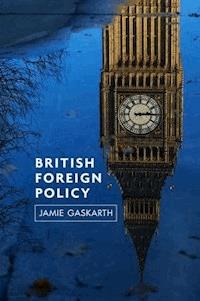
Britain has been a significant voice in global politics in the last two decades and its impact on world events far outweighs its material resources. But how does a small island on the edge of Europe continue to exercise this level of power on an international scale? What kind of actor is Britain internationally? And what future challenges will confront British foreign policymakers in a multi-polar world of emerging powers?
In this comprehensive introduction to British foreign policy today Jamie Gaskarth addresses these and other key questions. Against a rich historical backdrop, he examines the main actors and processes involved in British foreign policy-making as well as the role played by identity in shaping such choices. Later chapters focus on the relationship between economics and foreign policy, what it means to be ethical in this policy sphere, and the justification for and benefits of the UK’s continued use of force to achieve its foreign policy goals.
Combining interview research, theoretical insight and analysis of contemporary and historical trends, this book charts how British foreign policy has come to be understood and practised in the 21st Century. It will be an invaluable guide for students of British politics, foreign policy, international relations and related courses.
Sie lesen das E-Book in den Legimi-Apps auf:
Seitenzahl: 599
Veröffentlichungsjahr: 2013
Ähnliche




















Table of Contents
Cover
Title page
Copyright page
Acknowledgements
Abbreviations
CHAPTER ONE: Introduction: Analysing British Foreign Policy
All change?
Rationale
Methodology
CHAPTER TWO: The Actors in British Foreign Policy
Domestic foreign policy actors
‘External’ foreign policy actors
Conclusion
CHAPTER THREE: How is British Foreign Policy Made?
The Westminster model
The differentiated polity model
The asymmetric power model
Conclusion
CHAPTER FOUR: Self-Identity and British Foreign Policy
Identity and political action
Identity and foreign policy
The spatial construction of Britishness
The temporal construction of Britishness
The ethical construction of Britishness
Conclusion
CHAPTER FIVE: Britain in the World
Material drivers of Britain’s global identity
International society and Britain’s global identity
Britain’s role in the world
Britain’s motives and its global identity
Conclusion
CHAPTER SIX: The Ethics of British Foreign Policy
Arms sales
‘Humanitarian’ intervention
Complicity and the war on terrorism
Aid
Conclusion
CHAPTER SEVEN: Defence and British Foreign Policy
Purpose
Structure
Finance
Performance
Conclusion: Britain as a military actor
CHAPTER EIGHT: Economics and British Foreign Policy
The state as an economic actor
Economics and foreign policymaking
Conclusion
Conclusion: Future Challenges
The future according to the US National Intelligence Council
The future according to the UK Ministry of Defence
The future according to the Carnegie Endowment for International Peace
Conclusion
Bibliography
Index
Copyright © Jamie Gaskarth 2013
The right of Jamie Gaskarth to be identified as Author of this Work has been asserted in accordance with the UK Copyright, Designs and Patents Act 1988.
First published in 2013 by Polity Press
Polity Press
65 Bridge Street
Cambridge CB2 1UR, UK
Polity Press
350 Main Street
Malden, MA 02148, USA
All rights reserved. Except for the quotation of short passages for the purpose of criticism and review, no part of this publication may be reproduced, stored in a retrieval system, or transmitted, in any form or by any means, electronic, mechanical, photocopying, recording or otherwise, without the prior permission of the publisher.
ISBN-13: 978-0-7456-5114-9
ISBN-13: 978-0-7456-5115-6 (pb)
ISBN-13: 978-0-7456-7000-3 (Multi-user ebook)
ISBN-13: 978-0-7456-7001-0 (Single-user ebook)
A catalogue record for this book is available from the British Library.
The publisher has used its best endeavours to ensure that the URLs for external websites referred to in this book are correct and active at the time of going to press. However, the publisher has no responsibility for the websites and can make no guarantee that a site will remain live or that the content is or will remain appropriate.
Every effort has been made to trace all copyright holders, but if any have been inadvertently overlooked the publisher will be pleased to include any necessary credits in any subsequent reprint or edition.
For further information on Polity, visit our website: www.politybooks.com
Acknowledgements
I would like to thank a number of individuals whose help and support in the writing of this book have been immense. In the first place, I am grateful to Louise Knight of Polity Press for asking me to undertake this project, to David Winters, who has given me the space to see it through, and to Fiona Sewell for her patient attention to the manuscript’s preparation. As an outsider trying to understand the bureaucratic and political processes that feed into British foreign policymaking, I have relied heavily on the generosity of officials in the Foreign and Commonwealth Office and the Ministry of Defence, past and present, who have given me their time and advice freely. To preserve their anonymity I cannot name them here, but their assistance has spared the author’s blushes on more than one occasion through corrective readings and conversations on the manuscript. I am also truly thankful for the opportunity to interview former ministers, including Lord Owen, Lord Howe, Lord Hurd, Sir Malcolm Rifkind, Tony Lloyd, Chris Bryant, Margaret Beckett, Bill Rammell and Lord Malloch-Brown. For me, the fact that they were prepared to give their time to speak to a lowly academic speaks volumes about their kindness.
A series of academic colleagues have been extraordinarily generous in reading parts of the book, offering advice or observations or forwarding useful readings, including David Allen, David Armstrong, Klaus Brummer, Jim Buller, Dan Bulley, Stephen Burman, Malcolm Chalmers, Stuart Croft, Oliver Daddow, Theo Farrell, Ian Hall, Patrick Holden, David McCourt, Kai Oppermann and Paul Rogers. A special mention has to go to Mark Bevir, who graciously sponsored my Visiting Scholarship at Berkeley and read far more chapters than I was expecting him to, and whose comments improved the text immensely. The two anonymous reviewers also offered trenchant criticisms which I have sought to address, and the book is certainly much better for their insightful comments. Accurate and patient research support was afforded me by Aneta Brockhill, Nichola Harmer and Ben Nutt – who expertly prepared the diagrams. Nichola and Ben also read chapters and provided perceptive advice. Thanks to you all!
I also need to express my deepest gratitude to colleagues at Plymouth University for all their help and support over the years; in particular, to Phil Megicks and Kerry Howell for approving the sabbatical that enabled me to complete the manuscript. It is easy to moan about the bureaucratic tangles of academic life, but Plymouth is a hugely rewarding place to work, and if this book has any strengths they are due to the time, space and encouragement Plymouth offers its staff. In addition, I would like to thank my students on the Foreign Policy Analysis module who have challenged me to think more deeply about many of these issues. Needless to say, any errors made in this book are the author’s alone and should not be attributed to anyone mentioned above.
Last but not least I have to thank my wonderful family and friends for all their patience and support: my wife Ellie, who is the most lovely, inspiring and beautiful person you could ever meet; my brothers, Mark and Glyn; sister Delphi; sister-in-law Lynne; friends Ian, Ed Brett and the rest; but most of all my mum, to whom this book is dedicated, with love.
Abbreviations
The following list gives abbreviations and acronyms used more than once in the book, other than very widely known ones such as UK, US, EU etc.
APMasymmetric power modelARRCAllied Rapid Reaction CorpsBISDepartment for Business, Innovation and SkillsBRICBrazil, Russia, India and ChinaCAATCampaign Against Arms TradeCAECCommittees on Arms Export ControlsCAPCommon Agricultural PolicyCFSPCommon Foreign and Security PolicyCHOGMCommonwealth Heads of Government MeetingsCIDTcruel, inhuman and degrading treatmentCOBRACabinet Office Briefing Room ADFIDDepartment for International DevelopmentDTIDepartment of Trade and IndustryE3 + 3Germany, France and the UK plus the US, Russia and ChinaECEuropean CommunityECOWAS Economic Community of West African StatesEDLEnglish Defence LeagueEEASEuropean External Action ServiceEECEuropean Economic CommunityEFTAEuropean Free Trade AssociationERMexchange rate mechanismEU3Germany, France and the UKFACForeign Affairs CommitteeFATAFederally Administered Tribal AreasFCOForeign and Commonwealth OfficeFDIforeign direct investmentFPAforeign policy analysisGABGeneral Arrangements to BorrowGCHQGovernment Communications HeadquartersGDPgross domestic productGNIgross national incomeGTMOGuantanamo Bay Naval BaseICCInternational Criminal CourtIISSInternational Institute for Strategic StudiesIMFInternational Monetary FundISAFInternational Security Assistance ForceMFNmost favoured nationMODMinistry of DefenceMNCsmultinational corporationsNGOnon-governmental organizationNICNational Intelligence CouncilNSCNational Security CouncilNSIDNational Security, International Relations and Development Cabinet CommitteeODAOverseas Development AdministrationODPOverseas and Defence PolicyOECDOrganisation for Economic Co-operation and DevelopmentOPECOrganization of Petroleum Exporting CountriesOPMoverseas price mechanismPACPublic Administration CommitteePPPpurchasing power parityPSApublic service agreementPUSpermanent under-secretaryRIIARoyal Institute for International Affairs (Chatham House)SASSpecial Air ServiceSDRStrategic Defence ReviewSDSRStrategic Defence and Security ReviewSFOSerious Fraud OfficeSIS/MI6Secret Intelligence ServiceSySSecurity Service (MI5)UAVunmanned aerial vehiclesUKTIUK Trade and InvestmentUNAMIRUnited Nations Assistance Mission for RwandaWMDweapons of mass destructionWTOWorld Trade OrganizationCHAPTER ONE
Introduction: Analysing British Foreign Policy
Why bother with a book on British foreign policy? Hasn’t Britain had its day? That was certainly the feedback I received whenever I took a taxi in the United States, as I was writing this book. ‘The sun has set on your Empire’, one driver told me with undisguised relish. The twenty-first century is destined to be an ‘Asian’ century, when the ‘rising powers’ of China and India forge a new locus of influence and remake the world according to their own interests and values – with Brazil and Russia contributing to the balance against the former dominance of the United States and Western Europe. ‘The West’ is in decline. Europe is an ageing, fattened continent made lazy on generous welfare systems and living off the wealth and memory of its past industriousness.1 Meanwhile, Britain is a little island with a big history, borrowing its remaining status from the United States in return for unwavering support. At least, that seems to be the received wisdom.
It is an even further folly, perhaps, to wish to analyse foreign policy. Political scientists have been sounding the death knell of that field of inquiry for over forty years now. Regionalism, multilateralism and globalization are supposed to have weakened territorial boundaries, undermined governmental attempts to impose sovereignty, and promoted identities and political consciousness above and below the state – leaving the idea of ‘foreign’ and ‘domestic’ as quaint, archaic labels. It is a compelling narrative and may well turn out to be true. However, if we stop to analyse the world as it is rather than seek to prejudge how it might be in the future, a different picture emerges.
The recent record of British foreign policy does not imply Britain is an irrelevant anachronism. Indeed, it could be read as suggesting that the UK is a significant actor in world politics. From Tony Blair’s militarism, via Gordon Brown’s leadership of the G20 and the global response of 2008–9 to the financial crisis that began the previous year, to the coalition government’s actions in Libya, Britain has arguably occupied a leading role in world affairs. In each case it coordinated its policies with other actors, but this need not diminish our sense that Britain was acting and that its actions made a difference. International politics is a social activity and unilateral behaviour in this sphere is costly. If the UK perceives a problem as affecting its economic, military or ethical interest then it is likely other states will too, and that they will want a say in how policies are made and then implemented globally. The fact that states act in concert with others does not mean that their individual contributions are irrelevant. The British government retains the capacity to make political choices and these decisions have important effects.2
To deny this, and suggest that the actions of states such as the UK are determined by impersonal structural forces, or by more powerful states, may have the comforting benefit of pricking the pomposity of politicians and their self-aggrandizing statements. However, it also denies the observer the opportunity to critique the political choices and actions of these individuals and, hence, any chance of holding them accountable. This book takes a different approach, one that is unapologetically statist – in the sense that it views states as the primary actors in world politics – and governmental – i.e. its main research focus is the British government’s formulation of foreign policy. In exploring the making of British foreign policy, this book does not disregard the importance of non-state actors, or ignore the policy weakness of the UK government in frameworks where sovereignty is shared or the government’s power is constrained. Rather the book is interested in examining how policymakers adapt to these setbacks and reinterpret their policies in response.
Before outlining the structure of this text and proceeding with my analysis, this introduction will begin by exploring in more depth why some analysts have questioned the importance of the state and governments in world politics, and critiqued the idea of foreign policy as an appropriate subject of analysis. The introduction will then go on to defend the continuing emphasis on these concepts despite the social, political and technological changes that have arisen in recent decades.
All change?
One of the most fundamental challenges to the idea of the state as the primary political actor in world politics is the contrary notion that other forms of political community are now more important, either in terms of their power, or in their attraction as expressions of political identity. This conceit has emerged in successive waves of scholarship on international affairs. In 1962, Arnold Wolfers posed the rhetorical question: ‘are not national territorial units outdated today and on the way out, now that the age of nuclear weapons, long-range missiles, and earth satellites is upon us … ?’3 Critics of the idea of states-as-actors highlighted the significance of ‘non-state corporate actors’ such as the United Nations and the Communist International.4 By the early 1970s, the global energy crisis provoked by the cabal of governments in the multinational Organization of Petroleum Exporting Countries (OPEC)5 led some to see individual states as being at the mercy of markets and supranational organizations – particularly when this crisis was combined with the growth in multinational corporations (MNCs).6
In the decades since, the power of individual states has been perceived to be eroded by the forces of multilateralism, globalization and regionalism.7 Multilateralism has resulted in a proliferation of supranational forums for coordinating policy, and with it a profusion of international treaties and commitments that constrain state behaviour.8 Liberal institutionalists argued that international organizations set up to conduct multilateral diplomacy were capable of having an independent effect on policy outcomes and so constituted actors in their own right.9 A transnational class of bureaucrats and politicians was emerging to staff these corporations and they identified with transnational, rather than national, communities and goals.
Globalization, or the freer movement of people, goods, services and capital across borders – in part spurred by international cooperation and multilateralism but derived too from technological advances in travel and communication – eroded territorial boundaries. It also highlighted the global nature of many policy challenges, including those surrounding climate change, poverty, economic stability, crime, disease and terrorism. These have been described by Peter Hain as a ‘growing domain of interests that we all share – interests that affect every human being regardless of nationality’.10 As a result, Hain sees ‘new linkages between people’11 and a ‘globalization of responsibility’.12 Narrow, national identities bound up with the state are being challenged by transnational forms of political community that would previously have been impossible due to geographical distance. The development of new social media and digital technology is facilitating global protest movements, religious revivals and even acts of terrorism in ways that bypass state structures and control. It is also leading to a growing sense of ‘humanity’ as a community and identity that trumps nationalism.
Added to these processes is the increasing significance of regionalism, particularly in a European context. The member states of the European Union are now tied together in ways that cut across former boundaries of sovereignty, from defence and foreign affairs to fiscal and monetary policy. Such linkages arguably undermine the fiction of states as unitary actors, capable of independent action. Robert Cooper sees European states as increasingly ‘postmodern’, in that they appear to reject the trappings of the modern states-system, from unified national identities and strong militaries in balances of power, to the norms of sovereignty and non-interference in their domestic affairs.13
Coinciding with these changes is the rise to prominence of non-state actors.14 The number and scope of international organizations have increased in the post-Cold War era.15 European agencies and frameworks of governance have deepened and extended their reach beyond the immediate oversight of member states. A nascent global civil society, formed of international pressure groups and non-governmental organizations (NGOs), is shaping the agenda in forums such as the G8, G20 and United Nations.16 At the same time, individuals and small groups have achieved political prominence in international politics thanks to the communicative possibilities of the internet. Comparisons are made between the economic wealth of states and those of firms, such as Darryl Copeland’s observations that: ‘51 of the 100 largest economies in the world are corporations; Mitsubishi generates more annual economic activity than Indonesia; and sales by the 200 largest firms exceeded the combined economies of 182 countries.’17 Such evidence is offered to underscore a new reality, in which the ‘old domain’ of foreign policy, the ‘management of relations between states’, is said to be ‘no longer the centrepiece of world politics’.18
As a consequence of the apparent decline of the states-system, scholars have sought to redefine the concept and practice of foreign policy. For instance, Ole Waever describes a ‘post foreign policy’ analysis, exemplified, according to Waever, by James Rosenau’s idea of a ‘post-international politics’ made up of ‘sovereignty-free actors’.19 Here the focus of research moves away from the states-system and governments to include sub-state and supranational actors impacting on the global political arena. The emergence of a Common Foreign and Security Policy (CFSP) for the European Union under the Maastricht Treaty seemed to problematize the traditional view of foreign policy as about how national governments managed their external relations in a world of states.20 Once a high representative was appointed to coordinate ‘EU’ foreign policy under the Treaty of Amsterdam, the possibility of this regional organization functioning as an independent actor with an identity and policy in its own right appeared to be emerging. Yet in practice the CFSP has remained firmly intergovernmental, and attempts to strengthen the position of the high representative have been continually undermined by EU member states.21
The concept of foreign policy has been further redescribed by poststructuralists such as David Campbell, who have divided the idea of foreign policy as cultural mediation from its intergovernmental interpretation.22 Campbell posits ‘Foreign Policy’ as the official governmental management of a political community’s relations with other, geographically separate actors in international politics. He then distinguishes this from the social and political practices of ‘othering’, through which a community defines the ‘domestic’ and the ‘foreign’. The latter ‘foreign policy’ may involve the formulation of policy towards groups internal to the territory of the state but which are viewed as ‘foreign’ to the dominant culture, as in the case of Native Americans in the United States. Where common forms of consciousness are emerging in global politics, this idea of a ‘foreign policy’ separate from ‘Foreign Policy’ might also imply a ‘post-foreign’ politics, in which the separation of peoples into discrete political units is out of step with appeals to a wider political community, humanity, where the very idea of foreignness loses its meaning.23
It is important to resist denying the salience of some of these arguments altogether. There are more actors engaging in the practice of international politics today. Non-state, sub-state and supranational actors arguably do have a greater influence than at any time since the development of the modern states-system. This has led to confusion over what foreign policy is and who should practise it. However, there are also powerful counter-arguments questioning how far these new developments have changed the character of international relations, whether they really threaten the primacy of the state as the key actor in world politics, and how far they challenge traditional views of foreign policy.
In the first place, it is possible to critique the impression that states were once independent and sovereign and have declined from this former position of power. The Westphalian narrative of states having sovereignty over their particular territory and enjoying the right of non-interference bears scant relation to the actual historical practice of world politics. The great powers regularly redrew the territorial borders of weaker states in Europe, and colonies in Africa, the Middle East and Asia, in the centuries after the Treaty of Westphalia was signed. Almost as soon as the former colonies achieved their independence from imperial control in the post-1945 period, they found themselves pressured to join Cold War power blocs, subject to structural adjustment programmes if they required International Monetary Fund (IMF) support and censured for human rights abuses by the international community. Meanwhile, the larger powers have been constrained by market forces and tied to other actors in relations of complex interdependence since at least the growth in world trade in the nineteenth century, if not before.24
In the UK context, British foreign policy was bound by relations of responsibility even at the height of its imperial role and allies frequently had to be consulted before action. Furthermore, prior to the advent of total war in the twentieth century, individuals could often have little contact with the state throughout their lives.25 Whilst the British state did extend its influence over the lives of its citizens in the twentieth century, its sovereignty was severely compromised by economic and military reliance on the United States during and after the Second World War. From this perspective, it is possible to question how far multilateralism, regionalism and globalization have fundamentally altered the nature of states as political communities. For Stephen Krasner, their impact will be to ‘alter the scope of state authority rather than to generate some fundamentally new way to organize political life’.26 According to his view, sovereignty was not as inviolable as portrayed under the Westphalian model, and is not as compromised now, in a globalizing world, as some suggest.27
If the idea of states as being in decline can be challenged, so too can the sense that they have been supplanted by other actors in global politics.28 As Webber and Smith have argued: ‘the state (and its principal agent, national government) still retains a primacy in international life. It is the main subject of international law, the principal member of international organizations and the organising entity of political, military, diplomatic and, to some extent, economic power.’29 For all the talk of multilateralism and globalization, I have been struck in researching and interviewing for this book by how firmly intergovernmental much of the practice of international politics remains. British diplomats continue to conceive of their interactions in international organizations as about pursuing the ‘national interest’, to see other governments as the primary actors in most situations, and to view it as possible for ministers and officials to manage Britain’s external relations, making decisions and seeing them implemented.
This sense of Britain’s ‘actorness’ is perhaps borne out in the everyday practice of its foreign policy. In the post-Cold War era, the structural constraints of superpower conflict have given way to a plethora of military actions by British governments. The UK has committed division-sized forces to actions in Iraq in 1991 and 2003 as well as brigade-sized deployments to Bosnia, Kosovo, Sierra Leone and Afghanistan. As a result of Britain’s normative lead on ‘humanitarian intervention’, the international community has outlined a ‘responsibility to protect’ doctrine that challenges assumptions about non-interference in the domestic affairs of states.30 The importance of state action to enforce human rights is perhaps underlined by the consequences of the failure to act in Sudan and Syria. In the absence of action by countries such as Britain, human rights abuses were able to occur with little restraint or redress.
The UK has also promoted a series of other international initiatives, from the development of the International Criminal Court in 1998 to ‘drop the debt’ campaigns and calls for increased aid spending since the early 2000s.31 Britain has been instrumental in promoting climate change as a foreign policy priority, chairing the first UN Security Council debate on this problem in April 2007 and fashioning its presidency of the G8 in 2005 around climate change and development in Africa. In the economic sphere, the UK was a vociferous advocate of freer trade and deregulation of markets during the New Labour era.32 It then dramatically altered its position at the height of the financial crisis in 2008–9, spearheading extensive government support for banks and promoting economic stimuli to combat a global lack of liquidity and demand. Thus, we could argue that even states such as Britain, which is far from being a superpower, have nevertheless been able to act and exert influence on the ideas and conduct of international politics.
In addition, the categories of ‘foreign’ and ‘domestic’ arguably still retain a social and political power even as new technologies and social forces encourage transnational feelings of identity and responsibility. As I mention in chapter 4, the majority of individuals polled in the UK still associate themselves with a British identity. Support for the defence of the human rights of citizens in foreign countries is usually qualified by the belief that this should not come at the cost of British lives. The traditional bureaucracy and governmental practices of foreign policy to a large extent persist, even if they have had to adapt to new media and modes of interactions between international actors. Thus, the performance of foreign policy as a governmental activity to manage and control interactions between domestic actors and international ones, external to the territory of Britain, continues.
Rationale
In the light of these insights, this book aims to explore how the British government makes foreign policy, and how far this has changed or remained consistent in the face of new circumstances and new ideas about how states can and should act globally. To do so, it necessarily makes certain assumptions, the first of which is that there is such a thing as ‘Britain’. In the text, ‘Britain’, ‘Britishness’ and ‘United Kingdom’ are used interchangeably to refer to the political community formally described as the United Kingdom of Great Britain and Northern Ireland in international politics. The existence of this community is viewed as a social fact in that the UK is recognized by other states in world politics as existing, and is a meaningful community to the overwhelming majority of individuals that constitute its citizens.33 Debates about the nature of this community’s identity and how it should be expressed are explored in chapters 4 and 5, but these still assume that it is a meaningful category.
The second assumption is that this entity is capable of collective action. The mechanisms by which it is so are viewed by me as overwhelmingly governmental. Individual citizens may act collectively, apart from the government’s formulation of policy, at times. One example is perhaps the outburst of charitable donations that followed the Asian tsunami in 2004, with the Disasters Emergency Committee collecting a total of £392 million in donations from the British public.34 However, for the purposes of this text, it is the formal political actions of the UK government that are the primary locus of discussion and analysis. The British government, according to this view, is still the most potent force for the expression of this community’s political will, and its legitimacy and authority to act are accepted by most of its citizens.
The third assumption is that this collective governmental action, when directed at actors external to Britain’s territory, can be understood as foreign policy. Although the Foreign and Commonwealth Office (FCO) does construct policies towards UK citizens at times (as when it seeks to engage with minority groups such as the British Muslim community), and this seems to imply Campbell’s alternative view of foreign policy as the management of cultural difference, it is how the British government interacts with other states and peoples abroad that is the subject of this inquiry. If Britain is capable of acting internationally, and these actions are viewed as having tangible material and political effects, it would seem important to understand how these actions are brought about.
To explore this further, the book begins by establishing some of the essential elements that help to constitute Britain as a foreign policy actor. In chapter 2, it sets out to describe the primary actors in the British foreign policymaking process and how they influence policy practice. Chapter 3 then builds on this framework by analysing foreign policymaking in relation to theories of governance and asks: how is British foreign policy made? Chapters 4 and 5 are concerned with the construction of British identity at home and abroad, outlining some of the mechanisms by which UK foreign policy expresses the collective identity of the British people and locates Britain as an actor within international society. In short, chapters 2–5 aim to outline the political and social background to British foreign policymaking.
The discussion then proceeds with an analysis of how the British government has constructed its foreign policy in three practical contexts: the ethical, the military and the economic. These examples were chosen as the three most prominent sub-fields of foreign policy discussion. By including analysis of these contrasting but also overlapping facets of policy in one volume, I aim to provide a more holistic sense of how foreign policy is practised than a simple focus on diplomacy might have yielded. In each case, I begin by setting out some of the main theoretical arguments concerning governmental policy in the area in question and then examine how these are applicable to the British experience. As such, I aim to provide a sense of the governmentality of British foreign policymaking. Foreign policy may at times involve a greater degree of secrecy than other, domestic fields of public policy; however, it is still for the most part concerned with the management of political relations by public officials. Therefore, it is perhaps not so different to other forms of governance. Rather than see foreign policy as an inscrutable arena, it is important to highlight the issues of responsibility that arise when the UK government acts in this area. If politicians are to be held to proper account for how they conduct their foreign policy, it is first necessary to provide a fuller understanding of what British foreign policy is, how it has been constructed in the past, and how this affects expectations about how it should be devised and implemented in the future. In short, we need to set out the parameters of thought and action in this practice before locating and judging policy against these benchmarks.
Methodology
The terrain of foreign policy analysis is vast, and a host of different philosophies of research and methods is available to scholars wishing to understand how foreign policy is made. As with other areas of scholarly inquiry in international relations and politics, there is a division between those who seek to emulate the natural sciences and those who see politics as resisting such objective description and analysis.35 The former produce testable hypotheses, often measured and adjusted using quantitative data. Events in time are simplified to a few key aspects that are used as points of comparison with other situations to comprise a dataset of like examples. The aim is to produce generalizable rules about human behaviour. This approach is particularly evident in US scholarship, where an impressive array of equations is employed to explain how foreign policy actions can be aggregated to suggest a formal pattern. Efforts to collate information on the foreign policies of a variety of countries – comparative foreign policy – to build a meta-theory of action in this sphere in the 1970s were unsuccessful and for a brief period the whole field declined in popularity.36 However, other approaches, such as those analysing bureaucratic politics, political processes, groupthink and the beliefs or images of decisionmakers, have continued to be influential.37 More recently, the analysis of foreign policy decisionmaking according to the cognitive ordering principles of leaders – heuristics – has seen a renaissance.38
Whilst not wishing to diminish these efforts, I am inclined to follow Aristotle’s observation that politics is not an exact science and ‘Our account of this science will be adequate if it achieves such clarity as the subject-matter allows.’39 The use of natural scientific methods to inquire into political decisionmaking has long puzzled analysts from classically inspired schools of thought.40 Analysing human beings as if they were animals in the natural world is problematic as the subject and the object are both capable of conscious reflection and reinterpretation of their behaviour. Thus, meanings are not fixed and may shift in time. Moreover, the level of abstraction required to fit political behaviour into neat theoretical models can lead to academic work becoming detached from the messy reality of foreign policy practice.41
It is not the aim of this book to explain a particular decision in British foreign policy, or to establish a general rule of behaviour in this sphere, but rather to understand how this activity is perceived, rationalized, emoted and performed. Its approach is interpretivist, meaning that the book wishes to explore the beliefs and interpretations of policymakers and academics who study and practise British foreign policy.42 The methods employed are those of contemporary history,43 involving extensive interviews with personnel from the FCO,44 former ministers, former special advisers and fellow academics, as well as substantial reading of official government documents, parliamentary reports, newspapers, biographies, contemporary histories, blogs and journal articles. Peter Hennessey has described this approach (self-deprecatingly since it is one he adopts) as ‘gossip with footnotes’ and avers that: ‘Political scientists have theories, historians don’t.’45 Although this text does not seek to set out or apply a testable hypothesis in search of a general (or specific) theory, it does aim to provide theoretically informed discussion; viewing theories on identity, international action, the state, ethics, the use of force and economics as themselves important to understanding how actors interpret the practice of foreign policy. Whilst it does not see theoretical precision as desirable or possible, it aims, as Aristotle suggested, to be ‘satisfied with a broad outline of the truth’,46 of which theory is an important part.
What it does not do is apply a ‘realist’, ‘liberal’ or ‘constructivist’ interpretation to British foreign policymaking throughout. These categories are common to international relations and foreign policy scholarship and some excellent overviews have been offered of their main aspects.47 Yet they are not widely apparent in the discourses of policymakers or, arguably, the media. When politicians talk about realism they are usually aiming to convey the limits on their ability to influence events – they are asking their audience to be ‘realistic’ about what can be done.48 This does not automatically imply the realist assumptions that states are the main actors, that they define their interests in terms of power, or that success is necessarily related to the distribution of (largely material) capabilities.49 The term ‘liberal’ in British foreign policy circles implies a commitment to human rights, and perhaps free trade. It has become associated with military intervention. But it does not require an acceptance that international organizations have an independent effect, or that actors other than states, such as NGOs and private firms, are important to the foreign policy process.50 Meanwhile, ‘constructivism’ is a term for the most part unknown to the British foreign policy community. When discussing a seminar on the rising powers and international norms with an FCO official over the telephone, I was interrupted and asked to explain what a norm was.51
I say this not to belittle the importance of such international relations scholarship (or the FCO as an intellectual organization). However, if this text is to reflect the understanding of how British foreign policy is made in the minds of policymakers and influential commentators in the UK context, then these terms may not always be to the fore. Instead, I have endeavoured to use the scholarship that is most immediately relevant to each subject area, drawing on specific authors to illuminate the political processes under scrutiny. For instance, as my focus is on the governmental aspects of foreign policymaking, the political science literature on governance has proved particularly useful to my analysis, in chapter 3, of how British foreign policy is made.
Undertaking research in the field of foreign policy is not easy. Practitioners deal with material that is secret and may have a bearing on Britain’s security. They are also conscious that indiscreet comments about other states may have an adverse effect on the UK’s relations with other countries. Similarly, comments about other actors in a domestic setting may be politically sensitive. My requests to ministers and officials for interviews were often ignored or politely declined. However, a significant number of individuals were kind enough to speak, often on a non-attributable basis. This has informed the discussion, particularly in chapter 2’s breakdown of the actors in foreign policymaking and chapter 3’s analysis of how foreign policy is made. I have kept anonymized citations to a minimum so that others could follow up my research and critique my interpretations if they wished. Such transparency is vital to producing work of recognizable quality.52 Interpretivism is often situated within the reflectivist paradigm in US foreign policy analysis.53 A key component of this branch of inquiry – as the name implies – is that scholars reflect on their research methods and analyses and acknowledge the contingency of any conclusions. Allowing others to see how I have arrived at my conclusions and what evidence I am able to present in defence of them is central to this process.
To ensure that respondents were comfortable with the way interview data was used, I allowed them to approve a transcript and, where requested, offered interviewees the chance to see how quotations were being employed in the text and to make amendments to the contents of their remarks (though not my analysis). This process was time-consuming but vital to securing the cooperation and candour of participants.54 However, the interpretation of this data and the analysis offered in this text are the responsibility of the author alone and do not reflect the views of any individual participant or organization.
Notes
1 In November 2011, Jin Liqun, chairman of China Investment Corp, declared: ‘If you look at the troubles which happened in European countries, this is purely because of the accumulated troubles of the worn out welfare society … The labor laws induce sloth, indolence, rather than hardworking’ (China Post, ‘China fund official’).
2 For a theoretical discussion of agency in a globalized world, see Cerny, ‘Political agency’.
3 Wolfers, Discord and Collaboration, xvi.
4 Wolfers, Discord and Collaboration, 19.
5 OPEC quadrupled the price of oil in response to Western support for Israel in the 1973 war with Egypt and Syria: Keylor, The Twentieth Century World, 320.
6 E.g. Kindleberger, The International Corporation; Ohmae, The Borderless World; Ohmae, The End of the Nation State; Guéhenno, The End of the Nation State; Camilleri and Falk, The End of Sovereignty?
7 Brian Hocking notes a view that ‘the twin forces of globalisation and regionalisation are challenging governments and have diminished the significance of … traditional instruments of diplomacy’ (‘Introduction’, 1).
8 According to the Foreign and Commonwealth Office (FCO) website, Britain is now party to over 14,000 treaties.
9 Keohane, After Hegemony; Keohane and Martin, ‘The promise of liberal’.
10 Hain, The End of Foreign Policy?, 6.
11 Hain, The End of Foreign Policy?, 17.
12 Hain, The End of Foreign Policy?, 26.
13 Cooper, The Postmodern State and the World Order, 20.
14 Josselin and Wallace, Non-State Actors; Keck and Sikkink, Activists Beyond Borders.
15 Whitman, ‘Global dynamics’.
16 Kumar, ‘Global civil society’; Kaldor et al., Global Civil Society 2012; Falk, ‘On the political’; Nesadurai, ‘Introduction’; Shorr and Wright, ‘Forum: the G20’.
17 Copeland, Guerrilla Diplomacy, 29.
18 Copeland, Guerrilla Diplomacy, 45.
19 Waever, ‘Resisting the temptation’, 243; Rosenau and Czempiel, Governance Without Government.
20 Webber and Smith, Foreign Policy in a Transformed World, 11.
21 Cameron, An Introduction, 6–7, 40–1.
22 Campbell, Writing Security, 35–50.
23 Waever, ‘Resisting the temptation’.
24 Ferguson, ‘Sinking globalization’.
25 A. J. P. Taylor notes that: ‘Until August 1914 a sensible, law-abiding Englishman could pass through life and hardly notice the existence of the state, beyond the post office and the policeman. He could live where he liked and as he liked. He had no official number or identity card. He could travel abroad or leave his country for ever without a passport or any sort of official permission. He could exchange his money for any other currency without restriction or limit. He could buy goods from any country in the world on the same terms as he bought goods at home. For that matter, a foreigner could spend his life in this country without permit and without informing the police’ (English History, 1).
26 Krasner, ‘Think again: sovereignty’, 1.
27 See Krasner, Power, the State and Sovereignty, esp. part III.
28 E.g. Hirst and Thompson, Globalization in Question; Held et al., Global Transformations, conclusion; Gilpin, Global Political Economy.
29 Webber and Smith, Foreign Policy in a Transformed World, 2.
30 See ICISS, The Responsibility to Protect; Blair, ‘Doctrine of international community’.
31 Williams, British Foreign Policy, ch. 7.
32 Watson, ‘Sand in the wheels’; Coates and Hay, ‘The internal and external’.
33 See Wendt, ‘Anarchy is what states make of it’, 411, 421; Wendt, ‘Collective identity formation’.
34 Disasters Emergency Committee, ‘Tsunami earthquake appeal’.
35 Hollis and Smith described these two approaches as involving the different goals of explaining or understanding, with one seeking causal links and the other more diffuse contributory factors shaping events; see Hollis and Smith, Explaining and Understanding. For debates on the validity of each approach, see Walt, ‘The renaissance of security studies’; King et al., Designing Social Inquiry; Keohane, International Institutions; Walt, ‘International relations’; Smith, ‘Positivism and beyond’; George, ‘International relations’; George and Campbell, ‘Patterns of dissent’; Smith, ‘The discipline of international relations’.
36 Smith, ‘Foreign policy analysis’, 45. The key text of the comparative approach was Rosenau, The Scientific Study. A disciplinary history of FPA is available in Hudson, Foreign Policy Analysis, 3–36.
37 Smith, ‘Foreign policy analysis’, 47–8. For bureaucratic politics analyses, see Allison and Zelikow, Essence of Decision, ch. 3; Halperin, Bureaucratic Politics; Wallace, The Foreign Policy Process. A critique of this model is offered in Freedman, ‘Logic, politics and foreign policy’. A good overview of the main arguments is offered in Alden and Aran, Foreign Policy Analysis, ch. 3. Introductions to the study of political processes and foreign policy are given in Hill, The Changing Politics, ch. 9; Alden and Aran, Foreign Policy Analysis, ch. 4; Hilsman, The Politics of Policy Making, 74–7, 82–126. Groupthink analysis is particularly associated with Janis, Groupthink. It has since been applied in Smith, ‘Groupthink and the hostage’; Walker and Watson, ‘Groupthink’; Yetiv, ‘Groupthink and the Gulf crisis’; Badie, ‘Groupthink, Iraq’. For studies of beliefs and images, see Jervis, Perception and Misperception; Jervis, The Logic of Images; Herrmann et al., ‘Images in international relations’; Houghton, ‘The role of analogical reasoning’; Dyson, The Blair Identity; Brummer, ‘Decision-making on the use of force’.
38 For a summary of this approach, see Gross Stein, ‘Foreign policy decision-making’, 107–8. Recent examples include James and Zhang, ‘Chinese choices’; Mintz, ‘Applied decision analysis’; Oppermann, ‘Delineating the scope’; a useful overview is offered in Hudson, Foreign Policy Analysis, 39–45.
39 Aristotle, Ethics, 64.
40 Bull, ‘The case for a classical approach’.
41 This is precisely the charge levelled in Avery et al., ‘The beltway vs. the ivory tower’.
42 Interpretivism has its origins in hermeneutics, the study of texts to establish their essence or core spirit. It has moved beyond this approach in its anti-foundationalism, an approach that rejects the sense that there is one foundational truth to be uncovered in favour of an acceptance of the conditional and fragile nature of interpretation. See Bevir and Rhodes, Interpreting British Governance, 171; Bevir, Interpretive Political Science; Gadamer, Truth and Method; Berger and Luckman, The Social Construction; also the forthcoming special issue of British Journal of Politics and International Relations on interpretivism and British foreign policy, due in 2013.
43 I have found E. H. Carr’s extended essay What is History? a powerful influence on my own approach to historical research.
44 I have also made extensive use of the interview archives available through the British Diplomatic Oral History Programme, which has posted a treasure trove of interview data with former practitioners on the Churchill College, Cambridge, website; see www.chu.cam.ac.uk/archives/collections/BDOHP.
45 Hennessey, ‘John Garrett Memorial Lecture’.
46 Aristotle, Ethics, 65.
47 Beach, Analyzing Foreign Policy, part I; Alden and Aran, Foreign Policy Analysis, 1–14. See also the case studies in Smith et al., Foreign Policy.
48 A rare intervention in this territory was provided by Heath, ‘Realism in British foreign policy’. Heath does ground his discussion on ‘interests’ and refers to power on a regular basis, but his faith in supranational organizations such as the EEC and his desire to see European states ‘harmonizing foreign policy within the Council of Ministers of the EEC’ (46) put him at quite a distance from the more statist, sovereignty-fixated realism of Mearsheimer, for instance (see Mearsheimer, The Tragedy).
49 Useful introductions to realist thought include Morgenthau, Politics Among Nations; Waltz, Theory of International Politics; Donnelly, ‘Realism’; Mearsheimer, The Tragedy; Ned Lebow, The Tragic Vision; Der Derian, International Theory; Molloy, The Hidden History of Realism.
50 For an excellent overview of liberal theory, see Dunne, ‘Liberalism’; also Burchill, ‘Liberalism’; Moravcsik, ‘The new liberalism’.
51 The former permanent under-secretary of state at the FCO, Lord Kerr, complained in an interview that ‘too many’ entrants to the FCO now had degrees in ‘International Relations which I personally don’t think is a real university subject’ (Kerr, ‘Interview’). This might imply that the organization will be more aware of, and receptive to, international relations scholarship in future years as these entrants proceed up the career ladder. For the record, a norm is an expectation of behaviour, one that usually implies a moral responsibility for members of a society to follow.
52 For an excellent account of historical method, and the importance of referencing, see Evans, Telling Lies About Hitler.
53 See Smith, ‘The discipline of international relations’; Kurki and Wight, ‘International relations and social science’; Beach, Analyzing Foreign Policy, 235.
54 The most useful introductory texts on research methods were Wetherell et al., Discourse Theory as Data; Wetherell et al., Discourse Theory and Practice.
CHAPTER TWO
The Actors in British Foreign Policy
In this chapter, I intend to outline the main actors in British foreign policymaking and give some sense of how they interact to debate, formulate and decide British foreign policies. Britain pursues a series of policy objectives abroad. Each one may involve a different group of actors to a greater or lesser extent and these actors, and the policies they decide to pursue, may conflict with each other at times. Furthermore, the relationships between these actors can be conducted via a range of informal or formal mechanisms that can be seen to shift over time or according to the issue at hand. The analyst therefore needs to recognize that whilst some actors do have an ongoing influence on the patterns of foreign policymaking, these loose structures are continually being challenged and subverted by the untidy reality of international politics.
Lesen Sie weiter in der vollständigen Ausgabe!
Lesen Sie weiter in der vollständigen Ausgabe!
Lesen Sie weiter in der vollständigen Ausgabe!
Lesen Sie weiter in der vollständigen Ausgabe!
Lesen Sie weiter in der vollständigen Ausgabe!
Lesen Sie weiter in der vollständigen Ausgabe!
Lesen Sie weiter in der vollständigen Ausgabe!
Lesen Sie weiter in der vollständigen Ausgabe!
Lesen Sie weiter in der vollständigen Ausgabe!




