


18,49 €
Mehr erfahren.
- Herausgeber: The History Press
- Kategorie: Geisteswissenschaft
- Sprache: Englisch
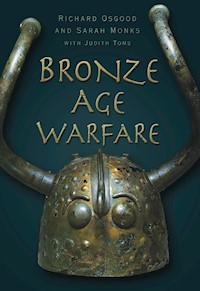
The Bronze Age, so named because of the technological advances in metalworking and countless innovations in the manufacture and design of tools and weapons, is among the most fascinating periods in human history. Archaeology has taught us much about the way of life, habits and homes of Bronze Age people, but as yet little has been written about warfare. What was Bronze Age warfare like? How did people fight and against whom? What weapons were used? Did they fortify their settlements, and, if so, were these intended as defensive or offensive structures? This detailed and fully illustrated study of warfare in Bronze Age Europe, aims to answer these and many other questions.
Das E-Book können Sie in Legimi-Apps oder einer beliebigen App lesen, die das folgende Format unterstützen:
Veröffentlichungsjahr: 2011
Ähnliche




















CONTENTS
Title
Preface
1.Introduction
Sarah Monks & Richard Osgood
Defining Warfare Terminology
2.Northern and Western Europe
Richard Osgood
Introduction
Settlements and Fortifications
Burials and Palaeopathology
Weaponry and Armour
Iconography
Conclusions
3.Spain
Sarah Monks
Introduction
Settlement Patterns and Fortifications
Burial and Skeletal Evidence
Weapons and Warrior Accoutrements
Iconography
Conclusions
4.Central and Eastern Europe
Richard Osgood
Introduction
Settlements and Fortifications
Burials and Palaeopathology
Weaponry
Defensive Equipment
Iconography
Conclusions
5.Italy
Judith Toms
Introduction
Chronological Note
Settlements and Fortifications
Weapons and Armour
Defensive Equipment
Burials and Palaeopathology
Iconography
Conclusions
6.The Aegean
Sarah Monks
Introduction
The Neolithic Aegean
The Bronze Age
Settlements and Fortifications
Burial Evidence
Palaeopathology
Weaponry
Shields
Helmets
Corselets and Greaves
Iconography
Warfare at Sea
Linear B Archives
Conclusions
The End of the Bronze Age
7.Conclusions
Sarah Monks & Richard Osgood
Warfare at the Start of the Bronze Age
Summary
Warfare in the Middle and Late Bronze Age
Defensive Equipment
Iconography
Mobility
Causes of Conflict
Summary
Bibliography
Glossary
Copyright
PREFACE
The original idea for this book was conceived by Richard Osgood following the completion of his thesis in 1996, subsequently published as Warfare in the Late Bronze Age of North Europe. He is responsible for writing Chapters Two and Four on north-western and central Europe respectively. He is currently involved in a number of field projects in northern Europe, including excavations of the Bronze Age linear ditch and human burials at Tormarton in south Gloucestershire.
The contributions of Sarah Monks and Judith Toms, who both have significant research interests in the Bronze Age, gave the project a more pan-European approach and allowed a broader range of evidence to be studied and evaluated.
Sarah Monks, who has co-written the book and is responsible for writing Chapters Three and Six, has been carrying out research on warfare in the West Mediterranean, and specifically Spain, for the past five years. Her thesis ‘The role of conflict and competition in the development of prehistoric West Mediterranean societies from the late 4th to early 2nd millennium BC’ was completed in 1998. Her research interests have focused largely on Copper and Bronze Age societies in many different parts of the Mediterranean, though specifically within Iberia, Cyprus and the Aegean.
Judith Toms has written Chapter Five on the Italian Bronze Age, and has given advice on the book as a whole. Her main area of research is the proto-history of Italy, and she has studied in particular Villanovan cemeteries and the symbolic nature of material culture in Villanovan and early Etruscan contexts.
The authors are grateful to the following people and organisations for their help and advice in bringing this book to fruition. Richard Osgood would like to thank Professors Richard Bradley, Anthony Harding, Barry Cunliffe and John Evans; Simon Pressey, Alison Wilkins and Kenton White for a number of the illustrations; Ian Cartwright for several of the photographs and Dr Mike Parker-Pearson who originally suggested that he should take a further look at Tormarton. Sarah Monks would like to thank Professors Richard Bradley and Robert Chapman; Dr Sturt Manning; David Mason (for some great photos); Simon Pressey (for the reconstruction drawing); Eva Baboula and Gerry Cox. Judith Toms would like to thank Doctors A. Sherratt, S. Sherratt, J. Robb, E. Macnamara, S. Swaddling and L. Vagnetti. Illustrations not otherwise credited are the work of the authors.
In addition, we wish to thank all the museums, institutions and individuals that granted us permission to use many of the photographs in this book. Finally, our thanks go to Rupert Harding and Sarah Cook of Suttons for their patience and perseverance.
ONE
INTRODUCTION
There has been a recent rise in the popularity of archaeological studies of warfare, although most of these have focused on a particular regional area or on specific case studies. Much of this work has been undertaken on the Roman or medieval periods where we have good documentary evidence to aid the interpretation of warfare, warriors and weapons. Prehistoric warfare has generally been treated with greater caution and many believe the evidence is too unreliable, uneven and open to many different interpretations. There has also been a tendency, when referring to the prehistoric period, to use ethnographic analogies to ‘fill in the gaps’ where evidence is patchy or difficult to interpret. Although the use of ethnographic case studies makes an important contribution to the study of archaeology, this present study tries to avoid the use of cross-cultural analogies between the prehistoric data and information on warfare from more recent societies.
A few recent publications have been significant in raising the ‘profile’ of prehistoric warfare, including Ancient Warfare (John Carman & Anthony Harding, eds), Material Harm (John Carman, ed.), War before Civilization (Lawrence Keeley), Warfare in the Late Bronze Age of North Europe (Richard Osgood) and Troubled Times: Violence and Warfare in the Past (Debra Martin & David Frayer, eds). In addition, there have been a number of articles in journals, although these typically focus on particular regional areas or specific cultural groups, or on types of analysis, for example, use-wear studies on weapons, skeletal studies or interpretations of rock art.
So where does this book fit in? It is intended to provide a general approach to warfare in Europe, addressing many of the key issues within warfare studies on a broad scale. The various chapters are specific to particular regions, and are written by people with a keen research interest in those areas, and within each chapter a multi-disciplinary approach is adopted, discussing a range of different types of evidence to produce a more rounded picture of the nature and frequency of combat, the weapons and armour employed, and the role of warfare in society, seen through burials and artistic traditions. The aim is not to provide a complete review of all the evidence, interpretations and theories on the data, because each region would then require a book of its own, but rather to identify general patterns and trends in the evidence for warfare and cite specific examples where appropriate. Of course, the period defined (and dated) as the ‘Bronze Age’ differs from region to region, a matter that is raised and discussed in each chapter. None the less, a cogent argument as to the essence of conflict in the Bronze Age of Europe can be produced.
Each chapter begins with a brief look at the preceding Copper Age or Neolithic period as a way of introducing the evidence for the Bronze Age. This is followed by a study of the various strands of evidence for warfare: settlement patterns, fortifications, burial and skeletal evidence, weapons and body protection, art and iconography. In terms of settlement patterns and fortifications, we consider what types of site were being occupied and the evidence for natural and artificial defences, and look at how the fortified, hilltop and non-fortified sites relate to one another in terms of their location, inter-visibility, function and so on. We cite examples of fortified sites, describing the nature of their defences and their development through time, including phases of destruction, repair and elaboration. The question of whether the defences were purely functional, or whether they served other social or symbolic purposes, is assessed.
We then move from the settlement sites to the people that lived in them (or at least to their physical remains). The skeletons of Bronze Age people provide perhaps the most unequivocal evidence for violence in the shape of injuries, many of them fatal. However, it is often difficult to distinguish between injuries caused by accidents and those sustained during fighting, and only a small number of examples of injuries and deaths from the Bronze Age can be conclusively attributed to violent actions. Death in combat need not leave any trace of trauma on the bones for the palaeopathologist to examine. In addition, a skeleton bearing, say, clear cut-marks on the bones may actually represent the physical manifestation of the result of a judicial execution, a murder or perhaps even post-mortem ritual treatment, as opposed to combat. Bearing this in mind, inferences are drawn from those skeletons which do seem to be reliable indicators of injuries through violence. The inferences made from this evidence relate to the method of violence used, weapon types, the angle and intensity of the assault (tactics), the types of injuries sustained and the likelihood of survival. The skeletal evidence is also considered within the context of the burial record as a whole in order to isolate unusual burial practices which may be significant. The so-called ‘warrior graves’ of the Bronze Age, typically accompanied by a rich array of weapons and warrior paraphernalia, are also discussed.
The evidence for weapons and body protection comes largely from burials, and thus not from the original context of use. Although some weapons may have been made purely for deposition in rich graves as votive offerings, or perhaps for ceremonial use, others were clearly damaged during combat and were repaired or recycled. Furthermore, it is clear that weapons were sometimes deliberately damaged in a more votive manner – for example, the ritual destruction or ‘killing’ of Late Bronze Age swords that were then deposited in water, or the deliberate stabbing of the shield from South Cadbury in Somerset. Though these blows were not received in combat, the votive damage may still have been connected to combat, perhaps being administered to destroy any items that symbolised the enemy.
A further problem with weapons is their multi-functionality. Whereas swords were clearly used for fighting (and ritual battles), knives, daggers, sticks, stones, arrows and spears could have been used for other purposes, such as for hunting or as tools. In addition, we must assume that only a relatively small percentage of the actual weapons used have been preserved in the archaeological record. We know from areas where good preservation occurs and also from the ethnographic record that weapons and armour were frequently made from perishable materials, such as leather and wood. Fortunately in some areas of Europe there is relatively good preservation of these perishable materials (see Chapter Two), while rock carvings and cave paintings indicate the types of evidence that might be missing from the archaeological record. Again, caution must be applied in always interpreting these as functional items, rather than as exaggerated symbols of power or status, or as objects used ritually rather than practically. For the prehistoric period there is much that we do not know, and in the absence of written records much that we will never know, such as the motives or causes of violence, attitudes to fighting, and its impact on society, the economy and political structure – these must be interpreted from the evidence available. For the Aegean we do have some written records, Linear B tablets, which aid our interpretation of warfare in that region, although they do not provide all the answers (see Chapter Six).
Throughout this work care has been taken not to assume that those involved in warfare had to be male. There are certainly documented examples from later periods of women taking an active part in combat, be it in the French Revolution, the Boudican revolt or the Vietnam conflict. Famously, the women of the Teutonic tribe, the Ambrones, fought not only the Roman General Marius in the second century BC, but also attacked their men-folk for retreating from the Romans. In addition, graves assumed to be of males simply because of the assemblages of weaponry they contain, may in fact be of females. This is the case with numerous examples from the Anglo-Saxon period and there are also examples from Iron Age Russia and possibly from Beaker burials in Britain. Women had an important role to play – either as active combatants, as victims or objects/causes of war, or in the pre- and post-war preparations and celebrations – and this should be borne in mind.
The archaeological evidence is inevitably very static and does not paint a very dynamic picture of warfare. Fortunately a range of paintings, engravings and carvings have been preserved, some of which depict scenes of war while others bring us face-to-face with Bronze Age warriors. Although these depictions are open to a range of different interpretations (as discussed in each chapter), they form an important category of evidence for the study of warfare. They help us to reconstruct different forms of fighting and to understand how weapons were used and what types of body protection were worn, and in some cases it even becomes possible to speculate on the identity of the combatants. At the end of each chapter we put forward an interpretation of what the evidence as a whole infers about motives and causes, defensive and offensive tactics, and attitudes to warfare and warriors (both living and in death), set within the context of Bronze Age communities as a whole.
By studying a specific period in time across a wide geographical area, we are able to make inter-regional comparisons and begin to suggest reasons for the existence of similarities and differences. This enables us to compare different interpretations and theories while continually reassessing our ideas and preconceptions of what we think warfare was like in the past. The evidence presented for each regional area is then summarised in the final chapter, with a review of general trends in warfare across Europe as a whole, touching on the types of fighting practised, the weapons used, the tactics and strategies employed (both defensive and offensive), the injuries sustained, and the role of warfare within society.
The overall aim of this book is to present a large body of evidence in an accessible and readable way, and to summarise information from different countries which is otherwise available only in native languages and in specialist or obscure publications. Further reading is suggested at the end of each chapter – we have tried to restrict this to literature which is both in English and easily available. A more detailed bibliography is provided at the end and a glossary of terms used in the book is also given. Obviously there are many problems surrounding the detection of evidence for warfare in the archaeological record, but when all the different strands of evidence are drawn together it is possible to weave a picture of the warfare that undoubtedly took place in Bronze Age Europe. As the following chapters demonstrate, there is much that we do not know about warfare in the Bronze Age, but clearly much can be gleaned from the archaeological record.
DEFINING WARFARE
It would be sensible at this point to undertake a brief examination of what is meant by warfare and to define some elements of terminology – for example, how is warfare to be differentiated from skirmishes, raids, revenge killings and so forth?
War is viewed by historians as organised, strategically planned, militarily disciplined and expressing political policy. Clausewitz, a veteran of the Napoleonic Wars, saw it as the continuation of ‘political intercourse’, but presupposed that it could be strictly defined, taking a number of distinct forms, and that it had a beginning and an end – i.e. war was an event rather than a part of everyday life. His work On War is perhaps the most famous book on the subject, although his ideas were coloured by modern perceptions of war and first-hand experience, and he gave no consideration to pre- or non-state forms of warfare which involved no distinction between the lawful and unlawful bearing of arms, a feature that pervaded much of the prehistoric period.
Clausewitz’s work typifies one of the main problems surrounding the study of early forms of warfare, namely that military history, and therefore the literate world, has been dominated by ‘civilised’ warfare. The lack of publications on prehistoric warfare, coupled with modern concepts of war, created two main schools of thought during the seventeenth and eighteenth centuries. The first approach was expressed by Thomas Hobbes, a prominent English philosopher of the time, who regarded prehistoric people as primitive and violent, and their lives as ‘solitary, poor, nasty, brutish and short’. A second approach put forward the view that civilised humans have fallen from a ‘peaceful golden age’. Jean-Jacques Rousseau, a critic of Hobbes, was an early proponent of this theory. He argued that man was not naturally cruel and that violent behaviour among primitive societies, past and present, was inconsequential and rare (see Keeley 1996: 5–8; Monks 1997: 3–5). The problem with both these theories is that they interpret prehistoric warfare from an historical point of view, and both Hobbes and Rousseau based their theories on an eclectic range of ethnographic examples. Furthermore, the period of European expansion and the work of the early missionaries, which brought westerners into contact with more ‘primitive’ societies, seemed to confirm the picture painted by Hobbes, reaffirming the need for European pacification and the introduction of Christianity to bring order to these peoples.
In addition to the work of historians, anthropologists have also tried long and hard to find causes and explanations for different forms of warfare; this too has been problematic. Early accounts of primitive societies were heavily biased and often mis-recorded and ethnographers were often deprived of much information on many aspects of society, including the frequency of fighting and the different forms of warfare practised. This being said, it is now clear that, contrary to the views of Rousseau, very few societies were ever truly peaceful and warfare was a common phenomenon within the ethnographic record. It would seem that small, pre-state groups in particular found peace difficult to maintain and derived few benefits from it. In contrast, warfare, or the maintenance of a certain level of hostility, was seen as an important way of creating social relationships (whether peaceful or hostile), maintaining social dialogue between groups, and countering shortages and periods of risk. Therefore, it would appear that early man was not the peace-loving animal that Rousseau would have us believe.
Archaeologists have traditionally considered warfare to be a feature of complex societies and states, despite the notable absence of studies into early forms of warfare. ‘The most widely used archaeological textbooks contain no references to warfare until the subject of urban civilizations is taken up’ (Keeley 1996: 18), and therefore warfare is implied to be insignificant before this time. Where ‘primitive’ warfare is mentioned there is a great deal of eclecticism in the choice of ethnographic examples, many of which are inherently biased through the recording process. More often in archaeology, early forms of warfare are assumed or implied but rarely deemed worthy of detailed discussion. Conflict is all too often dismissed either as a natural human characteristic, requiring no explanation, or as the inevitable solution to some economic or environmental crisis or change (Monks 1997: 1). In response to the former, anthropologists turned to theories and arguments derived from biological and behavioural studies, focusing on the activities of non-human primates, and comparing and contrasting this with evidence derived from simple, pre-state societies, principally in the New World. However, the different forms of violence found within the majority of societies are too diverse and too complex to be explained simply in terms of natural aggression, or the need to kill. With regard to the second point, the inevitability of warfare among developing societies can by no means be taken for granted and the question of possible ecological/environmental/economic causes requires careful investigation.
Many of these arguments lack not only a discussion of early forms of warfare, but also neglect its evolution and development within a social setting, and include no detailed empirical evidence in support of these hypotheses. More than fifteen years ago Slavomil Vencl called attention to the lack of behaviourally oriented archaeological studies of warfare, and to the difficulties of recognising evidence for prehistoric conflict, leading to an over-emphasis on peaceful ancient Europeans (cited Milner 1995: 222). Yet he was simply reiterating what a handful of other scholars had already noted – the need for studies that traced the first instances and subsequent rise of warfare: in other words an evolutionary and empirical approach which would test whether warfare was inevitable among humans and, if not, what circumstances or conditions caused and perpetuated it. As we have already noted, one of the most common areas in which this problem arises is in using the concept of warfare as a factor in the development of state-level societies. Once again, theories on the development of states often incorporate some form of coercion or violence but they provide little discussion as to the development of warfare amid non-state and pre-state societies. Twenty years on such issues have still to be addressed in many areas of European and Mediterranean prehistoric archaeology.
TERMINOLOGY
Definitions of terms such as violence, aggression, conflict, war and warfare can be found in many anthropological texts. The fact that these terms are discussed in great detail in anthropology may account for their lack of definition within archaeology. Among archaeologists such terms are used freely, and often interchangeably, without recourse to subtle nuances of meaning. But, since these terms imply a great deal about the scale, form and intentionality of fighting, the context of their use should be carefully considered.
Violence and aggression are considered to be biological or behavioural traits which involve the use of force against others. These characteristics can relate to all scales of force, from disputes between individuals to intense warfare between organised groups, and can be more closely defined as ‘harm-giving between human beings’ through which a social advantage is secured over an opponent (Riches 1991: 282). Violence is the operation of harm-giving, whereas aggression can denote a whole range of social behaviours (ibid. pp. 284–5).
‘War’, on the other hand, suggests greater scale, organisation and political direction, and has modern connotations of organised military action comprising the use of force and negotiation, and dictated by policy. Such factors are not necessarily appropriate to a discussion of the prehistoric situation, and therefore we advocate the use of the term ‘warfare’. Warfare is not necessarily premeditated, nor governed by specific policies or goals, and it may not involve large numbers of organised warriors, nor be the only means of achieving human goals. Warfare can refer to a hostile situation or to the regular occurrence of violence, or may even describe a type of lifestyle. It covers a much broader range of situations and actions, and most definitions make allowance for this: ‘Warfare means all organised forms of inter-group homicide involving combat teams of two or more persons, [and] explicitly includes highly localised and small-scale incidents which would more usually be described as skirmishes, raids or feuds’ (Divale & Harris 1976, cited Riches 1991: 290). Others have argued that to be distinguished as warfare, rather than as skirmishes or tussles, action must be purposeful: Warfare ‘refers to purposeful violence calculated to advance the ambitions of separate political factions, regardless of who was involved, the regularity of fighting, the numbers of participants, or specific combat tactics’ (Milner 1995: 221). In other words, violence or threats of an aggressive nature must have involved a motive or have been deliberate. Indeed, the threat of violence is certainly a major element of conflict and no casualties need be involved. To take a much more recent example, after the Falklands War of 1982 Britain and Argentina were still in a state of war for a number of years although no actual combat took place: here the very threat of warfare was important. Within an archaeological context the main problem is in determining the intentionality of violence and the decision-making process.
‘Defence’ is another term which is commonly brandished in archaeological discussions of warfare and its associated structural features. We talk about sites in terms of their natural defences or their defensible locations, and mention the presence of artificial defences, adding words like ‘strategic’ and ‘tactical’. Defence has been defined by one archaeologist as ‘any action that constitutes resistance against attack’ (Rowlands 1972: 447) and it is argued that aggressive behaviour stimulates a cultural response which includes the construction of defences to protect whatever is being challenged, whether it be objects, people or a defined space. Defensive action is therefore geared towards repelling an enemy attack or threat, and often takes the form of constructing physical barriers. Other defensive measures include fleeing or forming alliances or other relationships which reduce the likelihood of an attack. The building of actual barriers is seen as the most common form of defence, perhaps because of their physical presence and often their longevity. However, there is no easy way to distinguish between what is and what is not a defensive structure, since this depends on a number of social and cultural factors. The most fundamental of these are the perceptions and intentions of the constructors. It seems that the definition of defence also involves territoriality through the definition of boundaries, ownership and the need to exclude humans or animals from certain spaces, probably achieved through some kind of force or preventive measure.
To us, ‘warfare’ implies some degree of organisation or purposeful planning, either in terms of weapon and armour production, the provision of defensive measures or the use of offensive strategies. Unorganised fighting is different; it is ad hoc, often opportunistic and sporadic, unplanned and often has no obvious or consistent motives. In addition, such combat also leaves few traces in the archaeological record. In the chapters which follow we will see that this often characterises the nature of warfare in the early prehistoric periods (Mesolithic, Neolithic and Copper Age), based on our knowledge and understanding of the evidence, but in the Bronze Age things begin to change. In this period we have more concrete evidence that defences were being erected for the protection of sites (often involving a significant investment of time, labour and materials), weapons were being produced specifically for fighting (as opposed to hunting, or hunting and fighting) and warriors were being provided with body protection. Furthermore, warfare and warriors were being ascribed social status through the elaboration of their weapons, armour and other accoutrements, and they were represented in art and commemorated in death.
One caveat that should be raised is that the increasingly ritual and social aspects of warfare greatly skews our understanding of Bronze Age warfare and it would be naïve not to allow for a symbolic as well as a functional interpretation for much of the evidence. For example, the introduction of the chariot could be argued to reflect the change to a more mobile form of fighting, but it is important to consider how feasible this would have been: was the terrain suitable for fighting from chariots? What weapons would have been used and how? What is the evidence for the use of horses? Were chariots largely ceremonial? How representative is the iconographic evidence and how can we reconcile the different interpretations of the depictions? Ethnographic case studies also reveal the more social and symbolic side of warfare in the form of mock battles, ritual fighting and ceremonial displays of weapons and warrior accoutrements. It is clear that these aspects of warfare may greatly alter our interpretation of practices of warfare in the past and we must be wary of always presenting a functional or practical interpretation of the evidence. Furthermore, even taking into account any problems with the dataset, anthropology teaches us that imposing our modern perceptions of war and warfare on the past may also be wrong. Warfare is not necessarily something to be avoided whenever and wherever possible, something devastating and sporadic that breaks out during a continuum of peace. In many instances warfare could be argued to be a part of everyday life, a form of social interaction just like trade and exchange, marriage and feasting.
FURTHER READING
Carman, J. & Harding, A. 1999. Ancient Warfare (Sutton)
Carman, J. (ed.). 1997. Material Harm (Cruithne)
Clausewitz, C. von. 1968. On War (Penguin edn)
Haas, J. (ed.). 1990. The Anthropology of War (Cambridge)
Keeley, L.H. 1996. War Before Civilization: the Myth of the Peaceful Savage (Oxford)
Martin, D. & Frayer, M. (eds). 1997. Troubled Times: Violence and Warfare in the Past (War and Society vol. 3, Gordon & Breach)
Milner, G.R. 1995. ‘An osteological perspective on prehistoric warfare’, in L.A. Beck (ed.), Regional Approaches to Mortuary Analysis (Plenum Press), pp. 221–44
Monks, S.J. 1997. ‘Conflict and competition in Spanish prehistory: the role of warfare in societal development from the late fourth to third millennium BC’, Journal of Mediterranean Archaeology 10(1), pp. 3–32
Osgood, R. 1998. Warfare in the Late Bronze Age of North Europe (British Archaeological Reports Int. Series 694)
Riches, D. 1991. ‘Aggression, war, violence: space/time and paradigm’, Man 26, pp. 281–98
Rowlands, M.J. 1972. ‘Defence: a factor in the organization of settlements’, in P.J. Ucko, R. Tringham & G.W. Dimbleby (eds), Man, Settlement and Urbanism (Duckworth) pp. 447–62




