



Erhalten Sie Zugang zu diesem und mehr als 300000 Büchern ab EUR 5,99 monatlich.
- Herausgeber: Nick Hern Books
- Kategorie: Geisteswissenschaft
- Sprache: Englisch
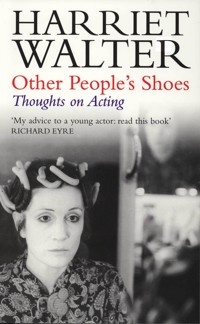
'A part we have played is like a person we once met, grew to know, became intimately enmeshed with and finally moved away from. Some of these characters remain friends, others are like ex–lovers with whom we no longer have anything in common. All of them bring something out in us that will never go back in the box.' In a varied and distinguished career, Harriet Walter has played almost all of Shakespeare's heroines, notably Ophelia, Helena, Portia, Viola, Imogen, Lady Macbeth, Beatrice and Cleopatra, mostly for the Royal Shakespeare Company. But where, she asks, does an actress go after playing Cleopatra's magnificent death? Why didn't Shakespeare write more – and more powerful – roles for mature women? For Walter, the solution was to ignore the dictates of centuries of tradition, and to begin playing the mature male characters. Her Brutus in an all–female Julius Caesar at the Donmar Warehouse was widely acclaimed, and was soon followed by Henry IV. What, she asks, can an actress bring to these roles – and is there any fundamental difference in the way they must be played? In Brutus and Other Heroines, Walter discusses each of these roles – both male and female – from the inside, explaining the particular choices she made in preparing and performing each character. Her extraordinarily perceptive and intimate accounts illuminate each play as a whole, offering a treasure trove of valuable insights for theatregoers, scholars and anyone interested in how the plays work on stage. Aspiring actors, too, will discover the many possibilities open to them in playing these magnificent roles. The book is an exploration of the Shakespearean canon through the eyes of a self-identified 'feminist actor' – but, above all, a remarkable account of an acting career unconstrained by tradition or expectations. It concludes with an affectionate rebuke to her beloved Will: 'I cannot imagine a world without you. I just wish you had put more women at the centre of your world/stage… I would love you to come back and do some rewrites.' 'A glorious reminder that genuine diversity on stage offers astonishing creative benefits… Harriet Walter is mesmerising in one play after another, bringing her classical training to bear as a conflicted Brutus, then a Henry IV who wears his crown heavily, and finally a Prospero who knows that the steel bars of prison are resistant to all magic… this is genuinely art to enchant' The Guardian on the Donmar Warehouse's Shakespeare Trilogy
Sie lesen das E-Book in den Legimi-Apps auf:
Seitenzahl: 306
Veröffentlichungsjahr: 2016
Das E-Book (TTS) können Sie hören im Abo „Legimi Premium” in Legimi-Apps auf:
Ähnliche



















HARRIET WALTER
NICK HERN BOOKSLondonwww.nickhernbooks.co.uk
Contents
Introduction
Acknowledgements
1. Ophelia
A Case Study
2. Helena
Heroine or Harpy?
3. Portia, Viola (& Imogen)
A Year of Playing Boys
4. Imogen
Peeling Back the Layers
5. Lady Macbeth
A Portrait of a Marriage
6. Beatrice
A Woman with a Past
7. Two Loves
Or, The Eternal Triangle
8. Cleopatra
The Consummate Actress
9. Brutus
The Honorary Man
10. Henry IV
‘Uneasy lies the head that wears a crown’
Epilogue
A Letter to Will
A Chronology of Shakespearean Performances
About the Author
Copyright Information
Introduction
A part we have played is like a person we once met, grew to know, became intimately enmeshed with and finally moved away from. Some of these characters remain friends, others are like ex-lovers with whom we no longer have anything in common. All of them bring something out in us that will never go back in the box.
In this book I write about the major Shakespeare characters I have played. This sometimes involved revisiting pieces I had written much earlier in my life and my career, and doing this was a bit like looking back through old diaries with a mixture of affection and embarrassment. In reworking these pieces, I have deliberately preserved references that place our productions in a particular time (e.g. in Chapter Four on Imogen, I mention Glasnost; in Chapter Three on Portia, I refer to President Ronald Reagan), and I have stuck to the original thoughts I was wanting to convey, even if that meant exposing the naivety or idealism of my younger self.
Apart from the chapters on Ophelia, Imogen and Lady Macbeth, which are abridged or edited versions of pieces that had been published elsewhere, all the material has been freshly written this year. Younger characters have been recollected in tranquillity or written up from early essays or rehearsal notes. I had never written anything about Beatrice or Cleopatra before, and enjoyed reawakening those parts played fourteen and ten years ago respectively.
The last chapters of the book deal with still-current roles: the male protagonists in Phyllida Lloyd’s all-female Shakespeare trilogy for the Donmar Warehouse. At the time of writing, we are reviving the two plays we have already performed (Julius Caesar and Henry IV) and are rehearsing the third (The Tempest). Here, the writing task is different. Obviously there is no difficulty in recalling details, but instead I have to step back, freeze the still flowing ideas about a part, and attempt to crystallise something that will have changed by the time you read this.
Many people suppose that we actors just have very vivid imaginations that carry us away until we believe we are someone else, and that all we then have to do is to remember the lines and not bump into the furniture. What is less understood is how we build a character through interpreting the text, and how we bring that character to life in collaboration with the director and the rest of the cast.
Much of acting work is about choices: the choices of interpretation and emphasis in rehearsing a role, and the minute-to-minute choices we make in response to an audience in performance. My choices will never be the same as someone else’s, and if there were a right way and a wrong way to play a part we would all try to copy some ‘definitive’ performance, and life would be very dull. So this book is not intended as a blueprint to be followed to the letter, but I hope that it shows the sort of questions an actor needs to ask him- or herself in preparing a role, and how Shakespeare’s text can be excavated for clues to support several interpretations. The important thing is that the character should be coherent with the play and production that surrounds it.
Two things happened to encourage me to write about playing Shakespeare. One was that, during my first seasons at the Royal Shakespeare Company in the 1980s, there existed a strong connection between the company and the Shakespeare Institute, a department of Birmingham University, based in Stratford-upon-Avon. The Institute produced the collections called Players of Shakespeare (Cambridge University Press), in which RSC actors were invited to contribute a chapter on the particular character they were playing that season (see Chapter Four on Imogen). Here was an academic institution taking actors’ insights seriously. They introduced the now totally accepted idea that, since Shakespeare wrote his plays to be performed and watched rather than studied, the players could make a valid contribution to the analysis of his works.
Secondly, around that same time, myself and four other leading actresses were interviewed by Professor Carol Rutter of Warwick University for her book Clamorous Voices (The Women’s Press, 1988). She was interested in gathering the reactions and opinions of a generation of actresses who were bringing a new feminist experience to the famous female roles. I had taken my feminism for granted, not really knowing how these roles had been interpreted before, and Carol’s book encouraged me to believe there was something fresh I could bring to the discussion.
This is not an academic book, nor is it a practical handbook. It is more personal than both of those. Perhaps it is a kind of autobiography in that it journeys from my thoughts as a thirty-year-old who understood the vulnerability of Ophelia, gaining confidence and complexity through my thirties and forties with Helena, Viola, Portia and Lady Macbeth, to a more relaxed, womanly Beatrice and Cleopatra in my fifties, and onward to finding new territory in the male roles in my sixties. As with any autobiography, I can impose a retrospective shape on a life that was experienced in a more blinkered present tense. Perhaps this is my attempt to lay down a record of an art form that is only true in the moment of performance.
August 2016
Acknowledgements
I want to thank the many directors who have given me such heady opportunities, passed on their insights and helped build and develop my courage as a performer of Shakespeare over so many years; in particular John Barton, Richard Eyre, Trevor Nunn, Greg Doran and Phyllida Lloyd.
A huge thank-you to Faith Evans, whom I first met as editor of Clamorous Voices, and who then became my literary agent, encouraging me to write my first book, Other People’s Shoes. Thanks also to Matt Applewhite and everyone at Nick Hern Books, who have benignly nagged me while I procrastinated in writing this book, and especially to Nick Hern himself, who reissued Other People’s Shoes, and saved me from many writing pitfalls while editing this book.
*
Photo credits: Ophelia in Hamlet © John Haynes/Lebrecht Music & Arts; Helena in All’s Well That Ends Well by Reg Wilson, Lady Macbeth in Macbeth by Jonathan Dockar-Drysdale, and Cleopatra in Antony and Cleopatra by Pascal Molliere, all © RSC; Portia in The Merchant of Venice by John Peters; Imogen in Cymbeline and Viola in Twelfth Night, both © Ivan Kyncl/ArenaPAL; Beatrice in Much Ado About Nothing © Donald Cooper/Photostage; Brutus in Julius Caesar and King Henry IV in Henry IV, both © Helen Maybanks. Every effort has been made to trace copyright holders, but if any have been inadvertently overlooked, the publisher will be pleased to make the necessary arrangements at the first opportunity.
OPHELIA
A Case Study
As Ophelia with Jonathan Pryce (Hamlet)Hamlet, Royal Court Theatre, London, 1980
This piece is taken from my book Other People’s Shoes, which I wrote in 1998. It came in a chapter in which I was specifically demonstrating the psychological approach to a character. I wrote it up from jotted notes I had made while rehearsing several years earlier in 1980. It was my first professional Shakespeare role but not the first I wrote about. This was a thrilling, groundbreaking production to be a part of, and Ophelia proved to be a stepping stone towards my understanding of how to approach character through language.
Sometimes, when one role is offered hot on the heels of another, your imagination remains so steeped in the world of the last role that it spills over into the next. When Richard Eyre asked me to play Ophelia to Jonathan Pryce’s Hamlet at the Royal Court, he had just finished directing me in a film for television called The Imitation Game by Ian McEwan. This was the story of a young woman, Cathy Raine, who joined the army in the Second World War and was posted to the code-breaking headquarters at Bletchley. She was bright and well educated but soon realised that her talents were to be buried in menial tasks cleaning up after the Cambridge boffins. Her frustration and need to get near the centre of things resulted in her being imprisoned for the duration of the war as a suspected spy.
The piece was a brilliant exposé of patriarchal double standards, and before starting work on it Richard Eyre suggested I read Virginia Woolf ’s essay Three Guineas. This was one of her last works before she committed suicide in 1941. It is an agonisingly relentless analysis of the patriarchal imperative to war and the way in which women collude with it. Woolf looked straight into the light alone and was burned up by it. At the end of The Imitation Game Cathy Raine has seen a similar light but lacks Woolf ’s tools to articulate it. Locked up, suicidal or tipped into madness, that was the fate of women who, had they lived now, would have been buoyed up by a tumultuous sisterly chorus.
With these things still churning in my mind, I started to tackle Ophelia. Fresh from The Imitation Game himself, Richard was also working on some kind of continuum of themes: patriarchal power, secrecy, corrupted love, the destruction of a woman. His version of Elsinore carried echoes of the corridors of Whitehall. Geoffrey Chater’s patrician Polonius would have been perfectly at home in MI5, and to reinforce the connection, he had played the witheringly steely colonel who had locked me up in The Imitation Game. Ophelia was to be no flibberty damsel, but an intelligent girl locked in her mind by the oppressive rules of the establishment.
The Royal Court’s brief was to put on new plays or, if it did do any classics, to rework or reinterpret them as if they were new plays. Richard had wanted to emphasise the modern political play in Hamlet, and to this end he chose to eschew the supernatural element. His most controversial decision was to cut the part of Hamlet’s father’s ghost. The reason for this was that unlike Shakespeare’s audience, we no longer believed in Heaven and Hell as actual places, nor in tormented spirits trapped between the two. Instead of Hamlet’s father’s ghost being an outward manifestation visible and audible to whoever was on watch that night, he was to be understood as a projection of Hamlet’s fevered mind. Hamlet was possessed by his father’s spirit. When his father ‘visited’ him, Jonathan Pryce’s body writhed and contorted as if some alien creature had invaded him and was kicking at his sides. He belched the ghost’s words from the pit of his stomach and gasped for air as his own voice recovered enough to answer.
Richard’s ‘modern play’ approach helped ease me into what was my first classical role. Before I came across John Barton and Cicely Berry at the RSC, who both taught me so much about creating character through language, I could think of no other way to approach Ophelia than through her psychology. We had a mere three-and-a-half weeks to rehearse, which meant that if I were lucky I would get about two shots at each scene before the run-throughs and technical rehearsals began. I was timid and apologetic about taking up rehearsal time, so inevitably I did a lot of my work at home.
The most famous thing about Ophelia is that she goes mad. Richard had given me one major tip as to what he wanted, by telling me what he didn’t want. He did not want ‘mad acting’. I knew what he meant. For Ophelia, her mad scene is an ungoverned artless release; for the actress playing her it can be a chance to show off her repertoire of lolling tongues and rolling eyes, in a fey and affecting aria which is anything but artless. That is the paradox of acting mad. The actor is self-conscious in every sense, while the mad person has lost their hold on self.
Generalised mad acting, being unhinged from any centre, leaves the actor floundering in their own embarrassment. The remedy for me was to find a method in Ophelia’s madness, so that I could root her actions in her motivations (however insane and disordered), just as I would with any other character I was playing. Before playing her I had shared with many others the impression that Ophelia was a bit of a colourless part—that is, until she goes mad. I needed to find a unifying scheme that would contain both the ‘interesting’ mad Ophelia and the ‘boring’ sane Ophelia.
Suppose Ophelia is happily ‘normal’ until her lover rejects her and murders her father. Is that necessarily a cue to go mad? After all, Juliet suffered something of the kind when Romeo killed Tybalt, and although the idea tormented her she did not flip. I started to see that the seeds of Ophelia’s madness had been sown long before the play started, by the workings of a cold, repressive environment on an already susceptible mind. I preferred this theory to the sudden-madness-through-grief idea which, together with broken hearts and walking spirits, seemed to belong in the theatre of Henry Irving or a Victorian poem.
In the little time available to me, I scoured the libraries for modern clinical accounts of madness and found much to latch on to in R.D. Laing’s Sanity, Madness and the Family and The Divided Self. I am not concerned here with the pros and cons of Laing’s approach; what interested me were his case histories of young schizophrenic women, and the mechanisms by which their families inadvertently contributed to their disorder. A latent schizophrenic tendency need not necessarily develop into madness, but certain triggers might set it off.
Here I found some uncanny Elsinore echoes. They always say Shakespeare can be made to fit any argument, but in this case I suppose it was just further proof that he knew all there was to know about human nature. If he had been directing me, he would no doubt have been impatient with my approach. ‘Just say the lines, love,’ he might have said. ‘I promise it will work.’ It was my own imagination that needed to do more. So with Shakespeare, Laing and Virginia Woolf to help me, I built my little theory.
From some of my jottings at the time
Family: father Polonius, brother Laertes. Mother is dead and no one mentions her. No known female companion. Only female role model known to be present in her life is Gertrude, who has too many of her own problems to be much help.
Speculation
Little experience of love. Duty rather than deep love binds her to her father, and although her brother had been an affectionate companion in childhood, they have been brought up increasingly apart from one another. Her education, such as it is, has been mostly at her father’s hands and of a deliberately unworldly nature, while her brother’s education was a serious preparation for a public role in life.
Clues in the text
All in the name of loving protection, Laertes undermines Ophelia’s trust in Hamlet and ‘the trifling of his favour’. ‘You must fear,’ he tells her. ‘Fear it, Ophelia, fear it my dear sister.’ And in case she still hasn’t got it, ‘Be wary.’ Layer upon layer he adds, talking of ‘the danger of desire’ and her ‘too credent ear’. On departing, Laertes charges her to ‘Remember well what I have said to you,’ and Ophelia replies, ‘’Tis in my memory locked, and you yourself shall keep the key of it.’ Yet the very next minute, when Polonius pounces in with, ‘What is’t Ophelia he hath said to you?’, she replies, ‘So please you, something touching the lord Hamlet,’ and within seconds she is spilling it all out. So much for locked-up secrets.
To keep a secret is a means of preserving the self. It is proof to the keeper that they own a private self that cannot be reached. One of Laing’s cases ‘found it difficult to keep anything to herself because she talked too much and besides she thought people could read her thoughts’.
Further quotes from R.D. Laing’s patients
One woman spoke of her father, who kept worrying ‘that I should be kidnapped or some dreadful thing happen to me. It’s my own fault. He’s got no confidence in me at all. I am always going to be led away by some crafty cunning bad man. He has put that into my mind, he has got that impregnated into my brain in some way.’
‘I am not supposed to have an opinion because my opinion is bound to be incorrect you know… Perhaps my opinion isn’t what you call reliable, perhaps in every way I am not reliable. I feel that I have to accept that I am not reliable.’
I know there is a danger in too schematic an approach to acting, particularly Shakespeare, and that I could easily have been carried off course by the sheer fun of theory-building, so I made sure that I took from Laing only what I needed, and relied on Shakespeare and events in the rehearsal room for the rest. The exercise was not about diagnosing Ophelia as a schizophrenic, but about gaining insight into the text. I started to hear the other characters’ words from Ophelia’s point of view, as traps and ambushes, and as means of controlling her mind.
‘To thine own self be true,’ Polonius advises Laertes as he sees him off on his travels, while in the same scene he tells Ophelia, ‘You do not understand yourself.’ Young men should learn to fend for themselves in life’s battles, gaining confidence through experience, whereas women must be kept in fear and ignorance of their very natures.
Ophelia submits to another battering from Polonius: ‘Do not believe his vows… Affection? Pooh! You speak like a green girl.’ He asks her, ‘Do you believe his tenders, as you call them?’, and to Ophelia’s simple reply, ‘I do not know, my lord, what I should think,’ he answers, ‘Marry, I shall teach you: think yourself a baby.’ He does such a good job on her that by the end of the scene Ophelia has promised to reject Hamlet, send back all his letters and never speak to him again.
Other Shakespeare heroines have fought back under like circumstances. Jessica defies Shylock and runs off with Lorenzo. Rosalind, Imogen and Julia risk punishment and banishment in search of true love, but a lifetime of indoctrination, together with a particularly impressionable nature, ensures that Ophelia cannot resist.
From that moment on she puts herself entirely in her father’s hands. Having been terrified by an encounter with the seemingly deranged Hamlet, rather than try to talk to him, she rushes to her father and blurts out the whole story. Polonius in his turn reports everything back to the King, and all this culminates in the plot to test Hamlet’s madness in which Ophelia is quite wittingly used as bait. Guilt, love, duty and, above all, terror confound her. Given this state of affairs, imagine the following exchanges from Ophelia’s point of view.
(Ophelia offers to return Hamlet’s gifts.)
HAMLET: I never gave you aught.
OPHELIA: My honour’d lord, you know right well you did…
(Which of them is going crazy?)
HAMLET: Are you honest?
OPHELIA: My lord?
HAMLET: Are you fair?
OPHELIA: What means your lordship?
HAMLET: That if you be honest and fair, your honesty should admit no discourse to your beauty.
OPHELIA: Could beauty, my lord, have better commerce than with honesty?
(Holding her own pretty well; but then…)
HAMLET: Ay, truly. For the power of beauty will sooner transform honesty from what it is to a bawd than the force of honesty can translate beauty into his likeness. This was sometime a paradox, but now the time gives it proof. I did love you once.
OPHELIA: Indeed, my lord, you made me believe so.
HAMLET: You should not have believed me… I loved you not.
OPHELIA: I was the more deceived.
This would be pretty devastating to most of us, but Ophelia is disintegrating fast. I am trying to convey something of the sensation of playing Ophelia, given the story so far.
When Hamlet suddenly springs on Ophelia, ‘Where’s your father?’, the girl who cannot keep a secret feels transparent and replies, ‘At home, my lord’, a little too quickly. She has blown the cover, and now that Hamlet has seen through the plot, she is powerless to dissociate herself from its cynical perpetrators. She puts up little resistance as Hamlet brutally rejects her, in a scene played out mostly for the ears of her eavesdropping puppet-masters.
When everyone has left the stage, Ophelia gives us her one soliloquy that ends with, ‘O woe is me, to have seen what I have seen, see what I see!’ The line has a similar ring to Isabella’s in Measure for Measure:
To whom should I complain? Did I tell this,
Who would believe me?
The audience has witnessed the abuse of both women and is on their side, but the women themselves cannot be reached or helped. They are sealed in the world of the play, with a knowledge that is too dangerous to share. The big difference is that Isabella has a gigantic sense of her self and her integrity while Ophelia has virtually none. She has depended on Hamlet and her brother and father for what flimsy self-definition she has. The one has just denounced her as a whore, the second is abroad and the third is about to be murdered by the first.
I am not going to start decoding Ophelia’s ramblings in the mad scene, because that is a task for each actress who plays her. How much does she know? Did she sleep with Hamlet? These and many other questions are up for grabs. The important thing is to work out your own private coherence and to have a strong intention behind each thing you say. However broken up your story, let each fragment come from a clear image. If there are ‘unconscious’ tics, let them come from a centred impulse. Inhabit your world, don’t demonstrate it.
With a director who is sympathetic to your intentions, any demonstrating can be done for you by the production itself. Out of sheer embarrassment I never disclosed the details of my homework to Richard Eyre, but the tentative sketch that I brought to rehearsals gave him at least enough to go on. He picked up Ophelia’s message, however faint, and helped to focus it physically. His greatest gift to me came in the shape of props.
The first was a bundle of Hamlet’s letters upon which my grasp weakened as the play progressed. In the first scene I clung to them as if they embodied my faith in Hamlet, only to surrender them to Polonius as soon as he beckoned me to. In Act III, Scene 1, Polonius placed the letters in my lap like a photographer arranging a picture. He and Claudius have staged the scene, and the letters are Ophelia’s props. She hands them to Hamlet, saying:
My lord, I have remembrances of yours
That I have longéd long to redeliver.
I pray you now receive them.
As Hamlet departs at the end of the scene, he throws the letters in Ophelia’s face, and they scatter on the floor. Claudius and Polonius re-emerge from their listening-post and discuss the scene they have just witnessed as if Ophelia were not in the room. She, meanwhile, crawls around the floor gathering up the letters as though they were the shards of her life.
The second prop that helped to tell my story was a bundle of blackened twigs. These were a memorable substitute for Ophelia’s usual picturesque garlands. This not only added to her delusion but somehow helped to suggest a subversiveness, a sense that she knew something. ‘Follow her close. Give her good watch, I pray you,’ says Claudius. She is dangerous not just to herself but to the court. When I presented Claudius with a gnarled stick saying, ‘Here’s fennel for you and columbines,’ it was no pretty gift but an accusation.
My performance fell far short of my aims, mainly because I was inexperienced and too inhibited to carry out all that I had planned at home, but I was totally supported by the production. Bill Dudley’s set, with its secret panels and trompe l’œil life-sized ‘spies’ lurking in the corners, together with a soundtrack of indecipherable whisperings, all added to the atmosphere of paranoia, and the chamber scale of the Royal Court suited my implosive rather than explosive version of madness.
But could I have been explosive if I’d wanted to be? That was the next question, put to me (in slightly different terms) by Trevor Nunn, who had seen my Ophelia and was sizing me up for the part of Helena in All’s Well That Ends Well. He had appreciated the detail of my performance but, as he put it, could I preserve that detail and reach the back of the auditorium? (Bear in mind that he was talking main house at Stratford, not the cosy Royal Court.) Luckily for me, Trevor took the risk, and over the next decade I joined in the effort to combine intimacy with projection, heightened language with naturalistic speech, and verbal dexterity with physical strength that has preoccupied the RSC since it first began.
HELENA
Heroine or Harpy?
As Helena with Peggy Ashcroft (Countess)All’s Well That Ends Well, Royal Shakespeare Company, 1981
In 1991 I was invited to give a paper on Women in Theatre at the Divina Conference at Turin University. I titled it ‘The Heroine, the Harpy and the Human Being’. I wanted to look at the perceptions of virtue and vice in female characters and to uphold the right of women and female characters to be imperfect and flawed without being condemned as the baddy, the whore or the temptress.
The full piece dealt with modern as well as classical roles and was later published in New Theatre Quarterly (Vol. IX, number 34).
For this book I decided to focus on the character of Helena in All’s Well That Ends Well, who exemplifies many of my observations. In order to be true to what I was writing at the time, I have kept to these observations in the current reworking for this book, but I am happy to say that a lot of the attitudes I was up against then have changed.
A more detailed study of Helena can be read in a piece I wrote for Clamorous Voices.
What is Virtue?
Any actress playing a classical heroine has to tackle the concepts of virtue and chastity: they are words which come up so centrally and so often that it is impossible to skirt round them. They are used to define the whole woman, and often nothing else about her is known or deemed to be important. As a modern woman I could never connect personally with the significance the word ‘chastity’ had for a character I was playing, until Helena in All’s Well That Ends Well showed me a way through. I found if I mentally substituted the word ‘integrity’ for ‘chastity’, I could reach her need to preserve her sense of self, her internal moral core.
According to the morality of the day, a woman was virtuous simply by being a virgin. A virgin was a commodity on the marriage market, and if a woman lost her virginity out of wedlock, she was sullied goods and lost all claim to virtue. Virtue and virginity became one and the same.
But this makes virtue passive, or at most something to be maintained by resisting, a negative action. This kind of virtue is a male-centred definition, to do with the value of a prize to be won by men, and nothing to do with the intrinsic moral worth of a female human being. In other words, in classical drama and literature men earn their worth through their actions, whereas a heroine doesn’t have to do anything, she just has to be innocent, preferably quiet, and definitely a virgin. Female virtue is a state of being, rather than doing.
Historically, it was men who created the tie-up between a woman’s virginity and her virtue, but we women want our heroines and ourselves to be tested against the general human virtues and prove ourselves by our deeds and decisions against the same criteria as men.
A Mingled Yarn
In Act IV, Scene 3, of All’s Well That Ends Well Shakespeare says:
The web of our life is of a mingled yarn, good and ill together: our virtues would be proud, if our faults whipped them not; and our crimes would despair, if they were not cherished by our virtues.
It is one of my favourite speeches. It is not at all famous and comes from the mouth of a minor character who doesn’t even have a name (the First Lord).
It felt to me to be one of the central tenets of the play, and therefore it seemed that Shakespeare intended his chief female character, Helena, to reflect it. I believe Shakespeare deliberately created a heroine who is imperfect but whose worth he ultimately believes in. He challenges the audience to accept a flawed female as their guide through the story and to allow her to win in the end. That end remains ambiguous but, I think, hopeful. It would be unbelievable if it were all rosy, but it would be uncharacteristically cynical if the title were entirely ironic.
Helena came to me with a bad reputation. Critics over the years had judged her as immodest, ambitious, predatory and sanctimonious. It was 1981, and the play had not often been performed because so many people deemed it unplayable and the heroine unacceptable. What is Helena’s crime? She pursues the man of her choice rather than waiting for him to choose her. Helena’s namesake in A Midsummer Night’s Dream (which I played in that same season) also chases after her man, but she is loveable because her quest is hopeless and it is treated comedically. In Act II, Scene 2, she voices the inappropriateness of her behaviour and despises her own desperation:
We cannot fight for love, as men may do.
We should be woo’d and were not made to woo,
and what is here comically expressed, is the predicament of the other, more serious Helena as well.
I was not interested in judging All’s Well’s Helena. I had my work cut out learning her very opaque speeches and summoning the courage and technique to play my first major Shakespeare role on the main stage at Stratford in the company of Dame Peggy Ashcroft among other luminaries.
What I instantly related to was a woman of ambition. To date, my favourite role had been Nina in The Seagull. Nina is no ordinary sweet young thing but an ambitious actress eager for experience, who gets battered by tragedy, is strengthened by it and moves on. I could always relate to ambition, having plenty of drive myself. What was harder to relate to was the fact that the full extent of Helena’s ambition was to get her man.
Precisely because she is hard to label, Helena is one of the most interesting and modern of Shakespeare’s women that I have ever played. However, the label-seeking analysts want to know where they stand. They fret over whether All’s Well is a comedy, a romance or a tragedy. The answer is that it hops between all three and all three overlap; a bit like life really. But a label it must have, so it becomes ‘a problem play’, and the major problem is what to make of the central couple, Helena and Bertram.
It is one thing to come to terms with a heroine who pursues and traps a man into marriage, but another to accept that the man she pursues doesn’t seem worth the effort. Neither hero nor heroine is likeable.
The issue of likeability is one I have come up against often since, but never so clearly as with Helena. Seldom does anybody ask whether they like Hamlet, Henry V, or King Lear, but somehow the heroine has to be sympathetic, palatable, liked. It is definitely easier for a woman to be liked if she is pretty, gentle, and unassuming than if she is intense, ambitious, and complicated like Helena.
On the other hand, it is interesting that George Bernard Shaw preferred Helena to any other Shakespeare heroine, and having studied the part in depth and played it in repertoire over a period of two years, I feel certain that Shakespeare was basically on her side. Every decent, wise character in the play approves of her, and her only detractors are Parolles, a known cheat, and Bertram, an immature snobbish boy.
From the start, I felt for Helena’s unrequited love and her social isolation. I liked her for her ambition and the way she shoved self-pity aside and followed her dream. I admired her guts chancing her arm at curing the King. I was fascinated by her oblique, broken-up, cryptic soliloquies at the beginning of the play. They gave me a clue as to her tangled thoughts, and the fact that she almost could not speak her ambition out loud, it seemed so transgressive. This means that she could barely admit her feelings to herself, since a confessional soliloquy to the audience is the equivalent of talking to oneself.
About her faults I was maybe less than honest. I was feeling defensive against what seemed to be a historical sea of prejudice, so I was perhaps in denial about any of her shortcomings, her possible underhandedness, her blinkeredness about Bertram’s feelings, her scheming—and I sought every justification for these that I could dig out of the text.
Trevor Nunn, the director, also saw the need to redeem the misunderstood Helena if he was going to make the play work. By setting the play in the early twentieth century, he helped my interpretation of Helena by suggesting a connection with the emancipated heroines of Ibsen and Shaw. He also encouraged me to emphasise Helena’s trepidation and thereby her bravery, to dig out and deliver whatever self-deprecatory wit she might have, and to find her moments of remorse and compassion for Bertram. The opportunities were all there in Shakespeare’s text.
Yes, she can seem secretive and indirect, especially in her dealings with Bertram, but I put that down to diffidence and self-doubt. Yes, she can seem manipulative but, as I see it, she only manipulates what Fate seems to set in her pathway, and Fate seems consistently to reward her faith. First her pursuit of Bertram gets a blessing from his own mother, the Countess of Rousillon, then her faith (plus a little medical know-how) manages to cure the King of France of a fatal disease, and then the King promises her Bertram as her reward.
When things go terribly wrong and Helena realises that her monomania has driven Bertram away from France and on to the battlefield and possible death, she is willing to give up her pursuit, become a wandering pilgrim and leave France, since it is her presence there that has forced Bertram to run to the wars.
No, come thou home, Rousillon,
Whence honour but of danger wins a scar,
As oft it loses all: I will be gone;
My being here it is that holds thee hence:
Shall I stay here to do’t? no, no, although
The air of paradise did fan the house
And angels officed all: I will be gone.




