


29,99 €
Mehr erfahren.
- Herausgeber: Packt Publishing
- Kategorie: Fachliteratur
- Sprache: Englisch
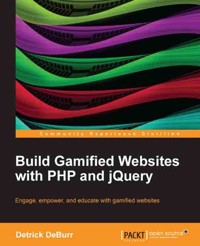
Gamification involves the process of leveraging the features of real games into real life. A gamified website has the potential to increase user engagement, ROI, and learning. This book will help you build gamified websites with PHP and jQuery by making you understand the gamification design process to implement game mechanics in practical applications.
Gamified websites are very popular amongst Internet users. The gamification of a web content draws users into action to empower them and help them develop new skills. Games engage user attention into the task and each task accomplished will mean the development and enhancement of new skills. This book will help you to apply the essence of games into real word applications such as business and education.
Build Gamified Websites with PHP and jQuery aims at empowering and educating the users with an educational gamified website. The book walks through the process of developing a gamified website. Through the course of the book, you will learn gamification development process. The book emphasizes on the application of game mechanics to motivate the user. You will then use the Fogg behaviour model to influence the user behaviour. By the end of the book, you will see yourself building more engaging yet simple websites based on rational principles.
Das E-Book können Sie in Legimi-Apps oder einer beliebigen App lesen, die das folgende Format unterstützen:
Seitenzahl: 127
Veröffentlichungsjahr: 2013
Ähnliche



















Table of Contents
Build Gamified Websites with PHP and jQuery
Build Gamified Websites with PHP and jQuery
Copyright © 2013 Packt Publishing
All rights reserved. No part of this book may be reproduced, stored in a retrieval system, or transmitted in any form or by any means, without the prior written permission of the publisher, except in the case of brief quotations embedded in critical articles or reviews.
Every effort has been made in the preparation of this book to ensure the accuracy of the information presented. However, the information contained in this book is sold without warranty, either express or implied. Neither the author, nor Packt Publishing, and its dealers and distributors will be held liable for any damages caused or alleged to be caused directly or indirectly by this book.
Packt Publishing has endeavored to provide trademark information about all of the companies and products mentioned in this book by the appropriate use of capitals. However, Packt Publishing cannot guarantee the accuracy of this information.
First published: September 2013
Production Reference: 1160913
Published by Packt Publishing Ltd.
Livery Place
35 Livery Street
Birmingham B3 2PB, UK.
ISBN 978-1-78216-811-9
www.packtpub.com
Cover Image by Suresh Mogre (<[email protected]>)
Credits
Author
Detrick DeBurr
Reviewers
P. Alex (Pruteanu Alexandru)
Robert Wąs
Acquisition Editor
Pramila Balan
Commissioning Editor
Shreerang Deshpande
Technical Editors
Anita Nayak
Vrinda Nitesh Bhosale
Copy Editors
Sayanee Mukherjee
Aditya Nair
Adithi Shetty
Project Coordinator
Amigya Khurana
Proofreader
Joel Johnson
Indexer
Monica Ajmera Mehta
Graphics
Ronak Dhruv
Production Coordinator
Shantanu Zagade
Cover Work
Shantanu Zagade
About the Author
Detrick DeBurr currently serves as a co-founder of CUPID On The Go! Prior to this, he was Founder/CEO of Digital Rhythm Inc., an information technology services provider based in Dallas, Texas, USA. Detrick has served in various software development roles through his career. In 2005, Black Engineer Magazine named him a Modern Day Technology Leader.
He is a graduate of Darden University's Minority Equity Boot camp, a program that educates minority business owners to access the private equity capital markets. In 2001, Mr DeBurr received Stanford University's Digital Visions Fellowship for his efforts with the Digital Literacy Alliance in Ghana, West Africa.
Mr. DeBurr is the author of Deal Us In! How Black America Can Play and Win in the Digital Economy, Anji Publishing, 2001.
He has served his community as Chairman of the Planning and Zoning Commission in Cedar Hill, Texas. He has also served on the Board of St. Philips School and Community Center and chaired the Dallas Blueprint for Leadership Program, a program that prepares minorities to serve non-profit boards and committees. He is an active member of Omega Psi Phi Fraternity Inc..
I would like to thank my wife Sonya DeBurr for her patience during this book project. I would also like to thank Terry, Joshua, and Aisha (my children) for the inspiration and incentive to write this book.
About the Reviewers
P. Alex is a young webmaster who loves the Web. His full name is Pruteanu Alexandru and he was born in Moldavia. He is currently living in Italy, where he studies Web and Multimedia Technologies at the University of Udine. He wakes up every morning with the desire to learn something absolutely new and always tries to widen his knowledge.
He is currently working on several projects and putting together his experience, passion, and creativity. He is a happy Linux user and an open source advocate. He was selected at the Google Summer of Code, 2013 with his project Improve Joomla! Frontend Semantics & Accessibility for the Joomla! organization. He created a new library and implemented Schema.org microdata semantics in Joomla! CMS. In his free time, he works on a website called HenGames.com, which he has created himself. P. Alex is also keen on Psychology, Marketing, Design, and all that is connected to the Web world. His home page is http://p-alex.com; you can also find him on Twitter (@PAlexcom).
Robert Wąs is always watching out for something new. Professionally, he is a programmer who prefers working in scripting languages or Java and creating UI. He likes working with human-centered projects and constantly observes UX trends and user behavior. In his private life, he's a husband and father who takes a keen interest in education and gamification. He can be found live on Twitter at @robertwpl or Facebook at robert.was.krk.
www.PacktPub.com
Support files, eBooks, discount offers and more
You might want to visit www.PacktPub.com for support files and downloads related to your book.
Did you know that Packt offers eBook versions of every book published, with PDF and ePub files available? You can upgrade to the eBook version at www.PacktPub.com and as a print book customer, you are entitled to a discount on the eBook copy. Get in touch with us at <[email protected]> for more details.
At www.PacktPub.com, you can also read a collection of free technical articles, sign up for a range of free newsletters and receive exclusive discounts and offers on Packt books and eBooks.
http://PacktLib.PacktPub.com
Do you need instant solutions to your IT questions? PacktLib is Packt's online digital book library. Here, you can access, read and search across Packt's entire library of books.
Why Subscribe?
Free Access for Packt account holders
If you have an account with Packt at www.PacktPub.com, you can use this to access PacktLib today and view nine entirely free books. Simply use your login credentials for immediate access.
Preface
A few years ago, if you would have said "gamification" to someone, you would have gotten a weird look, as though you were concocting something new. Maybe you would have gotten a quick follow up question, "Huh? What is that?"
Today, that encounter would be very different. Although very misunderstood, businesses are taking gamification very seriously, as they find it more and more difficult to engage and ultimately retain customers.
In this book, we take a closer look at gamification. We assume you know nothing about gamification but have some background in website development. We walk you through the Gamification Design Framework outlined in this book, applying gamification principles along the way.
Although not difficult to understand, gamification requires an approach that is focused on user engagement and fun to develop systems.
When you are done, you will have a live project so you can demonstrate your understanding of key gamification principles.
What this book covers
Chapter 1, Gamifying the Educational Process, inventories the current uses of gamification in educational settings.
Chapter 2, The Framework, gives the reader a framework to apply to future gamification projects, as well as a visual mockup of the final website project we will be building for the rest of the book.
Chapter 3, Objectives and Target Behavior, takes the reader through the first few practical steps in the gamification process. We define the objectives and target behaviors for our project.
Chapter 4, The Players, helps us identify the characters, users, and stakeholders (that is, players) in our system along with their motivations.
Chapter 5, Activity, outlines the crux of the gamified system, the mechanics, elements, rules, and so on, of our website project.
Chapter 6, The Fun, helps the reader understand the difference between intrinsic and extrinsic motivation and what makes an activity enjoyable to engage in.
Chapter 7, The Wrap Up, wraps up all that we have done in earlier chapters. The reader iteratively goes through the gamification design framework, implementing more game elements to drive user behavior.
Appendix, Tables, contains tables outlining the Engagement Loops for each of Bartle's player types and an outline of the Gamification Design Framework for our gamified system.
What you need for this book
To run the examples in the book, the latest version of the following software will be required:
The reader will find the material useful if they have a basic understanding of website development (HTML, JavaScript, CSS, and PHP).
Who this book is for
This book is for IT professionals wanting to build gamified applications. You do need to understand basic HTML and the fundamentals of how websites work. If you have ever built a website of any kind, you are well on your way.
Conventions
In this book, you will find a number of styles of text that distinguish between different kinds of information. Here are some examples of these styles, and an explanation of their meaning.
Code words in text are shown as follows: "Name the database VuPoint."
A block of code is set as follows:
New terms and important words are shown in bold. Words that you see on the screen, in menus or dialog boxes for example, appear in the text like this: "Click on the Databases menu".
Note
Warnings or important notes appear in a box like this.
Tip
Tips and tricks appear like this.
Reader feedback
Feedback from our readers is always welcome. Let us know what you think about this book—what you liked or may have disliked. Reader feedback is important for us to develop titles that you really get the most out of.
To send us general feedback, simply send an e-mail to <[email protected]>, and mention the book title via the subject of your message.
If there is a topic that you have expertise in and you are interested in either writing or contributing to a book, see our author guide on www.packtpub.com/authors.
Customer support
Now that you are the proud owner of a Packt book, we have a number of things to help you to get the most from your purchase.
Downloading the example code
You can download the example code files for all Packt books you have purchased from your account at http://www.packtpub.com. If you purchased this book elsewhere, you can visit http://www.packtpub.com/support and register to have the files e-mailed directly to you.
Errata
Although we have taken every care to ensure the accuracy of our content, mistakes do happen. If you find a mistake in one of our books—maybe a mistake in the text or the code—we would be grateful if you would report this to us. By doing so, you can save other readers from frustration and help us improve subsequent versions of this book. If you find any errata, please report them by visiting http://www.packtpub.com/submit-errata, selecting your book, clicking on the erratasubmissionform link, and entering the details of your errata. Once your errata are verified, your submission will be accepted and the errata will be uploaded on our website, or added to any list of existing errata, under the Errata section of that title. Any existing errata can be viewed by selecting your title from http://www.packtpub.com/support.
Piracy
Piracy of copyright material on the Internet is an ongoing problem across all media. At Packt, we take the protection of our copyright and licenses very seriously. If you come across any illegal copies of our works, in any form, on the Internet, please provide us with the location address or website name immediately so that we can pursue a remedy.
Please contact us at <[email protected]> with a link to the suspected pirated material.
We appreciate your help in protecting our authors, and our ability to bring you valuable content.
Questions
You can contact us at <[email protected]> if you are having a problem with any aspect of the book, and we will do our best to address it.
Chapter 1. Gamifying the Educational Process
Games have the potential to bring about phenomenal changes in an individual. Games have been used historically to improve skills, and in some cases develop new skills. The most visible example of gamification can be of the armed forces the world over, who conduct "war-games" to help soldiers experience the war environment and use their training skills to achieve the results. These games help them use and develop their skills. Although gamification methods need to be used cautiously, the advantages outweigh the cautions if the gamified process is implemented smartly.
What exactly is gamification?
Gamification is the use of strategies and techniques used by game designers, in situations other than games to get people to treat those situations more like a game. People confuse serious games, game theory, video game design, and gamification as one and the same. These could be things such as fun, rules, competition, points, and so on, and then applying them to non-game situations.
Gamification differs from serious games. Serious games are considered games, but they are not designed for the purpose of having fun. They are for more practical uses. Flight simulators, for example, have all the mechanics, technologies, and design processes found in a flight video game. Developers, however, create the video game for entertainment purposes, while the flight simulator has a more serious purpose.
Game theory, on the other




