


Erhalten Sie Zugang zu diesem und mehr als 300000 Büchern ab EUR 5,99 monatlich.
- Herausgeber: Books on Demand
- Kategorie: Geisteswissenschaft
- Sprache: Englisch
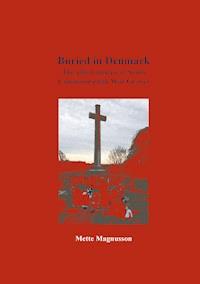
During World War II about 300 allied aircrafts crashed over Denmark. A little less than 100 crewmembers survived and were rescued to safety i Sweden. Approximately 300 crewmembers survived but were subsequently captured by the Germans and taken to a POW camp. It is assumed that approximately 500 airmen died in the ocean around Denmark and were never found. 1160 dead allied airmen were buried in Denmark. 108 allied airmen were buried at Svino Cemetery during the war. This little book tells the story of Svinø Memorial Grove and some of the destinies attached to this place.
Sie lesen das E-Book in den Legimi-Apps auf:
Seitenzahl: 154
Veröffentlichungsjahr: 2017
Das E-Book (TTS) können Sie hören im Abo „Legimi Premium” in Legimi-Apps auf:
Ähnliche




















- In remembrance of P/O Sydney Nelson Cross, whom I have never met but whose dear family became my New Zealand family
Mette Magnusson
During World War II about 300 allied aircrafts crashed over Denmark.
A little less than 100 crew members survived and were rescued to safety in Sweden.
Approximately 300 crew members survived but were subsequently captured by the Germans and sent to a POW camp.
It is estimated that around 500 airmen died in the oceans around Denmark and were never found.
1160 dead allied airmen were buried in Denmark - of which 134 Americans, who later were exhumed and taken out of Denmark - some for reburial in the United States, others to be buried in one of the American cemeteries in the Netherlands, Belgium and Luxembourg.
Eight American airmen are still buried in Denmark.
At Svino cemetery 108 allied airmen were buried during the war.
They were young men with hope and wishes for a future, they never even came to experience. Yet in many ways they became part of that future.
They live on in the hearts of their families and they still touch our hearts, when we visit their graves and read at the tombstones, how young they were.
They paid with their lives for the world they handed on to us.
Let us cherish this world in the hope of a future peaceful life in it - from love to it, and out of respect for those who fought for it.
This little book tells the story of Svino Memorial Grove and some of the destinies attached to this place, and it is written in honor and deep respect - not only of the fallen airmen, who were buried at Svino cemetery during World War II - but also of the families to these young men, who by their death lost a son, a husband, a brother or a father, and for whom this loss has provided them with a sorrow, they will always have to carry with them.
They shall grow not old, as we that are left grow old: Age shall not weary them, nor the years condemn. At the going down of the sun and in the morning We will remember them.
- Laurence Binyon (1869-1943)
In order to publish this little book, I am indebted to several people:
Thanks to Chief of the Air Staff, Major General Max A.L.T. Nielsen for his goodwill towards this book about Svino Memorial Grove and the allied airmen buried there.
Thanks to Brigadier General Steen Harboe Hartov for help and correction of the chapter on Airbase Avno.
And finally many thanks to the former Chief Sergeant Boeggild Gammelgaard, who saw the importance of publishing this book and helped it on the way and made publishing possible.
Mette Magnusson
Contents
Foreword by Chief of the Air Staff,
Major General Max A.L.T. Nielsen
The area – Svino
The church – Svino church
The airbase – Airbase Avno
The war – World War II in Danish airspace
The cemeteries
The burials at Svino
The burial plots
The graves are assembled and unknown airmen identified
The American airmen
Svino Memorial Grove and CWGC
The opening of Svino Memorial Grove
The vicar and the organ player
The graves of the German refugees
May 4
th
at Svino
Improvement of Svino Memorial Grove
Interment on May 4
th
, 1999 - Donald Smith and no.7 Squadron Association
More visits
A group of people connected with Svino Memorial Grove
The buried – Summary of allied airmen, buried at Svino Memorial Grove
Reflection
Explanation of words and source material
Every year on May 4th, we commemorate Denmark's liberation throughout the country. Especially one of these commemorations is close to the Royal Danish Air Force's heart and history, i.e. the Commemoration at the Svino Cemetery, where more than 100 allied airmen from WW2 found their final resting place.
With her work on the Svino Commonwealth War Graves vicar Mette Magnusson succeeded in assemble an important part of history, we must never forget. With her tenacious work on Svino Memorial Grove the danger of oblivion of this specific chapter of our common history is over.
Relatives and descendants of the young airmen who paid the ultimate price for our shared values of freedom and peace in the world, now has a deserved and readable memoir about their loved one’s final resting place. History buffs have been provided with yet another read worthy story and a comprehensive document that can complement and inspire further historical work.
All readers of Mette Magnusson's book will gain a deeper understanding of the many different sides of society that stand behind the establishment of Svino Memorial Grove, including the huge effort granted by volunteers, individual citizens and associations. Their work has been instrumental and a prerequisite for our possibility as a nation to honour, those who honour is due, and internationally demonstrate that Denmark does not take any sacrifices of our allies for granted. The Royal Danish Air Force is proud to contribute to the commemoration and honour our fallen colleagues with a "Missing Man" formation of aircraft from the Royal Danish Flying School.
As Chief of the Air Staff, I welcome this book, not just as interesting and enlightening reading, but also as a serious reminder about the fact that today, we are still dependent on skilled, brave men and women ready to provide a selfless effort for our common values and all that is worth fighting for.
Enjoy your reading!
Karup
17/04/2017
M.A.L.T. NIELSEN
Major General
Chief of the Air Staff
The area – Svino
The area of Svino, where 108 allied airmen were buried during World War II, is a peninsula in the southwestern part of Zealand between Naestved and Vordingborg and about 90 km southwest of Copenhagen.
It is in many ways a rural and remote area, and this was the reason why the Germans chose Svino as one of the five central cemeteries for dead allied airmen. (The other four central cemeteries, appointed by the Germans, are found in Aabenraa, Esbjerg, Lemvig and Frederikshavn.)
Svino is - besides being rural and remote - also a beautiful little corner of Denmark marked by ancient traditions.
For example there is a guild of farmers at Svino, which has existed for several hundred years, although it now mostly serves as a social club, giving a party every year at Michael’s day, September 29.
There are two explanations for this somewhat curious name "Svino" (the Danish word “svin” means pig).
One is that there in the sea off Svino were many porpoises, and therefore the good porpoise catch has given name to the place – porpoise is in Danish “marsvin”.
Another explanation is that there should have been unusually many pigs on Svino. A fact is, however, that there is now a relatively large seal population around Svinø and Avno, and therefore you might easily imagine that the first explanation was the real one.
Svino harbor, where the porpoises previously were landed, is situated at a narrow stream between Dybso and Svino.
In the middle of the 1800s, many of the goods to be traded in Kong, which, incidentally, at this time was a thriving commercial village, were sailed to and from Svino harbor. Now, the port is only in use for quite a few sport sailors and fishermen, and it's where "The Dybso-man" can travel to and from his home on Dybso, the tiny island just northwest of Svino.
The entire coastal area along Svino beach and the small harbor is a nice area, both for people who love to fish, and for those who just like to go for a walk in the lovely countryside.
Until about 1600 Svino was a real island - and not as today a peninsula - and in the Middle Ages Svino belonged to Roskilde bishopric, but in 1410 the bishop gave away Svino to Gavno, which at that time was a nunnery.
Sometime after the Reformation (1536), the island was given free but preserved some attachment to Gavno, and in the late 1600s the barony of Gavno actually owned Svino. The farmers from Svino therefore for a number of years had to work at the estate of Gavno. They had to bring both horses and carriages for the work, and the trip to Gavno therefore went overland past Kostraede and around the inlet of Dybso. Now and then Svino peasants on their way to Gavno began fighting with fellows from other places, and they therefore had a reputation of having a bad temper.
Besides regular farming there was also dealt a lot with both horses and cattle from Svino.
Residents of Svino loved to party, and none of life's celebrations were allowed to go unnoticed. And so it still is.
In the 1940s, when the allied airmen were buried at Svino, the small community was still marked by farming. There were also a couple of small grocery stores, and then there was a school.
Furthermore, there was a church, and it was recent. As a matter of fact, it was at that time only about 40 years old.
The Church - Svino Church
Svino church seen from southwest.
If you are standing just outside Svino Church, you can see very far.
To the southeast you will see the inlet of Avno and Knudshoved spit, and to the northwest you can see the inlet of Dybso.
South of the church you will find Svino cemetery, and north of the church you find Svino Memorial Grove with the graves of the allied airmen.
Svino became an independent parish in October 2010. Until then, the current Svino parish was a church district in Kong parish, and Kong Church can actually just be seen to the northeast. Therefore, all the allied airmen are buried at Svino but in Kong parish, as it was then called.
Svino parish now has joint parish council with Kong parish and belongs to Stege-Vordingborg deanery under Roskilde diocese.
The church was built in 1900 on the initiative of the women from Svino.
It is said that after they have been for worship on Sundays in Kong Church, the women had difficulty in getting the men back home from the subsequent and compulsory visit to Kong Inn. The women became tired of waiting for the men and therefore they started rising money for their own church on Svino.
They were well supported by the then parish vicar Jacob Holdt, who also would rather like a real church on Svino, instead of having to celebrate services in Svino school room from time to time.
The men from Svino gradually became accustomed with the idea of having their own church and set up a church committee.
Architect Hans Glahn, Nykobing F. designed the church and master builder Lars Hansen, Praestoe built it.
12.600kr. was allocated at the Finance Act in 1899, and among the locals additional 10.000 Danish Kroner were collected. It became approx. 22.000kr, and that was exactly what it at that time cost to build the church.
Much in and around the church are gifts - including the plot on which the church is built.
The estate of Gavno donated the altarpiece, which is a replica of the altarpiece in Rosenholm Chapel in Jutland. It was painted by A. Dorph. It is painted on wood, depicting the crucified Jesus. In front of the cross a person, who presumably must be the disciple John, is kneeling.
Also the baptismal dish is a gift from the estate of Gavno, while the baptismal font is processed by Stonemason Hans Jacob Hansen from a large stone, he found in a field near Allerslev near Praestoe.
The church bell of iron was made in the Netherlands.
The chalice and the disc comes from a warship as part of the altar service which since the bombardment of Copenhagen in 1807 had been in the custody of the then Ministry of Culture, and from 1894 these altar services were given away to new churches. Here Svino Church was considered.
From a local farm, Munkehojgaard, small cups for use in the communion of the church, were donated.
On the altar there are four candlesticks, two three-armed and two for the big ritual candles. The two three-armed silver candlesticks were donated by people at the local large farm, Ostergaard.
Of the two church chandeliers one is donated by the women from Svino, the second by a farmer, Peder Nielsen, Vestervang Farm.
The large crocheted Lord's Prayer in the church is done by Hildeborg Hansen from Dybso-road. She was a telephone operator at what was then called the West Svino telephone exchange.
Many things in the church as well as the entire history of the church witness of a strong local desire for a church on Svino.
In the early 1990s a real organ was set up in the church. Until then and since the church was build, music was performed on a harmonium.
Likewise, the church in the late 1990s received a nave, a copy of "The Norwegian Lion", built by Finn Knudsen, Ballerup, who after a visit to Svino church had noticed that there wasn’t any nave in the church, and he therefore would like to build and donate one.
Over the exit door from the church to the porch a small statuette was put up in 2015. It is a gift from a daughter, Rosalind Elliott, to one of the buried airmen Wilfred John Parsons. The figurine is a mini replica of a large monument in rough sheet iron, which is displayed at the airfield Lisset near the English town of Bridlington. This airfield was home to RAF no. 158 Squadron. (More about this on p. 80 )
In the small porch is a staircase to the tower. In the porch is also the pastor board along with some gifts from visitors.
Outside the church you can sit on the bench and enjoy the scenery of Zealand and the view towards the inlet of Dybso, or you can pay a visit to the Memorial Grove for the allied airmen.
The Airbase - Avno airbase
When I came to Kong and Svino as a vicar in 1989, it was so nice to hear the small training aircrafts from Avno airbase come buzzing over the vicarage in Kong, and I was told by the then head of the airbase and flying school at Avno, Lieutenant Colonel Donald Thestrup, that the students actually often were given the task of navigating towards Kong Church tower.
It ended abruptly; however, when the airbase on February 1, 1993 were shut down and dismantled both as an air base and as a flying school and the flying school was removed to Karup.
A period which began 63 years earlier was suddenly over.
In 1930 the Ministry of the Navy leased 40 hectares of land from proprietary Preisz on the big farm Avnogaarden.
A hangar and a wooden building was build which came to house classrooms and workshops. In addition, three barracks were built to give room for officers, flight engineers, servicemen and a cook.
The Danish Air Force did not exist at this time, so it was the Navy that would train student pilots in this so called Naval Air Station.
In the spring of 1931 the whole lot in all its glory began being used. "Glory" was perhaps not the right word as the primary water was a problem. It was salt water coming out of the taps, and you had at the beginning to fetch drinking water from the farm Avnogaarden. You also in the first years simply had to shut it all down in the winter (or "unrig" as it was called – as it was in the Navy!).
In 1936 The Marine Ministry, however, bought 66 ha land from the farm Avnogaarden, and they built a real barracks and one more hangar. Also, a minor hangar was moved from Ringsted to Avno.
On the whole the year 1936-37 was marked by construction at the Flying School and the Naval Air Station Avno, now belonging to the Navy Air Corps. They built gymnasium and established water drilling that could supply the airfield with good drinking water. There were established facilities in order to be able to accommodate 30 officers and 40 privates and also to train 40 privates.
However, there was no great enthusiasm of having neither to be trained nor to work at Naval Air Station Avno as the place now were called.
Most people thought it was too far away from everything, and therefore they had to try to make conditions inviting. Both the accommodation, but also living and recreational environment had to be attractive. Therefore a piece of forest was acquired from Avnogaarden.
The beautiful barracks of Air Field Avno built in 1936-37
The flying school was no more than just well underway when the Second World War broke out.
As Denmark on April 9th, 1940 was occupied by the Germans, they however, had initially forgotten Naval Air Station Avno, but two days later a message came from Copenhagen that the school had to be closed down, and on August 5th, 1940 Avno Naval Air Station was handed over to the Germans.
The Germans established a flying school at Avno that would give pilot candidates for the Luftwaffe basic flying training.
First it was Fliegerausbildungsregiment 22, which was established in Avno but this regiment was soon subject to Fliegerausbildungsregiment 42 which the first two years of the war was established in Neustadt-Glewe, and Avno was then used as a training airfield.
The Germans improved the Naval Air Station Avno with an accommodation hut, two hangars and two huts, some sheds and a control tower, which functioned until 1953, when instead a small glass cabin was put on top of one of the hangars. In 1990 a new control tower was built - unfortunately only three years before the whole airbase was closed down in 1993.
The flying school at Avno was used by the Germans throughout the war.
During the German occupation of Denmark the Germans had 21 accidents on the flying school at Avno, which resulted in six dead persons and five seriously injured. From the Danish side there was throughout the time of the flying school 14 accidents, in which five persons were killed.




