


Erhalten Sie Zugang zu diesem und mehr als 300000 Büchern ab EUR 5,99 monatlich.
- Herausgeber: The History Press
- Kategorie: Geisteswissenschaft
- Sprache: Englisch
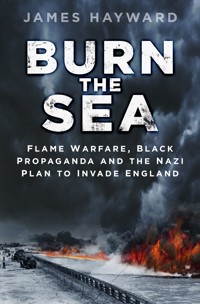
In the whole course of the war,' conceded Britain's chief press censor, 'there was no story which gave me so much trouble as that of the attempted German invasion, flaming oil on the water and 30,000 burned Germans.' Sparked by the Directorate of Military Intelligence and MI6, rumours that Britain had set fire to the English Channel to defeat a German invasion in 1940 quickly spread around the world. Highly popular in America, the incendiary 'Big Lie' became Britain's first significant propaganda victory of the Second World War. Yet the unlikely deception was founded in fact. Dead German soldiers were washed ashore on British beaches, a secret Petroleum Warfare Department tested lethal flame barrages on land and sea, and fire ships were hastily dispatched to enemy ports as part of Operation Lucid. British intelligence agencies even managed to plant the burning sea story on their opposite numbers in Nazi Germany. Burn the Sea is the definitive account of the origin, circulation and astonishing longevity of the myth of the 'invasion that failed' in 1940, as well as its remarkable revival in 1992.
Sie lesen das E-Book in den Legimi-Apps auf:
Seitenzahl: 352
Veröffentlichungsjahr: 2016
Das E-Book (TTS) können Sie hören im Abo „Legimi Premium” in Legimi-Apps auf:
Ähnliche


















ACKNOWLEDGEMENTS
The author owes a particular debt of thanks to Christopher Elliott, Ronald Harris, Edwin Horlington, Hadrian Jeffs, Bernard Kimpton, Phillip Knightley, Michael Lucock, Robin Prior, Winston G. Ramsey, Dr Peter Schenk, Dr L.O. Standaert and Nigel West. Thanks are also due to the following historians: Correlli Barnett, Michael Bowyer, David Collyer, R. Douglas Brown, Max Hastings, F.H. Hinsley, Ian V. Hogg, Robert Jackson, Gordon Kinsey, Norman Longmate, James Lucas, Wing Commander John MacBean, Roger Morgan, David Rolf, James Rusbridger, Norman Scarfe, Neil R. Storey, Andy Thomas, Major T.I.J. Toler and Dennis Turner. And to the following journalists: Lindsay Brooke (Anglia TV), Christy Campbell (TheSunday Telegraph), Russell Cook (EADT), Henry Creagh (EADT), Jeremy Hands (Anglia TV), Lisa Hempelé (BBC TV), Malcolm Pheby (EADT) and David Weisbloom (EADT).
From The History Press, the author wishes to thank Katie Beard, Jo de Vries, Andrew Latimer and Michael Leventhal.
All National Archives (TNA) material is Crown Copyright and is reproduced with the permission of the Controller of Her Majesty’s Stationery Office. All quotes from newspaper and television sources are reprinted with the kind permission of the editors concerned. All reasonable effort has been made to trace the copyright holders of material quoted in the text. Both the author and publisher welcome the opportunity to rectify any omissions brought to their attention.
Thanks are also due to the following museum staff: L. Ball (Commonwealth War Graves Commission), Terry Charman and Angela Wootton (Imperial War Museum), Commander P.R. Compton-Hall (RN Submarine Museum), P.J.V. Elliott and C. Richards (RAF Museum), I.D. Goode (Ministry of Defence Whitehall Library), E. Harris (The Barnes Wallis Trust), Anita Hollier (BP Archive), Gunhild Muschenheim (Goethe Institute), Dr John Rhodes (Royal Engineers Museum) and Martin Sawyer and Jo Bandy (MoD Army Historical Branch).
And more generally to the Imperial War Museum, The National Archives, HM General Register Office, The British Library, Cambridge University Library, PA News Library, Norfolk County Libraries, Colchester Public Library, MoD Army Historical Branch, Bundesarchiv (Koblenz), Le Centre de Recherches et d’Études Historiques de la Seconde Guerre Mondiale (Brussels), Plaistow Press Ltd and Barnwell’s Printers (Aylsham). Thanks also to Terry Burchell for his work on several of the illustrations.
Thanks also to the following writers and members of the public who took the time and trouble to contribute: Tom Abram, David Alexander, Stuart Bacon (Suffolk Underwater Studies Unit), Dr J.H. Bamberg, Terry Banham, Pat Barnes, K. Bathwest, W.A. Birkbeck, Francoise Le Boulanger, Peter Brackley, Major J.D. Braisby (Royal Artillery Museum), Andrew Burk, John Rux Burton, Winifred and Frank Buxton, Jamie Cann MP, Bruce Carter, Richard Challis, Nick Champion, Peter Constable, Len Cook, Peter Dachert, Percy Darvell, Christina Di Prima, Frank Dickinson, Jack Driscoll, Clive Dunn, G.H. Evans, Julian Foynes, Chief Superintendent P.A. Gell (Suffolk Constabulary), E.H. Gommo, Daphne Machin Goodall, Nicholas Green, Mr Grout, Sidney Gurton, George Ffoulkes, Hollis Fowler, William Hall, Olga Hardardottir (SIPRI), George Hearse, Beverley Hodgkinson, Regina Hoffman, J.H.D. Hooper, Doris Howes, Laura Humphreys, K. van Isacker, K.T. Hudson, Kenneth Jarmin, Peg and Eric Johnson, Tobin Jones, Rudiger Koschnitzki (Deutsches Institut für Filmkunde), E.C. Leslie, Peter Luther, R.J. Mabb, Agnes Mann, Mrs Marilyn Miles, Christiane Maubant (musées du Havre), D.J. Maxted, Eric Missant, Julian Morel, Frank North, Percy Nunn, T.H. Pimble, Reg Pollintine, Mrs P. Pulford, Herbert Reinecker, J. Rhodes (Royal Engineers Museum), Christopher Richford, G.W. Robertson, C.D. Robinson, Mr Seed, Edward Sharpin, L.R. Sidwell, Bill and Joy Sparks, T.E.A. Spong, J.V. Steward, Don Tate, Alberic De Tollenaere, T.H. Waterhouse, Alfred Weidenmann, Bryan Webb, D.V. Wells, Pamela Wilby, A.G. Williams and Ron Winton.
CONTENTS
Title
Acknowledgements
Foreword by Phillip Knightley
Introduction: The Smoke and the Fire
1 Subterranean Activities
2 Roasting the Nazis
3 Operation Lucid
4 ‘Beaches Black with Bodies’
5 ‘The Story that is Sweeping America’ (and Switzerland)
6 Flaming to Victory
7 The Men Who Never Were
8 Shingle Street
Appendix 1 Short Invasion Phrasebook (1940)
Appendix 2 Looked, Ducked, Vanis
Appendix 3 Army Historical Branch Report (1992)
Bibliography
Sources
Plates
Copyright
FOREWORD
In December 1968, the Soviet news agency Tass revealed to foreign correspondents in Moscow that Soviet newspapers would expose the intimate connection between the Secret Intelligence Service, MI6, and British editors and journalists. Sure enough, a series of articles appeared in Izvestia alleging that collaboration existed across a swathe of news organisations.
‘Secret Service men are to be found in the sedate Sunday Times and the brash People,’ the piece proclaimed. ‘They control scientific publications in London, as well as provincial newspapers.’ The supposed links between the spooks and the scribblers were trumpeted by Moscow as ‘evidence not of the strength but of the weakness of the ideological concept of imperialism’.
Fleet Street’s response to the article was derision. However this theory of collusion between military intelligence and the Fourth Estate is no more evident than in the reporting of a strange case which began on the coast of Suffolk and Norfolk in the autumn of 1940. Now James Hayward provides us with a textbook view of the still secret clandestine channels by which British intelligence agencies waged a psychological war across occupied Europe in 1940 and 1941. It is also a study of the fine art of the ‘Big Lie’ and people’s willingness in wartime to believe almost anything they see in print.
As Senator Hiram Johnson famously said: ‘The first casualty when war comes is truth.’ Our attitudes to history are moulded by what we read in wartime, and what we read too often bears little resemblance to reality. Myths are shaped, facts suppressed.
One fact we can be sure of, however, is that Operation Sealion, the planned invasion of the British Isles in September 1940, never set sail, and by the close of October had been indefinitely postponed. We might well ask, then, what was the truth behind the rumours of large numbers of bodies washed ashore on the eastern and then southern coasts of England that autumn? How did it come to pass that the New York Times – a paper of record – reported that as many as 80,000 German troops had drowned or burned to death while attempting an invasion? And why did a version of the story surface again as recently as 1992, leading to questions in the House of Commons and fresh allegations of conspiracy and cover-up.
Izvestia, no doubt, might have delivered a scornful opinion, had the Soviet Union not dissolved a year earlier. We will probably never know the whole truth about events in 1940. Strange things were happening within British intelligence during the early part of the Second World War. Once it was over, most people were keen for normal life to resume as quickly as possible, and were prepared to give the official version the benefit of the doubt. Few had the stomach for a long investigation. Fortunately James Hayward has continued to dig away at this fascinating mystery for more than two decades, and in doing so has uncovered a great deal more than it was ever intended the general public should see.
Phillip Knightley
INTRODUCTION:THE SMOKE AND THE FIRE
At the beginning of September 1940, civilians in the small village of Crostwick, a few miles north of Norwich, were astonished by the sudden appearance of a seemingly endless convoy of army trucks and ambulances. The vehicles moved very slowly, their drivers sporting grim expressions. One let slip to Mrs Barnes, the wife of a local poultry farmer, that they were carrying the bodies of German soldiers washed up on the Norfolk coast, the grisly aftermath of a failed invasion attempt.
Later that same month, Gunner William Robinson, stationed at Herne Bay with 333 Coastal Artillery Battery, was sent south to Folkestone to take part in a macabre fatigue. Together with half a dozen other men, Robinson was instructed to search the beach between Hythe and St Mary’s Bay for dead Germans. On the first day two such bodies were located, along with seven or eight more over the next two days. All were taken by truck to an isolated field west of New Romney, where they were discreetly unloaded behind a canvas screen. An NCO checked the corpses for identity discs and paybooks, which were then handed over to an officer. Robinson recognised the dead men as German soldiers, rather than Luftwaffe airmen or naval personnel, on account of their field-grey uniforms. Some appeared to be slightly burned from the waist down; all looked to have been in the water for some time.
By way of reward for discharging this unpleasant duty, Robinson and his colleagues drew a daily ration of twenty Woodbine cigarettes and additional pay of 2 shillings.
The bodies kept on coming. On 21 October the decaying corpse of a German infantry soldier, identified as Heinrich Poncke, was recovered from the broad shingle beach at Littlestone-on-Sea. His remains, like the bodies recovered by Gunner Robinson’s party, were removed to New Romney for burial. Unlike the others, Poncke’s posthumous arrival was widely reported by British newspapers and the BBC.
Were these casualties connected to the several long hospital trains observed in Berlin by American broadcaster William L. Shirer? On two consecutive days, 18 and 19 September, the future bestselling author of The Rise and Fall of the Third Reich spied large numbers of wounded German servicemen being unloaded at the Potsdamer and Charlottenburg yards. ‘I picked up a conversation with a railway workman,’ Shirer recorded in his earlier Berlin Diary. ‘He said most of the men taken from the train were suffering from burns. I wondered where so many wounded could have come from, as the armies in the west had stopped fighting three months ago.’
But burned how? According to the New York Times, while attempting nothing less than a full-scale invasion of England. On 15 December 1940, the paper reported that there had already been two such attempts, and that in both instances ‘the Nazis were literally consumed by fire’. French civilians in the occupied Channel ports estimated that as many as 80,000 German troops had perished. ‘Hospitals in occupied France are filled with Nazi soldiers, all of them suffering from severe burns. Thousands of dead Germans have been washed ashore.’ A wave of mutinies apparently followed in September, when many troops refused to face the ‘burning sea’ again on learning that a third attempt at invasion was planned.
Little wonder, then, that the chief press censor in Britain, Rear Admiral George Thomson, was eventually forced to concede: ‘In the whole course of the war there was no story which gave me so much trouble as that of the attempted German invasion, flaming oil on the water and 30,000 burned Germans.’
It is established historical fact that Operation Sealion, the planned German invasion of the British Isles in September 1940, never set sail, and by the close of October had been postponed until the following spring. What, then, was the truth behind the rumours of large numbers of bodies washed ashore along the southern and eastern coasts of England that autumn? Had a German landing force met with disaster in the Channel? Could it really be true that the sea itself had been set on fire? Was Hitler’s villainous scheme really derailed by a secret weapon still confined to the drawing board?
The myths and legends of the Second World War are legion, and often surprisingly durable. Indeed, conjecture that a German raiding force was thwarted by flame would again spark a small media firestorm in 1992, this time focused on the tiny Suffolk fishing hamlet of Shingle Street, a few miles north of Felixstowe. Soon, what began as a minor local story exploded across national print and television media, with questions raised in the House of Commons, the early release of classified wartime files and robust denials of a conspiracy and cover-up by the Ministry of Defence.
In truth, the Shingle Street legend was nothing more than an echo of unavowable black propaganda from 1940, concocted and spread by MI6 and the Foreign Office at a time when Britain’s ‘finest hour’ was fast becoming her darkest. ‘The burning sea story was our first large-scale attempt at a “Big Lie” and it proved amazingly successful,’ observed its creator, Major John Baker White of the Directorate of Military Intelligence. ‘It was produced by people who were still amateurs at the game, and projected through a machine still far from complete. But it worked.’
Burn the Sea provides the first comprehensive account of the origin, circulation and astonishing longevity of the myth of the ‘invasion that failed’ in 1940, as well as its remarkable revival in 1992. It is also the story of the oddball Petroleum Warfare Department, the rusted death trap fireships of Operation Lucid, mysterious foreign bodies, adroit double-cross by MI5 and MI6, and the still secret clandestine channels by which British intelligence agencies waged expert psychological warfare across occupied Europe and the United States in 1940.
Finally, it is a study of a textbook exercise in the deceptive art of the Big Lie, and of boundless credulity undimmed by the passage of fifty years.
James Hayward
2016
1
SUBTERRANEAN ACTIVITIES
Attempts by the Petroleum Warfare Department and other agencies to ‘set the sea on fire’ are generally regarded as typical of the hurried improvisations of mid-1940, at a time when Britain expected to be invaded at any moment. In reality, however, the notion of combining the disparate elements of fire and water as a weapon of war is rooted in deep antiquity.
Dating from 500 bc, the earliest known military manual, The Art of War, written by the great Chinese general Sun Tzu, described the use of incendiary arrows (known as Huo Chien), while the Athenian philosopher-historian Thucydides detailed how the Spartans constructed great bellows to project flames derived from sulphur and pitch during the Peloponnesian War. An early form of flamethrower, the siphon was reputedly fixed to the prows of fighting ships in Ancient Greece. Legend also credits a miraculous compound called Greek Fire with the preservation of Constantinople through two Arab sieges. In his classical text The Decline and Fall of the Roman Empire, first published in 1776, Edward Gibbon described this Byzantine super-weapon thus: ‘The principal ingredient was naphtha, or liquid bitumen, a light, tenacious and inflammatory oil, which springs from the earth and catches fire as soon as it comes in contact with the air.’ Instead of being extinguished, naphtha was said to be nourished and quickened by the addition of water. ‘Sand, wine or vinegar were the only remedies that could damp the fry of this powerful agent, which was employed with equal effect by sea or land, in battles or in sieges.’
By 1200, Greek Fire had fallen out of favour with naval tacticians and its chemical secret lost forever. Thereafter, the legend of liquid or maritime fire lay dormant, to resurface periodically like some exotic strain of malaria. The most celebrated resurrection came in 1588, when Sir Francis Drake launched fireships against the Spanish Armada off Gravelines, once again ‘singeing the beard’ of troublesome King Philip II. On land, during the American Civil War, a Major-General Quincy Gillmore besieged Confederate troops at Charleston with artillery shells charged with so-called Greek Fire, although the destructive effect of his ‘villainous compound’ was dwarfed by its value as propaganda.
The psychology of flame warfare is rooted in an elemental fear common to all humankind. Flame differs from most types of modern weaponry in that it is highly visible, whereas bullets, bombs and shrapnel make their presence known only by their sound – or sudden impact. ‘On the first sight of flame in an attack the choice of two alternatives – to stand or to run – is vividly presented to a man,’ offered a blunt appraisal issued by the War Office after the end of the Second World War. ‘His deep-rooted fear of fire, combined with a feeling of helplessness to counter its searching effect, is more likely to induce him to run than would be the case if he were attacked with normal weapons, whose capabilities and limitations are known.’
No race or national grouping was immune. ‘It was at one time contended that the Japanese stood up better to flame than did the Hun, but this was disproved. They liked flame no better than the Germans.’
In the twentieth century, the idea of unleashing blazing oil against a seaborne invasion of the British Isles was first mooted by Maurice Hankey as early as 1914. A key player in the British political establishment, and one who would go on to make the rare transition from civil servant to Cabinet minister, Hankey’s interest in flame warfare stemmed from a classical education, and a well-thumbed copy of Gibbon’s Decline and Fall. Following the outbreak of the First World War, Hankey, then an assistant secretary to the Committee of Imperial Defence, took it upon himself to commission a series of incendiary experiments using several of the ‘best petroleum experts of the day’. Attempts to reformulate Greek Fire on an Admiralty pond near Sheerness met with abject failure (‘Gibbon’s prescription was quite useless’), but a fuel mixture capable of burning on the surface of open water was perfected by specialists at Chatham Dockyard, and tested successfully on the River Ore in Suffolk in December. Hankey had hoped to strike at the large German naval base on Heligoland, but found his lengthy report all but ignored by the powers that be. His biographer suggests that these imaginative proposals were dropped due to French fears over possible German reprisals. Within a year, however, Germany would introduce the flamethrower (flammenwerfer) to the gruesome arsenal of trench warfare, and unleash the first chlorine gas attacks on the Western Front.
Ultimately, the Admiralty concluded that burning oil was of little practical use as a maritime weapon, not least because the quantities required were too great, and its transport and delivery too problematic. Undeterred, Hankey continued to ponder several rudimentary mechanicals. On 9 October 1915, at the height of the disastrous Gallipoli Campaign, his diary records a letter to Commodore Roger Keyes conveying a suggestion that ‘submarines should carry barrels of my Greek Fire lashed on, and let it go to burn up lighters etc. in the Dardanelles’.
At the end of the Great War in 1918, most armies consigned portable flame-throwers to the scrapheap, the War Office conceding some ‘anti-morale’ value, but judging them to be of little significance as a casualty producer. Poison gas was demonstrably far more effective, although in any event both these inhumane forms of killing would be prohibited under the Geneva Protocol of 1925. Nevertheless, the dream of firing the sea itself was not entirely extinguished. On 5 May 1937, Colonel C.E. Colbeck of the Royal Engineer and Signals Board addressed a memorandum to a Dr Wright of the Admiralty’s Department of Scientific Research. Colbeck’s idea was to ‘block or burn’ hostile landing craft by distributing petrol over the surface of the water at vulnerable beaches:
Depending on the amount of petroleum used and, if necessary, continuity of supply from a controlled source, I believe that it would be possible to render beaches quite unapproachable over prolonged periods. Alternatively, wholesale and decisive casualties could be inflicted upon a landing force if they were caught at a really propitious moment.
Colonel Colbeck mooted several different delivery systems, including an underwater pipeline, as well as floating fuel tanks moored offshore. Evidently his memo aroused a degree of interest, for in December the director of Armament Development minuted that consideration was being given to the use of burning fuel on water at defended beaches, as well as ports and congested anchorages. In August 1938, the War Office asked the Admiralty to lend a helping hand to the Royal Engineers, who for reasons of ‘secrecy and safety’ were by then unable to continue work at Christchurch: ‘They are trying to carry out experiments, mainly with the idea of keeping a minimum of men actually on the beaches while the bulk are in reserve. What they now want is to carry out a small experiment at sea, preferably off Weymouth.’
Sadly, nothing more is known of Colonel Colbeck’s exploits. Nevertheless, as we shall see, a series of more or less identical proposals would be more thoroughly investigated following the establishment of the Petroleum Warfare Department in July 1940.
A separate scheme to attack enemy harbours with burning oil was investigated by the Admiralty off Shoeburyness in May 1939. Seventeen tons of petrol were discharged, and found to burn for five minutes after spreading over an area of 1,100 square yards. From this and other experiments, the Admiralty calculated that at least 80 tons of fuel were required to fire 10,000 square yards of open water for the same period. These discouraging statistics conspired to put the project on hold.
In Britain, as abroad, the outbreak of the Second World War in September 1939 brought about the rejuvenation of countless vivid, ingenious and often desperate schemes. During the Phoney War period, the Admiralty circulated a hopeful paper evaluating several methods of firing enemy waterways. The given target was the Rhine in the Ruhr industrial zone, with the stated object of destroying wharves, barges and goods in transit. Three different means of delivery were considered: aircraft, fuel-laden barges and pipelines leading from bulk tanks concealed in French territory. None held much promise. Air-delivered means, the report found, were impractical, since sufficient oil could not be lifted, while the other options underline all too clearly how unlikely the rapid conquest of France and the Low Countries by Germany was considered – just eight weeks before the unthinkable occurred.
If simple flotation seemed the method most likely to succeed, the tactics put forward bordered on farce. Having drifted downstream for three or four days, some 18,000 tons of fuel would be ignited in the target area by air-dropped incendiaries – assuming that no one in Germany happened to notice such a vast slick of oil. This was Phoney War indeed. ‘Our action might be considered akin to unrestricted aerial bombing,’ warned a tremulous marginal note. ‘Before using oil, therefore, we should most carefully consider the effect on neutral opinion and possible retaliatory measures by the enemy.’
In the event, this unlikely plan was superseded by a more conventional scheme code-named Operation Royal Marine, in which fluvial mines were streamed into the Rhine. In the first week following the German assault in May, nearly 1,700 mines were released, causing some damage, although this minor Allied victory was swept away in a deluge of wider defeat. Nevertheless, the notion of floating flammable fuel down the Rhine was not entirely abandoned, and would be resurrected by the US Army as late as 1945.
Already, in November 1939, German seaplanes had set about seeding British ports and anchorages with state-of-the-art magnetic mines, resulting in the surprise loss of the destroyer HMS Gypsy outside Harwich harbour. Thirty of her crew, including the captain, were killed; some said the mine had been dropped by the same three-man Luftwaffe crew rescued by Gypsy earlier that day. Altogether, more than 200,000 tons of British shipping was lost to magnetic mines in November alone. The following month, a minute circulated by the Naval Intelligence Division offered a novel spin on Maurice Hankey’s proposal for Greek Fire at Gallipoli in 1915:
The American navy had been considering for some years the possibility of the Japanese using seaplanes to lay mines, as is now being done by the Germans. They had studied the best method of attack, and had reached the conclusion that neither bombs nor machine gun fire would be really effective. In consequence, they had carried out trials with a small submarine, into one of whose blowing tanks 20 to 30 tons of petrol had been placed. When the wind was onshore and favourable, the submarine blew her petrol tanks, and very shortly afterwards ignited the petrol by port fires or rockets. He assured me that in a very short time a very large area of the sea was on fire, and that it was a physical impossibility to put it out. No seaplane could possibly exist under such conditions.
Evidently some credibility attached to these generous American claims, for the following year similar trials were conducted with a training submarine, L26, operating from Gosport. Regrettably, the first trial, which took place on 16 April, yielded discouraging results. After diving to periscope depth, the submarine blew approximately 2 tons of petrol from her main ballast tanks, which was seen to spread rapidly on the surface. From this point onwards, however, failure was total. Two attempts at firing the slick using the underwater signal gun failed, one after the other. In desperation, the crew brought L26 to the surface and tried to ignite the slick – by now over 100 yards long and 20 yards wide – with a bundle of burning rags tossed overboard from the conning tower. Once again, the oil refused to burn.
A second experiment, on 22 April, met with greater success. Chief amongst several modifications were four special incendiary candles manufactured at Woolwich Arsenal, while a submarine tender, HMS Dwarf, proceeded to sea towing a motley assortment of scrap seaplane debris in lieu of a real target. Eighteen tons of petrol were successfully released and ignited, producing a blaze measuring 800 square yards. Unfortunately, this conflagration was judged to be too brief to inflict anything more than superficial damage to metal-skinned seaplanes, such as the Heinkel 115. There was also the inconvenient fact that Luftwaffe pilots could hardly be relied upon to wait patiently for several hours until a British submarine arrived on the scene and released its flammable cargo.
Had the silent service managed to bag a German seaplane, the deliberate roasting of enemy aircrew might well have gifted Berlin a potent propaganda opportunity. Due to the appalling human toll inflicted by the ‘frightfulness’ of chlorine, phosgene and mustard gas on the Western Front between 1915 and 1918, chemical weapons had eclipsed incendiaries in post-war treaties. While gas accounted for some 5 per cent of hospital admissions on the Western Front in 1918, burns and scalds from all causes totalled only a tenth of that figure. Flamethrowers were specifically outlawed by the Treaty of Versailles and therefore vanished from most peacetime arsenals. Yet it was not until 1925 that incendiary weapons came under close international scrutiny via the Geneva Protocol, by which thirty-eight signatories – Britain and Germany included – concurred that the use in war of ‘asphyxiating, poisonous or other gases, and of all analogous liquids, materials or devices’ stood condemned in the ‘general opinion of the civilized world’.
Deemed to be ‘analogous’ with chemical weapons under the terms of the Protocol, incendiary devices were proscribed by association alone – a sanction so vague as to negate any practical effect. The League of Nations Disarmament Conference of 1933 might conceivably have resolved these ambiguities, but the deteriorating political situation in Europe eroded faith in the new treaty, so the inadequate Geneva Protocol of 1925 would remain the most powerful restraint on chemical and biological warfare for several decades to come.
Flawed as the Protocol was, Britain understood as well as any other major power that flame warfare – like gas and unrestricted area bombing – amounted to an ungentlemanly act, and one likely to prompt retaliation in kind.
Two years after initiating chemical warfare in 1915, Germany launched a concerted effort to raze London using incendiaries (brandbomben) delivered by the world’s first strategic bomber force, operating Gotha and Gigant aircraft from forward bases in Belgium. What the British military mind may have lacked in technical ingenuity, however, it more than made up for in psychological guile. During the First World War, imaginative British propaganda agencies proved masters of the Big Lie, graduating from romantic tales of protective bowmen and angels at Mons in 1914, and 80,000 Russian reinforcements passing through England ‘with snow on their boots’, to more lurid depictions of Hunnish depravity, such as the gory legend of the Crucified Canadian in 1915 and grisly reports of a corpse factory, where dead German soldiers were rendered down to produce domestic products such as glycerine and soap. Their opposite numbers were never able to match this mendacious dexterity, besides which, Germany regularly queered its own pitch by causing the deaths of innocent civilians, whether during the brutal march of the Kaiser’s army through Belgium, the naval bombardment of east coast resort towns such as Hartlepool and Scarborough, the sinking of the passenger liner Lusitania or raining bombs on London from Zeppelins and Gothas. Each successive outrage served to cement the reputation of Germany as a barbarous nation populated by ‘baby killers’ and bestial Huns.
Berlin responded by sending warships to shell the country home of Lord Northcliffe, owner of TheTimes and the Daily Mail, and chief propagandist for the Allied cause. Besides killing the wife of his gardener, this ‘desperate, disgraceful and criminal’ bombardment also did for a mother and baby in nearby Broadstairs. Thus a misconceived attempt at assassination by shell served only to deliver another grisly own goal for the German side.
Following the Armistice in November 1918, the dark art of political warfare was left in the hands of the Foreign Office, along with the Secret Intelligence Service, MI6. Only in 1938 did the Committee of Imperial Defence, chaired by flame enthusiast Maurice Hankey, draw up plans for a dedicated Propaganda to the Enemy Department. Its first director was Sir Campbell Stuart, a veteran of First World War propaganda operations at Crewe House under Lord Northcliffe and subsequently employed as managing editor of both his flagship dailies. Funded through the Foreign Office, the skeleton section was allocated office space at Electra House on Victoria Embankment, and thus became known as Department EH.
The Munich Crisis in September 1938 saw the hasty preparation of several anti-Hitlerist leaflets, approximately 10 million of which were to have been dropped over Germany from lumbering Whitley bombers and small balloons. It was even envisaged that civilians in key target areas such as the Ruhr should receive twenty-four hours’ written notice of actual air raids with actual bombs – a kindness that would also alert German anti-aircraft defences. In the event, no paper bombardment of the Reich took place, yet this dry-run was not without value, for on 4 October Department EH dispatched a note to the Air Ministry, where it crossed the desk of a seasoned permanent secretary named Sir Donald Banks.
Like Hankey, Banks was a career civil servant. As the first director-general of the Post Office several years earlier, he could claim credit for the introduction of the 999 emergency service, along with the speaking clock. According to the memo from Electra House, the ‘sharpest and most urgent lesson’ taught by the Munich dress rehearsal was the need for ‘properly co-ordinated arrangements for the conveyance of information [propaganda] into enemy countries’. Evidently Sir Donald took careful note. Indeed, in July 1940 he would find himself appointed as the first director-general of yet another hush-hush organisation set up by Hankey: the Petroleum Warfare Department.
On 1 September 1939, two days before war was declared, Britain’s several military intelligence services were mobilised alongside the rest of the armed forces. The Ministry of Information was also activated, growing in four weeks from a staff of just twelve to a notorious 999. Fearing immediate destruction from the air, Department EH was hastily relocated from Central London to the rural surrounds of Woburn Abbey in Bedfordshire, known thereafter as Country Headquarters, with planning, editorial and other staff housed in the large riding school. There they were joined by a smaller team from Section IX, an MI6 subsection charged with ‘unavowable’ activities on foreign soil, chiefly sabotage, subversion and propaganda. Much of the latter was ‘black’ in character – misleading information, impossible to trace, and released in such a way that it appeared to originate within enemy countries or occupied territory. In order to engage the enemy more closely, EH also opened a European office in Paris, run by the celebrated actor and playwright Noël Coward.
Unfortunately, during the Phoney War period, work in Woburn and France appeared as moribund as the conflict itself. ‘If the policy of His Majesty’s government is to bore the Germans to death,’ warned Coward from Paris, ‘I don’t think we have time.’ The first nine months of the conflict saw EH concerned almost exclusively with the creation of ordinary ‘white’ material, aimed at ‘good Germans’ and delivered via air-dropped leaflets nicknamed ‘bomphs’ – 20 million of them in September 1939 alone. One such alleged that Göring had smuggled abroad a personal fortune of more than 30 million marks, and Himmler another 10 million. Meanwhile, obedient British newspapers ran insipid reports that the Siegfried Line had been constructed in haste from inferior concrete and that Luftwaffe aviation spirit was of a very low grade. Another early effort held that U-boat losses were far greater than Berlin cared to admit, with only two out of every three boats returning from patrols. German bombers, it was rumoured, were flown by women, as well as effeminate airmen with ‘painted lips and enamelled nails’. One fantastical scheme put up in March 1940 proposed the projection of enormous magic lantern images over opposing German lines, conveying discouraging messages to reduce morale. None of these squibs seemed likely to end the war by Christmas.
Far more effective was the canard that many German tanks were merely dummies constructed from wood and canvas, although this fiction would be exposed in dramatic fashion on 10 May 1940, when a dozen all too real Panzer divisions punched an iron fist through the Allied front line. At Eben-Emael, a supposedly impregnable fortress guarding the Albert Canal in Belgium, German glider-borne troops used flamethrowers and shaped-charges to knock out hardened defences, quickly forcing the surrender of the enormous complex to just fifty-six men. Regrettably, this dazzling coup de main set the tone for the entire campaign, with Hitler’s armoured spearhead reaching the Channel coast in less than a fortnight. June saw the chaotic evacuation of the British Expeditionary Force from Dunkirk, followed in short order by the capitulation of France, the occupation of the Channel Islands and the ousting of the ageing Sir Campbell Stuart as head of Department EH. His successor, Hugh Dalton, was a senior Labour politician appointed minister of economic warfare by Winston Churchill after the formation of the coalition government. A month later, on 16 July, Dalton also took charge of another new body, the Special Operations Executive (SOE), a clandestine organisation tasked with co-ordinating acts of sabotage and subversion in territory now under Nazi occupation, thereby ‘setting Europe ablaze’.
With this incendiary mission in mind, it seems only fitting that two of those present at the original SOE summit meeting on 1 July were Lord Hankey, veteran advocate of flame, and Geoffrey Lloyd, lately appointed to the post of petroleum secretary. Prior to the outbreak of war, Hankey had retired from government service after twenty-six years of faithful service and briefly served as a director of the Suez Canal Company. In 1939, with a new conflict looming in Europe, this supremely competent and trustworthy administrator was recalled to Whitehall by Neville Chamberlain, hastily ennobled, and as minister without portfolio tasked with undertaking an unprecedented review of the secret service, including MI5, MI6 and GCHQ. Within the crepuscular world of military intelligence, therefore, Lord Hankey became once more an omnipresent mandarin, whose broad purview ranged from propaganda to signals interception and the double-agent system, and even the foundation of the Special Operations Executive. Not for nothing would his three-part biography be titled Man of Secrets.
Less conveniently, Hankey harboured grave reservations about the new prime minister, who returned the compliment by excluding him from the inner War Cabinet formed in May. ‘Lord Hankey had been, and still was, a remarkable man,’ wrote John Cairncross, his private secretary in 1940:
He was highly regarded for his quiet and modest manner, and for his ability in military matters, since he was almost alone in the Cabinet in having the experience needed to stand up to Churchill in this field. His real ability lay in running the various Cabinet committees with tact and efficiency.
Unfortunately, it later transpired that John Cairncross was a Soviet mole, and may have leaked details of the Western atomic bomb programme, code-named the Manhattan Project. Fortunately, Hankey enjoyed a firmer friendship with Major Desmond Morton, Churchill’s personal intelligence advisor, and Geoffrey Lloyd, the new petroleum secretary. A poised Old Harrovian blessed with ‘volcanic’ levels of energy, according to Hankey, Lloyd had entered Parliament in 1931 as the Conservative member for Birmingham Ladywood, and for several years acted as private secretary to Stanley Baldwin. A lifelong bachelor, noted for his dapper dress sense, it was said that on first taking office in Whitehall, Lloyd insisted on new carpets to match his wallpaper. The two men quickly found a common purpose, as Hankey later recalled:
I learned from Lloyd that we had very large quantities of petroleum products. All the oil that would have gone to Norway, Sweden, Denmark, Holland, Belgium and France had been coming to this country and our storage was so full that ships have had to be kept waiting, both at home and abroad. Talking it over together, we came to the conclusion that some means should be found for using our surplus oil for defensive purposes.
By the end of May 1940, as the BEF was plucked from the beaches of Dunkirk, the prospect of a German invasion of the British Isles appeared suddenly all too real. In correspondence with the Home Secretary, Sir John Anderson, Hankey advocated a literal scorched earth policy, urging that Britain’s ‘vast’ stocks of petroleum should not only be denied to the enemy, but used as an obstacle. On dry land, he proposed, petrol stores in wayside garages could be emptied to flood roads as enemy vehicles approached. Other bold ideas included fireships, aerial spray from bomber aircraft, petrol in submerged barrels moored off likely landing beaches and arrangements for ‘rough storage’ on the coast, with ‘runnels or gutters leading to the sea by which massive quantities could be released on to the water and ignited.’
Concurrently, Geoffrey Lloyd invited the several oil companies which made up the Pool Board to consider ways and means of pitting burning fuel against enemy armour. Indeed, so dire were the straits that Hankey even looked into the possibility of disabling marauding Panzer tanks with great belches of flammable town gas. Curiously, in their haste to discover ways of roasting the enemy with surplus fuel, no one thought to revisit the research undertaken by Colonel C.E. Colbeck and his Sapper team at Christchurch between 1937 and 1938, whose object in burning oil on water had been to block or burn landing craft at vulnerable beaches. More surprising still, Colbeck’s experiments were ignored even after the foundation of the Petroleum Warfare Department on 9 July, an unofficial development steered by Hankey, Lloyd and Desmond Morton. It would be Colbeck’s fate instead to sit out the war on a series of obscure Royal Engineer and Signals Board committees.
Hankey referred to subversive operations, dirty tricks and other forms of clandestine warfare as ‘subterranean activities’. In reviewing arrangements within the Secret Intelligence Service (MI6), Hankey favoured leaving propaganda to Department EH and the Foreign Office. In the event, EH soon found itself folded into the Special Operations Executive, with elements of EH becoming SO1, and rival Section IX of MI6 absorbed into SO2 – albeit with considerable overlap, and no little friction. The following year EH and SO1 would be reorganised yet again as the Political Warfare Executive (aka the Political Intelligence Department), while the unreliable commander of IX, Major Lawrence Grand, was quietly sidelined. Hankey’s wide-ranging review had already flushed out that the maverick major was spending the astronomic sum of £11,000 a month on subversion and propaganda, chiefly in Eastern Europe. Closer to home, an attempt by Section IX to sabotage Swedish iron ore supplies to Germany ended in embarrassing fiasco and eight years’ hard labour for the agent concerned. ‘To pit such a man against the German General Staff and the German military intelligence service,’ declared one observer of Grand, ‘is like arranging an attack on a Panzer division by an actor mounted on a donkey.’
Fortunately, the production of propaganda material at Woburn in due course became every bit as streamlined and efficient as it had been at Crewe House during the First World War. Set up in July 1940, the Underground Propaganda Committee (UPC) gathered on Friday evenings to consider ideas put forward by various interested bodies, including individual service departments as well as MI6, the FO and the Directorate of Military Intelligence. ‘Black’ rumours came to be known as sibs, a term derived from the Latin verb sibilare, meaning to whisper or hiss. Final approval for political sibs lay with the Foreign Office, while military whispers were placed before the Joint Intelligence Committee (JIC). Those which stood approved were then returned to the UPC before being passed on to MI6 and SOE for circulation abroad, for the most part by word of mouth.
One of the few detailed UPC documents to be declassified and released to The National Archives at Kew confirms:
The object of [black] propaganda rumours is to induce alarm, despondency and bewilderment among the enemies, and hope and confidence among the friends. It should be emphasised that the method of dissemination is essentially oral, and this is the most difficult form of propaganda for enemy security services to deal with … Rumours are therefore the most covert of all forms of propaganda. Although the enemy may suspect that a certain rumour has been started by the British government, they can never prove it.
Departments and individuals whose sibs were taken up were expected to monitor their effectiveness once released, and in due course report back to the Committee. A set of ‘important rules’ soon emerged:
1 A good rumour should never be traceable to its source.
2 A rumour should be of the kind which is likely to gain in the telling.
3 Particular rumours should be designed to appeal to particular groups.
4 A particular rumour should have a particular purpose. The objectives of rumour-spreading may be many, but a single rumour cannot be expected to serve more than one of them.
5 Rumours are most effective if they can be originated in several different places simultaneously and in such a way that they shuttle back and forth, with each new report apparently confirming previous ones.




