


9,59 €
Mehr erfahren.
- Herausgeber: Luath Press
- Kategorie: Geisteswissenschaft
- Sprache: Englisch
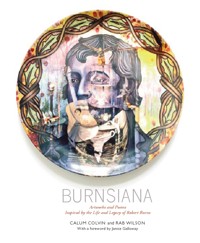
This unique reflection on the world of Robert Burns places a range of photographic artworks by celebrated Scottish artist Calum Colvin alongside poems written in response to each work by 'weel-kent' Scots poet Rab Wilson. Colvin's multi-referential artworks are concerned with the very process of looking, perceiving and interpreting. The potential meaning of any individual piece is intrinsically linked to the viewer's personal deconstruction of the image. Utilising the unique fixed-point perspective of the camera, Colvin creates and records manipulated and constructed images in order to create elaborate narratives which meditate on numerous aspects of Scottish culture, identity and the human condition in the early 21st century. At times witty, controversial and tender, the images are presented alongside poems in response by Rab Wilson which equally reflect on the life and aspects of Burns to dwell on who we are, and where we have been, toward what we may become. As Burns reflected through his art the world he inhabited, these works and words strive to reflect on a myriad of contemporary concerns.
Das E-Book können Sie in Legimi-Apps oder einer beliebigen App lesen, die das folgende Format unterstützen:
Seitenzahl: 76
Veröffentlichungsjahr: 2014
Ähnliche




















CALUM COLVIN was born in Glasgow in 1961 and is Professor of Fine Art Photography at Duncan of Jordanstone College of Art and Design, University of Dundee. Colvin’s artworks have been widely exhibited in venues as diverse as Orkney, Los Angeles and Ecuador. A practitioner of both sculpture and photography, Colvin brings these disciplines together in his unique style of ‘constructed photography’: assembled tableaux of objects, which are then painted and photographed. His complex compositions are rich in association and spatial ambiguities. As well as being visually exciting, humorous and intriguing, Colvin’s work demonstrates that the art of the past is relevant in a modern society.
His work is held in numerous collections including the Metropolitan Museum of Modern Art, New York; The Museum of Fine Art, Houston; The Victoria and Albert Museum, London as well as the Scottish National Portrait Gallery, Edinburgh and the Gallery of Modern Art in Glasgow.
RAB WILSON was born in New Cumnock, Ayrshire in 1960. After an engineering apprenticeship with the national coal board he left the pits following the miners’ strike of 1984–5 to become a psychiatric nurse. His work has appeared frequently inThe Herald as well as Chapman, Lallans and Markings magazines.
Rab has performed his work at the Edinburgh Fringe Festival, the StAnza poetry festival at St Andrews, the ‘Burns an a’ That Festival’ at Ayr and has been ‘Bard of the Festival’ at Wigtown, Scotland’s National Booktown. Additionally Rab is a previous winner of the McCash Poetry Prize. In 2013 he was the first ‘James Hogg Writer in Residence’ and was formerly ‘Robert Burns Writing Fellow – in Reading Scots’ for Dumfries and Galloway Region. Currently a member of the National Committee for the Scots Language Resource Centre, Rab regularly attends the parliamentary Cross Party Group for Scots language held at Holyrood. He is a passionate advocate for Scots writing. He has recently moved back to New Cumnock, where he now lives with his wife Margaret and daughter Rachel.
By the same authors:
CALUM COLVIN
The Seven Deadly Sins and the Four Last Things, text by Tom Normand (Portfolio Gallery, 1993)
Sacred and Profane, text by James Lawson (The National Galleries of Scotland, 1998)
Ossian: Fragments of Ancient Poetry, text by Tom Normand (National Galleries of Scotland, 2002)
Natural Magic, text by Tom Normand and Prof Nicholas Wade (Royal Scottish Academy, 2009)
RAB WILSON
The Ruba’iyat of Omar Khayyam in Scots (Luath Press, 2004)
Accent O the Mind: Poems chiefly in the Scots language(Luath Press, 2005)
Life Sentence: More poems chiefly in the Scots language(Luath Press, 2008)
A Map for the Blind: Poems chiefly in the Scots language(Luath Press, 2011)
Burnsiana
Artworks and PoemsInspired by the Life and Legacy of Robert Burns
Artworks by Calum Colvin
Poems by Rab Wilson
LuathPress Limited
EDINBURGH
www.luath.co.uk
PICTURE CREDITS
p17 Poosie Nansie’s Inn: Douglas McKenzie.
p18 ‘Ellisland’ by J. Ramage, engraved by A. Willmore fromThe National Burns:Burns Works,Vol 1ed. Rev. George Gilfillan (published by William MacKenzie, London, Edinburgh & Glasgow, circa 1880).
p22 One guinea note with a poem by Robert Burns, 1780: Robert Burns Birthplace Museum, Alloway (National Trust for Scotland).
p39 Bottom Photograph. Armorial binding of a French translation of Macpherson’sOssianfrom Napoleon I’s library at Fontainebleau: National Library of Scotland, NLS shelfmark Bdg.s.720.
p41 Top Photograph. Scott Monument: Shutterstock.
All other images: Calum Colvin
First published in 2014
ISBN: 978-1-908373-91-5 (hardback)
ISBN: 978-1-910021-01-9 (paperback)
ISBN: 978-1-909912-79-3 (ebook)
The publishers acknowledge the support of Creative Scotland towards the publication of this volume.
The authors’ right to be identified as authors of this book under The Copyright, Designs and Patents Act 1988 has been asserted.
Images © Calum Colvin 2014
Poems © Rab Wilson 2014
To my parents, David and Elma Colvin
CALUM COLVIN
To Margaret and Rachel
RAB WILSON
Contents
Acknowledgements
Foreword by Janice Galloway
Preface by Calum Colvin
Introduction by Rab Wilson
Calum Colvin, artist, interviewed by Rab Wilson, poet
POEMS
BurnsianaPrologue
Burns Country
Twa Plack
Portrait of Colin McLuckie
The Twa Dugs
Portrait of Robert Burns after Archibald Skirving
Blue Burns
Negative Sublime I
Blind Ossian
Sir Walter Scott
Negative Sublime II (or ‘Portrait of Lord Byron’)
Napoleon
Camera Lucida
Vestiarum Scoticum I
Vestiarum Scoticum II
Vestiarum Scoticum III
Pictland
BurnsianaEpilogue
Title of Works
Ceramic Works
Acknowledgements
I would particularly like to thank a few individuals for their support in the creation of this book, especially Dr Tom Normand from the University of St Andrews, who was particularly generous with encouragement and advice. I must also thank Janice Galloway for her kind words in the Foreword. Thanks also to Gavin MacDougall and all at Luath Press.
The Robert Burns Birthplace Museum in Alloway first hosted the ‘Burnsiana’ collection of artworks from June-Nov 2013, and I would like to especially thank Sheilagh Tennant (Curator) and Nat Edwards (Director).
For technical assistance Kenneth Caldwell at Being There Media and Elizabeth at Ayrshire Agencies provided much-needed recording and transcription services.
I pride myself in being the world’s slowest photographer and the work in this book has been created over a long period of time. This has involved the assistance and generosity of many individuals and organisations, too many to mention here in full. However, I would like to extend my thanks to Julie Lawson at the Scottish National Portrait Gallery and Cathy Shankland at Highland Region for their support in the creation of this work over the years.
Foreword by Janice Galloway
A lad o pairts
I don’t know if you have a just idea of my character, but I wish you to see me as I am. – I am, as most people of my trade are, a strange wil o’ wisp being; the victim too often of much imprudence and many follies. – My great constituent elements are Pride and Passion: the first I have endeavoured to humanise into integrity and honour; the last makes me a Devotee to the warmest degree of enthusiasm in Love, Religion or Friendship…
These are words Burns wrote about himself. It’s a consolation after hundreds of years of bottling the man, trying to pin him down, that the man himself understood he was more than just one thing.
Calum Colvin’s blends – the photographic and the painterly, the traditional and surreal, the lasting and the ephemeral – have fascinated me from the first time I clapped eyes on his work. It was a portrait of James MacMillan, the stellar contemporary composer from Cumnock, Ayrshire: his face made of a perspective 3D trickery of objects that invited the onlooker’s collaboration in assembling the disparate parts into the man. It was on exhibition in Edinburgh, the article said. I got my coat.
There, I found not only one Ayrshire boy but two. Beside MacMillan, another musician as stellar as they come: misunderstood, misaligned, shamelessly misappropriated by the Heritage industry, but whatever they did to him, wholly recognisable. It was Robert Burns.
I grew up in Ayrshire so knew Burns as only a child from Ayrshire can: way too little, too reductively and for just one thing. He was who you did once a year for the school poetry competition whether you liked it or not. ‘To a Mountain Daisy’ (served up as no more than a ditty about a flower), ‘Address to a Haggis’ (served up as serious). Burns, in other words, reduced, hog-tied, compulsory.
What Burns actually meant as opposed to signified to the national psyche took much, much longer for me to unravel. It involved reading the man’s own words about himself as well as the poetry as poetry, not shamanic slogans. It involved reading him as a working author and man of his times like no other. It involved fiercely reclaiming him from a hundred tartan shortbread tins – and I was glad, glad, glad I did it. Burns, afresh, was a liberating discovery.
Seeing him through Colvin’s eyes was that fresh discovery all over again. Like a fine novel or an excellent collection of poems, the work suggested new ways of seeing not only the subject but the subject’s context, the mythology grown around him without his compliance, and a homage to what might be the sum of these parts. This collection begins with Burns and wraps its arms around Burnsiana as bastard children the poet himself never conceived. Through everything, Burns rises serene, waiting for us to make him into something whole.
Notoriously devout and rebellious; crude and tender, acutely aware of his lack of social standing and cocky; sure of his talent yet apprehensive of his ability to succeed, Burns is not so much a mass of contradictions as a mass of unresolved energies. Calum Colvin shines light not only on this but on all that surrounds it. In the increasingly fraught run up to our votes being cast for Scottish Independence, Now is indeed the Day, and Now indeed the Hour.
How are we to find meaning in the complexities of our histories? How are we to interpret the melancholic past, acknowledge the present and aspire with honour, not cheap sentiment or mock heroics, to the future? Burns asked these questions. Calum Colvin reframes them now.




