


9,99 €
Mehr erfahren.
- Herausgeber: 50Minutes.com
- Kategorie: Lebensstil
- Serie: Management & Marketing
- Sprache: Englisch
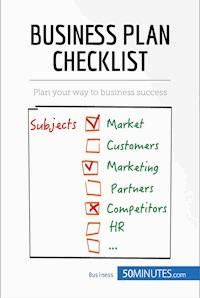
Plan your way to business success
This book is a practical and accessible guide to understanding and creating a business plan checklist, providing you with the essential information and saving time.
In 50 minutes you will be able to:
• Understand the 9 key steps you must follow when creating any business plan and what each step involves
• Use your business plan to guide your new business or products, predict turnover and anticipate future challenges
• Use your concrete business plan to grab the interest of investors and funding providers, using data and market research to convince them of the feasibility of your plan
ABOUT 50MINUTES.COM | Management & Marketing
50MINUTES.COM provides the tools to quickly understand the main theories and concepts that shape the economic world of today. Our publications are easy to use and they will save you time. They provide elements of theory and case studies, making them excellent guides to understand key concepts in just a few minutes. In fact, they are the starting point to take action and push your business to the next level.
Das E-Book können Sie in Legimi-Apps oder einer beliebigen App lesen, die das folgende Format unterstützen:
Seitenzahl: 30
Veröffentlichungsjahr: 2015
Ähnliche















Business plan checklist
Key information
Names: Business plan, development planUses: Generally used to create new businesses or launch new products, a business plan allows the feasibility of a project to be assessed, taking into account the characteristics of the market, and defines the marketing plan.Why is it successful? A business plan helps to identify the limits and the prospects of a business project by detailing all of the points relating to the launch of the business: product, market, resources, etc. It is compulsory when a new company is being set up and when external financing is being received, and helps to establish the short- and medium-term strategy and financial profitability of the project, as well as the key success factors. The forecasts and strategies set out in the business plan are then used to monitor the smooth running of the company’s activities and, if necessary, to make adjustments in order to achieve the objectives that were initially set as efficiently as possible.Key words:Financial plan:a plan detailing the financial inputs and outputs of a structure, including in particular the historical and projected assessments and income statements.Market:strictly speaking, all of the companies, customers, suppliers and other intermediaries involved in the same activity; more broadly, it includes the products, raw materials and third parties that interact with the market.Market research: qualitative and/or quantitative analysis of different stakeholders, such as customers, suppliers, competitors and market trends.Marketing mix:the coherent combination of the price, product, place and promotion variables of an activity (communication), directed towards the consumer to encourage them to buy.PESTLE analysis: the study of the macroeconomic factors (political, economic, socio-cultural, technological, environmental and legal) of the environment which may influence the development of a business. This analysis does not address the microeconomic environmental factors, which, although also outside the company, are specific to a business’s sector of activity.SWOT analysis:the study of the internal and external environment which allows the strengths, weaknesses, opportunities and threats related to a specific company to be identified.Introduction
The origin of the business plan coincides with a growing desire to establish and ensure a degree of stability, particularly in terms of funding, for a new venture (realisation of a project, creation of a business, etc.). To describe the future situation of a business project, with the aim of making this happen, a business plan is needed. It was particularly during the 1970s – a period which saw a proliferation of crises and cross-sectorial changes (due to oil crises and the arrival of computers) – that this tool became essential to start and run a company effectively. It allows users to attract the attention of decision-makers, managers, bankers, etc. These are all potential stakeholders who, if they see the potential for profit, may wish to invest in the project.
Definition of the model
The business plan provides information to managers, shareholders and potential lenders by delivering an overview of the (new) company, its development models, its strategic choices and its environment. In concrete terms, the document mainly describes:
The company and its main features, through a description of its strategy and future goals, a study of the strengths and weaknesses of the (new) company and, finally, a presentation of the future team;The market and customers, through market research that informs the third parties of the state of the market (its growth, its potential, etc.), customers (purchasing behaviour, etc.), competitors, suppliers and other key intermediaries.The expected competition, which lists the main strengths of the competitors, including the competitive advantages that the (new) company will try to gain;The marketing plan, which details the proposed marketing strategy for the product or service;The operational plan




