


16,99 €
Mehr erfahren.
- Herausgeber: John Wiley & Sons
- Kategorie: Fachliteratur
- Sprache: Englisch
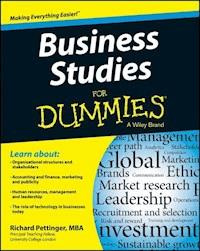
Your hands-on introduction to modern business and business education
Whether you're deciding on a course of study, headed to university, or settling down to your first year, Business Studies For Dummies provides you with a thorough overview of the subjects that form the foundation of a business studies degree.
You'll get trusted, easy-to-follow coverage of all the topics you'll encounter: business start-up, accounting and finance, operations, human resources, management, analytics, business environment, and economics.
- Includes a clear, engaging, and concise overview of the key topics you'll encounter in your studies
- The perfect study companion for students
With Business Studies For Dummies, you'll be one step ahead of the competition—at university and on the job.
Sie lesen das E-Book in den Legimi-Apps auf:
Seitenzahl: 601
Veröffentlichungsjahr: 2013
Ähnliche

















Business Studies For Dummies®
Published by: John Wiley & Sons, Ltd, The Atrium, Southern Gate, Chichester, www.wiley.com
This edition first published 2013
© 2014 John Wiley & Sons, Ltd, Chichester, West Sussex.
Registered Office
John Wiley & Sons Ltd, The Atrium, Southern Gate, Chichester, West Sussex, PO19 8SQ, United Kingdom
For details of our global editorial offices, for customer services and for information about how to apply for permission to reuse the copyright material in this book please see our website at www.wiley.com.
The right of the author to be identified as the author of this work has been asserted in accordance with the Copyright, Designs and Patents Act 1988.
All rights reserved. No part of this publication may be reproduced, stored in a retrieval system, or transmitted, in any form or by any means, electronic, mechanical, photocopying, recording or otherwise, except as permitted by the UK Copyright, Designs and Patents Act 1988, without the prior permission of the publisher.
Wiley publishes in a variety of print and electronic formats and by print-on-demand. Some material included with standard print versions of this book may not be included in e-books or in print-on-demand. If this book refers to media such as a CD or DVD that is not included in the version you purchased, you may download this material at http://booksupport.wiley.com. For more information about Wiley products, visit www.wiley.com.
Designations used by companies to distinguish their products are often claimed as trademarks. All brand names and product names used in this book are trade names, service marks, trademarks or registered trademarks of their respective owners. The publisher is not associated with any product or vendor mentioned in this book.
Limit of Liability/Disclaimer of Warranty: While the publisher and author have used their best efforts in preparing this book, they make no representations or warranties with the respect to the accuracy or completeness of the contents of this book and specifically disclaim any implied warranties of merchantability or fitness for a particular purpose. It is sold on the understanding that the publisher is not engaged in rendering professional services and neither the publisher nor the author shall be liable for damages arising herefrom. If professional advice or other expert assistance is required, the services of a competent professional should be sought.
For general information on our other products and services, please contact our Customer Care Department within the U.S. at 877-762-2974, outside the U.S. at (001) 317-572-3993, or fax 317-572-4002. For technical support, please visit www.wiley.com/techsupport.
A catalogue record for this book is available from the British Library.
ISBN 978-1-118-34811-6 (pbk); ISBN 978-1-118-34814-7 (ebk); ISBN 978-1-118-34817-8 (ebk)
Printed in Great Britain by TJ International Ltd, Padstow, Cornwall
10 9 8 7 6 5 4 3 2 1
Business Studies For Dummies®
Visit www.dummies.com/cheatsheet/businessstudies to view this book's cheat sheet.
Table of Contents
Introduction
About This Book
Foolish Assumptions
Icons Used in This Book
Beyond The Book
Where to Go from Here
Part I: What Is Business?
Chapter 1: Understanding Business and Business Studies
Defining Business
Why Study Business?
Knowing How to Study Business
Thinking for yourself
Putting theory into practice
Considering the Role of Business
Seeing the economic side of business
Understanding the social perspective
Understanding Business Risks
Situating the Business in Its Environment
Thinking about Beneficiaries and Stakeholders
Recognising Present Business Pressures
Chapter 2: Identifying the Internal and External Influences on Business
Considering Internal Influences: An Inside Job
Directors and top managers
Technology and expertise
Ethics and the work ethic
Drives and pressures
Crises and emergencies
Exploring External Influences: Looking Beyond Your Walls
Trade and the trading environment
Environmental issues
Chapter 3: Using Business Analyses
Starting with the Basics of Analyses
Figuring Out Three Principles of Business
Analysing the Environment
PESTEL analysis
Five Forces analysis
Competitor analysis
Analysing the Organisation
SWOT analysis
Locations
Costs and returns
Value
Analysing Products and Services
Product and service lifecycles
Product and service clusters
The Ford Matrix
Analysing Customers and Clients
Analysing Risks
Chapter 4: Making Decisions
Following the Decision-Making Process
Understanding Real-World Business Decisions
Reviewing the Role of Top Management in Decisions
Stakeholder pressures
Managerial pressures
Part II: How Business Works
Chapter 5: Structuring and Evolving Organisations
Identifying the Various Structures and Types of Organisations
Commercial organisations
Public service bodies
NGOs and quangos
The not-for-profit sector
Other organisational forms
Outsourcing Work to Other Companies and Countries
Changing Ownership and Activities
Takeovers and mergers
Privatisation
Chapter 6: Meeting Stakeholder Demands
Knowing Who the Stakeholders Are
Backers
Staff
Customers and clients
Suppliers
The public and the media
Pressure groups
Understanding Stakeholders’ Priorities
Considering Ethical Issues
Chapter 7: Organising for Success
Building the Foundations for Organising for Success
Understanding the Nature of Organisation
Considering Locations of Work
Weighing up a location
Working via the Internet
Organising Work and Work Groups
Departments, divisions and functions
Spans of control
Dealing with Staffing Issues
Investing in Technology and Assets
Part III: How to Be a Business and Do Business
Chapter 8: Understanding Business Strategy
Knowing What Strategy Is (and Isn’t)
Defining Your Organisation’s Strategy
What do you do?
When do you do it?
Where do you do it?
Why do you do it?
For whom do you do it?
Implementing Your Strategy
Formulation
Execution
Measuring the results
Looking for the warning signs
Chapter 9: Creating Great Products and Services
What’s in Your Stable Today? Evaluating Your Existing Products and Services
Offering a range of products and services
Analysing the contribution of products and services
Looking at product and service lifecycles
Paying attention to quality
Creating the New Kids on the Block: Product and Service Development
Finding reasons for development
Producing a prototype or mock-up of your idea
Getting to market
Building on your successes
Abandoning your failures
Chapter 10: Marketing Your Products or Services
Knowing What Marketing Is and What Marketing Does
Targeting Your Piece of the Pie: Market Segmentation
Devising Your Marketing Strategy
Choosing a Marketing Mix
Selecting Your Marketing Media
Branding: Showing Who You Are and What You’re About
Thinking about the brand you want
Building a brand
Doing Market Research
Customer surveys
Focus groups
Meetings with customer groups
Specialist groups involved in new product and service testing
Tracking purchases
Tracking Internet buying habits
Putting It All Together
Part IV: Money, Money, Money
Chapter 11: Understanding Finance
Knowing What Finance Is and Where It Comes From
Capital and shares
Loans
Retained profits
Using Finance
Investing in the business
Bonuses and rewards
Dividends and returns
Structuring Finance
Using loan capital
Drilling down to the core: Strength and integrity
Understanding assets and liabilities
Allocating Resources
Budgeting
Knowing why budgets matter
Looking at different kinds of budgets
Developing a budget
Keeping your eye on the figures
Apportioning Costs
Chapter 12: Structuring Accounts
Getting to Grips with the Basics of Accounting
The accounting cycle
The accounting equation
Double-entry bookkeeping
Depreciating your assets
Understanding Financial Statements
Gathering the important financial statements
Taking a snapshot: The balance sheet
Making money: The profit-and-loss account
Keeping more money than you spend: The cash flow statement
Audits: The Key to Accuracy
Chapter 13: Investing in the Present and in the Future
Understanding the Purpose of Investment
Doing Your Due Diligence
The cost of capital
Returns on investment
Future effects
Focusing on Financial Forecasting
Analysing Performance
Variance analysis
Ratio analysis
Cost/volume/profit analysis
Reading an Annual Report
Chapter 14: Using Numbers in Business
Delving into Data
Finding the data you need
Making use of the data
Recognising what numbers tell you, and what they don’t
Sidling Up to Statistics
Knowing the statistics that are relevant to your business
Using statistics to your business’s advantage
Defining Business Analytics
Calculating Risk
Accepting and mitigating risk
Don’t go there: Avoiding risk
Part V: The Awkward Bit: The People!
Chapter 15: Knowing People
Oh, Behave! (How People Behave)
Communication Nation: Seeing the Importance of Communication
Channels of communication
Types of communication
What we have is a failure to communicate: Barriers to communication
Culture Club: Considering Your Organisation’s Culture and Values
Understanding the characteristics of culture
Seeing how culture evolves
Oh, Captain! My Captain! Looking at Leadership
Motivation: Why People Do What They Do
The hierarchy of needs
The two-factor theory
Building the Work Ethic You Want
Go, Team!
Managing across Cultures, Borders and Time Differences
Chapter 16: Managing Human Resources
Recruiting New Employees
Defining the job
Setting a salary
Finding the cream of the crop
Sorting through the applications
Interviewing candidates
Checking references
Ranking your candidates
Welcome aboard! The first few days and weeks
Training and Development: Helping Your Employees Learn and Grow
Developing at all levels
Using performance appraisal
Atta Boy! Atta Girl! Rewarding Your Employees
Identifying the difference between intrinsic and extrinsic rewards
Making rewards and incentives pay off
Feeling Good: Health and Safety
Chapter 17: Handling Employee Relations
Policies and Procedures: Putting Them on Paper
Handling Conflict in the Workplace
Getting Employees Involved in the Organisation
Disciplining and Dismissing Employees
Discipline: Wearing the proverbial dunce cap
Dismissal: You’re outta here!
Addressing Employee Grievances
You’re in the Union, Jack: Appreciating the Role and Function of Trade Unions
Consulting and Negotiating with Your Staff
Flex Those Muscles! Flexible Working Conditions
Following the Letter of the Law
Part VI: Putting It All Together
Chapter 18: Examining Operations
Identifying the Nature of Production and Service Activities
Integrating the Efforts of Your Employees
Considering the Scales of Production and Service Delivery
Classifying production and service delivery
Seeing how technology helps
Making Quality Your Top Priority
Uniformity
Differentiation
Access and convenience
Tackling Organisational Issues
Managing alienation
Keeping control
Considering location
Balancing efficiency and effectiveness
Moving On Up: Growing and Diversifying
Chapter 19: Delivering Great Projects
Considering the Nature of Project Work
Getting to grips with the basics
Recognising the benefits of project work
Ticking off the trade-offs of project work
The Circle of Life: Looking at the Project Lifecycle
Phase 1: Design and conception
Phase 2: Building and delivery
Phase 3: Use and value
Time after Time: Setting and Meeting Deadlines
Critical paths
Some absolutes
Managing Projects Like a Pro
Following top management tips
Designing and structuring project organisation
Chapter 20: Using Technology to Your Best Advantage
Seeing What Technology Is and What It Can Do for You
Recognising the value of technology
Using technology
Focusing on Information Technology
Bringing Technology to Bear on Your Products and Services
Keeping Up with the Competition in the Technology Age
Keeping Current with Technology
Part VII: The Part of Tens
Chapter 21: Ten Tips for Succeeding at Business School
Contribute
Ask Questions
Go to Classes That Aren’t on Your Course (In Addition to Those That Are!)
Listen to Guest Speakers
Attend Conferences
Make the Most of Group Work
Join Societies
Read
Volunteer
Enjoy!
Chapter 22: Ten Ways to Put Your Knowledge to Work Outside the Classroom
Taking Internships
Working Outside of Your Studies
Volunteering
Visiting Companies and Organisations
Considering Customer Service
Networking
Evaluating Your Own Behaviour
Reading
Learning from Mentors
Creating a Winning Curriculum Vitae
About the Author
Cheat Sheet
Connect with Dummies
Introduction
There’s never been a more important, exciting or vital time to be studying business. So much has happened in the past: achievements and successes, but also mistakes and business conduct that, excellent though it may have been then, is no longer suitable or effective. And so much is going to change in the years to come, such as increased competition in a world that’s electronically charged and linked; industrial and commercial revolutions in countries such as Brazil, Russia, India and China; and the commercialisation of public services like health, education and security.
So it’s clearly time to take a step back and think about just what business is, how it’s conducted and how it should be conducted, and the benefits that it should be delivering for society at large, as well as for companies and organisations. And that’s where Business Studies For Dummies comes in: it’s a concise point of reference for everyone who wants to know and understand what business is and what it ought to be, and how to succeed in business now and in the future.
About This Book
This book provides the basis for acquiring and developing the substantial body of knowledge, skills and understanding that’s required of anyone who comes to study business. This knowledge forms the base upon which you can build practical excellence and expertise, and relate the lessons learned to what goes on in the world.
This book is full of vital and useful information. Everything included in the book is tried and tested. Of course, I introduce organisation and management theories, and I also introduce the distinctive disciplines of business – marketing, finance, numeracy and the understanding of people and their behaviour. I concentrate on what’s useful and valuable. All these aspects give you a firm foundation on which to build your professional knowledge, understanding and expertise.
I also include lots of real-world examples that I hope inspire you to understand the expertise and principles on which they’re based, and learn from the failures also, so that you can make sure you never make these mistakes yourself.
I also place an emphasis on providing practical information – so you’ll find lots of tips and guidance you can apply to your own career in business. Becoming fully professional and expert in business is terrifically rewarding and fulfilling, whatever sector you go on to work in.
Always put in your best effort! Remember that the best directors and managers in the world have reached their positions because of their personal and professional commitment, as well as their expertise. In addition to working very hard, they have read books like this and many others so that they know as much as they possibly can about everything to do with business.
Foolish Assumptions
In my line of work, everyone I meet has an active interest in business, companies and organisations, how they work, and what causes some of them to be profitable and effective, while others fail. In this book, therefore, I assume that you’re studying business on a course, or else actively interested and/or involved in business – what it is, how it works and how it can be improved.
I assume that you need and want comprehensive basic information about every aspect of what business is and the different elements – organisation, people, marketing, sales, accounts and finance – that together make up the whole.
I also assume that, whatever your occupation, rank or level of qualification, you can get something out of this book – just a few insights, or a pearl of wisdom, or a different approach to reviewing those things with which you’re familiar. As you work your way through this book, you’re able to access both the whole of what business is, and also those specific parts that are of greatest value to you (feel free to browse the table of contents if you’re looking for a particular topic to dive into).
Icons Used in This Book
We use icons next to blocks of text to draw your attention to particular nuggets of information throughout the book.
The bull’s-eye highlights a good idea or shortcut that can save you time or trouble.
This icon draws your attention to a piece of information about business that you shouldn’t forget.
This icon indicates information that can help you to avoid disasters.
The world of business is full of inspirational stories of business successes and failures, and this icon highlights them.
This icon shows vital lessons to learn, based on the experiences of others.
This icon draws your attention to the main things that you’ll likely learn and apply as you study business and develop your knowledge and expertise.
Everyone in business has their own point of view on all aspects of what is good and best practice, and this icon highlights the best of these.
Beyond The Book
As you make your journey into the world of business studies, you can supplement what you discover in this book by checking out some of the bonus content available to you at Dummies.com.
You can locate the book's e-cheat sheet at www.dummies.com/cheatsheet/businessstudies. Here you can find handy hints about the importance of people in everyday business, identifying and assessing risk, and relating your studies to real-life business.
Be sure to visit the book's extras page at www.dummies.com/extras/businessstudies for an extra Part of Tens chapter and many other interesting articles.
Where to Go from Here
The beauty of a book broken up into easily identifiable and manageable chunks is that you can start anywhere in your reading. Being new to business studies, you may want to start at the beginning and work your way through to the end. Then, later on, you can delve into the book, finding topics that are useful at different stages. A wealth of information and practical advice is waiting for you. Simply turn the page and begin!
Part I
What Is Business?
For Dummies can help you get started with lots of subjects. Visit www.dummies.com to learn more and do more with For Dummies.
In this part . . .
Get to grips with business. Identify whether studying business is for you and get advice on exactly how to go about doing this.
Apply a business-like approach to all business activity in order to improve the running of your commercial, public sector or not-for-profit business.
Acclimatize yourself to your business’s environment by learning about the internal and external influences on your business.
Optimize your business analyses skills to evaluate opportunities, constraints, drives and pressures from all parts of your business environment.
Chapter 1
Understanding Business and Business Studies
In This Chapter
Understanding why and how people study business
Thinking about the part that business plays socially and economically
Considering the risks facing businesses
Looking at the bigger picture: the business environment
Seeing what pressures businesses contend with
Welcome to the world of business and business studies!
The world of business is truly exciting. It provides everything that you need, want, consume and use in every part of your life. But the world of business can also be a scary one – times are uncertain, and this uncertainty is causing great changes in how companies and organisations conduct their affairs, how people organise their working and domestic lives, and how essential services (such as housing, energy and transport) are provided, delivered and paid for.
So, people knowing as much as possible about business is vital – how business is organised and structured, and how it goes about delivering what it’s supposed to produce.
That’s where you come in! Whether you’re studying business in order to get qualifications, or whether you’re doing so purely out of interest, you will acquire much greater knowledge, insight, understanding – and, ultimately, expertise – in everything to do with business and how business is conducted by reading this book!
In this chapter, I start you off on your business studies path by laying down the basics of this field of study, from defining business and understanding why people study it and how, to looking at the role of businesses, risks, the business environment, beneficiaries and stakeholders and, finally, the pressures that businesses face.
Defining Business
Business students must know the answers to two key questions:
What is business? Answer: the provision of products and services for consumption, in return for an agreed-upon price, charge or fee, or for having paid taxes and charges at some point (usually for public services – this also applies to direct debit payments for electricity, gas and water).
What is a business? Answer: an entity – an organisation – that conducts a particular set of activities, the purpose of which is to provide something – products, services or both – that’s of value to all or part of the community.
Ultimately, think of all organisations as businesses, whether they work on purely commercial lines, or whether they’re government departments, public service providers or charities. This makes studying business much more straightforward. Besides, all public service and charitable organisations are now run very much on ‘business lines’, with the kinds of pressures on their resources that have always occurred in commercial activities.
Why Study Business?
Business provides a fundamental structure for every part of society, affecting every walk of life and part of life. Most of what you do relates to businesses of one sort or another.
Lesen Sie weiter in der vollständigen Ausgabe!
Lesen Sie weiter in der vollständigen Ausgabe!
Lesen Sie weiter in der vollständigen Ausgabe!
Lesen Sie weiter in der vollständigen Ausgabe!
Lesen Sie weiter in der vollständigen Ausgabe!
Lesen Sie weiter in der vollständigen Ausgabe!
Lesen Sie weiter in der vollständigen Ausgabe!
Lesen Sie weiter in der vollständigen Ausgabe!
Lesen Sie weiter in der vollständigen Ausgabe!
Lesen Sie weiter in der vollständigen Ausgabe!
Lesen Sie weiter in der vollständigen Ausgabe!
Lesen Sie weiter in der vollständigen Ausgabe!
Lesen Sie weiter in der vollständigen Ausgabe!
Lesen Sie weiter in der vollständigen Ausgabe!
Lesen Sie weiter in der vollständigen Ausgabe!
Lesen Sie weiter in der vollständigen Ausgabe!
Lesen Sie weiter in der vollständigen Ausgabe!
Lesen Sie weiter in der vollständigen Ausgabe!
Lesen Sie weiter in der vollständigen Ausgabe!
Lesen Sie weiter in der vollständigen Ausgabe!
Lesen Sie weiter in der vollständigen Ausgabe!
Lesen Sie weiter in der vollständigen Ausgabe!
Lesen Sie weiter in der vollständigen Ausgabe!
Lesen Sie weiter in der vollständigen Ausgabe!
Lesen Sie weiter in der vollständigen Ausgabe!
Lesen Sie weiter in der vollständigen Ausgabe!
Lesen Sie weiter in der vollständigen Ausgabe!
Lesen Sie weiter in der vollständigen Ausgabe!
Lesen Sie weiter in der vollständigen Ausgabe!
Lesen Sie weiter in der vollständigen Ausgabe!




