


13,99 €
Mehr erfahren.
- Herausgeber: John Wiley & Sons
- Kategorie: Fachliteratur
- Sprache: Englisch
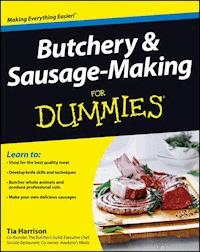
Discover how to butcher your own meat and make homemade sausage With interest in a back-to-basics approach to food on the rise, more and more people are becoming interested in butchering their own meat and making high-quality, preservative-free sausages. With easy-to-follow instructions and illustrations, Butchery & Sausage-Making For Dummies offers readers a look at how to butcher poultry, rabbit, beef, pork, lamb, and goats. The book will also explore sausage-making, with tips and recipes, and will look at preserving meat through curing and smoking. * Offers natural, healthier alternatives for sausages and preserved meats for people wary of processed foods * Provides helpful tips and guidance for home cooks and beginner butchers * Provides needed guidance for those looking to explore this long-overlooked profession Butchery & Sausage Making For Dummies is an invaluable resource for home cooks interested in being more responsible about their meat, or those that are looking to save money and enjoy healthier alternatives to what's found in their local grocery store.
Sie lesen das E-Book in den Legimi-Apps auf:
Seitenzahl: 473
Veröffentlichungsjahr: 2013
Ähnliche



















Butchery & Sausage-Making For Dummies®
Published byJohn Wiley & Sons Canada, Ltd.6045 Freemont Blvd.Mississauga, ON L5R 4J3www.wiley.com
Copyright © 2013 by John Wiley & Sons Canada, Ltd.
All rights reserved. No part of this book, including interior design, cover design, and icons, may be reproduced or transmitted in any form, by any means (electronic, photocopying, recording, or otherwise) without the prior written permission of the Publisher. Requests to the Publisher for permission should be addressed to the Permissions Department, John Wiley & Sons Canada, Ltd., 6045 Freemont Blvd., Mississauga, ON L5R 4J3, or online at http://www.wiley.com/go/permissions. For authorization to photocopy items for corporate, personal, or educational use, please contact in writing The Canadian Copyright Licensing Agency (Access Copyright). For more information, visit www.accesscopyright.ca or call toll free, 1-800-893-5777.
Trademarks: Wiley, the Wiley logo, For Dummies, the Dummies Man logo, A Reference for the Rest of Us!, The Dummies Way, Dummies Daily, The Fun and Easy Way, Dummies.com, Making Everything Easier, and related trade dress are trademarks or registered trademarks of John Wiley & Sons, Inc., and/or its affiliates in the United States and other countries, and may not be used without written permission. The Sustainable Kitchen is a registered trademark of Laurel Miller. All other trademarks are the property of their respective owners. John Wiley & Sons, Inc., is not associated with any product or vendor mentioned in this book.
Limit of Liability/Disclaimer of Warranty:The publisher and the author make no representations or warranties with respect to the accuracy or completeness of the contents of this work and specifically disclaim all warranties, including without limitation warranties of fitness for a particular purpose. No warranty may be created or extended by sales or promotional materials. The advice and strategies contained herein may not be suitable for every situation. This work is sold with the understanding that the publisher is not engaged in rendering legal, accounting, or other professional services. If professional assistance is required, the services of a competent professional person should be sought. Neither the publisher nor the author shall be liable for damages arising herefrom. The fact that an organization or Website is referred to in this work as a citation and/or a potential source of further information does not mean that the author or the publisher endorses the information the organization or Website may provide or recommendations it may make. Further, readers should be aware that Internet Websites listed in this work may have changed or disappeared between when this work was written and when it is read.
For general information on John Wiley & Sons Canada, Ltd., including all books published by John Wiley & Sons, Inc., please call our distribution centre at 1-800-567-4797. For reseller information, including discounts and premium sales, please call our sales department at 416-646-7992. For press review copies, author interviews, or other publicity information, please contact our publicity department, Tel. 416-646-4582, Fax 416-236-4448.
For technical support, please visit www.wiley.com/techsupport.
Wiley publishes in a variety of print and electronic formats and by print-on-demand. Some material included with standard print versions of this book may not be included in e-books or in print-on-demand. If this book refers to media such as a CD or DVD that is not included in the version you purchased, you may download this material at http://booksupport.wiley.com. For more information about Wiley products, visit www.wiley.com.
Library and Archives Canada Cataloguing in Publication
Harrison, Tia
Butchery & sausage-making for dummies / Tia Harrison.
Includes index.
Issued also in electronic format.
ISBN 978-1-118-37494-8
1. Meat cutting. 2. Sausages. 3. Cooking (Sausages).
4. Meat—Preservation. I. Title.
TS1962.H37 2012 664’.902 C2012-902751-0
978-1-118-38743-6 (ebk); 978-1-118-38744-3 (ebk); 978-1-118-38745-0 (ebk)
Printed in the United States
1 2 3 4 5 RRD 17 16 15 14 13
About the Author
Tia Harrison is co-founder of the Butcher’s Guild; executive chef and co-owner of Sociale, a northern-Italian–inspired restaurant; and co-owner of Avedano’s Holly Park Market, a neighborhood butcher shop that focuses on whole-animal butchery.
Since 2003, Tia has been Sociale’s executive chef, where she has worked to expand her expertise as a food professional in San Francisco. Located in the Presidio Heights district of San Francisco, Sociale has been an integral part of the “farm to table” approach to dining in the Bay Area and proudly serves only the best in locally grown produce, sustainably farmed meats, and wild-caught seafood.
In 2007, Tia Harrison opened Avedano’s Holly Park Market, the first women-owned and women-run butcher shop in the United States. Inspired to revive the dying art of butchering by hand and to support small farms and sustainable food systems, Avedano’s and its owners are leaders in the butcher’s revolution, focusing on educating others in the art of butchering and supporting consumers, local farmers, and the community in all things that are meaty and delicious. Tia Harrison is focused on education, community building, and good food.
Tia, along with her friend and business partner Marissa Guggiana, founded the Butcher’s Guild in 2010. The Guild, a fraternity of meat professionals bound to creating a support system for the butchery industry, focuses on education and camaraderie to achieve a communal goal: a network of successful, skilled, independent butchers all across the country.
Dedication
For Dacia. You are the light of my life.
Author’s Acknowledgments
To butchers, chefs, salumists: You inspire me. The meat industry has given me so much. A big, huge “thank you” to all the passionate people who work to support the craft of butchery. Thank you to all the members of the Butcher’s Guild. Your friendship and support mean so much to me. I am truly honored to know all of you. Thank you to Marshka Kiera for literally rocking our world and being such a kind, wonderful, and helpful friend to the Guild.
To my family: Ellice, Matt, Nya, Rocco, Ben, Carly, Gary, Marianne, Nathaniel, Travis, Caitlin, Ellen, Paul, Flora. All of you have helped me in my career. Thank you for always listening to my wild, crazy, entrepreneurial schemes (and pretending to be excited). I appreciate all your love and support. To BB, ily so much; thank you.
To all of the inspiring people who have contributed to and helped me with this book: Christopher Arentz, David Budworth, Bryan Butler, Craig Deihl, Mark DeNittis, Josh Donald, Brad Farmerie, Marissa Guggiana, Peter Hertzmann, Matthew Jennings, Josh Martin, Julio Mis, Pepe, Stephen Pocock, Berlin Reed, Gregg Rentfrow, Adam Tiberio, Kari Underly, Sarah Weiner, and Oscar Yedra.
Extra special thanks go to Adam Tiberio, Bryan Butler, and Julio Mis. Adam, thanks for sharing your knowledge, skills, and passion with me; for the advice and information you’ve provided; and for being an educator. Bryan, thank you for your help with this project; your feedback and support have been huge. Julio, thank you for always being on my team, no matter how much I ask for. Working with you is such a comfort to me. Thank you for all of your help with this book. You have done so much.
To my dear, dear friend and business partner, Marissa Guggiana. You hold a very special (almost creepy, perhaps stalker-y) place in my heart. You inspire me and give me the confidence to do impossible things. Your help during this experience was immeasurable. I truly could not have done it without you.
To David Nichol, you are a great friend and business partner. Thank you for understanding me and always letting me follow my dreams. Sociale is where my heart is.
To Angela Wilson and Melanie Eisemann: Thank you for believing in me, always being there for me, and for being such good friends and good people. You have both inspired me.
Publisher’s Acknowledgments
We’re proud of this book; please send us your comments at http://dummies.custhelp.com. For other comments, please contact our Customer Care Department within the U.S. at 877-762-2974, outside the U.S. at 317-572-3993, or fax 317-572-4002.
Some of the people who helped bring this book to market include the following:
Acquisitions, Editorial, and Vertical Websites
Acquisition Editor: Anam Ahmed
Project Editor: Tracy L. Barr
Production Editor: Pauline Ricablanca
Editorial Assistant: Kathy Deady
Technical Editor: Bryan Butler
Cover photos: © maria bacarella
Cartoons: Rich Tennant (www.the5thwave.com)
Composition Services
Senior Project Coordinator: Kristie Rees
Layout and Graphics: Carrie A. Cesavice, Jennifer Creasey, Brent Savage
Proofreaders: Melissa Cossell, Wordsmith Editorial
Indexer: Christine Karpeles
Recipe Tester: Emily Nolan
John Wiley & Sons Canada, Ltd.
Deborah Barton, Vice President and Director of Operations
Jennifer Smith, Publisher, Professional & Trade Division
Alison Maclean, Managing Editor, Professional & Trade Division
Publishing and Editorial for Consumer Dummies
Kathleen Nebenhaus, Vice President and Executive Publisher
David Palmer, Associate Publisher
Kristin Ferguson-Wagstaffe, Product Development Director
Publishing for Technology Dummies
Andy Cummings, Vice President and Publisher
Composition Services
Debbie Stailey, Director of Composition Services
Butchery & Sausage-Making For Dummies®
Visit www.dummies.com/cheatsheet/butcherysausagemaking to view this book's cheat sheet.
Table of Contents
Introduction
About This Book
Conventions Used in This Book
What You’re Not to Read
Foolish Assumptions
How This Book Is Organized
Part I: Time to Meet Your Meat!
Part II: Poultry, Rabbit, and Lamb Butchery
Part III: Pork Butchery
Part IV: Beef Butchery
Part V: Sausage-Making and Using the Whole Animal
Part VI: The Part of Tens
Icons Used in This Book
Where to Go from Here
Part I: Time to Meet Your Meat!
Chapter 1: The Butchery Room
Understanding the Importance of Ye Ol’ Butcher Shoppe
Identifying what butchers do
Patronizing your local shop
Assuming the Role of Butcher in Your Own Home
Knowledge and equipment you need
The benefits of butchering your own meat
Preserving Traditions: Sausage-Making and Other Preservation Methods
Making sausage
Other preservation techniques
Promoting Healthy Food Systems
Chapter 2: Meat Is Meat, Right? Wrong!
Knowing What You’re Getting
You say “tomato”; I say “porcupine” — Playing the name game
Think cooking instead of cutting
Deciphering labels
Focusing on Flavor
The amount and kind of fat
The age of the animal
The meat’s grade
Whether the meat is dry or wet aged
Ensuring you get the best flavor
Broadening Your Definition of “Good”
Chapter 3: Cuts and Terminology: The Basics of Butchery
Breaking It Down the Easy Way: Meat Maps
Making Heads or Tails of Butchery Terminology
Keeping track of body parts and positions
Understanding cut terminology
Breaking news: Bench (or table) or hanging
Sourcing the Freshest Cuts from the Supplier or Meat Counter
Finding a reputable supplier
Judging freshness at the meat counter
Identifying standard and specialty cuts
Substituting Cuts in Recipe Planning
Braising, slow cooking cuts
Grilling or quick-searing cuts
Roasting cuts
Chapter 4: Basic Knife Skills, Tools, and Techniques
Knives, Mallets, and More: Gathering Your Butchery Tools
The essential cutting implements
Other necessary items
Useful but nonessential items
Making Confident and Fluid Cuts: Basic Grips and Posture
Get a grip! Holding your knife properly
Maintaining good posture
Special Techniques Every Butcher Should Know
Denuding
Cutting steaks
Frenching
Butterflying
Cubing meats for braising
Being Safe While Using Sharp, Pointy Metal Tools
Part II: Poultry, Rabbit, and Lamb Butchery
Chapter 5: Duck, Duck, Goose, Chickens: Starting with Poultry
A Word about Cutting Up Birds
Getting familiar with poultry musculature
Basic chicken-butchering tools and techniques
Pieces of Eight: Cutting Up a Fryer
Removing the head and feet
Removing the wings
Removing the legs
Cutting out the spine
Splitting the breast
Dividing the legs into two pieces
Finishing up
Cutting the Chicken into Five Equal Portions
Freeing the oysters
Removing the legs and spine
Sectioning the wing portions
Making Boneless, Skinless Chicken Pieces
Removing the skin
Cutting up the skinned chicken
Deboning the breast
Deboning the thigh and drumsticks
Impressing Your Neighbors: Boneless Chicken Halves
Chapter 6: What’s Up, Doc? Rascally Rabbits!
Cutting Up Fryers and Roasters
Removing the offal and silver skin
Removing the back legs
Removing the front legs
Cutting through the ribs
Removing the pelvis
Sectioning the saddle
Portioning the loin
Finishing up the rack
Deboning the Rabbit
Removing the rib cage
Cutting out the skeleton
Removing the leg bones
Removing the arm bones
Chapter 7: Baaaaack to Basics: Lamb and Goat Butchery
Getting to Know Your Little Bovids
The lowdown on lamb
Getting (to know) your goat
Covering Lamb and Goat Butchery Basics
On the bench or on the hook?
The cuts
Dealing with the Neck/Shoulder
Slicing the Skirt Free
Removing the Flank
Two Tasks in One: Removing the Breast and Foreshank
Removing the foreshank
Removing the breast
Removing the Hindshanks
Using a saw to remove the hindshank
Using a boning knife to remove the hindshank
Removing the Shoulder
The Leg
Removing the legs from the loin
Sawing the legs in two
Working with the Rib
Separating the rib from the loin
Chining the rib
Cutting Denver ribs
Portioning the rib chops
The Loin
Part III: Pork Butchery
Chapter 8: Porky Pig: Understanding the Beast
Pork and Pigs: Getting to Know the Beast
Pork production
Weighty matters: Making sense of pork poundage
Pork’s USDA identification categories
Fundamentals of Pork Butchery
Inspecting the carcass
Paying attention to safety issues
Getting Familiar with Pig Primals, Subprimals, and Retail Cuts
First and second cuts: Primals and subprimals
The retail cuts
Chapter 9: Pork: Cutting It Up
A Bit of Advice before You Begin
Removing the Head
Removing the Front Trotters (Feet)
Removing the trotters with your boning knife
Removing the trotters by sawing
Removing the Foreshanks
Splitting the Breast-plate
Dealing with the Shoulders
Removing the shoulders
Splitting the shoulders in two
Trim work: Cleaning up the shoulder
Removing the Hind Trotters
Sectioning the Legs from the Loin
Freeing the legs from the belly
Separating the loin from the legs
Sawing the legs in two
Removing the Pork Skirt Steaks
Cutting the Belly from the Loin
Chapter 10: Moving into Pork Subprimals
From the Shoulder: The Boston Butt and Pork Shoulder (Picnic)
Separating the Boston butt from the picnic
Making retails cuts from the picnic
Producing Retails Cuts from the Loin
Cutting center loin chops
Boneless loin roast and chops
Baby back ribs
Removing the tenderloin
Porterhouse or T-bone steaks
Getting Great Cuts from the Leg (or Ham)
Spareribs from the Pork Belly
Trimming Meat for Grind
Part IV: Beef Butchery
Chapter 11: What’s Your Beef? Understanding the Cuts
The Lowdown on Beef Butchery
Muscles matter! Paying attention to beef musculature
Maximizing flavor and tenderness
Playing it safe
Dividing Up the Task: Primals, Subprimals, and Retail Cuts
Forequarter and hindquarter primals and subprimals
The retail cuts
Chapter 12: Beef: The Forequarter
Breaking the Forequarter: The Basics
Fashioning a hook and rail
Cutting on the rail
Removing the Outside Skirt (Rail)
Separating Out the Chuck, Arm, and Brisket from the Plate and Rib (Rail)
Step 1: Marking the chuck and rib
Step 2: Separating the rib from the chuck
Step 3: Scoring the brisket
Step 4: Removing the arm from the chuck
Step 5: Removing the brisket
Step 6: Removing the neck meat and atlas joint
Step 7: Removing the flat iron
Step 8: Removing the chuck
Squaring Up the Chuck Short Ribs (Rail)
Sectioning the Rib from the Plate (Rail)
Trimming the Brisket (Bench)
Trimming the Flat Iron (Bench)
Removing the Foreshank (Bench)
Cutting the foreshank from the arm
Osso bucco
The Arm/Shoulder Clod (Bench)
Removing the arm bone
Extracting the petite filet
Preparing a cross rib roast
Tying the arm roast
The Rib and Bone-in Ribeye Steaks (Bench)
Cutting bone-in rib eyes
Frenching the bone-in rib eye
Chuck Short Ribs (Bench)
Fabricating the chuck roll
Seaming out the mock tender
Removing the neck and spine
The last stages of the chuck
On the Bench: The Plate
Removing the inside skirt
Cutting the short ribs
Cleaning the breastbones
Chapter 13: Beef: The Hindquarter
Breaking the Hindquarter: The Basics
Removing the Elephant Ear (Rail)
Pulling the Cod Fat (Rail)
Dealing with the Flank
Removing the flank (rail)
Freeing the flank steak (bench)
Pulling the Tri-Tip (Rail)
Removing the Full Loin (Rail)
Removing and Portioning the Round (Rail)
Removing the knuckle from the round
Cutting the top sirloin free from the round
Removing the gooseneck (bottom round)
Cutting the Full Loin Down (Bench)
Removing the flank from the full loin
Seaming out the inside skirt
Seaming out the bottom sirloin flap (bavette steak)
Cutting the Tri-Tip Free (Bench)
Separating the Short Loin from the Sirloin (Bench)
Taking Care of the Top Sirloin (Bench)
Removing the head filet
Deboning the top sirloin
Cutting Steaks from the Short Loin (Bench)
Cutting bone-in steaks
Frenching the bone-in steaks
Producing Osso Bucco from the Hindshank (Bench)
Part V: Sausage-Making and Using the Whole Animal
Chapter 14: Setting Yourself Up for Sausage
Gathering the Right Equipment
Thinking about your sausage-making needs
Choosing a grinder
Looking at mixers
Have stuffer, will sausage
Other essentials
A word about casings
Picking from a Plethora of Sausages
Common sausage flavor combos
Types of sausages
Chapter 15: Sausage-Making Techniques
Getting in Touch with Your Inner Nerd: Sausage Science
Using quality ingredients
Getting the right amount of moisture
Achieving the right texture
Ensuring a good bind
Using the proper technique
Fermented sausages and guarding against botulism
Making Sausage: The Basic Steps
Gathering your ingredients
Preparing the meat for grinding
Chilling the meat before grinding and mixing
Grinding and mixing your sausage
Stuffing the sausage into the casing
Tying the knot: Linking and drying sausages
Hanging your links to dry
Storing Your Sausage
Chapter 16: Scrumptious Sausage Recipes
Chicken and Rabbit Sausage
Beef Sausage
Pork Sausage
Lamb and Goat Sausage
Chapter 17: Processing Techniques: The Good Kind
Whole-Muscle Curing
Following the general process
Identifying the equipment you need
Ensuring safe curing practices
Time for the cure
Smoke ’Em If You Got ’Em
Gathering (or building) your equipment
Choosing your wood chips
Smoking tips
Making bacon
From Scraps to Elegant Dining: Pâté, Terrines, and More
Making a meat paste: Pâtés
Creating scrumptious layers: Terrines
Upping the elegance factor: Galantines
Stocks and Sauces: It’s All Gravy, Baby
The secrets to a solid stock
Whipping up a hearty sauce
Praise the Lard, Save the Fats
Part VI: The Part of Tens
Chapter 18: Top Ten Mistakes to Avoid When Butchering
Keeping a Messy Workspace
Letting Your Meat Get Warm
Not Following the Separation of Time or Space Rule
Not Watching Your Posture
Improperly Storing Your Meat
Letting Your Knives Get Dull
Wasting Perfectly Useful Scrap
Rushing through the Process
Being Careless or Distracted
Being Fearful
Chapter 19: Top Ten Grilling Cuts
Chicken — The Whole Thing, Every Last Part
Ribs, Any Kind
Hamburgers, That Glorious Staple
Show Me Some Leg, Lamb
Flat Steaks and Their Three-Dimensional Flavor
Pork Chops — Brine and Shine
Flat Iron, a Butchers’ Discovery
Lamb Saratoga, a Treasure Seeker’s Prize
Strip Steak, America’s Sweetheart
The Rib Eye — There, I’ve Said It
Chapter 20: Ten Sssshhhhausage-Making Secrets
Keep It Cool
Keep It Clean
Keep Notes
Grind It Right
Get in the Mix
Test the Texture and Taste
Hone Your Stuffing Technique
Practice Linking Tricks
Store the Sausage Properly
Use Quality Seasonings
Introduction
Sixty years ago, the work of butchers seemed a lot less mysterious. Iremember going to a butcher shop in Alameda, California, with my grandmother when I was very young. While my grandma shopped for dinner, the butcher’s long arm reached over the counter and handed me a slice of paper-thin, house-made bologna. I remember thoroughly enjoying the meat snack, even though I thought I didn’t like bologna. It was the gesture that made it taste so great, and even at the time, it seemed to me a very sweet and special outing.
I still love butchery. As a chef, learning to butcher was just a part of the natural progression of my craft. I wanted to know more about the meat I was serving in my restaurant; I knew how to sear a steak or braise a short rib, but what I really wanted to know how was how to cut it. I have so much respect for butchers. When we opened Avedano’s in 2007, making the transition from chef to butcher was an eye-opener to say the least. I thought it would be a lot easier than it was. I had a lot to learn. I have been fortunate enough in my career to know many great, talented people (many of whom have contributed to this book) that have shared their meat expertise and knowledge with me. We need butchers, we need their skill, we need their perspective, and we need to support them to make sure that they stick around. They are a very important part of a healthy, local food system. I raise my knife to them, their heritage, and their craft.
Lesen Sie weiter in der vollständigen Ausgabe!
Lesen Sie weiter in der vollständigen Ausgabe!
Lesen Sie weiter in der vollständigen Ausgabe!
Lesen Sie weiter in der vollständigen Ausgabe!
Lesen Sie weiter in der vollständigen Ausgabe!
Lesen Sie weiter in der vollständigen Ausgabe!
Lesen Sie weiter in der vollständigen Ausgabe!
Lesen Sie weiter in der vollständigen Ausgabe!
Lesen Sie weiter in der vollständigen Ausgabe!
Lesen Sie weiter in der vollständigen Ausgabe!
Lesen Sie weiter in der vollständigen Ausgabe!
Lesen Sie weiter in der vollständigen Ausgabe!
Lesen Sie weiter in der vollständigen Ausgabe!
Lesen Sie weiter in der vollständigen Ausgabe!
Lesen Sie weiter in der vollständigen Ausgabe!
Lesen Sie weiter in der vollständigen Ausgabe!
Lesen Sie weiter in der vollständigen Ausgabe!
Lesen Sie weiter in der vollständigen Ausgabe!
Lesen Sie weiter in der vollständigen Ausgabe!
Lesen Sie weiter in der vollständigen Ausgabe!
Lesen Sie weiter in der vollständigen Ausgabe!
Lesen Sie weiter in der vollständigen Ausgabe!
Lesen Sie weiter in der vollständigen Ausgabe!
Lesen Sie weiter in der vollständigen Ausgabe!
Lesen Sie weiter in der vollständigen Ausgabe!
Lesen Sie weiter in der vollständigen Ausgabe!
Lesen Sie weiter in der vollständigen Ausgabe!




