


Erhalten Sie Zugang zu diesem und mehr als 300000 Büchern ab EUR 5,99 monatlich.
- Herausgeber: Luath Press
- Kategorie: Geisteswissenschaft
- Serie: Open Scotland
- Sprache: Englisch
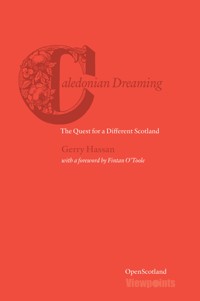
A different Scotland is possible. Caledonian Dreaming: The Quest for a Different Scotland offers a penetrating and original way forward for Scotland beyond the current independence debate. It identifies the myths of modern Scotland, describes what they say and why they need to be seen as myths. Hassan argues that Scotland is already changing, as traditional institutions and power decline and new forces emerge. He outlines a prospectus for Scotland to become more democratic and to embrace radical and far-reaching change. REVIEWS An intelligent, brave and much needed contribution to the debate around the referendum in Scotland. This, along with other great contributions, like Lesley Riddoch's Blossom, are hugely important to the general discourse and much needed research into the country we have been, the country we now are and the country we could become. ELAINE C. SMITH, actress and campaigner. This is a remarkable book - balanced and brave, insightful and incisive, intelligently blending the personal and the political. Whatever the referendum result, if Scotland really wants to be 'the best place in the world to grow up', Gerry Hassan's suggestions for 'a new democracy' would be an excellent starting point. SUE PALMER, author, Toxic Childhood Gerry Hassan sets out to challenge the lazy presumptions that are around about Scotland and its future. He invites the reader to think and think again. STUART COSGROVE, broadcaster. Understanding that the old stories we tell ourselves influence the new stories we go on to write, Gerry Hassan has crafted a brilliant book unpacking the political narratives that have shaped modern Scotland in order to create a space to imagine anew. A book about Scotland important to anyone, anywhere, dreaming a new world. STEPHEN DUNCOMBE, author, Dream: Re-imagining Progressive Politics in an Age of Fantasy The independence referendum changes what is possible regardless of its outcome. It forces people in Scotland to confront far more directly the nature of their country rather than continue to accept the myths that build up when there is no option to go it alone. In Caledonia Dreaming Gerry Hassan skillfully traverses these key myths to show that, if Scotland were to gain independence, it would have to confront internal realities that were hidden when Westminster could be blamed for so much. If the Scots prove the bookies wrong, if events over the summer of 2014 turn so that independence is achieved, then this book demonstrates that the new Scotland will be further from many possible idealised European utopias than many nationalists had ever imagined. It is a key contribution to the debate no matter where you stand. DANNY DORLING, author, Injustice: Why Social Justice Persists, Professor of Human Geography, Oxford University. With one bound Scotland could be free! How tempting that looks to the progressive-minded on both sides of the border. If only it were that easy. Gerry Hassan drills down to deeper reasons why the many dysfunctions of British democracy could dog an independent Scotland too. With a non-partisan but beady eye on society both sides of the border, in this clever book here are tougher questions to consider than a mere Yes/No. POLLY TOYNBEE, writer and journalist, The Guardian
Sie lesen das E-Book in den Legimi-Apps auf:
Seitenzahl: 491
Veröffentlichungsjahr: 2014
Das E-Book (TTS) können Sie hören im Abo „Legimi Premium” in Legimi-Apps auf:
Ähnliche


















GERRY HASSAN is a writer, commentator and Research Fellow at the University of the West of Scotland.
He has written, edited and published numerous books on Scottish and British politics, ideas, policy, social change and futures thinking, leading the DemosScotland 2020andGlasgow 2020projects. His books includeAfter Independence, The Strange Death of Labour Scotland, Radical Scotland: Arguments for Self-Determination, Thesnp:From Protest to Power and After Blair: Politics after the New Labour Decade. He regularly writes and appears in Scottish, UK and international media, and his writing can be found at www.gerryhassan.com
Advance Praise ForCaledonian Dreaming:
An intelligent, brave and much needed contribution to the debate around the referendum in Scotland. This, along with other great contributions, like Lesley Riddoch’sBlossom, are hugely important to the general discourse and much needed research into the country we have been, the country we now are and the country we could become.ELAINE C. SMITH, actress and campaigner
This is a remarkable book – balanced and brave, insightful and incisive, intelligently blending the personal and the political. Whatever the referendum result, if Scotland really wants to be ‘the best place in the world to grow up’, Gerry Hassan’s suggestions for ‘a new democracy’ would be an excellent starting point. SUE PALMER, author,Toxic Childhood
Gerry Hassan sets out to challenge the lazy presumptions that are around about Scotland and its future. He invites the reader to think and think again.STUART COSGROVE, broadcaster
Understanding that the old stories we tell ourselves influence the new stories we go on to write, Gerry Hassan has crafted a brilliant book unpacking the political narratives that have shaped modern Scotland in order to create a space to imagine anew. A book about Scotland important to anyone, anywhere, dreaming a new world.STEPHEN DUNCOMBE, author,Dream: Re-imagining Progressive Politics in an Age of Fantasy
The independence referendum changes what is possible regardless of its outcome. It forces people in Scotland to confront far more directly the nature of their country rather than continue to accept the myths that build up when there is no option to go it alone. InCaledonia DreamingGerry Hassan skillfully traverses these key myths to show that, if Scotland were to gain independence, it would have to confront internal realities that were hidden when Westminster could be blamed for so much. If the Scots prove the bookies wrong, if events over the summer of 2014 turn so that independence is achieved, then this book demonstrates that the new Scotland will be further from many possible idealised European utopias than many nationalists had ever imagined. It is a key contribution to the debate no matter where you stand. DANNY DORLING, author,Injustice: Why Social Justice Persists, Professor of Human Geography, Oxford University
With one bound Scotland could be free! How tempting that looks to the progressive-minded on both sides of the border. If only it were that easy. Gerry Hassan drills down to deeper reasons why the many dysfunctions of British democracy could dog an independent Scotland too. With a non-partisan but beady eye on society both sides of the border, in this clever book here are tougher questions to consider than a mere Yes/No.POLLY TOYNBEE, writer and journalist,The Guardian
Open Scotland is a series which aims to open up debate about the future of Scotland and do this by challenging the closed nature of many conversations, assumptions and parts of society. It is based on the belief that the closed Scotland has to be understood, and that this is a pre-requisite for the kind of debate and change society needs to have to challenge the status quo. It does this in a non-partisan, pluralist and open-minded manner, which contributes to making the idea of self-government into a genuine discussion about the prospects and possibilities of social change.
Luath Press is an independently owned and managed book publishing company based in Scotland, and is not aligned to any political party or grouping.Viewpointsis an occasional series exploring issues of current and future relevance.
Caledonian Dreaming
The Quest for a Different Scotland
GERRY HASSAN with a Foreword by FINTAN O’TOOLE
LuathPress Limited
EDINBURGH
www.luath.co.uk
First published 2014
ISBN: 978-1-910021-32-3
ISBN (eBook): 978-1-910324-01-1
The author’s right to be identified as author of this work under the Copyright, Designs and Patents Act 1988 has been asserted.
© Gerry Hassan 2014
Contents
Luve Poem
Acknowledgements
The Art of Growing Up: A Foreword Fintan O’Toole
CHAPTER ONE Scotland is Changing: A Nation in Transition
CHAPTER TWO The Six Myths of Modern Scotland
CHAPTER THREE The Personal is Political
CHAPTER FOUR The Global Kingdom: Britain after the Bubble
CHAPTER FIVE Back in the Old Country: The Power of the Past
CHAPTER SIX Scotland is not a Democracy
CHAPTER SEVEN The Rise and Fall of ‘Civic Scotland’
CHAPTER EIGHT The Stories of Radical Scotland
CHAPTER NINE A Different Kind of Politics is Possible: The Left, Laughter and Imagination
CHAPTER TEN Now That’s What I Call the Eighties: Scotland and Thatcherism
CHAPTER ELEVEN The Sounds of Silence: Thatcher, Blair and Understanding the Past
CHAPTER TWELVE What went wrong with Professional Scotland?
CHAPTER THIRTEEN The Emergence of ‘the Third Scotland’: Values, Voice and Vessels
CHAPTER FOURTEEN A Scotland Beyond Labels and ‘the Official Story’
CHAPTER FIFTEEN The Change We Can Become and the Power of Dreams
CHAPTER SIXTEEN The Limits of Politics and the Potential of Scotland International
Afterword: How to Make a New Democracy
Appendix: Some More Detailed Thoughts and Suggestions
Bibliography
Gie aa, and aa comes back
wi mair nor aa. Hain ocht, and ye’ll hae nocht,
aa flees awa.
LUVE
DOUGLAS YOUNG
Acknowledgements
Any book like this is assisted and encouraged by a range of people who aid its slow process coming from a set of ideas to its final form. First and foremost, I would like to show my gratitude and pleasure at working with the fantastic team at Luath Press – Gavin MacDougall, Lydia Nowak, Laura Nicol and Tom Bee.
Second, in terms of illustrations I would like to thank Tara Beall, Gerry McCartney, Greg Moodie, Ross Sinclair and Oxfam Scotland for giving permission for work to be used. Third, in electoral facts and figures, Sarah Mackie of the Electoral Commission Scotland was an embodiment of professionalism and support. Fourth, I would like to give my thanks for their encouragement and contribution to this project: Anthony Barnett, Simon Barrow, Eleanor Bell, Paddy Bort, Ross Colquhoun, Phil Denning, Roanne Dods, David Donnison, Stephen Duncombe, Ian Fraser, Michael Gardiner, Doug Gay, Joe Lafferty, Marc Lambert, Steve Lambert, Gayle MacPherson, Doreen MacWhannell, Robin McAlpine, Allan McConnell, James McCormick, Ailsa McKay, Susan McPhee, James Mitchell, Ken Neil, Alison Park, Karine Polwart, David Purdy, Eileen Reid, Eddie Rice, Philip Schlesinger, Martin Sime, Nigel Smith, Francis Stuart, Willie Sullivan, David Torrance, Michael Torrance, Katherine Trebeck, Jean Urquhart, Andy Wightman and Eleanor Yule. Fifth, many thanks to Clara Young for permission to use Douglas Young’s poem.
A special thanks and acknowledgement goes to Rosie Ilett who read and proofed the entire text at a near-final stage, and who was a source of inspiration and ideas throughout the course of this project.
Finally, a word on the style of this book. It has been written not as a specialist or academic book for those in the know but for the general informed reader. Therefore, despite what some readers might think, I have deliberately gone out of my way to avoid using obscure phrases or too much jargon. I have also kept references to other works and publications to a minimum. References are only used when absolutely necessary, and the range included indicate the main immediate sources for this book for further reading.
This book has been a pleasure to write and research, coming as it does at an august time, and also as the first in a series of books in the ‘Open Scotland’ series published by Luath. Many thanks for their commitment and professionalism in bringing this book and the series into being. I hope people find it as enjoyable and stimulating as I have writing it and immersing myself in the reading, ideas and thoughts at this exciting period in our country.
Gerry [email protected] Glasgow/Drummore March 2014
The Art of Growing Up:A Foreword
FINTAN O’TOOLE
IN 1926, THE NEW and fragile Irish state, barely recovering from a civil war, marked the tenth anniversary of the event that led to its foundation: the Easter Rising in Dublin in 1916. The Abbey, now the State’s national theatre, staged a new drama by its star playwright, Sean O’Casey,The Plough and the Stars. Most people wanted, even needed, an acknowledgment of the nobility of those who had given their lives for an Irish independence that had now been at least partially achieved.
What they got instead was a searing critique of the Rising, which O’Casey dramatised as a product of male vanity and the marginalising of the poor. The insult was deeply intimate: those who led the riotous protests against O’Casey included mothers, widows and sisters of men who had died for Irish independence. As one of them, Hannah Sheehy-Skeffington, asked, how could:
… a State-subsidised theatre presume on popular patience to the extent of making a mockery… of a revolutionary movement on which the present structure claims to stand?
The Abbey’s co-founder, W.B. Yeats, chose this moment to say something important: this is what independence looks like. Answering a question from the audience at a poetry reading, he suggested a vital distinction between national vanity and national pride:
The moment a nation reached intellectual maturity, it became exceedingly proud and ceased to be vain and when it became exceedingly proud it did not disguise its faults… but when it was immature it was exceedingly vain, and did not believe in itself, and so long as it did not believe in itself, it wanted other people to think well of it, in order that it might get a little reflected confidence. With success came pride, and with pride came indifference as to whether people were shown in a good light or a bad light on the stage.
Caledonian Dreamingis a shock to Scottish vanity and a beacon of Scottish pride. It doesn’t argue for independence, it embodies it. Gerry Hassan shows what intellectual maturity looks like: the clarity of vision and the honesty of purpose to live without the comfort of self-aggrandising myths. It strips away the protective clothing that all national movements love to wear and presents a Scotland denuded of some of its most cherished illusions. But just as bravely, it is not ashamed of that nakedness. Hassan’s vision is as hopeful as it is unflinching, as full of possibilities as it is empty of fantasy.
The great trap of nationalism is the tendency to define ‘us as ‘not them’. Nationalist movements need to imagine their country as both distinctive and unified. These are tricky tasks and the easiest way to get around them is to caricature one’s own country as the opposite of a caricature of the oppressor. Irish nationalism did this only too well: Britain was Protestant, monarchical, English-speaking industrial and urban, so Ireland had to be Catholic, republican, Gaelic-speaking, agricultural and rural. Scotland, in the 21st century, has a more sophisticated version of this reversal: England is all those things summed up in Thatcherism so Scotland embodies all the virtues of anti-Thatcherism: tolerant, social democratic, egalitarian, civic, open.
The problem with this Scottish version of the ‘not them’ double caricature is that it is so damned attractive. The Irish nationalist brand was largely reactionary and backward-looking. The Scottish version appeals to values that any progressive person would like to see embodied in a future state. There’s a warmth and decency to Scotland’s ‘not them’ that is lacking in so many other historic and contemporary nationalisms – and which make it all the more insidious. It is a sugar-coated hallucinogen.
Even a nice version of ‘not them’ traps a country in the immaturity of national vanity. A mature sense of national pride, on the other hand, demands a much more exacting examination of ‘us’. How well do the self-regarding myths map on to the lived reality? In what sense do ‘we’ form a single entity? Who gets to be ‘us’ and who is consigned to being another, internal, ‘them’? Can all oppression and injustice be blamed on ‘them’ or do they not perhaps have roots in our own hierarchies and habits?Caledonian Dreamingis wide awake to these questions.
At the heart of Hassan’s argument is a brilliant teasing-out of a relatively simple truth: national independence is not an event but a process. And a process with no simple beginning and no possible end. In this sense, he sees independence as being already well under way in a gradual maturing of self-government. And he also sees it as a struggle that will have to continue even if there is a great moment of ‘liberation’ in 2014. It is the struggle for truly meaningful democracy, which is to say a democracy in which every citizen shares the right to a dignified private and public existence and every citizen takes on the endless responsibility of renewing and deepening the collective processes that make this possible.
This is a great challenge but Scotland also has a great opportunity. Very few countries ever get the chance to become independent without inheriting the corrosive, distorting, disabling effects of violence. That this is taken for granted in Scotland doesn’t mean that it is not an extraordinary blessing.
Scotland also has the opportunity to become more mature and take responsibility without the baggage of national vanity and the heady rush of illusions that quickly become the toxic sludge of post-independence disillusionment. This is the art of growing up: far more important than any formal constitutional standing. There could be no better harbinger of these possibilities than this bracing, searching, discomfiting and ultimately exhilarating book.
CHAPTER ONE
Scotland is Changing: A Nation in Transition
Empathy is what keeps us together. It’s all really about people getting on with other people. And if you bring a kid up in a war zone, you’re going to get a warrior.
KARYN MCCLUSKEY,Head of Scottish Violence Reduction Unit,The Guardian, 19 December 2011
THESE ARE UNPRECEDENTED times to live in: of immense and complex change and uncertainty, and a set of crises and challenges in how institutions, politics and the mainstream media try to understand and explain these.
It is not an accident then that in the UK and most of the West, there is a widespread suspicion of traditional power and elites: whether bankers, politicians or many professional groups.
This is an age of flux and movement – of the emergence of new radical voices and forces, of the rise of populist and xenophobic parties across Europe, and the inability of conventional politics and the orthodoxies and dogmas which have dominated recent decades, to offer any plausible answer to the times we live in (Coggan, 2013; Mair, 2013).
These are also dramatic times for Scotland – witness the independence debate, the historic referendum in September 2014, and the possible end of the United Kingdom as we have come to know it – an eventuality which would carry with it consequences far beyond the shores of Scotland and the UK.
There is a short-term political account of how all this happened, focused on the SNP unexpectedly winning an overall majority in the Scottish Parliament 2011 elections, but much deeper and historic forces are at work. These include the long-term evolution of autonomy and distinctiveness in Scottish society, and what I call ‘voice’ both within the UK and Scotland. Another factor has been the nature of the UK, the values and priorities it has chosen to embrace, and the vision of society it has increasingly chosen to champion.
This makes where the Scotland of 2014 finds itself and where it might go the product of a host of factors which have potent roots and which are not going to go away or be resolved whatever the result of the referendum vote. This is one crucial point both Scottish and UK audiences need to reflect on, that the dynamics which have brought this debate to where it is will not disappear post-referendum. There is no tidy or final conclusion to this, whatever Scotland’s formal constitutional status.
Despite this, much of the tone, particularly that of certain politicians and parts of the mainstream media, deliberately poses the debate in an alienating and apocryphal black and white style – in terms of continuity and stability versus uncertainty and rupture.
This is inaccurate in at least two ways. First, the independence debate despite the Yes/No vote is not some modern equivalent of a Victorian duel of two sparing gentlemen or Cold War Mutual Assured Destruction (MAD). Instead, there is an element of ambiguity and continuity between the two offers. Second, and more importantly, the future cannot be future proofed. Indeed, we are continually told by ‘official’ voices that we cannot count on the social provisions experienced by previous generations in the future, and while that can be contested, the future is going to involve upheaval and uncertainty whatever Scotland ‘decides’ in 2014.
There is a bigger story to this. Look at the Scotland of recent years. It hasn’t exactly been a society of peace and calm. Some of the central pillars of public life have crashed and burned.
There was the Royal Bank of Scotland (RBS), once the fifth biggest bank in the world, which had to be nationalised to save it, but which has hardly cleaned up its ethical behaviour since. Then Glasgow Rangers FC, previously Scotland’s most successful football club, went into liquidation, and are currently working their way through Scotland’s lower leagues. Most recently, the Catholic Church has been tainted by a series of sexual scandals which have involved some of its most senior and high-profile figures.
These were all on their own tumultuous events, yet taken together they describe a society in flux, dramatic change and that old certainties no longer hold. They also point to the systemic abuse of power, dysfunctional leadership and wider issues in culture whether in business, football or churches.
Despite all of this, the Scotland presented to us in our mainstream politics, media and public life is one divorced from these dramatic changes. It is one of continuity, of dismissing each of the above as one-offs and the product of individual factors and inexcusable behaviour – of Fred Goodwin, David Murray and Keith O’Brien and the like. This is a culture of restoration of authority and of Scotland pre-crash, and wishing to continue collusion with powers, its uses and abuses, despite all that has happened.
Strangely, the way the independence debate is often portrayed is as one divorced from these changes – as if it is about a narrow set of constitutional choices, unconnected to discussion on the kind of society we want to live in.
This book aims to set out a very different prospectus – critiquing the conservative voices of Scotland – of left, right, nationalist, institutional and ‘civic Scotland’ persuasions. It argues that part of the change we have to go through needs to put our recent past into history, understanding not only the limits of British, but Scottish democracy, the blindsides of much of radical Scotland, and the need to understand the myths that we have created to tell ourselves how different and progressive we are, compared to the rest of the UK. Only by this self-reflection, honesty, and addressing the consequences of our cumulative choices, can we begin to understand where we are and where we might be going.
Scotland has not arrived in its present place solely by being inward looking and navel gazing, despite what some might say. It has been deeply affected by a host of historic and profound external factors. One such dimension is the long-term relative decline and crises of Britain and the British state. This has been aided and shaped in recent decades by the majority sentiment that Scotland rejected Thatcherism and instead remained steadfast in its commitment to what it saw as social democratic values.
But that is only one level and one that has become part of the ‘official story’ of modern Scotland which needs and demands a more rigorous critique than it has so far received. More crucial is a longer-term perspective which locates Scotland in the historical evolution of its administration, government, public services and state, from late Victorian times, and how this has altered Scotland both as a society and the voice and influence it has welded in the union.
This relates to the managed, ordered, closed society of ‘high Scotland’ whereby professional and institutional elites have dominated public life, often without any systematic scrutiny. One of the consequences of this state of affairs has been the development of a very weak, narrow public voice in society, and the interplay between domestic power dynamics in Scotland and the use of political voice by Scotland and its elites in the UK. This disequilibrium has shaped much of Scottish politics, society and culture, but is rarely commented upon let alone investigated, such are the power of some of the prevailing myths of modern Scotland: Labour, left, nationalist, and ‘civic Scotland’ being some of the most obvious.
One of the defining accounts of modern Scotland is one which emphasises our difference, uniqueness and the experience of this northern nation as progressive, social democratic and centre-left. This has come increasingly to the fore in the last 30 years since the election of the Thatcher Government (while drawing on earlier antecedents). Given the place in which Scotland now finds itself, it is time to ask whether the stories that we Scots tell ourselves are enough? Do we recognise ourselves in them? Do they reflect the diverse, contradictory, pluralist range that is modern Scotland, and do they aid mapping out and making sense of the future? The adequacy of the myths of modern Scotland is explored in the next chapter.
Then there is the important question of how the stories we tell inform and connect to our actions, values and practices. This book will attempt to explore this: the emergence of the modern Scotland we think we know and live in, the narrative of Scotland as more centre-left and progressive than the rest of the UK, and the quest for a different Scotland.
A Diverse Assembly or Not?
The independence debate will naturally have sound and fury, adversarialism, insult and invective, but we have to make sure these are not the dominant, or worse, the only, voices which get heard.
Alistair Darling has talked of Scottish independence as ‘serfdom’ (The Scotsman, 17 November 2012). Gordon Brown similarly declared that the SNP’s version of independence would be the equivalent of ‘a form of self-imposed colonialism more reminiscent of the old empire than of the modern world’ (The Scotsman, 4 November 2012). These are serious interventions by senior Labour Westminster politicians and display a deliberate decision to caricature and misunderstand the realities of Scottish independence and self-government. Darling, pouring scorn on the Scottish Government’s White Paper on independence, on its day of publication, called it ‘a work of fiction’, not stopping to acknowledge the momentous nature of the day or that it might be a significant document (bbcNews, 26 November 2013).
The late Baron Fraser of Carmyllie, a former Lord Advocate for Scotland, ruminated that a vote for independence may leave the rUK with no option but to take military action due to a military or security threat: ‘If that were to happen what alternative would England have but to come and bomb the hell out of Glasgow airport and Edinburgh airport’ (The Herald, 12 March 2012).
There is not a completely equivalent set of examples on the pro-independence side, but there are many examples of nationalist supporters making problematic statements. One prominent pro-independence blogger calledThe Guardian’s respected columnist Ian Jack an ‘Uncle Tom’, while the writer and pro-independence campaigner Alan Bissett stated at the November 2012 ‘Changin Scotland’ weekend that our nation has been regularly wronged by ‘the repeated English invasions, the Act of Union, Highland Clearances and Thatcherism – all violations of Scotland’ (National Collective, 30 November 2012). This latter set of comments were meant to show the need for anger and indignation in Scotland, but instead painted a sense of victimhood, along with a subjective interpretation of history.
There is in much of this a politics of labelling, naming and tribalism which helps and motivates the most partisan voices but which does not help debate. In truth, such actions contribute to politics as a minority pastime which just sails past most people. This book has been written, and here I may incur the wrath of some of the voices of certainty, not from the perspective of any one tribe or set of labels, but as a direct challenge to them.
This stance proposes that the politics of seeing everything in terms of left versus right, nationalist versus unionist, or about anti-Tory, anti-Thatcherite values, or a simplistic interpretation of class politics as if the last 30 years have not happened, does not really deal with the realities and challenges of modern Scotland. Similarly, the constant use of the words ‘separatism’ and ‘narrow nationalism’ merely illustrate where the speaker is coming from, and in effect demonstrate their desire to close down debate by controlling language and definitions.
These actions, from whichever side they originate, are a kind of psychological crutch, a search for certainty and anchor in a world of flux and change. But this is increasingly a law of diminishing returns, as well as a counter-productive exercise. Rather than aid us formulating ideas for the future, such behaviours are nearly always about embracing a closed- minded attitude which regards sloganising and constant mantras as good enough. They have never really been adequate, even in some supposed golden era of left v. right and class politics. Increasingly, these labels talk and mobilise less and less people, for all the wider radical sentiments in parts of Scotland.
This book is not written from within the confines of the straightjacket of such labels and name calling, whether left or right, nationalist or unionist. Instead, it is motivated by trying to engage in a more open-minded conversation about ideas, values and ideologies, and the challenges and crises we face in Scotland and the West. As I make clear in Chapter Three, my own origins and politics come unambiguously from the left and being pro-self-government, traditions that have made immense contributions to our public life. But the future requires an understanding of their limits and that many of our future challenges – demographics, climate change and the ethical dilemmas science is posing for us, to take just three examples – cannot be fitted into this framework.
As things stand, we have a mainstream debate dominated by two rather conservative forces, both of which look like accountancy versions of Scotland; of a managerial, cost-focused, economic calculus notion of the world. That is a very narrow focus. It is also as a debate of two competing nationalisms, Scottish and British, with the latter seemingly unaware that unionism is a form of nationalism. Mainstream Scottish nationalism years ago became moderate, reasonable and sensible, perhaps too much for many of us. British nationalism, on the other hand, seems in places to be reverting to a politics of despair, repeating mantras about identity, and damning and diminishing Scotland’s capacity to govern itself. This debate between two nationalisms has seen one ‘out’, self-reflective and mostly self-aware (Scottish), and one in denial, nearly completely lacking in self-knowledge and a sense of self-awareness (British). And this also illustrates the observation that nationalism of whatever kind was never going to be enough to offer adequate explanation to most people beyond some of the tribes.
Scottish society faces numerous constraints on how we debate, engage and listen to each other in public life. One of the most significant dimensions is that of gender, which still disfigures and diminishes too much of society – from representation in politics, business and the public realm, to the continuation of inequalities and discrimination, and the continued prevalence in places of misogyny and sexism.
There are so many layers to this. One is the over aggressiveness and combativeness of too much of political discussion, nearly always led by men. A couple of examples show the problem, which is not exclusive to any one party. Ian Davidson in August 2012 engaged in a bitter, acrimonious exchange with BBC Scotland presenter Isabel Fraser where he questioned her impartiality and that of the programme: the tone was menacing, drawing from a certain part of Scotland’s past (Newsnight Scotland, 7 August 2012). More recently, in a debate in Orkney in September 2013, Davidson declared the independence vote won and that all that was left was that ‘a large number of wounded still [had] to be bayoneted’ (The Times, 18 October 2013).
These sorts of attitudes, evoking unreconstructed men and masculinities, can be seen at its worst in relation to domestic violence, an area in which women’s and campaigning groups have done much work. Sadly, much more is needed. A terrible illustration of this was the recent revelation that with Rangers FC out of the Scottish top league, domestic violence levels in Glasgow have fallen. This had been widely suspected by the authorities but was given basis by St Andrews University research. The ‘official’ response from Celtic and Rangers was to deny the report and question its validity (The Herald, 21 September 2013). This problem goes deep into the psyche of our culture. Before the figures came out I discussed the above with a couple of Celtic fans – middle class, liberal, intelligent men – and what was their response? They dismissed it out of hand with what could only be called contempt. Clearly, we still have a lot of growing up to do.
Then there is the narrow spectrum of opinion put forward in public conversations and representation, one of which is male-only Scotland – a product of a middle-class self-preservation society, complacency and wider dimensions of power and exclusion. Recently a ‘Thatcher and the Scots’ panel discussion at the ‘Previously’ history festival in Edinburgh involved four males with the only woman involved being Margaret Thatcher. The examples of such discussions, panels and events are legion, but this is also about more than gender or ‘diversity’. Widening the middle- class net of voices and representation is not enough. Instead, as this book explores and identifies, the missing voices of Scotland have to be noticed, and that means talking about power, class, race and age. All of this entails men, of all persuasions and backgrounds, reflecting on their positions, influence and status, acting in a different way and being open to change.
Scotland and Voice, Loyalty and Exit
Scotland has been an imagined space, nation and place for several centuries, with a distinctive and autonomous public realm and public space. It has also, as this book explores, built up since the end of the 19th century territorial institutions and infrastructure of what can be seen as an embryonic state and greater self-government within the union of the United Kingdom.
Drawing on Albert O. Hirschman’s influentialExit, Voice and Loyalty(1970) in relation to the Scottish dimension allows the development of a nuanced understanding of these dynamics, the tensions they embody, and Scotland’s position and influence within the UK. From late Victorian times, we can note the evolution of a Scottish ‘voice’ leading to a period of conditional ‘loyalty’ in the union based on a more progressive expression of citizenship. Once this latter political settlement began to weaken and be challenged within British politics, a significant part of Scottish opinion began to move to the potential threat of ‘exit’ from the union and to a politics of more developed autonomy.
Whether the Scots embark on a formal embrace of ‘exit’ and independence, or a more partial, gradual ‘exit’ remains to be seen and may or may not be fully decided in the 2014 referendum. Hirschman argues that states can erect a high price for ‘exit’, and that this, along with the perceived price (and memories) of entry, can affect the balance between ‘voice’ and ‘exit’: ‘the fact that one fully “belongs” by birthright may not nurture voice and thus compensate for the virtual unreliability of the threat of exit’ (1970: 97–8). However, it is possible that ‘the huge price of the “unthinkability” of exit may not only fail to repress voice but may stimulate it’ (1970: 98).
This set of relationships – voice, loyalty and exit – within the UK can also be seen in the form of ‘voice’ at work historically within Scotland. This internal ‘voice’ matters in who is speaking, who they claim to speak for, and how they speak (along with who isn’t speaking), and critically affects the relationship between the voice of Scotland’s influence in the union, and this domestic voice and its components. The latter had self-interest in emphasising unity and consensus to be able to maximise the degree of Scottish opinion it claimed to represent, along with marginalising alternative, dissenting voices.
This is the politics of ‘the Scottish lobby’ in the union, and its institutionalised form in domestic life. This careful balancing act was articulated well by Scottish elites at the height of the union, in the increasing autonomy of Scottish public life, and in the ‘high Scotland’ of welfare state Britain, but post-Scottish Parliament, the tensions and divergent pressures in this have come increasingly to the fore.
The terminology of ‘voice’ used in this book explores both the domestic forces which have gained and claimed to speak for public opinion in Scotland, the summation of collective interests within the union, and the relationship between these. It is a useful and illuminating template for understanding Scotland’s evolution, its public life and realm, the role of institutional opinion, and Scotland’s position in the union, revealing much about Scottish society, power, democracy (lack thereof), and the nature of the UK.
It’s the Economy, Stupid
One of the other missing ingredients of most Scottish debates is an adequate discussion of the economy, and particularly the politics and dynamics of political economy, a subject Scotland gave to the modern world via the writings of Adam Smith (who was an enormous influence on Karl Marx). In the recent years of the Scottish Parliament, one of the main conventional explanations for the absence of the economy focused on two sources. The first was to blame the nature of the devolution settlement and the disjuncture between spending and taxation, and the fact that the Parliament had been devised with monies raised by Westminster. The second articulated a critique of the public sector, and bought into a right-wing argument that it had crowded out the private sector, encouraged a ‘dependency culture’ and suffocated innovation.
These explanations are not only superficial, but evidence of the lack of depth in economic arguments. A more serious contributory factor is the character of the Scottish economy, and studying an economy in which distinctive issues of ownership and control are even more problematic than your average capitalist economy. Basic questions abound, including: is there actually such a thing as a Scottish economy or an economy based in Scotland? How can we understand issues of capital and class without reverting to a caricatured Marxist analysis? And is there a substantial enough community prepared to engage in radical ideas of political economy which challenge existing orthodoxies and the biases found in mainstream opinion?
This brings us toThe Economist’s infamous issue of two years ago, ‘Skintland’ (14 April 2012). This combined its cover with made up names for Scottish towns and areas to emphasise a world of no hope representing the future of the nation – ‘Grumpians’, ‘Loanlands’, ‘Glasgone’, ‘Edinborrow’ and more. Its editorial was entitled, ‘It’ll cost you: Scottish independence would come at a high price’. It took a dim view of the independence project, considering that it flew in the face of the magazine’s vision of unfettered free markets. The editorial confidently proclaimed that Scots should decide on independence ‘in the knowledge their country could end up as one of Europe’s vulnerable, marginalised economies’ and to underline this summed up an independent Scotland as ‘a small, vulnerable barque’.
However,The Economist,for all its hyperbole and self-assuredness, isn’t about small things such as facts. It is an ideological project committed to opening up the world to the liberating force of markets. Hence, in the last year on Scotland it has swung from ‘Skintland’ to acknowledging the numerous strengths of the Scottish economy. For example, it noted the Scottish success story of Foreign Direct Investment (FDI) in an Ernst and Young survey covering 2012. London with 22 per cent of UK GDP took 45 per cent of FDI, while Scotland has the highest figures for anywhere apart from London: taking, with 8.3 per cent of population, 16.1 per cent of FDI.
The Economistoffers as part explanation that the Scots spend more government money per head than the neighbouring North East England on economic development: £191 per head versus £73, claiming that many think the ‘Scots are offering more lavish subsidies to lure foreign firms’ (31 August 2013). Another survey by the magazine the previous month explored why Scottish headline unemployment at 7.1 per cent was below the British average of 7.8 per cent, and found that the rate of private sector job growth north of the border in the last three years had been ahead of every part of the UK with the exception of London.The Economisttried to explain this by talking of its benefits from two industries – the oil and gas sector and food and drink – which have experienced strong growth through the recession. And it even tried to suggest that one reason for the robust figures was that ‘that companies have been reading opinion polls’ on independence. They did however, with grudging admiration, offer plaudits to the Scottish Government for its support of construction and investment in infrastructure (6 July 2013).
Yet of course it is easier to propagate the dismissive tone of ‘Skintland’ than to comprehend the facts cited in your own pages. This is because the worldview represented byThe Economistis not the objective, calm, rational minded economic intelligence that it likes to present. It is the opposite: part of the market determinist, relentlessly privatising, outsourcing and undermining public services and goods dogma, representative of the neo-liberal project which has circled the globe.
Take again some uncomfortable facts – the first fromThe Economistabout the British economy. The UK in terms of research and development is a staggering 159th out of 173 in the world; the 14 countries below include seven in sub-Saharan Africa. This was serious enough for evenThe Economistto worry declaring, ‘Why being 159th best at investment is no way for a country to sustain a recovery’. If that was not bad enough, UK investment has dropped by a quarter in real terms in the last five years, and in the first quarter of 2013 stood at 13.5 per cent of UK GDP, compared to a global average of 24 per cent (6 July 2013).
Another uncomfortable fact has been the size of the ‘real’ British economy in relation to banking and finance. In 1960, the UK banking sector’s balance sheets amounted to 32 per cent of GDP; in 1990 this had more than doubled to 75 per cent, and ten years later, it had nearly doubled again to 143 per cent. In 2010 the Bank of England estimated it was over 500 per cent and noted that, ‘the UK banking system is second only to Switzerland among G20 economies and is an order of magnitude larger than the US system’ (Martin, 2013: 212).
Then there is the silence in the mainstream media, politics and economic debate on the subject of economic democracy. Forty years ago, the UK and large parts of the Western world were filled with debates on workers’ control, co-operatives and how to make accountable firms and the forces of capital, with radical ideas being seriously considered by governments, such as the Swedish Social Democratic wage earner funds (which were originally intended to slowly socialise and democratise private industry, and which were eventually implemented in a much watered down form).
The United Kingdom on any measurement of worker participation comes off appallingly. A survey by the European Participation Index studied the then 27 EU nations by a basket of indices: plant level participation, board level participation, collective bargaining coverage and trade union membership (European Trade Union Institute, 2010). The UK comes 26th out of 27 in this index, only exceeded in terms of economic autocracy by Lithuania. The top rated nations, Denmark, Sweden and Finland, all exceed the UK in terms of economic growth, GDP, competitiveness, and of course, on issues like poverty and inequality. But still there is an unshakable conviction on the part of British political and business elites in the superiority of the British way.
The Masters of the Universe: From New Labour to the Neo-Lib Nats
The British bubble of the New Labour era produced a dramatic transformation of the party’s attitudes to markets, globalisation, wealth and the City of London. Blair and Brown believed they were presiding over a ‘British economic miracle’ which in Brown’s words had achieved ‘the end of Boom and Bust’: the reality was more prosaic, with New Labour’s GDP annual growth averaging 1.6 per cent compared to 2.2 per cent over the post-war era 1948–98 (Toynbee and Walker, 2010: 72).
The mantra of New Labour constantly evoked the merits of entrepreneurship, deregulation, being pro-enterprise and pro-City of London and buying into corporate capitalist orthodoxy to justify it. Gordon Brown, Tony Blair and Peter Mandelson, along with Mervyn King, Governor of the Bank of England from 2003–13, were unequivocal in this. The latter commented in 2003, ‘[T]he UK experienced a non-inflationary consistently-expansionary – or “nice” – decade’ (Elliott and Atkinson, 2007: 94). There was a belief that these good times could just continue into the future, aided by Gordon Brown’s blind faith that the Chairman of the American Federal Reserve, Alan Greenspan, understood the new dynamics of markets.
Pivotal to New Labour was two pillars: globalisation and the City of London. The former became an almost liberationary zeal of freedom, liberty and markets which would spread prosperity the world over and to which resistance was futile. Tony Blair encapsulated this at the 2005 Labour conference when he said, ‘I hear people say we have to stop and debate globalisation. You might as well debate whether autumn should follow summer’ (Finlayson, 2007: 42). This is a view of globalisation as an elemental force of nature which conjures up the idea of an economic whirlwind or tsunami, something which is useful imagery, but completely dangerous and wrong.
Peter Mandelson stated of New Labour’s attitude to the City: ‘There’s almost nothing in the world to rival it. Of course, you have to support it. You want to advance it and you want to grow it’ (Rawnsley, 2010: 480). This fed into a deeply reactionary, populist politics which spiralled rightwards on welfare, immigration and law and order. Peter Hyman, who worked for Blair in Downing Street, summarised his former master’s credo: ‘He also hates losers, hates impotence, hates meaningless protest’ (2005: 94). That summary is an accurate description of the prejudices of the global elite who New Labour aligned themselves with.
Months before the collapse of Northern Rock, Gordon Brown, in his last Mansion House speech, proclaimed that thanks to the achievements of his ten year ‘era’, he could safely say that ‘history will record [it] as the beginning of a new golden age for the City of London’. This had implications for the entire economy,
I believe that the lesson we learn from the success of the City has ramifications beyond the City itself – that we are leading because we are first in putting to work exactly the set of qualities that is needed for global success.
Foremost among these was a ‘deep and abiding belief in open markets’ (Hassan and Barnett, 2009).
All of this was to come home to haunt New Labour as first Northern Rock had to be rescued, then RBS and HBOS had to be nationalised, forcing Brown and others to eat the words of praise and the knighthood they had bestowed on Sir Fred Goodwin, who had trashed RBS by a series of colossal mistakes and over-expansion. One problem for Labour post-crash, which proved impossible for Brown as Prime Minister and Alistair Darling as Chancellor, was to satisfactorily offer any explanation of Labour’s romance with the City, nor after the bubble burst to develop any convincing Labour position on the economy. But this was not just a problem for Labour.
The SNP’s embrace of neo-liberalism followed a similar trajectory to New Labour. In the 1999 Scottish Parliament, Salmond and others approvingly cited the Laffer Curve, an analysis which had been used to justify Reaganite tax cuts in America, alongside their usual tax and spend pronouncements. Four years later, Salmond showed this was no exception when he said, ‘Art Laffer’s famous curve is alive and well, but for business rather than personal taxation’ (The Scotsman, 25 February 2003).
When Salmond returned as leader in 2004 the party was affected by, and bought into, the great British bubble. Mike Russell, for example, co-wrote a book,Grasping the Thistle, which proposed shrinking the state by 40 per cent in the first four years of an independent Scotland: the kind of brutal shock therapy not even seen in scale in post-Communist Europe (MacLeod and Russell, 2006). Not surprisingly, he subsequently disowned it, with Salmond furious for the political flank it had exposed.
The election of the SNP as a minority government in 2007 brought the tensions between social democratic sentiment and buying into market determinism to the fore. Just before the election, in April 2007, Salmond spoke of the need under independence for ‘light-touch regulation suitable to a Scottish financial sector with its outstanding reputation for probity’ (Daily Telegraph, 16 October 2008). As the cracks began to appear in the British banking system, Salmond and the SNP, like New Labour, reacted by trying to offer reassurance and keep the show on the road. The Fred Goodwin inspired RBS purchase of Dutch bank ABN Amro was enthusiastically supported by Salmond (as it was by New Labour), who personally wrote to Goodwin to ‘offer any assistance’ with ‘the bid’ (Sunday Herald, 8 August 2010). Salmond seems at this point to have had a curious faith in the efficacy of the Financial Services Authority and UK regulation: a judgement which was to be proven spectacularly wrong (Fraser, 2014).
Then when Edinburgh based HBOS were forced into a merger with Lloyds TSB, Salmond at first condemned ‘spivs and speculators’ and called it a ‘shotgun marriage’ (bbcNews, 17 September 2008). Things got more serious with the collapse of RBS and, as the UK government was planning nationalisation, Salmond, in aNewsnight Scotlandinterview, refused to condemn Goodwin and appeared politically to have lost his touch, declaring generally that there should be ‘no scapegoats’ (Newsnight Scotland, 13 October 2008).
Perhaps the most revealing comments of Salmond’s attempt to point in two directions at the same time came in an interview with publisher Iain Dale. Talking about the SNP’s opposition to Thatcherism, he commented, ‘We didn’t mind the economic side so much, but we didn’t like the social side at all’ (Total Politics, September 2008). Salmond and the SNP tried to explain and qualify the remarks, with Salmond having to take to the airwaves the next day to try and talk himself out his own remarks with little success.
A final example is the Scottish Government’s current policy on corporation tax. Once the UK Government announced its intention to reduce the tax to 20 per cent by 2015, the Scottish Government declared that its policy would be to undercut this by three per cent whatever the UK/rUK rate (which Nobel Prize winning economist and Scottish Government Council of Economic Advisers member Joe Stiglitz has criticised [The Herald, 30 May 2013]). A discussion paper produced by the government claimed this could produce 27,000 new jobs and an extra 1.4 per cent economic growth over a 20-year period (BBCNews, 9 September 2011). Similar to SNP policies on currency and monetary union after independence, this policy seemed to be trying to make a virtue out of the Treasury still controlling a large part of macro-economic and monetary policy post-independence.
The above remarks from Labour and SNP politicians show their similar views on banking, the economy and neo-liberalism, with little recalcitrance since the crash. This is not sufficiently talked about in Scotland. Instead, we have to witness a phoney war between Labour and SNP over such shibboleths as who most closely befriended Rupert Murdoch and his court, or ingratiated themselves with Fred Goodwin in his RBS reign of terror. This is displacement activity of the worst kind: both parties totally offered to acquiesce to the age of the self-defined masters of the universe. That is bad enough. Since the crash, this has all just been glossed over as if none of it had ever happened.
Scotland needs a meaningful debate to address the realities and compromises that politicians and informed opinion created with the mindset of ‘Fantasyland Britain’. To do otherwise is to contribute to our very own ‘fantasyland Scotland’, kidding ourselves that we were not affected and tainted by the delusions of the bubble and neo-liberal orthodoxy. It contributes to collective thinking that Scotland’s supposed social democratic consensus is enough; that we have resisted the market vandals who inhabit Westminster, and that our choices, public services and outcomes already contribute to us being progressive, inclusive and different. If only that were the case, we would be living in a better country than today. But even if it were, we would still have to resist the Scots’ propensity to want to close down debate and not interrogate too closely uncomfortable facts.
How Do We Have A Different Tone of Debate?
In concluding, one of the characteristics this book sets out to value is empathy – the quality elucidated by Karyn McCluskey of the Violence Reduction Unit quoted at the outset of this chapter. Some simplistic accounts of the human condition state (following on from the Beatles) that ‘all we need is love’. But this is transparently not the case. For love in too many circumstances can fall into loving too much, not being able to deal with the cavalcade of emotions, and in particular those who don’t love what you love. Thus, there is a direct relationship between love and hate which can be seen too often in Scotland: in the Celtic/Rangers divide, religion and politics.
Empathy is different. It means emotionally moving beyond the limits of the idea of the self, to recognising and understanding the needs and interests of others. It requires engagement, listening, calm, quiet and reflection. It necessitates that we begin to consider that the world does not start from our own views and then to spread out in a linear way to views we must change or overcome.
A Scotland which valued empathy would look and feel dramatically different. It would have conversations where people did not talk past each other. It would recognise a range of responses and logic – from the rational to the emotional and a variety of impulses and influences which shape our views. And it would radically alter the contours of our society and debates – for example, assisting in getting us past the binary nature of Yes and No in the independence debate.
This book has been written in the spirit of empathy, of trying to understand the dynamics and motivations of people and different perspectives in contemporary Scotland. Whatever I have to say about any individual or group or any views, I have done so while trying to empathise and respect their views, and to recognise that they are trying to make a valuable contribution. I am not claiming to have always succeeded in this, but I hope readers will feel I have at least tried.
In the forthcoming chapters, one important distinction is the fundamental difference between the concepts of optimism and hope. These are often used interchangeably or in the same sentence complementarily, but are very different, even opposing, ideas.
Part of the allure of optimism is that it often makes the claim that everything will be alright and work out fine whatever the challenges or pressures. The mindset of hope much more often starts with an engagement or understanding of the real world. Barbara Ehrenreich, in her study of positive thinking, observed that in the US, optimism has become an ‘ideology’ and offered the following distinction between optimism and hope:
Hope is an emotion, a yearning, the experience of which is not entirely within our control. Optimism is a cognitive stance, a conscious experience, which presumably anyone can develop through practice. (2009: 4)
Rabbi Jonathan Sacks, responding to Ehrenreich’s book, observed that,
Optimism is a passive virtue, hope an active one. It needs no courage, only a certain naiveté, to be an optimist. It needs a great deal of courage to have hope (The Times, 1 May 2010).
Capitalism by its nature has a culture of self-proclaimed optimism – linked to cycles of growth and recession, exuberance and retreat. This has an institutional optimism found in governments, banks and economic forecasting with a built-in bias to exaggeration and inflated predictions. This is combined with the rationale of linear optimism across the West pre-crash – an outlook centred on the idea of incremental growth and prosperity being a given. Taking this alongside the power given to measuring the world through numbers (growth, profit, loss) and mediated data, this legitimises instability, short-termism and a blinkered view of human behaviour. It is a perspective which was completely caught out by the global crash of 2008, and crisis of large parts of the international financial market.
If capitalist optimism illustrates the worst excesses of optimism, the idea of hope has to be differentiated and reclaimed. An important perspective in Ernst Bloch’sThe Principle of Hopemakes the case that hope is a motivating force which lies at the very centre of humanity, and offers the prospect of animating actions and beliefs (1986). This outlook runs through significant parts of the arguments in this book, and offers part of the terrain for a radically different politics, culture and prospectus for social change.
This book has been influenced by a range of perspectives, eclectic, diverse and from far and wide. In terms of Scottish influences in recent years, one important contribution has been Carol Craig’sThe Scots’ Crisis of Confidence(2003), a book I had the privilege of commissioning and publishing, and which has a special place in my heart. Craig’s book acts as a lodestar to many, attracting many with its wide canvas and observations, while frustrating others for its deliberate failure to not stick to one predictable recipe. Then there are others, such as Lesley Riddoch’s more recentBlossom(2013), which are deeply human and searching for a different kind of social change and Scotland of the future. Riddoch is also, in a way I admire, ever present as a dynamic force of positivity in her book, acknowledging her biases and motivations. Finally, in a very different style, there is Andy Wightman’sThe Poor Had No Lawyers(2010), which, as I explore later, offers an interrogation of power and the reclamation of lost history which both breaks new ground and taps into earlier radical traditions which need to be remembered and re-utilised.
From outwith Scotland, Fintan O’Toole’s two critiques of Irish orthodoxies and the hubris of the ‘Celtic Tiger’ and its hangover, post-bubble,Ship of Fools(2009) andEnough is Enough(2010), offer a mix of polemical and informed thinking which takes on elites and asks public opinion to stop engaging in self-deception. O’Toole’s prospectus is a call for taking on the myths of Irish society, and in particular, the notion that Ireland is a republic, calling for a ‘second republic’. Then there was the writing of American academic and activist Stephen Duncombe who inDream: Re-imagining Progressive Politics in an Age of Fantasy(2007), took on the constricted menu of too much of the left and radical opinion, and instead posed the importance of fun, play, irreverence and humour: an agenda with much relevance to Scotland.
Finally, this book is offered not as a final word or attempt at closing any debate, but as a call for an opening, and for more generous and wide-ranging public conversations. I have written it openly motivated by all the usual influences that people bring to such a project, thinking that their observations and insights may offer some inspiration to others. However, at the same time, a conscious personal strand runs through this book, and at several select points I reflect on my own experiences to connect this up to wider issues. I hope readers will find that this honesty and humanity aids the flow and case laid out in the book, for it is an approach I feel could facilitate a more genuine and engaging set of exchanges – ones which rise to the historic, challenging times we live in.
The environment in which we find ourselves is one of Scotland having changed and continuing to change, but many of our terms of reference, attitudes and habits do not reflect this. Many of the traditional institutions and ways of thinking about our nation and society are no longer adequate for the times we live in, while large sections of public opinion and what passed for commentary cling understandably to familiar and comforting truths.
The debate Scotland finds itself in during the year 2014 can only be understood in this historic perspective: reflecting on where we have come from, how we got here, and where we might be going. This dynamic – of a dramatically changing Scotland, the waning power of traditional authority but its inability to adapt or die, and the question of what kind of Scotland we collectively want to live in – will not be fully answered by the September 2014 vote. Instead, this is a debate without a final destination, which is reflective of a country trying to come to terms with what it is and what it wants to be. There can be no end point to that, but if we do it justice, we can begin to live in a country more attuned to the values and beliefs most of us aspire to.




