


33,99 €
Mehr erfahren.
- Herausgeber: John Wiley & Sons
- Kategorie: Geisteswissenschaft
- Serie: A History of Spain
- Sprache: Englisch
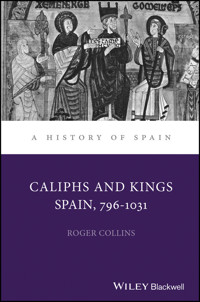
CALIPHS AND KINGS: SPAIN, 796-1031
The last twenty-five years have seen a renaissance of research and writing on Spanish history. Caliphs and Kings offers a formidable synthesis of existing knowledge as well as an investigation into new historical thinking, perspectives, and methods.
The nearly three-hundred-year rule of the Umayyad dynasty in Spain (756-1031) has been hailed by many as an era of unprecedented harmony and mutual tolerance between the three great religious faiths in the Iberian Peninsula – Christianity, Judaism, and Islam – the like of which has never been seen since. And yet, as this book demonstrates, historical reality defies the myth. Though the middle of the tenth century saw a flowering of artistic culture and sophistication in the Umayyad court and in the city of Córdoba, this period was all too shortlived and localized. Eventually, twenty years of civil war caused the implosion of the Umayyad regime. It is through the forces that divided – not united – the disparate elements in Spanish society that we may best glean its nature and its lessons. Caliphs and Kings is devoted to better understanding those circumstances, as historian Roger Collins takes a fresh look at certainties, both old and new, to strip ninth- and tenth-century Spain of its mythic narrative, revealing the more complex truth beneath.
Sie lesen das E-Book in den Legimi-Apps auf:
Seitenzahl: 702
Veröffentlichungsjahr: 2012
Ähnliche




















Contents
Cover
Series
Title Page
Copyright
Dedication
Genealogies
Maps
Introduction
Conquest and Aftermath: New Discoveries and Ongoing Problems
Chapter 1: Al-Andalus
The Annalists
Holy War and Order in Umayyad al-Andalus
The Administration
The Rulers: Al-akam I (796–822)
Abd al-Ramn II (822–852)
Muammad I (852–886) and Al-Mundhir (886–888)
Chapter 2: The Asturian Kingdom
Asturian Sources
Kings and Would-be Kings
Winners and Losers
Alfonso II (791–842)
Ramiro I (842–850)
Ordoño I (850–866)
Alfonso III (866–910)
Chapter 3: The Christians of al-Andalus
Conflict or Coexistence?
A Learned Society
Conversion or Continuation?
The Council of Córdoba, 839
Cultural Survival
Chapter 4: Monks, Books, and Saints in the Christian North
Monasteries
Learning
Buildings
The Cult of Santiago
Mozarabic Style
Chapter 5: Al-Andalus
Umar b. afsn and Regional Autonomy
The End of the afsnid Hegemony
The Expansion of Córdoba
Chapter 6: The Kingdom of León, 910–1037
The New Frontier
The Sons of Alfonso III (910–925)
Alfonso IV (925–932) and Ramiro II (931/2–951)
Ordoño III (951–956), and Sancho I, “the Fat” (956–966) with Ordoño IV, “the Bad” (958–959)
Ramiro III (966–985)
Vermudo II “the Gouty” (982/5–999)
Alfonso V (999–1028) and Vermudo III (1028–1037)
Chapter 7: Al-Andalus
The Golden Age of ‘Abd al-Ramn III (912–961)
An Ethnic Mix
The Jews
The Arabs
The Saqaliba
The Fall of the Umayyad Caliphate
The Sons of al-Manr, 1002–1009
Civil Wars, 1009–1013
Towards the Party Kings
Chapter 8: The Kingdom of Navarre and the Pyrenean Counties, 799–1035
Navarre
The Pyrenean Counties
Chapter 9: The County of Castile, c.860–1037
The Emergence of Castile c.860–932
The Dynasty of Fernán González, 932–1029
The 1030s as a Turning Point
Bibliography
Glossary
Acknowledgments
Index
A HISTORY OF SPAIN
General Editor: John Lynch
Published
Iberia in Prehistory*
María Cruz Fernndez Castro
The Romans in Spain
John S. Richardson
Visigothic Spain 409–711
Roger Collins
The Arab Conquest of Spain, 710–797
Roger Collins
Caliphs and Kings: Spain, 796–1031
Roger Collins
The Contest of Christian and Muslim Spain, 1031–1157
Bernard F. Reilly
Spain, 1157–1300: A Partible Inheritance
Peter Linehan
Spain's Centuries of Crisis: 1300–1474
Teofilo F. Ruiz
The Spain of the Catholic Monarchs 1474–1520
John Edwards
Spain 1516–1598: From Nation State to World Empire*
John Lynch
The Hispanic World in Crisis and Change, 1598–1700*
John Lynch
Bourbon Spain, 1700–1808*
John Lynch
Spain in the Liberal Age: From Constitution to Civil War, 1808–1939
Charles J. Esdaile
Spain: From Dictatorship to Democracy, 1939 to the Present
Javier Tusell
*Out of print
This edition first published 2012 © 2012 Roger Collins
Blackwell Publishing was acquired by John Wiley & Sons in February 2007. Blackwell’s publishing program has been merged with Wiley’s global Scientific, Technical, and Medical business to form Wiley-Blackwell.
Registered Office John Wiley & Sons Ltd, The Atrium, Southern Gate, Chichester, West Sussex, PO19 8SQ, UK
Editorial Offices 350 Main Street, Malden, MA 02148-5020, USA 9600 Garsington Road, Oxford, OX4 2DQ, UK The Atrium, Southern Gate, Chichester, West Sussex, PO19 8SQ, UK
For details of our global editorial offices, for customer services, and for information about how to apply for permission to reuse the copyright material in this book please see our website at www.wiley.com/wiley-blackwell.
The right of Roger Collins to be identified as the author of this work has been asserted in accordance with the UK Copyright, Designs and Patents Act 1988.
All rights reserved. No part of this publication may be reproduced, stored in a retrieval system, or transmitted, in any form or by any means, electronic, mechanical, photocopying, recording or otherwise, except as permitted by the UK Copyright, Designs and Patents Act 1988, without the prior permission of the publisher.
Wiley also publishes its books in a variety of electronic formats. Some content that appears in print may not be available in electronic books.
Designations used by companies to distinguish their products are often claimed as trademarks. All brand names and product names used in this book are trade names, service marks, trademarks or registered trademarks of their respective owners. The publisher is not associated with any product or vendor mentioned in this book. This publication is designed to provide accurate and authoritative information in regard to the subject matter covered. It is sold on the understanding that the publisher is not engaged in rendering professional services. If professional advice or other expert assistance is required, the services of a competent professional should be sought.
Library of Congress Cataloging-in-Publication Data
Collins, Roger, 1949- Caliphs and kings : Spain, 796-1031 / Roger Collins. p. cm. Includes bibliographical references and index. ISBN 978-0-631-18184-2 (cloth) 1. Spain–History–711-1516. 2. Spain–History–711-1516–Historiography. 3. Andalusia (Spain)–History–To 1500. 4. Asturias (Spain)–History–To 1500. 5. Castile (Spain)– History–To 1500. 6. León (Spain : Province)–History–To 1500. 7. Navarre (Spain)–History–To 1500. I. Title. DP99.C584 2012 946′.02–dc23 2011043331
A catalogue record for this book is available from the British Library.
1 2012
For Judith and in memory of Margaret Amy Collins (1929–2011)
Figure 1 Genealogy of the Spanish Umayyads.
Note: Caliphs of the Syrian Umayyad line, from whom the Spanish Umayyads descended, are shown in italic type.
Figure 2 Genealogy of the kings of the Asturias (c.718–910).
Figure 3 Genealogy of the kings of Leon and Navarre.
Map 1 Al-Andalus c.1030.
Map 2 The upper Ebro Valley c.900.
Map 3 The county of Castile.
Map 4 The counties of Catalunya c.1010.
Introduction
In recent years, to bring up the Umayyad period in Spanish history in casual conversation with friends, colleagues, and complete strangers often raises the issue of whether this was indeed that golden age of tolerance in which members of the three Abrahamic faiths of Judaism, Christianity, and Islm coexisted in harmony and mutual respect. To which question there can be but one quick answer, and that is a wholly negative one. If a fuller or more nuanced reply is required, then it would involve saying that if there were any truth in such a notion then it only applied for a very limited period of forty years or fewer in the mid-tenth century, in just one location, the city of Córdoba, and to a very small sector of society, the intellectual elite attached to the caliphal court. Beyond these chronological, geographical, and social confines, life in Umayyad al-Andalus as recorded in our far from insubstantial sources looks more like Thomas Hobbes's war of all against all than a realization of the prophetic vision of the wolf dwelling with the lamb, and the lion lying down with the goat.1
The Arab conquest created the conditions for a state of almost permanent warfare in the Iberian Peninsula that put especial emphasis upon destruction and the display of dead enemies, with a lively slave trade as an additional incentive. This continued throughout the period covered in this book, and in scale and intensity exceeded anything to be found elsewhere in Western Europe in these centuries. Even in Córdoba at its cultural apogee it will have been hard to escape the reek of decomposing flesh from the decapitated heads displayed on the gates and the bodies of those publically crucified, left to rot in front of the palace.
Quite why this roseate image of an age of mutual toleration has taken so strong a hold on the popular imagination both in the United States and throughout Europe is not easy to say.2 Perhaps we would like to believe that something we wish to achieve today once existed in the past, and therefore can seem an attainable goal. Worthy as the ideal may be, it needs to stand on its own two feet and not be made to rely on overly optimistic, and thus anachronistic, readings of the past. If there was a brief flicker of such mutual toleration in the Umayyad period, it was not something that was consciously intended or was recognized at the time.
More generally, the ninth and tenth centuries present particular problems in the compass of a book such as this. While the Visigothic period can be seen in a single focus, and even the eighth century can be treated from the standpoints of just two protagonists, Islamic al-Andalus and the infant Asturian kingdom, from the very start of the ninth century new players enter the game in the form of the Basque kingdom of Pamplona (also called the Kingdom of Navarre) and the Frankish counties of Catalunya, which multiply in number and extent over time. Castile, although formally a component of the Asturian and then Leonese kingdom demands separate treatment from the later ninth century onwards, as does Galicia, while fractures in al-Andalus result in the rise and fall of several regional regimes engaged in complex conflicts with the Umayyad state. There are also divergent cultural bodies within political ones: for example, the Christian population of al-Andalus, the Jewish communities in Córdoba and many other parts of the peninsula, and the Basque and Galician elements within the Asturian-Leonese monarchy.
To construct a simple overarching narrative that encompasses all or most of these long- and short-term political entities is probably impossible and would certainly be tedious and confusing. The alternative approach of focusing individual chapters on some of the major political or cultural components of this violent and fractured society is preferable, though it raises comparable dangers of repetitiveness and structural disorder. To attempt a full narrative of the history of any of the various groups, states, and cultures thus differentiated would also demand a book far longer than this, as can be seen from the numerous multi-volume studies of some of them listed in the bibliography. So, the intention here is to provide examples of differing length and degree of detail with the aim of trying to produce an overview of the social, political, and cultural complexities of the period, and something of the flavor of each, while seeking to avoid repetition and, hopefully, confusion in the mind of the reader. So some topics will inevitably be treated at greater or lesser length than any individual reader may wish, but the bibliography will be the key to further enquiry for those driven to it by either their aroused interest or by annoyance with the author.
In particular, attention is deliberately devoted to questions of the nature of source materials and the interpretation of evidence, as these are at the heart of proper historical enquiry. In a previous volume in this series, the Arabic sources for the conquest of 711 and the decades immediately following were dealt with too dismissively, a feature of the book that was rightly criticized by commentators from outside the Hispanic historiographical tradition.3 However, in the late 1980s, when it was first published, that tradition had yet to come to terms with the idea that these sources, all dating to the tenth century or thereafter, were not objective reports of the events of the early eighth century that just needed to have their narratives rationalized, despite fundamental divergences between them, so as to provide a seamless account of the events and personalities of that period. There was also very little scholarship in general on the history and distinctive characteristics of Arabic historiography, and of what there was hardly any even touched on Andalusi sources.
Fortunately, the situation is much changed and wholly for the better. Much more attention has been devoted to the wider questions of the Arabic historiographical tradition, and also to its manifestations in al-Andalus.4 In particular, it is now widely, though not universally, recognized that different currents of influence were at play and that the variations in the narratives of the conquest and other events represented distinct strands, some coming from outside al-Andalus and others being indigenous creations. Moreover, it is recognized that these historical narratives were the products of and responsive to the particular circumstances in which they were created.5 They are reflections of the concerns of their own day, in most cases the late Umayyad and Ta’ifa periods, and ultimately tell us more about those than about the events they describe. They are mirrors more than they are windows onto the past. Only by working out the preconceptions and purposes of their authors can these texts be safely used for our purposes. The same caveat applies to their role in elucidating the period covered by this book, but, as will be seen, the problems to be faced are far simpler. It can be hoped that these sources will play more of their rightful role here.
More generally, in the text, notes, and bibliography, attention is focused on unpublished as well as published materials, including items that exist in both forms. It is all too easy to rely, for example, on published editions of charters, which indeed serve for many purposes, but there are some questions that have to be asked that can only be answered from the study of the originals; for example, was a particular document actually signed by its witnesses or was it written entirely by its scribe (thus providing a strong indication that it may be a copy and not the original)? Who signed and who made a mark? What was the nature and quality of the parchment used? What other marks or scribbles can be seen on it? How were the signatures actually distributed on the document in comparison with the neat columns that have to be used in a modern edition? Might they, perhaps, have been added at later dates? From the answers to these and other such questions much interesting information can come, and editions can be evaluated in the same way that physical inspection of a codex can add additional dimensions to the study of a text that has been neatened, normalized, and printed in a modern published version. So, too, scholarly study of cartularies must involve the manuscripts themselves as well as their contents, as modern editions, however critical, do not tell the whole story.
Much valuable work has been done in recent decades on the history, art, and archaeology of both Umayyad al-Andalus and the Christian states in the north of the peninsula. This supplements classic treatments of earlier generations of scholars and replaces the work of some of them. On such scholarship, old and new, this book rests. These centuries have not suffered the damnatio memoriae of the Visigothic period and other later phases in Spanish history that have been seen as overly centralizing, imperialist, or too much associated with the intellectual fashions of the Franco era.6 Quite the contrary, the strongly regionalized and diverse nature of the history of these two centuries has added to their appeal. Not everything has been ideal. Some opportunities for archaeological knowledge have been lost forever through over-hasty development, and others languish thanks to funding problems now common to many parts of Europe. There has been particular dynamism in the publishing of editions of documents and other sources, but sometimes in runs so small that the volumes have become bibliographical rarities before most interested scholars know they exist. Overall, however, the study of the period covered by this book has been dynamic, as may be clearly seen from the select bibliography provided, and it promises to continue so.
Conquest and Aftermath: New Discoveries and Ongoing Problems
Traditionally, the Arab conquest of Spain that began in 711 has been seen as one of the most significant turning points in the history of the Iberian Peninsula.7 The rule of a Romano-Gothic elite and adherence to a Christian orthodoxy defined by the bishops of Toledo, the political capital of a kingdom that embraced all of the peninsula other than some areas in the western Pyrenees, had formed the basis of a relatively coherent social and cultural order, but this was replaced surprisingly rapidly by a completely different one, represented by a new governing class and a new dominant religion, as well as by the loss of political and cultural unity, which it would take over eight hundred years to reverse. So, it is hard not to see the events of 711 as marking a major turning point, possibly the most dramatic of all, in Spanish history, comparable not least to those of 1492.
Yet such a perspective is both the product of hindsight and primarily a reflection of the viewpoint of a small social elite, consisting of perhaps just the few dozen families that had constituted the court nobility of the Gothic kingdom.8 Questions of continuity and discontinuity across the divide marked by the Arab conquest will receive different answers when posed in different contexts. For that small social elite that dominated the royal court in Toledo and from whose ranks most of the Gothic kings were drawn the conquest was clearly a disaster because of the ensuing loss of political power and inherited wealth. Hardly any trace of this aristocracy can be found after the conquest. The widow of the last king, Roderic, is said in some Arabic sources, which name her as Umm-Aim or Egilona, to have married the son of Msa b. Nuayr, the governor of Ifrqiya responsible for the conquest, only for ’Abd al-Aziz b. Msa to be killed by his own men for trying to establish a monarchy for himself.9 Whether this is true in an absolute sense, as opposed to the story being an allegory of the rejection of continuity with the personnel and practices of the defeated Gothic regime, cannot be known.
Another, far more dubious, representative of that old order who appears in some of the Arabic narratives is the so-called Sara the Goth, a supposed granddaughter of the penultimate Gothic king, Wittiza. She is described as the ancestress of a late tenth-century Hispano-Muslim family and as a great landowner in her own right who went to Damascus in person to have her rights of property confirmed by the caliph himself. At least two other families, one Christian and the other Muslim, were claiming descent from sons of Wittiza in the same period, but without similar detailed tales about these obscure if illustrious forbears. In general, mythical ancestors need to be treated with considerable caution in almost any context.
While questioning the reality of both Egilona (though hers is the more credible name) and Sara, it is worth noting that the most conspicuous putative members of the former Gothic palatine elite in the post-conquest narratives are women. While some of the estates and portable wealth of this aristocracy may have simply been confiscated by the conquerors – we just do not know one way or another to what extent this happened – marriage to heiresses of such families was an alternative means by which the new elite could secure the property of the old. As the processes of settlement in the decades following the conquest involved soldiers rather than migrants, intermarriage with the indigenous population must have taken place from the earliest stages, with the small Arab, as opposed to Berber, ascendancy being best placed to secure the most desirable (from an economic point of view) of the potential wives.
If some of the female members of the old Romano-Gothic elite transposed their families into membership of the new ruling class in this way, their male equivalents disappear from the record, either dispossessed or economically and socially downgraded. But while these events subverted the social and political standing of the old palatine or court aristocracy, were they as damaging to the provincial elites? These were the families whose wealth and influence were concentrated in particular regional contexts, and who may have been the local allies of particular court factions or royal regimes. While our evidence relating to named individuals and to identifiable families in the late Gothic kingdom is slight, the existence of such regional potentates is not hard to detect. In some cases there may have been intense local rivalries for influence and status, with royal patronage and appointments to secular and clerical offices being used to build up the kind of networks of kingdom-wide alliances previously mentioned, upon which a particular king and his palatine supporters depended. A change of monarch could lead to sweeping reversals of local fortune, with office holders such as counts and fiscal officials being replaced by members of rival families.
Just as the Gothic kings and court aristocracy needed the support and cooperation of significant elements in the local elites in all the provinces of the kingdom, so too did the Arab conquerors require similar assistance in governing their newly acquired territories. Obscure in reality and overelaborated in later narratives as the actual events of the conquest may be, it is clear that it was carried out by relatively small forces that had only recently been established in the Tangiers peninsula themselves and consisted mainly of Berbers from the regions of modern Libya and Tunisia.10 Only certain key towns and fortresses, above all Toledo, were captured and garrisoned in the course of the campaigns from 711 to 721 that put an end to the Gothic kingdom both in the Iberian Peninsula and in the former Roman Septimania across the eastern Pyrenees. As the conquest rolled northwards and then eastwards it was necessary for most towns and regions to be left to look after themselves, so long as they were prepared to collaborate, as it would have been impossible to garrison all the settlements. As is well known, this was achieved through the making of treaties with local potentates, the best known of whom is the Count Theodemir, who controlled six small towns in the southeast.
Doubts have been cast on the reliability of the texts of the early treaties of capitulation made during the Arab conquests in the Near East and along the southern shores of the Mediterranean, of which that agreed with Theodemir is the only Spanish example.11 However, while we should not necessarily rely on the details of this particular treaty, which mirrors those said to have been made elsewhere in the seventh and eighth centuries, it is probably safe to assume that the basic principles it enshrines are sound: that local self-government was preserved in return for an undertaking not to try to impede the conquerors militarily and to pay the new rulers stipulated taxes, replacing those that would in any case have been paid to the previous regime.
As he was holding the office of count, Theodemir must have been an appointee of the last Gothic king. It was local officeholders like him, who were in post at the time of the conquest, who became the main beneficiaries of its consequences, as their local status was confirmed by the agreements made with the conquerors, whose local agents they became. So, apart from the small number of major towns – Córdoba, Toledo, Zaragoza, and Barcelona in particular – that were captured and occupied, in most other parts of the former Gothic kingdom the old order was left in place, but answering to different rulers.
What happens to these local elites in the generations after the conquest is not clear as there are few indications of long-term continuity. But this may be deceptive. As already mentioned, the conquest of 711 to 721 and the campaigns that followed in southern and western France in the 720s and early 730s were carried out by a relatively small number of troops. There is no mention in any of the sources of significant reinforcements arriving in Spain during this time. The next wave of migration was similarly military in character. In 741 some units of the army sent from Syria by Caliph Hishm to crush the Berber revolts in Ifrqiya were detached to deal with a similar outbreak amongst those in the Tangiers peninsula. But following the resounding defeat of the caliph's troops in Ifrqiya, this force, commanded by Balj b. Bishr, was left cut off in the far west. As a similar Berber revolt was already under way in al-Andalus (the Arab-ruled territories in the Iberian Peninsula), an agreement was made to bring Balj's men across the straits to fight against the Berber rebels in Spain. Here this small army remained, despite some intense fighting both against the Berbers and then against the descendants of the conquerors of 711, who did not want to have to surrender any of their own territorial spoils in order to accommodate the newcomers.
These two episodes (the initial invasion of 711 and the arrival of Balj's Syrian army in late 741) are the only two large-scale movements of new population into al-Andalus recorded in our sources in the eighth century. Even when the Umayyad refugee ’Abd al-Ramn crossed from North Africa to al-Andalus in 756 to lead his successful revolt against the last of the governors, he is not described as arriving with a large following. His support seems to have derived primarily from the contingents from his native Syria who had settled in Spain in 741. In fact, after the arrival of Balj and his forces in that year, the next recorded migration of any size is that of a new wave of Berber settlers invited into al-Andalus by the Umayyad regime in the later tenth century.
While individuals, families, and other small groups could have arrived more or less continuously in al-Andalus from elsewhere in the Islamic world from 711 onwards without making any mark in our limited sources, the scale and significance of such movement should not be exaggerated. Apart from the Tangiers peninsula, most other regions of what today are western Algeria and northern Morocco were not brought under Arab rule before the late eighth century, and the impact of Islm on them was relatively slow. So, migrants to al-Andalus will have had to travel from Tunis, roughly a thousand miles to the east, and almost certainly they would have had to make the journey by sea. Also, if al-Andalus was the “wild west” frontier of the caliphate, it certainly did not offer adventurous immigrants the prospects of unlimited wealth or social advancement. Quite the opposite: it may have been one of the least appealing places in the whole of the Arab world.
The two migrations were clearly different in composition. That in 711 consisted of a relatively small dominant group, mainly composed of mawali, that is to say, former slaves or their descendants affiliated to Arab tribes. Many of these had family connections with Ifrqiya, with which they would maintain close contacts until the middle of the eighth century. Accompanying them was a much larger body of Berbers, who served as the main garrisoning forces in the center and the north of the peninsula and in the Pyrenees in the years after internal resistance had been crushed. There is evidence from at least one archaeological site implying that the Berber soldiers brought their families with them.12 This, together with other cultural differences, may have restricted their assimilation into the indigenous society of the peninsula.
There is no way of knowing the size of the Berber population or its precise tribal composition, but it cannot have been very large, as the evidence suggests that these contingents came from Ifrqiya or even Tripolitania (Libya), and in any event many of them were destroyed or deported during and after the crushing of the Berber revolt in the early 740s. It is likely, for example, that at that time many of the Berber garrisons in the far north of the peninsula disappeared, facilitating the expansion of the small Christian kingdom that came into being in the Asturias.
Balj's Syrian army, on the other hand, had no known Berber component, not least because its original purpose was to assist in crushing the Berber revolt in Ifrqiya. Its arrival in al-Andalus thus introduced what may have been an exclusively Arabic-speaking body of men, but one whose members were linked by family and tribal ties to Syria rather than Ifrqiya.13 It should be noted that neither of the two waves of Arab immigration is likely to have included many, or indeed any, whose ancestors originated in the Arabian peninsula. Like Msa b. Nuayr himself, most were mawali, affiliated to Arab clans through ties of clientage. In other words, their ancestors were amongst those inhabitants of Byzantine and Sasanian Persian territories who had been captured and enslaved in the early phases of the Arab conquests in the Near East from the 620 s onwards and who were subsequently granted their freedom, but as perpetual clients of the clans that had once owned them.14
Now immersed in their new tribal identities, in some cases three or four generations old, such Arab freedmen formed the military elite that directed the subsequent conquests and administered the conquered lands on behalf of the Umayyad caliphs. It is not clear how far similar processes took place in al-Andalus in the eighth century, with members of the indigenous population being absorbed into an Arab identity through clientage.15 That something of the sort occurred is suggested by the evidence of the far more prolific sources of the late tenth and eleventh centuries relating to a supposed settlement of substantial numbers of members of different Arab tribes in many parts of al-Andalus.
As has been stressed, there were only ever two waves of migration, and both were small, certainly in relation to the size of the indigenous population. No further large-scale immigration is recorded, other than for the deliberate encouragement of settlement by a new wave of Berbers – this time from what is now northern Morocco – in the later tenth century. So, the presence of a substantial self-identified Arab population in the eleventh century is not the result of any earlier mass migration and would be better ascribed to alternative processes of assimilation of leading elements amongst the indigenous inhabitants of the peninsula, along with their dependents. When this took place is also uncertain, but enslavement of captives was certainly a feature of the conquest itself, as it extended across the Iberian Peninisula and then after 721 into southwestern France.
Archaeological evidence for continuity and discontinuity across the period of the conquest and the decades that followed has proved ambiguous in some respects. In the early 2000s it seemed that there were some significant pointers to aspects of the coexistence of the new conquerors and their subject population. In at least two cases earlier buildings, including a church, seemed to have been reused as mosques, with small mihrabs created in the existing structures to indicate the direction in which the Muslim worshippers should pray. However, in the case of the tiny church of El Gatillo, in the province of Cáceres, a further investigation now suggests that what was thought to be a mihrab was actually an indentation in the wall created to support a new font, probably erected to replace an earlier baptismal pool.16 So, the evidence here relates to changes in Christian baptismal practice, not to a Muslim reuse of a church. Interestingly, the new study shows that at some point the building ceased to have any religious significance and possibly became a seasonal dwelling, occupied by four or five different sets of inhabitants, each with their own hearth.
Evidence for apparently simultaneous Muslim and Christian use of a formerly uniquely Christian cemetery in the outskirts of the old Roman town of Segobriga is equally open to question, as there is no unambiguous evidence about the nature of Muslim burial practices before the late eighth century, by which time this particular cemetery may have been out of use.17 Changes in orientation and the placing of the body within its tomb do not of themselves necessarily establish the religious affiliation of the person thus buried. A cemetery in the province of Madrid associated with a small rural settlement of Visigothic origin, for which no trace of discontinuity in any other form can be found, has been shown to exhibit what are seen as characteristic Muslim burial practices in an eighth-century phase. While interpreted as implying a total conversion of the local population to Islm, this would be to say the least surprising at this date for a non-urban community with no close links to a major Muslim center. It may just be that the burial practices in question are non-diagnostic of religious affiliation.
Where continuity has been established is in the occupation of several major settlements, despite evidence for urban decay in some of them in the late Visigothic period. A good example is the presumed site of Reccopolis at Zorita de los Canes in the Province of Guadalajara.18 Although the results of earlier excavations were never able to be published, more recent work on parts of the site that had previously been left untouched has shown that the main building of the town, thought but never proved to be a palace, continued in occupation well on into the eighth century, though the upper floor seems to have collapsed or have been abandoned by the middle of it. Similar indications of continuous habitation have been found at several other sites, ranging from Tolmo de Minateda, the former Roman–Visigothic town of Eiotana, to a substantial suburb of Toledo, containing what may have been the former royal palace and the “Praetorian” basilica, as well as that of St Leocadia.19 From these and other examples it is fair to say that the events of the conquest and its immediate aftermath did not lead to a major change in the patterns of urban settlement as they had existed in the late Visigothic period.
Discontinuity can be detected in all these and other locations soon after, starting in the middle decades of the eighth century, and was perhaps prompted in some cases by the outbreak of the Berber revolt and then the civil wars between the Arab factions that followed during much of the 740s. Add to these the campaigns of ‘Abd al-Ramn I from 756 to the late 770s aimed at imposing his rule on all parts of al-Andalus and you have the makings of a period of serious turbulence.20 More significant still, though little noted in our sources, may be the local consequences of the breakdown of order that was caused by the disappearance of central authority for most of the middle decades of the century.
Occupation of several of the former Roman- and Visigothic-period towns in the central parts of the Iberian Peninsula, such as Termantia, Segobriga, Reccopolis, and Ercavica, ends in the eighth or early ninth centuries. The only reservation being that traces of continuing use of the sites may yet be discovered by archaeologists, but as none of these settlements was ever revived in the Middle Ages or later the assumption that it was in this period that they were finally abandoned is not unreasonable. Elsewhere, the disappearance at this time of the previously high-status suburb of Toledo argues for urban contraction and also for greater concerns with defensibility. In several other instances, once substantial but strategically poorly located settlements, like Reccopolis, were deserted by their inhabitants in favor of smaller but more easily defended locations nearby. In the case of Reccopolis, its abandonment by the end of the eighth or early in the ninth century is followed by the appearance of the fortified village of Zorita de los Canes only about a kilometer to the west.21
Where occupation of a town can be proved to be continuous, evidence of contraction and decline is also usually found, as in the case of Mérida, where recent excavation has shown that in the reoccupation of the sector of the city adjacent to the southern walls flanking the river Guadiana no attention was paid to the presence of earlier Roman streets, with new houses being built over parts of them and new lanes being created between them. This indicates that much or all of the former street layout had been lost to view in the preceding period, buried, it may be assumed, under debris, detritus, and earth. This period of abandonment in this section of the city may have begun in the preceding Visigothic period, but was not reversed until the ninth century.22
Evidence relating to rural settlements is harder to find, as it is only in recent years that a handful of small hamlets and villages of Visigothic date have been discovered in several parts of the center of the Peninsula.23 In a very few cases these have provided evidence of continuous occupation into the eighth century. So we do not have anything like enough information at the moment to be able to generalize about questions of continuity in the countryside. However, the very unsettled nature of much of the eighth and ninth centuries, with periods of intense local disorder and the frequent passage of armies needing to support themselves, suggests that the small, undefended rural settlements of the Visigothic period would not have been suited to survive the changed conditions. Only with the restoration of more centralized government by the Umayyads and their creation of new structured defensive arrangements for the protection of towns and their hinterlands, at least in the frontier regions, would life in the countryside in al-Andalus became more secure.
It is very difficult to recover much about the nature of town life in the eighth and ninth centuries, let alone that of the countryside, as the literary sources, which are all later in date, are limited and full of interpretational problems, and archaeological evidence is slight, though growing. It is certainly unwise to try to envisage conditions in this period as being fundamentally similar to the very changed ones of the mid- to later tenth century. That is the period that has given us most of our impressions of life in Umayyad al-Andalus, both in material terms – the surviving buildings and artifacts – and in cultural and intellectual ones. But this evidence is specific in both time and place. Even in the heyday of Umayyad power, conditions outside the capital and the royal palace cities are either little known to us or can be shown to be markedly different. So we must not be beguiled into viewing al-Andalus in the eighth to eleventh centuries through the distorting prism of evidence relating to a very small area of it during a very short time.
For the earlier period the literary evidence still focuses primarily on Córdoba, and reference to other towns is usually brief and tends to be confined to a handful of them. Thus, for example, we may hear about intercommunal violence in Toledo, but we have no way of knowing what sparked it and what were the relative sizes, distribution, and economic standing of the different communities forming its population. Even for Córdoba such information is generally lacking, but clearer answers can be given to some of these questions during limited and specific periods, such as that of the Martyr Movement that affected the Christians in the city in the mid-ninth century.
1. Isa. 11:6.
2. Menocal, Ornament of the World is perhaps the best known exposition of this view.
3. E.g. Brett, Journal of the Royal Asiatic Society, 273–276.
4. Robinson, Islamic Historiography.
5. See Clarke, “Medieval Arabic accounts,” 41–57 and Clarke, Muslim Conquest.
6. See Collins, Visigothic Spain, 2–4.
7. As this series’ volume on the eighth century, Collins, The Arab Conquest of Spain, 710–797, was first published in 1989, I am taking this opportunity to update some of the arguments and information relevant to the understanding of the period covered by the present book.
8. Collins, Visigothic Spain, 92–143.
9. In, amongst others, Lafuente y Alcántara, 20 (trans., 31 ).
10. Collins, Arab Conquest, 28–32.
11. On this topic see Robinson, Empire and Elites, 6–15.
12. This can be deduced from the Islamic cemetery dating from the mid-eighth century excavated in Pamplona in Navarre: Faro Carballa, García-Barberena Unzu, and Unzu Urmeneta, 97–138, especially 114–124.
13. See Manzano Moreno, Conquistadores, 129–139.
14. Crone, Slaves on Horses, 49–57.
15. Manzano Moreno, Conquistadores, 139–146.
16. Caballero Zoreda, Pervivencia de elementos, 1: 113–134; Caballero Zoreda and Sáez Lara, “La iglesia,” 155–184.
17. Halevi, Muammad's Grave, for the nature and development of these rites.
18. Olmo Enciso, “Proyecto Recópolis,” 209–223; Olmo Enciso (ed.), Recópolis.
19. Abad Casal, Gutiérrez Lloret, and Sanz Gamo, 115–125; Rojas Rodríguez-Malo, and Gómez Laguna,” 45–89.
20. See Collins, Arab Conquest, 168–182 for this interpretation.
21. Olmo Enciso, “Proyecto Recópolis,” 216–218.
22. Alba Calzado, “Ocupación diacrónica,” 285–315.
23. Vigil-Escalera Guirado, “El poblamiento rural,'' 205–229; also Vigil-Escalera Guirado, “Noticia preliminary,” 21 (2004): 57–61.
1
Al-Andalus
War and Society, 796–888
The Annalists
The problems we face in using the Arabic sources for the history of al-Andalus in the ninth to eleventh centuries are both fewer and simpler than those met with in trying to make sense of the preceding period of the conquest, the rule of the governors, and of the first two Umayyads (711–796).1 But we need to understand the purposes for which they were written and the relationships between them. Some of the earliest historical writings in al-Andalus were composed to resolve legal questions rather than provide factual narratives of events for their own sake. By the early part of the tenth century, however, Andalusi historians were motivated by rather different concerns and began using the relatively copious records of the Umayyad court to produce substantial narrative works containing detailed information on a number of specific topics. These included the appointments made by the ruler each year to military commands and to judicial and administrative posts; the deaths of distinguished individuals; and the aim, course, and outcome of any military expeditions, including the numbers of “infidels” killed and captured.2 The practice of compiling such lists goes back to the earliest phases of Islamic historiography in the mid-eighth century.3
Based on such yearly records kept by the Umayyad administration, these narrative histories generally took an annalistic form and structured their content into annual units. Only when a ruler died would this pattern be modified, when reports of his life, his wives, his children, his age and appearance, and the chief ministers who had served him would be included in a round-up section added to the appropriate annal. This pattern of historical writing was definitely not unique to al-Andalus, having first emerged around the middle of the eighth century in Syria, quite possibly influenced by the Syriac tradition of annal writing. It developed gradually into its full-grown form in the work of writers such as al-abar (d. 923) in the ‘Abbsid caliphate from the early ninth century onwards, and its Western equivalents generally followed a generation or more later.4 Indeed, some of the Andalusi historians wrote with the deliberate aim of providing information on Western events largely overlooked by their ‘Abbsid predecessors. Such a genesis in the official records of the Umayyad court makes the work of these historians extremely valuable, though it has to be accepted that the details given in government reports can be exaggerated, especially when it is a matter of publicizing the dynasty's achievements.
A more serious problem than allowing for propagandistic distortion of the details of military and other achievements is the fact that many of these works have been lost or survive only as fragments preserved in the larger-scale compilations of later generations of historians. Inevitably this raises the question of how such excerpts were made. Were they verbatim or did a later writer edit or condense the text he was borrowing, possibly interpolating other material? In some cases the survival of fragments of a work permits comparisons with the way it was used by later writers and thus reveals how faithful they were to the texts they were copying or excerpting.
For example, only some sections of the work of the most important Andalusi historian for this period, Ibn ayyn (d. 1076), have survived intact, but the whole of it was used as a source by a North African annalist, Ibn ‘Idhr, who was writing in 1313/4.5 Where direct comparison can be made, it is clear that sometimes Ibn ‘Idhr lightly condensed his predecessor's work but did not otherwise change or distort the information he took from it. However, it would seem that Ibn ayyn was not Ibn ‘Idhr's only source, as the latter's work includes information not found in the earlier author. As he did not name his informants, we can only guess at whom these others may have been. So, we cannot simply use Ibn ‘Idhr's text as a means of reconstructing the lost sections of that of Ibn ayyn.
A general problem with the narrative sources for the history of al-Andalus that may surprise Western medievalists is their limited manuscript survival. Most equivalent Latin historical texts, from any period and almost any part of medieval Christian Europe, normally survive in more than one manuscript copy, and most of them are preserved in many. In most cases, too, at least some of these copies were written close to the lifetime of the author, and in a few instances include authorial originals. The rate of survival of not only Arabic but also Latin works written in al-Andalus in these centuries is generally rather low. In many cases such texts are now only found in a single manuscript, which is usually several centuries later in date than the period of original composition.
A good but not untypical example is that of what is probably the only surviving section of the seventh book of the Muqtabis of Ibn ayyn, which covers the history of the Umayyad court in the years 971 to 975 in remarkable detail. This came to light during a visit by the foremost Spanish Arabist of the day, Don Francisco Codera (1836–1917), to Algeria and Tunisia in 1886. His journey was sponsored by the Real Academia de la Historia in Madrid and aimed at the discovery of manuscripts containing Arabic historical texts relating to al-Andalus. Alerted to the existence of two such codices in the Algerian town of Constantine (Qusan⃛nah), he tried to purchase them via the local Spanish vice-consul, who made the necessary enquiries. The owners, the “heirs of Sdammda,” would not sell but allowed the vice-consul to keep the two manuscripts for a fortnight. By the time Codera was informed and made his way to Constantine, only four of those days remained. He recognized the importance of the finds, especially of the section of the Muqtabis that formed part of the contents of one of them, and commissioned a local scribe named al-Fakkn to make a copy, to be sent on to him in Madrid in due course.6
More leisurely study of that copy, completed in 1887, revealed, from a dated colophon, that the manuscript in Constantine was itself a copy of an original made in Ceuta in 1249. But when the manuscript in Constantine owned by the heirs of Sdammda had been written could not be established. It itself vanished sometime after the 1887 copy was made. Codera was pleased with al-Fakkn's calligraphy, but when it was examined more closely with an eye to an edition of the text, the intending editor, Don Emilio García Gómez (1905–1995), said that al-Fakkn had “copied mechanically, without understanding much of what he was writing; he took no account of the disordered state of the original” – many of the folios being in the wrong order. Another distinguished scholar characterized it as “a bad copy” and “almost useless.”7 Yet this is all we have, as far as this text is concerned: a poor copy made in 1887 by a semi-literate scribe, which requires substantial editorial alteration of its text to make sense of the contents. The undated manuscript from Constantine, the manuscript from Ceuta of 1249 that it copied, and Ibn ayyn's authorial original from the eleventh century are all lost.8
As the study of better preserved texts shows, the process of copying results in the introduction of new errors each time it occurs, and a modern edition would normally rely on many or all of the extant manuscripts in attempting to reconstruct the author's original version. Where a work only survives in a single, late manuscript, it can be assumed that its text will have been corrupted by several generations of scribal errors, affecting names of persons and places in particular, as these are the most prone to such corruption. In addition, when a work is only to be found in a single and relatively late manuscript, as for example with the earliest surviving section of that of Ibn ayyn referred to above, we cannot be confident that we possess the most authoritative version of it. Thus, it could be that the material in the comparable parts of Ibn Idhr not found in Ibn ayyn, and which we therefore deduce must have come from another source or sources, actually derives from a fuller or less corrupt version of Ibn ayyn's text than the one contained in our sole manuscript of it.
Where the scholar working on Arabic texts can have a hypothetical advantage over one studying medieval Latin ones is that there is a much greater chance of new manuscripts being discovered. In particular, the recent revelation that large libraries of Arabic manuscripts have survived in mosques and madrassas in parts of West Africa, particularly in Timbuktu in Mali, is of particular significance for those interested in al-Andalus, in the light of the close political and trading links between these two areas in the Almoravid (1090–1147) and Almohad (1147–c.1220) periods, and the fact that Andalusi refugees certainly took manuscript books with them into exile in northern Africa in the centuries that followed.9
The earliest phase of historical writing in al-Andalus was prompted primarily by legal debates, such as whether a particular territory had been conquered forcefully or had submitted willingly following an initial Arab victory. On the answer to this depended many practical issues, such as the nature and extent of tribute to be levied and its distribution amongst the conquerors and their heirs. Thus our first Andalusi historical narratives, such as brief Khatb al-a’rikh or “Book of History” of ‘Abd al-Mlik ibn abb (d. 853), focus primarily on the conquest period and include much legendary material.10 Unfortunately, while it would be anachronistic to expect them to provide us with a coherent account of the events of the early eighth century, some scholars are convinced there is still a baby in the bath, and so wish to retain elements of these narratives, such as the roles played by Count Julian, “Sara the Goth,” and the supposed sons of Wittiza, while rightly rejecting such totally fanciful features as the Table of Solomon and the sealed chamber in Toledo.11
Not surprisingly, the chronological phases of the growth of historical writing in al-Andalus follow two generations or more behind equivalent developments in Egypt or the Near East and are directly influenced by them.12 The ninth century has been described as “the golden age of conquest narratives,” but most of these ignored events in North Africa or Spain.13 This prompted some Andalusis to try to provide supplements to the narratives of Eastern authors who had omitted the West. An early inspiration to them was the Egyptian Ibn ‘Abd al-akam (d. 870/1).14 Because of the administrative dependence of the governors of Ifrqiya and al-Andalus on the wali of Egypt, who was effectively the caliphal viceroy in the west, African and Spanish affairs feature in his narrative.
The author of the earliest substantial narrative history of al-Andalus was probably Amad al-Rz, who died in 955. The son of a merchant, originally from the Near East, who had also worked as an Umayyad spy in North Africa, Amad was only aged three when his father died in 890. He was brought up on the fringes of the royal court in Córdoba, sharing a tutor with the future amr and caliph ‘Abd al-Ramn III (912–961). His connections and possible government service allowed him access to official records, from which he compiled a set of annals, probably extending from the time of the conquest up to his own day. It was continued by his son Isa al-Rz (d. 980), whose part in the combined work may have begun with the accession of ‘Abd al-Ramn III. This section was more detailed; it also shows the influence of cultural interests of the last years of the reign of ‘Abd al-Ramn III and, even more so, that of his son, the caliph al-akam II (961–976), to whom it may have been dedicated. This is most obvious in the inclusion of some Christian Spanish Era dates as well as those of the Hijra and in the much fuller and generally reliable reports of events taking place in the Christian realms in the north. This increased interest partly reflects the closer, if not always amicable, relations then existing between them and Umayyad al-Andalus, but also the caliph's own concern for finding out more about the history of Spain before the conquest of 711 and about that of other lands outside his own. He is recorded as having commissioned the translation of a work on the history of the Franks by a Catalan bishop called Gotmar (938/941–951/2).15 This text is also said to have been used by the Iraqi historian al-Ma'sd.16 A brief but comprehensible narrative of the kings of Visigothic Spain found in the annals of Ibn al-Athr (d. 1233) may also ultimately be traceable back to al-Rz, who used both Visigothic and contemporary Christian-Arabic sources.
The historical and topographic compilation made by Amad and then continued by Isa al-Rz no longer survives as an independent work in its own right: a problem that affects several of the earlier and more valuable narrative sources for our period. A much abbreviated version of the part of it compiled by Amad al-Rz was translated into Portuguese around 1300 at the court of King Dinis, but even that is now only extant in a Spanish translation made c.1425/30.17 A better textual survival has been enjoyed by those extracts from the annals of both of the al-Rz that were incorporated into the work of later Arab historians, of whom the most significant by far is Ab Marwn ibn ayyn (987–1076), about whose life little is known.18
He was the author of numerous works on a variety of subjects, including Arabic grammar and verse, most of which have been lost. As a source for the history of al-Andalus, his Khatb al-Muqtabis fia’rikh al-Andalus (“Book of the Seeker after Knowledge of the History of al-Andalus”), probably divided into ten separate parts or books, is in practice the most important of his writings, although it is only partially preserved.19 He was also the author of a larger historical work entitled Khatb al-Matn (“The Solid Book”) which is said to have consisted of no less than sixty parts, but this is almost entirely lost, other than for some excerpts in later texts.20 Although it used to be thought that the Muqtabis was an early work and the Matn a late one, recent arguments have shown that both only reached their final form in their author's last years, probably in the later 1060s, and that the difference between them lies in the organization of their contents, with the former being an explicit compilation of earlier texts and the latter a reworking of them into a seamless narrative, with more original contributions by Ibn ayyn himself.21 Both were structured in the form of annals. In its present state the Muqtabis, as it is generally known, commences with the first half of its second book, starting at the accession of al-akam I in 796 and ending in 847. The third book, which is very brief, deals with the reign of ‘Abd ‘Allah (888–912), and the fifth covers the first thirty years of that of his grandson and successor, ‘Abd al-Ramn III, from 912 to 942. A final surviving section from Book Seven deals with the events of 971 to 975.22
Highly regarded for both his literary style and his qualities as an historian by medieval Arab biographers and modern scholars alike, Ibn ayyn followed Isa al-Rz in structuring his work as a set of annals. However, he also incorporated into them large extracts taken apparently verbatim from the writings of both of the al-Rz and of other less well-known predecessors. These borrowings are quite explicit, with their authors named, and they are inserted into the text at the appropriate chronological point in the overall narrative. His work, including his own original sections that may have related primarily to the period from 976 onwards, became in turn an authority for several other historians, writing in later centuries and in areas ranging from al-Andalus to Iraq. Not only was he used by Ibn ‘Idhr and Ibn al-Athr, he was an acknowledged source for the Granadan historian Ibn al-Khatb (1313–1374), the Berber polymath Ibn Khaldn (1332–1406), and Muammad al-Maqqar (d. 1632) from Tlemcen, amongst others. Some preserve particular sections of his work more fully than the rest.
While it will become obvious that our Arabic sources for the history of al-Andalus, and indeed the history of the whole of the Iberian peninsula, in this period are far more substantial, wide ranging, and generally reliable than the Latin ones produced in the Christian states in the north, there is a corresponding lack of documentary records. Charters abound from the late eighth century onwards in the Asturian kingdom and its Leonese successor, and even more so in the Catalan counties of the eastern Pyrenees. These record legal transactions of every sort, and in so doing give us insights into the social and political organization of these regions at a micro-level that is entirely lacking in the study of al-Andalus. The explanation for this absolute divergence in the survival of evidence is simple. Such documents were preserved in the Christian realms because they continued to be potentially useful as evidence for rights to property, showing how it had been acquired and what challenges had been faced. On the other hand, the legal records of the Muslim states ceased to have validity as each in turn fell into Christian hands over the course of the medieval centuries. There was thus no incentive to preserve them, and in some circumstances good reasons to destroy them. The same applies to other governmental records of al-Andalus, with the exception of some informal diplomatic correspondence in Latin sent by Christians in the service of Caliph ‘Abd al-Ramn III to the Count of Barcelona, preserved in the Archivo de la Corona de Aragón.23
In consequence, we lack the kind of evidence in al-Andalus for local society, its ethnic composition, naming practices, land holding, economic exchanges, pious giving, social structures, legal and other values, and much else besides that can be recovered to a much greater extent from the documentary records of the Christian north. Only in a few cases, such as that of Huesca following its conquest by the Atagonese in 1096, is it possible even to glimpse earlier patterns of property ownership from the documents recording its redistribution amongst the conquerors.24 Overall, while the politics and military activity of the Umayyad court can be depicted, sometimes in a remarkable degree of detail, knowledge of Andalusi society and its economy at the local level is at best thin and generalized.
To this deficiency archaeology can provide a partial remedy. As well as illuminating the spatial organization of sections of some towns and cities, of varying size, location, and importance, excavation of certain sites has produced much useful evidence of some of the material culture of this period. This includes the discovery of wares, mainly pottery, produced in other centers and imported into al-Andalus, not least from the eastern Mediterranean.25 It is also possible to achieve some sense of internal trade patterns, from the evidence for the distribution of wares whose production is associated with a particular place or region within the peninsula – for example, Elvira/Granada.26




