


17,99 €
Mehr erfahren.
- Herausgeber: John Wiley & Sons
- Kategorie: Fachliteratur
- Sprache: Englisch
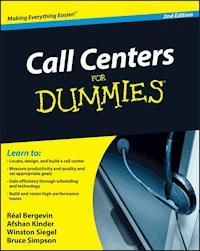
Tips on making your call center a genuine profit center In North America, call centers are a $13 billion business, employing 4 million people. For managers in charge of a call center operation, this practical, user-friendly guide outlines how to improve results measurably, following its principles of revenue generation, efficiency, and customer satisfaction. In addition, this new edition addresses many industry changes, such as the new technology that's transforming today's call center and the location-neutral call center. It also helps readers determine whether it's cost-efficient to outsource operations and looks at the changing role and requirements of agents. * The ultimate call center guide, now revised and updated * The authors have helped over 60 companies improve the efficiency and effectiveness of their call center operations * Offers comprehensive guidance for call centers of all sizes, from 20-person operations to multinational businesses With the latest edition of Call Centers For Dummies, managers will have an improved arsenal of techniques to boost their center's bottom line.
Sie lesen das E-Book in den Legimi-Apps auf:
Seitenzahl: 542
Veröffentlichungsjahr: 2010
Ähnliche



















Call Centers For Dummies®2nd Edition
Table of Contents
Introduction
About This Book
Foolish Assumptions
How This Book Is Organized
Part I: From the Ground Up: An Overview of the Call Center
Part II: The Master Plan: Finance, Analysis, and Resource Management
Part III: Making Life Better with Technology
Part IV: Creating High-Performance Teams
Part V: Ensuring Continuous Improvement
Part VI: The Part of Tens
Appendixes
Icons Used in This Book
Where to Go from Here
Part I: From the Ground Up: An Overview of the Call Center
Chapter 1: A First Look at Call Centers
Defining Call Centers
Inbound, outbound, or blended
Contact or call center: What’s in a name?
Tripping Down Memory Lane: The Evolution of the Call Center
Moving from low-tech to high-tech
Moving from cost center to profit center
Meeting legal and image challenges
Today’s call centers: Ringing up big numbers
Making Call Centers Work
Identifying good call center managers
Defining the culture
Understanding What Makes Call Centers Good or Bad
Characteristics of a good call center
Characteristics of a poor call center
Chapter 2: Business Basics: Models and Drivers and Goals, Oh My!
Creating a Call Center Business Model
Developing your mission
Dissecting a typical call center mission
Determining Your Business Goals
Defining a good objective
Avoiding misleading measures
Considering service level
Flowing goals through the accountability funnel
Measuring Progress with Performance Drivers
Categorizing the drivers
Balancing the drivers
Carrying Out Call Center Best Practices
Focusing on people
Focusing on process
Focusing on technology
Reporting: Providing Feedback
Chapter 3: Developing the Cast of Characters
Designing an Organizational Chart
Key considerations
Key tasks
Introducing the Call Center Team: Roles and Responsibilities
Senior management
Call center manager
Agent performance team
Scheduler
Analysts
Compliance and procedures officer
Call center agent
Finding the Best People for Your Jobs
Locating a call center manager
Picking an agent performance team: Recruiter, trainer, and team leader
Hiring a scheduler
Acquiring analysts
Rounding up a compliance and procedures officer
Recruiting agents
Creating and Managing Call Center Culture
Sizing the Organization
Ensuring the best management span
Planning for growth
Chapter 4: Building a Call Center of Your Own
First Things First: Asking Questions
What are the call center’s business goals?
What functions will the call center perform?
What support services will the call center require?
What skills do you need on your planning team?
How big will the call center be?
Will the call center stand alone, or do you plan to network it?
X Marks the Spot: Situating Your Call Center
Considering infrastructure
Considering the available workforce
Locating near other facilities in the corporation
Getting close to your customers
Being far, far away from your customers
Going big-city versus rural
Setting Up Shop
Beyond bricks and mortar: Planning the facilities
Designing the ideal space
Understanding environmental issues
Taking special needs into account
Building a Call Center One Step at a Time
Creating the plan
Managing the project
Planning for Problems
Multiple locations
Stand-alone call centers
Networked call centers
Chapter 5: Choosing the Outsourcing Option
Understanding the Benefits and Risks of Outsourcing
Potential benefits
Potential risks
Deciding Whether to Outsource
Clarifying your internal costs
Adding hidden costs to your outsourcer’s cost
Putting your comparison together
Picking the Right Outsourcing Partner
Looking for outsourcers in all the right places
Designing the contract documents
Negotiating the contract
Planning the Transition
Elements of a typical transition plan
Roles and resources required
Developing a Strong Relationship with Your Outsourcer
Setting expectations and creating operating guidelines
Verifying the outsourcer’s understanding
Staying involved
Knowing when to jump in
Part II: The Master Plan: Finance, Analysis, and Resource Management
Chapter 6: Analyze This!
Adding It Up: Call Center Math
Understanding the fundamental concepts
Using models in calculations
Analyzing Business Goals
Measuring Business Goals
Breaking down the operating budget
Measuring cost per contact
Measuring cost per customer
Measuring cost per resolution
Ringing up revenue
Scoring satisfaction
Performance Drivers: Managing the Results
Cost per agent hour
Call length
Contacts per customer
Occupancy
Conversion per contact
Dollar value per conversion
Accessibility
Agent professionalism and ability
Company and call center policies and procedures
Setting Performance Targets
Targets for accessibility/service level
Targets for call length
Targets for occupancy
Chapter 7: Right People, Right Place, Right Time: Resource Management
Understanding Resource Management Tasks and Concepts
Forecasting
Scheduling
Full-time equivalent
Real-time management of resources
Forecasting: Timing Is Everything
Long term: Setting budget and capital projections
Midterm: Creating the schedules
Short term: Making adjustments
Tracking forecast accuracy
Using the Tools of the Scheduling Trade
Calculating with Erlang C
Planning with spreadsheets
Using workforce management software
Scheduling the Work That Your Call Center Needs to Do
Starting long: The first step in forecasting call volume
Breaking the forecast into intervals
Forecasting call length
Accounting for unique situations
Chapter 8: Call Center Scheduling: Not As Simple As 1, 2, 3
Calculating the Resources Required to Do the Job
Considering occupancy
Calculating expected occupancy
Calculating expected occupancy versus optimal occupancy
Affecting occupancy
Give ’em a break: Accounting for off-phone time
Determining When the Resources Are Required
Calculating base staff requirements by half-hour intervals
Adding in the off-phone requirements
Using your forecast to determine call center size
Scheduling Available Resources to Meet Caller Demand
Starting to build your schedules with full-time shifts
Filling in the gaps with part-time shifts
Creating a summary of schedules
Creating weekly schedules
Creating People-Friendly Schedules
Letting agents bid for shifts
Offering flextime
Accounting for Unique Situations
Scheduling for different types of work
Making contingency plans
Scheduling for multiple-site call centers
Part III: Making Life Better with Technology
Chapter 9: An Introduction to Call Center Technology
Seeing What Technology Does for Call Centers
Using Telecommunications Technology in the Call Center
Automatic number identification
Dialed number identification service
Dynamic network routing
Automatic call distributor
Predictive dialing
Interactive voice response
Voice over Internet Protocol
Hosted call center applications
Web tools
Getting Information to Agents
Giving agents the tools they need
Providing specialized call center applications
Connecting agents to the local area network
Generating Reports
Using multiple systems to generate reports
Pulling the data together
Chapter 10: Technological Enhancements: Getting the Newest and Coolest Stuff
Integrating Phones and Computers
Screen pops
Mandatory data entry
Soft-phone functionality
Enhanced reporting
Idle-time training
Coordinated screen transfer
Call routing
Dynamic scripting
Call blending
Web-enabled call centers
Warehousing Data to Track Agent Performance
Monitoring Quality
Using Customer Relationship Management Technology
Putting CRM to work
Developing a CRM strategy
Employing a Knowledge Base
Surveying Customer Satisfaction
Getting Approval for Technology
Chapter 11: Using Home Agents
Seeing Reasons for a Home Agent Program
Making your business run more efficiently
Providing an attractive work option for your agents
Deciding Whether a Home Agent Program Is Right for You
Figuring Out the Technology
Deciding where to host the network
Setting up a network in-house
Implementing the Program
Creating an operating plan
Planning the work
Building a management team
Explaining the program to your staff
Selecting and/or recruiting agents
Setting up the agents at home
Integrating Best Practices into the Program
Delivering uniform customer service
Aligning the workforce and quality teams
Helping Agents Deal with In-House and At-Home Differences
Training
Isolation
Part IV: Creating High-Performance Teams
Chapter 12: Hiring and Training
Recognizing the Key Components of Optimal Performance
Managing Employee Performance in Five Simple Steps
Recruiting the Right People
Evaluating skill
Evaluating motivation
Setting Agent Expectations
Setting performance goals
Establishing bonuses
Doing the math on agent performance
Balancing your expectations
Giving specific directions
Providing Appropriate Training
Keeping the training simple
Covering the basics
Keeping the training short
Encouraging continued training
Chapter 13: Creating a Coaching Culture
Seeing the Benefits of Coaching
Financial benefits
Performance benefits
Understanding the Principles of Coaching
Get the coach on the court
Prioritize ruthlessly
Distinguish among management, leadership, and coaching
Ask, don’t tell
Put energy before value
Build on strengths
Focus on one skill and one step at a time
Be specific
Follow up
Practice consistency, repeatability, and results
Coaching the Coaches
Chapter 14: Creating a Motivated Workforce
Knowing What Motivating Your Employees Involves
Seeing the benefits of motivating agents
Identifying why agents leave
Figuring Out What Motivates Your Agents
Understanding what agents want
Surveying your agents
Comparing your call center with others
Motivating Your Agents
Making agents feel valued
Taking time to recognize agents
Paying agents appropriately
Offering incentive and bonus programs
Developing agents’ careers
Part V: Ensuring Continuous Improvement
Chapter 15: The Power of Process Improvement
Managing Complexity through Process Improvement
Considering complexity in call centers
Benefiting from process improvement
Developing a Culture of Improvement
Seeing your company through the customer’s eyes
Checking the internal view
Mapping your processes
Involving the team
Charting the Flow: An Amateur’s Guide to Process Mapping
Doing a root-cause analysis
Documenting policies and procedures
Staying Informed: Legislative Considerations
Law and order: Creating appropriate policies
Knowing the laws
Chapter 16: Mastering Change in Your Organization
Recognizing When Change Leadership Is Needed
Understanding common changes in call centers
Knowing how people react to change
Seeing why things go wrong sometimes
Improving Your Personal Change-Leadership Style
Avoiding change pitfalls
Following the Rule of Change Success
Reducing Resistance to Change
Earn — and keep — agents’ trust
Communicate well
Show empathy
Identify and work with influential agents
Involve the team
Launch a pilot program
Chapter 17: Quality-Control Programs and Certifications
Certifying Your Management Team
In-house versus external programs
A course is a course, of course, of course . . .
Who should attend management certification courses?
Instituting a Quality-Control Program
ISO 9001/2000
COPC-2000
Six Sigma
Finding Other Sources of Help
Consulting firms
Trade shows
Trade magazines
Part VI: The Part of Tens
Chapter 18: Ten Ways to Improve Agents’ Job Satisfaction
Recruit People Who Value the Work
Clarify Expectations
Provide Thorough Job-Specific Training
Ask, Don’t Tell
Remove Roadblocks to Success
Calm Fears
Don’t Ask Agents to Do Anything You Wouldn’t Want to Do
Communicate Honestly
Ask for Feedback
Be Positive
Chapter 19: Ten Questions Every Call Center Manager Should Answer
How Does Your Call Center Fit into the Bigger Company Picture?
Why Are People Calling You?
What’s Your Ideal Service-Level Objective?
What Does It Cost to Run Your Call Center for One Hour?
Are Your Employees Happy?
What Will the Call Center Look Like in 12 to 18 Months?
What Legislation Affects Your Call Center?
How Does Technology Affect Your Call Center?
What’s Your Disaster Recovery Plan?
What Are Your Three Initiatives for Improvement?
Chapter 20: Almost Ten Ways to Decrease Call Center Costs and Increase Efficiency
Improve Call Control
Map and Improve Call Processes
Achieve Your Service-Level Objective
Make Your Call Center Bigger
Use Skills-Based Routing
Turn Idle Time into Training Time
Eliminate Unnecessary Calls
Find Out What a Change in Agent Utilization Costs
Relocate Your Call Center
Appendix A: Key Call Center Definitions and Concepts
Appendix B: Call Center Support Services
Call Centers For Dummies®2nd Edition
Réal Bergevin with Afshan Bye, Winston Siegel and Bruce Simpson
Call Centers For Dummies®, 2nd Edition
Published byJohn Wiley & Sons Canada, Ltd.6045 Freemont BoulevardMississauga, Ontario, L5R 4J3
www.wiley.com
Copyright © 2010 by John Wiley & Sons Canada, Ltd.
Published by John Wiley & Sons Canada, Ltd.
All rights reserved. No part of this book, including interior design, cover design, and icons, may be reproduced or transmitted in any form, by any means (electronic, photocopying, recording, or otherwise) without the prior written permission of the publisher. Requests to the Publisher for permission should be addressed to the Permissions Department, John Wiley & Sons Canada, Ltd., 6045 Freemont Blvd., Mississauga, ON L5R 4J3, or online at http://www.wiley.com/go/permissions. For authorization to photocopy items for corporate, personal, or educational use, please contact in writing The Canadian Copyright Licensing Agency (Access Copyright). For more information, visit www.accesscopyright.ca or call toll free, 1-800-893-5777.
Trademarks: Wiley, the Wiley Publishing logo, For Dummies, the Dummies Man logo, A Reference for the Rest of Us!, The Dummies Way, Dummies Daily, The Fun and Easy Way, Dummies.com, Making Everything Easier, and related trade dress are trademarks or registered trademarks of John Wiley & Sons, Inc. and/or its affiliates in the United States and other countries, and may not be used without written permission. All other trademarks are the property of their respective owners. Wiley Publishing, Inc., is not associated with any product or vendor mentioned in this book.
Limit of Liability/Disclaimer of Warranty: The publisher and the author make no representations or warranties with respect to the accuracy or completeness of the contents of this work and specifically disclaim all warranties, including without limitation warranties of fitness for a particular purpose. No warranty may be created or extended by sales or promotional materials. The advice and strategies contained herein may not be suitable for every situation. This work is sold with the understanding that the publisher is not engaged in rendering legal, accounting, or other professional services. If professional assistance is required, the services of a competent professional person should be sought. Neither the publisher nor the author shall be liable for damages arising herefrom. The fact that an organization or Website is referred to in this work as a citation and/or a potential source of further information does not mean that the author or the publisher endorses the information the organization or Website may provide or recommendations it may make. Further, readers should be aware that Internet Websites listed in this work may have changed or disappeared between when this work was written and when it is read.
For general information on John Wiley & Sons Canada, Ltd., including all books published by Wiley Publishing, Inc., please call our distribution centre at 1-800-567-4797. For reseller information, including discounts and premium sales, please call our sales department at 416-646-7992. For press review copies, author interviews, or other publicity information, please contact our publicity department, Tel. 416-646-4582, Fax 416-236-4448.
For technical support, please visit www.wiley.com/techsupport.
Wiley also publishes its books in a variety of electronic formats. Some content that appears in print may not be available in electronic books.
Library and Archives Canada Cataloguing in Publication Data
Call centers for dummies / Réal Bergevin ... [et al.]. -- 2nd ed.
Includes index.
ISBN 978-0-470-67743-8
1. Call centers--Management. I. Bergevin, Réal
HE8788.C36 2010 658.8’12 C2009-906118-X
Printed in the United States
1 2 3 4 5 RRD 14 13 12 11 10
About the Authors
Réal Bergevin is executive vice president of Transcom Worldwide. In 1991, he founded a call center consulting business that he and his wife, Anne, expanded into NuComm International, a global outsourcing call center service provider. NuComm was listed in Deloitte & Touche’s Canada’s 50 Best Managed Companies for five consecutive years and, in 2005, was awarded the National Quality Institute’s Canadian Award of Excellence. NuComm was sold to Transcom in 2007.
In 2001, Réal was honored as one of The Caldwell Partners International’s Canada’s Top 40 Under 40 business executives. He holds a business degree from Sir Wilfrid Laurier University and is the author of 23 Steps to an Effective Call Centre (NuComm Solutions, Inc.).
Afshan Kinder (formerly Bye) is a partner in SwitchGear Consulting with more than 20 years’ experience running contact centers and more than 8 years’ experience as an industry consultant and magazine columnist. She has been a senior vice president of sales and service for companies including Sprint Canada (now Rogers Communications), ING Direct, and Wardair.
She is a past board member of Contact Centre Canada, a current board member of the Greater Toronto Association of Contact Centers, and the author of the “Dear Affy” column that appears in each issue of Contact Management magazine.
Winston Siegel is a founding partner in SwitchGear Consulting and a specialist in high-growth service businesses and leadership development. He brings multi-industry expertise to call centers, having run customer service operations in restaurants, musical theater, and retail before seeing the call center light. He was vice president of operations for North America and Australia at Lavalife, growing its call centers from 9 to 20, and became president of the company in 1999.
He is a speaker on call center metrics, leadership, and sales, as well as the author of several white papers, including “The 10 Sacred Cows of Call Center Metrics” (Innovators Roundtable). He has a philosophy degree from York University and an MBA from the Schulich School of Business in Toronto.
Bruce Simpson is a founding partner in SwitchGear Consulting with a sales background in pharmaceuticals, telecommunications, and insurance. He was a founder and chief operating officer of North Direct Response, a call center outsourcer with clients including Royal Bank of Canada, Clearnet (TELUS), and Hewlett-Packard.
He is the author of industry white papers including “The ROI of Coaching” and “How to Control Payroll Leakage,” published by Frost & Sullivan.
Dedication
This book is dedicated to the unsung heroes inside every call center. From front-line agents to team leaders and managers, you inspire us — and you inspired this book.
Authors’ Acknowledgments
We’d like to acknowledge the work of Réal Bergevin, who — with the support of John Dickhout, Daniel Willis, and other members of the Transcom team — wrote the first edition of this book. It was a privilege to add to your work and wisdom. We hope you approve.
Thank you to Amar Sidhu from Trader Corp., Arleen King and Ian Cruickshank from TELUS, Bernie Herenberg from ServiceOntario, Stephen Gaskin from Scotiabank, Paul Gyarmati from Reliance Home Comfort, Mariflor Di Rienzo from Ceridian Canada Ltd., Mario Perez from Telax Voice Solutions, and Karen Jensen from CI Investments for sharing their insights with us.
To the members of the SwitchGear army, who provided “roadside assistance” whenever we experienced writer’s block, thank you for your patience and support. A special “thank you” goes to Suzanne Figueirado, who chased us and prodded us relentlessly for months to make sure that we met the deadlines.
Thank you as well to the team of editors at John Wiley & Sons: Robert Hickey; Kathy Simpson; Pamela Vokey; our copy editor, Laura K. Miller; and our technical editor, Bob Milne. Your feedback and coaching helped us produce a better product and gave us a new appreciation for people who write books for a living.
Publisher’s Acknowledgments
We’re proud of this book; please send us your comments at http://dummies.custhelp.com. For other comments, please contact our Customer Care Department within the U.S. at 877-762-2974, outside the U.S. at 317-572-3993, or fax 317-572-4002.
Some of the people who helped bring this book to market include the following:
Acquisitions and Editorial
Developmental and Project Editor: Kathy Simpson
Acquiring Editor: Robert Hickey
Copy Editor: Laura K. Miller
Technical Editor: Bob Milne
Cartoons: Rich Tennant (www.the5thwave.com)
Composition
Project Coordinator, U.S.: Lynsey Stanford
Project Coordinator, Canada: Pamela Vokey
Layout and Graphics: Wiley Indianapolis Composition Services
Proofreader: Leeann Harney
Indexer: Ty Koonz
John Wiley & Sons Canada, Ltd.
Bill Zerter, Chief Operating Officer
Jennifer Smith, Publisher, Professional & Trade Division
Karen Bryan, Vice President, Publishing Services
Alison Maclean, Managing Editor
Publishing and Editorial for Consumer Dummies
Diane Graves Steele, Vice President and Publisher, Consumer Dummies
Kristin Ferguson-Wagstaffe, Product Development Director, Consumer Dummies
Ensley Eikenburg, Associate Publisher, Travel
Kelly Regan, Editorial Director, Travel
Composition Services
Debbie Stailey, Director of Composition Services
Introduction
Welcome to Call Centers For Dummies, 2nd Edition. If the topic of call centers has piqued your interest, and you’re looking for a road map that can help you lead and manage a call center, you’ve come to the right place. The purpose of this book is to demystify call centers, explaining clearly what they do and how they do it, all in a simple, straightforward manner. We hope that you’ll have a little fun along the way, too!
In the first edition, Réal Bergevin clearly laid out his approach to call center management and did an excellent job of covering a wide range of related topics. So why did we write a second edition? Well, call centers have changed significantly because of the advancements in technology and the growing influence of the Internet. A new challenge now exists because customers have many ways to communicate with the call center. In addition to the good ol’ phone, customers can use e-mail, online chat, or text messaging to express their feelings or ask questions about products or services.
In addition, many agents can work from home now, so you need to be able to communicate with those home agents effectively. You also have to find innovative ways to lead, motivate, and coach people remotely.
With change coming at a fast and furious pace, how are you going to provide consistently exceptional service to your customers? You can conquer this seemingly difficult task by sticking to the fundamentals, which we cover in this book. This book draws on the experience and insight of four people (us!), but we all lead our businesses by using the same people-first philosophy.
We can’t think of a better vehicle for sharing our knowledge, vision, and philosophy for leading and managing call centers than this book. We hope that you enjoy reading it as much as we enjoyed writing it.
About This Book
Many people have developed some pretty strong opinions about call centers. Executives and analysts alike realize more than ever that call centers can have a tremendous impact on a company’s revenue, costs, market intelligence, and customer loyalty. Call centers have become a significant part of local and world economies.
A well-run call center doesn’t happen by accident or chance. It happens only if the leader of the center has a clear vision of what can be achieved and creates an environment where high-performing teams can flourish. This book can help because it’s full of best practices for leading people and managing process and technology.
Because of the complexity of operating a business in today’s world, many call center professionals have come to us to deepen their understanding of how changes in business affect call center operations. We hope that you benefit not only from this book’s collection of best practices, but also from the depth of knowledge that we’ve gathered through our combined half century of experience. The difference between this book and the variety of call center publications, seminars, and Web sites out there is that this book doesn’t offer a call center “theory of everything.” We share with you concepts and practices that have worked for us in our operations. We know that managers benefit from their mistakes as much as they do from their successes, and through these pages, you get the advantage of seeing what to do as well as what not to do.
Foolish Assumptions
If you work in the call center industry, this book gives you an easy-to-use and (we hope) easy-to-read reference guide to the effective operation of a call center. We make some assumptions about who you are and what you may be looking for in this book:
You’re a hotshot MBA tracking through your career, and you find yourself running a call center.
You’re an experienced call center manager, and you’re looking for some new ideas and perspectives.
You supply the call center industry and want to better understand your clients’ management perspective.
You work in marketing, finance, or human resources, so you have some contact with a call center and wonder what goes on in it.
You’re considering a career in call centers.
You’re working in a call center and want to advance your career by unlocking the mysterious, ancient call center secrets.
You’re looking for new material with which you can dazzle members of the opposite sex. (Okay, we don’t make any promises about this one.)
How This Book Is Organized
Call Centers For Dummies, 2nd Edition is organized in six parts (plus two appendixes), each covering a different aspect of the call center. Chapters within each part cover specific topics in detail. Each part contains concepts and definitions, interesting facts and anecdotes, and (in most cases) practical how-to suggestions pertaining to the topic. You can take any approach to tackling this book. Unless you’re a seasoned call center pro, however, you’ll probably get the most out of this book by starting with Part I.
Part I: From the Ground Up: An Overview of the Call Center
This part provides a good overview of many of the topics covered in more detail in later parts. Consider it to be a call center primer, with a little bit extra. If you’re just getting started or want a brief indoctrination in all things call center, you may find this part to be especially useful.
In this part, we also discuss planning a new call center and considering outsourcing, and we introduce a business model for building a call center and relate that model to the larger corporate mission and goals.
Part II: The Master Plan: Finance, Analysis, and Resource Management
This part looks at call center analysis, financial planning, and staffing. We provide a simple overview of how (and what) measures come together to drive a call center’s operational and financial performance.
Also in this part, we uncover some of the mysteries of how and why call centers perform the way they do, and we explore everything from forecasting to schedule creation and workforce management automation.
Part III: Making Life Better with Technology
Part III reviews call center technologies, including basic requirements, valuable enhancements, and home agent programs. We also cover a simple approach to recommending and justifying new technology, and we show you what this technology can do for your customers, your agents, and your call center.
Part IV: Creating High-Performance Teams
In this part, we cover recruiting; establishing job expectations; offering training, feedback, and support; and creating employee engagement. We also show you how to implement a simple five-step process that can guide the way you manage agents’ performance.
Part V: Ensuring Continuous Improvement
In Part V, we explore the call center process and how to manage and improve it. In addition, we examine policies, procedures, and the effects of legislation and employment law on call centers. We also give you the scoop on mastering change, as well as details on various quality programs and certifications for call centers.
Part VI: The Part of Tens
In this part (a For Dummies classic), we offer tips and techniques that we’ve collected from the call center industry. These quick hits can give a boost to your company’s revenue and efficiency, employee morale, and customer satisfaction. Even if you don’t read the rest of this book, check out this part!
Appendixes
Many industries use a language all their own, and the call center industry is no exception, so Appendix A provides a glossary of key call center concepts. Appendix B gives you access to support services such as call center associations, technology suppliers, and consultants.
Icons Used in This Book
We’ve placed several icons throughout this book to point out certain information, and these icons have the following meanings.
Material marked with the Tip icon provides a general recommendation about how you can improve your call center or run it more easily.
This icon flags any potential pitfalls that you may want to be careful to avoid.
This content is — you guessed it — the stuff we don’t want you to forget.
This icon designates information that you probably don’t need to know but may find interesting.
This icon points out real-world stories that we’ve experienced or that someone told us.
Where to Go from Here
We certainly invite you to curl up on a Saturday night with a nice cup of tea, hot chocolate, or whatever and read this book from cover to cover. We’re sure that you hard-core call center types will find it quite gripping — a real page-turner.
We suspect, however, that some of you may not have the desire or need to read this entire book straight through. We encourage you to find the part that interests you most and start there.
Part I
From the Ground Up: An Overview of the Call Center
In this part . . .
We answer the question “What is a call center?” and explore what makes a good (or bad) call center. If you just want to know how call centers work, are thinking about working in one, or have ever had any aspirations to start a call center of your own, this is the part for you.
In this part, we introduce a business model for building a call center and relate that model to the larger corporate mission and goals. We examine the organizational structure, exploring the roles you need to fill to ensure that the center performs according to its business model and goals. We also discuss the logistics of building a call center and some key factors to consider if you’re thinking about outsourcing your call center.
Chapter 1
A First Look at Call Centers
In This Chapter
Understanding what call centers are
Following the evolution of call centers
Knowing how call centers operate
Differentiating the good and bad aspects of the industry
For years, Réal’s mom has been asking him, “What is it you do, again?” Well, here it is, Mom: He works in a call center. In fact, he works in a lot of call centers. Okay, okay — you don’t know what a call center is. Well, this chapter explains it all.
Defining Call Centers
Here’s a basic definition of a call center: When you call, say, an airline, cable-television company, or bank, the person you deal with at the other end of the phone is a call center
Lesen Sie weiter in der vollständigen Ausgabe!
Lesen Sie weiter in der vollständigen Ausgabe!
Lesen Sie weiter in der vollständigen Ausgabe!
Lesen Sie weiter in der vollständigen Ausgabe!
Lesen Sie weiter in der vollständigen Ausgabe!
Lesen Sie weiter in der vollständigen Ausgabe!
Lesen Sie weiter in der vollständigen Ausgabe!
Lesen Sie weiter in der vollständigen Ausgabe!
Lesen Sie weiter in der vollständigen Ausgabe!
Lesen Sie weiter in der vollständigen Ausgabe!
Lesen Sie weiter in der vollständigen Ausgabe!
Lesen Sie weiter in der vollständigen Ausgabe!
Lesen Sie weiter in der vollständigen Ausgabe!
Lesen Sie weiter in der vollständigen Ausgabe!
Lesen Sie weiter in der vollständigen Ausgabe!
Lesen Sie weiter in der vollständigen Ausgabe!
Lesen Sie weiter in der vollständigen Ausgabe!
Lesen Sie weiter in der vollständigen Ausgabe!
Lesen Sie weiter in der vollständigen Ausgabe!
Lesen Sie weiter in der vollständigen Ausgabe!
Lesen Sie weiter in der vollständigen Ausgabe!
Lesen Sie weiter in der vollständigen Ausgabe!
Lesen Sie weiter in der vollständigen Ausgabe!
Lesen Sie weiter in der vollständigen Ausgabe!
Lesen Sie weiter in der vollständigen Ausgabe!
Lesen Sie weiter in der vollständigen Ausgabe!




