


17,99 €
Mehr erfahren.
- Herausgeber: John Wiley & Sons
- Kategorie: Fachliteratur
- Sprache: Englisch
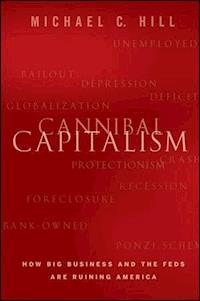
An unbiased look at how the economic practices of corporations, leaders, and government are severely damaging the American way of life Most of us have lived our lives by the rules--going to school, investing in real estate, and building careers--but the so-called Great Recession has changed everything. Cannibal Capitalism: How Big Business and the Feds Are Ruining America answers the questions on everyone's lips; what happened and where do we go from here? Unlike in most other recent instances of financial turbulence, when this crisis hit, the country turned on itself economically, with the powerhouses--corporations, business leaders, and government--throwing the everyman under the bus. In an effort to avoid becoming slightly less rich, the super-rich effectively cannibalized the true engines of growth in the economy, in the process putting the bottom ninety-nine percent of the population at serious risk of losing everything. Cannibal Capitalism fights back, arguing that to really recover we need to educate our children, invest in our small businesses, use our inflated money to develop real things that build real wealth, and get back to exporting in a big way. * Takes a thoughtful look at how income and wealth disparity, industry consolidation, anticompetitive business practices, political ideological extremism, and the hoarding of existing wealth are destroying the wealth building capacity of the nation and the promise of ideal capitalism * Examines the financial crisis and its fallout in a clear, no-nonsense way * Explains what we can do to fix a broken system and come out on top The economic crisis rocking the foundations of the international financial system has had a disproportionately devastating affect on the average person. Angry, afraid, and confused, regular people are looking for answers and Cannibal Capitalism is here to help, illustrating how the super-rich did everything in their power to stay safe at the expense of everyone else.
Sie lesen das E-Book in den Legimi-Apps auf:
Seitenzahl: 414
Veröffentlichungsjahr: 2011
Ähnliche



















Table of Contents
Introduction
Part One: What’s Wrong with This Picture?
Chapter One: The Face of Self-Destruction
The Systemic Flaw: Catabolism
A House Divided
Chapter Two: Putting the Cannibalism in Capitalism
Did You Say Ponzi?
Sanitized, Institutionalized Selfishness
When Capitalism Becomes Cannibalistic
The Socialism We Forget We Like
Enter Reaganomics
China and the World Gaining
Villainy and Waste
Chapter Three: Suicide-Enabling Case Study: Crash of 2007–9
The Crash Timeline: 2007
Rock Bottom in 2008
Making Sense of It
Part Two: How Did We Get Here?
Chapter Four: The Evolution of Cannibal Capitalism
What Is Normal?
Dependencies versus Ideologies
New World Economics
Genesis of Irrational Exuberance
Depression and Recessions
When Smith and Keynes Break Down
Chapter Five: Devolution of the Real Economy through Cannibal Capitalism
Visible Decline of the Middle Class
New Deal Gone Wrong
Chapter Six: Your Own Opinion or Own Facts? Selective Morality
Opposing Parties or Warring Factions?
Hypocrisy of Moral Relativists
It’s Intrinsic to Democracy
Semantics of Social Warfare
Part Three: Where Are We Going?
Chapter Seven: The Choice of Health
The State of Health
Health Insurance Conundrum
The 2009–10 Health Care Debate
Maybe Not “A Right,” but an “Is Right”
Chapter Eight: Miseducation of the Masses
The State of Education
Redesigning How We Teach
Needed Function of Public Education
Chapter Nine: Power to the People
Our Gluttonous Appetite for Energy
We’re Addicted to Oil!
Where Energy and Environment Collide
Impediments to Breaking the Addiction
We Need Hydrogen
Energy Cannibals
Cleaner, Safer, Renewable Energy for All
Chapter Ten: Bring the Money Home to Momma
Protectionism Won’t Save the Middle Class
Embrace Globalization, Spread the Wealth
Conclusion
We Have to Feed the Middle Class
Copyright © 2012 by Michael Hill. All rights reserved.
Published by John Wiley & Sons, Inc., Hoboken, New Jersey.
Published simultaneously in Canada.
No part of this publication may be reproduced, stored in a retrieval system, or transmitted in any form or by any means, electronic, mechanical, photocopying, recording, scanning, or otherwise, except as permitted under Section 107 or 108 of the 1976 United States Copyright Act, without either the prior written permission of the Publisher, or authorization through payment of the appropriate per-copy fee to the Copyright Clearance Center, Inc., 222 Rosewood Drive, Danvers, MA 01923, (978) 750-8400, fax (978) 646-8600, or on the Web at www.copyright.com. Requests to the Publisher for permission should be addressed to the Permissions Department, John Wiley & Sons, Inc., 111 River Street, Hoboken, NJ 07030, (201) 748-6011, fax (201) 748-6008, or online at http://www.wiley.com/go/permissions.
Limit of Liability/Disclaimer of Warranty: While the publisher and author have used their best efforts in preparing this book, they make no representations or warranties with respect to the accuracy or completeness of the contents of this book and specifically disclaim any implied warranties of merchantability or fitness for a particular purpose. No warranty may be created or extended by sales representatives or written sales materials. The advice and strategies contained herein may not be suitable for your situation. You should consult with a professional where appropriate. Neither the publisher nor author shall be liable for any loss of profit or any other commercial damages, including but not limited to special, incidental, consequential, or other damages.
For general information on our other products and services or for technical support, please contact our Customer Care Department within the United States at (800) 762-2974, outside the United States at (317) 572-3993 or fax (317) 572-4002.
Wiley also publishes its books in a variety of electronic formats. Some content that appears in print may not be available in electronic books. For more information about Wiley products, visit our web site at www.wiley.com.
Library of Congress Cataloging-in-Publication Data:
Hill, Michael, 1971-
Cannibal capitalism : how big business and the feds are ruining America / Michael Hill.
p. cm.
Includes bibliographical references and index.
ISBN 978-1-118-17531-6 (hardback); ISBN 978-1-118-19775-2 (ebk); ISBN 978-1-118-19776-9 (ebk); ISBN 978-1-118-19777-6 (ebk)
1. Income distribution—United States. 2. Industries—United States. 3. Capitalism—United States. 4. Right and left (Political science) 5. United States—Economic conditions—21st century. I. Title.
HC110.I5H55 2011
330.973—dc23
2011039742
Introduction
There I was, sitting in bankruptcy court. It was all gone. It was over. Why? Why me? What did I do wrong? How was I going to take care of my family? My wife was six months pregnant with our second child, a little sister for our two-year-old daughter. Why did I put their futures at risk? How didn’t I see it coming? I was all in. Everything I had was on the line, but it was all tied up in the “safe” haven of real estate. Everyone said the real estate market only slows, not stops. It was considered more stable than gold. In fact, land is the only property called “real,” and yet there I was. The whole thing had collapsed. They called it a subprime crisis, but the whole economy was in crisis.
By 2008, the whole thing had failed. “Dog eat dog world” is just a figure of speech, until you are the one being cannibalized. It was as if the whole country had turned on itself economically; instead of growing through the pain, the pain caused a cannibalization of engines of growth in the economy. Small businesses like mine that produce tangible goods and services and employ regular people were sacrificed, while paper traders who amass vast wealth through the exchange of abstractions derived from the real economy were propped up as too big to fail. It was a panic—a panic initiated by the greatest fear of the super-rich—the fear that they might become a little less rich. For those a little lower on the totem pole, the fear was based on the near reality of losing everything.
Just a year earlier, I had won a Custom Builder of the Year award for the Greater Washington Metropolitan region, and my company was valued by an investment bank at $47 million. My homes were featured in magazines, and I was rubbing shoulders with celebrities. We were engaged with a venture capital fund to take the business nationwide and ultimately go public with a stock offering. I thought I’d realized my dream, but it all blew up in my face. Sales froze and I was stuck holding over $10 million worth of real estate that was “underwater,” as they say.
I had to retrace my steps. I had to understand the market forces that drove my success, or the illusion of it, as well as its collapse—not just for me, but for everyone caught up in this economy. The old distinctions we once safely made between Wall Street and Main Street have proved to be fallacious. Our money may come from the banks, but the value of that money comes from the real economy of Main Street. When a business fails, they may say, “You win some, you lose some,” but what is a game for some is life and livelihood for so many more. The forces that drive wealth creation and destruction, the flow of capital up and down the socioeconomic ladder, and even the trading of financial instruments that no one understands, govern our lives in ways not easily perceived.
I pored over census data, market trends, economic theories and reports, and book after book of analysis of the economy. In the course of my studies, I turned myself into a sort of blue-collar economist, not academically trained in theory, but well practiced in real-world economics and the art of business. I am a career entrepreneur. I have skills in a variety of highly technical areas and very broad work experience. I’ve held jobs ranging from janitorial services to research assistant in a solid-state physics lab, but my life has been business. To understand my predicament, you have to understand my background.
Lesen Sie weiter in der vollständigen Ausgabe!
Lesen Sie weiter in der vollständigen Ausgabe!
Lesen Sie weiter in der vollständigen Ausgabe!
Lesen Sie weiter in der vollständigen Ausgabe!
Lesen Sie weiter in der vollständigen Ausgabe!
Lesen Sie weiter in der vollständigen Ausgabe!
Lesen Sie weiter in der vollständigen Ausgabe!
Lesen Sie weiter in der vollständigen Ausgabe!
Lesen Sie weiter in der vollständigen Ausgabe!
Lesen Sie weiter in der vollständigen Ausgabe!
Lesen Sie weiter in der vollständigen Ausgabe!
Lesen Sie weiter in der vollständigen Ausgabe!
Lesen Sie weiter in der vollständigen Ausgabe!
Lesen Sie weiter in der vollständigen Ausgabe!




