


67,99 €
Mehr erfahren.
- Herausgeber: John Wiley & Sons
- Kategorie: Fachliteratur
- Serie: Robert W. Kolb Series
- Sprache: Englisch
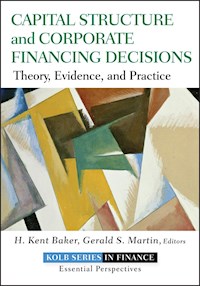
A comprehensive guide to making better capital structure and corporate financing decisions in today's dynamic business environment
Given the dramatic changes that have recently occurred in the economy, the topic of capital structure and corporate financing decisions is critically important. The fact is that firms need to constantly revisit their portfolio of debt, equity, and hybrid securities to finance assets, operations, and future growth.
Capital Structure and Corporate Financing Decisions provides an in-depth examination of critical capital structure topics, including discussions of basic capital structure components, key theories and practices, and practical application in an increasingly complex corporate world. Throughout, the book emphasizes how a sound capital structure simultaneously minimizes the firm's cost of capital and maximizes the value to shareholders.
- Offers a strategic focus that allows you to understand how financing decisions relates to a firm's overall corporate policy
- Consists of contributed chapters from both academics and experienced professionals, offering a variety of perspectives and a rich interplay of ideas
- Contains information from survey research describing actual financial practices of firms
This valuable resource takes a practical approach to capital structure by discussing why various theories make sense and how firms use them to solve problems and create wealth. In the wake of the recent financial crisis, the insights found here are essential to excelling in today's volatile business environment.
Sie lesen das E-Book in den Legimi-Apps auf:
Seitenzahl: 1094
Veröffentlichungsjahr: 2011
Ähnliche


















Contents
Cover
Series
Title Page
Copyright
Acknowledgments
Part I: The Elements of Capital Structure
Chapter 1: Capital Structure: An Overview
INTRODUCTION
PURPOSE OF THE BOOK
FEATURES OF THE BOOK
INTENDED AUDIENCE
STRUCTURE OF THE BOOK
SUMMARY AND CONCLUSIONS
ABOUT THE AUTHORS
Chapter 2: Factors Affecting Capital Structure Decisions
INTRODUCTION
CAPITAL STRUCTURE THEORIES
SURVEY EVIDENCE
A MORE STRUCTURED APPROACH: DEFINING CAPITAL STRUCTURE FACTORS
EMPIRICAL ISSUES
SUMMARY AND CONCLUSIONS
DISCUSSION QUESTIONS
ABOUT THE AUTHORS
Chapter 3: Capital Structure and Corporate Strategy
INTRODUCTION
CAPITAL STRUCTURE AND CORPORATE STRATEGY: THE ROLE OF FINANCIAL STAKEHOLDERS
CAPITAL STRUCTURE AND CORPORATE STRATEGY: THE ROLE OF NONFINANCIAL STAKEHOLDERS
SUMMARY AND CONCLUSIONS
DISCUSSION QUESTIONS
ABOUT THE AUTHOR
Chapter 4: Capital Structure and Firm Risk
INTRODUCTION
FINANCIAL LEVERAGE AND THE REAL OPERATIONS OF THE FIRM: THE THEORY
FINANCIAL LEVERAGE AND THE REAL OPERATIONS OF THE FIRM: THE EVIDENCE
FINANCIAL LEVERAGE AND STOCK RETURNS
SUMMARY AND CONCLUSIONS
DISCUSSION QUESTIONS
ABOUT THE AUTHOR
Chapter 5: Capital Structure and Returns
INTRODUCTION
THEORIES OF CAPITAL STRUCTURE
THEORIES OF CAPITAL STRUCTURE
EMPIRICAL WORK ON THE RELATIONSHIP BETWEEN LEVERAGE AND RETURNS
WHY THE EMPIRICAL RELATIONSHIP BETWEEN LEVERAGE AND RETURNS DIFFERS
SUMMARY AND CONCLUSIONS
DISCUSSION QUESTIONS
ABOUT THE AUTHORS
Chapter 6: Capital Structure and Compensation
INTRODUCTION
CAPITAL STRUCTURE AND COMPENSATION: ANALYSIS
CAPITAL STRUCTURE AND COMPENSATION: EMPIRICAL EVIDENCE
SUMMARY AND CONCLUSIONS
DISCUSSION QUESTIONS
ABOUT THE AUTHOR
Chapter 7: Worldwide Patterns in Capital Structure
INTRODUCTION
DETERMINANTS OF CAPITAL STRUCTURE: CROSS-COUNTRY COMPARISONS
THE IMPACT OF LEGAL TRADITIONS ON CAPITAL STRUCTURE
PARTIAL ADJUSTMENT TO A TARGET CAPITAL STRUCTURE: INTERNATIONAL EVIDENCE
THE PECKING ORDER THEORY: INTERNATIONAL EVIDENCE
SUMMARY AND CONCLUSIONS
DISCUSSION QUESTIONS
ABOUT THE AUTHORS
Part II: Capital Structure Choice
Chapter 8: Capital Structure Theories and Empirical Tests: An Overview
INTRODUCTION
CAPITAL STRUCTURE DETERMINANTS
DYNAMIC CAPITAL STRUCTURE AND TESTS OF PECKING ORDER THEORY VERSUS TRADE-OFF THEORY
SPEED OF ADJUSTMENT TO TARGET CAPITAL STRUCTURE
SURVEYS AND EVENTS STUDIES
SUMMARY AND CONCLUSIONS
DISCUSSION QUESTIONS
ABOUT THE AUTHOR
Chapter 9: Capital Structure Irrelevance: The Modigliani-Miller Model
INTRODUCTION
MM CAPITAL STRUCTURE PROPOSITIONS AND THEIR INTERPRETATIONS
THE TRADE-OFF BETWEEN TAX ADVANTAGES AND BANKRUPTCY COSTS
EXTENSION OF THE MM MODEL
SUMMARY AND CONCLUSIONS
DISCUSSION QUESTIONS
ABOUT THE AUTHOR
Chapter 10: Trade-Off, Pecking Order, Signaling, and Market Timing Models
INTRODUCTION
TRADE-OFF THEORY
PECKING ORDER THEORY
SIGNALING
MARKET TIMING
SUMMARY AND CONCLUSIONS
DISCUSSION QUESTIONS
ABOUT THE AUTHOR
Chapter 11: Estimating Capital Costs: Practical Implementation of Theory's Insights
INTRODUCTION
THE WEIGHTED AVERAGE COST OF CAPITAL
GUIDELINES FOR ESTIMATION FROM FINANCE THEORY
APPROACH AND DATA
THREE APPROACHES TO USING DATA FROM COMPARABLE FIRMS
DIFFERENCES IN COST OF CAPITAL ESTIMATES APPLYING ALTERNATE APPROACHES
IMPACT OF ASSUMPTIONS ABOUT THE MARKET RISK PREMIUM
AREAS FOR GUIDANCE FROM FUTURE RESEARCH
SUMMARY AND CONCLUSIONS
DISCUSSION QUESTIONS
ABOUT THE AUTHORS
ACKNOWLEDGMENT
Chapter 12: Economic, Regulatory, and Industry Effects on Capital Structure
INTRODUCTION
ECONOMIC AND INSTITUTIONAL FACTORS: AN INTERNATIONAL PERSPECTIVE
INDUSTRY EFFECTS AND CAPITAL STRUCTURE
FIRM CHARACTERISTICS AND CAPITAL STRUCTURE
THEORIES EXPLAINING THE CAPITAL STRUCTURE OF REGULATED FIRMS
INTER-INDUSTRY EMPIRICAL EVIDENCE ON REGULATED INDUSTRIES
THE U.S. ELECTRIC UTILITY INDUSTRY: A CASE STUDY
SUMMARY AND CONCLUSIONS
DISCUSSION QUESTIONS
ABOUT THE AUTHOR
Chapter 13: Survey Evidence on Financing Decisions and Cost of Capital
INTRODUCTION
WHAT SURVEYS TELL ABOUT THE COST OF CAPITAL
WHAT SURVEYS TELL ABOUT FINANCING DECISIONS
THE GAP BETWEEN THEORY AND PRACTICE
SUMMARY AND CONCLUSIONS
DISCUSSION QUESTIONS
ABOUT THE AUTHORS
Chapter 14: Survey Evidence on Capital Structure: Non-U.S. Evidence
INTRODUCTION
EVIDENCE FROM CAPITAL STRUCTURE SURVEYS
ALTERNATIVE SURVEY APPROACHES
FUTURE RESEARCH
SUMMARY AND CONCLUSIONS
DISCUSSION QUESTIONS
ABOUT THE AUTHORS
Part III: Raising Capital
Chapter 15: The Roles of Financial Intermediaries in Raising Capital
INTRODUCTION
LENDING BY FINANCIAL INTERMEDIARIES
UNDERWRITING BY FINANCIAL INTERMEDIARIES
UNIVERSAL BANKING
FINANCIAL CRISES
SUMMARY AND CONCLUSIONS
DISCUSSION QUESTIONS
ABOUT THE AUTHORS
Chapter 16: Bank Relationships and Collateralization
INTRODUCTION
BANK RELATIONSHIPS
COLLATERALIZATION
SUMMARY AND CONCLUSIONS
DISCUSSION QUESTIONS
ABOUT THE AUTHORS
Chapter 17: Rating Agencies and Credit Insurance
INTRODUCTION
THE THEORETICAL BASIS FOR CREDIT RATINGS
EMPIRICAL EVIDENCE ON THE PERFORMANCE OF CREDIT RATINGS
THEORETICAL WORK ON REPUTATION AND COMPETITION
RATING-DEPENDENT REGULATION
THE FIRST AMENDMENT AND RATING AGENCIES
THE FUTURE OF CREDIT RATING AGENCIES
CREDIT INSURANCE
SUMMARY AND CONCLUSIONS
DISCUSSION QUESTIONS
ABOUT THE AUTHOR
Chapter 18: Secured Financing
INTRODUCTION
TYPOLOGY AND DEFINITIONS OF SECURED DEBT
USING SECURED DEBT
THEORIES EXPLAINING THE USE OF SECURED DEBT
SUMMARY AND CONCLUSIONS
DISCUSSION QUESTIONS
ABOUT THE AUTHOR
Chapter 19: Sale and Leasebacks
INTRODUCTION
ACCOUNTING FOR SALE AND LEASEBACKS
BENEFITS OF A SALE AND LEASEBACK
COSTS OF SALE AND LEASEBACKS
THE SALE AND LEASEBACK: AN EXAMPLE
MARKET REACTION TO SALE AND LEASEBACKS
SUMMARY AND CONCLUSIONS
DISCUSSION QUESTIONS
ABOUT THE AUTHOR
Part IV: Special Topics
Chapter 20: Financial Distress and Bankruptcy
INTRODUCTION
PREDICTING DISTRESS
EXPECTED COST OF DISTRESS
EXTERNAL SOURCES OF FINANCIAL RISK
RESOLUTION OF DISTRESS
SUMMARY AND CONCLUSIONS
DISCUSSION QUESTIONS
ABOUT THE AUTHOR
Chapter 21: Fiduciary Responsibility and Financial Distress
INTRODUCTION
FIVE BACKGROUND ECONOMIC PRINCIPLES
DIRECTORS AND STAKEHOLDERS IN AND OUT OF INSOLVENCY: A REVIEW OF DOCTRINE AND CASE LAW
SUMMARY AND CONCLUSIONS
DISCUSSION QUESTIONS
ABOUT THE AUTHORS
Chapter 22: The Lease versus Buy Decision
INTRODUCTION
TAX-BASED MODELS OF LEASING
NONTAX MODELS OF LEASING
EMPIRICAL STUDIES ON LEASES
SUMMARY AND CONCLUSIONS
DISCUSSION QUESTIONS
ABOUT THE AUTHORS
Chapter 23: Private Investment in Public Equity
INTRODUCTION
PIPE TYPES
REGISTRATION REQUIREMENT
PIPE ISSUERS
PIPE INVESTORS
SECURITIES LAWS COMPLIANCE
SEC PIPE ENFORCEMENT ACTIONS
REGULATORY ARBITRAGE
SUMMARY AND CONCLUSIONS
DISCUSSION QUESTIONS
ABOUT THE AUTHOR
Chapter 24: Financing Corporate Mergers and Acquisitions
INTRODUCTION
METHOD OF PAYMENT
FINANCING ALTERNATIVES
CAPITAL STRUCTURE EFFECTS OF MERGERS AND ACQUISITIONS
SUMMARY AND CONCLUSIONS
DISCUSSION QUESTIONS
ABOUT THE AUTHORS
Answers to Chapter Discussion Questions
CHAPTER 2 FACTORS AFFECTING CAPITAL STRUCTURE DECISIONS
CHAPTER 3 CAPITAL STRUCTURE AND CORPORATE STRATEGY
CHAPTER 4 CAPITAL STRUCTURE AND FIRM RISK
CHAPTER 5 CAPITAL STRUCTURE AND RETURNS
CHAPTER 6 CAPITAL STRUCTURE AND COMPENSATION
CHAPTER 7 WORLDWIDE PATTERNS IN CAPITAL STRUCTURE
CHAPTER 8 CAPITAL STRUCTURE THEORIES AND EMPIRICAL TESTS: AN OVERVIEW
CHAPTER 9 CAPITAL STRUCTURE IRRELEVANCE: THE MODIGLIANI-MILLER MODEL
CHAPTER 10 TRADE-OFF, PECKING ORDER, SIGNALING, AND MARKET TIMING MODELS
CHAPTER 11 ESTIMATING CAPITAL COSTS: PRACTICAL IMPLEMENTATION OF THEORY'S INSIGHTS
CHAPTER 12 ECONOMIC, REGULATORY, AND INDUSTRY EFFECTS ON CAPITAL STRUCTURE
CHAPTER 13 SURVEY EVIDENCE ON FINANCING DECISIONS AND COST OF CAPITAL
CHAPTER 14 SURVEY EVIDENCE ON CAPITAL STRUCTURE: NON-U.S. EVIDENCE
CHAPTER 15 THE ROLES OF FINANCIAL INTERMEDIARIES IN RAISING CAPITAL
CHAPTER 16 BANK RELATIONSHIPS AND COLLATERALIZATION
CHAPTER 17 RATING AGENCIES AND CREDIT INSURANCE
CHAPTER 18 SECURED FINANCING
CHAPTER 19 SALE AND LEASEBACKS
CHAPTER 20 FINANCIAL DISTRESS AND BANKRUPTCY
CHAPTER 21 FIDUCIARY RESPONSIBILITY AND FINANCIAL DISTRESS
CHAPTER 22 THE LEASE VERSUS BUY DECISION
CHAPTER 23 PRIVATE INVESTMENT IN PUBLIC EQUITY
CHAPTER 24 FINANCING CORPORATE MERGERS AND ACQUISITIONS
Index
The Robert W. Kolb Series in Finance provides a comprehensive view of the field of finance in all of its variety and complexity. The series is projected to include approximately 65 volumes covering all major topics and specializations in finance, ranging from investments, to corporate finance, to financial institutions. Each volume in the Kolb Series in Finance consists of new articles especially written for the volume.
Each volume is edited by a specialist in a particular area of finance, who develops the volume outline and commissions articles by the world's experts in that particular field of finance. Each volume includes an editor's introduction and approximately 30 articles to fully describe the current state of financial research and practice in a particular area of finance.
The essays in each volume are intended for practicing finance professionals, graduate students, and advanced undergraduate students. The goal of each volume is to encapsulate the current state of knowledge in a particular area of finance so that the reader can quickly achieve a mastery of that special area of finance.
Please visit www.wiley.com/go/kolbseries to learn about recent and forthcoming titles in the Kolb Series.
Copyright © 2011 by John Wiley & Sons, Inc. All rights reserved.
Published by John Wiley & Sons, Inc., Hoboken, New Jersey. Published simultaneously in Canada.
No part of this publication may be reproduced, stored in a retrieval system, or transmitted in any form or by any means, electronic, mechanical, photocopying, recording, scanning, or otherwise, except as permitted under Section 107 or 108 of the 1976 United States Copyright Act, without either the prior written permission of the Publisher, or authorization through payment of the appropriate per-copy fee to the Copyright Clearance Center, Inc., 222 Rosewood Drive, Danvers, MA 01923, (978) 750-8400, fax (978) 646-8600, or on the Web at www.copyright.com. Requests to the Publisher for permission should be addressed to the Permissions Department, John Wiley & Sons, Inc., 111 River Street, Hoboken, NJ 07030, (201) 748-6011, fax (201) 748-6008, or online at http://www.wiley.com/go/permissions.
Limit of Liability/Disclaimer of Warranty: While the publisher and author have used their best efforts in preparing this book, they make no representations or warranties with respect to the accuracy or completeness of the contents of this book and specifically disclaim any implied warranties of merchantability or fitness for a particular purpose. No warranty may be created or extended by sales representatives or written sales materials. The advice and strategies contained herein may not be suitable for your situation. You should consult with a professional where appropriate. Neither the publisher nor author shall be liable for any loss of profit or any other commercial damages, including but not limited to special, incidental, consequential, or other damages.
For general information on our other products and services or for technical support, please contact our Customer Care Department within the United States at (800) 762-2974, outside the United States at (317) 572-3993 or fax (317) 572-4002.
Wiley also publishes its books in a variety of electronic formats. Some content that appears in print may not be available in electronic books. For more information about Wiley products, visit our web site at www.wiley.com.
Library of Congress Cataloging-in-Publication Data:
Capital structure and financing decisions : theory, evidence, and practice / H. Kent Baker and Gerald S. Martin, editors. p. cm.—(The Robert W. Kolb series in finance) Includes bibliographical references and index. ISBN 978-0-470-56952-8 (cloth); ISBN 978-1-118-02292-4 (ebk); ISBN 978-1-118-02293-1 (ebk); ISBN 978-1-118-02294-8 (ebk) 1. Corporations—Finance. 2. Capital investments. I. Baker, H. Kent (Harold Kent), 1944– II. Martin, Gerald S. III. Title: Capital structure and corporate financing decisions. HG4026.C2424 2011 658.15—dc22 2010045662
Acknowledgments
We extend our sincere appreciation to the many individuals involved in bringing Capital Structure and Corporate Financing Decisions: Theory, Evidence, and Practice from the idea stage to publication. We appreciate the support provided by Bob Kolb, the series editor, in reviewing the initial book proposal. The chapter authors deserve special thanks for their hard work in writing and revising chapters. Meghan Nesmith, who carefully reviewed each chapter and provided artful edits and comments, deserves high praise. Katharine Fredriksen also provided needed editorial assistance. Our expert publishing team at John Wiley & Sons skillfully turned the manuscript into final form. Special thanks go to Evan Burton as well as Emilie Herman, Senior Editorial Manager, and Melissa Lopez, Production Editor, all of whom demonstrated poise and professionalism. We also want to recognize the support provided by the Kogod School of Business at American University. Finally, Linda Baker deserves special thanks for her careful review of the manuscript as well as for her patience and encouragement.
PART I
The Elements of Capital Structure
Chapter 1
Capital Structure: An Overview
H. Kent Baker
University Professor of Finance and Kogod Research Professor, American University
Gerald S. Martin
Associate Professor of Finance, American University
INTRODUCTION
According to Baker and Powell (2005, p. 4), financial management is “an integrated decision-making process concerned with acquiring, financing, and managing assets to accomplish some overall goal within a business entity.” Jensen (2001) indicates that among most financial economists the criterion for evaluating performance and deciding between alternative courses of action should be maximization of long-term market value of the firm. He notes that this value maximization proposition has its roots in 200 years of research in economics and finance. For publicly-held firms, the maximization of shareholder wealth is reflected in the market price of the stock. By maximizing shareholder wealth, managers are serving the interests of the firm's owners as residual claimants. Under most circumstances, the premise of maximizing total firm value is also consistent with maximizing shareholder wealth.
This book focuses on one major aspect of financial management—how capital structure and financing decisions can contribute to maximizing the value of the firm. Financing decisions go hand in hand with investment decisions. That is, a firm needs sufficient funds to support its activities resulting from its investment decisions. Capital structure refers to the sources of financing employed by the firm. These sources include debt, equity, and hybrid securities that a firm uses to finance its assets, operations, and future growth. Often thought of in terms of financial leverage, a firm's capital structure is a direct determinant of its overall risk and cost of capital. The sources of capital have important consequences for the firm and can affect its value and hence shareholder wealth. For example, while debt is the least costly form of capital, the effects of increasing leverage through the use of debt simultaneously increase financial risk. Borrowing not only increases the risk of default for a firm but also increases the volatility of a firm's earnings per share and its return on equity. The benefits of a lower cost of debt decrease as leverage rises due to increasing financial risk and the likelihood of financial distress and bankruptcy. As with most financial decisions, financing decisions involve a risk-return trade-off. Given the dramatic changes that have occurred recently in the economy such as the global financial crisis, the topic of capital structure and corporate financing decisions is critically important.
Barclay and Smith (1999, p. 8) make the following observation:
A perennial debate in corporate finance concerns the question of optimal capital structure: Given a level of total capital necessary to support a company's activities, is there a way of dividing up that capital into debt and equity that maximizes current firm value? And if so, what are the critical factors in setting the leverage ratio for a given company?
An optimal capital structure is the financing mix that maximizes the value of the firm. Yet, mixed views exist about whether an optimal capital structure actually exists. Some believe that a firm's value does not depend on its financing mix, and hence an optimal capital structure does not exist. The modern theory of capital structure started with Modigliani and Miller (1958), who pioneered the research efforts relating capital structure and the value of the firm. In their seminal work, they show that under stringent conditions of competitive, frictionless, and complete capital markets, the value of a firm is independent of its capital structure. That is, managers cannot alter firm value or the cost of capital by the capital structures that they choose. Further, business risk alone determines the cost of capital. Thus, financing and capital structure decisions are not shareholder value enhancing and are deemed to be irrelevant. In reality, these conditions rarely exist. Empirical evidence suggests that financing does matter.
Others contend that managers can theoretically determine a firm's optimal capital structure. During the last five decades, financial economists have relaxed the restrictive assumptions underlying the theory of capital structure irrelevance and have introduced capital market frictions into their models. By introducing capital market frictions, such as taxes, bankruptcy costs, and asymmetric information, they are able to explain at least some factors driving capital structure decisions. Consequently, financial economists have set forth various capital structure theories such as trade-off theory (Kraus and Litzenberger 1973), pecking order theory (Myers 1984; Myers and Majluf 1984), signaling (Ross 1977), and market timing theory (Baker and Wurgler 2002) to explain the relevance of capital structure. These theories relate directly to taxes, asymmetric information, agency problems, and bankruptcy costs. Taken separately, these theories cannot explain certain important facts about capital structure. Despite extensive research into the area of capital structure, determining the precise financing mix that maximizes the market value of the firm remains elusive.
PURPOSE OF THE BOOK
The purpose of this book is to provide an in-depth examination of important topics about capital structure and corporate financing decisions. The coverage extends from discussing basic components and existing theories to their application to increasingly complex and real-world situations. Throughout, the book emphasizes how a sound capital structure can simultaneously reduce a firm's cost of capital while increasing value to shareholders. Given the sheer volume of theoretical and empirical studies involving capital structure and financing decisions, the prospect of surveying the extant literature is a formidable task. Although coverage is not exhaustive, the book includes a review of several hundred articles. Leading academics and researchers from around the globe provide a synthesis of the current state of capital structure and give their views about its future direction.
FEATURES OF THE BOOK
Many finance books deal with capital structure. Yet, few, if any, offer the scope of coverage and breadth of viewpoints contained in this volume. The book differs from others in several major ways. Perhaps the book's most distinctive feature is that it provides a comprehensive discussion of financial theory, empirical work, and practice involving corporate financial policies, strategies, and choices. This is an up-to-date book in terms of theoretical developments, empirical results, and practical applications.
Although the book cannot cover every topic on capital structure, given the voluminous amount of writing on the subject, it does seek to highlight some of the most important topics. The book takes a practical approach to capital structure by discussing why various theories make sense, the empirical support for them, and how firms use these theories to solve problems and to create wealth. This volume uses theoretical and mathematical derivations only when necessary to explain the topic. Although the book also reports the results of many empirical studies that link theory and practice, the objective is to distill them to their essential content so that they are understandable to the reader.
The book has six other distinguishing features.
1. The book contains contributions from numerous authors. This breadth of contributors provides a wide range of viewpoints and a rich interplay of ideas.
2. The book offers a strategic focus to help provide an understanding of how financing decisions relate to a firm's overall corporate policy. Because financial decisions are interconnected, managers must incorporate them into the overall corporate strategy of the firm.
3. The book has a global focus and examines worldwide patterns in capital structure. It reviews research not only centered on U.S. firms but also from companies around the world.
4. This volume takes both a prescriptive and descriptive perspective. Using a prescriptive approach, it examines how corporate managers should make financial decisions to improve firm value. The book's descriptive perspective discusses theories that shed light on which financial decisions managers make and analyzes the impact of these decisions on financial markets. The book also provides results from survey research describing actual financial practices of firms.
5. The book identifies areas needing future research in capital structure and financing decisions.
6. Each chapter except this introductory chapter contains a set of discussion questions to reinforce key aspects of the chapter's content. A separate section near the end of the book provides a guideline answer to each question.
INTENDED AUDIENCE
The intended audience for this book includes academics, researchers, corporate managers, students, and others interested in capital structure and corporate financing decisions. Considering its extensive coverage and focus on the theoretical and empirical literature, this book should be appealing to academics and researchers as a critical resource. Given the book's intuitive and largely nontechnical approach, it is geared toward helping corporate managers formulate policies and financial strategies that maximize firm value and policymakers in understanding capital structure choices. This volume can also stand alone or in tandem with another text or casebook for graduate and advanced undergraduate students, especially those in business or finance. This book should be especially useful in helping students develop the critical analytical skills required to understand the implications of capital structure. Finally, libraries should find this work to be suitable for reference purposes.
STRUCTURE OF THE BOOK
The remaining 23 chapters of this book are organized into four parts. A brief synopsis of each chapter follows.
Part I The Elements of Capital Structure
Chapters 2–7 provide an overview of the elements of capital structure. These chapters lay the foundation and discuss important principles and concepts involving capital structure. Chapters in this section examine the factors influencing capital structure decisions as well as the interactions among capital structure, strategy, risk, returns, and compensation. Additionally, this section identifies differences in capital structure across countries with different legal and institutional settings.
Chapter 2 Factors Affecting Capital Structure Decisions (Wolfgang Bessler, Wolfgang Drobetz, and Robin Kazemieh)
In perfect capital markets, capital structure decisions should not have any impact on the market value of a firm. However, once capital market frictions such as taxes, bankruptcy costs, and asymmetric information are introduced into the model, there are factors related to these frictions that affect capital structure decisions. This chapter provides a review of the main capital structure factors that have been identified in the literature. Survey evidence indicates that the most dominant factor that affects the decision to issue debt is maintaining financial flexibility. The major factors that determine the issuance of stock are earnings per share dilution and equity undervaluation or overvaluation. Results from regression studies using comprehensive firm-level data sets indicate that the most reliable factors for explaining corporate leverage are: market-to-book ratio (–), tangibility (+), profitability (–), firm size (+), expected inflation (+), and median industry leverage (+ effect on leverage).
Chapter 3 Capital Structure and Corporate Strategy (Maurizio La Rocca)
This chapter responds to the general call for integration between finance and strategy research by examining the relationship between capital structure decisions and corporate strategy. The literature on finance and strategy analyzes how the strategic actions of key players such as managers, shareholders, debt holders, competitors, workers, and suppliers affect firm value and its allocation between claimholders. Specifically, financing decisions can affect the value creation process by influencing efficient investment strategies due to conflicts of interest among managers, firm's financial stakeholders, and firm's nonfinancial stakeholders. In turn, the potential interactions between financial and nonfinancial stakeholders may give rise to inefficient managerial decisions or may shape the industry's competitive dynamics to achieve a competitive advantage. A good integration between finance and strategy can be tantamount to a competitive weapon.
Chapter 4 Capital Structure and Firm Risk (Valentin Dimitrov)
With market frictions, the real and financial sides of the firm are interrelated. As a result, variables such as financial leverage can have important consequences for firm risk. Prior analytical work has identified several mechanisms through which financial leverage can affect risk but has not reached a consensus on the relative importance of these mechanisms. The empirical evidence is more conclusive. When subjected to adverse economic shocks, highly leveraged firms have lower growth in sales, make fewer investments, and are less likely to survive than firms with low leverage. These findings suggest that financial leverage amplifies negative shocks; it makes firms riskier. However, shareholders of highly leveraged firms do not appear to be compensated for this higher risk. Highly leveraged firms earn lower stock returns in the cross-section. Furthermore, increases in leverage are associated with low subsequent stock returns. These return patterns present a challenge to traditional capital asset pricing models.
Chapter 5 Capital Structure and Returns (Yaz Gulnur Muradoglu and Sheeja Sivaprasad)
This chapter examines the link between stock returns and leverage. Proposition II of the Modigliani-Miller theorem on capital structure postulates that stock returns increase with leverage due to the increase in financial risk attached to debt. A limited number of studies test this association empirically and find contradictory results. Some empirical studies report that a positive relationship exists between leverage and returns, but others find a negative relationship. This chapter summarizes the theories of capital structure and then presents empirical tests. It then discusses how conflicting empirical results may be attributed to the various definitions used in measuring stock returns and leverage, and to the sample selection procedures and methodologies adopted to test this relationship.
Chapter 6 Capital Structure and Compensation (Alan Victor Scott Douglas)
This chapter examines the interactions between capital structure and compensation. It begins by reviewing the basic determinants of capital structure, particularly as related to shareholder-bondholder conflicts relating to investment decisions. Well-designed managerial compensation can maintain efficient investment incentives and significantly alter the determinants of capital structure. Complications arise, however, from managerial risk aversion and perquisite consumption as well as from managers trying to game the compensation-setting process. The empirical evidence indicates that two characteristics of compensation—sensitivity of pay to share price and to volatility—affect both the cost of capital and leverage. The evidence also identifies other factors affecting the compensation-capital structure relationship including the use of convertible debt, the maturity structure of the firm's debt, and debt-like components of compensation. The literature has yet to fully develop the interactions, but to date characteristics of compensation may be important determinants of capital structure.
Chapter 7 Worldwide Patterns in Capital Structure (Carmen Cotei and Joseph Farhat)
Recent research in international capital structure shows that capital structure decisions are influenced not only by firm-specific and macroeconomic factors but also by legal traditions and the quality of institutions of countries in which they operate. The differences in legal traditions and institutional settings across countries have important implications for individual firms’ ability to raise capital needed to finance profitable growth opportunities. Firms operating in countries with weaker institutional settings and legal systems may have difficulty overcoming the higher information asymmetry and agency costs of debt. This can affect both the ability of firms to operate at the optimal capital structure and managers to maximize firm value.
Part II Capital Structure Choice
Chapters 8–14 discuss key factors involved in capital structure choice. Chap-ters 8–10 focus on major capital structure theories and their empirical tests. Chapter 11 shows how to implement the insights provided by theory into estimating a firm's cost of capital. Chapter 12 discusses economic, regulatory, and industry effects on capital structure. Chapters 13 and 14 veer from traditional empirical studies that are based on large samples of financial data and provide empirical evidence from survey research. These two chapters, which discuss the results of major surveys, provide unique information about how corporate managers make financing decisions in practice.
Chapter 8 Capital Structure Theories and Empirical Tests: An Overview (Stein Frydenberg)
The findings of empirical capital structure studies are diverse, but a consensus exists stating that fixed assets, industry leverage, and size of firms have a positive effect on the debt level, while growth opportunities, profitability, and dividend payments have a negative effect. There are two main approaches to empirical tests of capital structure theory. The first is a static cross-section or a dynamic panel data approach where leverage is regressed against accounting variables that proxy for theoretical factors such as the firm's tax position, potential for agency costs, expected bankruptcy costs, asymmetric information, and transaction costs. The evidence about the determinants of capital structure is robust across firms and countries. The second is a time-series approach that examines the effects of new issues of securities on stock price returns. While the literature reaches a consensus about the direction of effects, it is far from reaching a consensus on the size of the effects.
Chapter 9 Capital Structure Irrelevance: The Modigliani-Miller Model (Sergei V. Cheremushkin)
Much debate exists about the real-world applications of the Modigliani-Miller theory given its highly restrictive assumptions. Although subsequent research identifies relevant factors affecting capital structure, additional work is needed to create a generalized analytical framework for determining capital structure under real-world conditions. This chapter provides a simple risk-shifting explanation that helps in understanding various problems and establishes the shapes of cost of debt and equity functions of leverage. This explanation offers several insights about the integration of trade-off theory and other approaches to dealing with market imperfections. A generalized cost of equity formula and an extended decision rule for capital budgeting are also presented.
Chapter 10 Trade-Off, Pecking Order, Signaling, and Market Timing Models (Anton Miglo)
Over recent years researchers have extensively tested the trade-off and pecking order theories of capital structure. Taken separately, these theories cannot explain certain important facts about capital structure. Market timing theory emerged after the publication of Baker and Wurgler (2002) as a separate theory of capital structure. The theoretical aspects of market timing theory are underdeveloped. A popular line of inquiry has emerged based on surveys of managers about their capital structure decisions. For example, Graham and Harvey (2001) report a large gap between theory and practice. The signaling theory of capital structure lacks empirical support for some of its core predictions. However, several new theories have emerged that contradict the notion of signaling quality through debt issuance. This chapter presents an overview of the pros and cons for each theory. A discussion of major recent papers and suggestions for future research are provided.
Chapter 11 Estimating Capital Costs: Practical Implementation of Theory's Insights (Robert M. Conroy and Robert S. Harris)
This chapter focuses on the challenges of estimating a company's cost of capital. Its goal is to illustrate and improve the craft of such estimation. While theory offers sound conceptual advice, decision makers still face a host of practical choices. The chapter reports results for a wide array of publicly-traded companies and highlights areas in which best practice would especially benefit from future research. The investigation shows that analysts can benefit from using estimates from both single-company data and comparable firm averages to triangulate the cost of capital. The findings also reinforce the belief that cost of capital estimation is a craft and done best when informed by substantial knowledge and care in selecting comparable firms. Finally, the chapter suggests three areas for future attention in both research and practice: extensions to private firms, better gauges of capital structure impacts, and methods to estimate changes in equity market risk premiums over time.
Chapter 12 Economic, Regulatory, and Industry Effects on Capital Structure (Paroma Sanyal)
The purpose of this chapter is to provide a comprehensive study of the nonfinancial determinants of capital structure. This chapter focuses on three important sets of factors that influence a firm's financing decision: (1) intercountry differences, (2) interindustry differences within a country, and (3) interfirm differences within the same industry. Within interindustry differences the focus is on the financing decision of firms in nonregulated versus regulated industries. By studying firms that are regulated and those that are transitioning from a regulated to a competitive environment, this chapter provides a unique window into how changing incentive structures influence financial choices of firms. Within firm-specific factors, this chapter highlights how small startups make their financing decisions.
Chapter 13 Survey Evidence on Financing Decisions and Cost of Capital (Franck Bancel and Usha R. Mittoo)
Survey evidence shows that managers in the United States and Europe identify financial flexibility as the main driver of debt policy and earnings per share dilution as the primary concern when issuing common stock. There is moderate support for the views that firms follow the trade-off theory, target their debt ratio, and use market timing when raising capital. Most managers use the capital asset pricing model (CAPM) to estimate cost of equity but a firm-wide discount rate to evaluate different projects. In making financing decisions, managers rely primarily on informal criteria and less on theories.
Chapter 14 Survey Evidence on Capital Structure: Non-U.S. Evidence (Abe de Jong and Patrick Verwijmeren)
Financial executives are responsible for making financing decisions that optimize firms’ financing arrangements. The capital structure literature has a rich set of theories that aim to prescribe optimal decisions or explain actual decisions. Most empirical research is based on publicly available data about firms’ financing structures and decisions in relation to characteristics of the market, the firm, and the decision maker. In survey research, the data often comes directly from the financial executives, which allows a direct assessment of theoretical predictions and constructs. This chapter describes survey evidence from countries other than the United States and also provides avenues for future survey research based on alternative survey-based research methods.
Part III Raising Capital
Chapters 15–19 explore various aspects of raising capital. Included are discussions about the effect of recent financial crises and potential regulatory changes that may occur. Chapter 15 highlights the functions of financial intermediaries while Chapter 16 examines the importance of bank relationships and the role of collateralization. Chapter 17 explores the role of credit rating agencies and credit insurance. Chapter 18 discusses the role that securitization plays in the capital-raising process. Chapter 19 provides an analysis of sale and leasebacks, a tool that simultaneously raises capital and recapitalizes the firm.
Chapter 15 The Roles of Financial Intermediaries in Raising Capital (Neal Galpin)
This chapter reviews the literature on financial intermediation, with a focus on lending and underwriting activities. It begins by exploring the direct lending function of financial intermediaries, considering theoretically and empirically what role financial intermediaries play in providing capital. It also provides evidence on which type of financial intermediary is most appropriate for different types of borrowers. The chapter then reviews the theory and evidence on underwriting activities by financial intermediaries. With the repeal of the Glass-Steagall Act, a single intermediary can engage in both lending and underwriting, so the chapter next turns to theory and evidence on combining these services. Finally, because recent financial crises have drastically affected financial intermediaries, the chapter concludes with some recent work on crises and financial intermediation.
Chapter 16 Bank Relationships and Collateralization (Aron A. Gottesman and Gordon S. Roberts)
This chapter surveys the literature related to bank relationships and collateralization. Bank relationships are developed through the bank's generation of proprietary information. Benefits of a bank relationship include the reduction in information asymmetries, superior monitoring, and the ability to negotiate contract terms. Costs include the soft-budget constraint problem and the hold-up problem. The primary market for loans is strengthened by a secondary loan market that has experienced significant growth and is both liquid and well-integrated with other markets. Borrowers engage in bonding when they pledge collateral, as its presence benefits lenders by controlling the agency problem of asset substitution and improving default recovery rates. Collateral also benefits borrowers by reducing loan spreads and facilitating access to financing. These benefits are greater for riskier borrowers, as they are most likely to engage in secured borrowing. Consequently, secured loans remain riskier and carry higher yields than unsecured loans, despite the role of collateral in reducing risk and spreads.
Chapter 17 Rating Agencies and Credit Insurance (John Patrick Hunt)
This chapter discusses credit ratings and their importance. It reviews the mixed event-study evidence on whether ratings are informative and other empirical evidence about rating performance during the financial crisis. The chapter also reviews recent work on the interrelated issues of the roles of reputation and competition in producing high-quality ratings. Although policymakers have assumed that rating-agency competition is good, economists’ theoretical conclusions and the empirical literature are mixed. In particular, models that incorporate ratings shopping often lead to the conclusion that competition is harmful. The chapter also reviews various aspects of U.S. rating-dependent financial regulation. The discussion of rating agencies concludes with a description of special legal protections the agencies claim and a review of recent proposals for reform. Finally, the chapter includes a brief discussion of bond insurance, a credit-protection mechanism that has been used extensively in the municipal and structured-finance markets.
Chapter 18 Secured Financing (Hugh Marble III)
Secured debt is often part of a firm's capital structure. While private loans are far more likely than public debt to be secured, the majority of firms use some secured debt. The explanations for the choice of security provisions are generally focused on (1) mitigating agency conflicts between bondholders and stockholders, (2) signaling or mitigating information asymmetry, (3) improving incentives to monitor and efficiently liquidate, and (4) transferring wealth from other claimants to stockholders and secured lenders. This chapter addresses the theoretical arguments and empirical support for these explanations. At least some evidence is consistent with each of the first three arguments. The use of security provisions to improve monitoring and liquidation choices has the strongest empirical support.
Chapter 19 Sale and Leasebacks (Kyle S. Wells)
A sale and leaseback is an alternative to traditional financing in which the owner of an asset contracts to sell the asset and then to lease it from the buyer. Leasebacks differ from direct leasing in that the operating assets essentially remain unchanged. A leaseback is primarily a financing decision. Although much of the literature focuses on the benefits from differential taxation, empirical research suggests other reasons that firms use leasebacks. Primary among these is utilizing hidden value in the firm's assets. This chapter discusses why a manager might choose a sale and leaseback and in what situations it could be an appropriate form of financing. The chapter also presents a summary of both the theoretical and empirical literature about leasebacks and provides anecdotal evidence of how a sale and leaseback transaction may affect a firm's cash flows and financial statements.
Part IV Special Topics
Chapters 20–24 provide a discussion of various considerations concerning capital structure choice. Chapters 20 and 21 focus on the role financial distress and bankruptcy, which is a product of capital structure choice, play on the operations and governance of the firm. Next, Chapter 22 explores the decision to lease and its implications on capital structure. Chapter 23 examines private investments in public equity (PIPE), an increasingly important source of capital for small firms and explains how hedge funds essentially use PIPEs as a means to underwrite securities offerings without following the normal underwriting process. Finally, Chapter 24 discusses how the choice of financing M&As interacts with capital structure decisions and why firms actively adjust their capital structure before and after such transactions.
Chapter 20 Financial Distress and Bankruptcy (Kimberly J. Cornaggia)
Optimal debt levels are limited by expected costs of financial distress and bankruptcy. This chapter reviews a host of methods for gauging financial risk, with attention paid to the increasing use of off-balance-sheet financing. The chapter discusses direct and indirect costs associated with distress including those observed well before any default event. Other topics include the role of economic viability of financially distressed firms and internal and external sources of risk, including those from distressed rivals, customers, and suppliers. The chapter compares the formal bankruptcy process to private workouts and explains key provisions of the Bankruptcy Code including changes made in 2005. Particular attention is paid to the inherent conflicts of interest among parties to the bankruptcy. Finally, the chapter reviews the literature pertaining to the resolution of financial distress both in and out of bankruptcy court.
Chapter 21 Fiduciary Responsibility and Financial Distress (Remus D. Valsan and Moin A. Yahya)
A legal debate exists regarding the fiduciary duties owed by directors to creditors, especially involving the “vicinity of insolvency.” Looking at the issue from a corporate finance perspective and using well-established theorems and results, the chapter shows that creditors can protect themselves. Studies show the extent to which creditors use covenants to protect themselves against opportunistic behavior by managers and shareholders. Debt can also increase the value of the firm and its shares. Therefore, the idea that shareholders use debt for opportunistic behavior is misplaced. Debt can align managerial incentives to maximize the value of the firm. Fiduciary duties should be owed to the corporation as a whole, which is essentially what happens in judicial practice.
Chapter 22 The Leave versus Buy Decision (Sris Chatterjee and An Yan)
Leasing an asset, in contrast to outright ownership, accounts for a large fraction of the market for fixed assets and durable goods. Leasing contracts exhibit many unique and complex features that provide a fertile ground for both theoretical and empirical research. This chapter provides an overview of models that try to explain why leasing can be a valuable financing option for many firms, why certain assets are more amenable to leasing as opposed to purchase, and why leasing has some special contractual features. Models are discussed that are based on taxes, asymmetric information, and incomplete contracts. The chapter also discusses some empirical findings including a review of a comprehensive test of the lease-versus-debt puzzle.
Chapter 23 Private Investment in Public Equity (William K. Sjostrom Jr.)
This chapter examines private investment in public equity (PIPE), an important source of financing for small public companies. The chapter describes common characteristics of PIPE deals, including the types of securities issued and the basic trading strategy employed by hedge funds, which are the most common investors in small company PIPEs. The chapter contends that by investing in a PIPE and promptly selling short the issuer's common stock, a hedge fund is essentially underwriting a follow-on public offering while legally avoiding many of the regulations applicable to underwriters. This regulatory arbitrage enables hedge funds to secure the advantageous terms responsible for the market-beating returns they have garnered from PIPE investments. Additionally, the chapter details securities law compliance issues with respect to PIPE transactions and explores SEC PIPE-related enforcement actions.
Chapter 24 Financing Corporate Mergers and Acquisitions (Wolfgang Bessler, Wolfgang Drobetz, and Jan Zimmermann)
Mergers and acquisitions (M&As) are major corporate investment and financing events that raise some important issues from a financial perspective. These issues include: (1) the method of payment (i.e., paying with either stock or cash); (2) the financing of the transaction (i.e., using internal funds or issuing new equity or debt); and (3) the interaction between the financing requirements and the firm's long-term target capital structure. This chapter analyzes these financial aspects of M&As and the interactions among them. The crucial factors for the method of payment decision are generally agency problems and particularly transaction risks such as overpayment and ownership considerations. Cash payments are mostly financed with internally generated funds and by issuing new debt, whereas equity payments are mainly associated with equity offerings. Nevertheless, the financing decision may also depend on the bidder's current financial leverage. Consequently, firms often adjust their capital structure before and after an M&A to minimize deviations from their optimal capital structure. The analysis suggests that financing corporate M&As involves a complex system of dependencies and interactions among many factors.
SUMMARY AND CONCLUSIONS
Despite extensive research, financial economists still view capital structure as a puzzle in which all the pieces do not fit perfectly into place. Surveys by Graham and Harvey (2001); Bancel and Mittoo (2004); and Brounen, Dirk, de Jong, and Koedijk ((2004, 2006)) report gaps between theory and practice involving capital structure decisions. Although understanding in this area is incomplete and questions still remain on how firms should determine their financing mix, much theoretical and empirical evidence is available to provide guidance in unraveling the capital structure puzzle. The following chapters offer a wealth of useful information about the factors that influence capital structure and corporate financing decisions in the real world. Let's now begin our journey into one of the most controversial and highly researched topics in corporate finance.
ABOUT THE AUTHORS
H. Kent Baker is a University Professor of Finance and Kogod Research Professor in the Kogod School of Business at American University. He has held faculty and administrative positions at Georgetown University and the University of Maryland. Professor Baker has written or edited numerous books of which his most recent include Survey Research in Corporate Finance: Bridging the Gap between Theory and Practice (Oxford University Press, 2011), The Art of Capital Restructuring: Creating Shareholder Value through Mergers and Acquisitions (John Wiley & Sons, 2011), Capital Budgeting Valuation: Financial Analysis for Today's Investment Projects (John Wiley & Sons, 2011), Behavioral Finance—Investors, Corporations, and Markets (John Wiley & Sons, 2010), Corporate Governance: A Synthesis of Theory, Research, and Practice (John Wiley & Sons, 2010), Dividends and Dividend Policy (John Wiley & Sons, 2009), and Understanding Financial Management: A Practical Guide (Blackwell, 2005). He has more than 230 publications in academic and practitioner outlets including in the Journal of Finance, Journal of Financial and Quantitative Analysis, Financial Management, Financial Analysts Journal, Journal of Portfolio Management, and Harvard Business Review. Professor Baker ranks among the most prolific authors in finance during the past half century. He has consulting and training experience with more than 100 organizations and has presented more than 750 training and development programs in the United States, Canada, and Europe. Professor Baker holds a BSBA from Georgetown University; MEd, MBA, and DBA degrees from the University of Maryland; and MA, MS, and two PhDs from American University. He also holds both CFA and CMA designations.
Gerald S. Martin is an Associate Professor of Finance in the Kogod School of Business at American University. He previously held faculty positions at the Mays Business School at Texas A&M University. Professor Martin's research focuses on securities regulation and enforcement activities, corporate payout policy, financial distress, and Warren Buffett with articles appearing in the top scholarly journals such as Journal of Financial Economics and Journal of Financial and Quantitative Analysis. He is often engaged as a consultant to mutual and hedge funds and an expert witness in corporate malfeasance and bankruptcy cases. His research has been featured in the popular press including BusinessWeek, Forbes, the New York Times, the Wall Street Journal, and other publications throughout the world. Professor Martin has made numerous personal appearances on CNBC, Bloomberg Television, and National Public Radio. His research has directly affected the way in which damage estimates are calculated in financial fraud class action lawsuits. Before his academic career, he spent 17 years in the private sector as President and CEO of TMI Aircraft Finance, LLC and TMI Leasing, LLC and as an executive in finance and marketing for Textron Financial Corporation and Bell Helicopter Textron Inc. During his professional career he financed more than a billion dollars in aviation equipment including corporate and commercial fixed-wing aircraft, helicopters, turbine, and piston aircraft engines in more than 40 countries. Professor Martin holds a PhD and MS degrees in finance and MBA and BBA degrees in marketing from Texas A&M University.
REFERENCES
Baker, H. Kent, and Gary E. Powell. 2005. Understanding Financial Management—A Practical Guide. Malden, MA: Blackwell Publishing.
Baker, Malcolm, and Jeffrey Wurgler. 2002. “Market Timing and Capital Structure.” Journal of Finance 57:1, 1–32.
Bancel, Franck, and Usha Mittoo. 2004. “Cross-Country Determinants of Capital Structure Choice: A Survey of European Firms.” Financial Management 33:4, 103–132.
Barclay, Michael J., and Clifford W. Smith Jr. 1999. “The Capital Structure Puzzle: Another Look at the Evidence.” Journal of Applied Corporate Finance 12:1, 8–20.
Brounen, Dirk, Abe de Jong, and Kees Koedijk. 2004. “Corporate Finance in Europe: Confronting Theory with Practice.” Financial Management 33:4, 71–101.
Brounen, Dirk, Abe de Jong, and Kees Koedijk. 2006. “Capital Structure Policies in Europe: Survey Evidence.” Journal of Banking & Finance 30:5, 1409–1442.
Graham, John R., and Campbell R. Harvey. 2001. “The Theory and Practice of Corporate Finance: Evidence from the Field.” Journal of Financial Economics 60:2, 187–243.
Jensen, Michael C. 2001. “Value Maximization, Stakeholder Theory, and the Corporate Objective Function.” Journal of Applied Corporate Finance 14:3, 8–21.
Kraus, Alan, and Robert H. Litzenberger. 1973. “A State Preference Model of Optimal Financial Leverage.” Journal of Finance 38:4, 911–922.
Modigliani, Franco, and Merton H. Miller. 1958. “The Cost of Capital, Corporation Finance and the Theory of Investment.” American Economic Review 48:3, 261–297.
Myers, Stewart C. 1984. “The Capital Structure Puzzle.” Journal of Finance 39:3, 575–592.
Myers, Stewart C., and Nicholas S. Majluf. 1984. “Corporate Financing and Investment Decisions When Firms Have Information That Investors Do Not Have.” Journal of Financial Economics 13:2, 187–222.
Ross, Stephen A. 1977. “The Determination of Financial Structure: The Incentive Signaling Approach.” Bell Journal of Economics 8:1, 23–40.
Lesen Sie weiter in der vollständigen Ausgabe!
Lesen Sie weiter in der vollständigen Ausgabe!
Lesen Sie weiter in der vollständigen Ausgabe!
Lesen Sie weiter in der vollständigen Ausgabe!
Lesen Sie weiter in der vollständigen Ausgabe!
Lesen Sie weiter in der vollständigen Ausgabe!
Lesen Sie weiter in der vollständigen Ausgabe!
Lesen Sie weiter in der vollständigen Ausgabe!
Lesen Sie weiter in der vollständigen Ausgabe!
Lesen Sie weiter in der vollständigen Ausgabe!
Lesen Sie weiter in der vollständigen Ausgabe!
Lesen Sie weiter in der vollständigen Ausgabe!
Lesen Sie weiter in der vollständigen Ausgabe!
Lesen Sie weiter in der vollständigen Ausgabe!
Lesen Sie weiter in der vollständigen Ausgabe!
Lesen Sie weiter in der vollständigen Ausgabe!
Lesen Sie weiter in der vollständigen Ausgabe!
Lesen Sie weiter in der vollständigen Ausgabe!
Lesen Sie weiter in der vollständigen Ausgabe!
Lesen Sie weiter in der vollständigen Ausgabe!
Lesen Sie weiter in der vollständigen Ausgabe!
Lesen Sie weiter in der vollständigen Ausgabe!
Lesen Sie weiter in der vollständigen Ausgabe!
Lesen Sie weiter in der vollständigen Ausgabe!
Lesen Sie weiter in der vollständigen Ausgabe!
Lesen Sie weiter in der vollständigen Ausgabe!
Lesen Sie weiter in der vollständigen Ausgabe!




