


65,99 €
Mehr erfahren.
- Herausgeber: John Wiley & Sons
- Kategorie: Fachliteratur
- Sprache: Englisch
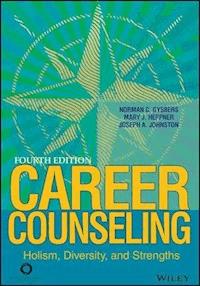
"This book establishes a new standard. The focus on 'holism, diversity, and strengths' sets a fresh direction for the field that will inspire today's counselors. Distinct from other texts both in terms of style and ease of use, Career Counseling provides a practical model that connects theory, practice, and resources in hopeful and affirming ways, while offering readers new skills and insights." --Rich Feller, PhD University Distinguished Teaching Scholar, Colorado State University Past President, National Career Development Association "Gysbers, Heppner, and Johnston have continued their excellent contributions to the field with this 4th edition. Their approach is highly practical for counselors in helping diverse clients prepare for and manage the changing workplace and economy. I enthusiastically recommend this book as a must-have resource for counseling professionals and as a textbook for graduate counseling programs." --Kenneth F. Hughey, PhD Kansas State University "We invite all students, professionals, and researchers to read this volume to enrich their practice, research, and the values by which they should be inspired to persist in being active agents of change in the world." --Laura Nota, PhD, and the Larios Vocational Psychology Team University of Padova, Italy The latest edition of this bestseller will help both counselors-in-training and experienced clinicians update and expand their existing knowledge and skills in career counseling with clients of all ages and circumstances. Significant attention is placed on expanding the career options and empowering the life choices of women; men; racial and ethnic minorities; gay, lesbian, bisexual, and transgender clients; clients from diverse socioeconomic backgrounds; and individuals with disabilities. Additional topics discussed include traditional and postmodern career theories and approaches, forming a productive alliance with the client, effective use of assessment inventories and instruments, helping clients respond to changes in the workplace and family life, working with resistant clients, developing client action plans, and bringing closure to the counseling process. A new chapter titled "Using Social Media in Career Counseling" rounds out this exceptional book. *Requests for digital versions from ACA can be found on www.wiley.com. *To purchase print copies, please visit the ACA website. *Reproduction requests for material from books published by ACA should be directed to [email protected].
Sie lesen das E-Book in den Legimi-Apps auf:
Seitenzahl: 857
Veröffentlichungsjahr: 2014
Ähnliche


















CONTENTS
Cover
Title Page
Copyright
Dedication
Preface
Acknowledgments
About the Authors
About the Contributors
Part One: Career Counseling in the 21st Century: Evolving Contexts, Challenges, and Concepts
Chapter 1: Career Counseling: A Life Career Development Perspective
Chapter 2: Ways of Understanding Career Behavior and Development: Selected Theories
Chapter 3: Empowering Life Choices: Career Counseling in the Contexts of Race and Class
Chapter 4: Empowering Women’s Life Choices: An Examination of Gender and Sexual Orientation
Chapter 5: Empowering Men’s Life Choices: An Examination of Gender and Sexual Orientation
Chapter 6: Facilitating the Career Development of Individuals With Disabilities Through Empowering Career Counseling
Chapter 7: Helping Clients Understand and Respond to Changes in the Workplace and Family Life
Part Two: Client Goal or Problem Identification, Clarification, and Specification
Chapter 8: Opening Phase of the Career Counseling Process: Forming the Working Alliance
Chapter 9: Identifying and Analyzing Life Career Themes
Chapter 10: Life Career Assessment: An Interview Framework to Help Clients Tell Their Stories
Chapter 11: Career, Multicultural, Marital, and Military Family Genograms: Helping Clients Tell Their Stories About Their Career–Family Connections
Chapter 12: Gathering Client Information Using an Occupational Card Sort: Using Occupational Titles as Stimuli
Chapter 13: Gathering Client Information Using Selected Standardized Tests and Inventories: An In-Depth Approach
Chapter 14: Assessments That Focus on Strengths and Positive Psychology: The Clifton StrengthsFinder and the INSIGHT Inventory
Chapter 15: Understanding and Working With Resistant Clients
Part Three: Client Goal or Problem Resolution
Chapter 16: Using Information, Taking Action, and Developing Plans of Action
Chapter 17: Using Social Media in Career Counseling
Chapter 18: Bringing Closure to Career Counseling
Index
Technical Support
End User License Agreement
Guide
Cover
Table of Contents
Begin Reading
Part 1
Chapter 1
Pages
i
ii
iii
iv
ix
x
xi
xii
xiii
xiv
xv
xvi
xvii
1
2
3
4
5
6
7
8
9
10
11
12
13
14
15
16
17
18
19
20
21
22
23
24
25
26
27
28
29
30
31
32
33
34
35
36
37
38
39
40
41
42
43
44
45
46
47
48
49
50
51
52
53
54
55
56
57
58
59
60
61
62
63
64
65
66
67
68
69
70
71
72
73
74
75
76
77
78
79
80
81
82
83
84
85
86
87
88
89
90
91
92
93
94
95
96
97
98
99
100
101
102
103
104
105
106
107
108
109
110
111
112
113
114
115
116
117
118
119
120
121
122
123
124
125
126
127
128
129
130
131
132
133
134
135
136
137
138
139
140
141
142
143
144
145
146
147
148
149
150
151
152
153
154
155
156
157
158
159
160
161
162
163
164
165
166
167
168
169
170
171
172
173
174
175
176
177
178
179
180
181
182
183
184
185
186
187
188
189
190
191
192
193
194
195
196
197
198
199
200
201
202
203
204
205
206
207
208
209
210
211
212
213
214
215
216
217
218
219
220
221
222
223
224
225
226
227
228
229
230
231
232
233
234
235
236
237
238
239
240
241
242
243
244
245
246
247
248
249
250
251
252
253
254
255
256
257
258
259
260
261
262
263
264
265
266
267
268
269
270
271
272
273
274
275
276
277
278
279
280
281
282
283
284
285
286
287
288
289
290
291
292
293
294
295
296
297
298
299
300
301
302
303
304
305
306
307
308
309
310
311
312
313
314
315
316
317
318
319
320
321
322
323
324
Career Counseling
Holism, Diversity, and Strengths
Fourth Edition
Norman C. Gysbers
Mary J. Heppner
Joseph A. Johnston
5999 Stevenson Avenue | Alexandria, VA 22304 | http://www.counseling.org
Copyright © 2014 by the American Counseling Association. All rights reserved. Printed in the United States of America. Except as permitted under the United States Copyright Act of 1976, no part of this publication may be reproduced or distributed in any form or by any means, or stored in a database or retrieval system, without the written permission of the publisher.
10987654321
American Counseling Association
5999 Stevenson Avenue
Alexandria, VA 22304
Associate Publisher Carolyn C. Baker
Production Manager Bonny E. Gaston
Copy Editor Susan B. Klender
Editorial Assistant Catherine A. Brumley
Cover and text design by Bonny E. Gaston.
Library of Congress Cataloging-in-Publication Data
Gysbers, Norman C.
Career counseling: holism, diversity, and strengths/Norman C. Gysbers, Mary J. Heppner, Joseph A. Johnston.—Fourth Edition.
pages cm
Includes bibliographical references and index.
ISBN 978-1-55620-333-6 (alk. paper)
1. Vocational guidance—Study and teaching. 2. Personality and occupation. I. Heppner, Mary J. II. Johnston, Joseph A. III. Title.
HF5381.G95 2014
158.7—dc23
2013037326
Dedication
To all our graduate studentsand colleagues worldwide who havesupported and encouraged thedevelopment and writingof this book
Preface
The USA is bigger, older, more Hispanic and Asian and less wedded to marriage and traditional families than it was in 1990. It also is less enamored of kids, more embracing of several generations living under one roof, more inclusive of same-sex couples, more cognizant of multiracial identities, more suburban, less rural and leaning more to the South and West.
—Nasser & Overberg, 2011
Vast and far-reaching changes are taking place in the nature and structure of the social and economic systems in which people live and the industrial and occupational structures in which they work (U.S. Department of Labor, 2013). The values and beliefs individuals hold about themselves, about others, and about the world are changing too. More and more people are seeking meaning and coherence in their lives. Our society also is becoming multiracial, multilingual, and multicultural. Women are entering the labor force in record numbers, and men are questioning traditionally held beliefs about their roles.
Demographic trends in the 2000s showed the continuing separation of family and household because of factors such as childbearing among single parents, the dissolution of cohabiting unions, divorce, repartnering, and remarriage. The transnational families of many immigrants also displayed this separation, as families extended across borders. In addition, demographers demonstrated during the decade that trends such as marriage and divorce were diverging according to education. Moreover, demographic trends in the age structure of the population showed that a large increase in the elderly population will occur in the 2010s. Overall, demographic trends produced an increased complexity of family life and a more ambiguous and fluid set of categories than demographers are accustomed to measuring.
—Cherlin, 2010, p. 403
Far from being a standard or rote procedure, career counseling, in response to these social and economic changes, has become a dynamic, creative, and highly individualized process. The continually emerging and evolving ideas about the nature and structure of individuals’ career development are providing practitioners with new ways to understand and work with clients of all ages and circumstances. To keep abreast of these changes you may wish to update your knowledge about the ever-changing contexts and conditions in which people will live and work in the 21st century. You may wish to revisit and revitalize how you conceptualize the career development of individuals and the structure of the career counseling you do with clients. You may be looking for specific interventions, including qualitative and quantitative assessments, to help you and your clients gather information about their goals and problems, to work together to understand and interpret this information, and to choose interventions that will assist them in reaching their goals or resolving their problems.
Purpose of the Book
The purpose of this book is to help you expand and extend your understanding of individuals’ career development as well as your vision of career counseling and the skills and techniques in your career counseling repertoire. Specifically, this book is designed to help you update and add to the knowledge and skills you already have. It will help you better understand and interpret client information gathered and behavior observed during career counseling by using concepts from traditional and new and emerging postmodern conceptualizations of career development. It also will help you better understand and interpret client information and behavior in terms of life career themes, or the ideas, beliefs, attitudes, and values clients hold about themselves, others, and the world in which they live. Finally, it will help you assist clients of all ages and circumstances to more effectively understand and use such information and behavior in their quest to achieve their career goals or resolve their career concerns.
This book incorporates the strongest parts of the traditional understanding of the career counseling process with the ever-changing social and economic demands of the 21st century. In addition, it incorporates new and emerging postmodern career development concepts into career counseling practices, further strengthening your understanding of the career counseling process. This is important, because we believe that the process of career counseling has long been overlooked, as if this particular brand of counseling were devoid of process. We propose a process for career counseling, and we focus particular attention on how this process can be helpful in expanding options and empowering the authentic life choices of women; men; racial and ethnic minorities; gay, lesbian, bisexual, and transgender clients; and individuals with disabilities. Although we are keenly aware that these categories do not cover all forms of diversity in human life, we choose to highlight them and hope that much of what we express is transferable to the issues of other diverse groups as well.
To help you gain these specific skills, this book brings together selected concepts and techniques from the disciplines of counseling, psychology, sociology, and economics in general, and the discipline of career psychology specifically. It is a book for you if you are looking to enhance your theoretical knowledge and expand your practice skills through an in-depth examination of specifically selected career counseling interventions, including various qualitative and quantitative assessments. It is a book for you if you are looking to update and expand your ability to gain insights into client behavior, to develop hypotheses about such behavior, and to apply this knowledge in the selection of effective career counseling techniques and assessments.
Overview of the Contents
This book presents a theory-based, practice-focused approach to career counseling. It presents career counseling holistically using life career development as a way to view and understand overall human development in general and career development specifically. It is a strengths-based, theoretically sound conception of career counseling that is practitioner friendly and very usable with clients of all ages and circumstances. Specific attention is given to the critical life contexts in which career development unfolds and career counseling takes place, including gender, culture/race, sexual orientation, social class, spirituality, and disability. Specific attention is also given to the ever-changing work world, including the implications of globalization and the interactions of work and family.
Because the book is theory based and practice oriented, there is an emphasis on the nature and structure of the working alliance as central to the career counseling process. A strength of the book is the use of postmodern theories, including constructivism, social constructionism, and chaos theory. It focuses on narratives to identify life career themes used by clients to organize their thoughts, feelings, and ideas. To assist career counselors in gathering client information, understanding and hypothesizing client behavior, and helping clients develop and carry out action plans, the book includes very practical and highly usable presentations of a number of qualitative career assessments along with several quantitative instruments. A unique emphasis in the book focuses on dealing with resistant clients, why and how these clients may resist, and how to work with such resistance. Finally, the book describes how to use information in career counseling, how to help clients develop and use action plans, how to use social media, and how to bring closure to the career counseling process.
Part I, “Career Counseling in the 21st Century: Evolving Contexts, Challenges, and Concepts,” provides you with foundation knowledge and perspectives concerning our changing world in the 21st century. Chapter 1 focuses on the career counseling process and the phases that are involved in working with clients. It describes the career counseling process from a life career development perspective and presents information about the Career Counseling Self-Efficacy Scale. Chapter 2 describes the evolution of career development theory building and presents selected traditional and postmodern theories and approaches to understanding career development, with an emphasis on the use of theoretical constructs in the practice of career counseling. Chapters 3, 4, and 5 highlight the implications of increasing diversity, focus on the impact of social class, describe women’s and men’s issues as they affect career counseling, and discuss sexual orientation issues and concerns. Finally, Chapter 6 focuses on empowering the life choices of people with disabilities, whereas Chapter 7 examines the changes that are occurring in the worlds of work and family and the impact these changes have on the lives of individuals.
Part II, “Client Goal or Problem Identification, Clarification, and Specification,” provides in-depth discussions of issues and selected techniques and instruments, all tied to the first phases of the career counseling process detailed in Chapter 1. Chapter 8 examines the opening phase of career counseling, focusing on the working alliance and its importance in the career counseling process. Chapter 9 describes the concept of life career themes, shows how life career themes are identified and described by using example career themes, and details how these life career themes assist in understanding client goals, behavior, or concerns. Chapters 10, 11, and 12 feature postmodern qualitative techniques—a structured interview, the genogram, an occupational card sort—that provide structure and stimuli to help clients tell their stories and identify their life career themes during the information-gathering phase of career counseling. Then Chapter 13 presents an in-depth discussion of how selected standardized tests and inventories provide information about clients’ interests and personalities. Chapter 14 presents assessments that focus on clients’ styles and strengths. Finally, Chapter 15 deals with resistant clients, the kinds of resistance they may exhibit, and ways to respond to clients who resist.
Part III, “Client Goal or Problem Resolution,” emphasizes career counseling strategies to use to assist clients in reaching their goals or resolving their concerns. Chapter 16 pays attention to the use of information in the career counseling process and presents the details of how clients can set goals and develop career plans based on the outcomes clients and counselors have arrived at through their work in career counseling. Chapter 17, a new chapter, focuses on the use of social media in career counseling. Finally, Chapter 18 examines closure in career counseling. The topic of how to bring closure to the career counseling process and the issues that are involved in closing the working alliance between client and counselor are featured.
Who Should Read This Book?
This book is designed for a variety of readers. First, practicing counselors in many different work settings who do career counseling will find this book to be an excellent in-depth update of traditional and contemporary postmodern career theories, issues, and techniques. But it is more than just an update for practitioners. With its three carefully crafted and connected parts, all organized around a holistic perspective of career development and the career counseling process, this book is a source of renewal for practitioners. Second, this book is also for counselors-in-training in counseling psychology, counselor education, and other helping relationship programs because it provides them with the prerequisite knowledge and skills to do career counseling. It features the career counseling process based on a life career development perspective, with particular attention to diversity, social class, disability, sexual orientation, and gender issues. The book takes counselors-in-training through the phases of the career counseling process, providing in-depth presentations of selected techniques and assessment procedures. It offers a framework for integrating postmodern qualitative and traditional quantitative assessment techniques and information into the career counseling process directly and naturally, something that many counselors-in-training have difficulty doing.
New to This Edition
Because interest in career counseling continues to increase, and because the literature on career counseling trends, issues, and practices has expanded substantially, it was clear that the third edition of Career Counseling was in need of revision. In this, the fourth edition, we thoroughly updated our chapters with current literature and research concerning the many contextual variables that influence our work as career counselors as well as the theory and practice of career counseling. Our goal was to enhance the theoretical foundations and contextual underpinnings of our field while maintaining our emphasis on the practical. Some of the most significant revisions and additions include the following:
The title of the book was changed to emphasize holism, diversity, and strengths, major themes that are interwoven through the book.
The chapter on ways to understand career behavior was expanded to provide a brief overview of the evolution of career theory building as well as coverage of postmodern theories of career development, including constructivism, social constructionism, and chaos theory.
A new chapter has been added focusing on the role of social media in career counseling.
References
Cherlin, A. J. (2010). Demographic trends in the United States: A review of research in the 2000s.
Journal of Marriage and Family, 72,
403–419.
Nasser, H. E., & Overberg, P. (2011). Census tracks 20 years of sweeping change.
USA Today
. Retrieved from
http://www.usatoday.com
U.S. Department of Labor. (2013).
Occupational outlook handbook, 2013–2014 ed.
St. Paul, MN: Jist Publishing.
Acknowledgments
This book was written with the support, encouragement, and tangible contributions of many colleagues. We particularly acknowledge the contributions of Lisa Flores, Patrick Handley, Puncky Heppner, John Kosciulek, and Amanda Nell: Lisa for her substantial contributions to Chapter 3, “Empowering Life Choices: Career Counseling in the Contexts of Race and Class”; Patrick for his contribution to Chapter 14 concerning the INSIGHT Inventory; Puncky for his substantial contributions to Chapter 5, “Empowering Men’s Life Choices: An Examination of Gender and Sexual Orientation”; John for writing Chapter 6, “Facilitating the Career Development of Individuals With Disabilities Through Empowering Career Counseling”; and Amanda for writing Chapter 17, “Using Social Media in Career Counseling.” We also thank Kathleen Kerr for her help in researching portions of the book. Thank you, Lisa, Patrick, Puncky, John, Amanda, and Kathleen.
Finally, this book could not have been completed without the very effective and efficient work of our administrative associate, Linda Coats, who has now helped us through three editions of this book. Thank you, Linda.
About the Authors
Norman C. Gysbers, PhD, is a Curators’ Distinguished Professor in the Department of Educational, School, and Counseling Psychology at the University of Missouri in Columbia, Missouri. He received his bachelor’s degree from Hope College in Holland, Michigan, in 1954. He was a teacher in the Muskegon Heights Michigan School District (1954–1956) and served in the U.S. Army Artillery (1956–1958). He received his master’s (1959) and doctorate (1963) from the University of Michigan. He joined the faculty of the College of Education at the University of Missouri–Columbia in 1963 as an assistant professor. In addition to his duties as an assistant professor, he also served as the licensed school counselor at the University Laboratory School until 1970.
He was awarded a Franqui Professorship from the Universite Libre de Bruxelles, Belgium, and lectured there in February 1984. He was a visiting scholar at the University of Hong Kong in May 2000, 2002, and 2004; a visiting scholar at the Chinese University of Hong Kong in January 2001; and a scholar in residence at the University of British Columbia in July/August 2000. He also was an International Visiting Scholar at National Taiwan Normal University in 2011.
His research and teaching interests are in career development, career counseling, and school guidance as well as in counseling program development, management, and evaluation. He is the author of 96 articles, 40 chapters in published books, 15 monographs, and 22 books, one of which has been translated into Italian, Korean, Japanese, and Chinese, and one into Chinese.
He has received many awards, most notably the National Career Development Association’s Eminent Career Award in 1989; the Missouri Career Development Association’s Lifetime Career Achievement Award in 2013; the American School Counselor Association’s Mary Gehrke Lifetime Achievement Award in 2004; the William T. Kemper Award for Excellence in Teaching in 2002; the Governor’s Award for Excellence in Teaching in 2004; the Faculty/Alumni Award from the University of Missouri–Columbia in 1997; and the Distinguished Faculty Award from the Mizzou Alumni Association, University of Missouri, in 2008.
Gysbers was editor of The Career Development Quarterly (1962–1970), president of the National Career Development Association (1972–1973), president of the American Counseling Association (1977–1978), and vice president of the Association of Career and Technical Education (1979–1982). He was also editor of the Journal of Career Development from 1978 until 2006.
Mary J. Heppner, PhD, is a full professor of counseling psychology at the University of Missouri. Dr. Heppner graduated from the University of Minnesota–Morris with her bachelor’s, the University of Nebraska–Lincoln with her master’s, and the University of Missouri–Columbia with her doctorate. She has written in the areas of women’s career development and adult career transitions. She is coauthor of the texts Career Counseling: Process, Issues, and Techniques (1998, 2003), Career Planning for the Twenty-First Century (2000), and A Guide to Successful Theses, Dissertations, and Publishing Research (2004) and is coeditor of and contributor to the Handbook of Career Counseling for Women (2006). She is author of the Career Transitions Inventory and coauthor of the Career Counseling Self-Efficacy Scale. Her most recent research has been in the area of examining which aspects of the process of career counseling lead to effective outcomes. In addition, she has a programmatic line of research on the prevention of sexual assault in middle school, high school, and college populations.
She has been a Fulbright scholar in Taiwan. She is a Fellow in the Society of Counseling Psychology of the American Psychological Association. She has won the John Holland Award for Research in Career Development and the Early Scientist Practitioner Award, both from the Society of Counseling Psychology. She was also awarded the National Career Development Association Merit Award. On the University of Missouri campus she has won the William T. Kemper Award for Outstanding Teaching, the Robert S. Daniel Junior Faculty Teaching Award, the College of Education Outstanding Graduate Mentor Award, and the Graduate School’s Outstanding Mentor Award. She was also awarded the Provost’s Committee on the Status of Women’s First Annual Tribute to Mizzou Women Award for contributions and commitment to the University and to the women who work and study at the University of Missouri.
Joseph A. Johnston, PhD, is a professor in the Department of Educational, School, and Counseling Psychology at the University of Missouri, where he is also director of the university career center. His bachelor’s, master’s, and doctoral degrees are all from the University of Michigan. He regularly teaches courses in career development. He is a founder of the Wakonse Foundation, an organization helping to elevate and improve college teaching. His memberships include the American Association for Counseling and Development, American College Personnel Association, and National Career Development Association.
He initiated the A Way With Words literacy program, the A Way With Numbers tutoring program, and the Jumpstart program at the University of Missouri in response to the America Reads Challenge. He has published in numerous professional journals, organized workshops, and presented at professional meetings nationally and internationally. He has served on the editorial boards of several professional journals. He has a strong commitment to career theory and practice, leadership, self-directed learning, faculty development, entrepreneurship, and positive psychology.
His awards and achievements include the following: Research Award in Career Development Scholarship named in his honor, February 2000; Excellence in Education Award, May 1996, Division of Student Affairs, University of Missouri; Certificate of Recognition of Service, April 2002, Kiwanis Club of Columbia, Missouri; Distinguished Membership, National Society of Collegiate Scholars, September 2002; Sam M. Walton Free Enterprise Fellow, 2005; Honorary Member of the National Residence Hall Honorary, 2005; Member, Board of Directors, Funding African Children’s Education, Inc. (FACE); Member, Planning Committee for MU Colleague Circles, 2000–2007; Faculty Advisors, MU Student Entrepreneurs, 2005–2006. He was awarded the Missouri Career Development Association’s Lifetime Career Achievement Award in 2013.
About the Contributors
Lisa Y. Flores, PhD, is an associate professor in the Department of Educational, School, and Counseling Psychology at the University of Missouri.
Patrick Handley, PhD, is a professional speaker and trainer, and developer of the INSIGHT Inventory.
P. Paul Heppner, PhD, is a Curator’s Distinguished professor at the University of Missouri as well as the cofounder and codirector of the Center for Cultural Competence.
John F. Kosciulek, PhD, CRC, is a professor in the Department of Counseling, Educational Psychology, and Special Education at Michigan State University in East Lansing.
Amanda Nell, MA, is a Senior Student Services Coordinator in the Career Center at the University of Missouri.
Part OneCareer Counseling in the 21st CenturyEvolving Contexts, Challenges, and Concepts
Chapter 1Career Counseling: A Life Career Development Perspective
Careers are person-specific and created by the choices we make throughout our lives. Careers emerge from the constant interplay between the person and the environment. They include activities engaged in prior to entering the workforce and after formal activity as a worker has been completed. Careers encompass the total constellation of life roles that we play. Thus, managing our careers effectively also involves integrating the roles of life effectively. In a very real sense, careers are the manifestations of our attempts at making sense out of our life experiences. The career development process is, in essence, a spiritual journey reflecting our choices concerning how we will spend our time on Earth.
—Niles & Harris-Bowlsbey, 2005, p. 30
The theory and research base of career development and the practice of career counseling has evolved and changed as the 21st century has continued to unfold. Modern normative, science-based theories such as Holland’s theory of vocational personalities and work environments continue to be useful in guiding the practice of career counseling (R. W. Lent, 2013). At the same time, there has been “a proliferation of career counselling approaches underpinned by postmodern and constructivist philosophies” (McMahon, Watson, Chetty, & Hoelson, 2012, p. 127).
The combination of modern theories and postmodern theories is stimulating a reexamination of the nature and structure of career development and the career counseling practices used to facilitate it. This reexamination is also stimulating new ways of gathering client information as career counseling unfolds. Just as important, it is giving us new ways to think about and develop hypotheses concerning client information and behavior. It is opening up new ways to apply these hypotheses to the selection of interventions used to assist clients in resolving their problems and achieving their goals.
To set the stage for the rest of the book, the first part of Chapter 1 examines the nature and structure of career counseling in light of the changes occurring in career development theory building. This discussion is presented to provide a perspective and an organizer for the career counseling interventions that are described in the chapters that follow. Then, in the second part of Chapter 1, a holistic view of career development, called life career development, is described to provide a conceptual foundation and point of departure for career counseling with clients of all ages and circumstances. The chapter closes with a discussion of competencies for counselors who do career counseling. The Career Counseling Self-Efficacy Scale (O’Brien & Heppner, 1995) is presented and described.
Career Counseling
What is career counseling? Is it different from other forms of counseling? Is it the same? Is there overlap? These questions are being asked with increasing frequency today as attempts are being made to clarify this form of counseling (Amundson, Harris-Bowlsbey, & Niles, 2009; Capuzzi & Stauffer, 2012; Savickas, 2011). Central to the ongoing discussion about career counseling are two issues. First is the issue of the nature of career counseling. What are its intrinsic characteristics and qualities? Are psychological processes involved? Second is the issue of structure. Does career counseling have structure? If so, what is the configuration, sequence, and interrelationships of the phases and subphases involved?
Lesen Sie weiter in der vollständigen Ausgabe!
Lesen Sie weiter in der vollständigen Ausgabe!
Lesen Sie weiter in der vollständigen Ausgabe!
Lesen Sie weiter in der vollständigen Ausgabe!
Lesen Sie weiter in der vollständigen Ausgabe!
Lesen Sie weiter in der vollständigen Ausgabe!
Lesen Sie weiter in der vollständigen Ausgabe!
Lesen Sie weiter in der vollständigen Ausgabe!
Lesen Sie weiter in der vollständigen Ausgabe!
Lesen Sie weiter in der vollständigen Ausgabe!
Lesen Sie weiter in der vollständigen Ausgabe!
Lesen Sie weiter in der vollständigen Ausgabe!
Lesen Sie weiter in der vollständigen Ausgabe!
Lesen Sie weiter in der vollständigen Ausgabe!
Lesen Sie weiter in der vollständigen Ausgabe!
Lesen Sie weiter in der vollständigen Ausgabe!
Lesen Sie weiter in der vollständigen Ausgabe!
Lesen Sie weiter in der vollständigen Ausgabe!
Lesen Sie weiter in der vollständigen Ausgabe!
Lesen Sie weiter in der vollständigen Ausgabe!
Lesen Sie weiter in der vollständigen Ausgabe!
Lesen Sie weiter in der vollständigen Ausgabe!




