


9,49 €
Mehr erfahren.
- Herausgeber: Sonicbond Publishing
- Kategorie: Geisteswissenschaft
- Serie: On Track
- Sprache: Englisch
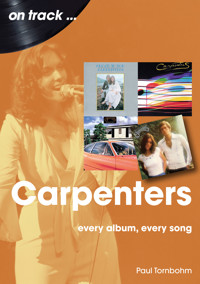
The brother and sister team of Karen and Richard Carpenter rank as one of the most successful acts in pop music history. Between the first Carpenters’ album released in 1969 and their final studio album together in 1981, they achieved three Grammy awards, 18 hits in the US Top 20 (and ten in the UK) and multiple platinum discs, leading to eventual sales of over 100 million copies worldwide. Although the group’s career was brought to a tragic and premature end by the untimely death of Karen Carpenter in 1983, they remain a much-loved band.
The Carpenters crafted their own distinctive sound with multi-part harmonies and lush arrangements. A unique singer and gifted interpreter of songs, Karen was also passionate about playing the drums, with Richard’s talents extending to keyboards, singing, composing, arranging and producing.
This book explores the background to each of their studio albums and classic singles, as well as their solo recordings, live albums and compilations of rare tracks. From their earliest recordings in a jazz trio through to Richard’s reinterpretations of their best-known songs with the Royal Philharmonic Orchestra, and as a solo pianist, this appraisal looks at over 55 years of Carpenters material.
Paul Tornbohm is a songwriter and musician. As befits a Carpenters fan, he has recorded an album of his songs, August Afternoons, with his sister Cathy on lead vocals. A former member of the ‘ghost-rock’ group Piano Magic, Paul has also released the solo EP Down an English Lane. Additionally, he composes for Spontaneous Productions, a theatre company in Sydenham, London. Paul has a Masters in music production from Kingston University, teaches music qualifications at a sixth-form college in Surrey and lives in Crystal Palace, London, with his wife, the composer Yumi Mashiki. This is his first book.
Das E-Book können Sie in Legimi-Apps oder einer beliebigen App lesen, die das folgende Format unterstützen:
Seitenzahl: 273
Veröffentlichungsjahr: 2024
Ähnliche




















Dedication
To my mother, Yvonne Hamilton, 1943-2023
Acknowledgements
In researching this book, I am grateful to Carpenters authors Ray Coleman, Mike Cidoni Lennox, Rick Henry, Chris May, John Tobler and Randy L. Schmidt for their detailed research. I am also grateful to those who have shared their knowledge and collections online – including A&M Corner’s Carpenters Complete Recording Resource, The Carpenters: History and News Facebook page, Jonathan Owen’s online collection, David Grant’s discography, and last but definitely not least, Richard Carpenter’s official Carpenters website. Chart positions were principally sourced from Craig Halstead’s book on the band’s Top 40 hits.
I would like to thank Stephen Lambe for this opportunity, my wife Yumi Mashiki for her patience, my sister Cathy for being my Karen Carpenter, and my parents Noel and Yvonne for a musical education. Special thanks to On Track authors Peter Kearns, Richard James and Georg Purvis for their helpful guidance.
I am also indebted to the following for their insights and encouragement – Elizabeth Benitez Morales, Tom Bromley, Kevin Chambers (for road-testing Carpenters’ cover songs at open-mic nights together), Glen Johnson, Paul Sarcich, Jeremy Simmonds, Royston Vince, Stephen Wang, Matthew Welton, and lastly to my supportive work colleagues.
Foreword
Growing up in the 1970s, our kitchen radio was permanently tuned to the easy-listening station BBC Radio 2, and the group I remember hearing the most was the Carpenters. I also remember seeing the ‘Please Mr Postman’ video on TV, no doubt because it was filmed at Disneyland: the place in the world I most wanted to visit.
By the time I was a teenager in the 1980s, my musical taste had outgrown Radio 2, but my yesterday-once-more moment came in the 1990s with the release of the tribute album If I Were A Carpenter. Here, the alternative rock bands I was listening to (like Sonic Youth and Babes in Toyland) had given the Carpenters’ sound a fuzz-and-feedback makeover, and instead of being an ironic takedown of the duo’s soft-rocking music, their interpretations sounded surprisingly reverential, proving that deeply melancholic songs like ‘Rainy Days and Mondays’ and ‘Superstar’ could resonate with Gen X.
Tragically, Karen Carpenter passed away in 1983. Since then, the Carpenters’ story has been retold through books, documentaries and biopics. Their catalogue has been remastered and repackaged, reinterpreted with orchestras, and recreated by tribute acts and artificial intelligence software. The internet has strengthened and increased their fan base from the US and UK to Asia, Latin America and beyond.
To understand their wide-reaching and enduring appeal, I will investigate how the brother-and-sister team created their singular sound, balancing musical sophistication and pop success. I will explore how they drew on diverse influences from jazz and classical to country and pop, and how they chose some of the best musicians, songwriters and studios to realise their unique musical vision. I will review all their studio albums, live and solo releases. Each chapter will begin with insights into an album’s making, along with the factors that influenced their success. My main focus is on their music, so I have limited details of their personal lives to the specific events that most directly affected their careers. For anyone seeking further biographical insight, I highly recommend Randy Schmidt’s thorough biography Little Girl Blue: The Life of Karen Carpenter, Lucy O’Brien’s Lead Sister: The Story of Karen Carpenter, and other informative books listed in the bibliography. Lastly, I’ve used some music terminology that may be unfamiliar to some readers but have attempted to contextualise this as much as possible.
Contents
Introduction – From The Top
Offering/Ticket To Ride (1969)
Close To You (1970)
Carpenters (Tan Album) (1971)
A Song For You (1972)
Now And Then (1973)
Horizon (1975)
A Kind Of Hush (1976)
Passage (1977)
Christmas Portrait (1978)
Made In America (1981)
Voice Of The Heart (1983)
An Old-Fashioned Christmas (1984)
Live Albums And Bootlegs
Bootlegs
Compilations And Tribute Albums
Solo Albums and Reinterpretations
On Karen’s Voice
Selected Bibliography
Introduction – From The Top
The Carpenter siblings (Richard (b. 15 Oct 1946) and Karen (b. 2 March 1950 – d. 4 Feb 1983) grew up in New Haven, Connecticut, USA. As children, they listened to their father Harold’s record collection, which ranged from jazz to western swing, and from piano concertos to traditional Hawaiian music. The pioneering multitrack recordings of guitarist Les Paul and his vocalist wife, Mary Ford, held a particular fascination, as did those by madcap musical comedian Spike Jones. The Carpenter siblings also heard their mother, Agnes, sing along to crooners like Bing Crosby, Perry Como and Nat King Cole on the radio. Both siblings started piano lessons, but gave up within a year, though Richard continued to work out songs by ear on the piano, while Karen was more interested in playing sports and attending dance classes. Richard eventually resumed piano lessons with a new teacher who introduced him to the fake book of jazz chord charts, and who helped him enrol in a weekly piano class at the Yale music school.
At the age of 15, Richard formed a jazz quartet with some High School classmates, which brought his talents to the attention of a group of older musicians. This led to gigs in clubs and restaurants, where Richard hoped the glasses he wore would disguise his true age. It also led to his first recording date, travelling to Manhattan to add Jerry Lee Lewis-style keyboard sweeps to the track ‘Why Don’t You Write Me’ by the New Haven vocal group The Barries. In 1963, when Karen was 13 and Richard 16, the family headed west from Connecticut to California, seeking warmer weather and opportunities for Richard in show business. Spotted at a talent show in a local park, Richard was soon recruited as a church organist, learning to play the pipe organ and sneaking in Beatles tunes alongside the hymns. A local paper ran a story on Richard, which led to an offer from a band in need of a pianist. During his time with this group, Richard met singer Ed Sulzer, who would become the duo’s first manager, supporting them through their early incarnations and helping them land their deal with A&M Records.
By the time that group fizzled out, Richard had joined the school concert band, with additional weekend club gigs backing band leader Bruce Gifford in a cabaret group. By 1964, Karen had joined the school marching band on glockenspiel, but her heart was really set on the drums. She began lessons, and even rehearsed briefly with an all-girl instrumental surf band, playing a set that included Beatles numbers. By 1965, and with a Ludwig kit just like Ringo Starr’s, Karen was ready to join Richard in The Richard Carpenter Trio: a jazz group formed with another college student, Wes Jacobs. Jacobs was a tuba and double-bass player whom Richard met after starting as a music major at California State University, Long Beach (CSULB). Rehearsing at the Carpenter home, Karen tried singing a few numbers, including ‘I Who Have Nothing’ and a ballad version of The Beatles’ ‘I Want to Hold Your Hand’. Unhappy with how she sounded on tape, she quickly retreated back behind the drum kit, and the trio played weddings and dances with a hired singer instead. But in May 1966, Karen followed Richard to a friend’s audition for the new independent label Magic Lamp. Karen was invited to give a vocal audition of her own and sang the recent Righteous Brothers hit ‘Ebb Tide’. All agreed that her voice had great promise, and she was promptly signed as a solo artist with Richard as her composer/arranger/keyboardist. The studio they visited that night was in the garage of the record label co-founder Joe Osborn: an experienced session bass player and member of L.A.’s legendary Wrecking Crew. Osborn was to give the duo considerable support throughout their career.
The following month, The Richard Carpenter Trio won the Hollywood Bowl Battle of the Bands. They were spotted that day by an RCA Victor talent scout, and were offered a recording contract. They duly recorded demos at RCA studios, but on hearing these, the label obviously thought twice about the prospects of a jazz-rock tuba group, and decided to pass.
By this time, Richard was a member of the CSULB choir, and was learning choral arrangement under its leader, Frank Pooler. Pooler introduced Richard to student and lyricist John Bettis, and the pair became fast friends, working the summer of ‘67 as vaudeville-era musicians at Coke Corner in Disneyland. Back at university, they gathered other choir members to form the group Summerchimes, who soon evolved into Spectrum. Karen sang and drummed with these groups, and enrolled at the university in 1967, joining the choir. Ed Sulzer touted Spectrum’s demo tapes around record labels, and secured them some gigs – most notably as an ill-matched opening act for Steppenwolf – whilst the band often queued up for Hootenanny talent nights on Mondays at West Hollywood’s Troubadour. However, the band’s old-fashioned choral sound and dowdy image failed to engage the Whisky à Go Go audience, and the band never made it past the first night of their three-night booking. Similarly, their demo tape was provoking more bemusement than interest from record labels. Even offers from two independent labels – Uni and White Whale – ran aground.
When both Spectrum and the Magic Lamp label burnt out, Karen and Richard resolved to present themselves as a duo. To name the band, they chose their surname, leaving out the definite article ‘The’, as Richard felt this sounded more hip. Throughout 1968, they demoed songs in Joe Osborn’s 4-track studio, exploring ways to multitrack their harmonies, and creating the demo that – with Ed Sulzer’s help – was to get them signed to A&M Records in 1969.
Offering/Ticket To Ride (1969)
Personnel:
Karen Carpenter: vocals, drums, bass (5, 11)
Richard Carpenter: vocals, keyboards, arranger
Joe Osborn, Bob Messenger: bass
Gary Sims: guitar
Herb Alpert: shaker
Recorded at A&M Records, Hollywood, California
Produced by Jack Daugherty
Engineered by Ray Gerhardt
Release date: 9 October 1969
Charts: US: 150, UK: 20 (1972)
Label: A&M
Retitled Ticket To Ride, 10 November 1970
Running time 36:52
After all those years of preparation, when the offer of a recording contract finally arrived, Karen and Richard had just agreed to an advertising deal with the Ford Motor Company, who were to pay the duo $50,000 each and give them each their own Ford Mustang car. Extracting themselves from that deal, the duo signed with A&M on 22 April 1969. One week later, the Carpenters entered studio A on the A&M lot to begin recording their debut album. In their excitement, they gave no thought to changing any of the repertoire they’d developed over the past few years, which was already sounding out-of-date. All the same, the album had high production values, and contained an ambitious blend of jazz and pop, with even a touch of psychedelia. Since Karen preferred her role as drummer and still lacked confidence as a lead singer, she and Richard shared the lead vocals.
As an unknown act, there was less pressure to deliver the album quickly, and they spent the next few months and a generous budget piecing together the elements of what would become their trademark sound. Karen played bass on two numbers, with the remaining bass parts supplied by either Magic Lamp’s Joe Osborn or Bob Messenger, whom Richard had met when standing in for another pianist at a gig in Downey, CA. Messenger – a multi-instrumentalist who also played saxophone and flute, was to become a fixture of the duo’s touring band.
Richard played the studio’s Steinway model A grand piano on tracks like ‘Someday’, ‘Ticket To Ride’ and ‘Eve’. Elsewhere, he played a harpsichord and the Wurlitzer 140B organ he’d purchased from Jeff Hanna of The Nitty Gritty Dirt Band. Guitarist Gary Sims – another college friend who’d been a member of Summerchimes and Spectrum – played on ‘All of My Life’ and ‘Nowadays Clancy Can’t Even Sing’. The album was produced by former Woody Herman Band trumpeter Jack Daugherty, who’d helped forward the Carpenters’ demo to A&M’s Herb Alpert.
To show off Karen’s voice to its fullest, Richard arranged songs to emphasise the lower end of her vocal range with its characterful warmth and tone. He was also mindful to leave space for Karen’s vocals when creating orchestral arrangements, reserving the opening verse of ballads for voice and keyboards before introducing other musical elements. He also paired Karen’s voice with the near-human tone of reed instruments like the cor anglais and oboe, as heard towards the end of ‘Someday’. And right at the heart of their sound were the multitracked vocal harmonies, which the pair would record and then review, deciding whether a part needed to be doubled or tripled.
The ingredients of the Carpenters’ unique sound were now in place, yet their debut was still subtly different from their later releases – not only in the pair’s shared lead vocals, but in the husky tone of Karen’s youthful voice. Several of the lyrics were aligned with the late-1960s countercultural hippy worldview; not that the rock press were persuaded, however, dismissing the duo as little more than a wholesome brother-and-sister vocal act. It also didn’t help that the label had placed dull photos of the pair on the front and back of Offering. Unsurprisingly, sales were poor, and the album made a loss on its $50,000 production costs. Thankfully, their luck was about to change.
‘Invocation’(Richard Carpenter, John Bettis)
Side one begins with a religious a cappella pastiche with a lyric stating the album title, Offering. This hymn-like piece shows the influence of the Carpenters’ choral training under Frank Pooler. The lines are delivered in suitably chorister-like tones, while the arrangement uses techniques like antiphony and call-and-response. Richard described the multilayered choir as an excuse to have fun with voice overdubbing.
The album version is a remix of the demo recorded the previous year by Joe Osborn in his garage studio. This demo, like many of their earliest recordings mentioned throughout this chapter, can be heard in the box-set compilations From the Top and The Essential Collection: 1965-1997.
‘Your Wonderful Parade’(Richard Carpenter, John Bettis)
This recording, made in 1968 in Joe Osborn’s garage, was on the demo tape that secured the A&M deal. Some new features were added to the demo for album inclusion, such as the string section, tubular bells and the spoken introduction. Richard also replaced his original lead vocal with a more enthusiastic take, which, together with the upbeat tempo, makes it a strong choice to open the album. Listeners can compare the changes with the original demo available on the compilations mentioned above.
The song was written in 1967 as a youthful satire on the establishment, ‘of which we were later to become a part’, Richard conceded in the From the Top booklet. The lyric makes an absurdist analogy between the routines of a conventional lifestyle and a circus parade march, as depicted by Karen’s military drum patterns, which she doubtlessly picked up during her time in the Downey High School marching band. The spoken introduction, therefore, features Richard as a circus barker, recalling Harry Nilsson’s announcements at the start of his 1967 Pandemonium Shadow Show album, and The Beatles’ ‘Being for the Benefit of Mr Kite’ on Sgt. Pepper’s ... the same year. The segment closes with a line adapted from Abraham Lincoln’s famous 1863 Gettysburg address – ‘of the people, by the people and for the people’, after which Karen’s spoken count-in can be heard.
Musically, the song is full of details, such as Joe Osborn’s bass climbing up into the higher register in the middle section to leave space for the cello solo. Also, while the song is in a 4/4 time signature, a sneaky bar of 2/4 is fitted into the bridge section at the phrase ‘a better way to fall’. There are also three key changes which can be heard at the start of the verses and cello solo.
To end the song, Karen’s military snare drum marches off into the distance with a swirly phase effect applied on top. According to Richard, this was an unintended but welcome by-product that occurred at the album’s mastering stage. A similar phase effect can be briefly heard around the two-minute mark on the line ‘Meet your wife at cocktail time’.
The song also appeared on the B-side of ‘Ticket To Ride’ with a newly recorded shorter vocal introduction.
‘Someday’(Richard Carpenter, John Bettis)
At 5:13 in length, ‘Someday’ is the album’s longest track and possibly its most epic. From the eerie piano fade-in to the cinematic string sweeps, the arrangement was constructed as a dramatic frame for Karen’s passionate performance. This is the album’s one track without backing vocals, highlighting the affecting vulnerability in Karen’s voice. Whenever she sings the title, the two notes fall by either a 3rd or a 5th, replicating a sigh of exasperation. At the end, the phrase rises instead, as if Karen were proclaiming a powerful promise.
The young couple’s fate remains undecided at the song’s conclusion, just as Richard’s melody lines remain unresolved at the end of each verse, and the brass section plays an unresolved chord at the very end.
The track is a true album high point, though neither Richard nor Karen were fully happy with the recording. Richard was specifically unhappy with the harp distortion in verse two, while Karen was displeased with her vocal, having had a cold on the day of recording. The opportunity to re-record the song came much later when it was revisited in a medley on their 1980 TV special Music Music Music. This version can be heard as part of the ‘1980 Medley’ on the From the Top and Essential Collection compilations.
‘Get Together’(Chet Powers)
This era-defining anthem to peace and brotherhood was written by Chet Powers, aka Dino Valenti of Quicksilver Messenger Service, and was first released as ‘Let’s Get Together’ by the Kingston Trio in 1964. Epitomising hippy ideals, it became a popular track to cover in the 1960s, with versions by artists like Jefferson Airplane, Julie Felix and The Sunshine Company. ‘Get Together’ is perhaps most associated with The Youngbloods, whose recording inspired Richard to create his own arrangement. But any hopes that the Carpenters may have nurtured of scoring their own hit with the song, were dashed when The Youngbloods’ re-released their version in September 1969, hitting five on the Billboard Hot 100 just a month before the release of Offering.
Trombones were added to the Carpenters’ recording at the suggestion of Herb Alpert to give the track more impact. Richard also wanted a psychedelic effect on the vocals, feeding them through his Baldwin keyboard amplifier on the tremolo setting. This may have been inspired by the similar effect on The Beatles’ 1966 recording ‘Tomorrow Never Knows’, where a revolving Leslie speaker was used to alter John Lennon’s vocal to sound like the chanting of Tibetan monks on a mountaintop.
‘All Of My Life’ (Richard Carpenter)
Karen and Richard first recorded this song with Spectrum in 1967, and though that version has never been released, it’s currently available online. They recorded another version for the Joe Osborn demo tape, but the version on Offering/Ticket To Ride was newly recorded and featured additional orchestration. The yearning lyric is set to a 12/8 rhythm, and recalls 1960s teen ballads like The Angels’ ‘Cry Baby Cry’ or Skeeter Davis’ ‘The End of the World’. Gary Sims’ tremolo guitar also recalls The Beach Boys’ ‘In My Room’: another 12/8 ballad from the 1960s.
Karen’s delivery becomes increasingly impassioned towards the song’s climax, where the rhythm temporarily changes time signature for three bars of 4/4, before slowing to a pause and returning to 12/8. In addition to drums, Karen also played bass on this song, using an instrument given to her by Joe Osborn. In 1987, he replaced her bass part for the version heard in The Karen Carpenter Story (CBS, 1989) and subsequent compilations. Richard also re-recorded his Wurlitzer 140B organ part on a Yamaha DX7 synthesizer.
‘Turn Away’(Richard Carpenter, John Bettis)
This cheerful number closes side one and features Richard on vocals. Following an uptempo verse with a funky drum part, the pace slows for the chorus, where backing vocals enter and the key shifts temporarily from D major to B major.
‘Ticket To Ride’(John Lennon, Paul McCartney)
Single A-side b/w ‘Your Wonderful Parade’
Release date: 5 November 1969
Charts: US: 54
Side two opens with this inventive take on the well-known 1965 Beatles hit. Karen and Richard were both big Beatles fans, playing several of the band’s songs in the early repertoire, often giving the pieces a new twist. In this case, the original song’s hypnotic, proto-psychedelic mood is reshaped into a dramatic Walker Brothers-style ballad. Karen even seems to mimic Scott Walker’s baritone as she drops to the lowest part of her vocal range at the end of each chorus. Many Carpenters recordings were arranged to showcase Karen’s characterful lower vocal range, of which (according to Tom Bahler quoted in Ray Coleman’s biography) Karen would say, ‘The money’s in the basement’.
In addition to slowing the tempo, Richard makes further bold modifications to the song, replacing the original intro’s hypnotic chiming guitars with a newly-composed classical piano passage. This piano section was included on the album version, but removed for the single release. In the final section of the Beatles recording, the tempo suddenly switches to double time for the repeating line ‘My baby don’t care’, but Richard takes the arrangement in the opposite direction, repeating the phrase ‘Think I’m gonna be sad’. Karen and Richard created a four-part harmony for this final line, with the chord’s lowest and highest notes pitched at an interval of a 6th apart. They recorded the two outer harmonies first before the inner chord harmonies and then repeated each part a further three times to create a 12-voice choir.
The song became their debut single, following the strategy of introducing an unknown act with their recording of a well-known song: in this case, it was a startling reinvention of a Beatles classic. Unfortunately, it was only a moderate hit, climbing slowly to 54 over six months, and reaching 19 on Billboard’s Easy Listening chart. A film clip was shot in Squaw Valley, California on 2 March 1970 (Karen’s 20th birthday) for the TV show Something Else. The snow-filled winter setting recalled The Beatles’ filmed performance of the song in the 1965 movie Help!, which was filmed on the ski slopes of Obertauern in Austria.
‘Don’t Be Afraid’ (Richard Carpenter)
Picking up the mood, this jaunty ditty instantly demands your attention with a harmonised vocal introduction that pre-empts the iconic backing vocal ‘aah’s of ‘Goodbye To Love’ by a few years. With ‘Don’t Be Afraid’, Richard proves he can single-handedly compose a catchy pop tune, though the far-out 1960s lyric sounds very much of its time. Nevertheless, the song appeared in their live sets right up until 1978.
Karen’s tone is friendly and reassuring as she delivers the pep talk, yet the amount of reverb on her vocal makes it sound more distant than the backing vocals. Richard’s brief keyboard solo concludes with some fast and frantic passages – the result of slowing down the tape to record the complex phrases at an easier speed. The track ends with a cascading vocal canon – a musical device they were to re-employ in future arrangements such as the Bacharach/David medley.
‘Don’t Be Afraid’ was one of the songs on the original demo tape, and changed little when re-recorded for the Offering album.
‘What’s The Use’(Richard Carpenter, John Bettis)
Another happy-go-lucky number, this was written in the Spectrum days. Richard sings the lead, delivering an ode to being idle that seemingly contradicts his reputation for being hardworking.
The chorus lyric includes a reference to ‘I’ve Got Plenty of Nothing’ from George Gershwin’s 1935 musical Porgy and Bess. Also in the chorus, the line ‘I’ve a better life in mind’ can just be heard beneath ‘To be somebody’s slave for a dime’. The ending breaks down to a simple hi-hat pulse that seems like a count-in to the next song …
‘All I Can Do’(Richard Carpenter, John Bettis)
…except, just to wrong-foot us, this song is in an entirely different time signature – 5/4 and is much faster, almost going past in a blur. Karen demonstrates her impressive drumming, creating a busy, jazz-influenced pattern packed with rapid rolls. Richard’s brief Wurlitzer electric piano solo squeezes a lot of notes into a short space, while the deep keyboard bass riff is reminiscent of The Doors. The backing vocal parts combine to form jazz-sounding 9th chords, and the Carpenters acknowledged in interviews how they sang a lot harder in their early career, which can certainly be heard here. In addition to the uncommon 5/4 signature, the verse chords shift unexpectedly up and down by a semitone, passing through two different keys in the chorus.
One of the first Carpenter/Bettis collaborations, this song was originally demoed for Spectrum in 1967 on Richard’s two-track reel-to-reel at the Carpenter’s home, where vocals were recorded in the bathroom for its unique reverberation. That version can be heard on later compilations. The following year, the duo recorded a new version in Joe Osborn’s garage, which was included on the demo heard by Herb Alpert, and remixed for inclusion on Offering/Ticket To Ride.
‘Eve’(Richard Carpenter, John Bettis)
The tempo now slows for a haunting ballad inspired by a 1968 episode of Journey to the Unknown: a British fantasy TV series similar to The Twilight Zone. The episode is about the doomed love affair between a sales assistant (played by Dennis Waterman) and a shop mannequin, which occasionally comes to life (played by Carol Lynley).
As with many of the group’s ballads, the arrangement begins simply with vocals and piano, before the arrival of bass and drums, both played by Karen. Reflecting the strange story and its unhappy characters, the song’s key centre never seems to fully settle, moving erratically in the opening verse, just as a bar of 3/4 disrupts the rhythm at the end of the first line. There is some effective word painting with the line ‘Notice how her image saddens’, the chord falling from Bb to A-diminished, matching Eve’s feeling of dejection.
As with other tracks on the album, Karen was unhappy with her vocal, and planned to re-record it. In particular, she wanted to fix an off-key note on the word ‘become’ in the second chorus. Though that re-recording never happened, the track was remixed in 1987 with Joe Osborn replacing Karen’s bass part, as heard on subsequent compilations.
‘Nowadays Clancy Can’t Even Sing’(Neil Young)
Perhaps the album’s most out-there of the selection, this Neil Young song was first recorded in 1966 by Buffalo Springfield, then covered by psychedelic rock group Fever Tree in 1968. The Clancy of the title was a child Young knew at school, who suffered from multiple sclerosis and also had the habit of singing to himself. Clancy dropped his singing habit after other students mocked him for it, which had saddened and angered Young.
The structure switches from major-key verses in 4/4, to minor-key choruses in 3/4. This version is certainly more spirited than the previous recordings mentioned, adding new backing vocal parts, orchestral and an instrumental coda in 3/4 where Richard plays a long keyboard solo and Karen stretches out on the drums. The song has enough twists and turns to complement the album’s other tracks, but few other songs in their catalogue would have lines as strange as ‘Who’s that stomping all over my face?’ or ‘Who’s seeing eyes through the cracks in the floor?’.
If anything, the song demonstrates how the duo used their debut album to experiment in their search for a musical identity, and Richard has remarked on how little stylistic guidance he received from the record label or management at the time. In interviews, Richard often professed to be a fan of the very singular Frank Zappa, and it’s interesting to consider the possible directions the band could’ve headed in.
‘Benediction’(Richard Carpenter, John Bettis)
In religious services, a benediction is a short blessing by which the proceedings are concluded and the congregation is dismissed. This companion piece to ‘Invocation’ lasts just 40 seconds, has only four lyric lines, and ends again with the album’s title Offering. Like ‘Invocation’, it begins with a cappella choral harmonies, using semi-religious language to ‘offer’ the gift of music. A harp glissando launches a powerful blast of tubular bells and strings, and thus, concludes the album.
Related Tracks
‘Caravan’(Irving Mills, Duke Ellington)
This energetic version of the 1930 Duke Ellington jazz classic was recorded in the summer of 1965 on Richard’s Sony reel-to-reel machine in the family’s front room. Calling themselves The Richard Carpenter Trio, they teamed up with Richard’s high-school friend Wes Jacobs on double bass and tuba, and assembled a repertoire of instrumental numbers. Richard created the fast-paced arrangement, giving each player an opportunity to show off their fledgling skills.
After racing through the familiar main melody, the band drops to a swinging, cool-jazz rhythm, where the piano and bass trade bars with the drums. They then move to a 12-bar blues form for Richard’s piano solo, which is filled with blues licks and rapid runs up and down the keys. Next comes Jacobs’ bass solo, the pace then quickening for Karen’s drum solo in which she works her way around the kit in a steady flurry of semiquavers. Returning to the main riff, Richard is heard to shoosh the band towards the end.
Richard was 18 at the time, while Karen was 15 and had been learning drums for only a few months. She can be heard breaking out in excited giggles throughout the recording, along with sneezing at the start.
‘Iced Tea’(Richard Carpenter)
In the summer of 1966, the Richard Carpenter Trio played two songs at the Battle of the Bands finals at the Hollywood Bowl – an instrumental version of ‘The Girl from Ipanema’, and ‘Iced Tea’: a frantic Richard original written especially for the competition. This piece was designed to show off each band member’s skills, including Wes Jacobs on the tuba.
After a frantic introduction, Richard plays a crazed chromatic melody, followed by a scurrying solo of blues licks to a hectic 3/4 rhythm. This is contrasted by a wistful interlude throughout which Jacobs plays a discordant riff using a bow on the double bass. Karen then bursts in with some furious drum fills, pulling us back to the frenzy of the main tune. The band’s novelty and skill enabled them to walk away with the winning trophy.
Better yet, as he returned to the car park, Richard was approached by RCA producer Neely Plumb, who arranged for the trio to sign a recording contract. They then made a demo for RCA of eleven instrumentals, including ‘Strangers in the Night’, The Beatles’ ‘Every Little Thing’, ‘I’ve Never Been in Love Before’ from the musical Guys and Dolls, and Richard’s original numbers ‘Iced Tea’, ‘Flat Baroque’ and ‘I Never Had a Love Before’. Unfortunately, on hearing the demos, RCA decided not to continue with the band, and the contract was terminated. Of the tracks recorded, ‘Iced Tea’ is the only one that’s been released, and can be found on compilations, while some of the other tracks have found their way onto the internet.
‘The Parting Of Our Ways’(Richard Carpenter)
In May 1966, Karen was signed to Magic Lamp Records as a solo artist, only two months after her 16th birthday. Her mother, Agnes, was incensed that the label had overlooked Richard, who she considered to be the more talented of her two children. In a conciliatory move, the label subsequently signed him as a songwriter with the label’s publishing wing Lightup Music.
Using the facilities at Joe Osborn’s garage, ‘The Parting of Our Ways’ was one of the first songs Karen recorded as a lead singer, also adding a harmony part and playing drums. Richard plays various keyboards, including the Chamberlin Music Master (a version of the Mellotron) to provide the flute sound. Joe Osborn produced, engineered and played bass.
Richard’s song included several twists and turns, from key changes in the bridge and outro to the minor-key song ending unexpectedly on a major chord. Since the song was never a single, and the original master tape was lost in a fire at Osborn’s house in 1975, the recording source for these compilations was an acetate reference disc.
‘Looking For Love’(Richard Carpenter)
A-side b/w ‘I’ll Be Yours’, issued under the name Karen Carpenter.
This was released in 1966 on the Magic Lamp label, though only around 500 discs were ever issued, making existing copies highly collectable. The source for the From the Top compilation was a copy of the single, since the master tape was lost in the 1975 fire.
Many consider this to be the first Carpenters single. The track begins with a catchy piano riff and keyboard flute part, both of which return to close the song. Karen is just 16 years old but sings with authority, adding harmonies and playing a busy drum part. Bass duties are undertaken by Wes Jacobs.
‘I’ll Be Yours’(Richard Carpenter)
Appearing as the B-side of ‘Looking for Love’ in 1966, several friends




