


12,00 €
Mehr erfahren.
- Herausgeber: Notting Hill Editions
- Kategorie: Geisteswissenschaft
- Sprache: Englisch
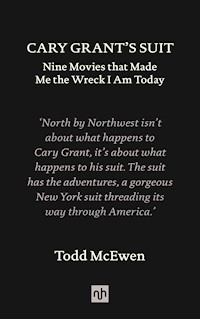
'A hilarious and morose invocation of a lost world. Anyone who has ever been movie-mad will relish this irrepressibly digressive, surprise-filled, exquisitely written memoir (sort of). I certainly did.' Phillip Lopate'North by Northwest isn't about what happens to Cary Grant, it's about what happens to his suit. The suit has the adventures, a gorgeous New York suit threading its way through America. The suit, Cary inside it, strides with confidence into the Plaza Hotel. Nothing bad happens to it until one of the greasy henchmen grasps Cary by the shoulder. We're already in love with this suit and it feels like a real violation.'Todd McEwen grew up in Southern California, so his head was hopelessly messed with by the movies. As the son of relatively NORMAL PEOPLE, Todd had no in with Hollywood, a mere thirteen miles away, yearn and try as he might. This is a kid who loved the movies so much, he got up at 4.30 in the morning to watch Laurel and Hardy. A kid who insisted on his birthday that his father project 8mm cartoons onto the family's dining room curtains so they could be slowly parted, just like at a real cinema. This is a kid who liked to leave the movie and trudge up hundreds of dangerous iron steps to visit the lugubrious and always surprised projectionist. This is a kid who, years later, watched Chinatown over 60 times.
Das E-Book können Sie in Legimi-Apps oder einer beliebigen App lesen, die das folgende Format unterstützen:
Veröffentlichungsjahr: 2023
Ähnliche




















i
Notting Hill Editions is an independent British publisher. The company was founded by Tom Kremer (1930–2017), champion of innovation and the man responsible for popularising the Rubik’s Cube.
After a successful business career in toy invention Tom decided, at the age of eighty, to fulfil his passion for literature. In a fast-moving digital world Tom’s aim was to revive the art of the essay, and to create exceptionally beautiful books that would be lingered over and cherished.
Hailed as ‘the shape of things to come’, the family-run press brings to print the most surprising thinkers of past and present. In an era of information-overload, these collectible pocket-size books distil ideas that linger in the mind.
nottinghilleditions.com
iii
CARY GRANT’S SUIT
Nine Movies that Made Me the Wreck I Am Today –
Todd McEwen
v
For Patchy, with love
vi
The great miraculous event, half sunset half sunrise, with the intervening night displaced, would start to unfold. The lights dimmed, a hush, like the end of the day, fell on the audience, and the first titles came up on the screen, and they could, just for a moment, be seen, the far side of the gauze curtains, as clear as pebbles through still water.
– Richard Wollheim, Germs
People always think something’s all true.
– J. D. Salinger
Contents
– I Am Sucked into the System –
In the middle of Bambi I started to scream and wouldn’t stop. I had to be removed and then hosed down. Is this any way to begin one’s movie-going life?
Getting used to the movies was like learning to drink coffee or to smoke. You never knew when something adult and horrible was going to rush at you off the screen and make you feel parentless, powerless in the middle of a black ocean, where home was far away and there was only the occasional cynical usher and his conical orange flashlight.
In Tomahawk I was confronted with a twenty-foot high Navajo’s breast-plate, seemingly made out of bleached chicken bones, from which a huge arrow was protruding and blood gushed. In Lemonade Joe, after the typical Western saloon fight, the town’s undertaker came in, selected a corkscrew from the bar, twisted it straight into a dead cowboy, and carried him outside as if he were a Gladstone bag.
I was born the year Shane was released. Still, they wouldn’t even allow me a cap gun. Not at birth of course but four or five years later, when I really needed one. When I realized what our neighborhood was: a desert, a jungle, a swamp, a menacing fairyland, outer 2space, a prison, a marital bed, a theater of war. All danger. They were never going to understand; they were never going to help. They gave me a baby sister. I’ve had to use her ever since as a human shield.
On our street, there were only three games: Cowboys, Baseball and War. Just like in America. But this trio of crap began to be eroded. We gradually spent more time in front of the television, which had ever more weird and ever more stupid stuff on it. We began spilling our subconscious seed all over the street, making strange, evanescent, theatrical things – much as we’d make a ‘skeleton’ on the sidewalk, running through lawn sprinklers half naked and then lying down for a few seconds on the hot concrete. This gave a dark, Rorschachy suggestion of yourself, which you’d stand on and watch quickly disappear.
What we had to do was recreate instantly what we saw on television or at the movies. Had to!, with searing attention to detail, not just fall into some vague game of Boot Hill or Burma Road. Baseball all but disappeared, except for a pack of buck-toothed goofballs who lived on Clark Street.
We were children, this much was apparent; we knew we were having a childhood, but we kept seeking models for it. Our parents, their own lives interrupted, capped, sealed by war, had forgotten to tell us what …
I was confused by what we were shown with particular assiduousness by afternoon television ‘hosts’, a 3frightening bunch of adults who’d be thrown in jail today for the ingenuity of the methods they used to appeal to us, posing as children, sailors, firemen, jovial ‘uncles’ with prizes, secret words, candy … You’d be lucky to escape with your life from their fake submarines, fake garages, fake circus tents. We were being ‘groomed’. For what? To be the suckers we’ve become, of course.
What looked a little too real, we found, a little too polished, in something purporting to be real, was transformed by our own efforts to realize it into something surreal. Which provided us with only disappointment and frustration and unhappiness. Spanky, Alfalfa and Darla were having an endless childhood in a parallel universe we couldn’t get at, for all our powers of imitation, which grew and grew until as young adults we achieved the power to ignore the real world entirely. The triumph of our generation.
Although from a booky family, I was reviled for it and got sucked into the system of images first. Our exposure to books at school was execrable. The movies we’d seen by the age of ten were much better than the books we’d read. I can remember reading very few books in my school except an appalling thing about a boy who is blinded by a firework and goes all petulant (Follow My Leader), Julius Caesar (not for kids, let’s face it), two war novels (God is My Co-Pilot and The Bridges at Toko-Ri), and something called Hot Rod. Can you imagine studying Hot Rod for half a 4year? If books really are dying, these should be among the first.
I took in rather too much about the act of going to the movies for my father’s liking. I dawdled under the hundreds of tiny light bulbs in the marquee, I gawped at the ticket machine. I took my time breathing in the mammalian smells of the thick, old-fashioned carpeting on the stairs … why not? This had become my church.
But my worship was not always cinematic. I once watched The Flintstones, in Sacramento, four times in a row, purely for the sake of the air conditioning. Similarly overheated in Paris, I watched a lot of Gene Tierney. A little cinema in the rue Christine had the strange habit of running American movies which, really, nobody could possibly care about any more. The air conditioning was equally abstruse, and I had to watch most of Leave Her to Heaven before I felt cool. Not in the St-Germain sense. Gene Tierney rode a horse and there were it seemed acres of her face. This was also one of those pictures where you have to watch Vincent Price struggling to act normal; I mean before he gave it up. It’s really unsettling to have to believe in him as a lawyer, pushing his big shoulders around the room in a post-war sport jacket that looks like a goddamn sofa. You keep thinking he’ll bust all the finely turned chair legs in the ranch house.
I was once in a huge cinema on 57th Street watching 5a double bill, as it turned out, of The Last Detail and Emmanuelle. Who thought up this combo? Maybe there were sailors in town. Outside it was a chilly day in early spring and everyone in the warm theater was drowsing and snuggling in their overcoats. I don’t think most of them wanted to watch Emmanuelle – how could they? It was just too nice and warm and difficult to leave. Halfway through the thing a guy in about row 10 fell totally and helplessly asleep, head back and mouth open, snoring loudly during a scene in which a pointy-eared slaphead ravishes Sylvia Kristel. His neighbors jostled him a little to no effect, and then people started throwing things at him, popcorn and candy and pennies, particularly from the balcony. Thinking of a way to wake this guy up had riveted the audience, they couldn’t care less about soft focus buttocks … Then someone in back of me launched a tangerine, which not only struck his face but dropped perfectly into his open mouth and stayed there – a hole in one. Strangling, he jumped to his feet and flailed his arms, to wild applause.
– What the Outdoors Had to Offer –
The smells of Balfour Avenue were these: fertilizer (every lawn was new), concrete (you could smell it when the sprinklers were on), grass, and an acrid odor which was the product of cars, farms, and the few small factories of our town. We made potato chips, Hawaiian Punch, tubas and electric guitars. I say we. But in those days we were all together. Supposedly.
Ours was a three-bedroom house. My parents bought it in 1955 for $14, 580. There was a kitchen, a living/dining room, a ‘den’ and two bathrooms. There was a garage, separated from the house by a ‘breezeway’. Breezes were not included.
In the back yard were an unsuccessful banana tree, a birch, and a lot of dirt and geraniums. In the side yard were our swings. In front of the house was a curious driveway which my father had resurfaced himself; lots of sea shells were visible in the concrete. There was a plum tree that didn’t bear fruit, which we decorated for the confused birds of the desert at Christmas with popcorn, dried cranberries and bacon fat.
There was the sidewalk, the location of many, or all, encounters, fantasies and dramas. There was a young liquidambar tree in a strip of grass between the 7sidewalk and the street, uniform with every home, and there was the street.
I thought about our neighborhood in a diagrammatic way. It was so many feet to one house or another. The street curved gently, but I thought of it as straight. It took ten minutes to walk to school, where there was no vegetation.
As a child I had very little experience of shade. My parents had a practice of keeping the house dark when the weather was hot. To cool us, they put us in water: they took us to the swimming club, or plunked us in the inflatable wading pool. All the food we ate was refrigerated, all year long. I still prefer most of what I eat to be chilled.
The houses were all of a certain type: stucco and decorated wood. They looked different from each other, but really they weren’t.
The street contained things. For us it was a staging area: baseball, battles, re-enactments. It was a backdrop, a ‘set’ – this is what your environment is when you are young, because you can’t be sure of its reality, or permanence. The street was a cultural blank, on which we could write anything. The neighborhood was as blank as a Colorforms board. The street was a train track, a river, a conduit of slow-moving adults in cars (sometimes a useful obstacle if somebody was chasing you).
Several of us were admirers of the street-sweeping machine and the man who drove it. He wore gloves 8and a dirty hat and had a cigar in his mouth. But what was there for the machine to suck up? There was never anything in the gutters, no trash, no leaves. After the machine passed by, the street was slightly wet, and we really liked that smell. It was different from the wet sidewalk smell.
I was submerged, I was muffled. I felt I couldn’t get at anything. I found it hard to connect with anyone. Debbie was OK. And later, Fard. With everyone else on the street I had either an uncomprehending relationship or a potentially fractious one steeped in fear.
The neighborhood was not an especially poor or violent one. I didn’t get beaten up nearly as often as I thought I was going to. In my own way I developed a love of wildness, of trespass. Not of violence. I was not in favor of violence. Even I could see that Charlie Chaplin sticking a fork in someone’s butt would be painful; that if Tom really did that to Jerry they’d be scraping him off the road. There was a lot of post-war violence hanging around us kids. There was a contingent in the neighborhood that would only play war. These endless pantomime machine-gunnings of each other didn’t interest me as I didn’t know the conventions, not watching war movies. Nor was I allowed to own a toy gun. So here was another blow to camaraderie.
Model building was big – battleships and fighter planes. The brothers next door had a virtual air force hanging by nylon threads from the ceiling. You felt 9like you were under aerial attack if you walked into their bedroom.
Let’s say it was early on a Saturday morning. It almost never rained, it was almost never cloudy, but say it was overcast. Our neighborhood was quiet enough, although we were becoming used to noise: ever more traffic. The droning of airplanes. But an overcast day was so unusual, it held a special excitement. You heard, noticed things more.
It felt natural, best, to be awake in the house on such a morning. Coolness felt right; the air seemed to move in the early mornings and then to stop for the rest of the day. Sometimes the only thing you heard was the hissing and dripping of sprinklers. There was a kind that went back and forth like a fan, there was a kind that looked like the eyes of an owl, and there was a kind that you just stuck in the ground with a long rusty spike and had to go out and move every twenty minutes.
I would have been sleeping with just a sheet over me. I had nylon pajamas with short sleeves and snaps. I was the worst sleeper in the family. I always got up early on weekends because the day promised something, even if the others weren’t going to be up for hours. I liked the smells and the coolness. I went to the kitchen for cereal and milk. Then I went to the den. What else would you expect?
Our TV was a DuMont, now an extinct name, though it was even a television network at one time. 10But it stands to reason they’d never get away with that, naming a TV network after yourself. People were going to be electrified only by three-letter zappy names. CBS! ABC! NBC! ‘Mutual’ was doomed, obviously. (Later Ted Turner tried to get everyone to call his company ‘TBS’, but it didn’t work. And neither do fictitious names of broadcasting companies – UBS in Network, for example, FBC in Desk Set, IBC in Scrooged – it’s not believable. It jolts. Everyone just lay down in front of this charmed, malevolent trinity. And now there is MSNBC – forget it.)
This TV was a cube of maroon masonite, about two feet square. The screen was a stubby rectangle with rounded edges, mounted behind glass and edged with a dull, gold-colored aluminum strip. On the front, below the screen, were two big knobs, and two big knobs only: the knob that turned it on and regulated the volume, and the channel knob. The channel knob was illuminated for part of its life, but like many electrical niceties of the 1950s, this little bit of magic soon departed. Is this something you would ring a repairman for? The little numbers don’t light up anymore? Nah. On the side of the set were vents so it could breathe, and a speaker covered with the usual 50s grille cloth, brown stuff with metallic thread in it.




