


Erhalten Sie Zugang zu diesem und mehr als 300000 Büchern ab EUR 5,99 monatlich.
- Herausgeber: Kamera Books
- Kategorie: Geisteswissenschaft
- Sprache: Englisch
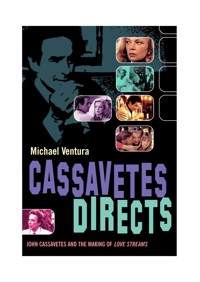
In 1983 visionary director John Cassavetes asked journalist Michael Ventura to write a unique film study - an on-set diary of the making of his film Love Streams. Cassavetes laid out his expectations. He wanted 'a daring book, a tough book'. In Ventura's words, 'All I had to do for 'daring' and 'tough' was transcribe this man's audacity day by day.' Cassavetes Directs describes the creation of Love Streams shot by shot, crisis by crisis. During production, the director learned that he was seriously ill, that this film might, as it tragically turned out, be his last. Starring alongside actress and wife Gena Rowlands, Cassavetes shot in sequence, reconceiving and revising his film almost nightly, in order that Love Streams could stand as his final statement. Both an intimate portrait of the man and an insight into his unique filmmaking philosophy, Cassavetes Directs documents a heroic moment in the life of a great artist.
Sie lesen das E-Book in den Legimi-Apps auf:
Seitenzahl: 494
Veröffentlichungsjahr: 2010
Das E-Book (TTS) können Sie hören im Abo „Legimi Premium” in Legimi-Apps auf:
Ähnliche




















For John Ertha
…who, when I was a boy, was the first in my experience to embodythe passion, courage, mind, and rascality that could be: a man.
You know I think that movies are a conspiracy – they are actually a conspiracy, because they set you up, Florence, they set you up from the time you’re a little kid. They set you up to believe in everything. They set you up to believe in ideals, and strength, and good guys, and romance, and, of course, love – love, Florence. So – you believe it, right? You go off and start looking. It doesn’t happen. You keep looking. You get a job, like us, and you spend a lot of time fixing up things, your apartment and jazz, and you learn how to be feminine… There’s no Charles Boyer in my life, Florence, you know? I never even met a Charles Boyer! I never met Clark Gable, I never met Humphrey Bogart, I never met any of them. You know who I mean. I mean, they don’t exist, Florence, that’s the truth. But the movies set you up, you know? They set you up. And no matter how bright you are, you believe it. And, Florence, you know that we’re bright? Florence, we’re geniuses compared to some of them! I mean, we go the movies and…
– Gena Rowlands as Minnie, in John Cassavetes’ Minnie and Moskowitz,
Art is a put-up-or-shut-up proposition.
– Michael Berger
The only thing that remains constant is the love of what you’re doing.
– John Cassavetes
Contents
Title PageDedicationEpigraphIntroduction:THURSDAY, MARCH 17, 1983 – Trying to get itTHURSDAY, MARCH 24 – No more room on the napkinAPRIL-MAY – Friends of SamWEDNESDAY, MAY 25 – I don’t understand where all this light is coming fromTHURSDAY, MAY 26 – We can’t tell them the answer unless they ask the questionFRIDAY, MAY 27 – People use that language when they’re in troubleTUESDAY, MAY 31 – The confusion of the action is the sceneWEDNESDAY, JUNE 1 – We find out what we can do, we take chancesTHURSDAY, JUNE 2 – Don’t cry on my setFRIDAY, JUNE 3 – It’s harder to do slowMONDAY, JUNE 6 – About your lifeTUESDAY, JUNE 7 – A cinema of alcoholWEDNESDAY, JUNE 8 – Gena’s first dayTHURSDAY, JUNE 9 – If I dieFRIDAY, JUNE 10 – Love is a streamMONDAY, JUNE 13 – He wants you to do it in your wayTUESDAY, JUNE 14 – Nothing to hide behindWEDNESDAY, JUNE 15 – Cuisine of Tony the AntTHURSDAY, JUNE 16 – Keep it a secret, ok?FRIDAY, JUNE 17 – You stinkMONDAY, JUNE 20 – The worst I’ve seen him blowTUESDAY, JUNE 21 – All that jazzWEDNESDAY, JUNE 22 – A movie, not a momentTHURSDAY, June 23 – My dinner with CassavetesFRIDAY, JUNE 24 – You can’t hide anythingMONDAY, JUNE 27 – It’s a dreamTUESDAY, JUNE 28 – I don’t dance unless I have a drinkWEDNESDAY, JUNE 29 – Let him do itTHURSDAY, JUNE 30 – A quick yesFRIDAY, JULY 1 – Not afraid of being badTUESDAY, JULY 5 – No man’s manWEDNESDAY, JULY 6 – Building a houseTHURSDAY, JULY 7 – I love stupidityFRIDAY, JULY 8 – Hours of beginningsMONDAY, JULY 11 – Did I kiss you off a little abruptly?TUESDAY, JULY 12 – Where were you?WEDNESDAY, JULY 13 – What are you doing behind the camera?THURSDAY, JULY 14 – Speak, Jumbo, speak!FRIDAY, JULY 15 – LimboMONDAY, JULY 18 – It’s like musicTUESDAY, JULY 19 – Fifteen hours a day isn’t enoughWEDNESDAY, JULY 20 – If it was easy anybody could do itFAST FORWARD: MONTHS LATER – The best storyTHURSDAY, JULY 21 – Hating okraFRIDAY, JULY 22 – Every line in your lifeMONDAY, JULY 25 – That’s very dangerousTUESDAY AFTERNOON TO SATURDAY DAWN, JULY 26–30 – Double sixesMONDAY, AUGUST 1 – The fuckin’ end of the worldTUESDAY, AUGUST 2 – I didn’t make it for you anywayWEDNESDAY-THURSDAY, AUGUST 10–11 – That is a wrapI’M GONNA HAVE MY OWN LIFEIllustrationsCopyright
Introduction:
The Art of the Unpredictable
“I think he’s a genius. I always have.” So said Steven Spielberg when I asked him about John Cassavetes.
The year was 1982. In two weeks Spielberg would premier E.T. Our interview had turned to the question of influences. Spielberg named Frank Capra, Michael Curtiz, and David Lean, influences whom anyone schooled in cinema would assume. But Spielberg’s best films feature performances of tense immediacy, a realistic roughness-around-the-edges not associated with classic Hollywood. I was fishing when I asked about John Cassavetes, but Spielberg lit up at the name and told the kind of story many tell about John, a story of generous and unpredictable engagement.
“Cassavetes is one of the first people I met in Hollywood, one of the first people who ever talked to me and gave me the time of day. He met me when I was sneaking around Universal Studios watching other people shoot TV shows. He was doing an episode of Chrysler Theater, that Robert Ellis Miller was directing, and he pulled me aside and said, ‘What do you want to do?’ And I said, ‘I want to be a director.’ He said, ‘Okay, after every take you tell me what I’m doing wrong, and you give me direction.’ So here I am, 18 years old, and there’s a professional company at Universal Studios doing this TV episode, and after every take John walks past the other actors, walks past the director, he walks right up to me and says, ‘What did you think? How can I improve it? What am I doing wrong?’ And I would say, ‘Gah, it’s too embarrassing right here, Mr. Cassavetes! Mr. Cassavetes, don’t ask me in front of everybody, can’t we go around the corner and talk?’
“And he made me a production assistant on Faces for a couple of weeks, and I hung around and watched him shoot that movie, and John was much more interested in the story and the actors than he was in the camera. He loved his cast. He treated his cast like they had been part of his family for many years. And so I really got off on the right foot, learning how to deal with actors as I watched Cassavetes with his repertory company.”
I said, “It’s funny about Cassavetes. When I first met him, you know – he’s short, but you’re never aware of it, because of the way he holds his head, like he’s looking down at you, like a tall guy. He tilts his head down, and his eyes burn up at you.”
Spielberg laughed at my imitation. “You got that, you got that. It’s funny you mention that, because I’ve always thought that one of the best ways of being a director was, as John did, scrounge around for the cast, promise them anything but give them quality, and look with great poignancy and attitude at your cast and crew up through your eyebrows, with your nose facing the ground. That’s something I learned from John.”
As I write now, in 2006, 17 years after his death, Cassavetes is a hero of cinema, lionized as the “founder” of the independent film movement in America. There’s an Independent Spirit Award named after him, given annually for the best film made with a budget of under $500,000. He’s even been featured on a postage stamp. But when Spielberg told me that story in 1982, mainstream critics in print and academia were dismissive toward Cassavetes. If occasionally they liked his work they praised the performances more than the film, as though the picture was effective in spite of John. He’d had a hit in 1980 with Gloria, a studio-produced picture he later claimed to dislike. But his previous independent film, Opening Night (1978), now considered a masterpiece, received bad press and closed quickly. TheKilling of a Chinese Bookie (1976), disliked by audiences as well as critics, played briefly, and only in New York and Los Angeles. Nor did his last film, Love Streams (1984), find many friends in America. Cassavetes rarely admitted bitterness or disappointment, but in the early days of home-video I ventured to him that at least now his films could be issued on tape. He glared, shook his head no: “If they didn’t come to see us in theaters, fuck ’em.”
That was then. Now Cassavetes is revered. His family has released on DVD the five films he produced, which include his finest save for Husbands and Love Streams. His pictures disquiet audiences as much as ever, but many recognize that Cassavetes’ techniques have become central to the vocabulary of contemporary cinema.
John Cassavetes released his first film, Shadows, in 1959. In films prior to that year, nothing resembles the camerawork and scenic pacing of Shadows. Its last frames announced, “The Film You Have Just Seen Was An Improvisation.” American critics missed the point, assuming that improvisation was a loose, anything-goes process. But for Cassavetes the word improvisation meant what it means in jazz: a carefully structured but freely performed whole. Misunderstanding this, American critics did not credit John with intent. But Cassavetes’ next major work, Faces (1968), was scripted (his screenplay even won an Academy Award® nomination). Faces made clear that John’s camerawork, dialogue, and performances were precisely what he intended.
His intentions were as unique as the techniques he created for their expression. Ingmar Bergman’s people may or may not make peace with God, or the Void, or whatever; Fellini’s may or may not make peace with themselves; and the characters of John Ford, Howard Hawks, and Steven Spielberg relate to themselves as part of a story that is larger than themselves. But Cassavetes’ people must make, or fail to make, peace with each other. There is no “larger story.” There are only common people facing each other in rooms as common as any. He tolerated no other terms. Two people, able or unable to look into each other’s eyes – that was his ultimate test for all codes, manners, morals, politics, psychologies, and beliefs. To give that test its due, he reshaped the vocabulary of film.
John Cassavetes’ work is the art of the unpredictable, because he felt that in life one never knows what will happen next. His is the art of the edgy and unresolved; in daily life he saw no resolutions or solutions and no certainty that would not be tested by tomorrow’s uncertainty. He invented a cinematic form in which this vision could be both expressed and embodied. Cassavetes’ is an art of crowded close-ups and irregular pacing. His is a dialogue of sentence-fragments, commonplaces, outbursts, reveries, and overlapped lines, punctuated with silences – moments when one character looks at another in a naked plea for acceptance, without understanding as a condition. In cinematography, John Cassavetes does away with the certainty of the camera’s point of view – and, with that, he destroys the viewer’s certainty. Other directors had given us, through their cameras, a defined space in which to view a story; but with Cassavetes the camera’s point-of-view is that of an anxious child or stranger, uncertain of precisely where to be or of what it’s seeing, the frame often undefined and always shifting. His eye doesn’t pretend to see all, but sees only a fragment perceived in a particular moment. This creates a connective uneasiness with the viewer, who becomes as uncertain as the characters on screen. Thus the inviolate boundary usually conferred by the screen is pierced, creating an effect as immediate as theater. Cassavetes establishes a deliberate bond between viewer and character, as though they are in the same room. Everybody’s uncertain. As in the “scenes” of life, no one knows what’s coming next and you never know when a Cassavetes scene will end. It may cut off abruptly or drag on beyond endurance – as do the scenes of our private hours.
That Cassavetes’ innovations have proved pivotal to the evolution of cinema is not difficult to demonstrate. Watch a few double-features and you’ll see for yourself.
Watch Stanley Kubrick’s pre-Shadows films (The Killing, Paths ofGlory), then watch the camera-work and performances of his post-Shadows masterpiece, Dr. Strangelove (1964). Kubrick was the first major American director to incorporate Cassavetes’ innovations into his own style.
Watch Shadows and Martin Scorsese’s Mean Streets (1973). Scorsese has written that Shadows was “the film that had the biggest impact on me,” but you don’t need to know that. All you need do is watch. The speech rhythms, antics, pacing and even some shots of Shadows are emulated in Mean Streets. Mean Streets is great in its own right, and Scorsese’s themes are quite different from Cassavetes’, but it’s clear that Scorsese’s absorption of Cassavetes’ cinema is intentional and complete – so much so that sometimes Mean Streets seems a kind of re-make, Shadows-plus-violence.
Watch Shadows or Faces and Robert Altman’s M.A.S.H. (1970) or Nashville (1975), remembering that those Altman films are the template for many contemporary comedies. Altman’s objective was satire, in which Cassavetes had no interest. But Altman sought an anti-Hollywood style of comedy, and he found his means in his own version of the open-ended pacing and edgy yet fluid camerawork pioneered by Cassavetes.
Double-feature A Woman Under the Influence (1974) and the director’s cut of Spielberg’s Close Encounters of the Third Kind (1977). The marital scenes between Richard Dreyfuss and Teri Garr in Close Encounters mirror the immediacy and audacity of Peter Falk’s and Gena Rowlands’ in Woman. Before CloseEncounters, there’d been no such scenes in a major studio production.
Watch Cassavetes’ Minnie and Moskowitz (1971) and Woody Allen’s Annie Hall (1977). Allen shares few, if any, intentions with Cassavetes. But, like Spielberg, Woody Allen domesticated Cassavetes’ innovations, melding Cassavetes’ scenic immediacy with a Hawks-like omniscient camera.
Through Scorsese, Altman, Spielberg, Allen, and others, John Cassavetes taught filmmakers new dimensions of what a motion picture could communicate. His influence is everywhere now, from Quentin Tarantino’s violent wet dreams to Fernando Meirelles’ elegant The Constant Gardener. Television, too, has absorbed and adapted Cassavetes. Watch how TV used to be shot in programs like Star Trek, Kojak, and Columbo; then watch, to name only two, ABC’s Lost or the Sci-Fi Channel’s BattlestarGalactica, with their erratically mobile and intimate camerawork. The difference: techniques John pioneered in Shadows and Faces, taken for granted now even on prime-time TV.
The proof is on the screen.
It all started with one man working on his own, on his own terms, unabashed and unafraid. Referring to the public’s relation to his art he told me, “They’re going to be ready for us maybe five minutes a day.” John Cassavetes staked his life on that slim possibility, and indelibly enlarged the possibilities of the motion picture. Watch these double-features and see for yourself how Cassavetes’ cinematography, dialogue, and scenic pacing are as influential as those of any director you can name. In cinema, John is of the pantheon.
What Pablo Picasso said of himself could also be said of John Cassavetes.
“You do it first, then others come and do it pretty.”
The proof is on the screen.
JOHN CASSAVETESDIRECTSLOVE STREAMS
THURSDAY, MARCH 17, 1983 – Trying to get it
It’s after 10 at night, the phone rings, I pick up, and the caller announces, “Michael! This is John!” Then he launches into a monologue I can barely follow, while I’m trying to figure who “John” might be. I don’t know any Johns very well. It takes a few moments to realize that this is Cassavetes speaking. Surprised – no, stunned – I wish I’d listened harder to his initial barrage of sentences. The man is very enthusiastic about something. I’m trying to get my bearings while he’s praising me for an interview we’d done six months before, the last time we’d spoken. During the interview he’d stopped suddenly and said, “This isn’t going well,” and I said, “Trust me, I see your words as printed sentences as you’re saying them, and this is going very well.” Now it seems he agrees, and that I know my business is something he respects. Of course this pleases me very much, but still his rap tonight doesn’t compute – my impression of the man is that it’s not like him to make conversation, and, at the moment, that’s what he’s doing. The thought occurs: maybe he’s drunk. In his circles, as in mine, people often are.
Now he’s saying that he’s gotten a deal to direct Love Streams. Do I remember the play?
Yes, but more vaguely than I admit. A year, no, it was two years ago, John produced a trilogy of plays written by himself and Ted Allan. Love Streams was Allan’s, and what, if I am honest, do I retain of it? An airy Jon Voight never quite connecting with the material, while Gena Rowlands played with that same material as a child plays in fresh-fallen snow, totally involved, utterly captivating. What I remembered most painfully, however, was how after the play John took about 20 of us to Ma Maison, where I drank too much and made an ass of myself, really made an ass of myself, conversing with two famous women. I wasn’t used to dining with stars and I proved it.
But the play… there was this dog… strangest dog I’ve ever seen, because it wasn’t really a dog, it was a man. That is, the dog was played by a man. The man – Neil Bell – wore no doggy make-up, wore nothing on his well-molded body but shorts. He had reddish hair and beard, and serious, penetrating, dog-like eyes. But why did we believe he was a dog? It wasn’t only because his physical imitation was perfect – he growled, leapt, flinched and panted so very like a dog. It was that Neil Bell found that place where dogs and people understand one another; rather than just imitating a canine, Bell played that area of understanding. In what was otherwise a relentlessly realistic play, we accepted his dog-ness without question. I can’t quote a line of the play, but I will always remember that dog-man leaping over furniture, growling, backing Jon Voight up against a wall.
And, now that I think of it, I remember very well another play of the trilogy (though not its title), written by Cassavetes, where Peter Falk is being questioned on the witness stand about killing his wife. The lawyer asks, “Did you love your wife?” Falk looks at the lawyer, looks away, thinks, looks at him again, says: “On which day?”
Meanwhile, on the phone, Cassavetes is saying of Love Streams, “Every bit of it there’s no melodrama, it’s just misplaced sincerity all the way through.”
He is in the midst of his thought while I’m faking my half of the call, trying to catch up. He describes what he thinks will be the last shot of the film: a dog barking in the rain. “So it’s the dog’s picture! He has the last word!”
Now Cassavetes comes round to why he’s called. He’s always thought it would be interesting to have a book written on the day-to-day making of a film. To his knowledge, it’s never been done. He wants not a book about filmmaking but about “the play between the people who make the film and the ideas within the film.”
“It would be a daring book, a tough book,” he says. Would I be interested in writing it?
Quickly I say yes. And stammer about how honored I feel to be invited, a subject in which John is not much interested.
He talks on while I’m kind of weirded out, as we used to say. Cassavetes is an inclusive man, he’ll talk and listen to anybody high or low; but he’s also a deeply private man. It doesn’t seem like Cassavetes to want somebody staring at him, taking down his every word, making a book of the quicksilver ups and downs of his days. Yet he wants this book very much, he’s talking now about its possibilities as enthusiastically as he’s talked about his film, while I’m wondering if it’s possible to catch what some people call “the creative process.” Even if you watch its actions, can it truly be seen? Also… I suspect John Cassavetes is not the easiest man to be around on a daily basis.
I make the mistake of saying the word “genius.” That is, calling him one. His response is sharp: “There are no geniuses. It’s just a lot of fucking hard work and trying to get it.”
We get off the phone and I want to pour a drink, but – doctor’s orders – I’m not drinking this year, nor smoking either, alas. My ticker’s been on the fritz. It would have been good to toast the honor I’ve been bestowed – before telling my wife (we’ve been married five months this day) that all our plans from now through August are cancelled.
Now-through-August is pre-production and shooting of Love Streams.
She takes the news gracefully, and has the generosity to be excited for me. She knows John and I go back a long way, longer than John knows.
In 1956, when I was an 11-year-old street-kid in a Brooklyn slum, I’d play hooky from school and use my 25-cents-for-lunch to go to a movie, any movie, whatever was playing. For me, as a kid, movies didn’t have titles, they weren’t directed, and I cared for no actors whose names weren’t John Wayne, Tony Curtis, or Marilyn Monroe. Rather, to me movies were another order of existence, a fascinating form of life that ran parallel to the cockroach realities of my streets. I’d see any picture, often sitting through a double-feature twice, to experience this strange enhanced cinematic “other world” – very other, but somehow more real than ours. One day in 1956 I forgot very quickly (and didn’t re-discover until decades later) the title of the picture I was seeing, Edge of the City. What struck me (and that is not a cliché, I was struck) was a black man such as I had never been exposed to (for I knew not one), a man of complexity, humor, strength, and grace – my street-prejudices would never be the same, I was so impressed with this man. It wasn’t until years later that I’d fasten to him the name Sidney Poitier. The white man he befriended struck me just as hard, for he was the first I’d seen on screen who was like us – a person who embodied the street as I knew it. Edgy, contradictory, tense with violence and a desperate grace. You wanted to like him, but there was something about him you didn’t trust. You wanted to dislike him, but there was something about him you couldn’t help liking. Years later I would see that John Cassavetes never played to be liked or disliked, but played for both at once. As a kid, all I saw was someone I recognized. A real street-guy, not (as with James Dean and Marlon Brando) an artist’s concoction. At that age I couldn’t articulate my impression, and I forgot or never registered John’s name, but he revealed to me this: what I knew to be genuine could find its place on the screen.
Years later, still innocent of the mechanics of cinema, I got off work as a typist in Manhattan and wandered into a theater called the Little Carnegie, around the corner (or was it down the block?) from Carnegie Hall, to see a movie, any movie. The movie was Faces. I was 22 or 23. I left that movie frightened, wishing I’d never seen it, but wanting to see it again. Its people behaved as irrationally, as compulsively, as the people of my life – as I did myself. Faces was a confirmation I did not desire: that craziness was normal, and that normal was insane. In a word, it helped me face growing up.
I was working a typing job in Boston in 1970 when Husbands was released there. In the course of 10 days I saw Husbands five times. After the first time I rounded up anyone I could find to go with me, and our friendships deepened or ended on whether or not, and to what degree, they got that film. For here were men like my father, like my uncles, heroic precisely to the degree that they were not heroes, trying and failing every day to live a normal life. They would always fail and, in some screwed up way, they would always try. And this film made that beautiful. Who else had ever honestly conferred the quality of beauty upon such men?
As for A Woman Under the Influence, by then I was writing for the Austin Sun, my first writing gig. Woman played Austin in the spring of 1975. Watching Woman I saw not only my own childhood but the family-life of all my relatives. My cousin Rocco visited me and his first act upon seeing me was to lift me off my feet (Rocco is strong), saying, “Did you see that movie!?” I knew he was speaking of Woman. “Isn’t that the way it was?! I kept sayin’, ‘Ok, now he’s gonna lie,’ but he never lied.”
Then… 1979, Los Angeles. Ginger Varney and I helmed the film section of LA Weekly. In those days before videos, Los Angeles boasted more “revival” theaters than any city in the world. A dozen at least. On Melrose Avenue, a block or so from Paramount Studios, on the south side of the street, there was a revival house that I believe was called The Continental, where one night they featured a rare screening of A Woman Under theInfluence. Ginger and I plugged it in our paper, thinking we’d draw crowds. There was almost no one. Then, just before the film screened, John Cassavetes entered with a gaggle of friends. His friends were dismayed – they’d expected a full house, a kind of party. Cassavetes tried to appear undismayed, but his eyes were crazy. The picture began. The film broke. Was mended. Continued. Broke. Several times. It was excruciating. And every time it broke Cassavetes cackled. When it was all thankfully over, I went to him and asked to shake his hand. Names weren’t exchanged. His eyes asked, “Friend or phony?” Mine tried to convey, “Friend.” He shook my hand. I never expected to see him again.
John and I finally met professionally in 1981, through my function as a journalist. There was a screening of Woman at USC. I was asked to moderate a discussion with John and Gena after the film. I arrived early, saw him across the lobby, walked toward him, and while I was still several yards away he said, “Ventura, right? I know by the walk.”
I never quite got that one.
Now this night, March 17, 1983… John calls me. He doesn’t know he’s calling the kid who saw him in ‘56, or all those other versions of me, to whom he’s meant so much.
I tell my wife, “I’ve gotta be careful not to hero-worship this fucker.”
“Well he is a hero.”
“He is.”
“Then recognize that. Just don’t worship him.”
THURSDAY, MARCH 24 – No more room on the napkin
We’re to meet at John’s production office and discuss the book. This morning over tea (no more coffee, doctor’s orders), I re-read my interview of the summer before.
Cassavetes: “I’m a totally intuitive person. I mean, I think about things that human beings would do, but I am just guessing – so I don’t really have a preconceived vision of a way a performer should perform, or of ‘the character.’ I don’t believe in ‘the character.’ Once the actor’s playing that part, that’s the person. And it’s up to that person to go in and do anything he can. If it takes the script this way and that, I let it do it. But that’s because I really am more an actor than a director. And I appreciate that there might be secrets in people. And that that might be more interesting than a ‘plot.’”
As I read I hear his voice. The page does no justice to the way he says appreciate. Spoken, he said: “And I apPREciate that there might be secrets in people – and that – that might be more interesting than a ‘plot.’” His eyebrows shot up on secrets and slammed down on plot.
“I like actors, and I depend on them a lot. I depend on them to think. And to be honest. And to say, ‘That never would happen to me, I don’t believe it.’ And to try to decipher what is defense and what is a real irregularity in someone’s behavioral pattern. And then I try to find some kind of positive way to make a world exist like a family – make a family, not of us, behind the camera, not of the actors but of the characters.”
“A shared world?” I’d asked.
“That they can patrol certain streets, patrol their house, and – that’s what I feel people do, they know their way home. And when they cease to know the way home, things go wrong.”
“How do you mean, know the way home?”
“You somehow, drunk or sober or any other way, you always find your way back to where you live. And then you get detoured. And when you can’t find your way home, that’s when I consider it’s worth it to make a film. ‘Cause that’s interesting.”
I notice this morning what I didn’t during the interview. In those last sentences, Cassavetes shifted from talking about characters to talking in a kind of first-person “you,” then shifted from “you” to “I.” Had he lost his way home, and could nothing but making another film get him home again?
It’s not the kind of question I ask people because I feel it’s none of my business. Still, it feels like a question that won’t go away. And it occurs to me, uncomfortably, that what is and isn’t my business could become a sticky issue during the course of this book.
The offices of Cannon Films are in a building near Sunset and Vine. Seventy years ago on that corner, where a bank now stands, there was a big old barn. Cecil B. DeMille set up production offices in that barn when he directed The Squaw Man, the first feature-length movie shot in Hollywood. D.W. Griffith, Mary Pickford, and Mack Sennett were in town by then, so were Fatty Arbuckle and Mabel Normand, making one- and two-reelers. Chaplin and Douglas Fairbanks would arrive soon. The hills were green and flowered, there were many farms, and they say you could smell the sea all the way into the city. Now, what with the smog, you have to stand on the beach to smell the sea. But would-be filmmakers still flock here for the same reasons that brought DeMille 75 years ago and Cassavetes 25 years ago. Movies can be made anywhere, but you still can’t be part of the filmmaking community anywhere else.
So an Israeli director-producer named Menahem Golan and his cousin, producer Yorum Globus, successful filmmakers in their native land, moved here, bought a soft-porn outfit called Cannon Films, and financed a string of low-budget thrillers and comedies. They’ve captivated local media attention because their style goes back to the days of DeMille and Sennett – making deals on the impulse of a moment, writing binding contracts on a napkin in a bar. Which, according to John, is what he and Golan did. (The final negotiations, I’m sure, were as complex as always.)
John would tell me later, “He wanted to give me points in the picture but I said, ‘Why? I’ll never see them anyway.’ I shouldn’t have said it, I hurt his feelings. He said, ‘I don’t steal.’ I said, ‘If I don’t have points I don’t get mad about the points – anyway, there’s no more room on the napkin!’”
So the Love Streams production offices are at Cannon. The company occupies two floors at 6464 Sunset Boulevard. On the 11th floor, in almost every room there’s a typewriter. On the 10th floor, a Steenbeck (the editing console that’s replaced the classic Movieolas). I am to meet Cassavetes to discuss this book.
Pre-production offices are surly by nature, and their surliness comes in two flavors. An uptight director will have an office of people working at tremendous speed who are, at one and the same time, artificially formal and artificially jovial. Suspicion lurks in every glance, and nobody makes the most minor decision without consulting somebody else. Everybody tries to cover their ass. And this usually shows up on screen.
In the pre-production offices of a vital director, a natural leader who relishes every decision he makes, the same phones constantly ring and everyone’s job consists of the same relentless series of interruptions. But the surliness is the kind you find in a neighborhood bar. Rough humor, sudden verbal explosions of abuse mixed with laughter, no-nonsense shouting, bleak depressions, and occasional cries of triumph. Under it all, the constant hum of work, each person accumulating the hundreds of bits and pieces that will soon be a motion picture. In Cassavetes’ office, there is an additional source of noise: friends dropping in. The fat-ish, gangster-ish guy John partied with in Boston sometime last year – or was it 10 years ago? – who’s so happy Cassavetes is making another film that he had to visit and wish him well. Or someone vaguely recognizable to a watcher of Cassavetes’ films – John Finnegan, as I find out later, a gangster in Gloria, a cabbie in The Killing of a Chinese Bookie, a stagehand in Opening Night, and one of Peter Falk’s work-gang in A Woman Under theInfluence. He’s signing on again for two or three days of a bit part. Not for fame or fortune – there will be neither – but for the hell of it, for Cassavetes. This crew has a kind of mantra that I’m in the process of buying into: Anything for John.
Whatever else he is, John Cassavetes is a man, an artist, a leader, to whom people give everything they can. You might expect such devotion of fellow-artists, actors, would-be filmmakers, but you don’t expect it of secretaries, production go-fers, gaffers, techs, Teamsters. Composer and sound-mixer Bo Harwood would later give me a reason that felt true. They do it so that someday they can say, as Bo explained, “I rode with Billy the Kid.”
It is always a surprise to see Cassavetes, because he is never quite the way you left him, especially these days – at 53, the intensity of his life is catching up with him.
To be honest: Half the time he looks awful. As though the skin of his face has lost all life of its own and only his eyes are keeping him alive. No one has eyes like him. Everything fierce, everything street-wise, every mockery and irony, everything that makes men laugh or long for tenderness, every anger, everything that cannot lie and everything that wants to, everything angelic or demonic in his soul – at one time or another in the course of a day, his eyes give it all away. Like any man he tries to protect himself, but his eyes don’t participate in that. Yet, for all their frankness, you sense in John’s eyes the presence of a terrible secret. Terrible, I mean, to him. I doubt anyone, except perhaps Gena, knows what that secret may be. He himself may not know. Whatever it is, you sense that it’s driving him and that, through his eyes, it’s looking at you. Some find him difficult to talk to, because even the gentlest of his looks can be uncomfortably direct. When Cassavetes looks at you, he looks at you – not your function, not your salary, not your contract, not your credits, and certainly not your pose. You. And he’s interested. In the midst of his most hectic days he’ll take the time to talk a little with – anybody. If he wasn’t sincerely interested, it would be difficult for the timid to bear those eyes at all. In fact, considering how volatile he can be, if John didn’t have a profound respect for human beings just because they’re human beings, he might be, well, hard to take. His enormous charm isn’t quite enough to overcome the impression that he’s kind of scary – not in a sinister way, but in the sense that even at his most relaxed you feel he might at any moment quite literally blow up. I don’t mean blow up emotionally. I mean blow like he does at the end of The Fury, when his whole body explodes and his head flies through the air. I am not being hyperbolic. There’s that much concentrated energy in the man. And it all streams out of his eyes.
Those eyes don’t change. The eyes of 26-year-old John Cassavetes in Edge of the City and his eyes today have the same force, frankness, and strange secrecy. But the rest of him changes drastically – partly because so many images of Cassavetes live in one’s mind. The skinny maddened street-kid of Crime in theStreets… the handsome, svelt piano-playing detective of JohnnyStaccato… the ugly wiry cackling soldier of The Dirty Dozen, sporting the first punk haircut… the unctuous sinister husband of Rosemary’s Baby… puffy, happy, good-hearted Gus of Husbands… the doomed low-life hustler of Mikey and Nicky… the merciless conniver of that ludicrous picture, The Fury, which at least gave us the strangely believable image of John exploding… the intellectual, mystic, spookily frail Prospero of Tempest… too many Johns to keep track of. But all have the same eyes. All of which is to venture the hypothesis that John Cassavetes is not a man who can be known. I’d better just try to see him, clear, and hope for the best.
So today, walking into the neighborhood-bar-like atmosphere of Love Stream’s production offices at Cannon, I have no notion of what to expect. I’m waved in, introduced around, quickly and casually, to Cassavetes’ rough-and-ready staff – my first blurred impression is of an office staffed by male and female old-school Manhattan cabdrivers. Which is homey for me, since my father was such a cabdriver. Cassavetes offers me a vodka, a Coke, a coffee, in the same breath that he’s saying two or three other things, and asks Helen Caldwell to get them – a lovely woman in her 20s with very wide-lensed glasses. She raises an eyebrow. He raises a more formidable eyebrow: “Didn’t I get you your coffee this morning? I did, right?”
“As a matter of fact, you did.”
Helen Caldwell rises from her chair to get me a Coke. (Doctor’s orders, I shouldn’t be drinking Coke any more than I should be drinking coffee. But it was tough enough to turn down the vodka. Especially when he’s drinking vodka. Early in the afternoon.)
Physically, he’s changed again. The face more drawn, the skin more wan, and he’s gained weight in the oddest way. His face, arms, legs, and butt are skinny, but his stomach – his stomach has ballooned. He looks three months’ pregnant. His belly is huge and tight as a drum, as though his shirt has been buttoned with difficulty over a basketball.
Cassavetes is a man of immense ego but little vanity. He either won’t or can’t get that stomach down, but he does nothing (like wear looser shirts) to hide it. He intends to play the belly as part of his Love Streams costume. The film’s Robert Harmon will be weighed down with Cassavetes’ belly, and on Robert Harmon it will be an emblem of the dead weight of his life. Cassavetes is about to enact a scathing portrayal of the weaknesses and needs of men, a portrait of desperation and longing, culminating in a most unlikely vision of redemption. But for dying his gray hair dark brown, he will use what is most ravaged in his appearance to convey the reality of Robert Harmon.
*
Cassavetes and I sit in his office speaking of the possibilities of this book. But Cassavetes rarely speaks of one thing at a time, or even on one level at a time. The silly and serious, the sacred and profane, the intimate and impersonal, interweave from sentence to sentence. What holds his conversation together isn’t any sense of narrative but his intense presence, the style of the man.
He is speaking of the book: “Everybody just refers to their own experiences and they call that truth.”
Then of the character he will play in Love Streams: “I think that a man is composed of two things: confusion and pride.”
Then of the film: “They’re going to be ready for us maybe five minutes a day.”
I’d like to stop and unpack those sentences with him. In the first is his declaration that all art, all vision, is relative. In the second he is either stripping men of any possible nobility or emphasizing how impossible and beautiful it is when such creatures rise to anything noble. In the third he’s sized up his chance with his audience and dismissed that chance – a chance upon which he is willing to stake his entire effort.
Or so you may be thinking, but he’s left you to think what you want and has gone on to the necessity of trying to persuade his producers that the picture needs a first-class caterer. A film crew, like an army, marches on its stomach. “All these things that they call luxuries are really the cheapest things,” he says, “compared to what it costs for one day’s fuck-up if people don’t feel that they’re making a movie.”
The production designer, Phedon Papamichael, arrives with pieces of cloth and artificial flowers. He is Cassavetes’ cousin, Greek by birth and rearing, and he’s worked with Cassavetes since Faces, as well as doing art direction and production design for directors like Jules Dassin and Michael Cacoyannis. Phedon is a few years older than Cassavetes, tells even more stories, and smokes just as much. (Have I neglected to mention that John’s offices are always thick with smoke? Temporarily a non-smoker, I’m a rarity here.) A difference between Phedon and John is that Phedon tends to light each cigarette precisely, as though to prove a point, whereas John can light a match and not notice it’s burning down to his fingers while he talks on. Phedon always knows where his cigarettes are and carries elegant lighters, while John’s constant “Does anyone have a cigarette?” is a joke on his sets, he rarely has a match, and he’s capable of leaving his innumerable packs of Marlboros anywhere and everywhere. (Well into the LoveStreams shoot a pack he left on the dashboard of my car will remain there in anticipation of the next time I give John a lift.)
When they want to be, Papamichael and Cassavetes are two of the most stubborn men in town, which is perhaps why they have so much patience with each other. They need it. Phedon’s scraps of cloth and artificial flowers are cause for an argument that would leave most people not speaking for days, if ever again. They hiss, yell, and curse. Phedon passionately argues for this cloth and this flower, but John wants this other cloth and other flower, and maybe not even them, maybe none of it’s right, goddamn all such scraps and plastics to hell. Phedon storms out of the office, Phedon storms back, they argue more until suddenly John says quietly:
“You may be right.” Phedon stares in surprise. John smiles grimly, “After all my bullshit, you may be right.”
And the matter is settled. For today.
I will learn that this scene is typical of a Cassavetes production. He expects you to fight him for what you want, really fight. As often as not, he’ll wind up agreeing with you – and, in his way, he’ll apologize for “all my bullshit.”
After this argument there is, to the surprise of this observer, no residue of tension whatever. Phedon asks after the health of John’s mother. She is in the hospital and seems to be doing well. Cassavetes speaks whimsically of how, the other day, a nurse came in while he was visiting and said to his mother, “Oh, is this your husband?” He mimes how his mother was embarrassed and flattered, and how she looked shyly away from the nurse toward him.
Then suddenly, somehow, they’re arguing about Socrates. (I will learn they often argue about Socrates.) The argument begins so suddenly that I don’t catch its trigger, but I sense it’s been going on for the better part of 20 years. Then Socrates evaporates as quickly as he materialized, and just as suddenly these two are speaking of love. Sooner or later, if you speak with Cassavetes, you’ll speak of love. Something in the ringing phones, or the poster of A Woman Under the Influence above Helen Caldwell’s desk, or the argument about Socrates, which (now I get it) sprang out of a reference to Aristophanes, which in turn was a reference to the comedic elements of Love Streams – something, in short, hard to put your finger on, but present in the room, now has John thinking:
“That was the biggest discovery I ever made – that love stops. Just like a clock. Or a watch. Or anything. Then you wind it up and it goes again. ‘Cause if it stops forever, then you die.”
What kind of love, love for whom, and who stopped loving whom,who stopped loving what? – are questions that are none of my business.
“Love,” says Phedon, as though about to say something further, but John interrupts with:
“I know what love is.”
“You don’t,” Phedon says quietly.
“You know I know.”
“And, if you know?”
“Love – is the ability of not knowing.”
That sentence will buzz in my head for a long time. For a while I’ll conclude it means: love is having faith.
No. Faith is a kind of knowing.
Now I think John means: Unless you realize that there exist aspects, depths, topologies of your beloved that you’ll never know, touch, or even guess at – unless you realize this, you’re not really loving, you’re merely filling in the blanks with what you imagine and prefer. Not to do so takes what John calls “ability” – learned capacities cultivated with difficulty over time. Yes, it takes a cultivated strength, and a humble admission, to learn notto know, and yet to love.
Not a half hour after I leave his office Cassavetes receives word that his mother has had a massive heart attack.
Several days later…
John’s mother, Katherine Cassavetes, dies.
While waiting beside her deathbed, he thinks to tell Helen Caldwell to call me and assure me that the picture and the book are still on, still being attended to.
It’s not unusual in this business to wait days or weeks for a call from a director, or from anyone else. As a journalist, I’ve been guilty of such delays with no more excuse than the confusion of being too busy. But at his mother’s deathbed, John thinks to have Helen call me. Cassavetes hates politeness – he’s always saying, “You can’t be polite, it just gets used against you.” Polite or not, he is considerate, in the big things. For all his volatility, that fundamental sense of consideration is a signature of the man.
APRIL-MAY – Friends of Sam
John wants me on the set when Love Streams starts shooting in May, since pre-production will consist mostly of countless repetitive hours not unlike John’s “discussion” with Phedon about cloth and artificial flowers. The most crucial activity during this period is finishing the shooting script, an activity I’m not invited to witness and, as a writer, I well understand why.
Cassavetes worked with Ted Allan on the Love Streams screenplay off and on for years, but at this stage John’s preferred method is to dictate, mostly late into the night. He does this with Helen Caldwell, who, I’m told, can take dictation at 250 words a minute.
“I’ll tell you how he works,” Helen relates on the set later. “On pre-production we’d work all day, and it was impossible to write the script during the day because there were so many people coming in and grabbing him. So we would stay up at night and write the script. We’d start writing it at seven or eight in the evening and work until three or four in the morning. The man has an incredible amount of energy. It’s like he’s obsessed with creativity. He’d sit down and dictate a scene, and I’d take it down in shorthand. While I was taking it down, there’d be things in there that I would think, ‘I don’t understand why he’s doing this,’ so when we’d get done with the scene I would ask him about it. And he’d explain to me his reasoning behind it, the impact, and he would take the time to really explain. A lot of writers don’t do that [she’s done this work before]. They’ll just – this is their script, their idea, they don’t want any questions, if you don’t get it then tough.
“So – it’s very presumptuous of me to say this, maybe – but I think my questions contributed, because they let him clarify what he was thinking. One night we were working together real late, and John all of a sudden says to me, ‘You know, Helen, this is the most special part of the whole process. We share something that no one else on the whole picture can share, just you and me, and without us this picture wouldn’t be here. There wouldn’t be a crew, we wouldn’t be hiring all these people, we wouldn’t have all this pre-production. Without the script we have nothing.’ He always gave me the feeling that I was really contributing, which is very satisfying to me in my work.
“Oh, I get pissed off at him. Sure. The first time I got really pissed off at him, we were working on pre-production and he was getting really uptight about some things. And so I kept catching his fly-off, and he would be short with me and everything. For about a week this was going on. I was really miserable about it, I would talk to my mother about it! Finally, one day, we were sitting in a meeting, and we’d just written a scene, and we were reading it back to Al [Ruban, long-time Cassavetes collaborator] and whoever, to get feedback, and something happened – I hadn’t typed the scene exactly the way he’d imagined it. ‘Cause sometimes, when you speak to him, he’s the kind of person you can talk to for five minutes and afterwards you think, ‘What did he say?!” So, anyway, it hadn’t come out the way he wanted it to, and he was disagreeing with me. And it was the first time I’d ever raised my voice to him. I raised my voice to him, I was really upset. But afterwards he comes up to me, after the meeting, he gives me this big hug, and he says, ‘It’s good to see you yell once in a while, it’s good to know you’re human.’”
This seems to me a lot of re-writing for what Ted Allan first conceived as a play. When I ask John, he says, “I’m really motivated by Ted’s material. It really begins with Ted’s material. Every day we [he and Helen] worked, Ted worked. And every time I couldn’t discover what to do working alone, I could always discover it with Ted.”
As a writer, this interests me – because, frankly, I don’t believe it. Or I don’t believe all of it. Cassavetes’ pictures, after all, have been so individual. There doesn’t seem room for two visions to meet in his densely textured films.
So I go to Ted Allan. In his late 60s, he now celebrates his birthday on the anniversary of his last major heart attack. By this count, he is five years old. For a five year old he’s had quite a life. A Canadian, when just a boy in the 1930s he went to fight for the Spanish Republic against the fascist General Franco. Later he was blacklisted in the United States during the McCarthy era. He’s written many plays, including one directed by Bertolt Brecht. He’s had success in the theater in London and Paris, and volunteers that a major character in Doris Lessing’s The Golden Notebook is based upon him – he says it resentfully, he doesn’t like her portrait, but he volunteered the information. His screenplay LiesMy Father Told Me received an Academy Award® nomination, and at this I light up and tell Ted that I often quote him. In that film, the little boy’s grandfather is an immigrant Jewish junkman with an old horse and an older wagon. The boy rides with Grandpa on his rounds through Toronto’s alleys, picking up useable stuff. The thoughtful boy asks, “Grandpa, do you believe in miracles?” “No – but I depend on them.”
“Let me tell you a story which may or may not be useable for you,” Ted says to me, “that will give you an indication of his relationship with me. I was living with a girl in London called Genevieve. We lived together for six or seven years. I adored her, even though we kept splitting up. And during one of the splitups, John and I started to work on this Love Streams screenplay. And I was saying to John, ‘God, I miss Gen. I love Gen. I really love her.’ ‘Yeah, okay,’ John would say. And this went on for about six or seven months while we were working together. I kept missing Gen. Loving Gen. Missing Gen. And in the middle of writing a scene I said, ‘Oh God, I love Gen. God, I miss her so much.’ Finally, after six or seven months of this, he said, ‘Okay, enough.’ I said, ‘Enough what? What do you mean?’ He said, ‘I’ve heard enough.’ I said, ‘What do you mean, you’ve heard enough?’ He said, ‘For six to seven months now, I’ve been hearing you tell me how much you love Gena, and – enough!’ I said, ‘What?’ He said, ‘Yeah, what! Enough.’ He thought I was talking about GENA! Loving Gena, being in love with Gena, and missing Gena. He never once mentioned it to Gena. And he never once mentioned it to me, and accepted it totally – that if I was in love with Gena, all right, I was in love with Gena.
“Now, I find that incredible. So I said, ‘Are you crazy? Genevieve!’ I said. He said, ‘Oh.’ ‘Do you think I’ve been talking about Gena?’ He said, ‘Yeah, I’ve been thinking that all this time. You keep telling me about Gena.’ Now, I know if I were working with a guy who was telling me how much he missed my wife, I would say, ‘Gee, what the hell goes on here?’ after the first declaration. This man did not. Now, Ventura, what do you make of that story?”
“What do you make of it?!”
“What I make of it is this. That he trusts me. Trusts her, totally. He knew, as far as he was concerned, that despite the fact that I kept saying how much I was in love with his wife, how much I missed her, that never would I make a move. And he knew that never would she. That’s what I make of the story. And that’s why I tell the story, because it’s a reflection about our relationship, and it’s a reflection on their relationship. For the man to tolerate this guy for six months telling him how much he loved his wife, and during that time our relationship never changed! We were as close as ever, despite the fact that he ‘knew’ I was madly in love with his wife.”
Ted can’t go on talking for laughing. When he calms down he says, “I told Gena, and she screamed with laughter. I said, ‘He thought I was talking about you.’ She said, ‘Oh, goody!’ ‘Goody,’ said Gena.”
“How long had you known him then?”
“We met in Ireland about 25 years ago. He arrived in Dublin to play the lead in a movie I had written, the name of which I very understandably have forgotten. And I knew him as a television actor. Never had met him. He was a very handsome man. He was a very vibrant man. He was quick. And he criticized the script in quite detailed fashion, so that the director kept saying, ‘Uh-huh, uh-huh,’ but I, listening to him criticizing the script, got the very peculiar feeling that he had never read the script. But he had mentioned, as he walked into the room, he had whispered to me quickly, ‘I’m a friend of Sam’s,’ meaning a friend of Sam Shaw. [Sam Shaw is a photographer, producer, Cassavetes’ mentor and long-time collaborator. I’ve gotten the impression that being a friend of Sam Shaw was like an underground password among New York’s artistic community 20-odd years ago.] And that was why I kept quiet. Otherwise I would have said, ‘I don’t know what you’re talking about, I don’t think you read this script.’ The director just listened as if every word uttered by John was from God. And finally, when we were alone, I said, ‘Did you read the script?’ He started laughing, he said, ‘No, I forgot it in a bar on my way to the airplane.’ And then he said, ‘Sam and I are very close friends.’ And I said, ‘Why did you do this?’ And he said, ‘I don’t know.’
“Well, that’s my first meeting with John. I’ve known him 25 years since that first meeting and he’s one of my closest friends. And, while this collaboration is exciting for me, when people ask, ‘How do you feel when he changes things?’ – well, I feel marvelous when he changes things that I agree with. When he changes things I don’t agree with, I don’t feel marvelous. I feel awful. But this is the choice I made. I know how John works. Once I allow myself the luxury to work with John on a collaboration, I know that John is going to change. I accept that. Other directors I have worked with, I don’t accept it. Neither do I accept them as fellow-writers. They’re not. He is. I feel that he has become, in a way, my alter ego. He is really extending and exploring what I set out to do.”
“Which of you wrote the line ‘I’m almost not crazy?’ That’s my favorite line.”
“I would love to claim it as my line, but it isn’t. It’s John’s line. But John will probably tell you that I probably told him at one




