


19,99 €
Mehr erfahren.
- Herausgeber: John Wiley & Sons
- Kategorie: Fachliteratur
- Sprache: Englisch
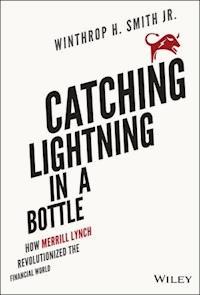
The fascinating story behind the company that revolutionized the financial world
Catching Lightning in a Bottle traces the complete history of Merrill Lynch and the company's substantial impact on the world of finance, from the birth of the once-mighty company to its inauspicious end. Throughout its ninety-four year history, Merrill Lynch revolutionized finance by bringing Wall Street to Main Street, operating under a series of guidelines known as the Principles. These values allowed the company to gain the trust of small investors by putting the clients' interests first, driving a business trajectory that expanded capital markets and fueled the growth of the American post-war economy. Written by the son of Merrill Lynch co-founder Winthrop H. Smith, this book describes the creation and evolution of the company from Charlie Merrill's one-man shop in 1914 to its acquisition by Bank of America in 2008.
Author Winthrop H. Smith Jr. spent twenty-eight years at the company his father co-founded, bringing a unique perspective to bear in telling the story of the company that democratized the stock market and eventually fell from its lofty perch.
- Learn why the industry initially scoffed at Charles Merrill's "radical" investment ideas
- Discover the origin of the Principles, and how they drove operations for nearly a century
- Find out why the author left a successful Wall Street career, and why it was such a smart move
- Examine the culture and values that built Merrill Lynch into one of the world's most successful and respected companies
Revolutionary vision is rare, and enduring success is even more so. When a single organization demonstrates both of those characteristics, it is felt throughout the world. Discover the fascinating story behind Merrill Lynch and the men who built it from an insider's perspective in Catching Lightning in a Bottle.
Sie lesen das E-Book in den Legimi-Apps auf:
Seitenzahl: 1047
Veröffentlichungsjahr: 2014
Ähnliche



















Contents
Author’s Note
Prologue
Part One
Chapter One: Little Doc (1885–1907)
Chapter Two: The Odd Couple (1907–1915)
Chapter Three: Mr. Smith Goes to Wall Street (1915–1929)
Chapter Four: The Grocer (1929–1940)
Part Two
Chapter Five: Wall Street to Main Street (1940–1942)
Chapter Six: Investigate Before You Invest (1942–1957)
Chapter Seven: Good-bye, Beane—Hello, Smith (1957–1970)
Chapter Eight: Bullish on America (1970–1980)
Chapter Nine: Mr. Integrity (1980–1985)
Chapter Ten: The Eternal Optimist (1985–1993)
Chapter Eleven: Cementing the Principles (1993–1997)
Part Three
Chapter Twelve: It Should Have Been a Solid Legacy (1997–2001)
Chapter Thirteen: The Day My Father Wept (2001)
Chapter Fourteen: The Death of Mother Merrill (2002–2007)
Chapter Fifteen: Catching Lightning in a Bottle (2008)
Epilogue
Index
End User License Agreement
Pages
iii
iv
v
vi
1
2
3
4
5
6
7
8
9
10
11
12
13
14
15
16
17
18
19
20
21
22
23
24
25
26
27
28
29
30
31
32
33
34
35
36
37
38
39
40
41
42
43
44
45
46
47
48
49
50
51
52
53
54
55
56
57
58
59
60
61
62
63
64
65
66
67
68
69
70
71
72
73
74
75
76
77
78
79
80
81
82
83
84
85
86
87
88
89
90
91
92
93
94
95
96
97
98
99
100
101
102
103
104
105
106
107
108
109
110
111
112
113
114
115
116
117
118
119
120
121
122
123
124
125
126
127
128
129
130
131
132
133
134
135
136
137
138
139
140
141
142
143
144
145
146
147
148
149
150
151
152
153
154
155
156
157
158
159
160
161
162
163
164
165
166
167
168
169
170
171
172
173
174
175
176
177
178
179
180
181
182
183
184
185
186
187
188
189
190
191
192
193
194
195
196
197
198
199
200
201
202
203
204
205
206
207
208
209
210
211
212
213
214
215
216
217
218
219
220
221
222
223
224
225
226
227
228
229
230
231
232
233
234
235
236
237
238
239
240
241
242
243
244
245
246
247
248
249
250
251
252
253
254
255
256
257
258
259
260
261
262
263
264
265
266
267
268
269
270
271
272
273
274
275
276
277
278
279
280
281
282
283
284
285
286
287
288
289
290
291
292
293
294
295
296
297
298
299
300
301
302
303
304
305
306
307
308
309
310
311
312
313
314
315
316
317
318
319
320
321
322
323
324
325
326
327
328
329
330
331
332
333
334
335
336
337
338
339
340
341
342
343
344
345
346
347
348
349
350
351
352
353
354
355
356
357
358
359
360
361
362
363
364
365
366
367
368
369
370
371
372
373
374
375
376
377
378
379
380
381
382
383
384
385
386
387
388
389
390
391
392
393
394
395
396
397
398
399
400
401
402
403
404
405
406
407
408
409
410
411
412
413
414
415
416
417
418
419
420
421
422
423
424
425
426
427
428
429
430
431
432
433
434
435
436
437
438
439
440
441
442
443
444
445
446
447
448
449
450
451
452
453
454
455
456
457
458
459
460
461
462
463
464
465
466
467
468
469
470
471
472
473
474
475
476
477
478
479
480
481
482
483
484
485
486
487
488
489
490
491
492
493
494
495
496
497
498
499
500
501
502
503
504
505
506
507
508
509
510
511
512
513
514
515
516
517
518
519
520
521
522
523
524
525
526
527
528
529
530
531
532
533
534
535
536
537
538
539
540
541
542
543
544
545
546
547
548
549
550
551
552
553
554
555
556
557
558
559
560
561
562
563
564
565
566
567
568
569
570
571
572
573
574
575
576
577
578
579
580
581
582
583
584
585
586
587
588
589
590
591
592
593
594
595
596
597
598
599
600
601
Guide
Cover
Table of Contents
Begin Reading
CATCHING LIGHTNING IN A BOTTLE
HOW MERRILL LYNCH REVOLUTIONIZED THE FINANCIAL WORLD
WINTHROP H. SMITH JR.
Cover Design: C. Wallace
Cover Illustration: Bull silhouette © iStock.com/AlexeyPushkin
Copyright © 2013 by Winthrop H. Smith, Jr.. All rights reserved.
Co-author: William Ecenbarger
Published by John Wiley & Sons, Inc., Hoboken, New Jersey.
Published simultaneously in Canada.
No part of this publication may be reproduced, stored in a retrieval system, or transmitted in any form or by any means, electronic, mechanical, photocopying, recording, scanning, or otherwise, except as permitted under Section 107 or 108 of the 1976 United States Copyright Act, without either the prior written permission of the Publisher, or authorization through payment of the appropriate per-copy fee to the Copyright Clearance Center, Inc., 222 Rosewood Drive, Danvers, MA 01923, (978) 750-8400, fax (978) 646-8600, or on the Web at www.copyright.com. Requests to the Publisher for permission should be addressed to the Permissions Department, John Wiley & Sons, Inc., 111 River Street, Hoboken, NJ 07030, (201) 748-6011, fax (201) 748-6008, or online at http://www.wiley.com/go/permissions.
Limit of Liability/Disclaimer of Warranty: While the publisher and author have used their best efforts in preparing this book, they make no representations or warranties with respect to the accuracy or completeness of the contents of this book and specifically disclaim any implied warranties of merchantability or fitness for a particular purpose. No warranty may be created or extended by sales representatives or written sales materials. The advice and strategies contained herein may not be suitable for your situation. You should consult with a professional where appropriate. Neither the publisher nor author shall be liable for any loss of profit or any other commercial damages, including but not limited to special, incidental, consequential, or other damages.
For general information on our other products and services or for technical support, please contact our Customer Care Department within the United States at (800) 762-2974, outside the United States at (317) 572-3993 or fax (317) 572-4002.
Wiley publishes in a variety of print and electronic formats and by print-on-demand. Some material included with standard print versions of this book may not be included in e-books or in print-on-demand. If this book refers to media such as a CD or DVD that is not included in the version you purchased, you may download this material at http://booksupport.wiley.com. For more information about Wiley products, visit www.wiley.com.
Library of Congress Cataloging-in-Publication Data:
ISBN 978-1-118-96760-7 (Hardcover)
ISBN 978-1-118-96764-5 (ePDF)
ISBN 978-1-118-96761-4 (ePub)
This book is dedicated first to my father, a principled leader and a humble, generous man who lived his life with the highest integrity. It is also dedicated to my family, who by reading this will have an even greater appreciation for the Mother Merrill that my father and I knew and loved. And it is for the thousands of other Merrill Lynch families who contributed to our great company’s success in its first hundred years.
Author’s Note
When my father graduated from Amherst College in the spring of 1916, he joined the two-year-old Merrill, Lynch & Co., thus beginning his life’s work. It was an impressive career marked by significant achievements and lasted more than forty-five years. From the outset, he developed a personal friendship and business partnership with Charlie Merrill, a brilliant visionary and pioneer in the grocery and financial services industries. While Charlie was the better known of these two partners, I have come to understand the depth of the role my father played in shaping the Merrill Lynch of the future.
It was my father who convinced Charlie to reenter the brokerage business in 1940 after a decade of involvement with other enterprises. Together they brought Wall Street to Main Street, changing the paradigm of financial services in the modern age. But most important, they developed a uniquely powerful set of principles that became the North Star for future generations of Merrill leaders. The culture that this established was the primary reason for Merrill’s success over the years. My father died in 1961.
Thirteen years later, I joined Merrill Lynch as an associate in the Investment Banking Division after receiving an MBA from Wharton. Since my dad passed away when I was only eleven, I never fully appreciated his leadership skills and the power of his humility. During nearly twenty-eight years at the company, however, I came to know him better and to appreciate the principles and the culture that he and Charlie Merrill had created. I was proud to be a member of the Mother Merrill family.
Being the son of Winthrop H. Smith had many benefits, but it also presented challenges. I had to work extremely hard every day to prove myself worthy of the name. Over the years I held line and staff positions in investment banking, wealth management, finance, human resources, and marketing prior to becoming Executive Vice President, Chairman of Merrill Lynch International and a member of the Merrill Lynch & Co. Executive Committee. I had a great career and feel so fortunate to have been at Merrill when I was.
In October 2001, the culture of Merrill Lynch was about to change as a result of a new management team with different ideas about how to maximize profits. I knew that I couldn’t work within this new environment, so I decided to retire. And I resolved to write the story of Merrill Lynch.
Several years passed, and I had not begun writing. Then in 2007, the financial crisis hit and my former firm became a victim of greed and the lack of proper oversight by its Board of Directors. Two years later, two people motivated me to start a book. Bill Ecenbarger had been hired a decade earlier to write the corporate history of Merrill Lynch. Bill is a Pulitzer Prize winner, and he interviewed me in my Connecticut office in 2002. He was well along with the project when Stan O’Neal, Merrill’s new CEO, decided there was no need for a history of the firm and his efforts ceased. In late 2009, Bill called me. “Win, I read the speech you gave at the final shareholders meeting,” he said. “You need to write the history of Merrill Lynch. No one can tell it better than you, and I’d enjoy working on it with you.” When I told Lili, my wife-to-be, about this conversation, she made me realize that this was not only something that I needed to do for my own therapeutic reasons, but also something that I was compelled to do so that future generations could know the truth about Merrill Lynch and appreciate its historical importance.
This book is about the history of Merrill Lynch and its leadership—the rise and fall of an American institution. The chapters are organized around the twelve leaders of Merrill Lynch, ending with John Thain—all of whom I had known. Each left his own mark on the company and, with one stark exception, respected and strengthened the firm’s culture. It is a story about an idea that began with a man named Charlie Merrill, without a doubt one of the leading entrepreneurs in the history of American business. By bringing Wall Street to Main Street and democratizing investing, Merrill Lynch helped countless middle-class individuals save and invest and, in turn, helped thousands of companies, municipalities, and governments fund their growth. Merrill was at the center of the financial intermediation process that allowed the United States to grow into the economic powerhouse it became in the last half of the twentieth century. Like all companies, it made mistakes, but it was guided by principled leaders who always attempted to do the right thing and for the right reason.
Catching Lightning in a Bottle is based on three years of solid research but it is very personal, too. Besides being a history of one of America’s great companies, it also reflects my personal memories of many of Merrill’s leaders and of significant events over a twenty-eight-year career. During those years, I not only discovered more about the enormous impact my father had on Merrill Lynch, but I also learned to appreciate how important a corporate culture and a set of values can be in creating a successful company. Unfortunately, I also learned how quickly they can be destroyed. Because of this personal perspective, events are sometimes not presented in strict chronological sequence as they might be in a more traditional account.
For this book, hundreds of people shared their stories, documents, and memorabilia with me. They told me what working at Merrill Lynch meant to them and to their families. For so many, our firm was not only a place to work but an enormous source of pride. Although I have written mostly about the important leaders who shaped, influenced, and grew the firm, there are tens of thousands of others who contributed to its success as well. They embraced its culture, protected it, and passed it along to future generations. It was a remarkable family.
This has been an emotional book to write. I am grateful to my wife, Lili Ruane, for convincing me to begin in earnest. And I am indebted to so many friends and colleagues who helped me along the way. Special thanks are due to Bill Ecenbarger, my partner in writing this history. His research and co-authorship were invaluable. Also special credit is due to Meg Drislane for her editorial skills, to Barb Justice for the design of the book, and to Susan Hemmeter, my executive assistant at Sugarbush. I also want to thank Bank of America for allowing us access to Merrill Lynch’s archives, which are now located in Charlotte, North Carolina.
I hope that this book will enable every member of the Merrill Lynch extended family to remember and appreciate, even more, what we collectively accomplished and that it will help many others to know the real Mother Merrill. In particular, I hope that my own children and grandchildren will have a greater appreciation of what their grandfather and great-grandfather helped to create.
Prologue
I went into the meeting with every intention of saying yes. But the answer to my own seemingly simple question changed all that, and I knew in an instant that my life would never be the same. What I could not have imagined was how quickly Mother Merrill would metamorphose into something I would not even recognize.
It was October 2001, just a few weeks after the terrorist attacks on the World Trade Center. Merrill Lynch had been forced out of its offices in the neighboring World Financial Center. The new president and eventual CEO, E. Stanley O’Neal, was temporarily using our office at 717 Fifth Avenue in Midtown Manhattan. A few days before, as part of his broad reorganization, O’Neal had removed me from my twin positions as chairman of Merrill Lynch International and president of the International Private Client Group. He had asked me to stay on as vice chairman of Merrill Lynch & Co. to focus on our most important client relationships throughout the world. I was initially skeptical. I had become increasingly concerned about O’Neal’s vision for Merrill Lynch, about how he was starting to shape his administration, and about his shabby treatment of some of my fellow executives. However, conversations with several ML colleagues whose judgment I respected convinced me to give the new role a try. We scheduled another meeting.
Stan was never big on small talk, so just as I was settling into my chair he said: “I hope that you’re here to accept the job. I want you to be a core part of my team. We are going to have to change a lot of things about the way this place is being run. As soon as we get rid of Komansky, we can get started running this place the right way.” Wow! I stared at him in disbelief. Here was the new president talking about discarding his nominal superior, David H. Komansky, the chairman and chief executive officer. O’Neal rambled on until I asked him where he stood on the Principles.
“The Principles” were our mantra at Merrill Lynch. Charlie Merrill and my father had built the firm on a core set of values, and through the years they had been carried forward by their successors. Every chairman and CEO up to O’Neal had always felt and acted as though they stood on the shoulders of the leaders who had preceded them. Dan Tully, Komansky’s predecessor, capsulized these Principles and now they were displayed prominently in every Merrill Lynch office throughout the world. In our foreign offices, they were written in the local language. And they were etched in the concrete of our headquarters in New York:
CLIENT FOCUS
RESPECT FOR THE INDIVIDUAL
TEAMWORK
RESPONSIBLE CITIZENSHIP
INTEGRITY
Tully revered them and always referenced the Principles whenever we had to make difficult decisions. “Okay,” he would ask in a weekly Executive Committee meeting, “is this really in the client’s best interests?” But when I asked O’Neal about them, his face distorted with anger and I could see the arteries throbbing in his neck.
O’Neal launched into a scathing attack against “Mother Merrill”—he said the words the way a sick man names his disease—and he ridiculed the Principles and the culture that had made the company revered by both its customers and its employees. As he ranted on, I grew angrier and felt my cheeks quivering and the veins throbbing in my own neck. Clearly this man cared nothing about our heritage or our prestige in the business world. Finally, I interrupted him. I had heard enough. “Stan,” I said, “thank you for your offer but I can’t work for you.” I stood up and walked out, to the silent amazement of O’Neal.
Back home in Connecticut that night, doubts began to fester as I tried to fall asleep. Had I acted impulsively rather than rationally? Was it the wrong decision—a huge mistake? Abruptly leaving a firm where my father had worked for forty-five years, finishing at the very top, and a place where I had been for twenty-eight years was not an easy decision. I knew that I would be disappointing many colleagues as well as my family. And I understood that I would be giving up many millions in future compensation.
But the next morning I awoke refreshed, with a sense of relief. I knew I had made the right decision. I looked out the window at a glorious autumn day. Every leaf looked like a flower. I got into my car and began driving north—first on Interstate 95, then on Interstate 91. As I passed the exit for Holyoke, Massachusetts, I thought about my father, who had been born and raised only a few miles from there in South Hadley Falls. Also nearby was Amherst College, where both Charlie Merrill and my father had studied and from which I graduated in 1971.
At that moment I was sure that my father would have been proud of my decision because it was based on principle—his Principles. The Merrill Lynch culture that I loved and respected was going to change dramatically, and I could not be a party to it. I could not be a member of this new management team.
While I was driving, I suddenly thought of the matryoshka, the Russian nesting dolls, in Dave Komansky’s office. Dave had been presented with these as a gift when he succeeded Dan Tully as CEO in 1997. There were ten dolls, each with the face of a Merrill Lynch leader, beginning with Charlie Merrill. Next came my father. Then Mike McCarthy, George Leness, Jim Thompson, Don Regan, Roger Birk, Bill Schreyer, Dan Tully, and Dave Komansky. The dolls got progressively larger from Merrill up. The symbolism of the dolls was that each era of Merrill Lynch grew from what was inherited from the prior one and that each new leader built on the success of his predecessor rather than relied on what he could achieve alone. Each of us stood on the shoulders of those who came before us, those who built our successful firm and created a powerful and enduring culture. It was our responsibility to maintain the essence of what came before us while moving into the future. It was our obligation to adopt change without throwing out the Principles that were our solid foundation. It was our obligation to preserve the culture.
By the time I crossed the border into Vermont that day, I could really see that autumn had taken a firm grip on the landscape. The change is dramatic because Vermont has outlawed billboards and all you see is the vista. I drove past trees in gorgeous Van Gogh colors, past farmland that had been harvested to stubble. My destination was Sugarbush, a ski resort that I and a few other investors had purchased on September 10, the day before the terrorist attacks.
One nagging thought refused to go away, however, and it clung to my brain like a barnacle on a hull. Stanley O’Neal was dead wrong when he characterized my company—my former company—as inefficient, paternalistic, and bloated. On the contrary, Merrill had become one of the leading investment banking and private wealth firms in the world. We had a global footprint that was unmatched and envied by our competition. We were proud to wear “the Bull” on our sleeves and in our hearts, and we felt privileged to be a member of Mother Merrill’s family. The “bloated” firm that O’Neal was about to disassemble had earned a record $3.8 billion the prior year, had a pre-tax margin of 21.3 percent, and had a return-on-equity of 24.2 percent. For the forty-eighth consecutive quarter we had led the Global Underwriting league tables with a 13.3 percent market share, and we ranked No. 3 in global mergers and acquisitions, with very little difference between us and No. 1. Our global research was ranked No. 1 in the world, and we were the dominant secondary equity trading firm in the world. Our private wealth business held $1.5 trillion in client assets and our global asset management business managed $557 billion. We had 72,000 employees, 21,200 financial advisers, and 975 offices in forty-four countries around the world. In the first quarter of 2001, our stock price hit a record high of $80.
However, O’Neal had no interest in continuing the culture that had allowed our firm to prosper. In my opinion he was enabled by a Board of Directors who valued their positions and compensation as directors more than they valued a culture that required integrity and respect. They allowed short-term profitability to blind their views of the highly leveraged and risky business Merrill would become, and they allowed a small group of greedy individuals to destroy an icon. What happened from 2001 through 2007 never should have been allowed to occur.
The real story of Merrill Lynch had to be written. There was a reason why Arthur Levitt, the former chairman of the Securities and Exchange Commission under President Clinton, called Merrill Lynch “the only firm on Wall Street with a soul.” This is mostly a positive story about a firm that grew into greatness through principled leadership and a core set of values that shaped its culture and brought Wall Street to Main Street after World War II. Through innovation and principled leadership, it became one of the world’s leading and most venerated financial firms. For the hundreds of thousands of us who knew the real Mother Merrill, our experience there was like catching lightning in a bottle. Unfortunately, the years after 2001 were not the same.
I sat down in the spring of 2010 to begin writing this book. Link by link, I retraced the glorious history of this company. It was a story I knew well. In considering where to begin, I finally settled on a scorching afternoon ninety-four years earlier in the dusty, sleepy town of Shaw, Mississippi.
Part One
A young and charismatic Charlie Merrill begins to charm Wall Street.
Chapter OneLittle Doc(1885–1907)
The wooden sidewalks on either side of the single dirt street were perfectly still, without any moving thing. The town’s commerce was conducted in false-fronted shacks, but all of the respectable enterprises—a drugstore, two hotels, and several cafés—were closed. On one side of town, there were nine churches—four white and five black. On the other side, on the banks of Porter’s Bayou, there were at least that many brothels and saloons. But even they weren’t open for business today.
It was August 1907, and all across small-town America, in each of the other forty-four states, it was the same as here in Mississippi. Everyone was just outside of town, at the ball park. Nearly every town in America had its own ball park and its own ball team, and both were sources of considerable civic pride. The smaller the community, the greater the pride. Challenges were issued to neighboring towns, and the games became festive occasions with bands and cookouts. Special trains brought in the out-of-town fans, though visiting teams were at a disadvantage because the home team supplied the umpires. Nevertheless, the betting was heavy.
Baseball really was the national pastime, and in Shaw, this really was the only game in town. No one missed it. It would be years before radio broadcasts of major-league games began eroding attendance. Typically, the games were played on rock-studded vacant lots and in cow pastures where sometimes dried fecal matter served as bases. Shaw’s ball park was an old cotton field that had been dragged more or less smooth with a huge steel rail. The backstop was fashioned from weathered, discarded lumber and chicken wire. The bases were burlap bags filled with sand. The field was surrounded by horse-drawn wagons and buggies, and fans watched attentively from chairs and spread-out quilts they had brought with them.
Shaw’s center fielder that day was a short, wiry man just a few months away from his twenty-second birthday. While his teammates looked vaguely comic in their beanie caps and baggy uniforms, the man in center field was tailored to parade-ground neatness. The only shabby thing was his glove, which was nothing more than a flimsy lace-less pad, not unlike a hot pad, that required him to use his fingers when he caught the ball. He played a shallow center field—not because he had great range but because he had a weak arm, the legacy of a boyhood fight in which it was broken.
Lesen Sie weiter in der vollständigen Ausgabe!
Lesen Sie weiter in der vollständigen Ausgabe!
Lesen Sie weiter in der vollständigen Ausgabe!
Lesen Sie weiter in der vollständigen Ausgabe!
Lesen Sie weiter in der vollständigen Ausgabe!
Lesen Sie weiter in der vollständigen Ausgabe!
Lesen Sie weiter in der vollständigen Ausgabe!
Lesen Sie weiter in der vollständigen Ausgabe!
Lesen Sie weiter in der vollständigen Ausgabe!
Lesen Sie weiter in der vollständigen Ausgabe!
Lesen Sie weiter in der vollständigen Ausgabe!
Lesen Sie weiter in der vollständigen Ausgabe!
Lesen Sie weiter in der vollständigen Ausgabe!
Lesen Sie weiter in der vollständigen Ausgabe!
Lesen Sie weiter in der vollständigen Ausgabe!
Lesen Sie weiter in der vollständigen Ausgabe!
Lesen Sie weiter in der vollständigen Ausgabe!
Lesen Sie weiter in der vollständigen Ausgabe!
Lesen Sie weiter in der vollständigen Ausgabe!
Lesen Sie weiter in der vollständigen Ausgabe!




