


11,51 €
Mehr erfahren.
- Herausgeber: Fernhurst Books Limited
- Kategorie: Fachliteratur
- Sprache: Englisch
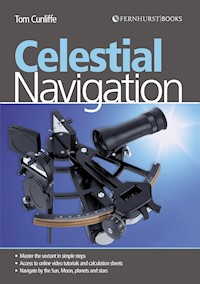
Celestial navigation is one of the oldest of the mariner's arts – and one of the most awe-inspiring. It is also essential for every ocean sailor who wants to be able to fix his position should the GPS fail. Tom Cunliffe shows you how to master the art in easy stages. Within a few pages you'll be taking your first sight. From there it is a short step to plotting your position, wherever you may be on the world's oceans. Whether you need to pass an exam, want a back-up to GPS positioning or simply choose to delight in the wonder of the cosmos, this is the perfect guide. With photographs, charts and diagrams to help your learning, you will be able to master the sextant and navigate using the sun, moon, planets and stars.
Das E-Book können Sie in Legimi-Apps oder einer beliebigen App lesen, die das folgende Format unterstützen:
Veröffentlichungsjahr: 2010
Ähnliche


















Contents
Introduction
Chapter 1: The Earth and the Heavens
The Terrestrial Sphere
The Celestial Sphere
Horizon
Chapter 2: The Sextant
How The Sextant Works
Setting Up the Sextant
True Altitude and Sextant Altitude
Using a Sextant
Care of the Sextant
Chapter 3: The Noon Sight for Latitude
Finding the Time of Local Noon
Taking the Sight
The Theory
Calculating a Latitude
Other Bodies
‘Maximum’ Altitudes
Chapter 4: Time
"The ‘Mean Sun’ and the ‘apparent Sun’
Zone Time
Naming the Zones: ‘+’ or ‘−’
Standard Time
The Navigation Clock
Chapter 5: Position Lines and Plotting
Azimuth
Practical Plotting
Chapter 6: Sun Sights
The Assumed Position
Azimuth and Intercept
Producing a Sun Sight
Using the Sight
Chapter 7: The Planets
Twilight
Planet Identification
Shooting a Planet or Star
Planet Sight Reduction
Chapter 8: The Moon
Corrections in Sight Reduction
The Moon Sight Pro Forma
Altitude Correction Tables for the Moon
Chapter 9: The Stars
Brightness of Stars (Magnitude)
First Point of Aries and Sidereal Hour Angle (SHA)
Reducing a Single Star Sight
Planning a Star Sight Session
Distance Run Between Star Sights
Multiple Star Sight Reduction
Precession and Nutation
Chapter 10: Polaris – the Pole Star
Corrections to the Apparent Altitude of Polaris
Chapter 11: Compass Checking on the Ocean
Sunset and Sunrise: Amplitude Tables
Points to note
Azimuths for Compass Checks
Chapter 12: The Shortest Way
Great Circle Sailing
Composite Tracks
Reprinted in 2013, 2015 by Fernhurst Books Limited 62 Brandon Parade, Holly Walk, Leamington Spa, Warwickshire, CV32 4JE, UK Tel: +44 (0) 1926 337488 | www.fernhurstbooks.com.
Copyright © 2010 Tom Cunliffe
First published in 1989 by Fernhurst Books This edition first published in 2010 by John Wiley & Sons Ltd
The right of the author to be identified as the author of this work has been asserted in accordance with the Copyright, Designs and Patents Act 1988.
All rights reserved. No part of this publication may be reproduced, stored in a retrieval system or transmitted, in any form or by any means, electronic, mechanical, photocopying, recording, scanning or otherwise, except under the terms of the Copyright, Designs and Patents Act 1988 or under the terms of a license issued by The Copyright Licensing Agency Ltd, Saffron House, 6-10 Kirby Street, London, EC1N 8TS, UK, without the permission in writing of the Publisher.
Designations used by companies to distinguish their products are often claimed as trademarks. All brand names and product names used in this book are trade names, service marks, trademarks or registered trademarks of their respective owners. The Publisher is not associated with any product or vendor mentioned in this book.
This publication is designed to provide accurate and authoritative information in regard to the subject matter covered. It is sold on the understanding that the Publisher is not engaged in rendering professional services. If professional advice or other expert assistance is required, the services of a competent professional should be sought. The Publisher accepts no responsibilty for any errors or omissions, or for any accidents or mishaps which may arise from the use of this publication.
A catalogue record for this book is available from the British Library ISBN 978-0-470-66633-3 (paperback) ISBN 9781118315576 (eBook) ISBN 9781118315699 (eBook) ISBN 9781118361870 (eBook)
Photo credits pages 10, 11, 12, 14, 15 and 16: © Lester McCarthy/Yachting Monthly/IPC+ Syndication
Thanks to charter and events specialists, Lymington Yacht Charters, for the provision of a yacht for the filming of the video tutorials. Tel: 01590 676470; www.lyc.co.uk
Artwork by Creative Byte
Introduction
NAVIGATION is that art which instructs the mariner in what manner to conduct a ship through the wide and trackless ocean, from one part to another, with the greatest safety, and in the shortest time possible.
JW Norie Norie’s Practical Navigation (mid-nineteenth century)
For a thousand years, celestial navigation in one form or another has guided mariners across the trackless oceans. Since the days of Captain Cook, a seaman with a clear horizon and a glimpse of the heavens has needed only a sextant and a chronometer to ascertain his position to within a mile or two.
Only the most cynical of navigators has not at some time looked at the fix on his chart in awe, remembering that the position lines have been derived from stars and galaxies marching at unimaginable distances through space. Whilst the electronics of the new era can only stand to increase man’s pride in his own works, the celestial navigation of the ages encourages a deep humility which, at sea in a small vessel, is no bad thing.
Ocean navigation has changed utterly in the 35 years between my first venture across the Atlantic as skipper and my most recent crossing of the same stretch of water. From celestial navigation as the only option, we have stumbled through a dawn period of transit satellites into the full daylight of universal GPS, Galileo and GLONASS. If the bulkhead GPS fails for any reason out on the wide ocean, the skipper simply reaches into his kitbag for the back-up unit he bought at the boat show for the price of his night’s lodging. Those whose experience of technology has presented a catalogue of disappointments may even have invested in more than two such wonders.
From the beginnings of seafaring, mankind navigated under the inescapable reality that for much of the time his position was seen through a frosted window. All at once, in the early 1990s, technology leapt ahead. An exact fix became available whenever it was desired. For the foreseeable future, therefore, mainstream navigators will use satellite systems as their primary fixing tool. Celestial navigation is deposed from its hitherto unassailable situation at the summit of the navigator’s achievement. Overnight, the skills of the ages were degraded to mere back-up against the ultimate catastrophe, loss of volts. For many sailors, however, the change is to be lamented as well as welcomed.
Until a few years ago, students plunged into the “Celestial Navigation” section of the Yachtmaster Ocean syllabus in earnest. Without it, they would have been truly lost while off soundings. Except in an emergency, this is no longer the case, but it does not mean that when things are going smoothly on the electronic front the old ways should be consigned to an unvisited corner of the mind.
Daily connection with the heavens used to serve as a constant reminder of our own ultimate insignificance which did wonders for any skipper tempted by megalomania. Together with this metaphysical aspect to astro navigation came an inevitable degree of uncertainty about one’s exact position which bred seamanlike caution. When finally dispelled by a good landfall, this gave rise to an elation that no longer has a parallel. All this is potentially lost to the electronic navigator.
Of greater concern to some, however, will be that sextant work, like all arts, requires continuous practice to achieve any real proficiency. It just isn’t sufficient to take a couple of sun sights on a short passage and send them to an examiner who may then declare you an Ocean Yachtmaster. The traditional daily round of morning or evening stars and the forenoon sight of the sun followed by a noon latitude not only gave rhythm to the watch system, it also bred a facility with the tools that today’s navigator will still need if the electronics ever go down. And one thing at least is certain: the firmament will continue to blaze long after the last navigational satellite has escaped into deep space, or burned up in the final truth of its re-entry.
For all these reasons, any skipper of a yacht on the ocean should make the effort to master celestial navigation. The methods and techniques have been set out here in a form that will get you navigating by the sky as soon as possible-long before you have finished the book-but do not for one moment suppose that because the Sun makes its appearance in these pages before the stars that it is more important. You have to start somewhere and the Sun is pretty hard to miss, so it’s the best thing on which to practise using your sextant. It won’t help you much though, if you are expecting a dawn landfall on an unlit coast and you are wondering where you are. It won’t be around to be observed until after breakfast, and then it will only offer a single position line. Morning stars and a planet thrown in for good measure will, if the sky is clear, fix your position to within a mile or so. As you will see, stars are surprisingly easy to operate with; the planets are our neighbours under the Sun, and simple to reduce; the Moon is so close that its movements are a challenge but, given proper respect, it will smile wryly down on our efforts and provide a useful signpost.
I am not an astronomer. I am by no stretch of the imagination either a physicist or a mathematician. I am, before everything, a practical seaman. I learned my celestial navigation by spending long periods of time on the ocean in the days before GPS. One by one I have forced myself over the hurdles presented in my mind by planets, Moon and stars. On each occasion, what I imagined to be a problem soluble only by the academic or hard-line professional turned out to be yet another piece of cake. The whole business, if tackled in the right order, is amazingly simple. In the following chapters I have set out from my own experience what you need to know. Very little more, and no less. You’ll notice that Chapter 1 is all about concepts, conventions and definitions. As Saint John noted, “In the beginning was the Word”. Skip it, and you’re in trouble. Read it, understand it and be ready to refer back to it because it is the rock on which the rest is built.
Apologies to any women offended by my use of the masculine personal pronoun. Absolutely no disrespect is intended and some of the best star navigators of my acquaintance have been ladies. However, continuously using the phrase ‘he or she’ is tiresome, and I categorically refuse to insult my readers by using the plural pronoun for a singular case. So, for convenience only, male it is. The Romans did it that way too. Fair winds to you on your voyage!
Chapter 1
The Earth and the Heavens
We all learn as infants that the Earth revolves once a day and that the stars remain, to a greater or lesser extent, stationary. We also become aware that the Moon is in our own back yard, that the stars are plunging through space at various mind-boggling distances from us and that the Earth is travelling on an annual voyage around the Sun. Whether or not all this is true is of no relevance to the practical astro navigator.
For our purposes the Earth, otherwise known as the terrestrial sphere, may be taken to be a perfectly round ball swimming in a vacuum at the centre of the known universe. At the outside of the vacuum, an indeterminate but fortunately irrelevant distance away, is a further big ball which marks the perimeter of the universe. This ball is known as the celestial sphere. For our purposes all the heavenly bodies move in their courses on its inside surface, and its centre coincides exactly with the centre of the Earth.
Looking down on the Earth’s axis from the Pole. An observer at 80°W longitude is at an angular distance of 80° west of the Greenwich Meridian.
The Terrestrial Sphere
Any location on the Earth’s surface can be expressed in terms of latitude and longitude.
Meridians of longitude
To define our position on the globe in an east-west direction we make use of the meridians of longitude. These are great circles which converge at the poles of the Earth, a great circle being the line described on the Earth’s surface by a plane passing through the centre of the Earth. In the case of a meridian, it is best thought of as what you would see if you pulled a segment out of a perfectly round orange. The segment starts and ends at the opposite poles of the orange. Its curved surface is the shortest distance between them on the surface of the orange. This definition becomes more important when great circle sailing is discussed later. For now, it is enough that a meridian runs direct from pole to pole on the surface of the terrestrial sphere.
Great and small circles (Earth viewed from just north of the equator). The equator is a great circle – that is, on a plane that passes through the centre of the Earth – but all the other parallels of latitude are small circles.
Position is measured in terms of angular distance (see below) east or west of the zero or datum meridian. This passes through the Greenwich Observatory in England, and is known as the Greenwich Meridian. Those in denial of Britain’s contribution to astronomy and longitude can choose to call this the International Reference Meridian, or the Prime Meridian. Longitude is measured in degrees east or west of Greenwich until east and west meet somewhere in the remote Pacific Ocean.
Parallels of latitude
Having determined our angular distance east or west of Greenwich we need another set of co-ordinates to fix us in a north-south direction. These are the parallels of latitude, which define angular distance north or south of the equator, which is actually the great circle on a plane at right angles to the Earth’s axis, halfway between two poles.
The equator is the only parallel of latitude which fulfils the definition of a great circle. All the others are small circles (see diagram).
Latitude-the Earth (the terrestrial sphere) viewed from the plane of the equator. Latitude is expressed as an angu lar distance north or south of the equator, measured from the centre of the Earth.
The celestial sphere is an imaginary sphere enclosing the Earth, with its own poles and equator. For the purposes of navigation, all celestial bodies such as the Sun and the stars are positioned on the surface of this sphere regardless of their actual distance from the Earth.




