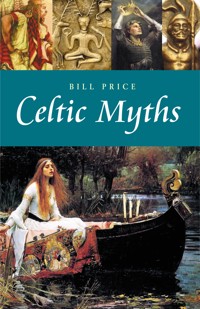
The cover of Celtic Myths may evoke soft-focus Pre-Raphaelite swirling mists of New Age nonsense (with an imagined soundtrack by Enya), but that’s the whole point of author Bill Price’s argument. It turns out that the whole Celtic ‘race’ may very well be just as mythical as Cú Chulainn, Balor of the Evil Eye and other more evidently mythical figures of ‘Celtic’ legend. Price observes that the people whom the Greeks and then the Romans described as Celts were in present-day France and Spain, and Roman invaders in Britain emphasised the physical and linguistic differences between the various tribes within Britain. The term ‘Celtic languages’, and the subsequent idea of ‘Celtic races’, was made up in a wave of Welsh, Scottish and Irish romantic nationalism that started in the 18th century.
But as Price observes, ‘Myths of the Peoples of the Atlantic Façade doesn’t have the same ring to it.’ For all the romanticism surrounding ‘Celtic mythology’ it’s surprising how down-to-earth and free of supernatural elements the myths are: most are more about heroic cattle raids and spectacular feats of adultery rather than titanic struggles between gods and monsters. Perhaps the early Christian monks who wrote down these old stories censored their pagan elements. Some echoes of the older culture remain, notably the more active role of women, at least among the ‘Celtic’ aristocracy.
Celtic Myths briskly canters through a narrative of the heroic tales from Ireland, Wales, Scotland and the Isle of Man, but its best parts are taken up by a long and engaging exposition about myths in general – their development, their structure and the ‘need’ for myths in a pre-literate society. But dry anthropology this is not.
Celtic Myths is beautifully written, with something to fascinate everyone, and its format – yes, it does fit in a jacket pocket – makes it perfect for reading all the way through, or just for dipping into on short bus journeys.- Matt Salusbury, Fortean Times
Bill Price grew up on a farm in Herefordshire, not far from Hay-on-Wye. He worked in the book trade in Hay and London for almost twenty years and is now a freelance writer, with a particular interest in archaeology and ancient history.
Other Pocket Essentials by Bill Price:
Tutankhamun
Charles Darwin: Origins and Arguments
Celtic Myths
BILL PRICE
POCKET ESSENTIALS
Contents
Introduction
On Mythology
The Purpose of MythMythos and LogosMythtimeCeltic Myth
The Celts
IntroductionWho Were the Celts?The Story in the DNAArchaeology, Genes and MythsIron Age SocietyTara and Navan FortReligion
The Spoken and Written Word
Oral TraditionThe StorytellersThe Written StoryThe Celtic Revival
The Irish Cycles
OverviewThe Ulster CycleThe Hound of CulannThe TáinThe Fenian CycleThe Mythological CycleThe Cycles of the KingsAdventures and Voyages
Tales from Wales
The MabinogionThe Four BranchesOther Sources
And the Rest
Mythology and FolktalesScotland and ManCornwall and Brittany
NotesBibliographyCopyright
Introduction
At some point during the 1880s the teenage Mary MacDonald left her home on an island off the coast of County Donegal in the north west of Ireland to take up a position as a maid in a convent in Birmingham. It was more than 30 years after the worst of the Irish Famine, but times were still hard in the west of Ireland and emigration to find work and escape from poverty was a common occurrence. It must have been difficult at first for Mary to adjust to a life in an industrial city, not least because, when she arrived, she didn't speak any English. Her family, like the majority of the people from that part of Ireland at the time, were Irish speakers and English, if it was spoken at all, would only have been used when talking to outsiders. Although I don't know what conditions were like in the convent, it is easy to imagine the regime being strict and the work hard. At some point in her late teens or early twenties, Mary MacDonald left the convent and got married to a young man, who also came from within the Irish Catholic community in Birmingham, and they started a family.
There is nothing exceptional about this story, but it is important to me because Mary MacDonald was my great grandmother. It is one part of the story of my family, of how they left Ireland and established themselves in Birmingham. I have never questioned this version of events and, in writing it down now, I have not checked to make sure I have got the story straight. Other members of my family may well tell it in a different way entirely, but this is my version, this is the way I remember it being told to me.
The story can be seen as one strand of my own personal foundation myth. It tells me something about where I am from and, to a certain extent, who I am. A fascination with our origins and ancestry appears to be a universal trait, shared throughout humanity and across all cultures, and, going back to the time before the invention of the written word, one of the ways of expressing, explaining and preserving these ideas was through storytelling. This, in essence, is what mythology is. Mythology uses stories to offer explanations for what might otherwise be inexplicable.
Another of my purposes in telling the story is to demonstrate my own Celtic roots. I am, in a rather obvious fashion, trying to give myself some connection to the subject matter of this book, as if, by doing so, I have a more legitimate claim on the stories than someone who cannot trace their ancestry back to the west coast of Ireland. This is, of course, complete nonsense, but it does illustrate that stories can have more meanings and purposes than they might initially appear to have. Myths certainly fall into this category.They can offer explanations to the big questions (life, the universe and everything, as Douglas Adams put it in TheHitchhiker's Guide to the Galaxy); they are a way of understanding the world in which we live; they can reinforce cultural ties by showing listeners their place within society; and they can act as a resource of information. Although not often discussed in great detail in the academic literature on the subject, myths can also be enjoyable and entertaining. In fact, it could be argued, their primary function is to engage and enthral. We all love a good story, whether we get all its nuances and inferences or we are simply swept along by the narrative. It would be interesting to learn, for instance, how many of the fans of the Star Wars films, which are clearly based on traditional storytelling and have storylines involving heroes, princesses and tyrants and the fight between good and evil, could really care less about any deeper meanings the films may have. Most probably viewers watch them for their entertainment value alone.
This book is primarily concerned with the surviving mythology of the people of the Atlantic fringes of northwest Europe, collectively known as the Celts: the Irish, Welsh, Scottish, Manx, Cornish and Bretons. It is a book of two halves. The first half begins by briefly considering myths in general, what they are and what they are for, before going on to tackle the controversial question of who the Ancient Celts, the people who inhabited Britain and Ireland before the Romans arrived, actually were and what the society in which they lived was like. Chapter three then deals with storytelling in general and how, and in what form, the mythic stories, generated as part of an oral tradition and in a pre-Christian culture, survived the transition to Christianity to come down to us in the modern age.
The vast majority of the surviving myths come from Ireland and, to a lesser extent, from Wales. Because of this, the second half of the book, which concerns the myths themselves, concentrates on these two countries. This is not intended to imply that the myths of the other Celtic regions were in any way inferior to those of Ireland and Wales and, in Chapter 6, consideration is given to these. Unfortunately, for the most part, the myths of Scotland and Man and of Cornwall and Brittany have been lost and their richness can now only be inferred from folktales, the telling of which among speakers of the Celtic languages continued until quite recently. In some respects, it continues today.
This, then, is a book about stories and storytelling, about the heroes Cúchulainn and Fionn mac Cumhaill and the heroines Deirdre and Rhiannon, about this world and the Otherworld. The stories can be tragic, romantic, intense or funny and, sometimes, they can be combinations of any and all of these.They can be magical or grimly realistic, epic in scale or highly personal, full of symbolism and allusion or entirely straightforward, brilliantly realised works of literature or, on occasion, contrived nonsense. The world was a very different place when these stories were being told by bards and storytellers and we will probably never fully understand all the hidden meanings and references they contain but, even so, they can have a relevance to the world in which we now live. Like all great art, the Celtic myths are fundamentally concerned with what it is like to be a human being and, whatever else changes, this is one thing that stays much the same.
On Mythology
The Purpose of Myth
Some of the greatest minds of the twentieth century – Sigmund Freud, Carl Gustav Jung,Vladimir Propp, Claude Levi-Strauss, to name but a few – have exercised their considerable intellects on the subject of mythology.Although it is beyond the scope of this book to consider the development of mythology as an academic discipline,1 it is certainly worth exploring aspects of the general thought on the subject as a means both of introducing the specific field of Celtic Mythology and of placing it within an overall framework.
Perhaps the most obvious starting point is to define what is meant by the term myth and to consider what, if anything, differentiates myths from other similar forms of story such as legends or folktales. The main entry under myth in the Shorter Oxford English Dictionary gives a clear and uncluttered definition:
A traditional story, either wholly or partially fictitious, providing an explanation for or embodying a popular idea concerning some natural or social phenomenon or some religious belief or ritual; specifically one involving supernatural persons, actions, or events; a similar newly created story.2
This is the sense in which the word myth is used in this book. As the definition makes clear, myths are first and foremost traditional stories. A great deal has been written about the purpose of these stories but, for them to have survived and to have been passed down through generations of storytellers, the stories themselves must have engaged, informed and, above all else, entertained the audience. This aspect of myths has been much less remarked upon in the academic literature, perhaps because it is self-evident that a story which bores its audience will not be one that remains in any successful storyteller's repertoire for long.
Describing what a myth is, then, would appear to be quite straightforward, but a problem arises out of the modern usage of the word. A second definition in the dictionary states that a myth is a widely held story or belief which, on examination, turns out to be entirely untrue. An example could be the myth of the American dream, in which people in America, whatever their background or financial status, are supposed to have an equal chance of achieving whatever they set out to do through hard work and perseverance. As attractive as this idea may be, all of us know, if we are being honest, that it is no more true in America than it is anywhere else in the world.
When someone uses the phrase, 'It's a myth', what they are saying is that whatever they are referring to is untrue. It is easy to envisage the extension of this usage to include the stories that make up a mythology, giving rise to the idea that these stories are untrue and that the entire mythology constitutes a false way of thinking. But myths, of course, don't deal with the world they describe in terms of what is specifically true and false. In the same way, novels and films are not necessarily concerned directly with reality. Nobody, for example, would think to describe Tolstoy's Anna Karenina as untrue, although the situations and characters described were invented by the author. The purpose of the novel is not to give accurate biographies of real people but to examine the actions and motivations of the characters in order to cast some light on what we may call the human condition. Myths, like modern fiction or art in general, can be seen as a way of attempting to describe what may otherwise be inexplicable and to provide, at least to some extent, meaning and understanding amidst the complexities and vicissitudes of life.
A further problem arises through the tendency to con fuse the stories making up a mythology with the otherwise separate subject of mysticism. Presumably this confusion occurs not only because both mythology and mysticism deal with the unknown and otherworldly, although in different ways, but also because the words look and sound similar. Mysticism deals with beliefs that transcend human understanding, including those of mainstream religions, although today the word is often associated with occult and alternative belief systems. An example of the confusion arising out of the conflation of these two words is the fact that many bookshops shelve books on mythology, including highbrow academic tomes on the subject, in sections with titles like 'New Age' or 'Mind, Body and Spirit' when, in many cases, these books would be much more suited to the literature sections.3 It would be unthinkable to consider shelving The Iliad and The Odyssey, the bedrocks of the entire Western literary canon, anywhere other than under literature, although the only difference between these two works of epic poetry and many myths is that The Iliad and The Odyssey have a named author.
Celtic mythology has been viewed through the lens of mysticism to a greater degree than has been the case with the myths of any other culture. One of the reasons for this has been the tendency of neighbouring Anglo-Saxons to belittle the people of the Celtic fringes of the British Isles by characterising them as (amongst other things) overly superstitious, possessed of a weak-minded fascination with fairies and ghosts that compared unfavourably with their own sturdy, commonsensical belief in Anglican Christianity. The Celtic Revival, beginning in the eighteenth century, also emphasised the otherworldly, mystical aspects of Celtic culture to the point where it became almost impossible to consider anything to do with the Celts without getting misty-eyed and sentimental.
In the introduction to A Celtic Miscellany, Kenneth Jackson makes this point, saying, 'It has been the fashion to think of the Celtic mind as something mysterious, magical, filled with dark broodings over a mighty past.' He goes on to dismiss these ideas as preposterous and considers how they have informed our appreciation of the mythology, saying:
In fact, the Celtic literatures are about as little given to mysticism or sentimentality as it is possible to be; their most outstanding characteristic is rather their astonishing power of imagination.4
While Kenneth Jackson's unequivocal language may be something of an overstatement, he is nevertheless making a valid point. The stories making up the mythology can be seen as one way of attempting to deal with a world full of uncertainty and imponderable questions. It does not necessarily follow that the people who listened to the stories gained any greater spiritual knowledge or were more in touch with higher spheres of consciousness than anyone else.
Myths may involve dealing with the esoteric up to a point but, taken overall, they are often much more down to earth. There is a huge literature on the purpose of myths within the cultures which generated them, much of which goes on to compare the similarities that have been uncovered between the myths of different cultures, giving rise to theories suggesting that there are universal aspects to these purposes, applicable to humanity in general. A detailed discussion of this subject would easily fill the rest of this book and many more volumes besides. What follows is a very brief summary.
As well as entertaining the audience, myths can be a way of passing on information from one generation to the next, in effect by acting as a store of knowledge. Stories are relatively easy to remember and can be retained through frequent retelling. In cultures where nothing is written down, which are where myths are generated, the art of remembering important information involves constantly repeating it, otherwise it will be forgotten. Once this has happened, there is no way of retrieving the lost information. It is not easy to envisage from the point of view of the 'Information Age' we now live in but, before the advent of writing, storytellers and the store of knowledge they carried with them acted as the collective memories of the societies in which they lived. They would have been as important in an oral culture as libraries, the media and the internet are now.
Some of the common features shared between different mythologies include those stories which tell of how the world was formed in the first place – the creation myths – and those telling how a group of people came together to form a society – the foundation myths – together with stories of how that society was maintained and enhanced through the deeds of heroic ancestors (a particular feature of Celtic mythology). These stories impart a sense of togetherness and belonging to the listeners, both through the shared experience of being part of a communal audience and by reinforcing the cultural identity of the group. By telling people where they came from and how they came to be together, the myths provide answers to some of the fundamental questions common to humanity, allowing individuals to find their place in the world and live within the framework of beliefs of their society.5
This is very much like the purpose of religion. Some commentators have suggested that religions are made up of an amalgamation of mythology and ritual, although this association is not usually much appreciated by the followers of different religions, probably because of the modern usage of the word myth to describe an idea that is not true. A further feature of mythology also shares common ground with religion. Myths provide examples of how to live correctly within a society and how to behave when confronted by difficult situations. In other words, the myths demonstrate a system of ethics and morals in much the same way as religions do. Many biblical stories, for example, could just as well be called myths if it were not for the modern usage of the word.
In summary then, myths present the people who listen to them with a way of looking at the world which is consistent across the society to which they belong. In an uncertain world, which does not often submit to rational explanations and where the threat of misfortune is ever present, the stories making up a mythology often offer answers to questions which would otherwise remain beyond the reach of human consciousness.
Mythos and Logos
One way of getting closer to an understanding of what is involved in mythology is to consider the duality between the ideas represented by the Ancient Greek words mythos, meaning 'story', and logos, which means 'reason' and is the root of the word logic.
The duality exists between two different, not necessarily opposing, ways of thinking about and explaining the world which are analogous to the difference between art and science. Art, it could be argued, makes use of the imagination in an attempt to describe what it is like to be a human being, while science seeks to explain the physical world through direct observation and the use of deductive reasoning. Since the Enlightenment of the seventeenth and eighteenth centuries – the Age of Reason as it is sometimes called – we have come to expect the phenomena of the world to be explained along rational scientific lines, in other words, to make use of logos. Previously, before scientific method was available, explanations had to be based more on the imagination, on mythos.
Mythology explains how the world works by telling stories of how it was created and how human beings came into existence, leading some commentators to describe it as the science of the ancient world. If mythology is considered in terms of providing scientific explanations, then it fails completely in its purpose and can be easily dismissed. But this is to think of myths in terms of logos, a concept to which they do not, in any sense, conform. Myths employ such literary techniques as symbolism, allegory and metaphor in an attempt to describe what it is like to live in the world and what it is like to be a human being rather than to describe directly how we experience the world.
If myths are thought of as science, they become entirely redundant, products of an age when the state of knowledge was insufficient for the purpose. But, if they are thought of as art, then they retain their relevance. In other words, myths are not the product of logos but, when taken for what they really are, they can be understood and appreciated, even in the modern age of supposed rationality.
Mythtime
One of the defining characteristics of myths is that the stories do not take place at any particular point in historical time, but at an unspecified point in the distant past, beyond the living memory of the people who are listening to the stories and at sufficient distance so they cannot recognise the protagonists of the stories as real historical figures. The placing of the story in what might be described as any time and no time, the mythtime, has been used to distinguish myths from legends. Legends, in contrast to myths, can be defined as stories occurring in specific historical periods and to characters who are thought of as having a historical reality.
Such clear distinctions are useful in a discussion of myths but, in reality, the lines between different categories are often much more blurred. The stories concerning King Arthur are, for example, generally described as legends, or sometimes as romances, although it is not known when the events related in the stories are supposed to have taken place or even if Arthur actually existed as a historical figure at all. In the past, it seems, storytellers didn't feel the need to classify their stories in the same way as we do now. This is particularly clear with the stories that constitute the subject of this book, many of which could equally well be called legends, sagas, epics or folktales. In academic circles they are often grouped together under titles which sound somewhat more highbrow, such as Early Irish Literature or the Literature of Medieval Wales but, in this book, for the sake of convenience and because the stories all take place at an unspecified time in the past, they are all lumped together under the one heading of Celtic Myths.