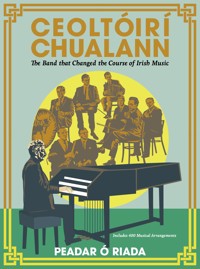
C C
C C
TheBandThaTchangedThecourseofIrIshMusIc
P Ó R
M P
Cork
www.mercierpress.ie
© Peadar Ó Riada 2024
ISBN: 978-1-78117-869-0
eBook: 978-1-78117-870-6
Cover design: Craig Carry
A CIP record for this title is available from the British Library.
is book is sold subject to the condition that it shall not, by way of trade or otherwise, be lent,
resold, hired out or otherwise circulated without the publisher’s prior consent in any form of
binding or cover other than that in which it is published and without a similar condition including
this condition being imposed on the subsequent purchaser.
No part of this publication may be reproduced or transmitted in any form or by any means, electronic
or mechanical, including photocopying, recording or any information or retrieval system, without
the prior permission of the publisher in writing.
Printed and bound in the EU.
C
Foreword 7
The birth of a band 9
Index of the band’s list of arrangements 55
The arrangements 65
Discography 212
Scores 225
Miscellaneous pieces 239
Index 245
7
F
♫
I account of Ceoltóirí Chualann, I have relied upon the
extensive records of Éamon de Buitléar, Michael Tubridy and the family archives
here. I have had the good fortune that Seán Ó Sé has sat by my side constantly
advising and correcting the unfolding account. And until recently, I could talk to
Seán Keane regularly. I was very privileged to have grown up with, and known,
the band members of Ceoltóirí Chualann and to have counted them all, and their
partners, as our extended family.ere was a bond of love within this group that
extends to this day.ey were, and are, my friends.
I have assembled this account, and furnished as much detail as possible, so that
ordinary people may learn of the extent of their knowledge, innovation, ability and
courage.e idea that Sonny Brogan or John Kelly would take on complicated
scored arrangements may surprise some today. But they were very able musicians
with a wide understanding of music.ey also had great faith in my father, Seán Ó
Riada. He was a good teacher and could find unorthodox ways of explaining what
he needed.
People should also remember that the times they were working in were very different
to today’s expectations. Irish music in general was referred to as diddle-dee-di music
or only played in remote places. It was folklore. It was relegated to being something
of value for collecting and admiring. It was not generally tolerated in public houses
or in hotels.ere were notable exceptions of course but they were scarce. Ireland
was ‘modernising’. Electricity was entering more of the country’s human habitation
spaces. Younger generations now looked for a more exotic or foreign spark to their
entertainment.Television arrived during this period. Yet Ceoltóirí Chualann thrived
and innovated their way through these 1960s with great success.
When you read the arrangements, you will see that they are far more sophisticated
than mere accompaniment. I admit that I find it very hard to see anything comparable,
in the last fifty-three years, since they played their last notes.
Occasionally, over the years, we have assembled and played for special events.
Accordingly, as a member died and passed on, a close relative, or similar musician, has
8
taken their seat. I sat in for my father. We always use the original arrangements when
playing. I wonder if we will ever sit together again on stage, making music publicly.
I thank Mary Feehan, Dee Collins and Mercier Press for their interest and
assistance. My eternal thanks to Éamon, Mick, Seán Keane and Seán Ó Sé for their
help with this project, and to Eoin Ó Suilleabháin, Réamonn Ó Ciaráin of Gael
Linn, D. A. Duncan, courtesy of Irish Traditional Music Archive archives for the
Sonny Brogan photo, Liam O’Connor and Maeve Gebruers of ITMA, Michael
Scott, DMG Property Group and Emer Twomey of UCC Archives for help with
pictures and copies. I hope some of you readers find it of interest.
Beannacht Dé le h-anamnacha na mairbh.
P Ó R
An Draighean, 2024
9
T B B
♫
S Ó R grew up in a house where music was part of the background fabric
of life. His father, a fiddle player from Clare, was a sergeant in An Gárda Síochána
– the Irish police force. As a youth, he drilled and trained with Sinn Féin but
joined up with the new fledgling national police force, initially as a member of the
Dublin Metropolitan Police.e Irish state was in the process of setting up its own
institutions and this force was amalgamated into the new An Gárda Síochána.‘Seán
Ó Riada’ the elder (John omas Reidy) ‘passed out’ as a member of the first class
or intake on 23 June 1923. He had an uncle in the RIC, Michael Lernihan. Seán Ó
Riada’s mother, a concertina /melodeon player from the West Cork Gaeltacht Cill
na Martra, was a nurse and worked as a surgical theatre nurse under Dr Dundon
in the North Infirmary during the War of Independence in Ireland.While I think
her father Dan was a bit of a Redmonite, two of her brothers had to hot foot it to
Australia having been recognised during an ambush and a friendly RIC sergeant
cycled out form Macroom to Dan to warn him that the dreaded Tans were coming
to raid and pick them up. So my granduncles, Denis and Jim, left for Queenstown
(Cobh) immediately. Denis never returned but Jim came back briefly in the late
1960s.
Both John and Julia, Seán’s parents, sang around the house and danced if suitable
music erupted from the radio.ey were both good traditional set dancers and both
came from families where entertainment was based around the household and
visiting neighbours at night-time, which included card-playing, dancing, storytelling,
singing and music. Both came from agricultural backgrounds and were reared on
farms. Seán grew up in Adare, County Limerick where his father was sergeant for
twenty-eight years. He studied music from a very young age and became a member
of the Limerick youth orchestra of the time, and apparently was leader of the string
section by the age of twelve. He studied violin and piano. On going to university,
University College Cork, where he studied Classics first before changing to Music
under Aloys Fleischmann, he developed his interest in jazz and indeed made his
pocket money playing jazz in various bands.
10
He married at the age of twenty-two in 1953 and once qualified, that year,
assumed the position of assistant musical director of radio in the national radio
station – Radio Éireann.Towards the end of 1954 he went to England and then to
France in search of patronage or position to allow him to compose classical music. It
didn’t happen and he returned in the following early summer of 1955, and assumed
the position as musical director of the Abbey eatre. Whilst in this post he was
composing for orchestra and aslo composing choral settings for Radio Éireann.
His duties in the Abbey eatre meant he was heavily involved each year in
their annual pantomime in the Irish language. He also was in charge of providing
interval music and all other incidental music during or indeed before or after plays
on stage in this, the Irish National eatre. At the playwright’s request he assembled
his first vestiges of Ceoltóirí Chualann for the play e Song of the Anvil by Bryan
MacMahon. Bryan, an accomplished writer from Listowel in County Kerry, asked
Seán to provide a group of traditional musicians, as the sound backdrop to his play,
which opened for three performances on 12 September 1960.e full-length play
revolved around a fantasy story MacMahon created in a world and place called
the valley of Glensharon.e valley is under threat of an evil spell, that may be
cast upon it at any time, by a stranger. Emerging from the mist come a visionary,
a failed priest, a magician of the mysterious, two village nitwits and a sex-starved
spinster.e Lucht Sí (fairy folk) element gave the play a secondary title of e
Golden Folk. It involved fifteen dancers and Wren Boys and hence the need for
traditional players. Bryan had a great cast, as can be seen below, from the listing on
the play’s programme. With its cast of twenty-two, one can see many famous names
in the annals of Irish theatre in subsequent years:
Mooney, Ria – Director
Brogan, Harry – Actor as Mick Twin
Carroll, Bert – Stage Manager
Ó Guaillí, Éamonn – Actor as Garrett Gowa Fitzgerald
Long, Paddy – Actor as Dancers
Mac an Ailí (Fhailí), Reamonn – Actor as Dancers
Mac Anna,Tomás – Set Designer
Mac Cafraidh, Seamus – Actor as Dancers
Mac Cionnaith,Tomás P. – Actor as Fr ‘O Priest’ McHugh
Mac Leid, Pádraig – Actor as Crowd
Mac Seáin, Raghnall – Actor as Crowd
Ní Bhearain, Caitlín – Actor as Elenrose Schneide
Ní Bhrolcháin, Ester – Actor as Dancers
11
Ní Chatháin, Máire – Actor as Kitsy Carty
Ní Cheallaigh, Eadaoin – Actor as Crowd
Ní Dhomhnaill, Máire – Actor as Deborah
Ní Liodáin, Eithne – Actor as Dancers
Ní Mhurchú, Fidelma – Actor as Crowd
Ní Nuamain, Aingeal – Actor as Crowd
Ó Briain, Micheál – Actor as Paddy Twin
Ó Dubhlainn, Uinsionn – Actor as Walter Cunningham
Ó Floinn, Philib – Actor as Darby Jer. O’Shea
Ó Foghludh (Foghlú), Liam – Actor as Dancers
Ó Goilidhe (Ó Goilí), Seathrún – Actor as Crowd
Ó hAonghusa, Micheál – Actor as Crowd
Ó Luain, Peadar – Actor as Ulick Madigan
Ó Riada, Seán – Music
O’Sullivan, Clara – Actor as Dancers
Redmond, Avice – Actor as Dancers
Ryan, Patricia – Choreographer
R at the same time (opened 15 September 1960) in Amharclann
an Damer (an Irish language theatre on Stephen’s Green) was a play from Seán’s
e old Abbey eatre went on re in 1951 and the company moved to the Queens
where they performed until 1966.e eatre itself was demolished in 1975 and the site
now is one of Trinity College’s buildings.
12
pen entitled An Ceannaí Glic based on the death of the poet Eoghan Rua Ó
Súilleabháin. He assembled another small group of musicians for this play and when
he amalgamated both groups, he had Ceoltóirí Chualann.
Seán had become friendly with Éamon de Buitléar whilst purchasing fishing
and shooting equipment in Hely’s sports shop in Dame Street Dublin. He also
had a pet shop of his own.When he received Bryan MacMahon’s request Seán
spoke to Éamon about it and he introduced him to Sonny Brogan. John Kelly from
Carrigaholt in Clare was never far from Sonny and
Seán already knew him through his stint at Radio
Éireann.
Éamon de Buitléar became part of our lives
and acted as secretary to the band members for
Seán. He was married to Lally Lamb and she
would baby-sit us from time to time. She was calm
and quiet, very warm and gentle and I associated
her with warm homely actions such as baking and
knitting. She always had her hair in a bun. She was
from a very famous painting family (her father was
Charles Lamb) and worked in a shop selling books
and painting and craft materials and would bring
painting and colouring materials to us regularly. We
always looked forward to her visits.
Both she and Bernie Potts were the
‘advisers’ to the other girls or spouses to the
lads at practice sessions of the band. Éamon
seemed to be always dressed in native natural
materials such as tweed or báinín suits. He
spoke Irish or Gaelic always and was a very
interesting man and communicator. He and
Seán would discuss anything from nature,
fishing, history, interesting details of the
Náisiún Gaelach and the weekly progress of
our bee colonies.
Éamon was born in Galway where his
father was stationed in Dún Uí Mhaoilíosa
13
(Renmore Barracks) at the time. His father Col Éamon de Buitléar was aide-de-camp
to Douglas Hyde, Ireland’s first president. Éamon’s mother, a Waterford woman,
like her husband spoke fluent Irish and thus Éamon Óg de Buitléar was raised. His
father was a multi-linguist and a member of the Irish army intelligence unit.Éamon
was a truly committed environmentalist long before such a person was common. He
made many documentary films on Irish wildlife, published books and promoted the
language and culture in pioneering ways, including cartoons for young children. He
made a major contribution to Irish life and the nation during his life and will be
long remembered as the man who brought nature into our living rooms through the
television with his programme series Amuigh Faoin Spéir.
He knew Cúil Aodha pretty well having being sent there by his father to polish
his Irish. He stayed in Peaití Tadhg Pheig’s (Ó Tuama) house during those summers
so you can see there were circles of communication and community throughout all
our families and milieu.
Éamon played the accordion. In particular, my father would give him chords to
play in the band arrangements.ese were a new feature in Irish music at the time.
I remember my father explaining the sequence required and mapping it out, on the
floor in front of Éamon, in match sticks lined up in squares. I recall on one Sunday
evening during rehearsal, my father came up with an unusual arrangement for a song
called ‘Ding Dong Detheró, buail sin séid seo’ (Ding Dong Detherow, Beat this,
blow that). My father had the idea that the chorus would be accompanied by strange
sounds so we kids were sent off to find things that would make noise, if hit. I came
back with a green bottle and we found a USA biscuit tin box lid as well. Éamon and
Ronnie had to hit these items in a certain sequence to make a music ‘loop’ before
such things were even invented. You can hear this arrangement on the band’s second
LP called Ding Dong published by Gael Linn (1966).
Éamon was one of the rocks of my life until he died in 2012. He was what we call
in our own language a ‘Duine Uasal’ meaning a ‘Noble Man’. He was instrumental in
gathering the band together in the beginning and later did a lot of the organisational
work when Seán had moved to Cúil Aodha in West Cork. After Seán died, Éamon
formed a band called Ceoltóirí Laighean which also had John Kelly as a member.
♫
T hierarchy in Ceoltóirí Chualann of course.e Clare fiddle and
14
concertina player John Kelly appointed himself the
second in command, he always sat by my father’s
side. He gave opinions about all things musical and
had a gruff exterior. He was always right so my father
listened to him and was also involved with him in
other projects. John Kelly was the senior man in the
band and everyone listened carefully to what he had
to say.
John Kelly was from the townland of Rehy, near
Kilbaha, at the very tip of the western Clare Loop head peninsula. His father
Michaelandmother,Elizabeth Keane, were steeped in our native culture and
tradition. His mother was from Scattery island nearby and many a tune in today’s
repertoire originated there and arrived through John Kelly. He knew and played with
many iconic figures in the past of our great tradition – his uncle Tom Keane and
neighbour Patsy Geary were major influences, as were people like Nell Galvin who
knew Garrett Barry, the piper. John also recorded with the great piper Johnny Doran.
He moved to Dublin in 1945 and opened a hardware shop at the end of Capel
Street where you would find all kinds of useful things, including instruments – if
needed. As a child I used to be fascinated by the selection of ‘pen-knifes’, which I
coveted, but they were all under lock and key, under glass, along with a selection of
mouth organs. John married a Wicklow woman Frances Hilliard and they raised a
family who we became entwined with as we all grew up.eir older members were
slightly older than us Riada’s but we have always been close since that time. John was
one of the great traditional fiddle players of the twentieth century. In his youth he
diligently followed the music, no matter how difficult the journey might have been.
is trait he kept to the end of his life when he could be seen at a Stephan Grappelli
concert or instructing aspiring young fiddle players. His knowledge of the tradition
was a constant rich source for my father, Seán. Like everyone else in the band they
were good friends and he introduced Seán to many traditional musicians.
John Kelly’s side kick was the Dubliner Sonny Brogan who played the accordion
or box. Sonny worked as an elephant keeper in Dublin Zoo and used to complain
about their noisy racket. He suffered a little and would say ‘Me nerves are at me’.
He must have been married to a wonderful woman. I remember her as Margaret,
a small lovely friendly woman who would wave Sonny off with a gentle smile in
her blue kitchen smock with its red trim and flowery pattern. She always had Sonny
15
nattily and carefully dressed in a dark navy-blue
suit.ere was always a crease in the trousers
that could mow a lawn. His shirt was dazzlingly
white and the pinned collar was as stiff as a
plank and encased a red peacock patterned
tie that was carefully tied to perfection. He
was a great box player but would get nervous
when having to perform in the full glare of
the audience or in front of the radio or studio
microphone.ough born and bred in Dublin,
his parents hailed from the Kildare side.John
Kelly and himself were always sitting together
to one side of my father who would be at the
piano. I remember his sudden death in January 1965 and how it affected my father
when the news arrived.e members of Ceoltóirí Chualann were like a ‘Band of
Brothers’ and I saw Seán shed tears in our kitchen before heading for Dublin. He later
wrote of Sonny:
It was in the autumn of 1960 that I first met Sonny Brogan. I had been asked to supply
music for Bryan MacMahon’s play e Song of the Anvil at the Abbey eatre, and had
conceived the idea of using a group of traditional musicians for this purpose – the first
time, as far as I am aware, that such a step had been taken. It was Éamon de Buitléar
who introduced me to Sonny, who was at first rather shy and reserved, until he realised
what was wanted of him.e play went on and, though it did not find favour with the
public which it more than merited, the music seemed to succeed with everyone, not least
of all the actors and backstage staff, who used to be entertained by impromptu concerts
given by the musicians in the dressing rooms. Sonny was, of course, a prime mover in all
this and one of the reels which they used play most often backstage, commonly called
‘Redigan’s’, was re-christened by us privately as ‘e Abbey Reel’.
When the run of the play was over I hated the idea of parting from the musicians and
so formed ‘Ceoltóirí Chualann’, of which, during the few years we have been functioning
Sonny was a mainstay. I would not suggest for a moment that our association was all
sweetness and light. Many the argument we had – it is well known that musicians argue
more fiercely about traditional music than about anything else. However, we always saw
eye-to-eye in the finish and each argument served only to make us better friends.
Sonny’s qualities as a musician were rare. He had an astounding memory, so much
so that I was inclined to regard him, with John Kelly, as our living reference library. He
could recall three or four different versions of a tune going back through three or four
layers of time and often through three or four changes of title. He had a passion for the
pure, simple essence of tunes, uncluttered by mistaken ornamentation. He was also, of
16
course, an outstanding accordion player, one of the very few who could make it sound
suitable for playing Irish music.
As a person, Sonny was – well, he was contentious, convivial, argumentative, loyal,
dogmatic, witty, utterly reliable, a tiger when his temper was roused (which was rare), and
at the same time curiously gentle and courteous. He was a good friend. I shall miss him.
‘Beannacht Dé lena anam’. (Seán Ó Riada)
♫
A would sit at rehearsals in our sitting
room in Galloping Green, on my father’s other
side or righthand side, and in the window would
be the pipes and piper Paddy Moloney. He was
a young wiry Donnycarney,Dublin, lad with a
mop of fair hair. He worked as an accountant
in Baxendales, one of Dublin’s major hardware
stores. He was following his father’s footsteps in
that his father John had also been an accountant.
But it was his mother Catherine who bought
him his first tin whistle and started him on his
glittering musical path through life. He attended
the famous Leo Rowsome, who was his piping
teacher. It was at Baxendales that he met his fiancé Rita whom he later married and
they both raised their three talented children.
At rehearsals he would give out about the reeds in his pipes a bit but could do
anything he wanted to with the chanter, on which he was a true wizard. He also
played the tin whistle and was no stranger to the melodeon. I remember him courting
his wife Rita at rehearsals. He had a good musical ear so that he could be given contra
melodies and rhythms, which were a new phenomenon at that time. A good example
can be heard in the early track fromReacaireacht an Riadaigh– ‘Toss the Feathers’ (Ag
Scaipeadh na gCleití). Paddy later went on to form the group ‘e Chieftains’ who
have successfully travelled the world stage since then.is group initially consisted of
some of the members of Ceoltóirí Chualann and was augmented as the years went
by. In those early years most of their arrangements were Ceoltóirí material but since
then they have gone on to do many collaborations with many famous musicians of
other cultures, various genres and traditions. It is no exaggeration to say that his band
e Chieftains have become world famous.
17
e main tin whistle player in Ceoltóirí Chualann
was Seán Potts. Seán was a Liberties man, born and
bred, but his people originally came from Wexford and
for generations were one of Ireland’s iconic traditional
music families. As a kid I remember him as working for
the Department of Post and Telegraphs. I used to marvel
at the way his wide fingers could shape the sound of
his melody by exposing only fractions of a hole on the
tin whistle. It would always make and mark him, as the
‘standard’ on that instrument. His uncle Tommy was a
particularly innovative musician. Seán’s style on whistle is
instantly recognisable. But he also played the pipes. He had just married by the time I
got to know him. His wife Bernie Sanfey was the boss amongst spouses at rehearsals
and she and Lally (Éamon’s wife) would steer or advise the others who were either
courting or just married.ere was always great fun around them. Bernie is an ardent
Dublin GAA supporter while Seán’s roots are in Wexford. My father would often
give Potts the lead on tin whistle, in slow airs, because of his distinctive style.Seán
Potts later formed a group called Bakerswell, after he spent some early years with e
Chieftains. Once he came off the road with e Chieftains in 1979, he ploughed much
of his energy into Na Píobairí Uilleann, an organisation promoting Irish Uilleann Pipe
playing and music. In his time there it grew immensely and now has a fine premises
and a burgeoning following all over the world. Indeed, I have heard it said that you
cannot throw a stone now without hitting a piper. A very different world to 1960,
when I knew of only six practising pipers in all of Ireland. His tradition carries on
through his son Seán Óg who is also a good piper.
e third tin-whistle player was Mick Tubridy.
e longer in my life that I know Mick, the more I am
convinced he is the truest gentleman I have ever known.
He was the flute player in the band. He would come armed
with a paper bag of small liquorice multi-coloured sweets.
He was always smiling and quite spoken and gentle. He
wore glasses. He worked as a structural engineer until his
retirement in 1993. He was responsible for the structural
design of government buildings in Merrion Street,Dublin,
and of the passenger terminal buildings at Dublin airport.
18
In 1994, Michael was asked to re-design the Birr telescope before its reconstruction
in 1996–1997.
But his biggest task, as far as we kids were concerned, was to pass our test. As
the band would rehearse, we would get to know the arrangement and when each
instrument was due to join in that arrangement and play, we would wait until the last
second and pop one of the small sweets onto the embrasure or hole for blowing the
flute. Poor Mick would have to stick his tongue out and whip the sweet out of the
flute so that he could play on cue. We never managed to catch him out. He married
a fine step dancer called Celine Kelly of Gort a Choirce in Donegal.
Later in life they both developed a very strong interest in set-dancing and
traditional step-dancing.ey travelled the world teaching and were famous in
countries as far away as Japan. Celine passed away in 2017. Perhaps one of their
lasting legacies will be a wonderful book Mick published under the title A Collection
of Irish Traditional Step Dances.
Michael acted as a recorder of the arrangements and would write them out neatly
every evening as Celine went through the very extensive list. He was a founding
member of e Chieftains group along with Paddy,Seán Potts and Martin. He
retired from that group in 1979. I have never heard a raised voice from him or a
negative comment of any kind about anyone or anything. In later life I have found
him to be a fascinating companion when on dark winter nights at the end of a
session he starts reading the sky as we head for home.
e second fiddle player in those initial early days was one of Seán’s colleagues
from the Abbey eatre pit orchestra, Martin Fay. He worked at an electronics
firm, Unidare, but also did quite a lot of session playing
for the Gaiety Opera season, Mosney and so on. He
also married an Irish step-dancer and teacher,Gertie
McCormack. He had the great advantage, from Seán’s
point of view, that he was a professional musician and a
good music reader. is meant, in particular, that Seán
could give him sheet music with contrapuntal melodies
or harmonies. He also could play the viola, which gave
a greater depth to the strings, when required. Martin
also did a bit of acting for Seán in his ‘movie-making’
years. He was the suave, debonair member of the band
with a laconic kind of humour. Martin was the font of
19
many muttered jokes to the lads that would be inaudible to us young ones but would
always result in loud guffaws from the men. He never seemed to push himself ahead
of others and I have to say I was fond of him and in later years his quite manner and
kind smile were always considered an oasis of friendship.
Ronnie McShane was a fellow worker in the Abbey eatre and was a props
manager/maker when Seán was musical director. He was a McShane from Dublin
and as such he came from a rich theatre tradition, with both his parents working for
the Queen’s Royal eatre.is theatre, called the Queens by all, was situated across
the road from the Pearse Street fire station. Ronnie’s father was the very popular
caretaker and usher.ey lived next door to the theatre. Ronnie’s aunt Kitty was
married to the English actor Arthur Lucan.ey had a very popular mother and
daughter routine called ‘Old Mother Riley’ which appeared on stage and screen
regularly.e Queens had a who’s who of famous actors passing through at the time,
including the likes of Charlie Chaplin. Ronnie had two brothers and the three of
them attended the local St Andrews School where Ronnie was very popular with
his jokes and humour. When the Abbey eatre went on fire on 18 July 1951, the
company shifted over to the Queens.
When Seán Ó Riada arrived there in the summer of 1955 he immediately struck
up a friendship with Ronnie who became family to us. He was full of tricks and funny
stories and would always play and tease us. He was a kind of army style batman to
my father and always came to the rescue when something went wrong. I remember
at one stage a Hollywood film director,Stanley Kubrick, was coming to the house
in Galloping Green to meet Seán and discuss some
projects. Seán had by now been associated with the
film Mise Éire for which he provided the score. Seán
wanted to introduce Kubrick to the sound of Ceoltóirí
Chualann and decided that having them nonchalantly
playing downstairs in the basement, while himself and
Stanley conferred in the sitting-room overhead, was
the best method to engineer this encounter. But a drain
flowed underneath the basement floor.e room had a
big open fireplace in it and another room leading off. On
the Friday of the Kubrick weekend visit it rained from
the high heavens and the drain burst through the floor
until halfway up the basement stairs.
20
Mother was not amused and Seán sent for Ronnie. Calmness itself, he arrived
on his motorbike, assessed the situation, and called the fire-brigade – to pump the
place out. With the water gone, we all set about cleaning up the place and my father
decided that a fire should be lit to dry the damp floor and walls. No Hollywood
Indian smoke signals ever produced as much smoke and the place was still choking
all below decks, when Kubrick arrived the following day.e lads in Ceoltóirí
Chualann played away, below in the smoky pit, as ordered with pre-arranged signals
tapped by Seán’s foot on the floor above. I recount the story to demonstrate Ronnie’s
importance to Seán, the kind of unusual mix of people that flowed through the
house and the closeness of the band members to the family – they were our extended
family.
Ronnie was a very true and loyal friend of Seán’s and later followed him to Cúil
Aodha where he worked with him as a PA/batman/fixer and long-suffering guinea
pig for Seán’s different projects and schemes. Ronnie was always innovative and
would try anything. He had the sharpest beat on the bones of anyone I ever heard.
He was a willing experimentalist with Seán. He also made and prepared his own
sets of bones. A real Dubliner, always witty, he provided running commentaries for
various situations and even for arrangements such as the ‘Galway Races’ and the
‘Foilmore Drag hunt’. He married the wonderful Vera, and they had two great sons.
Seán Keane joined Ceoltóirí Chualann as a young man who my father described
to somebody as being as handsome as a Greek Adonis. He had entered a fiddle
competition in conjunction with theFleadh Cheoil an Radio series and had come to
my father’s attention. On winning the competition Seán asked him to join the band.
Seán Keane was born into a musical
family in Drimnagh, a Dublin suburb.
Keane’s mother and father were both
fiddle players from musical communities in
County Longford and County Clare. He
had a brother James who is no slouch on the
accordion as well. A brilliant musician he
pioneered the idea of technique associated
with traditional Irish fiddle playing. He
brought another dimension to the fiddle
section of the band, augmenting both John
Kelly’s rich traditional style, repertoire and
21
understanding and Martin Fay’s versatilityand ability.is tall fair giant of a man
is also a giant in the world of traditional Irish fiddle music. He has travelled the world
with e Chieftains.
He was married to a wonderful convivial woman Marie Conneally from
Ennistymon in County Clare but she sadly passed away in 2020. I think it is true
to say that her death, during covid lockdown, knocked the stuffing out of Seán.
Marie and Seán raised a musical family of their own in Rathcoole – a daughter
and two sons. He joined e Chieftains in 1968 and remained with them until his
death. He died peacefully and suddenly in his sleep at his home in Rathcoole in
early May 2023 and caught us by surprise and shocked us thoroughly. I had had a
long phone conversation with him days beforehand which started out about one of
the arrangements in this book but, as usual, wandered around the world for forty
minutes. He was a good friend to many traditional musicians around Dublin and
Clare and further afield and always willing to play a tune. He will be missed in
traditional Irish music circles for many years to come.
Peadar Mercier was the last member to join
the band. He did so during the mid to late 1960s
as bodhrán and bones player. I believe he was in
the original group playing in the Damer for Sean’s
play,AnCeannaí Glic, in 1960 but was called Paddy
rather than Peadar in the programme notes. My
abiding memories of Peadar are of his extraordinary
gentleness. He took over much of my father’s bodhrán
playing in the later arrangements as Seán concentrated
on the harpsichord. Peadar was a good Gaelgóir and married Nuala McGann from
Ennis, County Clare. She also sadly died in 2020. Peadar also played with e
Chieftains for many years and travelled the world with Paddy and the boys. Like
most of the Ceoltóirí, Peadar has been followed by his children into the world
of music and stage. His son Mel takes his father’s place when the band reforms
occasionally for special anniversaries.
efirstsinger chosen by Seán for this new fledgling band was Darach Ó Catháin.
Darach was born in 1922 on the Máimín in Leitir Mór west in Connemara but had
been moved as a youth in 1935, to the newly created Gaeltacht in Rath Chairn,
County Meath.e government of the time had bought up old estates and was
redistributing the lands to small farmers. As part of the movement, they set up