


13,99 €
Mehr erfahren.
- Herausgeber: Parkstone International
- Kategorie: Geisteswissenschaft
- Sprache: Englisch
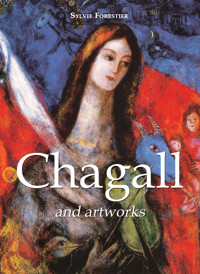
Marc Chagall was born into a strict Jewish family for whom the ban on representations of the human figure had the weight of dogma. A failure in the entrance examination for the Stieglitz School did not stop Chagall from later joining that famous school founded by the Imperial Society for the Encouragement of the Arts and directed by Nicholas Roerich. Chagall moved to Paris in 1910. The city was his “second Vitebsk”. At first, isolated in the little room on the Impasse du Maine at La Ruche, Chagall soon found numerous compatriots also attracted by the prestige of Paris: Lipchitz, Zadkine, Archipenko and Soutine, all of whom were to maintain the “smell” of his native land. From his very arrival Chagall wanted to “discover everything”. And to his dazzled eyes painting did indeed reveal itself. Even the most attentive and partial observer is at times unable to distinguish the “Parisian”, Chagall from the “Vitebskian”. The artist was not full of contradictions, nor was he a split personality, but he always remained different; he looked around and within himself and at the surrounding world, and he used his present thoughts and recollections. He had an utterly poetical mode of thought that enabled him to pursue such a complex course. Chagall was endowed with a sort of stylistic immunity: he enriched himself without destroying anything of his own inner structure. Admiring the works of others he studied them ingenuously, ridding himself of his youthful awkwardness, yet never losing his authenticity for a moment. At times Chagall seemed to look at the world through magic crystal – overloaded with artistic experimentation – of the Ecole de Paris. In such cases he would embark on a subtle and serious play with the various discoveries of the turn of the century and turned his prophetic gaze like that of a biblical youth, to look at himself ironically and thoughtfully in the mirror. Naturally, it totally and uneclectically reflected the painterly discoveries of Cézanne, the delicate inspiration of Modigliani, and the complex surface rhythms recalling the experiments of the early Cubists (See-Portrait at the Easel, 1914). Despite the analyses which nowadays illuminate the painter’s Judaeo-Russian sources, inherited or borrowed but always sublime, and his formal relationships, there is always some share of mystery in Chagall’s art. The mystery perhaps lies in the very nature of his art, in which he uses his experiences and memories. Painting truly is life, and perhaps life is painting.
Das E-Book können Sie in Legimi-Apps oder einer beliebigen App lesen, die das folgende Format unterstützen:
Seitenzahl: 57
Veröffentlichungsjahr: 2022
Ähnliche




















Sylvie Forestier
© 2014, Confidential Concepts, Worldwide, USA
© 2014, Parkstone Press USA, New York
© Image-Barwww.image-bar.com
All rights reserved. No part of this may be reproduced or adapted without the permission of the copyright holder, throughout the world.
Unless otherwise specified, copyright on the works reproduced lies with the respective photographers. Despite intensive research, it has not always been possible to establish copyright ownership. Where this is the case, we would appreciate notification.
ISBN: 978-1-78160-935-4
Contents
BIOGRAPHY
LIST OF ILLUSTRATIONS
A
A Soldier and a Girl
Apollinaire
Apparition of the Artist’s Family
Around Her
Artist at Easel
B
Barbershop
Bella with a White Collar
Birth of a Child
Birthday
By the Window at Night
C
Champ de Mars
Chemist’s Shop in Vitebsk
Concert in Blue
Confidence at Circus
Costume Design for Nikolai Gogol’s “The Inspector General”
D
Dedicated to My Fiancée
Double Portrait with a Wineglass
F
Father
G
Golgotha
H
Hommage à Apollinaire
House in the Village of Liozno
I
I and the Village
Illustration to Nikolai Gogol’s “Dead Souls”
Illustration to Nikolai Gogol’s “Dead Souls”
Illustration to Nikolai Gogol’s “Dead Souls”
Illustration to Nikolai Gogol’s “Dead Souls”
Illustration to Nikolai Gogol’s “Dead Souls”
Illustration to Nikolai Gogol’s “Dead Souls”
Illustration to Nikolai Gogol’s “Dead Souls”
Illustration to Nikolai Gogol’s “Dead Souls”
Interior with Flowers
J
Jew Holding the Torah
Jew in Green
Jew in Prayer
Jew in Red
Jewish Wedding
K
Kermis
King David
L
Lilies of the Valley
Lovers
Lovers in Blue
Lovers in Green
Lovers in Grey
Lovers in Pink
M
Madonna of the Village
Man with a Cat and Woman with a Child
Maternity (Pregnant Woman)
My Fiancée in Black Gloves
O
Old Man and Old Woman
On the Road
Over the Town
Over Vitebsk
P
Paris Through the Window
Peace to Cottages, War on Palaces
Portrait of the Artist’s Sister Mariassinka
Promenade
R
Russian Village Under the Moon
S
Sabbath
Le Saoul (The Drinker)
Self-Portrait
Self-Portrait
Self-Portrait
Self-Portrait
Self-Portrait at the Easel
Self-Portrait with Muse (The Apparition)
Self-Portrait with Seven Fingers
Self-Portrait with White Collar
Soldiers
Soldiers with Bread
Soukkot (Rabbi with a Lemon)
Still-Life with Lamp
Street in the Village
Street in Vitebsk
Study for “The Rain”
T
The Acrobat
The Artist’s Sister (Mania)
The Baby’s Bath
The Blue House
The Butcher
The Cattle Dealer
The Cemetery Gates
The Circus
The Circus Rider
The Clock
The Cock
The Cock in Love
The Dacha
The Fiddler
The Green Violonist
The Grey House
The House in the Suburbs
The Juggler
The Mirror
The Newspaper Vendor
The Old Jew
The Poet (Half Past Three)
The Poet Reclining
The Promenade
The Red Houses
The Revolution
The Sky of Paris
The Soldier Drinks
The Street Sweeper (Janitor with Birds)
The Street Sweeper
The Triumph of Music
The Violonist
The Vitebsk Preacher
The Wall of Lamentations
The Wedding
The Wedding
The Yellow Room
Time is a River without Banks
To My Wife
To Russia, Asses and Others
V
View from the Window, Vitebsk
Village Scene in Vitebsk
W
Wall Clock with a Blue Wing
Wedding at the Eiffel Tower
Window at the Dacha, Zaolshye near Vitebsk
Window Overlooking the Garden
Wounded Soldier
Self-Portrait
1909. Oil on canvas, 57 x 48 cm. Kunstsammlung Nordrhein-Westfalen, Düsseldort
Biography
7 July 1887
Marc Zakharovich Chagall, the son of a fish vendor, was born in Vitebsk.
1906
Studied at the art school of Yuri Pen in Vitebsk, leaving for St. Petersburg in the winter.
1907-1910
Studied at the Drawing School of the Society for the Encouragement of the Arts, St. Petersburg (then directed by Nicholas Roerich) and the private school of S. Saidenberg; entered the private art school of Yelizaveta Zvantseva, where he studied under Léon Bakst and Matislav Dobuzhinsky. Showed his works at the school exhibition held in the office of the magazine Apollon.
1910-1914
Lived in Paris, on the Impasse du Maine. In 1911, moved to La Ruche. Met Pablo Picasso, Georges Braque, Fernand Léger, Amedeo Modigliani, Alexander Arkhipenko, Guillaume Apollinaire, Max Jacob, Blaise Cendrars, and other famous artists and writers. Exhibited at the Salon des Independants and the Salon d’Automne in Paris, with the Donkey’s Tail group in Moscow, at Der Sturm Gallery in Berlin (first one-man show) and also in St. Petersburg and Amsterdam. On the eve of the war, returned to Vitebsk.
July 1915
Married Bella Rosenfeld.
1915-1917
Worked in Petrograd, served on the military-industrial committee. Exhibited in Moscow and Petrograd.
1916
Birth of his daughter Ida.
1918-1919
Appointed Commissar for the Arts in the Regional Department of People’s Education in Vitebsk. Set up and ran (from early 1919) an art school in Vitebsk, where the teachers included Mstislav Dobuzhinsky, Ivan Puni and Kasimir Malevich. Headed the Free Painting Workshop (Svomas) and the museum. Organized the celebrations in 1918 for the first anniversary of the October Revolution. Took part in the First State Free Exhibition held in the Winter Palace, Petrograd.
1920-1921
Conflict with Malevich and Lissitzky forced Chagall to leave Vitebsk. He lived in and near Moscow, producing works for the Jewish Chamber Theatre and teaching in the Malakhovka and Third International colonies for homeless children. Began work on the book My Life.
1922
Joint exhibition in Moscow with Nathan Altman and David Sterenberg.
1922-1923
Travelled to Kaunas with an exhibition of his works. Visited Berlin and Paris. Settled in Paris in September 1923. Produced etchings for My Life and began work on illustrations to Gogol’s Dead Souls.
1926
One-man shows in Paris and New York.
1930-1931
Worked on illustrations for the Bible. Travelled to Switzerland, Palestine, Syria and Egypt. Exhibitions in Paris, Brussels and New York.
1933
At Goebbels’ command, Chagall’s works were burnt in public in Mannheim. Exhibition in Basle.
1935
Visited Poland.
1937
Granted French citizenship. Travelled to Italy.
1939
Carnegie Prize (USA).
1940
Moved to the Loire and then to Provence.
1941
Arrested in Marseille and then freed. Moved to the USA.
1942
Worked for theatres in the USA and Mexico.
1944
Death of Bella Chagall in New York.
1945
Set designs and costumes for Stravinsky’s ballet The Firebird.
1946
Exhibitions in New York and Chicago.
1947
Exhibition at the Musée National d’Art Moderne in Paris.
1948
Returned to France. Publication of Dead Souls with illustrations by Chagall. Exhibitions in Amsterdam and London. Travelled widely in this and the following years.
1950
Moved to Vence, near Nice. Worked on lithographs and ceramics.
1951
First stone sculptures. Large exhibitions in Bern and Jerusalem.
1952
Married Valentina Brodsky. Visit to Greece.
1953-1955
Major exhibitions in Turin, Vienna and Hanover.
1956




